Global Political Economy Report: Brexit, US Trade, and Africa's Role
VerifiedAdded on 2022/09/18
|11
|2732
|27
Report
AI Summary
This report analyzes the global political economy, focusing on the effects of Brexit on the UK, Africa, and the global economy. It explores the potential benefits and challenges for Africa arising from Brexit, including the renegotiation of trade deals and the importance of technological advancement. The report also examines US trade interventions, particularly the trade war with China, protectionism, and the use of sanctions to exert influence. It discusses the stance of BRICS nations against protectionism and the impact of US actions on various countries. Furthermore, the report provides an overview of potential trade sanctions imposed by the US and their effects on international trade and economic relations. The report draws on academic sources to support its arguments and provides insights into the complex dynamics of international trade and political economy.
Running head: GLOBAL POLITICAL ECONOMY
Global Political Economy
Name of the Student
Name of the University
Author note
Global Political Economy
Name of the Student
Name of the University
Author note

Paraphrase This Document
Need a fresh take? Get an instant paraphrase of this document with our AI Paraphraser
1
GLOBAL POLITICAL ECONOMY
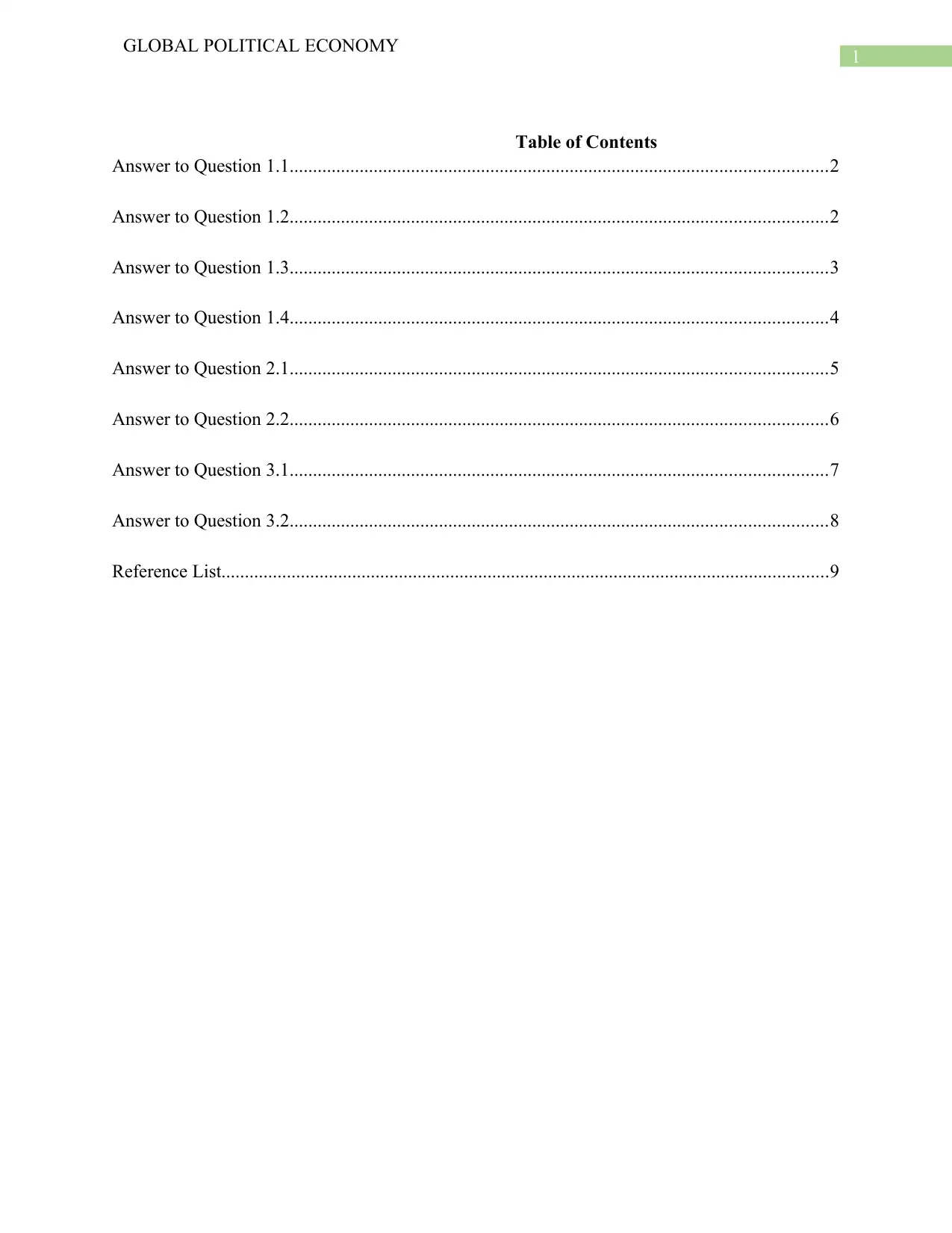
Table of Contents
Answer to Question 1.1...................................................................................................................2
Answer to Question 1.2...................................................................................................................2
Answer to Question 1.3...................................................................................................................3
Answer to Question 1.4...................................................................................................................4
Answer to Question 2.1...................................................................................................................5
Answer to Question 2.2...................................................................................................................6
Answer to Question 3.1...................................................................................................................7
Answer to Question 3.2...................................................................................................................8
Reference List..................................................................................................................................9
GLOBAL POLITICAL ECONOMY
Table of Contents
Answer to Question 1.1...................................................................................................................2
Answer to Question 1.2...................................................................................................................2
Answer to Question 1.3...................................................................................................................3
Answer to Question 1.4...................................................................................................................4
Answer to Question 2.1...................................................................................................................5
Answer to Question 2.2...................................................................................................................6
Answer to Question 3.1...................................................................................................................7
Answer to Question 3.2...................................................................................................................8
Reference List..................................................................................................................................9
2
GLOBAL POLITICAL ECONOMY
Answer to Question 1.1
Effects of UK leaving the Eurozone
The effects of UK leaving EU is huge on the global economy as well as the countries of
the world. The regional economic inequality will exacerbate in the UK for Brexit. After the vote
of Brexit the global economy contracted by $2 trillion. As an effect of Brexit gold mining stock
rose in value and the dollar strengthened. Hence, the gold price hiked to $1,358 per once and
lead to significant gains for South African miners such as Gold Fields and AngloGold Ashanti.
The trade relationship of the UK with rest of the world changed after the decision of leaving EU
(Adler-Nissen 2016).
New tariffs are negotiated between UK and EU as the country is leaving EU. Therefore,
if the UK is unable to find new market for trade, the growth of the trade of UK will reduce and
the economy will shrink. Leaving EU will enable UK to trade with the emerging markets and
economic powerhouses of the future. Thus, if UK’s exit from the EU is followed by the recession
then producers of oil, copper, flower and wineries from Nigeria, Zambia, Kenya and South
Africa will suffer respectively (Ansorg and Haastrup 2016). The countries outside EU will
facilitate through Brexit as they can establish trade deals with UK without intervention of EU.
Countries like China is planning for a free trade deal with UK to minimize trade barriers and
maximize revenue of both countries. Africa may facilitate from UK leaving the EU with the help
of advanced technology rather depending on its commodities.
Answer to Question 1.2
Importance of Britain investing in Africa
GLOBAL POLITICAL ECONOMY
Answer to Question 1.1
Effects of UK leaving the Eurozone
The effects of UK leaving EU is huge on the global economy as well as the countries of
the world. The regional economic inequality will exacerbate in the UK for Brexit. After the vote
of Brexit the global economy contracted by $2 trillion. As an effect of Brexit gold mining stock
rose in value and the dollar strengthened. Hence, the gold price hiked to $1,358 per once and
lead to significant gains for South African miners such as Gold Fields and AngloGold Ashanti.
The trade relationship of the UK with rest of the world changed after the decision of leaving EU
(Adler-Nissen 2016).
New tariffs are negotiated between UK and EU as the country is leaving EU. Therefore,
if the UK is unable to find new market for trade, the growth of the trade of UK will reduce and
the economy will shrink. Leaving EU will enable UK to trade with the emerging markets and
economic powerhouses of the future. Thus, if UK’s exit from the EU is followed by the recession
then producers of oil, copper, flower and wineries from Nigeria, Zambia, Kenya and South
Africa will suffer respectively (Ansorg and Haastrup 2016). The countries outside EU will
facilitate through Brexit as they can establish trade deals with UK without intervention of EU.
Countries like China is planning for a free trade deal with UK to minimize trade barriers and
maximize revenue of both countries. Africa may facilitate from UK leaving the EU with the help
of advanced technology rather depending on its commodities.
Answer to Question 1.2
Importance of Britain investing in Africa
⊘ This is a preview!⊘
Do you want full access?
Subscribe today to unlock all pages.

Trusted by 1+ million students worldwide
3
GLOBAL POLITICAL ECONOMY
In the developed economies several factors are hampering the growth of business such as
stringent legislation and regulations, low cyber security and terrorism. Whereas, in Africa there
is no such trade barriers and it is offerings a frontier where investment and entrepreneurship both
may find long term growth and value. With large population, natural resources, growing
agriculture and manufacturing industries the country is a lucrative hub for foreign investment for
infrastructure and technological development (Ayittey 2016). International competition in the
Africa increased because of China’s influence. The countries such as China, France and
Germany are the biggest trading partner of Africa. The UK government also stepped into a trade
deal with three biggest players of Africa including Kenya, Nigeria and South Africa. The Brexit
impacted the UK and it is surrounded by uncertainty. In this situation trading with Africa will
improve the country’s present scenario (Bennell 2017). The enhanced trading opportunity
between both the countries will stimulate investment in infrastructure and manufacturing sector
and push the long term growth. The companies of UK invested $110 million in the African
country of Ghana and Nigeria. Africa is one of the fastest growing economies of the world and to
support its growth long term investment goal is required.
Answer to Question 1.3
Benefit of Africa from UK exit the EU
Africa may face a serious impact for the uncertainty and volatility arising out of Brexit.
There is as well some good effects of Brexit on African economy. As the UK exit from the EU,
all the trade deal between Africa and UK must be renegotiated (Butler, Jensen and Snaith 2016).
The negotiation of trade deal may offer some preferential trade agreements for the African
economy. The African farmers may facilitate through the new trade relation as they will get UK
market to sell their products at an attractive rate. The use of Common Agricultural Policy (CAP)
GLOBAL POLITICAL ECONOMY
In the developed economies several factors are hampering the growth of business such as
stringent legislation and regulations, low cyber security and terrorism. Whereas, in Africa there
is no such trade barriers and it is offerings a frontier where investment and entrepreneurship both
may find long term growth and value. With large population, natural resources, growing
agriculture and manufacturing industries the country is a lucrative hub for foreign investment for
infrastructure and technological development (Ayittey 2016). International competition in the
Africa increased because of China’s influence. The countries such as China, France and
Germany are the biggest trading partner of Africa. The UK government also stepped into a trade
deal with three biggest players of Africa including Kenya, Nigeria and South Africa. The Brexit
impacted the UK and it is surrounded by uncertainty. In this situation trading with Africa will
improve the country’s present scenario (Bennell 2017). The enhanced trading opportunity
between both the countries will stimulate investment in infrastructure and manufacturing sector
and push the long term growth. The companies of UK invested $110 million in the African
country of Ghana and Nigeria. Africa is one of the fastest growing economies of the world and to
support its growth long term investment goal is required.
Answer to Question 1.3
Benefit of Africa from UK exit the EU
Africa may face a serious impact for the uncertainty and volatility arising out of Brexit.
There is as well some good effects of Brexit on African economy. As the UK exit from the EU,
all the trade deal between Africa and UK must be renegotiated (Butler, Jensen and Snaith 2016).
The negotiation of trade deal may offer some preferential trade agreements for the African
economy. The African farmers may facilitate through the new trade relation as they will get UK
market to sell their products at an attractive rate. The use of Common Agricultural Policy (CAP)
Paraphrase This Document
Need a fresh take? Get an instant paraphrase of this document with our AI Paraphraser
4
GLOBAL POLITICAL ECONOMY
is scrapped because of Brexit. In this way, subsidized European farmers are not allowed to dump
goods in Africa and stop tariff imposition to allow equitable trade. The livelihoods of African
farmers will improve as the subsidies take a toll on their income. Therefore, it would be easier
for South Africa and Kenya to export its wine and roses to the UK, as the demand for these
goods in UK is high. To be benefitted from Brexit Africa should inculcate the use of advanced
technology rather than depending on its commodities (Kufuor 2017). The Cotonou agreement
and CAP which involves 48 sub-Saharan countries with EU will be a get way for African
countries to industrial development and technological innovation.
Answer to Question 1.4
Differentiate between the motivating factors for regional integration for UK and Africa
The regional integration build better trade relation with other countries by eliminating or
reducing trade restrictions and applying common fiscal policies for both the parties. Both
developed and developing nations get benefitted from the regional integration. The decision of
UK leaving EU, promoted regional integration between developing economy Africa and
developed economy UK (De Melo and Tsikata 2015). The advantages two country may enjoy
are employment, trade benefits and political cooperation. The most important motivating factor
for regional integration for Africa is getting access of more diverse and large Britain market. The
trade liberalization will assist farmers of Africa to sell products at an attractive rate in large UK
market and they will get rid of subsidized European farmers and tariff imposition which, enable
them to avail profit. On the other hand, the most motivating factor of regional integration for UK
is trading with large African continent without EU intervention (Murray-Evans 2016). The
imposition tariff by EU create trade barrier for UK to deal with Africa. The greater availability of
goods and services, wider choice of selection and reduced cost of trade will improve trade
GLOBAL POLITICAL ECONOMY
is scrapped because of Brexit. In this way, subsidized European farmers are not allowed to dump
goods in Africa and stop tariff imposition to allow equitable trade. The livelihoods of African
farmers will improve as the subsidies take a toll on their income. Therefore, it would be easier
for South Africa and Kenya to export its wine and roses to the UK, as the demand for these
goods in UK is high. To be benefitted from Brexit Africa should inculcate the use of advanced
technology rather than depending on its commodities (Kufuor 2017). The Cotonou agreement
and CAP which involves 48 sub-Saharan countries with EU will be a get way for African
countries to industrial development and technological innovation.
Answer to Question 1.4
Differentiate between the motivating factors for regional integration for UK and Africa
The regional integration build better trade relation with other countries by eliminating or
reducing trade restrictions and applying common fiscal policies for both the parties. Both
developed and developing nations get benefitted from the regional integration. The decision of
UK leaving EU, promoted regional integration between developing economy Africa and
developed economy UK (De Melo and Tsikata 2015). The advantages two country may enjoy
are employment, trade benefits and political cooperation. The most important motivating factor
for regional integration for Africa is getting access of more diverse and large Britain market. The
trade liberalization will assist farmers of Africa to sell products at an attractive rate in large UK
market and they will get rid of subsidized European farmers and tariff imposition which, enable
them to avail profit. On the other hand, the most motivating factor of regional integration for UK
is trading with large African continent without EU intervention (Murray-Evans 2016). The
imposition tariff by EU create trade barrier for UK to deal with Africa. The greater availability of
goods and services, wider choice of selection and reduced cost of trade will improve trade
5
GLOBAL POLITICAL ECONOMY
efficiency of both the countries and the gains leads to better purchasing power. Elimination of
trade barriers will provide employment opportunities for the vast population of the Africa. As a
result market of both the countries will expand and cross border investment will cater to African
companies and UK companies.
It allow African companies to get investment easily for expanding business and provide
UK companies a great market to invest for profitability. The biggest player in the African
market, China is already invested large amount to boost infrastructure of the country. Market
expansion will attract other countries to invest in Africa. To grow African industry in an
exponential manner technological expertise play an important role. Regional integration push
technology sharing between two countries which will African industry to expand (Lovely,
Rosenthal and Sharma 2017). It is very important for a developing country like Africa to utilize
innovation, science and technological advancement for development of economy and industry.
The stronger economic ties between developed and developing economies will improve political
cooperation among countries. The conflicts among the countries can be resolved peacefully
through political cooperation which lead to economic development and greater stability. The
multiple economic indicators of regional integration includes movement of people, labor
migration and free capital flow. The regional integration among UK and Africa will mutually
benefit both the countries.
Answer to Question 2.1
Reasons for intervention in international trade by Donald Trump
To reduce the trade gap between US and China and to prevent the transfer of technology
and intellectual property, the president of US has imposed tariffs of billions of dollars on Chinese
GLOBAL POLITICAL ECONOMY
efficiency of both the countries and the gains leads to better purchasing power. Elimination of
trade barriers will provide employment opportunities for the vast population of the Africa. As a
result market of both the countries will expand and cross border investment will cater to African
companies and UK companies.
It allow African companies to get investment easily for expanding business and provide
UK companies a great market to invest for profitability. The biggest player in the African
market, China is already invested large amount to boost infrastructure of the country. Market
expansion will attract other countries to invest in Africa. To grow African industry in an
exponential manner technological expertise play an important role. Regional integration push
technology sharing between two countries which will African industry to expand (Lovely,
Rosenthal and Sharma 2017). It is very important for a developing country like Africa to utilize
innovation, science and technological advancement for development of economy and industry.
The stronger economic ties between developed and developing economies will improve political
cooperation among countries. The conflicts among the countries can be resolved peacefully
through political cooperation which lead to economic development and greater stability. The
multiple economic indicators of regional integration includes movement of people, labor
migration and free capital flow. The regional integration among UK and Africa will mutually
benefit both the countries.
Answer to Question 2.1
Reasons for intervention in international trade by Donald Trump
To reduce the trade gap between US and China and to prevent the transfer of technology
and intellectual property, the president of US has imposed tariffs of billions of dollars on Chinese
⊘ This is a preview!⊘
Do you want full access?
Subscribe today to unlock all pages.
Trusted by 1+ million students worldwide
6
GLOBAL POLITICAL ECONOMY
imports. The 25% of tariff is imposed on Chinese imports of worth $200 billion as China imports
less quantity goods and services compared to US (Cohen 2019). In retaliation, China also
imposed same amount of tariffs on US imports. The escalation of trade war between two
developed economies affected the world economy significantly especially Asian economy.
Growing trade tension between two countries creates risks including excessive leveraging,
property bubbles and rising income for the economy.
To control the growing power of Chinese economy and prevent theft of intellectual
property by China the trade restricted between two economies. The companies from US are
forced to work with Chinese companies and share technological know-how which enable the
transfer of technology. The trade between China and biggest partners like Australia and Asian
economies including Singapore, Taiwan, South Korea and Hong Kong will be affected by tariff
imposition of Trump government (Li, He and Lin 2018). This will create pressure on China to
purchase more goods and services from US and to stop intellectual property transfer. To get the
control over global economy and strengthen US dollar, Trump government asked China to
eliminate subsidies to its state owned entities.
Answer to Question 2.2
Why BRICS would take a stance against protectionism
US uses protectionism to shield domestic market by imposing tax from foreign countries.
The protectionism will pose a threat on sustainable global growth and multilateralism. The
escalation of trade war between two developed economies of the world China and US, will not
be beneficial for any country of the world (Barone and Bendini 2015). The economic hegemony
caused by trade restrictions will undermine the international community’s collective interest.
GLOBAL POLITICAL ECONOMY
imports. The 25% of tariff is imposed on Chinese imports of worth $200 billion as China imports
less quantity goods and services compared to US (Cohen 2019). In retaliation, China also
imposed same amount of tariffs on US imports. The escalation of trade war between two
developed economies affected the world economy significantly especially Asian economy.
Growing trade tension between two countries creates risks including excessive leveraging,
property bubbles and rising income for the economy.
To control the growing power of Chinese economy and prevent theft of intellectual
property by China the trade restricted between two economies. The companies from US are
forced to work with Chinese companies and share technological know-how which enable the
transfer of technology. The trade between China and biggest partners like Australia and Asian
economies including Singapore, Taiwan, South Korea and Hong Kong will be affected by tariff
imposition of Trump government (Li, He and Lin 2018). This will create pressure on China to
purchase more goods and services from US and to stop intellectual property transfer. To get the
control over global economy and strengthen US dollar, Trump government asked China to
eliminate subsidies to its state owned entities.
Answer to Question 2.2
Why BRICS would take a stance against protectionism
US uses protectionism to shield domestic market by imposing tax from foreign countries.
The protectionism will pose a threat on sustainable global growth and multilateralism. The
escalation of trade war between two developed economies of the world China and US, will not
be beneficial for any country of the world (Barone and Bendini 2015). The economic hegemony
caused by trade restrictions will undermine the international community’s collective interest.
Paraphrase This Document
Need a fresh take? Get an instant paraphrase of this document with our AI Paraphraser
7
GLOBAL POLITICAL ECONOMY
BRICS opposed protectionism as unprecedented challenges are faced by multilateral trading
system. The incompatibility of rise in unilateral measures with rules of World Trade
Organization is a cause of concern as it will impact the developing economies and countries.
BRICS nations want to promote a rule based world order and multilateralism. The intervention
of US in monetary transactions of all the countries because all the transfers are done worldwide
using the dollars and the SWIFT system (Wajda-Lichy 2014). Using the political and economic
power it prevented other countries from engaging in nuclear deal with Iran. US utilized the dollar
dependence of other countries to impose tariffs and sanctions which causes economic losses.
Answer to Question 3.1
US threaten countries using power
After world war II, the financial architecture and economic order established by US and
other western countries to dominate the rest of world economically and politically (Borio 2014).
US threaten countries through the international monetary system and the dollar by using the
opportunities it has. It established unjust order and punishment for not maintain the order. All the
monetary transactions between the banks are made using dollars and the SWIFT system
worldwide which pass through the US automatically. The strong dollar posed a threat for the
countries as there is no alternative payment system. The intervention of US in money transfer
created problem for the countries. It removed Iranian banks from the international banking
system and seized the money of companies and individuals (Drezner 2015). The political
influence of US manipulate the sanctions on other countries. The sanctions imposed by the US
left no choice for the countries to abide by and face great cost economically. The business of
China impacted due to US export controls and trade sanctions on Iran. The biggest business
partner of China is affected as a lot of companies of China invested in infrastructure of Iran. The
GLOBAL POLITICAL ECONOMY
BRICS opposed protectionism as unprecedented challenges are faced by multilateral trading
system. The incompatibility of rise in unilateral measures with rules of World Trade
Organization is a cause of concern as it will impact the developing economies and countries.
BRICS nations want to promote a rule based world order and multilateralism. The intervention
of US in monetary transactions of all the countries because all the transfers are done worldwide
using the dollars and the SWIFT system (Wajda-Lichy 2014). Using the political and economic
power it prevented other countries from engaging in nuclear deal with Iran. US utilized the dollar
dependence of other countries to impose tariffs and sanctions which causes economic losses.
Answer to Question 3.1
US threaten countries using power
After world war II, the financial architecture and economic order established by US and
other western countries to dominate the rest of world economically and politically (Borio 2014).
US threaten countries through the international monetary system and the dollar by using the
opportunities it has. It established unjust order and punishment for not maintain the order. All the
monetary transactions between the banks are made using dollars and the SWIFT system
worldwide which pass through the US automatically. The strong dollar posed a threat for the
countries as there is no alternative payment system. The intervention of US in money transfer
created problem for the countries. It removed Iranian banks from the international banking
system and seized the money of companies and individuals (Drezner 2015). The political
influence of US manipulate the sanctions on other countries. The sanctions imposed by the US
left no choice for the countries to abide by and face great cost economically. The business of
China impacted due to US export controls and trade sanctions on Iran. The biggest business
partner of China is affected as a lot of companies of China invested in infrastructure of Iran. The
8
GLOBAL POLITICAL ECONOMY
financial loss of Chinese companies are huge as continuing business with Iran will violate the US
sanction rule and impose penalties on companies. All the companies around the world are
prohibited from engaging indirectly or directly involving Iran in any transactions. The
restrictions imposed by US have a series of significant impact on a business of companies, distort
ability of a company to deal with US financial system, detrimental effect on reputation of the
company and deterioration of relationship with non-US third parties and US.
Answer to Question 3.2
Possible trade sanctions imposed by the US
To prevent theft of intellectual property and to minimize trade gap with China, US
imposed tariffs on China imports (Lovely, Rosenthal and Sharma 2017). China also imposed
retaliatory tariffs of same amount on US imports The trade war between two emerged economies
affected many countries and the global economy. As other countries asked for more
comprehensive multilateral trade system to protect the economy of the particular country (Stokes
2018). US may impose some new tariffs on other countries from BRICS and G20. US also may
impose new sanctions on the countries that are continuing nuclear deal with Iran. There is a
possibility of new tariff imposition on China to control the growing economic and technological
power of it. Other than criminal or civil penalties through the sanctions, US may impose
secondary sanctions on countries involves in activities contrary to policy of US like transactions
related to Iran.
GLOBAL POLITICAL ECONOMY
financial loss of Chinese companies are huge as continuing business with Iran will violate the US
sanction rule and impose penalties on companies. All the companies around the world are
prohibited from engaging indirectly or directly involving Iran in any transactions. The
restrictions imposed by US have a series of significant impact on a business of companies, distort
ability of a company to deal with US financial system, detrimental effect on reputation of the
company and deterioration of relationship with non-US third parties and US.
Answer to Question 3.2
Possible trade sanctions imposed by the US
To prevent theft of intellectual property and to minimize trade gap with China, US
imposed tariffs on China imports (Lovely, Rosenthal and Sharma 2017). China also imposed
retaliatory tariffs of same amount on US imports The trade war between two emerged economies
affected many countries and the global economy. As other countries asked for more
comprehensive multilateral trade system to protect the economy of the particular country (Stokes
2018). US may impose some new tariffs on other countries from BRICS and G20. US also may
impose new sanctions on the countries that are continuing nuclear deal with Iran. There is a
possibility of new tariff imposition on China to control the growing economic and technological
power of it. Other than criminal or civil penalties through the sanctions, US may impose
secondary sanctions on countries involves in activities contrary to policy of US like transactions
related to Iran.
⊘ This is a preview!⊘
Do you want full access?
Subscribe today to unlock all pages.
Trusted by 1+ million students worldwide
9
GLOBAL POLITICAL ECONOMY
Reference List
Adler‐Nissen, R., 2016. The Vocal Euro‐outsider: The UK in a Two‐speed Europe. The Political
Quarterly, 87(2), pp.238-246.
Ansorg, N. and Haastrup, T., 2016. Brexit Beyond the UK’s Borders: What It Means for Africa.
GIGA Focus Afrika, (3).
Ayittey, G. ed., 2016. Africa unchained: The blueprint for Africa's future. Springer.
Barone, B. and Bendini, R., 2015. Protectionism in the G20. Directorate-General for External
Policies of the Union Policy Department. European Union, Belgium.
Bennell, P., 2017. British industrial investment in sub-Saharan Africa: corporate responses to
economic crisis in the 1980s.
Borio, C.E., 2014. The international monetary and financial system: its Achilles heel and what to
do about it.
Butler, G., Jensen, M.D. and Snaith, H., 2016. ‘Slow change may pull us apart’: debating a
British exit from the European Union. Journal of European Public Policy, 23(9), pp.1278-1284.
Cohen, S.D., 2019. Fundamentals of US foreign trade policy: economics, politics, laws, and
issues. Routledge.
De Melo, J. and Tsikata, Y., 2015. Regional integration in Africa: Challenges and prospects.
Drezner, D.W., 2015. Targeted sanctions in a world of global finance. International
Interactions, 41(4), pp.755-764.
GLOBAL POLITICAL ECONOMY
Reference List
Adler‐Nissen, R., 2016. The Vocal Euro‐outsider: The UK in a Two‐speed Europe. The Political
Quarterly, 87(2), pp.238-246.
Ansorg, N. and Haastrup, T., 2016. Brexit Beyond the UK’s Borders: What It Means for Africa.
GIGA Focus Afrika, (3).
Ayittey, G. ed., 2016. Africa unchained: The blueprint for Africa's future. Springer.
Barone, B. and Bendini, R., 2015. Protectionism in the G20. Directorate-General for External
Policies of the Union Policy Department. European Union, Belgium.
Bennell, P., 2017. British industrial investment in sub-Saharan Africa: corporate responses to
economic crisis in the 1980s.
Borio, C.E., 2014. The international monetary and financial system: its Achilles heel and what to
do about it.
Butler, G., Jensen, M.D. and Snaith, H., 2016. ‘Slow change may pull us apart’: debating a
British exit from the European Union. Journal of European Public Policy, 23(9), pp.1278-1284.
Cohen, S.D., 2019. Fundamentals of US foreign trade policy: economics, politics, laws, and
issues. Routledge.
De Melo, J. and Tsikata, Y., 2015. Regional integration in Africa: Challenges and prospects.
Drezner, D.W., 2015. Targeted sanctions in a world of global finance. International
Interactions, 41(4), pp.755-764.
Paraphrase This Document
Need a fresh take? Get an instant paraphrase of this document with our AI Paraphraser
10
GLOBAL POLITICAL ECONOMY
Kufuor, K.O., 2017. The Institutional Transformation of the Economic Community of West
African States. Routledge.
Li, C., He, C. and Lin, C., 2018. Economic Impacts of the Possible China–US Trade War.
Emerging Markets Finance and Trade, 54(7), pp.1557-1577.
Lovely, M.E., Rosenthal, S.S. and Sharma, S., 2017. Information, agglomeration, and the
headquarters of US exporters. In International Economic Integration and Domestic
Performance (pp. 93-117).
Murray-Evans, P., 2016. Myths of Commonwealth betrayal: UK–Africa trade before and after
Brexit. The round table, 105(5), pp.489-498.
Stokes, D., 2018. Trump, American hegemony and the future of the liberal international order.
International Affairs, 94(1), pp.133-150.
Wajda-Lichy, M., 2014. Traditional protectionism versus behind-the-border barriers in the post-
crisis era: experience of three groups of countries: the EU, NAFTA and BRICS. Journal of
International Studies, 7(2).
GLOBAL POLITICAL ECONOMY
Kufuor, K.O., 2017. The Institutional Transformation of the Economic Community of West
African States. Routledge.
Li, C., He, C. and Lin, C., 2018. Economic Impacts of the Possible China–US Trade War.
Emerging Markets Finance and Trade, 54(7), pp.1557-1577.
Lovely, M.E., Rosenthal, S.S. and Sharma, S., 2017. Information, agglomeration, and the
headquarters of US exporters. In International Economic Integration and Domestic
Performance (pp. 93-117).
Murray-Evans, P., 2016. Myths of Commonwealth betrayal: UK–Africa trade before and after
Brexit. The round table, 105(5), pp.489-498.
Stokes, D., 2018. Trump, American hegemony and the future of the liberal international order.
International Affairs, 94(1), pp.133-150.
Wajda-Lichy, M., 2014. Traditional protectionism versus behind-the-border barriers in the post-
crisis era: experience of three groups of countries: the EU, NAFTA and BRICS. Journal of
International Studies, 7(2).

1 out of 11


Related Documents


Your All-in-One AI-Powered Toolkit for Academic Success.
+13062052269
info@desklib.com
Available 24*7 on WhatsApp / Email
![[object Object]](/_next/static/media/star-bottom.7253800d.svg)
Unlock your academic potential
Copyright © 2020–2026 A2Z Services. All Rights Reserved. Developed and managed by ZUCOL.