Evaluating Political Marketing: Jacinda Ardern's Strategies & Impact
VerifiedAdded on 2023/03/23
|16
|3940
|35
Report
AI Summary
This report analyzes the political marketing strategies employed by New Zealand's Prime Minister, Jacinda Ardern, focusing on her response to the Christchurch Mosque shootings and her efforts to reform abortion laws. It examines her actions through the lens of Schweiger and Adami's theory of political image attributes, Jackson's principles of E-Marketing, and the Delivery Theory of Political Marketing. The report highlights Ardern's symbolic gestures, her use of social media to disseminate messages of solidarity and policy changes, and her attempts to build personal relationships with the public. It also evaluates the effectiveness of her strategies in garnering political support and addressing critical social issues, offering recommendations for future practice in political marketing and leadership.
Running head: POLITICAL MARKETING
POLITICAL MARKETING
Name of the Student
Name of the University
Author Note
POLITICAL MARKETING
Name of the Student
Name of the University
Author Note

Paraphrase This Document
Need a fresh take? Get an instant paraphrase of this document with our AI Paraphraser
1POLITICAL MARKETING
Table of Contents
Statement of purpose.......................................................................................................................2
Analysis of the behaviour of the politician......................................................................................3
Background: synoptic view of the chosen recent political behaviour of the politician...............3
Political candidate positive and negative non verbal image attribute by Schweiger and Adami 3
Brief overview of the theory........................................................................................................3
Explanation of the Political Behaviour against the theoretical premise......................................4
Principles of E Marketing by Jackson.........................................................................................4
Brief overview of the theory........................................................................................................4
Explanation of the Political Behaviour against the theoretical premise......................................5
Delivery Theory of Political Marketing Tools by Jackson..........................................................5
Brief overview of the theory........................................................................................................5
Explanation of the Political Behaviour against the theoretical premise......................................7
Recommendations for future practice..............................................................................................9
Table of Contents
Statement of purpose.......................................................................................................................2
Analysis of the behaviour of the politician......................................................................................3
Background: synoptic view of the chosen recent political behaviour of the politician...............3
Political candidate positive and negative non verbal image attribute by Schweiger and Adami 3
Brief overview of the theory........................................................................................................3
Explanation of the Political Behaviour against the theoretical premise......................................4
Principles of E Marketing by Jackson.........................................................................................4
Brief overview of the theory........................................................................................................4
Explanation of the Political Behaviour against the theoretical premise......................................5
Delivery Theory of Political Marketing Tools by Jackson..........................................................5
Brief overview of the theory........................................................................................................5
Explanation of the Political Behaviour against the theoretical premise......................................7
Recommendations for future practice..............................................................................................9
2POLITICAL MARKETING
Statement of purpose
Garnering of political support and consolidating it is a matter of the application of skilful
methods and tools for winning over the masses, which includes effective propaganda,
indulgences in the political rituals and the upholding of the spirit of politicians being the
representative through the usage of political symbols. This makes the task of garnering the
political support similar to that of marketing of products as it happens in commercial dealings, as
it necessitates the marketization and the increasing of the visibility and outreach to the people.
This is considered as the creation of hegemony in Gramscian terms (Reicher, Haslam & Van
Bavel, 2019).
In this particular report the topic of discussion shall be focusing upon the recent political
act of the Prime Minister of New Zealand, Jacinda Ardern, of her public appearance in a veiled
demeanour similar to the code of dressing the muslim women are supposed to follow, in order to
express solidarity with the victims of the Christchurch Mosque shooting which had claimed the
lives of several worshippers offering their namaaz. The politically relevant act of Prime Minister
Jacinda Ardern shall be in the following sections analyzed against the theoretical background of
Political positive and negative image attribute by Scheweiger and Adami and Principles of E
Marketing by Jackson, along with a recommendation on what could have been done to deal with
the situation in a better way.
Statement of purpose
Garnering of political support and consolidating it is a matter of the application of skilful
methods and tools for winning over the masses, which includes effective propaganda,
indulgences in the political rituals and the upholding of the spirit of politicians being the
representative through the usage of political symbols. This makes the task of garnering the
political support similar to that of marketing of products as it happens in commercial dealings, as
it necessitates the marketization and the increasing of the visibility and outreach to the people.
This is considered as the creation of hegemony in Gramscian terms (Reicher, Haslam & Van
Bavel, 2019).
In this particular report the topic of discussion shall be focusing upon the recent political
act of the Prime Minister of New Zealand, Jacinda Ardern, of her public appearance in a veiled
demeanour similar to the code of dressing the muslim women are supposed to follow, in order to
express solidarity with the victims of the Christchurch Mosque shooting which had claimed the
lives of several worshippers offering their namaaz. The politically relevant act of Prime Minister
Jacinda Ardern shall be in the following sections analyzed against the theoretical background of
Political positive and negative image attribute by Scheweiger and Adami and Principles of E
Marketing by Jackson, along with a recommendation on what could have been done to deal with
the situation in a better way.
⊘ This is a preview!⊘
Do you want full access?
Subscribe today to unlock all pages.

Trusted by 1+ million students worldwide
3POLITICAL MARKETING
Analysis of the behaviour of the politician
Political candidate positive and negative non verbal image attribute by Schweiger
and Adami
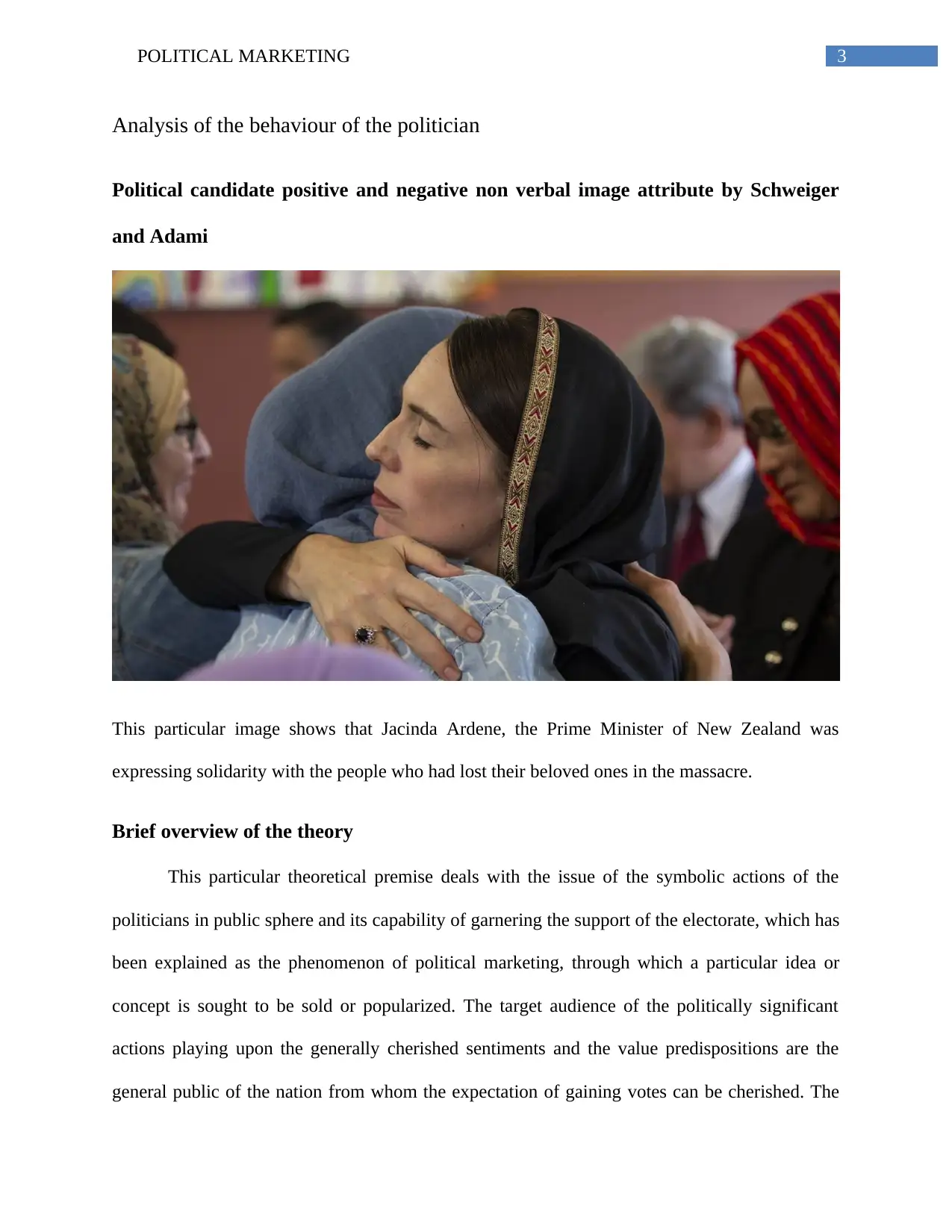
This particular image shows that Jacinda Ardene, the Prime Minister of New Zealand was
expressing solidarity with the people who had lost their beloved ones in the massacre.
Brief overview of the theory
This particular theoretical premise deals with the issue of the symbolic actions of the
politicians in public sphere and its capability of garnering the support of the electorate, which has
been explained as the phenomenon of political marketing, through which a particular idea or
concept is sought to be sold or popularized. The target audience of the politically significant
actions playing upon the generally cherished sentiments and the value predispositions are the
general public of the nation from whom the expectation of gaining votes can be cherished. The
Analysis of the behaviour of the politician
Political candidate positive and negative non verbal image attribute by Schweiger
and Adami
This particular image shows that Jacinda Ardene, the Prime Minister of New Zealand was
expressing solidarity with the people who had lost their beloved ones in the massacre.
Brief overview of the theory
This particular theoretical premise deals with the issue of the symbolic actions of the
politicians in public sphere and its capability of garnering the support of the electorate, which has
been explained as the phenomenon of political marketing, through which a particular idea or
concept is sought to be sold or popularized. The target audience of the politically significant
actions playing upon the generally cherished sentiments and the value predispositions are the
general public of the nation from whom the expectation of gaining votes can be cherished. The
Paraphrase This Document
Need a fresh take? Get an instant paraphrase of this document with our AI Paraphraser
4POLITICAL MARKETING
aim is thus of making the best usage of the culturally and socially held beliefs in order to appeal
to the masses and relate with them thereby reinstating the democratic convention that the
government is the representative of the people. As per the views of Schweiger and Adami, the
political rituals of the political leaders to appeal to the masses involve a high degree of utilization
of the social media in order to disseminate the message to a large number of people, and that
these are pre planned forming a part of the political agenda (Schill, 2012).
Explanation of the Political Behaviour against the theoretical premise
On the 15th of March 2019, New Zealand had witnessed one of the deadliest attacks in
which the muslim community had been targeted by a white supremacist man of Australian
nationality, named Brenton Tarrant. The customary Friday prayers were going on as a part of the
observance of the Islamic Sabbath Day when the 28 year old attacker had opened fire at Al Noor
Mosque and at the Linwood Islamic Centre, killing almost 50 people. The very next day, on the
16th, Prime Minister Jacinda Ardern had appeared publicly in a veiled appearance to express her
solidarity with the bereaved relatives and friends of the victims and also to extend her support to
the entire muslim community of the nation. This symbolic gesture has been quite an important
political action on her part as it expressed a sense of genuineness, which has attracted
commendations not just from the Kiwis but also from rest of the world. In the follow sections the
discussion shall be focusing upon the analysis of the political behaviour of Prime Minister
Jacinda Ardern (Reicher, Haslam & Van Bavel, 2019).
With regard to the theoretical premise, the example of the appearance of Prime Minister
Jacinda Ardern in a veiled demeanour to express solidarity with the Christchurch mosque
shootings can be provided. It is a part of the political ritual of the political leader relating oneself
to the masses very closely and also considering the issues faced by the masses as their own.
aim is thus of making the best usage of the culturally and socially held beliefs in order to appeal
to the masses and relate with them thereby reinstating the democratic convention that the
government is the representative of the people. As per the views of Schweiger and Adami, the
political rituals of the political leaders to appeal to the masses involve a high degree of utilization
of the social media in order to disseminate the message to a large number of people, and that
these are pre planned forming a part of the political agenda (Schill, 2012).
Explanation of the Political Behaviour against the theoretical premise
On the 15th of March 2019, New Zealand had witnessed one of the deadliest attacks in
which the muslim community had been targeted by a white supremacist man of Australian
nationality, named Brenton Tarrant. The customary Friday prayers were going on as a part of the
observance of the Islamic Sabbath Day when the 28 year old attacker had opened fire at Al Noor
Mosque and at the Linwood Islamic Centre, killing almost 50 people. The very next day, on the
16th, Prime Minister Jacinda Ardern had appeared publicly in a veiled appearance to express her
solidarity with the bereaved relatives and friends of the victims and also to extend her support to
the entire muslim community of the nation. This symbolic gesture has been quite an important
political action on her part as it expressed a sense of genuineness, which has attracted
commendations not just from the Kiwis but also from rest of the world. In the follow sections the
discussion shall be focusing upon the analysis of the political behaviour of Prime Minister
Jacinda Ardern (Reicher, Haslam & Van Bavel, 2019).
With regard to the theoretical premise, the example of the appearance of Prime Minister
Jacinda Ardern in a veiled demeanour to express solidarity with the Christchurch mosque
shootings can be provided. It is a part of the political ritual of the political leader relating oneself
to the masses very closely and also considering the issues faced by the masses as their own.
5POLITICAL MARKETING
Prime Minister Jacinda Ardern had genuinely been moved by the tragedy and her expressions
were a testimony to the depth of her feelings. Since it was genuine and was a response to an
untoward incident, the gesture of Prime Minister Jacinda Ardern cannot be called as an agenda
driven political ritual ("New Zealand Labour (@nzlabour) on Twitter", 2019).
With regard to the political act of Prime Minister Jacinda Ardern on the occasion of the
tragic event of the massacre of worshippers at the Christchurch mosques, the message of the
solidarity and compassion of the political leader had been disseminated through the social media.
Facebook, Instagram and Twitter had been the most popular methods which were used to ensure
that the message was spread rapidly. The social media had been an effective tool which was
taken to by the general public to popularize the act of benevolence and empathy of Prime
Minister Jacinda Ardern (Schwartz, 2019). Following the Christchurch Mosque shootings, Prime
Minister Jacinda Ardern had banned the sale, usage and purchase of semi automatic rifles as they
have the potential of causing huge casualties as demonstrated by the one which had demonstrated
by the one on 15th March ("New Zealand Labour (@nzlabour) on Twitter", 2019). Hence the
decision of banning of such lethal weapons which have the potential of causing death in huge
numbers in a short period of time have been taken Prime Minister Jacinda Ardern to avoid such
incidents in future. This particular political behaviour to counter the future occurrence had been
announced by Prime Minister Jacinda Ardern to appeal to the masses ("Labour's 2017 Election
Platform", 2017). These examples can justify the applicability of theoretical premise of E-
Marketing.
Prime Minister Jacinda Ardern had genuinely been moved by the tragedy and her expressions
were a testimony to the depth of her feelings. Since it was genuine and was a response to an
untoward incident, the gesture of Prime Minister Jacinda Ardern cannot be called as an agenda
driven political ritual ("New Zealand Labour (@nzlabour) on Twitter", 2019).
With regard to the political act of Prime Minister Jacinda Ardern on the occasion of the
tragic event of the massacre of worshippers at the Christchurch mosques, the message of the
solidarity and compassion of the political leader had been disseminated through the social media.
Facebook, Instagram and Twitter had been the most popular methods which were used to ensure
that the message was spread rapidly. The social media had been an effective tool which was
taken to by the general public to popularize the act of benevolence and empathy of Prime
Minister Jacinda Ardern (Schwartz, 2019). Following the Christchurch Mosque shootings, Prime
Minister Jacinda Ardern had banned the sale, usage and purchase of semi automatic rifles as they
have the potential of causing huge casualties as demonstrated by the one which had demonstrated
by the one on 15th March ("New Zealand Labour (@nzlabour) on Twitter", 2019). Hence the
decision of banning of such lethal weapons which have the potential of causing death in huge
numbers in a short period of time have been taken Prime Minister Jacinda Ardern to avoid such
incidents in future. This particular political behaviour to counter the future occurrence had been
announced by Prime Minister Jacinda Ardern to appeal to the masses ("Labour's 2017 Election
Platform", 2017). These examples can justify the applicability of theoretical premise of E-
Marketing.
⊘ This is a preview!⊘
Do you want full access?
Subscribe today to unlock all pages.
Trusted by 1+ million students worldwide
6POLITICAL MARKETING
Principles of E Marketing by Jackson
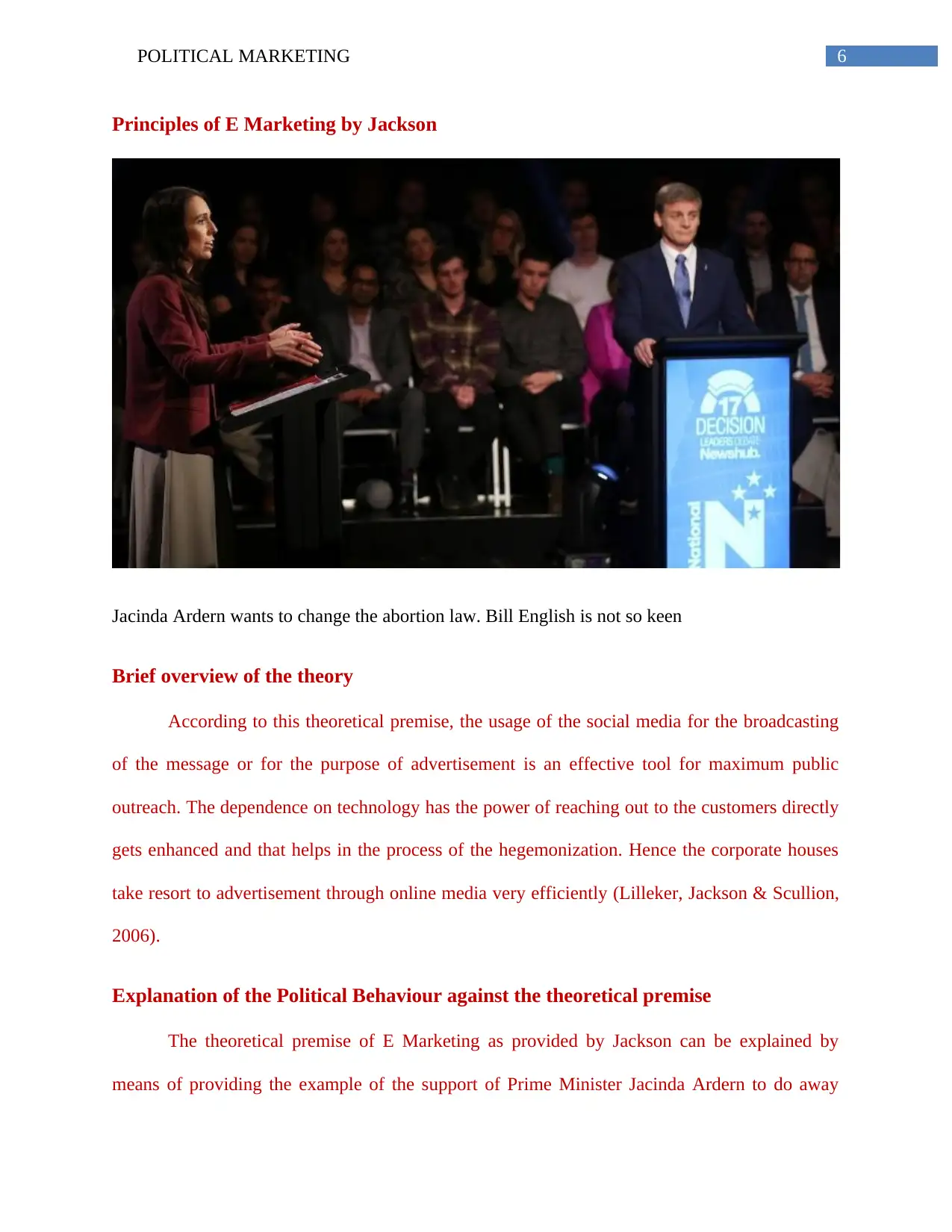
Jacinda Ardern wants to change the abortion law. Bill English is not so keen
Brief overview of the theory
According to this theoretical premise, the usage of the social media for the broadcasting
of the message or for the purpose of advertisement is an effective tool for maximum public
outreach. The dependence on technology has the power of reaching out to the customers directly
gets enhanced and that helps in the process of the hegemonization. Hence the corporate houses
take resort to advertisement through online media very efficiently (Lilleker, Jackson & Scullion,
2006).
Explanation of the Political Behaviour against the theoretical premise
The theoretical premise of E Marketing as provided by Jackson can be explained by
means of providing the example of the support of Prime Minister Jacinda Ardern to do away
Principles of E Marketing by Jackson
Jacinda Ardern wants to change the abortion law. Bill English is not so keen
Brief overview of the theory
According to this theoretical premise, the usage of the social media for the broadcasting
of the message or for the purpose of advertisement is an effective tool for maximum public
outreach. The dependence on technology has the power of reaching out to the customers directly
gets enhanced and that helps in the process of the hegemonization. Hence the corporate houses
take resort to advertisement through online media very efficiently (Lilleker, Jackson & Scullion,
2006).
Explanation of the Political Behaviour against the theoretical premise
The theoretical premise of E Marketing as provided by Jackson can be explained by
means of providing the example of the support of Prime Minister Jacinda Ardern to do away
Paraphrase This Document
Need a fresh take? Get an instant paraphrase of this document with our AI Paraphraser
7POLITICAL MARKETING
with the abortion law which was there at place in New Zealand for over forty years. The
principles of E Marketing cannot be implemented for the purpose of political marketing if it is
not backed up with proper promise of bringing about change in the lives of the people, especially
New Zealand being a democratic nation with a vibrant civil society whereby the political leaders
must do or promise something substantial which shall change the lives of the people ("New
Zealand Labour (@nzlabour) on Twitter", 2019). Prime Minister Jacinda Ardern had voiced her
opinion in favour of banning the abortion law which made aborting fetuses illegal and the
conditions which were there place in the nation made abortion very difficult and that was an
impediment in the path of the women exercising their right to agency over their bodies. "People
should be able to exercise their own rights and I as a parliamentarian shouldn't stand in the way
of that," was what she had said to express her support for the law she had proposed (Ardern,
2019). Not just the abortion she had also promised to introduce two other big social reforms:
euthanasia and medicinal cannabis. While the other parliamentarians were not very keen on
introducing the reforms, Prime Minister Jacinda Ardern was very much supportive of the
introduction of the reforms (Reicher, Haslam & Van Bavel, 2019).
with the abortion law which was there at place in New Zealand for over forty years. The
principles of E Marketing cannot be implemented for the purpose of political marketing if it is
not backed up with proper promise of bringing about change in the lives of the people, especially
New Zealand being a democratic nation with a vibrant civil society whereby the political leaders
must do or promise something substantial which shall change the lives of the people ("New
Zealand Labour (@nzlabour) on Twitter", 2019). Prime Minister Jacinda Ardern had voiced her
opinion in favour of banning the abortion law which made aborting fetuses illegal and the
conditions which were there place in the nation made abortion very difficult and that was an
impediment in the path of the women exercising their right to agency over their bodies. "People
should be able to exercise their own rights and I as a parliamentarian shouldn't stand in the way
of that," was what she had said to express her support for the law she had proposed (Ardern,
2019). Not just the abortion she had also promised to introduce two other big social reforms:
euthanasia and medicinal cannabis. While the other parliamentarians were not very keen on
introducing the reforms, Prime Minister Jacinda Ardern was very much supportive of the
introduction of the reforms (Reicher, Haslam & Van Bavel, 2019).
8POLITICAL MARKETING
Delivery Theory of Political Marketing
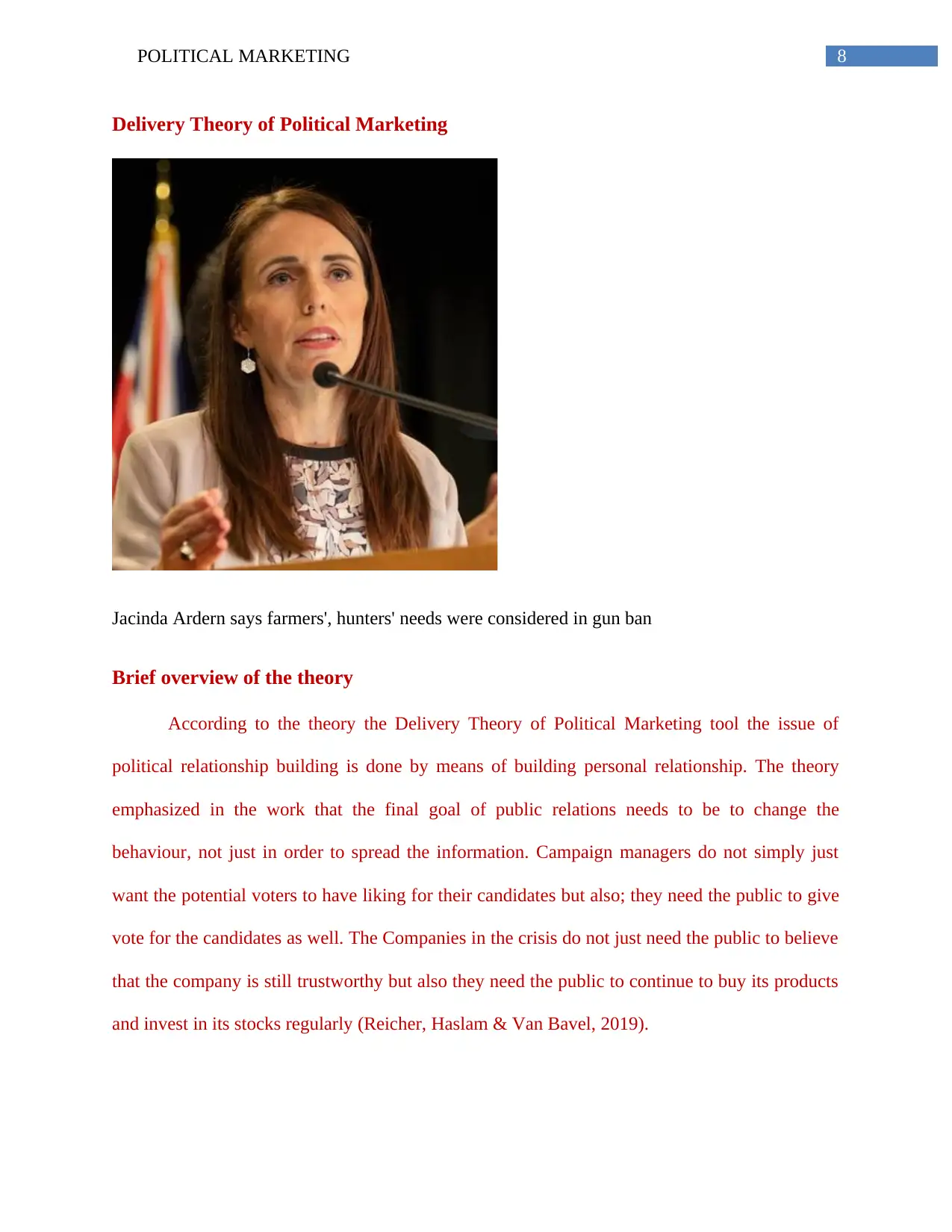
Jacinda Ardern says farmers', hunters' needs were considered in gun ban
Brief overview of the theory
According to the theory the Delivery Theory of Political Marketing tool the issue of
political relationship building is done by means of building personal relationship. The theory
emphasized in the work that the final goal of public relations needs to be to change the
behaviour, not just in order to spread the information. Campaign managers do not simply just
want the potential voters to have liking for their candidates but also; they need the public to give
vote for the candidates as well. The Companies in the crisis do not just need the public to believe
that the company is still trustworthy but also they need the public to continue to buy its products
and invest in its stocks regularly (Reicher, Haslam & Van Bavel, 2019).
Delivery Theory of Political Marketing
Jacinda Ardern says farmers', hunters' needs were considered in gun ban
Brief overview of the theory
According to the theory the Delivery Theory of Political Marketing tool the issue of
political relationship building is done by means of building personal relationship. The theory
emphasized in the work that the final goal of public relations needs to be to change the
behaviour, not just in order to spread the information. Campaign managers do not simply just
want the potential voters to have liking for their candidates but also; they need the public to give
vote for the candidates as well. The Companies in the crisis do not just need the public to believe
that the company is still trustworthy but also they need the public to continue to buy its products
and invest in its stocks regularly (Reicher, Haslam & Van Bavel, 2019).
⊘ This is a preview!⊘
Do you want full access?
Subscribe today to unlock all pages.
Trusted by 1+ million students worldwide
9POLITICAL MARKETING
The Five Steps toward Behavioral Change as outlined by the theory focus on behavioral
change is at the core of public relations. According to the theory, the process of changing the
public's behavior happens in five steps: (1) building awareness, (2) developing a latent readiness,
(3) a triggering event, (4) engaging in intermediate behavior, and (5) making behavioral change.
Let us look at each of these five steps:
1. Building awareness -- The first step is perhaps the most obvious. For ideas to spread, one has
to share them with others. This is exactly what the first step entails. Whether the information is
about an issue or the idea has spread through the mass media or by the word of the mouth,
information need to be available for the public for consumption (Reicher, Haslam & Van Bavel,
2019).
2. Developing a latent readiness -- Once the information has reached the public sphere, people
begin to form opinions about the issue. Different people may react to different opinions on the
basis of differing strengths, based on their personalities, values, and prior beliefs. Those having
the stronger opinions in favor of the idea fully reach the stage of latent readiness, which means
that they are having then potential to be ready to act on the basis of their opinion (Reicher,
Haslam & Van Bavel, 2019).
3. Triggering event -- This is an event or occurrence which is tragic in all case that is likely to
move those with a latent readiness to action. The event could be something natural and or could
be unplanned by the public relations team for example a natural calamity like a hurricane, a virus
outbreak, a terrorist attack et cetera or it could be something which have been created by the PR
representatives themselves specifically to encourage those people predisposed to take actions in
order to finally take the steps toward the desired behaviour for example the, weight loss
The Five Steps toward Behavioral Change as outlined by the theory focus on behavioral
change is at the core of public relations. According to the theory, the process of changing the
public's behavior happens in five steps: (1) building awareness, (2) developing a latent readiness,
(3) a triggering event, (4) engaging in intermediate behavior, and (5) making behavioral change.
Let us look at each of these five steps:
1. Building awareness -- The first step is perhaps the most obvious. For ideas to spread, one has
to share them with others. This is exactly what the first step entails. Whether the information is
about an issue or the idea has spread through the mass media or by the word of the mouth,
information need to be available for the public for consumption (Reicher, Haslam & Van Bavel,
2019).
2. Developing a latent readiness -- Once the information has reached the public sphere, people
begin to form opinions about the issue. Different people may react to different opinions on the
basis of differing strengths, based on their personalities, values, and prior beliefs. Those having
the stronger opinions in favor of the idea fully reach the stage of latent readiness, which means
that they are having then potential to be ready to act on the basis of their opinion (Reicher,
Haslam & Van Bavel, 2019).
3. Triggering event -- This is an event or occurrence which is tragic in all case that is likely to
move those with a latent readiness to action. The event could be something natural and or could
be unplanned by the public relations team for example a natural calamity like a hurricane, a virus
outbreak, a terrorist attack et cetera or it could be something which have been created by the PR
representatives themselves specifically to encourage those people predisposed to take actions in
order to finally take the steps toward the desired behaviour for example the, weight loss
Paraphrase This Document
Need a fresh take? Get an instant paraphrase of this document with our AI Paraphraser
10POLITICAL MARKETING
challenge, the fundraising drive, the contest, the sales event et cetera (Reicher, Haslam & Van
Bavel, 2019).
4. Intermediate behaviors -- These are the 'little steps' that people take when they are considering
the larger behavioral change. These steps could include inquiry calls, taking brochures, signing
up for free trial periods, etc. Although these little steps are not the ultimate behavioral goal PR
executives hope the public will reach, they are important to note. Keeping track of these
intermediate behaviors will help to determine how well a message has been received by the
public and how many people are on the cusp of taking the ultimately desired action (Reicher,
Haslam & Van Bavel, 2019).
5. Behavior change -- After demonstrating the intermediate behaviors, hopefully some (if not
many) will be persuaded to make the ultimate behavior change. As mentioned earlier, this is the
real goal of the public relations message. Whether it is buying a product, investing money,
changing health-related behaviors, or taking some other specific action, behavior changes are
measurable outputs of public relations and the ultimate success of the process (Reicher, Haslam
& Van Bavel, 2019).
Explanation of the Political Behaviour against the theoretical premise
In this section the political behaviour shall be explained in order to substantiate the cause
of it. On the 15th of March 2019, New Zealand had witnessed one of the deadliest attacks in
which the muslim community had been targeted by a white supremacist man of Australian
nationality, named Brenton Tarrant. The customary Friday prayers were going on as a part of the
observance of the Islamic Sabbath Day when the 28 year old attacker had opened fire at Al Noor
Mosque and at the Linwood Islamic Centre, killing almost 50 people. The very next day, on the
challenge, the fundraising drive, the contest, the sales event et cetera (Reicher, Haslam & Van
Bavel, 2019).
4. Intermediate behaviors -- These are the 'little steps' that people take when they are considering
the larger behavioral change. These steps could include inquiry calls, taking brochures, signing
up for free trial periods, etc. Although these little steps are not the ultimate behavioral goal PR
executives hope the public will reach, they are important to note. Keeping track of these
intermediate behaviors will help to determine how well a message has been received by the
public and how many people are on the cusp of taking the ultimately desired action (Reicher,
Haslam & Van Bavel, 2019).
5. Behavior change -- After demonstrating the intermediate behaviors, hopefully some (if not
many) will be persuaded to make the ultimate behavior change. As mentioned earlier, this is the
real goal of the public relations message. Whether it is buying a product, investing money,
changing health-related behaviors, or taking some other specific action, behavior changes are
measurable outputs of public relations and the ultimate success of the process (Reicher, Haslam
& Van Bavel, 2019).
Explanation of the Political Behaviour against the theoretical premise
In this section the political behaviour shall be explained in order to substantiate the cause
of it. On the 15th of March 2019, New Zealand had witnessed one of the deadliest attacks in
which the muslim community had been targeted by a white supremacist man of Australian
nationality, named Brenton Tarrant. The customary Friday prayers were going on as a part of the
observance of the Islamic Sabbath Day when the 28 year old attacker had opened fire at Al Noor
Mosque and at the Linwood Islamic Centre, killing almost 50 people. The very next day, on the
11POLITICAL MARKETING
16th, Prime Minister Jacinda Ardern had appeared publicly in a veiled appearance to express her
solidarity with the bereaved relatives and friends of the victims and also to extend her support to
the entire muslim community of the nation. This symbolic gesture has been quite an important
political action on her part as it expressed a sense of genuineness, which has attracted
commendations not just from the Kiwis but also from rest of the world. In the follow sections the
discussion shall be focusing upon the analysis of the political behaviour of Prime Minister
Jacinda Ardern (Reicher, Haslam & Van Bavel, 2019).
With regard to the political act of Prime Minister Jacinda Ardern on the occasion of the
tragic event of the massacre of worshippers at the Christchurch mosques, the message of the
solidarity and compassion of the political leader had been disseminated through the social media.
Facebook, Instagram and Twitter had been the most popular methods which were used to ensure
that the message was spread rapidly. The social media had been an effective tool which was
taken to by the general public to popularize the act of benevolence and empathy of Prime
Minister Jacinda Ardern (Schwartz, 2019). Following the Christchurch Mosque shootings, Prime
Minister Jacinda Ardern had banned the sale, usage and purchase of semi automatic rifles as they
have the potential of causing huge casualties as demonstrated by the one which had demonstrated
by the one on 15th March. Hence the decision of banning of such lethal weapons which have the
potential of causing death in huge numbers in a short period of time have been taken Prime
Minister Jacinda Ardern to avoid such incidents in future. This particular political behaviour to
counter the future occurrence had been announced by Prime Minister Jacinda Ardern to appeal to
the masses ("Labour's 2017 Election Platform", 2017). the example of the appearance of Prime
Minister Jacinda Ardern in a veiled demeanour to express solidarity with the Christchurch
mosque shootings can be provided. It is a part of the political ritual of the political leader relating
16th, Prime Minister Jacinda Ardern had appeared publicly in a veiled appearance to express her
solidarity with the bereaved relatives and friends of the victims and also to extend her support to
the entire muslim community of the nation. This symbolic gesture has been quite an important
political action on her part as it expressed a sense of genuineness, which has attracted
commendations not just from the Kiwis but also from rest of the world. In the follow sections the
discussion shall be focusing upon the analysis of the political behaviour of Prime Minister
Jacinda Ardern (Reicher, Haslam & Van Bavel, 2019).
With regard to the political act of Prime Minister Jacinda Ardern on the occasion of the
tragic event of the massacre of worshippers at the Christchurch mosques, the message of the
solidarity and compassion of the political leader had been disseminated through the social media.
Facebook, Instagram and Twitter had been the most popular methods which were used to ensure
that the message was spread rapidly. The social media had been an effective tool which was
taken to by the general public to popularize the act of benevolence and empathy of Prime
Minister Jacinda Ardern (Schwartz, 2019). Following the Christchurch Mosque shootings, Prime
Minister Jacinda Ardern had banned the sale, usage and purchase of semi automatic rifles as they
have the potential of causing huge casualties as demonstrated by the one which had demonstrated
by the one on 15th March. Hence the decision of banning of such lethal weapons which have the
potential of causing death in huge numbers in a short period of time have been taken Prime
Minister Jacinda Ardern to avoid such incidents in future. This particular political behaviour to
counter the future occurrence had been announced by Prime Minister Jacinda Ardern to appeal to
the masses ("Labour's 2017 Election Platform", 2017). the example of the appearance of Prime
Minister Jacinda Ardern in a veiled demeanour to express solidarity with the Christchurch
mosque shootings can be provided. It is a part of the political ritual of the political leader relating
⊘ This is a preview!⊘
Do you want full access?
Subscribe today to unlock all pages.
Trusted by 1+ million students worldwide

1 out of 16


Your All-in-One AI-Powered Toolkit for Academic Success.
+13062052269
info@desklib.com
Available 24*7 on WhatsApp / Email
![[object Object]](/_next/static/media/star-bottom.7253800d.svg)
Unlock your academic potential
Copyright © 2020–2026 A2Z Services. All Rights Reserved. Developed and managed by ZUCOL.