Political Orientation Impact on Moral Judgement: Research Report
VerifiedAdded on 2020/06/03
|20
|3979
|58
Report
AI Summary
This research report investigates the relationship between political orientation and moral judgement, focusing on liberal and conservative viewpoints through the lens of the Moral Foundation Theory (MFT). The study surveyed 227 students from Swinburne Online (SOL), examining how participants rated the relevance of the five moral foundations: harm/care, fairness/reciprocity, ingroup/loyalty, authority/respect, and purity/sanctity. The findings revealed that liberal-leaning participants prioritized harm/care and fairness/reciprocity, while conservatives rated all five foundations more equally. The report details the methodology, including participant demographics, materials used (political orientation scale and Moral Foundation Questionnaire), and procedure. The results section presents the demographic breakdown, self-reported political identities, and mean scores for each moral foundation across different political orientations. The discussion analyzes the implications of the findings, suggesting a link between moral reasoning and political ideology and highlighting the need for further research into the underlying motivational processes. The report includes tables and figures to illustrate the data and provides references to relevant academic literature.
Research Report

Paraphrase This Document
Need a fresh take? Get an instant paraphrase of this document with our AI Paraphraser
ABSTRACT
Political orientation characterises the thought, attitudes and beliefs of a particular group
or nation towards their political leaders and overall government system. Individuals have thus
been classified under varying political ideologies with preference being predominantly attributed
to the liberal and conservative bands. Liberalism constitutes a reformed outlook and tolerance to
change that is unbound by neither tradition nor authority. Conservatism entails the exact opposite
whereby value is prescribed to preservation of traditional civil and cultural institutions. This
research investigation examines the influence political orientation has on moral judgement with
focus on the liberal and conservative groups and the five moral foundation elements presented in
the Moral Foundation Theory (MFT). In order to test the designed hypothesis, results
demonstrate Harm/care and Fairness/reciprocity as most relevant element among liberal
politicians. However, conservatives rated the five moral foundations equally relevant. To test this,
a survey of 227 SOL students was conducted. The sample thus included a total of 168 (74%)
females and 59 (26%) male participants. The results acquired from the survey demonstrate that
majority of the participants reported their self-identity as moderately liberal and only 1 participant
reported a strongly conservative identity. Ultimately, these results imply that a relationship
between an individual’s moral judgement and political orientation exists whereby political
ideology and preference can influence moral reasoning. Further research that identifies the
motivational and thought processes that initiate moral conviction in the first place is thus required
for greater insight into the liberal-conservative approach to morality.
Political orientation characterises the thought, attitudes and beliefs of a particular group
or nation towards their political leaders and overall government system. Individuals have thus
been classified under varying political ideologies with preference being predominantly attributed
to the liberal and conservative bands. Liberalism constitutes a reformed outlook and tolerance to
change that is unbound by neither tradition nor authority. Conservatism entails the exact opposite
whereby value is prescribed to preservation of traditional civil and cultural institutions. This
research investigation examines the influence political orientation has on moral judgement with
focus on the liberal and conservative groups and the five moral foundation elements presented in
the Moral Foundation Theory (MFT). In order to test the designed hypothesis, results
demonstrate Harm/care and Fairness/reciprocity as most relevant element among liberal
politicians. However, conservatives rated the five moral foundations equally relevant. To test this,
a survey of 227 SOL students was conducted. The sample thus included a total of 168 (74%)
females and 59 (26%) male participants. The results acquired from the survey demonstrate that
majority of the participants reported their self-identity as moderately liberal and only 1 participant
reported a strongly conservative identity. Ultimately, these results imply that a relationship
between an individual’s moral judgement and political orientation exists whereby political
ideology and preference can influence moral reasoning. Further research that identifies the
motivational and thought processes that initiate moral conviction in the first place is thus required
for greater insight into the liberal-conservative approach to morality.

⊘ This is a preview!⊘
Do you want full access?
Subscribe today to unlock all pages.

Trusted by 1+ million students worldwide
Table of Contents
INTRODUCTION...........................................................................................................................1
METHOD........................................................................................................................................1
Participants.............................................................................................................................1
Materials.................................................................................................................................1
Procedure................................................................................................................................2
RESULTS........................................................................................................................................2
Demographic basis.................................................................................................................2
Mean.......................................................................................................................................4
Standard deviation..................................................................................................................5
DISCUSSION..................................................................................................................................6
REFERENCES................................................................................................................................9
Table of Figures
Figure 1 Demographic basis survey from mean and Standard deviation........................................3
Figure 2 People self identity's responses.........................................................................................4
Figure 3 Relationship between moral foundation and politics: Mean.............................................5
Figure 4 Relationship between moral foundation and politics: standard deviation.........................6
INTRODUCTION...........................................................................................................................1
METHOD........................................................................................................................................1
Participants.............................................................................................................................1
Materials.................................................................................................................................1
Procedure................................................................................................................................2
RESULTS........................................................................................................................................2
Demographic basis.................................................................................................................2
Mean.......................................................................................................................................4
Standard deviation..................................................................................................................5
DISCUSSION..................................................................................................................................6
REFERENCES................................................................................................................................9
Table of Figures
Figure 1 Demographic basis survey from mean and Standard deviation........................................3
Figure 2 People self identity's responses.........................................................................................4
Figure 3 Relationship between moral foundation and politics: Mean.............................................5
Figure 4 Relationship between moral foundation and politics: standard deviation.........................6
Paraphrase This Document
Need a fresh take? Get an instant paraphrase of this document with our AI Paraphraser
INTRODUCTION
Political orientation characterizes thinking of a group of people, region and nation. Moral
Foundation Theory (MFT) is theory of social psychology which presents changes in human
moral reasoning considering five fundamental moral elements. Initially, the theory was based on
cultural differences while subsequently; it pays more attention towards political ideology. As per
the theory, there are 5 fundamental moral aspects that are harm, fairness, Ingroup loyalty,
authority and purity. Graham, Haidt & Nosek, (2009) found that liberal politicians consistently
reflected high use of harm and fairness whilst in contrast, conservative used all the 5 elements
more equally. The study aims at exploring moral foundation theory to examine its relationship
with liberal and conservative political orientation. The research study will test the hypothesis to
assess that whether conservative and liberal politicians rate different morality aspects equally or
not.
According to Graham, Nosek & Haidt (2012), moral foundation theory is developed for
identification of the moral content areas which have been highly affected at a wide level. The
study mainly focuses on the identification and understanding of the reasons for different types of
human behaviour (Graham, Nosek & Haidt, 2012). This theory is mainly divided into five
foundations such as Care/Harm, Fairness/Reciprocity, In group/Loyalty, Authority/Respect and
purity/Sanctity (Haidt & Graham007). As per Graham, Nosek & Haidt (2012) , the first two
foundations such as Care/Harm and fairness/reciprocity are highly concerned with the protection
factors and in providing fair treatment to the individuals. In contrast to this, they also consider
binding foundations because as per the approach, people are bound to perform in a larger group.
The remaining three foundations such as in any group, authority etc., it does not focuses on the
individuals (Haidt & Graham 2007). The study is totally based on the welfare of society. It also
1
Political orientation characterizes thinking of a group of people, region and nation. Moral
Foundation Theory (MFT) is theory of social psychology which presents changes in human
moral reasoning considering five fundamental moral elements. Initially, the theory was based on
cultural differences while subsequently; it pays more attention towards political ideology. As per
the theory, there are 5 fundamental moral aspects that are harm, fairness, Ingroup loyalty,
authority and purity. Graham, Haidt & Nosek, (2009) found that liberal politicians consistently
reflected high use of harm and fairness whilst in contrast, conservative used all the 5 elements
more equally. The study aims at exploring moral foundation theory to examine its relationship
with liberal and conservative political orientation. The research study will test the hypothesis to
assess that whether conservative and liberal politicians rate different morality aspects equally or
not.
According to Graham, Nosek & Haidt (2012), moral foundation theory is developed for
identification of the moral content areas which have been highly affected at a wide level. The
study mainly focuses on the identification and understanding of the reasons for different types of
human behaviour (Graham, Nosek & Haidt, 2012). This theory is mainly divided into five
foundations such as Care/Harm, Fairness/Reciprocity, In group/Loyalty, Authority/Respect and
purity/Sanctity (Haidt & Graham007). As per Graham, Nosek & Haidt (2012) , the first two
foundations such as Care/Harm and fairness/reciprocity are highly concerned with the protection
factors and in providing fair treatment to the individuals. In contrast to this, they also consider
binding foundations because as per the approach, people are bound to perform in a larger group.
The remaining three foundations such as in any group, authority etc., it does not focuses on the
individuals (Haidt & Graham 2007). The study is totally based on the welfare of society. It also
1
found that these two foundations are based on liberal orientation approach whereas the remaining
three are totally based on conservative political orientation (Haidt & Graham 2007). The actual
reason for developing this theory was to analyse the differences in culture which impacts on the
political ideology. As per Janoff-Bulman & Carnes (2013), there are various scholars which
provide different forms of moral theories for the analysis of the the future progress concerning
political works. Using conservatives, libertarians, different kinds of variations referring opinion
have been discussed in this theory. It also refers to the position of liberals which are considered
quite more conservative to make any fair arguments and have greater concern with various
principles like care and equality. According to Janoff-Bulman & Carnes (2013) moral foundation
theory can be classified into five parts. The first foundation refersto the care or harm in which
people have to be protected by some factors of harmful activities which they are facing have
already gone through in the work place. On the other hand, Fairness/ Reciprocity, refers for
providing justice as per the described rules which protect the people from various types of
cheating (Haidt & Graham 2007).
In the study of Godwin (2015), Loyal/ In-group considers to take action or stand for the
group, family, and nation which can help them in getting complete support from betrayal.
Authority or respect also refers to provide traditional and legitimate authority which is totally
different and sometimes opposite from the subversion. Sanctity involves purity which means
providing complete security in terms of food, actions for protecting the people from degradation.
As per Feinberg & Willer (2013) , moral foundation theory is highly concerned with the
political orientation and it can be measured by two single terms such as "liberal-conservative" or
"left-right", inn which the highly conservative one represents the great binding foundations in the
2
three are totally based on conservative political orientation (Haidt & Graham 2007). The actual
reason for developing this theory was to analyse the differences in culture which impacts on the
political ideology. As per Janoff-Bulman & Carnes (2013), there are various scholars which
provide different forms of moral theories for the analysis of the the future progress concerning
political works. Using conservatives, libertarians, different kinds of variations referring opinion
have been discussed in this theory. It also refers to the position of liberals which are considered
quite more conservative to make any fair arguments and have greater concern with various
principles like care and equality. According to Janoff-Bulman & Carnes (2013) moral foundation
theory can be classified into five parts. The first foundation refersto the care or harm in which
people have to be protected by some factors of harmful activities which they are facing have
already gone through in the work place. On the other hand, Fairness/ Reciprocity, refers for
providing justice as per the described rules which protect the people from various types of
cheating (Haidt & Graham 2007).
In the study of Godwin (2015), Loyal/ In-group considers to take action or stand for the
group, family, and nation which can help them in getting complete support from betrayal.
Authority or respect also refers to provide traditional and legitimate authority which is totally
different and sometimes opposite from the subversion. Sanctity involves purity which means
providing complete security in terms of food, actions for protecting the people from degradation.
As per Feinberg & Willer (2013) , moral foundation theory is highly concerned with the
political orientation and it can be measured by two single terms such as "liberal-conservative" or
"left-right", inn which the highly conservative one represents the great binding foundations in the
2
⊘ This is a preview!⊘
Do you want full access?
Subscribe today to unlock all pages.
Trusted by 1+ million students worldwide
form of loyalty, sanctity and authority. In addition to this, individual foundation is related to the
harm as well as fairness. Whereas, a left-right measure does not relate with the sanctity but it is
associated with all other foundations in moral foundation theory. According to Graham, Haidt &
Nosek (2009) in case of political orientation, it can be measured on the basis of fairness and
harm. Furthermore, all the binding foundations are highly associated with the measures of
liberal-conservative factors. Whereas, some areas adopt purity in groups and authorities, which is
based on the conservative measures. Hence, many authors do not consider liberal-conservative
and left-right measures as they are interchangeable in nature.
According to Cronin & De Greiff (2015), moral foundation theory acts important in the
production of a good political orientation as it can help in providing accurate and efficient
results. The study also suggests systematic differences between liberals and conservative
activities. It is also helpful in creating relationships between conservative and mental rigidity. It
is analysed that conservatives are more reliable and accurate by using the moral foundation
theory. It also provides a complete understanding of various political issues and activities for
protecting the people from any uncertainties. It also gives various suggestions so that the moral
stereotypes & philosophies can be easily understood by the intergroup for segregating the
processes. It was hypothesised that liberals would rate the Harm/care and Fairness/reciprocity as
most relevant. Also, it was hypothesized that the conservatives would rate all the five moral
foundations equally relevant.
3
harm as well as fairness. Whereas, a left-right measure does not relate with the sanctity but it is
associated with all other foundations in moral foundation theory. According to Graham, Haidt &
Nosek (2009) in case of political orientation, it can be measured on the basis of fairness and
harm. Furthermore, all the binding foundations are highly associated with the measures of
liberal-conservative factors. Whereas, some areas adopt purity in groups and authorities, which is
based on the conservative measures. Hence, many authors do not consider liberal-conservative
and left-right measures as they are interchangeable in nature.
According to Cronin & De Greiff (2015), moral foundation theory acts important in the
production of a good political orientation as it can help in providing accurate and efficient
results. The study also suggests systematic differences between liberals and conservative
activities. It is also helpful in creating relationships between conservative and mental rigidity. It
is analysed that conservatives are more reliable and accurate by using the moral foundation
theory. It also provides a complete understanding of various political issues and activities for
protecting the people from any uncertainties. It also gives various suggestions so that the moral
stereotypes & philosophies can be easily understood by the intergroup for segregating the
processes. It was hypothesised that liberals would rate the Harm/care and Fairness/reciprocity as
most relevant. Also, it was hypothesized that the conservatives would rate all the five moral
foundations equally relevant.
3
Paraphrase This Document
Need a fresh take? Get an instant paraphrase of this document with our AI Paraphraser
METHOD
Participants
The participants were randomly selected from the students enlisted in the undergraduate
Psychology 101 class at the University of Swinburne Online (SOL). Originally, a total of 239
surveys commenced, however prior to analysis this number was reduced to only 227 eligible
responses. Of the 239, 12 sets of responses were omitted due to missing data with an incomplete
political orientation item seen by 3 participants and an incomplete Moral Foundation
Questionnaire attributed to the other 9 participants. Ultimately, the sample comprised of 168
women with a mean age of 21.41 years, (SD= 5.47). The remaining 59 were men that held a
mean age of 23.42 years (SD= 7.60). The students thus participated as part of a Research
Experience Program (REP) to receive extra credit for their unit of study. All the participants
answered the required demographic information which included aspects such as age, gender, and
their political orientation- strongly liberal to strongly conservative (Hirsh, DeYoung, Xu &
Peterson, 2010).
Materials
Political orientation was measured using a 7-point rating scale with ratings corresponding
to the extent in which an individual reported their self identity as a liberal or conservative. (1.
Strongly liberal 2. Moderately liberal 3. Slightly liberal 4. Neutral (moderate) 5. Slightly
conservative 6. Moderately conservative 7. Strongly conservative). The materials include
research that is based on Moral Foundation Questionnaire which consists of two parts; moral
relevance and moral judgement. These two parts contain 16 questions each with the first being
measured using a 5-point scale that contains answers varying from not at all relevant to
extremely relevant. The second part entails the use of five categories to answer the prescribed
4
Participants
The participants were randomly selected from the students enlisted in the undergraduate
Psychology 101 class at the University of Swinburne Online (SOL). Originally, a total of 239
surveys commenced, however prior to analysis this number was reduced to only 227 eligible
responses. Of the 239, 12 sets of responses were omitted due to missing data with an incomplete
political orientation item seen by 3 participants and an incomplete Moral Foundation
Questionnaire attributed to the other 9 participants. Ultimately, the sample comprised of 168
women with a mean age of 21.41 years, (SD= 5.47). The remaining 59 were men that held a
mean age of 23.42 years (SD= 7.60). The students thus participated as part of a Research
Experience Program (REP) to receive extra credit for their unit of study. All the participants
answered the required demographic information which included aspects such as age, gender, and
their political orientation- strongly liberal to strongly conservative (Hirsh, DeYoung, Xu &
Peterson, 2010).
Materials
Political orientation was measured using a 7-point rating scale with ratings corresponding
to the extent in which an individual reported their self identity as a liberal or conservative. (1.
Strongly liberal 2. Moderately liberal 3. Slightly liberal 4. Neutral (moderate) 5. Slightly
conservative 6. Moderately conservative 7. Strongly conservative). The materials include
research that is based on Moral Foundation Questionnaire which consists of two parts; moral
relevance and moral judgement. These two parts contain 16 questions each with the first being
measured using a 5-point scale that contains answers varying from not at all relevant to
extremely relevant. The second part entails the use of five categories to answer the prescribed
4
questions which include; strongly disagree, moderately disagree, slightly disagree, slightly agree,
moderately agree and strongly agree. Furthermore, to ensure the responses are both valid and
reliable, participants are encouraged to answer with honesty by virtue of promised confidentiality
regarding their responses. Also, management of the survey data must be practical in respect to
ensuring responses are not manipulated based on the researcher’s personal preference for an
overall valid investigation (Graham, Nosek & Haidt, 2012).
Procedure
The method used to carry out the survey on the 227 SOL participants can be acquired from
the Graham, Nosek et al. (2011) article, 'Mapping the moral domain’ under Moral Foundation
Questionnaire (MFQ). This questionnaire sectioned into two parts involves the analysis of moral
relevancy and moral judgement (Feldman & Johnston, 2014). The analysis of moral relevance is
based on the four foundations; harm/care, fairness/reciprocity, in group/loyalty and
purity/sanctity. A total of 16 respondents are selected and a frequency score of the test is
acquired by summarising the responses of each item allowing the test to be easily scored
manually. While conducting the survey from MFQ, responses can thus be averaged and divided
into subgroup participants. As such, scores will be given in a 0 to 5 manner. The Data will then
be collected and analysed via the Research Experience program (REP).
RESULTS
Demographic basis
Foundation Number percentage Mean SD T-test
Men 59 26% 23.42 7.6 2.18
Women 168 74% 21.41 5.47
Total 227 100%
5
moderately agree and strongly agree. Furthermore, to ensure the responses are both valid and
reliable, participants are encouraged to answer with honesty by virtue of promised confidentiality
regarding their responses. Also, management of the survey data must be practical in respect to
ensuring responses are not manipulated based on the researcher’s personal preference for an
overall valid investigation (Graham, Nosek & Haidt, 2012).
Procedure
The method used to carry out the survey on the 227 SOL participants can be acquired from
the Graham, Nosek et al. (2011) article, 'Mapping the moral domain’ under Moral Foundation
Questionnaire (MFQ). This questionnaire sectioned into two parts involves the analysis of moral
relevancy and moral judgement (Feldman & Johnston, 2014). The analysis of moral relevance is
based on the four foundations; harm/care, fairness/reciprocity, in group/loyalty and
purity/sanctity. A total of 16 respondents are selected and a frequency score of the test is
acquired by summarising the responses of each item allowing the test to be easily scored
manually. While conducting the survey from MFQ, responses can thus be averaged and divided
into subgroup participants. As such, scores will be given in a 0 to 5 manner. The Data will then
be collected and analysed via the Research Experience program (REP).
RESULTS
Demographic basis
Foundation Number percentage Mean SD T-test
Men 59 26% 23.42 7.6 2.18
Women 168 74% 21.41 5.47
Total 227 100%
5
⊘ This is a preview!⊘
Do you want full access?
Subscribe today to unlock all pages.
Trusted by 1+ million students worldwide
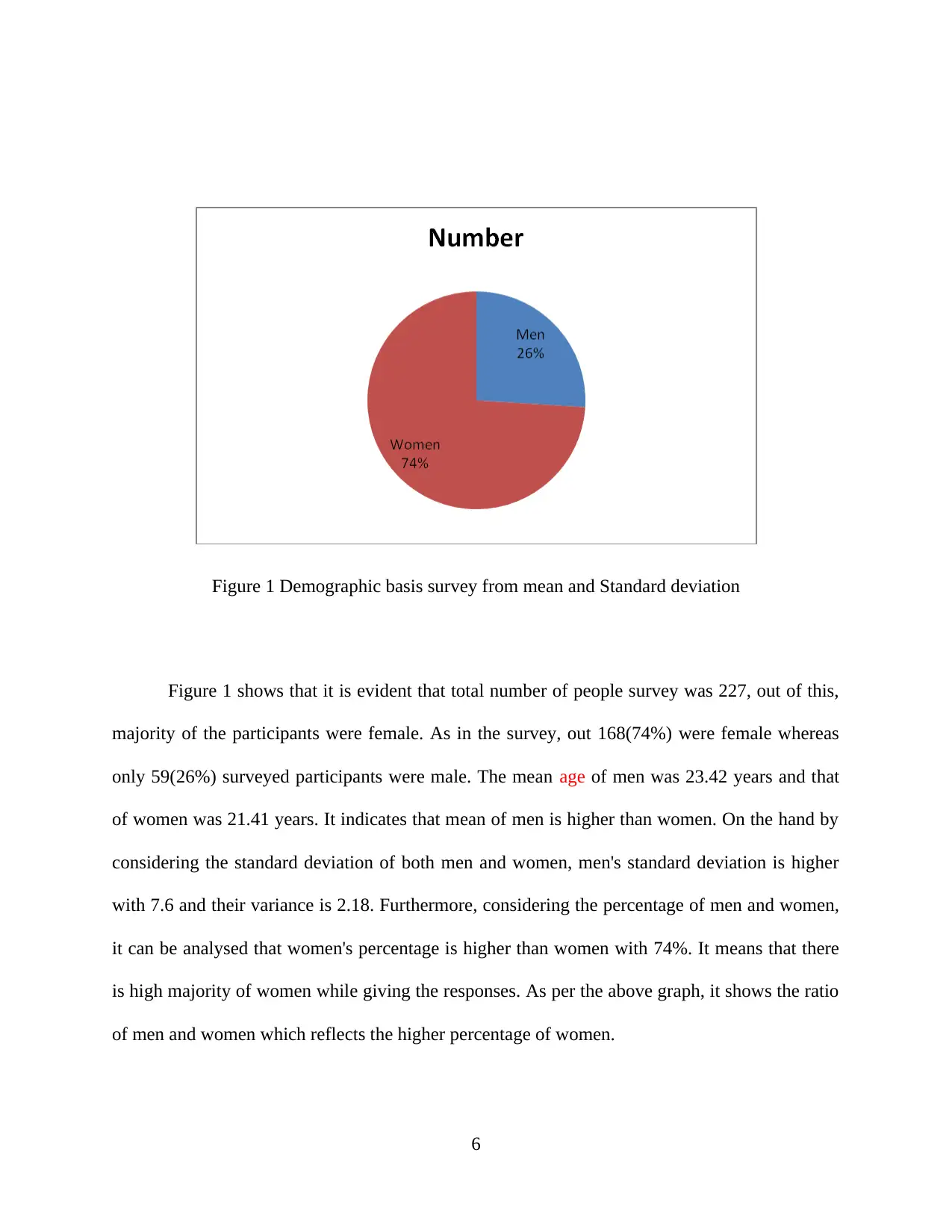
Figure 1 Demographic basis survey from mean and Standard deviation
Figure 1 shows that it is evident that total number of people survey was 227, out of this,
majority of the participants were female. As in the survey, out 168(74%) were female whereas
only 59(26%) surveyed participants were male. The mean age of men was 23.42 years and that
of women was 21.41 years. It indicates that mean of men is higher than women. On the hand by
considering the standard deviation of both men and women, men's standard deviation is higher
with 7.6 and their variance is 2.18. Furthermore, considering the percentage of men and women,
it can be analysed that women's percentage is higher than women with 74%. It means that there
is high majority of women while giving the responses. As per the above graph, it shows the ratio
of men and women which reflects the higher percentage of women.
6
Figure 1 shows that it is evident that total number of people survey was 227, out of this,
majority of the participants were female. As in the survey, out 168(74%) were female whereas
only 59(26%) surveyed participants were male. The mean age of men was 23.42 years and that
of women was 21.41 years. It indicates that mean of men is higher than women. On the hand by
considering the standard deviation of both men and women, men's standard deviation is higher
with 7.6 and their variance is 2.18. Furthermore, considering the percentage of men and women,
it can be analysed that women's percentage is higher than women with 74%. It means that there
is high majority of women while giving the responses. As per the above graph, it shows the ratio
of men and women which reflects the higher percentage of women.
6
Paraphrase This Document
Need a fresh take? Get an instant paraphrase of this document with our AI Paraphraser
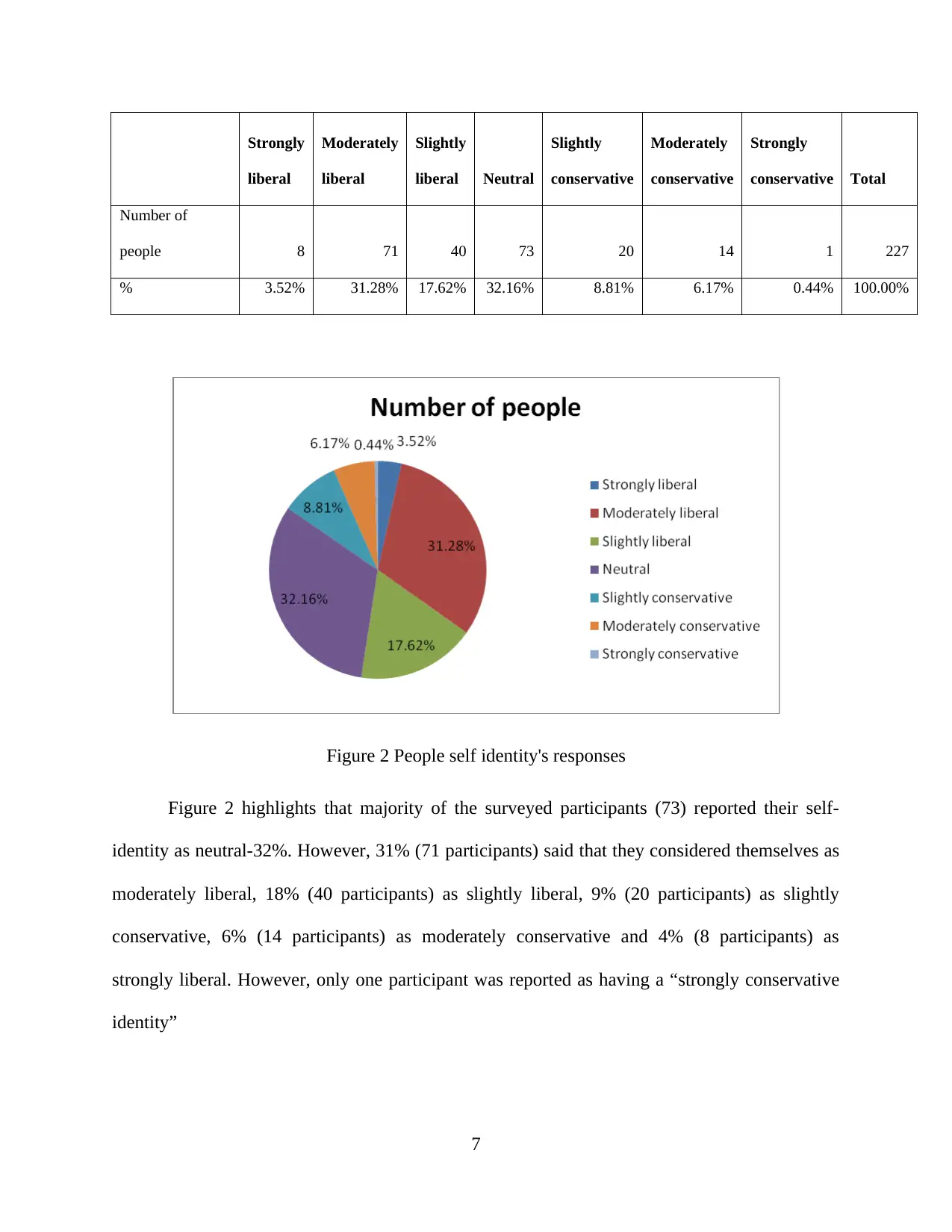
Strongly
liberal
Moderately
liberal
Slightly
liberal Neutral
Slightly
conservative
Moderately
conservative
Strongly
conservative Total
Number of
people 8 71 40 73 20 14 1 227
% 3.52% 31.28% 17.62% 32.16% 8.81% 6.17% 0.44% 100.00%
Figure 2 People self identity's responses
Figure 2 highlights that majority of the surveyed participants (73) reported their self-
identity as neutral-32%. However, 31% (71 participants) said that they considered themselves as
moderately liberal, 18% (40 participants) as slightly liberal, 9% (20 participants) as slightly
conservative, 6% (14 participants) as moderately conservative and 4% (8 participants) as
strongly liberal. However, only one participant was reported as having a “strongly conservative
identity”
7
liberal
Moderately
liberal
Slightly
liberal Neutral
Slightly
conservative
Moderately
conservative
Strongly
conservative Total
Number of
people 8 71 40 73 20 14 1 227
% 3.52% 31.28% 17.62% 32.16% 8.81% 6.17% 0.44% 100.00%
Figure 2 People self identity's responses
Figure 2 highlights that majority of the surveyed participants (73) reported their self-
identity as neutral-32%. However, 31% (71 participants) said that they considered themselves as
moderately liberal, 18% (40 participants) as slightly liberal, 9% (20 participants) as slightly
conservative, 6% (14 participants) as moderately conservative and 4% (8 participants) as
strongly liberal. However, only one participant was reported as having a “strongly conservative
identity”
7
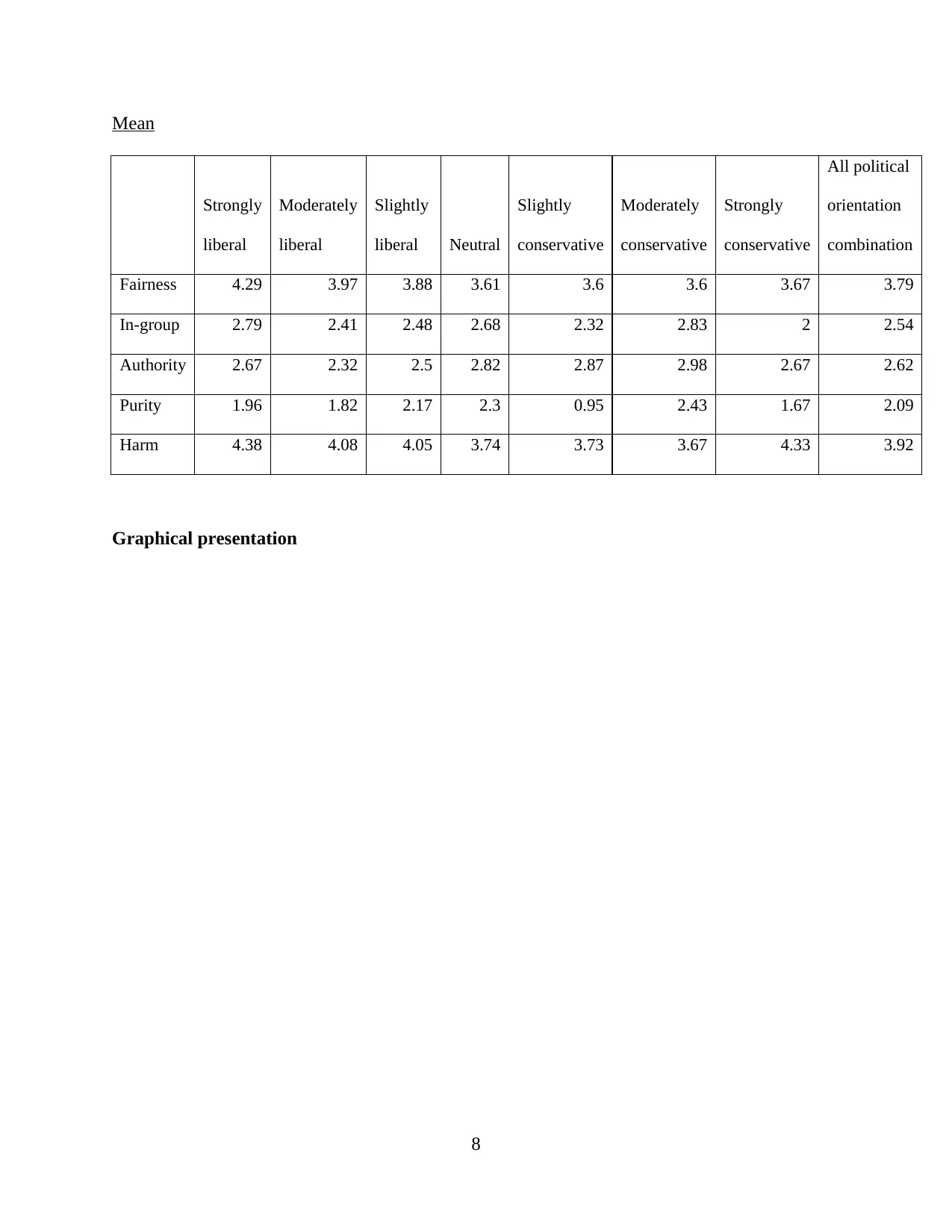
Mean
Strongly
liberal
Moderately
liberal
Slightly
liberal Neutral
Slightly
conservative
Moderately
conservative
Strongly
conservative
All political
orientation
combination
Fairness 4.29 3.97 3.88 3.61 3.6 3.6 3.67 3.79
In-group 2.79 2.41 2.48 2.68 2.32 2.83 2 2.54
Authority 2.67 2.32 2.5 2.82 2.87 2.98 2.67 2.62
Purity 1.96 1.82 2.17 2.3 0.95 2.43 1.67 2.09
Harm 4.38 4.08 4.05 3.74 3.73 3.67 4.33 3.92
Graphical presentation
8
Strongly
liberal
Moderately
liberal
Slightly
liberal Neutral
Slightly
conservative
Moderately
conservative
Strongly
conservative
All political
orientation
combination
Fairness 4.29 3.97 3.88 3.61 3.6 3.6 3.67 3.79
In-group 2.79 2.41 2.48 2.68 2.32 2.83 2 2.54
Authority 2.67 2.32 2.5 2.82 2.87 2.98 2.67 2.62
Purity 1.96 1.82 2.17 2.3 0.95 2.43 1.67 2.09
Harm 4.38 4.08 4.05 3.74 3.73 3.67 4.33 3.92
Graphical presentation
8
⊘ This is a preview!⊘
Do you want full access?
Subscribe today to unlock all pages.
Trusted by 1+ million students worldwide

1 out of 20


Related Documents


Your All-in-One AI-Powered Toolkit for Academic Success.
+13062052269
info@desklib.com
Available 24*7 on WhatsApp / Email
![[object Object]](/_next/static/media/star-bottom.7253800d.svg)
Unlock your academic potential
Copyright © 2020–2026 A2Z Services. All Rights Reserved. Developed and managed by ZUCOL.