Analyzing Constitutional Choices for New Democracies Essay

Verified

Added on  2023/06/09

|4
|537
|97
Essay
AI Summary
This essay provides a comprehensive analysis of Arend Lijphart's arguments regarding constitutional choices for new democracies, focusing on the crucial decisions between proportional representation and plurality elections, as well as presidential and parliamentary forms of governance. It highlights Lijphart's agreement with Horowitz's emphasis on the importance of electoral systems in democratic constitutional design. The essay discusses the advantages and disadvantages of both PR and plurality, parliamentarism and presidentialism, referencing countries like the USA, the UK, and those in Latin America and Europe to illustrate different systems in practice. It further examines the factors influencing the adoption of PR, such as ethnic and religious diversity, and concludes that a Parliamentary PR system is more suitable for countries with ethnic diversity and growing economies due to its emphasis on broad consensus.
Document Page
Running Head: POLITICAL SCIENCE ESSAY
Political Science Essay
Name of the Student
Name of the University
Author Note
tabler-icon-diamond-filled.svg

Paraphrase This Document

Need a fresh take? Get an instant paraphrase of this document with our AI Paraphraser
Document Page
1POLITICAL SCIENCE ESSAY
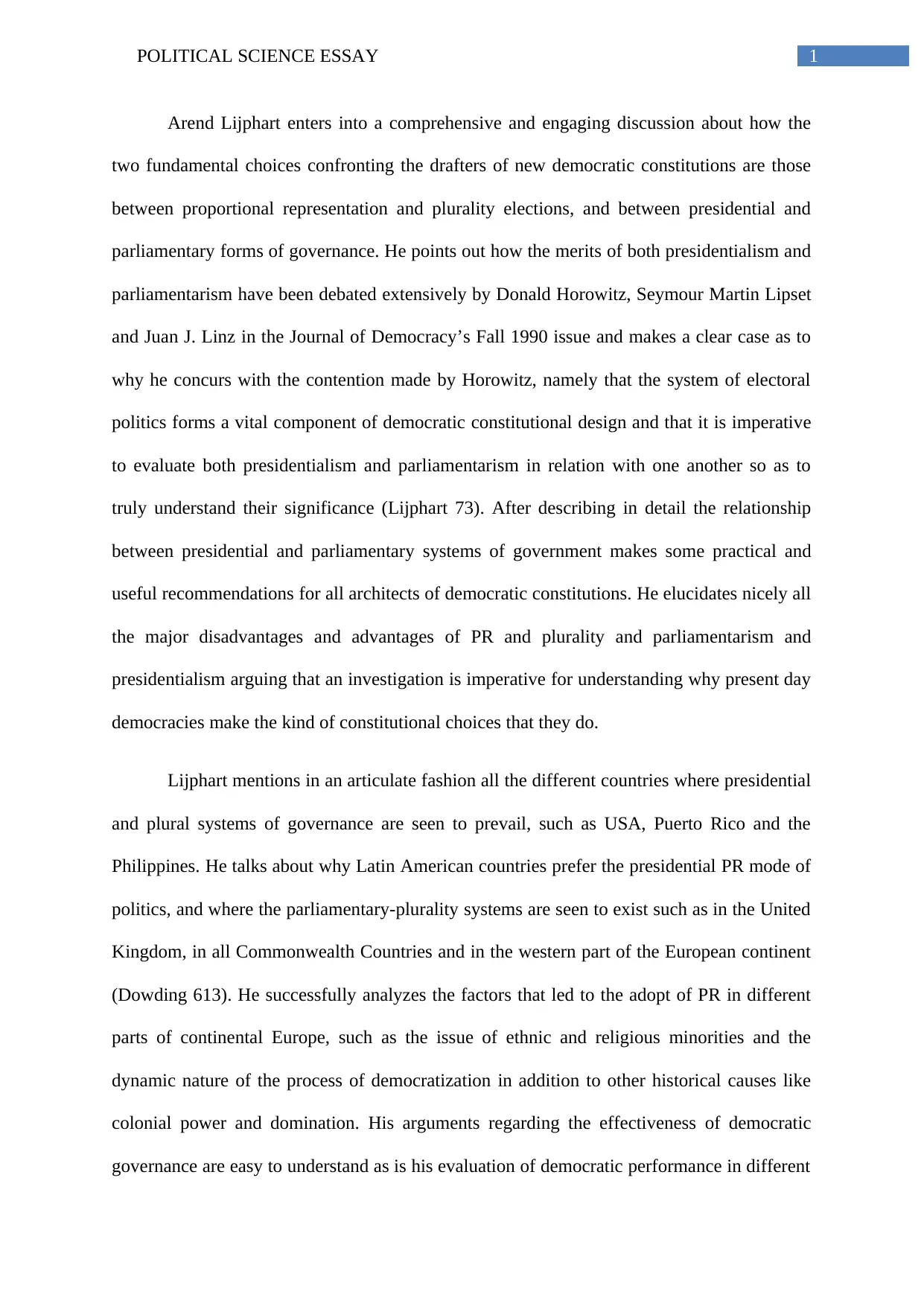
Arend Lijphart enters into a comprehensive and engaging discussion about how the
two fundamental choices confronting the drafters of new democratic constitutions are those
between proportional representation and plurality elections, and between presidential and
parliamentary forms of governance. He points out how the merits of both presidentialism and
parliamentarism have been debated extensively by Donald Horowitz, Seymour Martin Lipset
and Juan J. Linz in the Journal of Democracy’s Fall 1990 issue and makes a clear case as to
why he concurs with the contention made by Horowitz, namely that the system of electoral
politics forms a vital component of democratic constitutional design and that it is imperative
to evaluate both presidentialism and parliamentarism in relation with one another so as to
truly understand their significance (Lijphart 73). After describing in detail the relationship
between presidential and parliamentary systems of government makes some practical and
useful recommendations for all architects of democratic constitutions. He elucidates nicely all
the major disadvantages and advantages of PR and plurality and parliamentarism and
presidentialism arguing that an investigation is imperative for understanding why present day
democracies make the kind of constitutional choices that they do.
Lijphart mentions in an articulate fashion all the different countries where presidential
and plural systems of governance are seen to prevail, such as USA, Puerto Rico and the
Philippines. He talks about why Latin American countries prefer the presidential PR mode of
politics, and where the parliamentary-plurality systems are seen to exist such as in the United
Kingdom, in all Commonwealth Countries and in the western part of the European continent
(Dowding 613). He successfully analyzes the factors that led to the adopt of PR in different
parts of continental Europe, such as the issue of ethnic and religious minorities and the
dynamic nature of the process of democratization in addition to other historical causes like
colonial power and domination. His arguments regarding the effectiveness of democratic
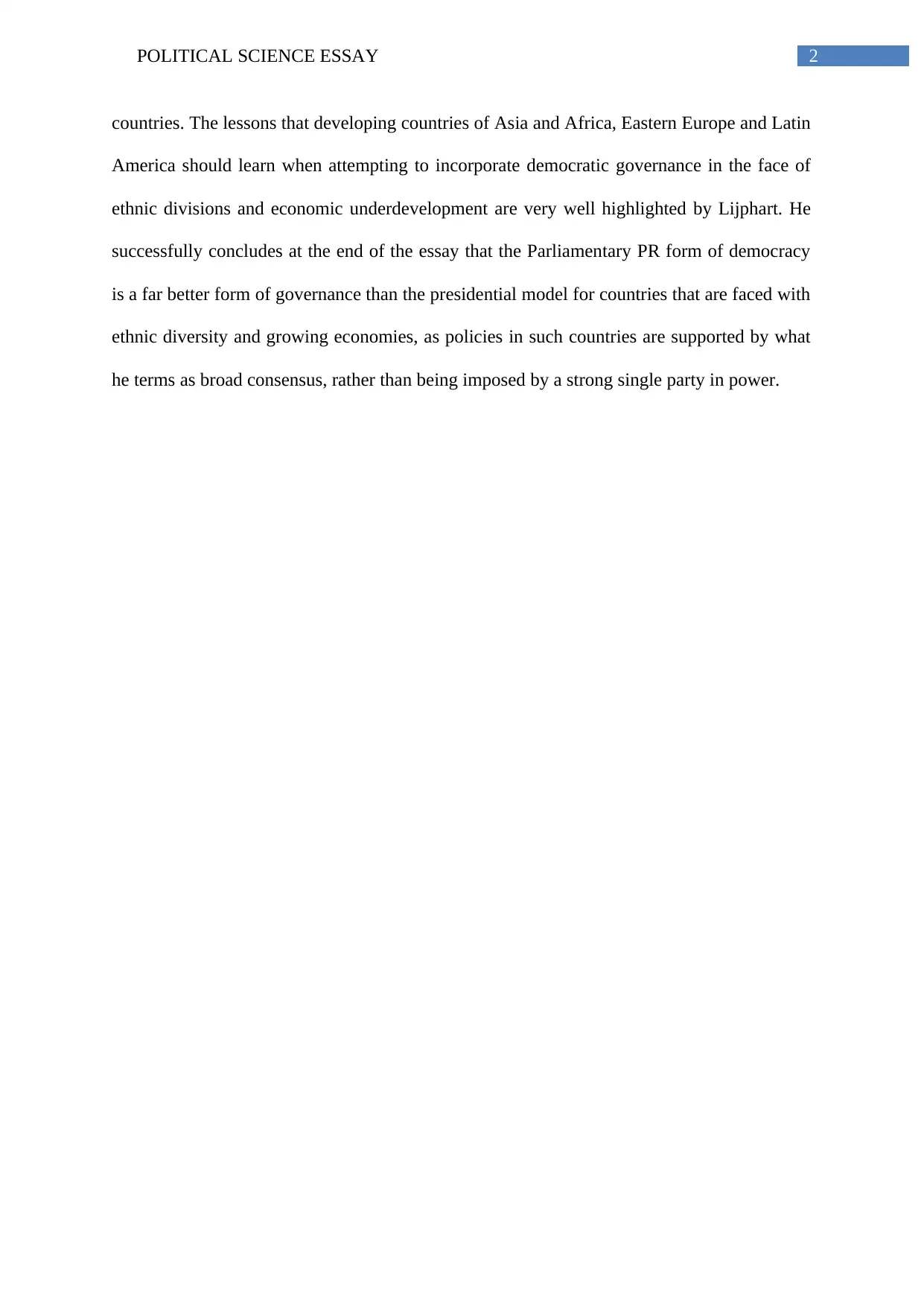
governance are easy to understand as is his evaluation of democratic performance in different
Document Page
2POLITICAL SCIENCE ESSAY
countries. The lessons that developing countries of Asia and Africa, Eastern Europe and Latin
America should learn when attempting to incorporate democratic governance in the face of
ethnic divisions and economic underdevelopment are very well highlighted by Lijphart. He
successfully concludes at the end of the essay that the Parliamentary PR form of democracy
is a far better form of governance than the presidential model for countries that are faced with
ethnic diversity and growing economies, as policies in such countries are supported by what
he terms as broad consensus, rather than being imposed by a strong single party in power.
Document Page
3POLITICAL SCIENCE ESSAY
References
Dowding, Keith. "The prime ministerialisation of the British prime minister." Parliamentary
Affairs 66.3 (2013): 617-635.
Lijphart, Arend. "Constitutional choices for new democracies." Journal of democracy 2.1
(1991): 72-84.
chevron_up_icon
1 out of 4
circle_padding
hide_on_mobile
zoom_out_icon
[object Object]