Political Science Assignment: Human Rights and Feminism Analysis
VerifiedAdded on 2022/12/14
|7
|1948
|253
Homework Assignment
AI Summary
This assignment delves into the multifaceted realm of human rights, commencing with an exploration of the three generations of rights: civil and political, socio-economic, and collective rights. It elucidates the key differences among these generations, focusing on their negative or positive obligations, individual or collective nature, and national or international liabilities. The assignment then critically examines the counter-arguments against the subordination of socio-economic rights to civil and political rights, emphasizing the evolving recognition and importance of both sets of rights. Finally, it provides a concise overview of the main arguments of feminism, underscoring its commitment to gender equality and the critique of social and political relations, including discussions on the binary gender constructs and the core beliefs of feminists. The assignment is well-researched and includes relevant references to support its arguments.

Short response to 3 questions
Paraphrase This Document
Need a fresh take? Get an instant paraphrase of this document with our AI Paraphraser

TABLE OF CONTENTS
QUESTION 1..................................................................................................................................3
Three Generation of Human Rights.............................................................................................3
QUESTION 2..................................................................................................................................4
Counter-arguments on the “socio-economic rights are subordinate to political and civil rights”
.....................................................................................................................................................4
QUESTION 3..................................................................................................................................5
Main arguments of Feminism......................................................................................................5
REFERENCES................................................................................................................................7
QUESTION 1..................................................................................................................................3
Three Generation of Human Rights.............................................................................................3
QUESTION 2..................................................................................................................................4
Counter-arguments on the “socio-economic rights are subordinate to political and civil rights”
.....................................................................................................................................................4
QUESTION 3..................................................................................................................................5
Main arguments of Feminism......................................................................................................5
REFERENCES................................................................................................................................7

QUESTION 1
Three Generation of Human Rights
The concept of three generation of rights is basically offered by a Czech jurist, Karel
Vasak in 1979, which embraced the whole spectrum of human rights. This notion became the
most comprehensive, practical and commonly used categorization of the human rights. This
helps in improving the conversations about the rights especially in terms of the role played by
government in human rights and the legislations imposed by the government. There are major
differences between all the three generations of human rights. The difference in these generations
can be based on three major points which are negative or positive, individual or collective and
national or international liability (Accordini and et.al., 2018).
The first generation of human rights deals in the political and civil rights of the individual. The
history of this generation focuses on accenting liberty and includes the milestone documents
such as the US Bill of Rights and the Declaration of Rights of Citizens and Man. These rights
include the freedom of speech, equality before the law, freedom of religion, right to life, right to
fair trial etc. These rights of first generation can be divided into sub-categories. The first sub
category deals in the civil and physical security which involves not committing acts of slavery,
torture or treating the people inhumanely. On the other hand, the second sub category is related
to the empowerments and the civil political liberties which include the right to political
participation and freedom of religion. These rights lay emphasis on the rights of individual
person and mainly focus on the human rights conversations in the western countries. The rights
in this generation are negative, individual and national.
The second generation of the human rights lays emphasis on the socio-economic rights and
can also be divided into sub categories. The first category focuses on the norms which fulfils the
basic needs such as healthcare and nutrition while on the other hand the second category focuses
on the fulfilment of economic needs such as the sufficient standards of living and fair wages.
These are based on the terms to establish the equal conditions. These also focus on the individual
and national liability. The first and second generation rights are differentiated in terms of the
responsibility they place on the government (Harley, Yoshie and Gentile, 2021). On one hand,
the first generation rights become the negative obligation in which the fulfilling of rights is not
3
Three Generation of Human Rights
The concept of three generation of rights is basically offered by a Czech jurist, Karel
Vasak in 1979, which embraced the whole spectrum of human rights. This notion became the
most comprehensive, practical and commonly used categorization of the human rights. This
helps in improving the conversations about the rights especially in terms of the role played by
government in human rights and the legislations imposed by the government. There are major
differences between all the three generations of human rights. The difference in these generations
can be based on three major points which are negative or positive, individual or collective and
national or international liability (Accordini and et.al., 2018).
The first generation of human rights deals in the political and civil rights of the individual. The
history of this generation focuses on accenting liberty and includes the milestone documents
such as the US Bill of Rights and the Declaration of Rights of Citizens and Man. These rights
include the freedom of speech, equality before the law, freedom of religion, right to life, right to
fair trial etc. These rights of first generation can be divided into sub-categories. The first sub
category deals in the civil and physical security which involves not committing acts of slavery,
torture or treating the people inhumanely. On the other hand, the second sub category is related
to the empowerments and the civil political liberties which include the right to political
participation and freedom of religion. These rights lay emphasis on the rights of individual
person and mainly focus on the human rights conversations in the western countries. The rights
in this generation are negative, individual and national.
The second generation of the human rights lays emphasis on the socio-economic rights and
can also be divided into sub categories. The first category focuses on the norms which fulfils the
basic needs such as healthcare and nutrition while on the other hand the second category focuses
on the fulfilment of economic needs such as the sufficient standards of living and fair wages.
These are based on the terms to establish the equal conditions. These also focus on the individual
and national liability. The first and second generation rights are differentiated in terms of the
responsibility they place on the government (Harley, Yoshie and Gentile, 2021). On one hand,
the first generation rights become the negative obligation in which the fulfilling of rights is not
3
⊘ This is a preview!⊘
Do you want full access?
Subscribe today to unlock all pages.

Trusted by 1+ million students worldwide

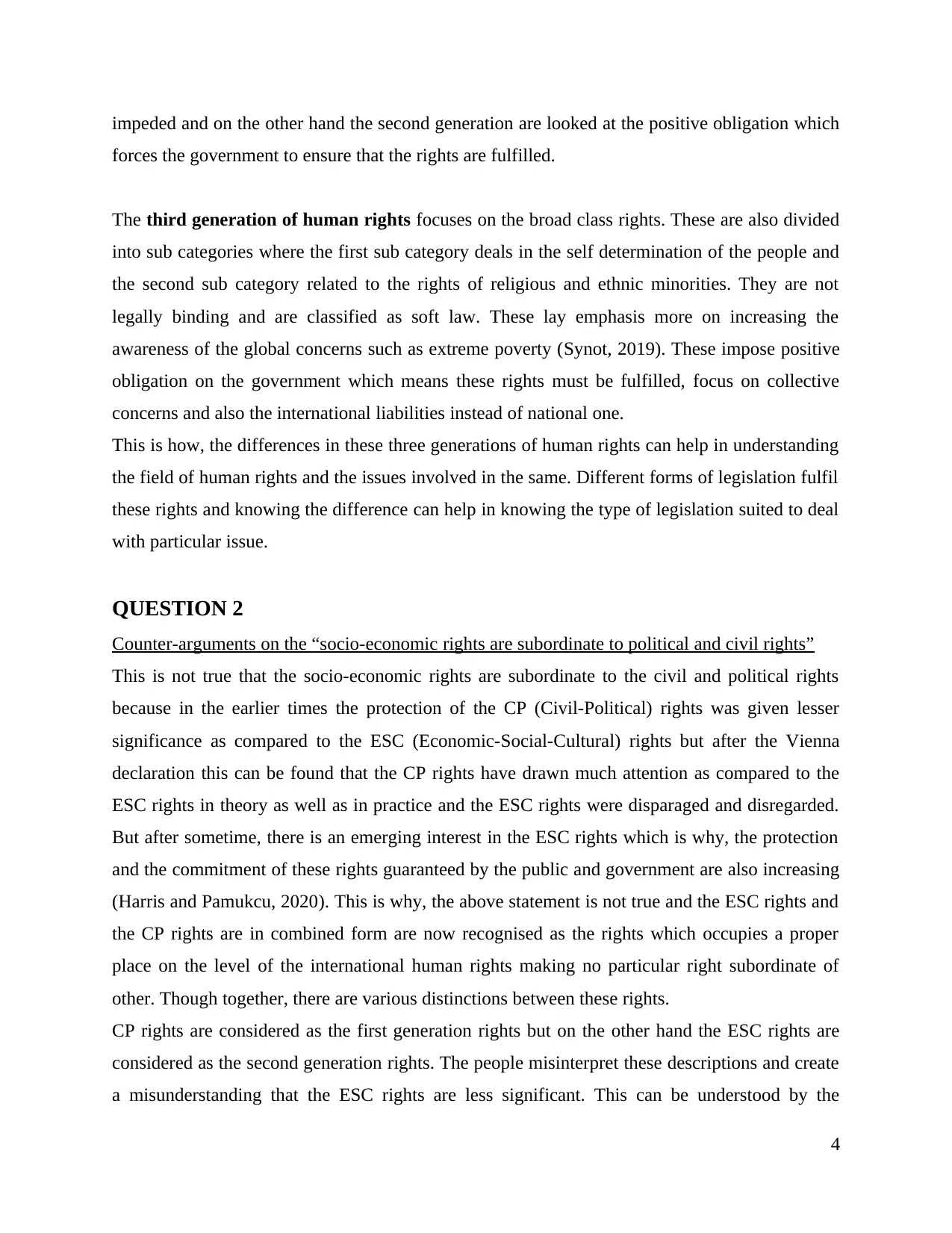
impeded and on the other hand the second generation are looked at the positive obligation which
forces the government to ensure that the rights are fulfilled.
The third generation of human rights focuses on the broad class rights. These are also divided
into sub categories where the first sub category deals in the self determination of the people and
the second sub category related to the rights of religious and ethnic minorities. They are not
legally binding and are classified as soft law. These lay emphasis more on increasing the
awareness of the global concerns such as extreme poverty (Synot, 2019). These impose positive
obligation on the government which means these rights must be fulfilled, focus on collective
concerns and also the international liabilities instead of national one.
This is how, the differences in these three generations of human rights can help in understanding
the field of human rights and the issues involved in the same. Different forms of legislation fulfil
these rights and knowing the difference can help in knowing the type of legislation suited to deal
with particular issue.
QUESTION 2
Counter-arguments on the “socio-economic rights are subordinate to political and civil rights”
This is not true that the socio-economic rights are subordinate to the civil and political rights
because in the earlier times the protection of the CP (Civil-Political) rights was given lesser
significance as compared to the ESC (Economic-Social-Cultural) rights but after the Vienna
declaration this can be found that the CP rights have drawn much attention as compared to the
ESC rights in theory as well as in practice and the ESC rights were disparaged and disregarded.
But after sometime, there is an emerging interest in the ESC rights which is why, the protection
and the commitment of these rights guaranteed by the public and government are also increasing
(Harris and Pamukcu, 2020). This is why, the above statement is not true and the ESC rights and
the CP rights are in combined form are now recognised as the rights which occupies a proper
place on the level of the international human rights making no particular right subordinate of
other. Though together, there are various distinctions between these rights.
CP rights are considered as the first generation rights but on the other hand the ESC rights are
considered as the second generation rights. The people misinterpret these descriptions and create
a misunderstanding that the ESC rights are less significant. This can be understood by the
4
forces the government to ensure that the rights are fulfilled.
The third generation of human rights focuses on the broad class rights. These are also divided
into sub categories where the first sub category deals in the self determination of the people and
the second sub category related to the rights of religious and ethnic minorities. They are not
legally binding and are classified as soft law. These lay emphasis more on increasing the
awareness of the global concerns such as extreme poverty (Synot, 2019). These impose positive
obligation on the government which means these rights must be fulfilled, focus on collective
concerns and also the international liabilities instead of national one.
This is how, the differences in these three generations of human rights can help in understanding
the field of human rights and the issues involved in the same. Different forms of legislation fulfil
these rights and knowing the difference can help in knowing the type of legislation suited to deal
with particular issue.
QUESTION 2
Counter-arguments on the “socio-economic rights are subordinate to political and civil rights”
This is not true that the socio-economic rights are subordinate to the civil and political rights
because in the earlier times the protection of the CP (Civil-Political) rights was given lesser
significance as compared to the ESC (Economic-Social-Cultural) rights but after the Vienna
declaration this can be found that the CP rights have drawn much attention as compared to the
ESC rights in theory as well as in practice and the ESC rights were disparaged and disregarded.
But after sometime, there is an emerging interest in the ESC rights which is why, the protection
and the commitment of these rights guaranteed by the public and government are also increasing
(Harris and Pamukcu, 2020). This is why, the above statement is not true and the ESC rights and
the CP rights are in combined form are now recognised as the rights which occupies a proper
place on the level of the international human rights making no particular right subordinate of
other. Though together, there are various distinctions between these rights.
CP rights are considered as the first generation rights but on the other hand the ESC rights are
considered as the second generation rights. The people misinterpret these descriptions and create
a misunderstanding that the ESC rights are less significant. This can be understood by the
4
Paraphrase This Document
Need a fresh take? Get an instant paraphrase of this document with our AI Paraphraser

example that the example of CP right is the right to life which is absolute while the example of
ESC rights is the right to education which is concerned about the quality of one life. This
basically depends on the covenants and their views for example the CP rights are conveyed by
ICCPR while the ESC rights are conveyed by ICESCR. The ICCPER states that the ESC rights
are depended on the CP rights as CP rights are more urgent and direct so the actions in the case
of CP rights must be taken urgently while in the case of ESC must be taken gradually (Nasir,
Dimyati and Absori, 2020). There were many arguments for considering the CP rights as
absolute and ESC rights as progressive. This is because if there is a breach of CP right the victim
can be determined easily while it becomes difficult in case of infringement of ESC right. This is
argued that the two covenants are the reason behind this notion and considering one more
important than the other. But later the scholars and the publishers stressed on the equality of both
type of rights. Therefore, much criticism is seen by General Assembly for creating two different
covenants for both the sets of rights (Černič, 2018). The international law must be introduced for
combining both the sets of rights under one.
QUESTION 3
Main arguments of Feminism
Feminism is considered as the belief in economic, political and social equality of the
genders or sexes. Feminism is mainly committed to response to the restriction for rights and
interests of women. The theory of feminism also aims for understanding the gender equality and
also lays emphasis on the power relations, gender politics and sexuality. When the critique is
done on the political and social relations, the feminist theories also deals in promoting the
women’s interests and rights. Being a feminist is not only a political fight but also a political
belief (Felski, 2020). The goal of the feminist is to engage and educate the people and convince
them for the political, social and economical equality is valid and must be logically grounded in
the experiential evidence and statistics.
The obvious and violent manifestations of inequality can be seen in the women’s clothes,
school textbooks, pay for work, unpaid labour and many more. These arguments which are
against the feminism also resort to the female-male binary which excludes the transgender and
the gender-fluid persons. This was the argument that when the males and females are not
biologically same then how they can be considered equal. This can be considered that the
5
ESC rights is the right to education which is concerned about the quality of one life. This
basically depends on the covenants and their views for example the CP rights are conveyed by
ICCPR while the ESC rights are conveyed by ICESCR. The ICCPER states that the ESC rights
are depended on the CP rights as CP rights are more urgent and direct so the actions in the case
of CP rights must be taken urgently while in the case of ESC must be taken gradually (Nasir,
Dimyati and Absori, 2020). There were many arguments for considering the CP rights as
absolute and ESC rights as progressive. This is because if there is a breach of CP right the victim
can be determined easily while it becomes difficult in case of infringement of ESC right. This is
argued that the two covenants are the reason behind this notion and considering one more
important than the other. But later the scholars and the publishers stressed on the equality of both
type of rights. Therefore, much criticism is seen by General Assembly for creating two different
covenants for both the sets of rights (Černič, 2018). The international law must be introduced for
combining both the sets of rights under one.
QUESTION 3
Main arguments of Feminism
Feminism is considered as the belief in economic, political and social equality of the
genders or sexes. Feminism is mainly committed to response to the restriction for rights and
interests of women. The theory of feminism also aims for understanding the gender equality and
also lays emphasis on the power relations, gender politics and sexuality. When the critique is
done on the political and social relations, the feminist theories also deals in promoting the
women’s interests and rights. Being a feminist is not only a political fight but also a political
belief (Felski, 2020). The goal of the feminist is to engage and educate the people and convince
them for the political, social and economical equality is valid and must be logically grounded in
the experiential evidence and statistics.
The obvious and violent manifestations of inequality can be seen in the women’s clothes,
school textbooks, pay for work, unpaid labour and many more. These arguments which are
against the feminism also resort to the female-male binary which excludes the transgender and
the gender-fluid persons. This was the argument that when the males and females are not
biologically same then how they can be considered equal. This can be considered that the
5

females and males are alike in terms of cognitive ability, leadership potential and personality.
This difference is due to the socialization instead of genetic coding. On the other hand, this was
also analysed that the men are more creative than the women because they do not look for
socially acceptable solutions.
The counter to this argument is that the men are stronger than women. Men can carry out
the tasks which cannot be carried by women. The physical strength possessed by men and
women is different because men has fast-twitch muscles which helps in performing activities like
moving heavy objects and lifting while on the other hand the muscles of women are slow-twitch
which provides them the strength of endurance for performing assembly line jobs (Golding,
2021).
This was also observed that men are less likely to express their emotions which increases
the suicide rates in men whereas the women seek more support for problems related to mental
health. This is also observed that the feminists are not the haters of men or they are campaigning
for the giving special treatment to women instead they are striving hard to provide equal rights to
women as compared to men. This can also be analysed that all the feminists are not same they do
not always believe in the same things (Jordan, 2018). Men are also seen as feminists supporting
equal opportunities and rights for everyone. Feminists not only benefits the women but all the
people as the males also need not to handle the social pressures and will also get the same
privileges.
6
This difference is due to the socialization instead of genetic coding. On the other hand, this was
also analysed that the men are more creative than the women because they do not look for
socially acceptable solutions.
The counter to this argument is that the men are stronger than women. Men can carry out
the tasks which cannot be carried by women. The physical strength possessed by men and
women is different because men has fast-twitch muscles which helps in performing activities like
moving heavy objects and lifting while on the other hand the muscles of women are slow-twitch
which provides them the strength of endurance for performing assembly line jobs (Golding,
2021).
This was also observed that men are less likely to express their emotions which increases
the suicide rates in men whereas the women seek more support for problems related to mental
health. This is also observed that the feminists are not the haters of men or they are campaigning
for the giving special treatment to women instead they are striving hard to provide equal rights to
women as compared to men. This can also be analysed that all the feminists are not same they do
not always believe in the same things (Jordan, 2018). Men are also seen as feminists supporting
equal opportunities and rights for everyone. Feminists not only benefits the women but all the
people as the males also need not to handle the social pressures and will also get the same
privileges.
6
⊘ This is a preview!⊘
Do you want full access?
Subscribe today to unlock all pages.

Trusted by 1+ million students worldwide

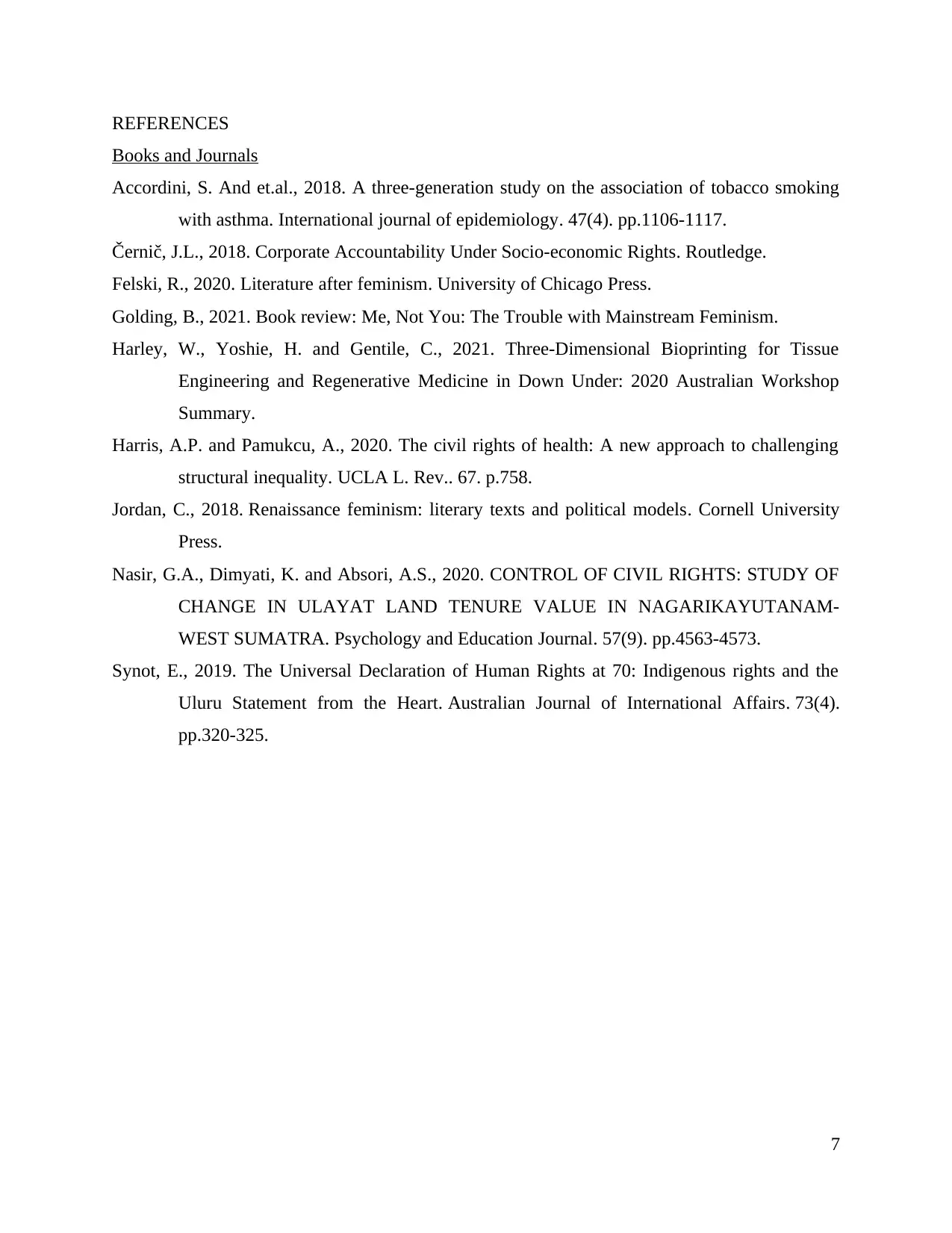
REFERENCES
Books and Journals
Accordini, S. And et.al., 2018. A three-generation study on the association of tobacco smoking
with asthma. International journal of epidemiology. 47(4). pp.1106-1117.
Černič, J.L., 2018. Corporate Accountability Under Socio-economic Rights. Routledge.
Felski, R., 2020. Literature after feminism. University of Chicago Press.
Golding, B., 2021. Book review: Me, Not You: The Trouble with Mainstream Feminism.
Harley, W., Yoshie, H. and Gentile, C., 2021. Three-Dimensional Bioprinting for Tissue
Engineering and Regenerative Medicine in Down Under: 2020 Australian Workshop
Summary.
Harris, A.P. and Pamukcu, A., 2020. The civil rights of health: A new approach to challenging
structural inequality. UCLA L. Rev.. 67. p.758.
Jordan, C., 2018. Renaissance feminism: literary texts and political models. Cornell University
Press.
Nasir, G.A., Dimyati, K. and Absori, A.S., 2020. CONTROL OF CIVIL RIGHTS: STUDY OF
CHANGE IN ULAYAT LAND TENURE VALUE IN NAGARIKAYUTANAM-
WEST SUMATRA. Psychology and Education Journal. 57(9). pp.4563-4573.
Synot, E., 2019. The Universal Declaration of Human Rights at 70: Indigenous rights and the
Uluru Statement from the Heart. Australian Journal of International Affairs. 73(4).
pp.320-325.
7
Books and Journals
Accordini, S. And et.al., 2018. A three-generation study on the association of tobacco smoking
with asthma. International journal of epidemiology. 47(4). pp.1106-1117.
Černič, J.L., 2018. Corporate Accountability Under Socio-economic Rights. Routledge.
Felski, R., 2020. Literature after feminism. University of Chicago Press.
Golding, B., 2021. Book review: Me, Not You: The Trouble with Mainstream Feminism.
Harley, W., Yoshie, H. and Gentile, C., 2021. Three-Dimensional Bioprinting for Tissue
Engineering and Regenerative Medicine in Down Under: 2020 Australian Workshop
Summary.
Harris, A.P. and Pamukcu, A., 2020. The civil rights of health: A new approach to challenging
structural inequality. UCLA L. Rev.. 67. p.758.
Jordan, C., 2018. Renaissance feminism: literary texts and political models. Cornell University
Press.
Nasir, G.A., Dimyati, K. and Absori, A.S., 2020. CONTROL OF CIVIL RIGHTS: STUDY OF
CHANGE IN ULAYAT LAND TENURE VALUE IN NAGARIKAYUTANAM-
WEST SUMATRA. Psychology and Education Journal. 57(9). pp.4563-4573.
Synot, E., 2019. The Universal Declaration of Human Rights at 70: Indigenous rights and the
Uluru Statement from the Heart. Australian Journal of International Affairs. 73(4).
pp.320-325.
7
1 out of 7
Related Documents
Your All-in-One AI-Powered Toolkit for Academic Success.
+13062052269
info@desklib.com
Available 24*7 on WhatsApp / Email
Unlock your academic potential
Copyright © 2020–2026 A2Z Services. All Rights Reserved. Developed and managed by ZUCOL.