Moral Foundations Theory: Political Orientation in Australia

Verified

Added on  2023/05/29

|6
|1278
|262
Report
AI Summary
This psychology report explores the applicability of Moral Foundations Theory in Australia, examining the relationship between political orientation (liberal vs. conservative) and moral relevance. It hypothesizes that liberals will rate all moral foundations equally, while conservatives will exhibit a hierarchical ranking. The report defines Moral Foundations Theory, outlining its core components: Care, Fairness, Authority, Loyalty, Purity, and Liberty. It references North American studies that establish a strong link between political orientation and moral foundations, questioning whether the same pattern exists in Australia. The research design involves participants from diverse political backgrounds, aiming to determine if moral relevance differs based on political affiliation. The report concludes with an initial list of references formatted in APA style.

Document Page
Psychology
Psychology
Name
Professor
Course
Date
tabler-icon-diamond-filled.svg

Paraphrase This Document

Need a fresh take? Get an instant paraphrase of this document with our AI Paraphraser
Document Page
Psychology
Introduction
North America studies find a very strong relationship between absolute political
orientation where someone lies on conservative-liberal spectrum and a moral foundation. The
research question to address by this report is whether or not this statement holds in Australia and
if moral relevance as measured by behavioral statements questionnaires differs as a function of a
participant’s political orientation.
Hypothesis
This research is quite cynical in nature and based on the empirical data yet to be analyzed the
following are some assumptions about the Australian people based on the moral foundation
theory that are yet to be proven by the data and information to be obtained from this research.
a) First and foremost it is presumed that based on persons with liberal political orientations,
reach foundation will be rated equally (Maxwell & Narvaez, 2013). This is so because we
do believe that each foundation plays a very crucial rule in the case of a person having a
liberal political orientation. This has been evident in many instances that such research
has been conducted and it is assumed that the same case holds for people in Australia.
b) For individuals having a conservative political orientation it is presumed that that each
foundation will not be rated as equally relevant but rather there will be some kind of
ranking that follows the order of importance of each foundation. This would be so
because literally, conservative political orientation is more dynamic in nature and it
encompasses a much broader view and/or perspective as far as the foundations are
concerned compared to a liberal political orientation (Jansson & Dorrepaal, 2015).
Basically, what is meant here is that the foundations would be rated differently and the
Document Page
Psychology
rating will follow a specific order which will be the same for each individual. This would
be so because previous researches conducted have shown that individuals with
conservative political orientations are hard to deal with and rating each of these
foundations in an order of increasing importance might be a solution.
First and foremost, it is important that we understand each and every term that encompass
our research question. Moral foundation theory is the key aspect of this research question. The
moral foundation theory is a social psychological theory explicitly explains the origin and also
variations in human fundamental moral reasoning on the basis of crucial modular foundations
(Nilsson & Erlandsson, 2013).The group of cultural psychologists that created this theory
includes Jonathan Haidt, Jesse Graham and Richard Shweder. Their main goal towards
developing this theory was try and understand how and why morality varies so much across
different cultures and at the same times still showing significant amount of similarities and
recurrent themes.
There are certain foundations that comprise of the moral foundation theory.
Understanding each foundation is very important towards getting to know what moral foundation
theory is all about. These theories are outlined below;
Care-According to the theory, this refers to the intimate desire and urge to protect one’s own
people be it children or siblings from harm. According to modern redevelopment of the theory,
however, the concept of care has been expanded and it now includes even the desire to protect
anyone who is found at the bottom of the social ladder.
Document Page
Psychology
Fairness-This aspect is quite open and can have different meanings and interpretation depending
on the individuals interpreting it. It’s, however, more concerned about justice, social justice. It
can be portrayed in a number of ways such as having equal opportunities.
Authority-This is more related to having some kind of hierarchy in the overall social orientation.
Having someone who is in charge for the betterment of the entire society. Someone who will be
calling the shots if need be.
Loyalty-This relates to commitment towards a certain social aspect or thought and being
completely bound to it.
Purity-Purity here has been used to refer to that evolutionary drive that exists within an
individual that makes them avoid things and behaviors that are contagious in nature. It is
important to note that purity is this case is usually more related to social issues (Maxwell &
Narvaez, 2013).
Liberty-In this context liberty refers to the desire to create and be free from any form of external
form.
Moral foundation theory revolves around understanding these differences and thus
relating to the diverse political polarism that exists and is greatly eating up our society.
Having understood what the moral foundation is and what it entails, there are two groups of
people with different political orientations that would be involved and these are the liberals and
conservatives. Different persons from these two political spectrums have totally different moral
judgments regarding on the matter of interest (Haidt & Joseph, 2011).
tabler-icon-diamond-filled.svg

Paraphrase This Document

Need a fresh take? Get an instant paraphrase of this document with our AI Paraphraser
Document Page
Psychology
North America studies find a very strong relationship between absolute political
orientation where someone lies on conservative-liberal spectrum and a moral foundation; this has
been proven beyond doubt by previous studies conducted. There are quite a number of studies
that have been conducted by various scholars and academicians as far as this issue is concerned
and the results indicate that there is a very deep relationship that actually exists between these
two aspects. As a matter of fact, there exists a direct relationship between these two aspects.
In the case of Australia which is the aim of this research a connection is yet to be determined that
connects between these two aspects in accordance to the moral foundation theory. The research
will include a number of participants from multiple political fronts and different geographical
backgrounds. The participants will be randomly chosen without a prior confirmation of their
political front. It is assumed that this will greatly help avoid any bias in the case of the research
(Graham & Haidt, 2012).
Document Page
Psychology
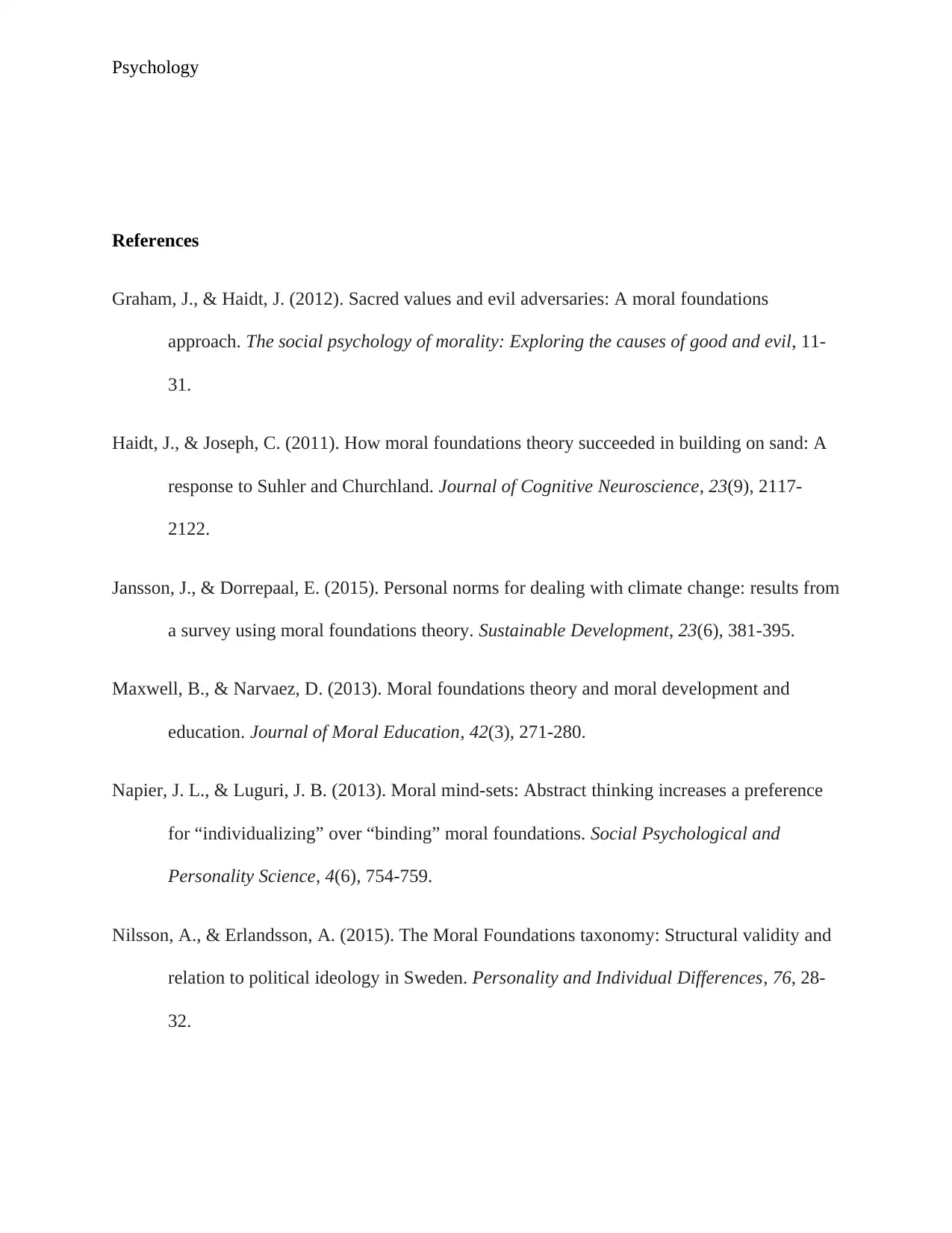
References
Graham, J., & Haidt, J. (2012). Sacred values and evil adversaries: A moral foundations
approach. The social psychology of morality: Exploring the causes of good and evil, 11-
31.
Haidt, J., & Joseph, C. (2011). How moral foundations theory succeeded in building on sand: A
response to Suhler and Churchland. Journal of Cognitive Neuroscience, 23(9), 2117-
2122.
Jansson, J., & Dorrepaal, E. (2015). Personal norms for dealing with climate change: results from
a survey using moral foundations theory. Sustainable Development, 23(6), 381-395.
Maxwell, B., & Narvaez, D. (2013). Moral foundations theory and moral development and
education. Journal of Moral Education, 42(3), 271-280.
Napier, J. L., & Luguri, J. B. (2013). Moral mind-sets: Abstract thinking increases a preference
for “individualizing” over “binding” moral foundations. Social Psychological and
Personality Science, 4(6), 754-759.
Nilsson, A., & Erlandsson, A. (2015). The Moral Foundations taxonomy: Structural validity and
relation to political ideology in Sweden. Personality and Individual Differences, 76, 28-
32.
chevron_up_icon
1 out of 6
circle_padding
hide_on_mobile
zoom_out_icon
[object Object]