Politics, Racism, and Higher Education: A Critical Analysis
VerifiedAdded on 2022/08/08
|7
|1556
|326
Essay
AI Summary
This essay critically examines the intricate relationship between politics and racism within the framework of higher education in the United States. It explores how socioeconomic biases and discriminatory practices contribute to a distorted educational system, particularly affecting marginalized groups. The analysis draws upon the works of Sanford and Michelle, highlighting the impact of political influence, racial discrimination, and the role of liberal arts in shaping the educational landscape. The essay investigates how the political framework and economic conditions contribute to biased educational systems, leading to the non-acceptance of juvenile learners for higher education. It further discusses how the corrupted discrimination still prevails in the educational system despite the importance of diversity and values.
Running Head: POLITICS & RACISM IN HIGHER EDUCATION
POLITICS & RACISM IN HIGHER EDUCATION
Name of the Student:
Name of the University:
Author Note:
POLITICS & RACISM IN HIGHER EDUCATION
Name of the Student:
Name of the University:
Author Note:
Paraphrase This Document
Need a fresh take? Get an instant paraphrase of this document with our AI Paraphraser

1POLITICS & RACISM IN HIGHER EDUCATION
Introduction
Higher Education in United States of America is a big component with political features
embedded in it with the social and economic conditions like income class and the family size.
How can an education system be biased under the theme of racial discrimination? Is the
education only a by-product of political framework?
Thus, the paper aims to synthesize how corruption has dominated the educational
infrastructure through the racial biasness and slavery of other communities. The paper focuses on
how these factors affect the students and their learning inadequacies with respect to the nation
functioning and learning structure of economy through the readings of Sanford’s ‘The New
Liberal Arts’ and Michelle’s ‘The New Jim Crow-Mass Incarceration in the Age of
Colorblindness”.
Discussion
Socio-economic biasness leads to a distorted education system. Sanford holds the
opinion that “We cannot assign different socio-economic groups to different levels or different
types of education” how diverse groups from different cultures are not meant to collaborate and
study in the same universities. This is a highly political issue of keeping the immigrant and
lower-economic classes detached from the higher education. Michelle confronts it by stating that
“The most comprehensive studies of racial bias in the exercise of prosecutorial and judicial
discretion involve the treatment of juveniles by portraying the factor of how the biased treatment
among the juveniles make them suffer from pursuing higher education. Thus, the acceptance of
black people in universities of USA and mostly belonging from the juvenile group are not
entertained in the educational degree attainment.
Introduction
Higher Education in United States of America is a big component with political features
embedded in it with the social and economic conditions like income class and the family size.
How can an education system be biased under the theme of racial discrimination? Is the
education only a by-product of political framework?
Thus, the paper aims to synthesize how corruption has dominated the educational
infrastructure through the racial biasness and slavery of other communities. The paper focuses on
how these factors affect the students and their learning inadequacies with respect to the nation
functioning and learning structure of economy through the readings of Sanford’s ‘The New
Liberal Arts’ and Michelle’s ‘The New Jim Crow-Mass Incarceration in the Age of
Colorblindness”.
Discussion
Socio-economic biasness leads to a distorted education system. Sanford holds the
opinion that “We cannot assign different socio-economic groups to different levels or different
types of education” how diverse groups from different cultures are not meant to collaborate and
study in the same universities. This is a highly political issue of keeping the immigrant and
lower-economic classes detached from the higher education. Michelle confronts it by stating that
“The most comprehensive studies of racial bias in the exercise of prosecutorial and judicial
discretion involve the treatment of juveniles by portraying the factor of how the biased treatment
among the juveniles make them suffer from pursuing higher education. Thus, the acceptance of
black people in universities of USA and mostly belonging from the juvenile group are not
entertained in the educational degree attainment.

2POLITICS & RACISM IN HIGHER EDUCATION
The worth of education system in USA is a low priority. According to Michelle “The
young men who go to prison rather than college face a lifetime of closed doors, discrimination,
and ostracism” in the sense that these young minds are restricted to pursue their career education
and this plight is not communicated to the public through media. This is agreed upon by Sanford
also stating “The best way to understand genuine national priorities is to follow the money, and
by that standard, education is really not at all that important to this country”. He believes that
the American system of education does not take into account the educational structure decisions
in serious terms but only concerned about high quality national output. These racial caste system,
I feel it is a normal phenomenon where the young students trapped in their cages for skin-color
are not vocalized and taken as an important consideration to focus on by the American
Government.
The liberal education in career holds power in shaping the nation. According to
Sanford “This is a country where a mixed-race child raised overseas by a struggling single
mother who confronts impossible odds can grow up to be a president. It is precisely liberal
education that allowed him to catch up and move on”. He feels that American society is much
open to the mixed races and communities in terms of choosing its democratic leader. However,
to become a leader and rule the nation, liberal education make an individual perfect for this role,
stressing the importance of philosophies and liberal values being dominant to politics. Michelle
shares his opinion against such fact by stating that “Throughout the criminal justice system, as
well as in our schools and public spaces, young + black + male is equated with reasonable
suspicion… thousands of African Americans every year, as well as their exclusion from
The worth of education system in USA is a low priority. According to Michelle “The
young men who go to prison rather than college face a lifetime of closed doors, discrimination,
and ostracism” in the sense that these young minds are restricted to pursue their career education
and this plight is not communicated to the public through media. This is agreed upon by Sanford
also stating “The best way to understand genuine national priorities is to follow the money, and
by that standard, education is really not at all that important to this country”. He believes that
the American system of education does not take into account the educational structure decisions
in serious terms but only concerned about high quality national output. These racial caste system,
I feel it is a normal phenomenon where the young students trapped in their cages for skin-color
are not vocalized and taken as an important consideration to focus on by the American
Government.
The liberal education in career holds power in shaping the nation. According to
Sanford “This is a country where a mixed-race child raised overseas by a struggling single
mother who confronts impossible odds can grow up to be a president. It is precisely liberal
education that allowed him to catch up and move on”. He feels that American society is much
open to the mixed races and communities in terms of choosing its democratic leader. However,
to become a leader and rule the nation, liberal education make an individual perfect for this role,
stressing the importance of philosophies and liberal values being dominant to politics. Michelle
shares his opinion against such fact by stating that “Throughout the criminal justice system, as
well as in our schools and public spaces, young + black + male is equated with reasonable
suspicion… thousands of African Americans every year, as well as their exclusion from
⊘ This is a preview!⊘
Do you want full access?
Subscribe today to unlock all pages.

Trusted by 1+ million students worldwide

3POLITICS & RACISM IN HIGHER EDUCATION
employment and housing and the denial of educational opportunity”. The nation prefers mixed
race in the democratic power but fails to accommodate the young black males by providing them
housing and employment needs. The mixed race and liberalism is bounded by the specific races
holding political power-sharing value like China and Asia countries. Thus, the liberal education
is not enough to shape the nation. An open education system with affordability of opportunities
to lower races and migrants.
Discriminatory policies in educational institutions make a huge proportion of black
youth suffer. Michelle highlighted the fact that “Because black youth are viewed as criminals,
they face severe employment discrimination and are also “pushed out” of schools through
racially biased school discipline policies”. This is a very general practise by the white professors
with staff making the students suffer and torture through harsh punishments due to belonging to
a different race and prone to slavery. Nevertheless, the above statement is not supported by
Sanford commenting that “Through immersion in liberal arts, students learn not just to make a
living, but also to live a life rich in values and character. They come on terms of complexity and
diversity…” which is although not wrong but quite a controversy in the political structure of
America. He believes pursuing liberal arts being a diverse field will make the students and the
staff collaborate in leaning moral values and development of a good character. I feel that liberal
arts education alone cannot groom an individual’s character and build the moral values. The
educational policies and the national overview of educational base restrict the diversity in terms
of slavery classes. The moral values do not apply to them consorting to discrimination beyond
values.
Diversity in race and classes hold the growth of higher education and national peace
in America. According to Stanford’s viewpoint “We should respect what everyone brings to the
employment and housing and the denial of educational opportunity”. The nation prefers mixed
race in the democratic power but fails to accommodate the young black males by providing them
housing and employment needs. The mixed race and liberalism is bounded by the specific races
holding political power-sharing value like China and Asia countries. Thus, the liberal education
is not enough to shape the nation. An open education system with affordability of opportunities
to lower races and migrants.
Discriminatory policies in educational institutions make a huge proportion of black
youth suffer. Michelle highlighted the fact that “Because black youth are viewed as criminals,
they face severe employment discrimination and are also “pushed out” of schools through
racially biased school discipline policies”. This is a very general practise by the white professors
with staff making the students suffer and torture through harsh punishments due to belonging to
a different race and prone to slavery. Nevertheless, the above statement is not supported by
Sanford commenting that “Through immersion in liberal arts, students learn not just to make a
living, but also to live a life rich in values and character. They come on terms of complexity and
diversity…” which is although not wrong but quite a controversy in the political structure of
America. He believes pursuing liberal arts being a diverse field will make the students and the
staff collaborate in leaning moral values and development of a good character. I feel that liberal
arts education alone cannot groom an individual’s character and build the moral values. The
educational policies and the national overview of educational base restrict the diversity in terms
of slavery classes. The moral values do not apply to them consorting to discrimination beyond
values.
Diversity in race and classes hold the growth of higher education and national peace
in America. According to Stanford’s viewpoint “We should respect what everyone brings to the
Paraphrase This Document
Need a fresh take? Get an instant paraphrase of this document with our AI Paraphraser

4POLITICS & RACISM IN HIGHER EDUCATION
table and train the broadest possible cross section of the American society to participate in, and
help shape, civil discourse”. The open channels of accommodation and acceptance of diverse
races of the youth from all groups and communities will bring the nation in inter-cultural civil
power attainment. The various groups gathered will promote the socio-economic status of the
nation with better provisions for the high prestigious universities to produce quality minds.
Michelle holds his counter viewpoint “To begin with, the argument implies that African
Americans prefer harsh criminal justice policies to other forms of governmental intervention,
such as job creation, economic development, educational reform…” stating that the diverse
culture accommodation comes as a political motive to fight for the power attainment with other
nations. The youth belonging to the black community are not given fair accommodation with
unequal justice in the form of bondage and slavery with no educational, job and living
conditions. I feel that although American society accept diversity in the collaboration
programmes, the home education system does not allow the complete freedom to the black race
to afford education. They are punished and kept out of all the benefits through unfair distribution
of rights in the nation.
Conclusion
In conclusion, the political framework with the economic conditions contribute to the
biased educational system in United States of America. This racial biasness with the juvenile
group of young learners facing non-acceptance for higher education created a discriminated
admission system in the universities. While coming across Michelle’s readings, we find that the
racism is a huge issue to provide educational rights in America. Sanford although state that
liberal education through diversity and values can transform the system yet the corrupted
discrimination still prevails in the educational system.
table and train the broadest possible cross section of the American society to participate in, and
help shape, civil discourse”. The open channels of accommodation and acceptance of diverse
races of the youth from all groups and communities will bring the nation in inter-cultural civil
power attainment. The various groups gathered will promote the socio-economic status of the
nation with better provisions for the high prestigious universities to produce quality minds.
Michelle holds his counter viewpoint “To begin with, the argument implies that African
Americans prefer harsh criminal justice policies to other forms of governmental intervention,
such as job creation, economic development, educational reform…” stating that the diverse
culture accommodation comes as a political motive to fight for the power attainment with other
nations. The youth belonging to the black community are not given fair accommodation with
unequal justice in the form of bondage and slavery with no educational, job and living
conditions. I feel that although American society accept diversity in the collaboration
programmes, the home education system does not allow the complete freedom to the black race
to afford education. They are punished and kept out of all the benefits through unfair distribution
of rights in the nation.
Conclusion
In conclusion, the political framework with the economic conditions contribute to the
biased educational system in United States of America. This racial biasness with the juvenile
group of young learners facing non-acceptance for higher education created a discriminated
admission system in the universities. While coming across Michelle’s readings, we find that the
racism is a huge issue to provide educational rights in America. Sanford although state that
liberal education through diversity and values can transform the system yet the corrupted
discrimination still prevails in the educational system.

5POLITICS & RACISM IN HIGHER EDUCATION
⊘ This is a preview!⊘
Do you want full access?
Subscribe today to unlock all pages.

Trusted by 1+ million students worldwide

6POLITICS & RACISM IN HIGHER EDUCATION
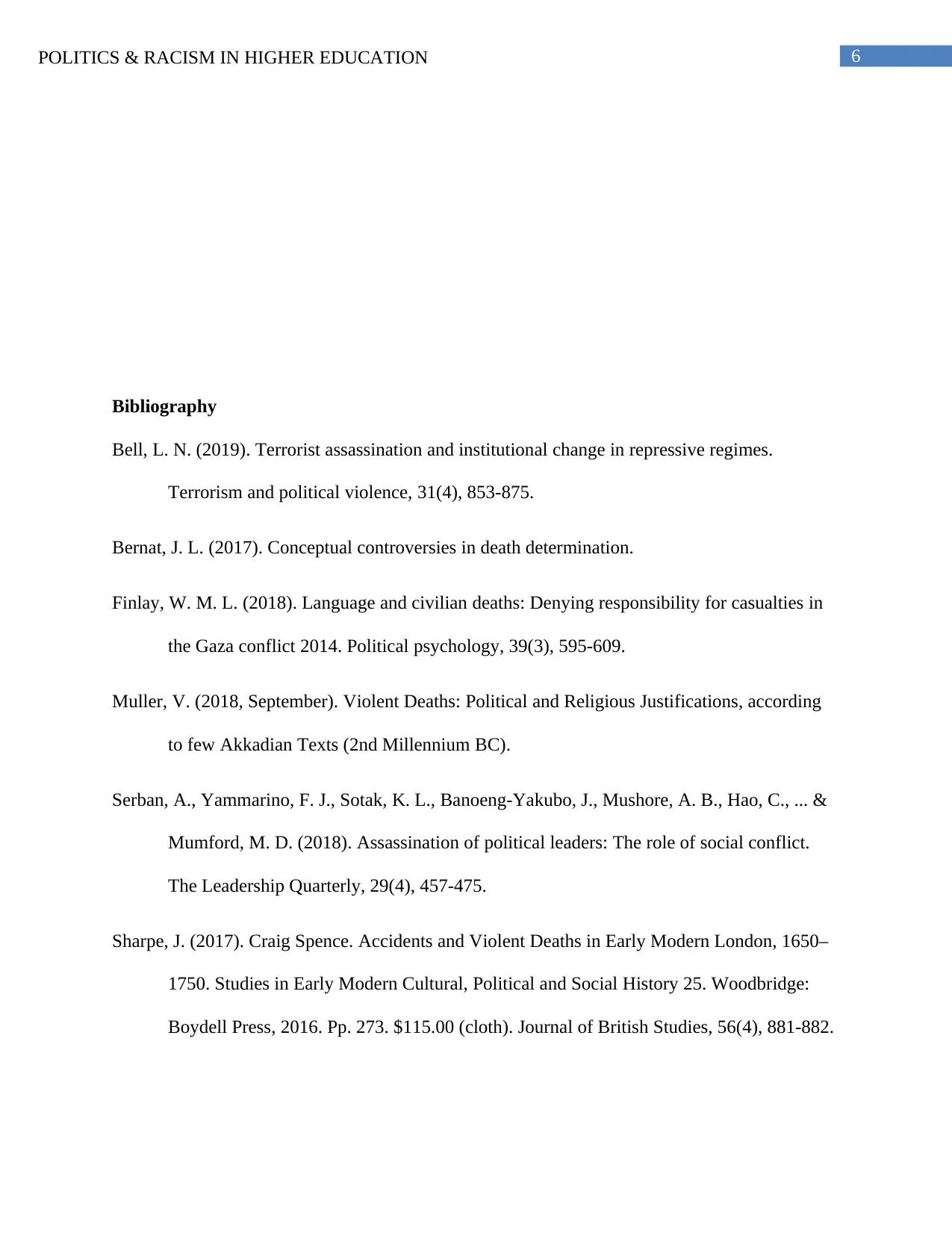
Bibliography
Bell, L. N. (2019). Terrorist assassination and institutional change in repressive regimes.
Terrorism and political violence, 31(4), 853-875.
Bernat, J. L. (2017). Conceptual controversies in death determination.
Finlay, W. M. L. (2018). Language and civilian deaths: Denying responsibility for casualties in
the Gaza conflict 2014. Political psychology, 39(3), 595-609.
Muller, V. (2018, September). Violent Deaths: Political and Religious Justifications, according
to few Akkadian Texts (2nd Millennium BC).
Serban, A., Yammarino, F. J., Sotak, K. L., Banoeng-Yakubo, J., Mushore, A. B., Hao, C., ... &
Mumford, M. D. (2018). Assassination of political leaders: The role of social conflict.
The Leadership Quarterly, 29(4), 457-475.
Sharpe, J. (2017). Craig Spence. Accidents and Violent Deaths in Early Modern London, 1650–
1750. Studies in Early Modern Cultural, Political and Social History 25. Woodbridge:
Boydell Press, 2016. Pp. 273. $115.00 (cloth). Journal of British Studies, 56(4), 881-882.
Bibliography
Bell, L. N. (2019). Terrorist assassination and institutional change in repressive regimes.
Terrorism and political violence, 31(4), 853-875.
Bernat, J. L. (2017). Conceptual controversies in death determination.
Finlay, W. M. L. (2018). Language and civilian deaths: Denying responsibility for casualties in
the Gaza conflict 2014. Political psychology, 39(3), 595-609.
Muller, V. (2018, September). Violent Deaths: Political and Religious Justifications, according
to few Akkadian Texts (2nd Millennium BC).
Serban, A., Yammarino, F. J., Sotak, K. L., Banoeng-Yakubo, J., Mushore, A. B., Hao, C., ... &
Mumford, M. D. (2018). Assassination of political leaders: The role of social conflict.
The Leadership Quarterly, 29(4), 457-475.
Sharpe, J. (2017). Craig Spence. Accidents and Violent Deaths in Early Modern London, 1650–
1750. Studies in Early Modern Cultural, Political and Social History 25. Woodbridge:
Boydell Press, 2016. Pp. 273. $115.00 (cloth). Journal of British Studies, 56(4), 881-882.
1 out of 7
Your All-in-One AI-Powered Toolkit for Academic Success.
+13062052269
info@desklib.com
Available 24*7 on WhatsApp / Email
Unlock your academic potential
Copyright © 2020–2026 A2Z Services. All Rights Reserved. Developed and managed by ZUCOL.