Arden University: Porsche Marketing Strategy Implementation Report
VerifiedAdded on 2022/12/09
|28
|6864
|470
Report
AI Summary
This report provides a comprehensive analysis of Porsche's marketing strategy, starting with an overview of the company and its history. It delves into Porsche's strategic audit, evaluating its current market position, positioning strategy, and differentiation strategy. The report examines corporate-level strategies, core competencies, and a value chain analysis to understand Porsche's internal operations. It critically evaluates Porsche's vision, values, ethics, and innovation capabilities, including its approach to original equipment manufacturing, e-performance, and corporate social responsibility. The report utilizes PESTLE and Porter's Five Forces analyses to assess the external environment, followed by a SWOT analysis and an application of the Ansoff Matrix to explore strategic growth options. The conclusion summarizes key findings and recommendations for Porsche's future strategic actions, emphasizing market penetration strategies.
Marketing-
Implementing
Strategy
Porsche
7 / 1 / 2 0 1 9
Implementing
Strategy
Porsche
7 / 1 / 2 0 1 9

Paraphrase This Document
Need a fresh take? Get an instant paraphrase of this document with our AI Paraphraser
IMPLEMENTING STRATEGY 1
Table of Contents
Introduction................................................................................................................................2
Overview of Porsche..............................................................................................................2
Strategic Audit and Evaluation of the current position of Porsche........................................3
Positioning Strategy...........................................................................................................4
Differentiation Strategy......................................................................................................5
Corporate Level Strategy...................................................................................................6
Core Competencies of Porsche..............................................................................................7
Value Chain Analysis of Porsche.......................................................................................7
Critical evaluation of Porsche................................................................................................9
Turnaround.......................................................................................................................10
Mission of Porsche...............................................................................................................11
Vision of Porsche.................................................................................................................11
Value of Porsche..................................................................................................................11
Ethics or Principle of Porsche..............................................................................................12
Capabilities of Porsche to Innovate......................................................................................12
Original Equipment Manufacturer/ Vehicle Development..............................................12
E-Performance..................................................................................................................13
CO2 Reduction.................................................................................................................13
Testing..............................................................................................................................13
Non-Automotive..............................................................................................................13
Corporate Social Responsibility of Porsche.........................................................................13
Further Actions for Porsche Necessary for Meeting its Corporate Social Responsibility
..........................................................................................................................................15
PESTLE Analysis.................................................................................................................16
Political Force..................................................................................................................16
Economic Force...............................................................................................................16
Social Force......................................................................................................................17
Technological Force.........................................................................................................17
Legal Force.......................................................................................................................18
Environmental Force........................................................................................................18
Porter Five Force Analysis...................................................................................................18
Table of Contents
Introduction................................................................................................................................2
Overview of Porsche..............................................................................................................2
Strategic Audit and Evaluation of the current position of Porsche........................................3
Positioning Strategy...........................................................................................................4
Differentiation Strategy......................................................................................................5
Corporate Level Strategy...................................................................................................6
Core Competencies of Porsche..............................................................................................7
Value Chain Analysis of Porsche.......................................................................................7
Critical evaluation of Porsche................................................................................................9
Turnaround.......................................................................................................................10
Mission of Porsche...............................................................................................................11
Vision of Porsche.................................................................................................................11
Value of Porsche..................................................................................................................11
Ethics or Principle of Porsche..............................................................................................12
Capabilities of Porsche to Innovate......................................................................................12
Original Equipment Manufacturer/ Vehicle Development..............................................12
E-Performance..................................................................................................................13
CO2 Reduction.................................................................................................................13
Testing..............................................................................................................................13
Non-Automotive..............................................................................................................13
Corporate Social Responsibility of Porsche.........................................................................13
Further Actions for Porsche Necessary for Meeting its Corporate Social Responsibility
..........................................................................................................................................15
PESTLE Analysis.................................................................................................................16
Political Force..................................................................................................................16
Economic Force...............................................................................................................16
Social Force......................................................................................................................17
Technological Force.........................................................................................................17
Legal Force.......................................................................................................................18
Environmental Force........................................................................................................18
Porter Five Force Analysis...................................................................................................18
IMPLEMENTING STRATEGY 2
The threat of New Entrant................................................................................................18
Threat of Substitute..........................................................................................................19
Power of Buyer................................................................................................................19
Power of Supplier.............................................................................................................19
The competitive rivalry among existing players..............................................................19
SWOT Analysis...................................................................................................................19
Strength............................................................................................................................19
Weaknesses......................................................................................................................20
Opportunities....................................................................................................................20
Threats..............................................................................................................................20
Ansoff Matrix.......................................................................................................................20
Market penetration...........................................................................................................21
Conclusion................................................................................................................................21
References................................................................................................................................22
The threat of New Entrant................................................................................................18
Threat of Substitute..........................................................................................................19
Power of Buyer................................................................................................................19
Power of Supplier.............................................................................................................19
The competitive rivalry among existing players..............................................................19
SWOT Analysis...................................................................................................................19
Strength............................................................................................................................19
Weaknesses......................................................................................................................20
Opportunities....................................................................................................................20
Threats..............................................................................................................................20
Ansoff Matrix.......................................................................................................................20
Market penetration...........................................................................................................21
Conclusion................................................................................................................................21
References................................................................................................................................22
⊘ This is a preview!⊘
Do you want full access?
Subscribe today to unlock all pages.

Trusted by 1+ million students worldwide
IMPLEMENTING STRATEGY 3
Introduction
Strategy implementation is the transformation of the selected strategy into the action of the
organization to attain the strategic objectives and goals. Strategy implementation is also
called as a way through which a business must create, utilize, and combine its control
systems, culture, and organizational structure to track strategies that could support in
attaining competitive advantage in the market and improved performance (Morgan, Katsikeas
and Vorhies, 2012). Organizational structure assigns task and roles to the employees and
explains how these roles and task could be correlated to increase, efficiency, quality, and
satisfaction of the customer which are considered as the pillars of competitive advantage.
However, the organizational structure is not enough to provide motivation to the employees
and the successful implementation of the strategy. There is a need for an organizational
control system too. This control system provides executives the motivational incentives for
the workforce and feedback on organizational and employees performance (Chang, 2016).
The organizational culture is the collection of attitudes, beliefs, norms, and values that are
commonly shared by the groups and members of the organization. The intent of this report is
to provide a detailed analysis of the current position of the Porsche in its external
environment with the use of different strategies adopted by the business to attain its market
position. The report has also critically evaluated the company’s vision, value, and ethics and
its capabilities to successfully innovate in the market. In addition to this, the report is
highlighting the current position of the company in relation to its corporate social
responsibility initiatives. In the end, the report evaluated the strategic options for the growth
of Porsche with the help of different marketing models.
Introduction
Strategy implementation is the transformation of the selected strategy into the action of the
organization to attain the strategic objectives and goals. Strategy implementation is also
called as a way through which a business must create, utilize, and combine its control
systems, culture, and organizational structure to track strategies that could support in
attaining competitive advantage in the market and improved performance (Morgan, Katsikeas
and Vorhies, 2012). Organizational structure assigns task and roles to the employees and
explains how these roles and task could be correlated to increase, efficiency, quality, and
satisfaction of the customer which are considered as the pillars of competitive advantage.
However, the organizational structure is not enough to provide motivation to the employees
and the successful implementation of the strategy. There is a need for an organizational
control system too. This control system provides executives the motivational incentives for
the workforce and feedback on organizational and employees performance (Chang, 2016).
The organizational culture is the collection of attitudes, beliefs, norms, and values that are
commonly shared by the groups and members of the organization. The intent of this report is
to provide a detailed analysis of the current position of the Porsche in its external
environment with the use of different strategies adopted by the business to attain its market
position. The report has also critically evaluated the company’s vision, value, and ethics and
its capabilities to successfully innovate in the market. In addition to this, the report is
highlighting the current position of the company in relation to its corporate social
responsibility initiatives. In the end, the report evaluated the strategic options for the growth
of Porsche with the help of different marketing models.
Paraphrase This Document
Need a fresh take? Get an instant paraphrase of this document with our AI Paraphraser
IMPLEMENTING STRATEGY 4
Overview of Porsche
Porsche is a well-known automobile brand of Germany which specializes in manufacturing
high-performance Sedans, SUVs, and Sports Car. Headquarter of Porsche AG is established
in Stuttgart. The company is owned by Volkswagen AG, which is majorly owned by the
Porsche Automobil Holdings SE. The current product portfolio of Porsche is comprised of
Cayenne, Panamera, \ 718 Boxster/Cayman, 911, and Macan. The company was founded in
the year 1931 by Ferdinand Porsche. In its initial phase, the company was involved in the
work of motor vehicle development and consulting and did not manufacture any cars under
its own brand. The very first assignment that the company received is from the government of
Germany for designing a car for the public that was a “Volkswagen”. This lead to the
designing of the Volkswagen Beetle, which is one of the most successful designs of the car of
all time. In fact, one of the cars that are the Porsche 64 was designed in the year 1939 with
the use of different features and components of the Beetle (Porsche, 2019g).
The design and engineering of Porsche are called as the hallmark of the competitive
advantage of the brand. With the support of its 100% wholly owned customer engineering
development, the engineering group of Porsche that is PEG, company has successfully
established its wide-ranging proficiency in the vehicle production and development
accessible to clients from different industries. PEG was measured as the ‘secret weapon, of
Porsche, as it allows the company to hire more engineers than if it worked alone, offered it an
advantage in product development (Porsche, 2019h).
Strategic Audit and Evaluation of the current position of Porsche
Porsche is considered as the most profitable car company in the world. It is a matter of
thought that how the company changed its way of looking in 50 years. The answer to this
though is how the management and engineering team of the Porsche adopted differentiation
and positioning strategy to establish the brand in the market in front of its rivals.
Overview of Porsche
Porsche is a well-known automobile brand of Germany which specializes in manufacturing
high-performance Sedans, SUVs, and Sports Car. Headquarter of Porsche AG is established
in Stuttgart. The company is owned by Volkswagen AG, which is majorly owned by the
Porsche Automobil Holdings SE. The current product portfolio of Porsche is comprised of
Cayenne, Panamera, \ 718 Boxster/Cayman, 911, and Macan. The company was founded in
the year 1931 by Ferdinand Porsche. In its initial phase, the company was involved in the
work of motor vehicle development and consulting and did not manufacture any cars under
its own brand. The very first assignment that the company received is from the government of
Germany for designing a car for the public that was a “Volkswagen”. This lead to the
designing of the Volkswagen Beetle, which is one of the most successful designs of the car of
all time. In fact, one of the cars that are the Porsche 64 was designed in the year 1939 with
the use of different features and components of the Beetle (Porsche, 2019g).
The design and engineering of Porsche are called as the hallmark of the competitive
advantage of the brand. With the support of its 100% wholly owned customer engineering
development, the engineering group of Porsche that is PEG, company has successfully
established its wide-ranging proficiency in the vehicle production and development
accessible to clients from different industries. PEG was measured as the ‘secret weapon, of
Porsche, as it allows the company to hire more engineers than if it worked alone, offered it an
advantage in product development (Porsche, 2019h).
Strategic Audit and Evaluation of the current position of Porsche
Porsche is considered as the most profitable car company in the world. It is a matter of
thought that how the company changed its way of looking in 50 years. The answer to this
though is how the management and engineering team of the Porsche adopted differentiation
and positioning strategy to establish the brand in the market in front of its rivals.
IMPLEMENTING STRATEGY 5
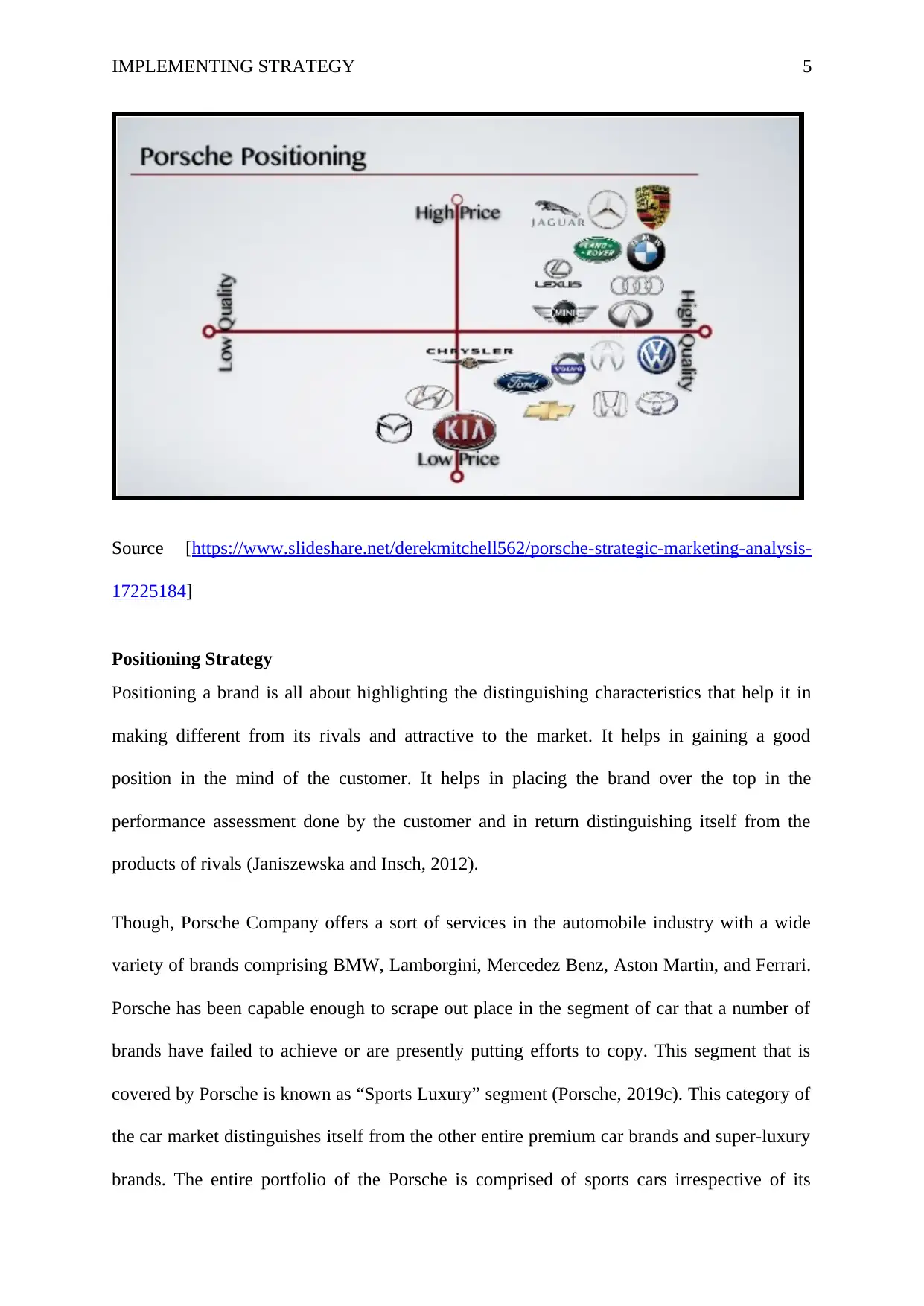
Source [https://www.slideshare.net/derekmitchell562/porsche-strategic-marketing-analysis-
17225184]
Positioning Strategy
Positioning a brand is all about highlighting the distinguishing characteristics that help it in
making different from its rivals and attractive to the market. It helps in gaining a good
position in the mind of the customer. It helps in placing the brand over the top in the
performance assessment done by the customer and in return distinguishing itself from the
products of rivals (Janiszewska and Insch, 2012).
Though, Porsche Company offers a sort of services in the automobile industry with a wide
variety of brands comprising BMW, Lamborgini, Mercedez Benz, Aston Martin, and Ferrari.
Porsche has been capable enough to scrape out place in the segment of car that a number of
brands have failed to achieve or are presently putting efforts to copy. This segment that is
covered by Porsche is known as “Sports Luxury” segment (Porsche, 2019c). This category of
the car market distinguishes itself from the other entire premium car brands and super-luxury
brands. The entire portfolio of the Porsche is comprised of sports cars irrespective of its
Source [https://www.slideshare.net/derekmitchell562/porsche-strategic-marketing-analysis-
17225184]
Positioning Strategy
Positioning a brand is all about highlighting the distinguishing characteristics that help it in
making different from its rivals and attractive to the market. It helps in gaining a good
position in the mind of the customer. It helps in placing the brand over the top in the
performance assessment done by the customer and in return distinguishing itself from the
products of rivals (Janiszewska and Insch, 2012).
Though, Porsche Company offers a sort of services in the automobile industry with a wide
variety of brands comprising BMW, Lamborgini, Mercedez Benz, Aston Martin, and Ferrari.
Porsche has been capable enough to scrape out place in the segment of car that a number of
brands have failed to achieve or are presently putting efforts to copy. This segment that is
covered by Porsche is known as “Sports Luxury” segment (Porsche, 2019c). This category of
the car market distinguishes itself from the other entire premium car brands and super-luxury
brands. The entire portfolio of the Porsche is comprised of sports cars irrespective of its
⊘ This is a preview!⊘
Do you want full access?
Subscribe today to unlock all pages.
Trusted by 1+ million students worldwide
IMPLEMENTING STRATEGY 6
design as well as the format which are framed with the aim to serve all the purpose of daily
life. The company gains the benefits of marketing which represent the brand as more than
luxury than BMW and Mercedes Benz. Porsche is also sportier than these luxury brands and
the major intention of the company behind its designing is to meet the purpose of being used
every day means such that it is called as the world’s most reliable sports car. The company
has successfully positioned itself in the market as the brand which could be derived daily to
work and thrash it around a track on weekends.
The factor of reliability distinguishes Porsche from other super-exotics cars that are highly
expensive and owns a reputation of not designed to be reliable. Porsche has initiated
manufacturing of sports car. The company has been successfully in the production in Le
Mans 24 Hour Endurance race and Porsche 911 is majorly utilized as the factory setup cars in
the series of racing across the world (Porsche Innovation, 2019).
Differentiation Strategy
The Porsche Company has also adopted the differentiation strategy under which it has
entered in the segment of sport luxury SUV. In this segment too, the company attained huge
success that has not just transformed the financial fortunes of the company but also has
manufactured more SUV in comparison to its sports cars. It has today become the fact that
the most iconic manufacturer of the sports car in the world not majorly sells SUV’s (Porsche,
2019i). This alteration in the activity of the brand has not led to a dilution of the sports car
brand. The company has been clever and hence they market their SUVs in the segment of
sports luxury which reflects that the company is still serving the same target audience as
before. Customers that Consumers that were unable to purchase the Porsche 911 because of
its shortcomings of the functions, but SUV offer customers a complete experience of the
vehicle that can be useful for the commuting and families.
design as well as the format which are framed with the aim to serve all the purpose of daily
life. The company gains the benefits of marketing which represent the brand as more than
luxury than BMW and Mercedes Benz. Porsche is also sportier than these luxury brands and
the major intention of the company behind its designing is to meet the purpose of being used
every day means such that it is called as the world’s most reliable sports car. The company
has successfully positioned itself in the market as the brand which could be derived daily to
work and thrash it around a track on weekends.
The factor of reliability distinguishes Porsche from other super-exotics cars that are highly
expensive and owns a reputation of not designed to be reliable. Porsche has initiated
manufacturing of sports car. The company has been successfully in the production in Le
Mans 24 Hour Endurance race and Porsche 911 is majorly utilized as the factory setup cars in
the series of racing across the world (Porsche Innovation, 2019).
Differentiation Strategy
The Porsche Company has also adopted the differentiation strategy under which it has
entered in the segment of sport luxury SUV. In this segment too, the company attained huge
success that has not just transformed the financial fortunes of the company but also has
manufactured more SUV in comparison to its sports cars. It has today become the fact that
the most iconic manufacturer of the sports car in the world not majorly sells SUV’s (Porsche,
2019i). This alteration in the activity of the brand has not led to a dilution of the sports car
brand. The company has been clever and hence they market their SUVs in the segment of
sports luxury which reflects that the company is still serving the same target audience as
before. Customers that Consumers that were unable to purchase the Porsche 911 because of
its shortcomings of the functions, but SUV offer customers a complete experience of the
vehicle that can be useful for the commuting and families.
Paraphrase This Document
Need a fresh take? Get an instant paraphrase of this document with our AI Paraphraser
IMPLEMENTING STRATEGY 7
Corporate Level Strategy
The above analysis highlights that Porsche is known in the market for offering cars in the
sports car segment including its SUVs. This has supported the company in increasing its
profit margins. The profits that the company earns from its SUV segment success has been
majorly invested in enhancing the standard and performance of its sports cars. The company
has realized that the brand’s success majorly is based on the desirability and perception of its
sports car segment even if it sells SUVs more in comparison to sports car because it is
important for the success of the brand. It endures concentrating on its core business segment
that is sports cars. The perception and emotion of the Porsche surpass the form as well as the
shape of 911 now, however, it is yet inseparably related to the iconic 911 (Stallwood, 2019).
Porsche brand has consequently simulated the success with the SUVs of mid-size, the
Cayenne, and also introduced the Panamera sedan sports car, and the Macan which is the
Compact Utility Vehicle. The company has also involved in the manufacturing of soft top
and compact coupe premium sports cars are known as 718.
The results of the effective positioning and differentiation strategy of the Porsche reflects that
the company is capable enough to own the segment in the sector of automobile which has not
been yet matched by anyone else. This has allowed Porsche to become the most profitable
company of cars across the world and have enough capability to endure to be at the top of
designing desirable as well as reliable sports luxury vehicles.
Recently, the company has experienced the threats from the company like Jaguar with its F-
Type Sports Compact Car and F-Pace SUV. Though Jaguar is considered to be the luxury
brand it does not possess a similar positioning as Porsche has in terms of prestige, value, and
reliability. In recent time, Maserati has also introduced its SUV car and is regularly putting
Corporate Level Strategy
The above analysis highlights that Porsche is known in the market for offering cars in the
sports car segment including its SUVs. This has supported the company in increasing its
profit margins. The profits that the company earns from its SUV segment success has been
majorly invested in enhancing the standard and performance of its sports cars. The company
has realized that the brand’s success majorly is based on the desirability and perception of its
sports car segment even if it sells SUVs more in comparison to sports car because it is
important for the success of the brand. It endures concentrating on its core business segment
that is sports cars. The perception and emotion of the Porsche surpass the form as well as the
shape of 911 now, however, it is yet inseparably related to the iconic 911 (Stallwood, 2019).
Porsche brand has consequently simulated the success with the SUVs of mid-size, the
Cayenne, and also introduced the Panamera sedan sports car, and the Macan which is the
Compact Utility Vehicle. The company has also involved in the manufacturing of soft top
and compact coupe premium sports cars are known as 718.
The results of the effective positioning and differentiation strategy of the Porsche reflects that
the company is capable enough to own the segment in the sector of automobile which has not
been yet matched by anyone else. This has allowed Porsche to become the most profitable
company of cars across the world and have enough capability to endure to be at the top of
designing desirable as well as reliable sports luxury vehicles.
Recently, the company has experienced the threats from the company like Jaguar with its F-
Type Sports Compact Car and F-Pace SUV. Though Jaguar is considered to be the luxury
brand it does not possess a similar positioning as Porsche has in terms of prestige, value, and
reliability. In recent time, Maserati has also introduced its SUV car and is regularly putting
IMPLEMENTING STRATEGY 8
efforts to enhance its brand image however deals with a similar viewpoint from which Jaguar
deals.
Core Competencies of Porsche
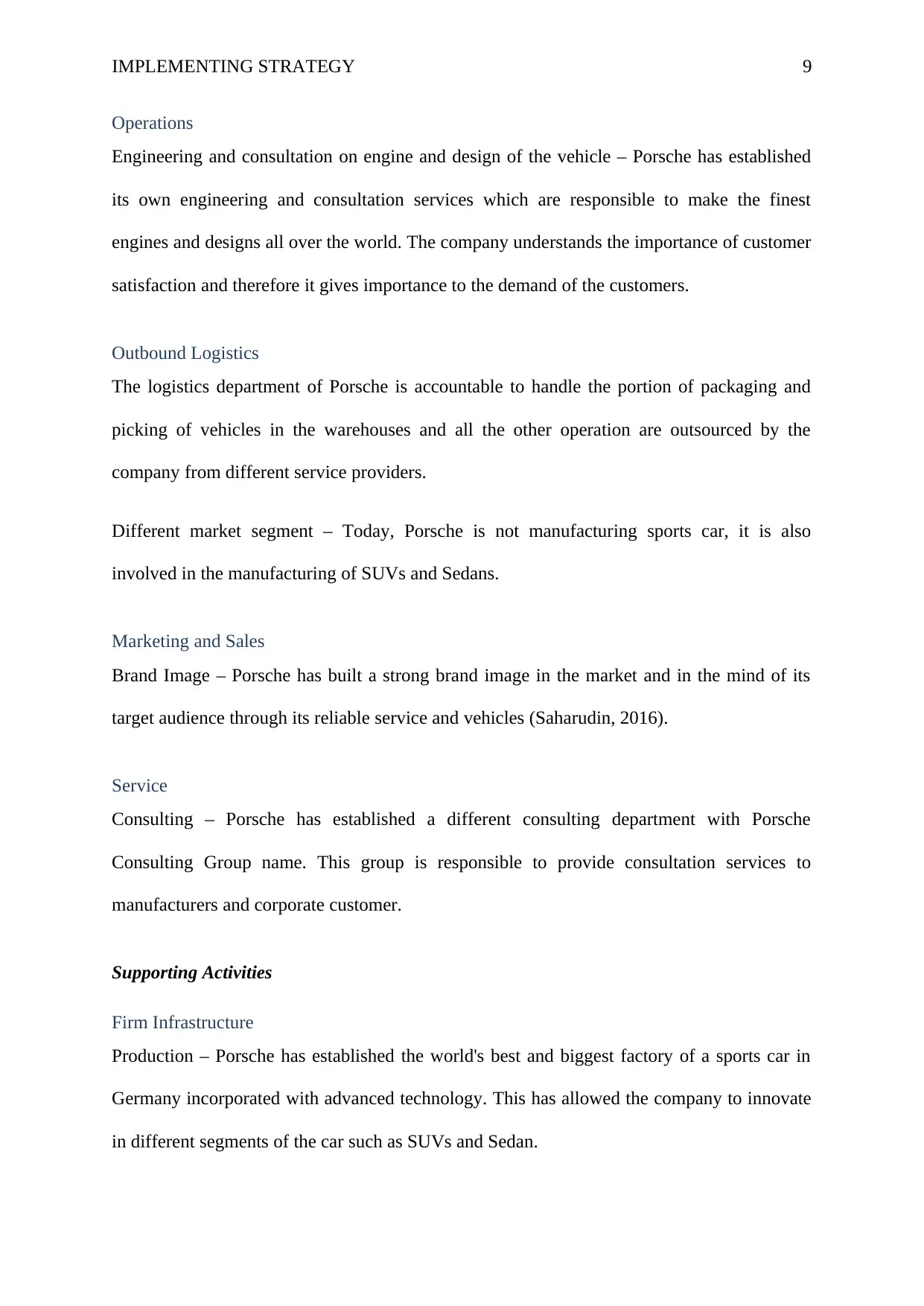
Value Chain Analysis of Porsche
Source [(Dudovskiy, 2016)]
Value chain analysis is one of the strategic tools that is utilized to evaluate the internet
activities of the company. The goal of the tool is to identify the most valuable activities of the
business and which of the activity could be improved in order to attain competitive
advantage.
Primary Activities
Inbound Logistics
Wide distribution channel - Porsche and Volkswagen both operate a business together under
a single umbrella. Porsche operates its business with a simple distribution channel with an
edge over its rival automobile companies. The company comply with the concept of a direct
channel of distribution Sales representatives are responsible to attend clients and explain all
the functions of the vehicle (Perner, 2019). Thus, this result in quick follows up.
efforts to enhance its brand image however deals with a similar viewpoint from which Jaguar
deals.
Core Competencies of Porsche
Value Chain Analysis of Porsche
Source [(Dudovskiy, 2016)]
Value chain analysis is one of the strategic tools that is utilized to evaluate the internet
activities of the company. The goal of the tool is to identify the most valuable activities of the
business and which of the activity could be improved in order to attain competitive
advantage.
Primary Activities
Inbound Logistics
Wide distribution channel - Porsche and Volkswagen both operate a business together under
a single umbrella. Porsche operates its business with a simple distribution channel with an
edge over its rival automobile companies. The company comply with the concept of a direct
channel of distribution Sales representatives are responsible to attend clients and explain all
the functions of the vehicle (Perner, 2019). Thus, this result in quick follows up.
⊘ This is a preview!⊘
Do you want full access?
Subscribe today to unlock all pages.
Trusted by 1+ million students worldwide
IMPLEMENTING STRATEGY 9
Operations
Engineering and consultation on engine and design of the vehicle – Porsche has established
its own engineering and consultation services which are responsible to make the finest
engines and designs all over the world. The company understands the importance of customer
satisfaction and therefore it gives importance to the demand of the customers.
Outbound Logistics
The logistics department of Porsche is accountable to handle the portion of packaging and
picking of vehicles in the warehouses and all the other operation are outsourced by the
company from different service providers.
Different market segment – Today, Porsche is not manufacturing sports car, it is also
involved in the manufacturing of SUVs and Sedans.
Marketing and Sales
Brand Image – Porsche has built a strong brand image in the market and in the mind of its
target audience through its reliable service and vehicles (Saharudin, 2016).
Service
Consulting – Porsche has established a different consulting department with Porsche
Consulting Group name. This group is responsible to provide consultation services to
manufacturers and corporate customer.
Supporting Activities
Firm Infrastructure
Production – Porsche has established the world's best and biggest factory of a sports car in
Germany incorporated with advanced technology. This has allowed the company to innovate
in different segments of the car such as SUVs and Sedan.
Operations
Engineering and consultation on engine and design of the vehicle – Porsche has established
its own engineering and consultation services which are responsible to make the finest
engines and designs all over the world. The company understands the importance of customer
satisfaction and therefore it gives importance to the demand of the customers.
Outbound Logistics
The logistics department of Porsche is accountable to handle the portion of packaging and
picking of vehicles in the warehouses and all the other operation are outsourced by the
company from different service providers.
Different market segment – Today, Porsche is not manufacturing sports car, it is also
involved in the manufacturing of SUVs and Sedans.
Marketing and Sales
Brand Image – Porsche has built a strong brand image in the market and in the mind of its
target audience through its reliable service and vehicles (Saharudin, 2016).
Service
Consulting – Porsche has established a different consulting department with Porsche
Consulting Group name. This group is responsible to provide consultation services to
manufacturers and corporate customer.
Supporting Activities
Firm Infrastructure
Production – Porsche has established the world's best and biggest factory of a sports car in
Germany incorporated with advanced technology. This has allowed the company to innovate
in different segments of the car such as SUVs and Sedan.
Paraphrase This Document
Need a fresh take? Get an instant paraphrase of this document with our AI Paraphraser
IMPLEMENTING STRATEGY 10
Human Resource
Trained employees – The employees of Porsche are trained and expert workforce who ensure
the service, design, and quality of its cars. In addition to this, employees of the company
provide the best customer service to its employees through their knowledge which leaves a
positive impact over customers (Porsche, 2019j).
Technology Development
Porsche has implemented different advanced technology in its system for designing highly
innovative cars for its customers. Some of the advanced technology adopted by Porsche is E-
Performance, 919 Hybrid, etc. (Baggott, 2019)
Procurement
The procurement and support management department provides support Porsche in finding
the finest suppliers for purchasing the different equipment of the car. With years of
experience as the premiums manufacturer of cars, the company understands what is essential
in regards to procurement for having a robust supply chain (Porsche, 2019a).
Critical evaluation of Porsche
In early 2008, the supervisory board of Porsche, which was comprised of Volkswagen
Group’s Chairman Ferdinand Piëch, decided to increase its holding in in the Volkswagen
group from 31% to 50% which provides it the major stake (MIT Sloan Management, 2009).
There were many investors who were looking at the Porsche’s takeover of Volkswagen and
being considered as one of the wise move for the independent and small company of car that
dissimilar to its competitive brands like Lamborghini, Lotus, Jaguar, , and Ferrari has handled
to majorly evade being gobbled up by the huge industry players like Ford, Chrysler, and
General Motors.
Human Resource
Trained employees – The employees of Porsche are trained and expert workforce who ensure
the service, design, and quality of its cars. In addition to this, employees of the company
provide the best customer service to its employees through their knowledge which leaves a
positive impact over customers (Porsche, 2019j).
Technology Development
Porsche has implemented different advanced technology in its system for designing highly
innovative cars for its customers. Some of the advanced technology adopted by Porsche is E-
Performance, 919 Hybrid, etc. (Baggott, 2019)
Procurement
The procurement and support management department provides support Porsche in finding
the finest suppliers for purchasing the different equipment of the car. With years of
experience as the premiums manufacturer of cars, the company understands what is essential
in regards to procurement for having a robust supply chain (Porsche, 2019a).
Critical evaluation of Porsche
In early 2008, the supervisory board of Porsche, which was comprised of Volkswagen
Group’s Chairman Ferdinand Piëch, decided to increase its holding in in the Volkswagen
group from 31% to 50% which provides it the major stake (MIT Sloan Management, 2009).
There were many investors who were looking at the Porsche’s takeover of Volkswagen and
being considered as one of the wise move for the independent and small company of car that
dissimilar to its competitive brands like Lamborghini, Lotus, Jaguar, , and Ferrari has handled
to majorly evade being gobbled up by the huge industry players like Ford, Chrysler, and
General Motors.
IMPLEMENTING STRATEGY 11
Carrying the research and development function of both the companies can possibly decrease
the sense of belonging of the engineers of Porsche and could have demotivated them. While
Porsche is a brand that has flourished on the healthy profit margins, Volkswagen’s business
model was always about volume. Besides this, if the engineering of Porsche was closely
related with the complete portfolio of Volkswagen, the business can have lost its capability to
sell external engineering to different OEMs as they would be sharing their innovation as well
as strategies with Volkswagen. But the senior leaders of Porsche ensured that the
incorporation of Volkswagen VW has not adversely influenced the outside engineering
business of Porsche (MIT Sloan Management, 2009).
Turnaround
Porsche brand hit the speed bump in the year 1990 when the procedure of production
determined as the “fat and wasteful”. Between the year 1986 and 1993, the sales of Porsche
has decreased from around 50,000 units to 14,000 units. The brand was at the bankruptcy
verger and there were different rumors regarding the possible takeover (MIT Sloan
Management, 2009).
The new CEO of Porsche that is Wendelin Wiedeking presented a turnaround focused on
creating new capabilities in the synchronized and lean manufacturing engineering. In ancient
time, the celebration of Porsche of craftwork inspires people to make efforts on their own
procedures in place of incorporating with the complete line of production. However, with
time this strategy also became a major handicap for the brand. Hence, as the turnaround
strategy, the management of the company took the decision of extending the product line of
Porsche beyond its sports car position which has for many decades dominated different
companies in the market.
Carrying the research and development function of both the companies can possibly decrease
the sense of belonging of the engineers of Porsche and could have demotivated them. While
Porsche is a brand that has flourished on the healthy profit margins, Volkswagen’s business
model was always about volume. Besides this, if the engineering of Porsche was closely
related with the complete portfolio of Volkswagen, the business can have lost its capability to
sell external engineering to different OEMs as they would be sharing their innovation as well
as strategies with Volkswagen. But the senior leaders of Porsche ensured that the
incorporation of Volkswagen VW has not adversely influenced the outside engineering
business of Porsche (MIT Sloan Management, 2009).
Turnaround
Porsche brand hit the speed bump in the year 1990 when the procedure of production
determined as the “fat and wasteful”. Between the year 1986 and 1993, the sales of Porsche
has decreased from around 50,000 units to 14,000 units. The brand was at the bankruptcy
verger and there were different rumors regarding the possible takeover (MIT Sloan
Management, 2009).
The new CEO of Porsche that is Wendelin Wiedeking presented a turnaround focused on
creating new capabilities in the synchronized and lean manufacturing engineering. In ancient
time, the celebration of Porsche of craftwork inspires people to make efforts on their own
procedures in place of incorporating with the complete line of production. However, with
time this strategy also became a major handicap for the brand. Hence, as the turnaround
strategy, the management of the company took the decision of extending the product line of
Porsche beyond its sports car position which has for many decades dominated different
companies in the market.
⊘ This is a preview!⊘
Do you want full access?
Subscribe today to unlock all pages.
Trusted by 1+ million students worldwide

1 out of 28


Related Documents


Your All-in-One AI-Powered Toolkit for Academic Success.
+13062052269
info@desklib.com
Available 24*7 on WhatsApp / Email
![[object Object]](/_next/static/media/star-bottom.7253800d.svg)
Unlock your academic potential
Copyright © 2020–2026 A2Z Services. All Rights Reserved. Developed and managed by ZUCOL.