Competitive Advantage: Porter's Five Forces in Kenyan Universities

Verified

Added on  2023/04/25

|7
|391
|164
Report
AI Summary
This report focuses on the effectiveness of Porter's Five Forces in providing competitive advantages to universities located in Kenya, an industry undergoing continuous change. The analysis identifies threats based on severity, with the threat of new entrants being low due to accreditation restrictions, while the bargaining power of suppliers is high. The bargaining power of buyers, threats from rivals, and threats from substitutes are also significant. The application of Porter's model is influenced by new entrants and considers the age and categories of universities, proving the effectiveness of competitive forces. The report concludes that stakeholder pressure increases changes in universities, with a focus on public universities to analyze the most effective factors for growth, aiming for international recognition. The report references several academic articles and applies the five forces model to a specific context within the business environment.
Document Page
Management
tabler-icon-diamond-filled.svg

Paraphrase This Document

Need a fresh take? Get an instant paraphrase of this document with our AI Paraphraser
Document Page
The focus is on the effectiveness of the
five forces of Porter that provides
business with competitive advantage
Universities located in Kenya is the focus
Continuous changes is the reason for
selecting the industry
The focus is on the significant factors
Introduction
Document Page
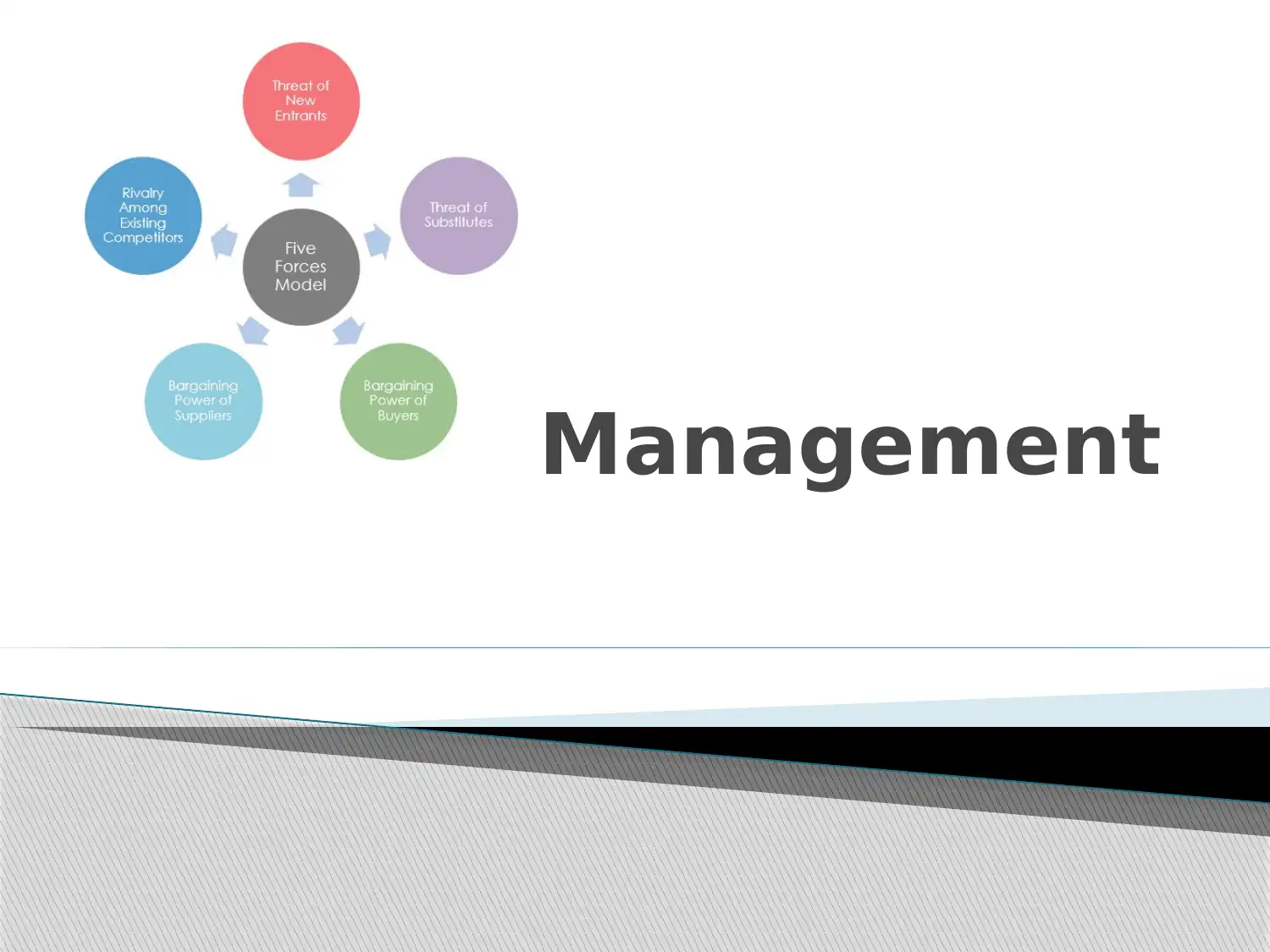
Porter’s five forces assists in identifying the
threats
The threats based on the level of severity is the
basis of analysis for the Kenyan Universities
The threat of new entrants can be low as the
restrictions are provided by the education
accreditation bodies
The bargaining power of suppliers is high with
an increased number of Universities
Critical review
Document Page
The bargaining power of buyers, threat from
rivals as well as threats from substitutes are
high
The application of five forces of Porter can
be influenced by the threat of new entrants
The choices made were influenced by the
taking into account the age and categories
of the Universities
The application of the model have proved
the effectiveness of the competitive forces
Contd..
tabler-icon-diamond-filled.svg

Paraphrase This Document

Need a fresh take? Get an instant paraphrase of this document with our AI Paraphraser
Document Page
Stakeholder pressure increases changes
in the Universities
Only public Universities has been
anaysed for the research
Analyse the most effective factors
necessary for growth
The Universities can become reputed
internationally
Conclusion
Document Page
Huang, L. & Bae, Y., 2018, ‘Analysis of Chaotic Behavior in a
Novel Extended Love Model Considering Positive and Negative
External Environment’. Entropy, 20(5), p.365.
Kirlik, A., 2018, ‘Requirements for psychological models to
support design: Toward ecological task analysis’. In Global
perspectives on the ecology of human-machine systems (pp.
68-120). CRC Press.
Madhavaram, S., Hunt, S.D. & Bicen, P., 2017, ‘The FREE (Firm
Resources and External Environment) Framework as an
Alternative to SWOT: An Abstract’. In Academy of Marketing
Science Annual Conference (pp. 49-49). Springer, Cham.
Vollaro, A. D. L., Galli, G., & Vallati, A. 2015, ‘CFD analysis of
convective heat transfer coefficient on external surfaces of
buildings’. Sustainability, 7(7), 9088-9099.
Reference
Document Page
chevron_up_icon
1 out of 7
circle_padding
hide_on_mobile
zoom_out_icon
[object Object]