Portfolio on Thinking Critically, Ethically, and Creatively
VerifiedAdded on 2023/06/10
|8
|1208
|403
Portfolio
AI Summary
This document presents an individual portfolio focusing on critical, ethical, and creative thinking. It aims to engage the student in a self-assessment of their core strengths and weaknesses. The portfolio is structured into three parts, each designed to demonstrate the quality of the student's findings related to the assigned tasks. Part A discusses the application of critical perspectives to various challenges and decisions, emphasizing the importance of disciplined thinking. Part B addresses the impact of the COVID-19 pandemic and related lockdowns, highlighting the need for proactive planning and prioritization of public health. Part C explores the history and significance of university grading systems, questioning the true meaning of grades in higher education. The portfolio concludes by summarizing the key insights gained through the analysis of these diverse topics, reinforcing the value of critical self-reflection and ethical reasoning in personal and professional development. Desklib provides access to this and many other solved assignments.

CW1
Paraphrase This Document
Need a fresh take? Get an instant paraphrase of this document with our AI Paraphraser

Contents
Introduction..................................................................................................................................................................................................................3
Main Body....................................................................................................................................................................................................................3
PART A........................................................................................................................................................................................................................3
PART B........................................................................................................................................................................................................................5
PART C........................................................................................................................................................................................................................6
Conclusion....................................................................................................................................................................................................................6
References....................................................................................................................................................................................................................7
Introduction..................................................................................................................................................................................................................3
Main Body....................................................................................................................................................................................................................3
PART A........................................................................................................................................................................................................................3
PART B........................................................................................................................................................................................................................5
PART C........................................................................................................................................................................................................................6
Conclusion....................................................................................................................................................................................................................6
References....................................................................................................................................................................................................................7

Introduction
The given document is an individual portfolio for thinking critically, ethically and creatively for engaging the student with their personal
core strengths and identification of weakness. The provided document is being separated into 3 parts that will deliver quality of their findings
over the provided task.
Main Body
PART A
The given document is an individual portfolio for thinking critically, ethically and creatively for engaging the student with their personal
core strengths and identification of weakness. The provided document is being separated into 3 parts that will deliver quality of their findings
over the provided task.
Main Body
PART A
⊘ This is a preview!⊘
Do you want full access?
Subscribe today to unlock all pages.

Trusted by 1+ million students worldwide

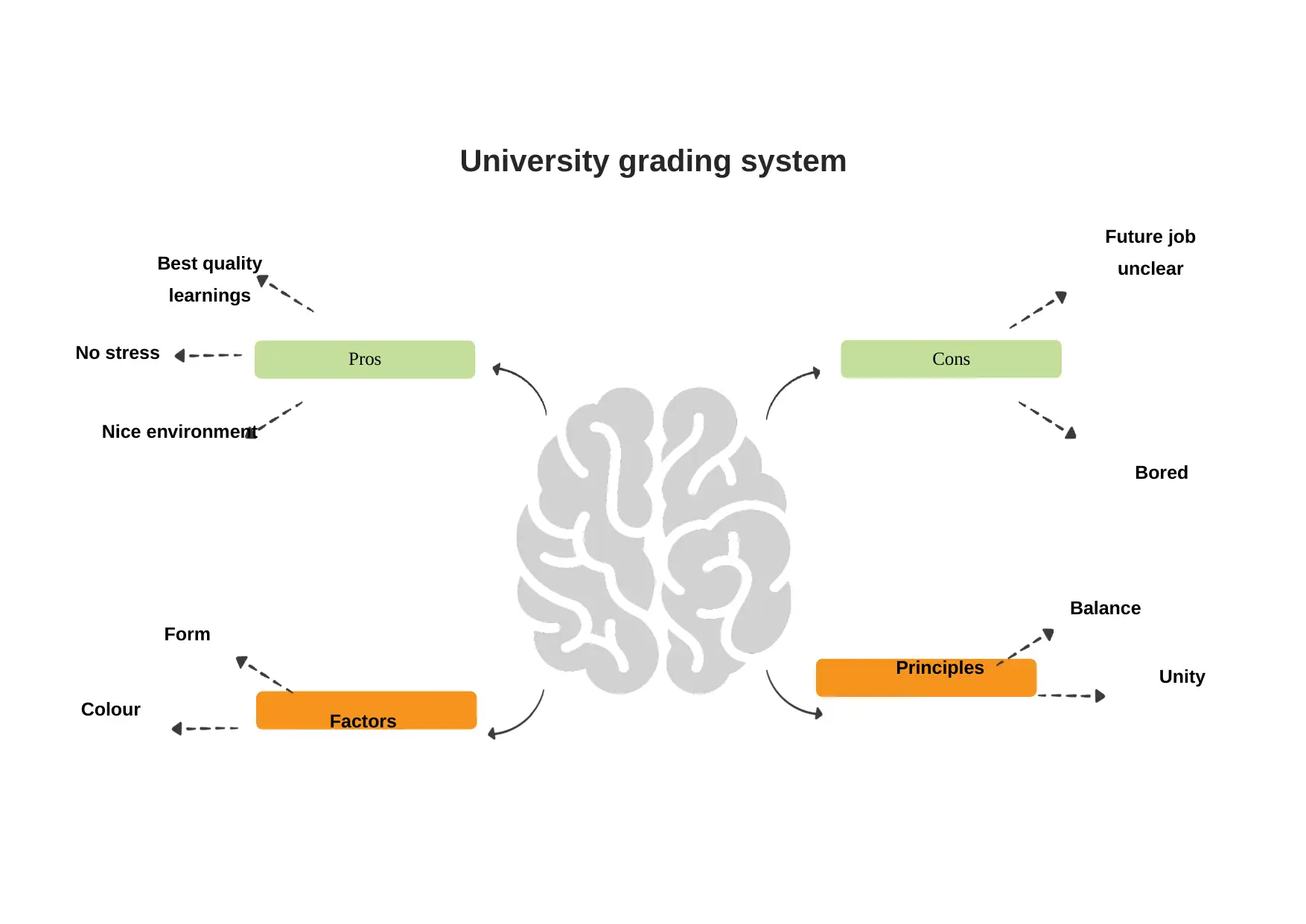
University grading system
Cons
Principles
Factors
Pros
Bored
Balance
Unity
Best quality
learnings
No stress
Nice environment
Form
Colour
Future job
unclear
Cons
Principles
Factors
Pros
Bored
Balance
Unity
Best quality
learnings
No stress
Nice environment
Form
Colour
Future job
unclear
Paraphrase This Document
Need a fresh take? Get an instant paraphrase of this document with our AI Paraphraser

A critical perspective is the greatest method to approach all challenges and decisions
in individualr life. This does not imply that individual should work on individualr abilities to
critique others. Rather, I mean that individual should consider the difficulties and possibilities
that individual encounter seriously. To put it another way, individual have to make a lot of
decisions in individualr life, from determining whether to pursue a college degree to choosing
a partner and having children (or not), and individual'll want to do the best thinking
individual can while making those decisions. To put it another way, individual'll want to
make decisions that have favourable outcomes. Without discipline and rigour, the human
mind is prone to sloppy thinking. Surprisingly, it frequently prefers not to have to "think."
Rather than inquiring into the nuances of topics, it is usually impetuous, preferring to act on
its immediate reaction to a circumstance or problem. Despite the fact that it is non-reflective
by nature, it is completely capable of changing and enhancing its operations. Most
individuals are unaware of this truth since such thinking requires intellectual discipline,
which is rarely understood or respected in our culture.
PART B
The first lockdown resulted in school closures, which were obviously damaging to
pupils' education. This makes it even more perplexing that the government has done so little
to protect our children's education. Despite saying that it was their top priority on several
times, the government has not done anything to reduce the impact of lockdowns. Although
improved planning may have helped to lessen the worst effects of the first lockdown in the
UK, it might be claimed that it was unavoidable. Given the stark warnings sent by the first
wave of lockdowns in 2020, it's tougher to argue that the second and third waves were
actually unavoidable. We had time to implement managed isolation and quarantine for
incoming travellers, locally driven contact tracing, effective public health messaging, and
improved ventilation in schools and workplaces, all of which would have helped to blunt, if
not completely avoid, the alpha wave we experienced in the winter of 2020, possibly without
the need for further lockdowns.
Many individuals would put the safety of the most vulnerable people at the top of
their priority list. Many individuals would cherish a functional NHS that provided equitable
access to everyone in times of need. Many people place a high value on their population's
long-term health. On March 23, 2020, at 8 p.m., Prime Minister Boris Johnson addressed the
country on the worsening of the covid crisis in the United Kingdom. "I must give the British
in individualr life. This does not imply that individual should work on individualr abilities to
critique others. Rather, I mean that individual should consider the difficulties and possibilities
that individual encounter seriously. To put it another way, individual have to make a lot of
decisions in individualr life, from determining whether to pursue a college degree to choosing
a partner and having children (or not), and individual'll want to do the best thinking
individual can while making those decisions. To put it another way, individual'll want to
make decisions that have favourable outcomes. Without discipline and rigour, the human
mind is prone to sloppy thinking. Surprisingly, it frequently prefers not to have to "think."
Rather than inquiring into the nuances of topics, it is usually impetuous, preferring to act on
its immediate reaction to a circumstance or problem. Despite the fact that it is non-reflective
by nature, it is completely capable of changing and enhancing its operations. Most
individuals are unaware of this truth since such thinking requires intellectual discipline,
which is rarely understood or respected in our culture.
PART B
The first lockdown resulted in school closures, which were obviously damaging to
pupils' education. This makes it even more perplexing that the government has done so little
to protect our children's education. Despite saying that it was their top priority on several
times, the government has not done anything to reduce the impact of lockdowns. Although
improved planning may have helped to lessen the worst effects of the first lockdown in the
UK, it might be claimed that it was unavoidable. Given the stark warnings sent by the first
wave of lockdowns in 2020, it's tougher to argue that the second and third waves were
actually unavoidable. We had time to implement managed isolation and quarantine for
incoming travellers, locally driven contact tracing, effective public health messaging, and
improved ventilation in schools and workplaces, all of which would have helped to blunt, if
not completely avoid, the alpha wave we experienced in the winter of 2020, possibly without
the need for further lockdowns.
Many individuals would put the safety of the most vulnerable people at the top of
their priority list. Many individuals would cherish a functional NHS that provided equitable
access to everyone in times of need. Many people place a high value on their population's
long-term health. On March 23, 2020, at 8 p.m., Prime Minister Boris Johnson addressed the
country on the worsening of the covid crisis in the United Kingdom. "I must give the British

people a very basic instruction beginning this evening," he stated. "Individual have to return
home." It marked the start of the United Kingdom's first lockdown.
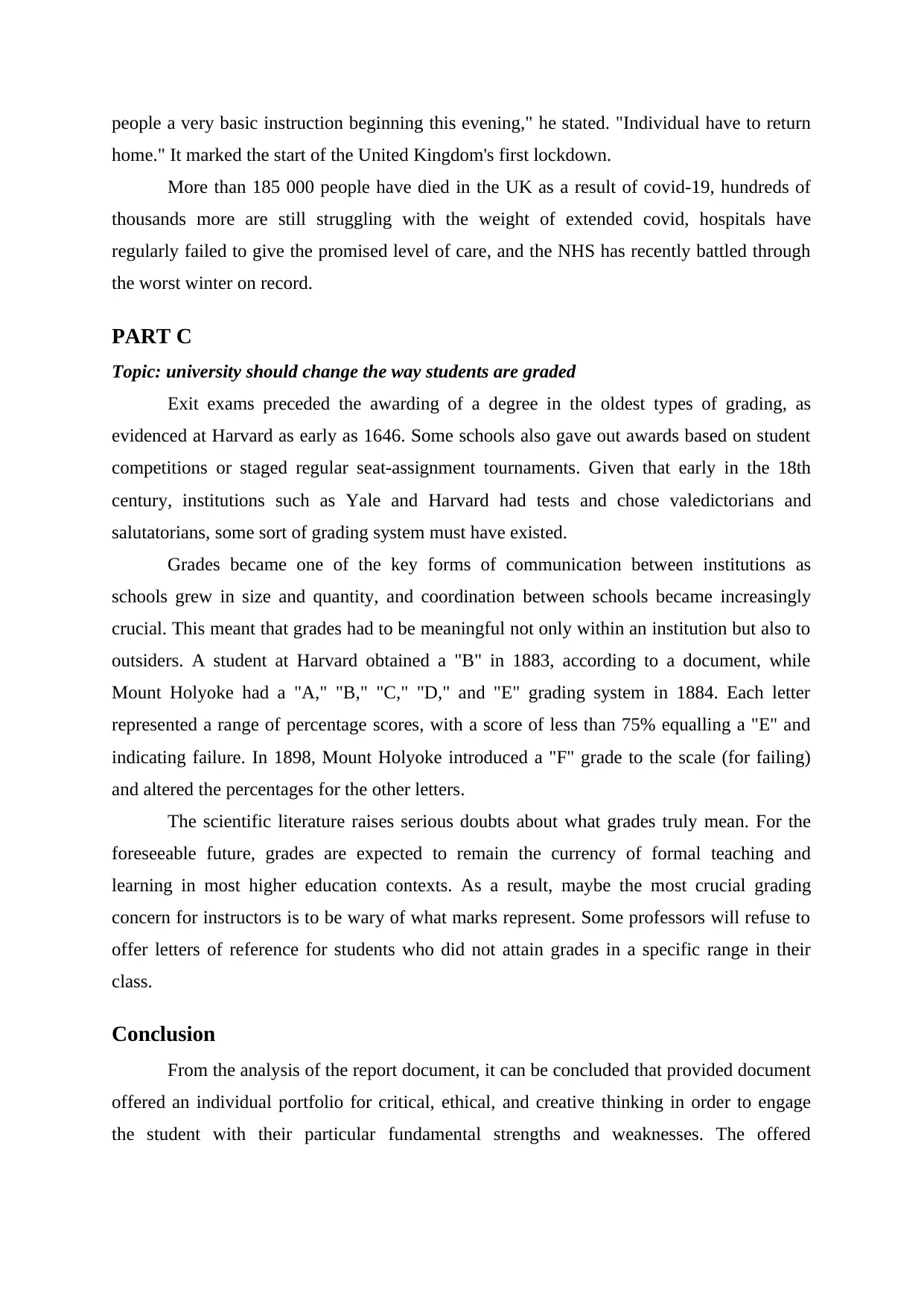
More than 185 000 people have died in the UK as a result of covid-19, hundreds of
thousands more are still struggling with the weight of extended covid, hospitals have
regularly failed to give the promised level of care, and the NHS has recently battled through
the worst winter on record.
PART C
Topic: university should change the way students are graded
Exit exams preceded the awarding of a degree in the oldest types of grading, as
evidenced at Harvard as early as 1646. Some schools also gave out awards based on student
competitions or staged regular seat-assignment tournaments. Given that early in the 18th
century, institutions such as Yale and Harvard had tests and chose valedictorians and
salutatorians, some sort of grading system must have existed.
Grades became one of the key forms of communication between institutions as
schools grew in size and quantity, and coordination between schools became increasingly
crucial. This meant that grades had to be meaningful not only within an institution but also to
outsiders. A student at Harvard obtained a "B" in 1883, according to a document, while
Mount Holyoke had a "A," "B," "C," "D," and "E" grading system in 1884. Each letter
represented a range of percentage scores, with a score of less than 75% equalling a "E" and
indicating failure. In 1898, Mount Holyoke introduced a "F" grade to the scale (for failing)
and altered the percentages for the other letters.
The scientific literature raises serious doubts about what grades truly mean. For the
foreseeable future, grades are expected to remain the currency of formal teaching and
learning in most higher education contexts. As a result, maybe the most crucial grading
concern for instructors is to be wary of what marks represent. Some professors will refuse to
offer letters of reference for students who did not attain grades in a specific range in their
class.
Conclusion
From the analysis of the report document, it can be concluded that provided document
offered an individual portfolio for critical, ethical, and creative thinking in order to engage
the student with their particular fundamental strengths and weaknesses. The offered
home." It marked the start of the United Kingdom's first lockdown.
More than 185 000 people have died in the UK as a result of covid-19, hundreds of
thousands more are still struggling with the weight of extended covid, hospitals have
regularly failed to give the promised level of care, and the NHS has recently battled through
the worst winter on record.
PART C
Topic: university should change the way students are graded
Exit exams preceded the awarding of a degree in the oldest types of grading, as
evidenced at Harvard as early as 1646. Some schools also gave out awards based on student
competitions or staged regular seat-assignment tournaments. Given that early in the 18th
century, institutions such as Yale and Harvard had tests and chose valedictorians and
salutatorians, some sort of grading system must have existed.
Grades became one of the key forms of communication between institutions as
schools grew in size and quantity, and coordination between schools became increasingly
crucial. This meant that grades had to be meaningful not only within an institution but also to
outsiders. A student at Harvard obtained a "B" in 1883, according to a document, while
Mount Holyoke had a "A," "B," "C," "D," and "E" grading system in 1884. Each letter
represented a range of percentage scores, with a score of less than 75% equalling a "E" and
indicating failure. In 1898, Mount Holyoke introduced a "F" grade to the scale (for failing)
and altered the percentages for the other letters.
The scientific literature raises serious doubts about what grades truly mean. For the
foreseeable future, grades are expected to remain the currency of formal teaching and
learning in most higher education contexts. As a result, maybe the most crucial grading
concern for instructors is to be wary of what marks represent. Some professors will refuse to
offer letters of reference for students who did not attain grades in a specific range in their
class.
Conclusion
From the analysis of the report document, it can be concluded that provided document
offered an individual portfolio for critical, ethical, and creative thinking in order to engage
the student with their particular fundamental strengths and weaknesses. The offered
⊘ This is a preview!⊘
Do you want full access?
Subscribe today to unlock all pages.

Trusted by 1+ million students worldwide

document is divided into three parts, each of which will deliver high-quality findings for the
work at hand.
work at hand.
Paraphrase This Document
Need a fresh take? Get an instant paraphrase of this document with our AI Paraphraser

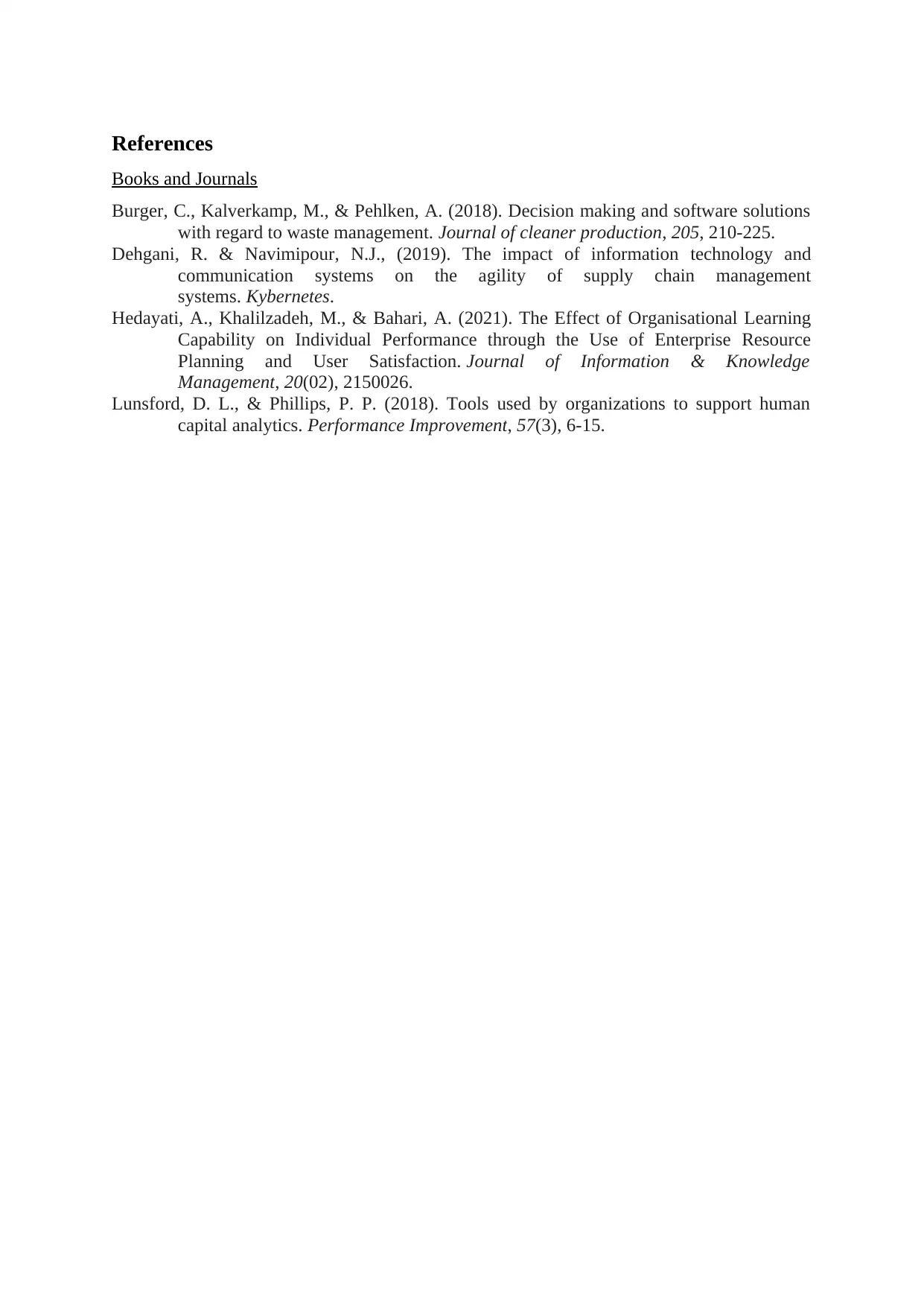
References
Books and Journals
Burger, C., Kalverkamp, M., & Pehlken, A. (2018). Decision making and software solutions
with regard to waste management. Journal of cleaner production, 205, 210-225.
Dehgani, R. & Navimipour, N.J., (2019). The impact of information technology and
communication systems on the agility of supply chain management
systems. Kybernetes.
Hedayati, A., Khalilzadeh, M., & Bahari, A. (2021). The Effect of Organisational Learning
Capability on Individual Performance through the Use of Enterprise Resource
Planning and User Satisfaction. Journal of Information & Knowledge
Management, 20(02), 2150026.
Lunsford, D. L., & Phillips, P. P. (2018). Tools used by organizations to support human
capital analytics. Performance Improvement, 57(3), 6-15.
Books and Journals
Burger, C., Kalverkamp, M., & Pehlken, A. (2018). Decision making and software solutions
with regard to waste management. Journal of cleaner production, 205, 210-225.
Dehgani, R. & Navimipour, N.J., (2019). The impact of information technology and
communication systems on the agility of supply chain management
systems. Kybernetes.
Hedayati, A., Khalilzadeh, M., & Bahari, A. (2021). The Effect of Organisational Learning
Capability on Individual Performance through the Use of Enterprise Resource
Planning and User Satisfaction. Journal of Information & Knowledge
Management, 20(02), 2150026.
Lunsford, D. L., & Phillips, P. P. (2018). Tools used by organizations to support human
capital analytics. Performance Improvement, 57(3), 6-15.
1 out of 8
Related Documents
Your All-in-One AI-Powered Toolkit for Academic Success.
+13062052269
info@desklib.com
Available 24*7 on WhatsApp / Email
Unlock your academic potential
Copyright © 2020–2025 A2Z Services. All Rights Reserved. Developed and managed by ZUCOL.