Reflective Practice: A Critique of the Position Statement Analysis

Verified

Added on  2021/04/21

|4
|764
|50
Essay
AI Summary
This essay offers a critical analysis of a position statement on reflective practice, emphasizing its importance for healthcare professionals. The critique highlights the two dimensions of reflective practice: reflection on and in action, and it discusses how the statement primarily focuses on reflection in action. The essay also examines the role of reflective practice in relation to nursing standards, emphasizing both individual and group reflection methods. It underscores the importance of evidence-based practice and the use of checklists for future reference. While acknowledging the statement's recognition of reflective practice's benefits, such as enhancing self-awareness and promoting deeper learning, the essay also points out potential limitations, including the time-consuming nature of reflection and the possibility of discomfort for some practitioners. The essay concludes by suggesting that reflective practice may not be sufficient to resolve all clinical problems and provides relevant references to support its arguments. This assignment is contributed to Desklib, a platform offering AI-based study tools.
Document Page
Running head: POSITION STATEMENT CRITIQUE 1
Position Statement Critique
Student’s Name
Institutional Affiliation
tabler-icon-diamond-filled.svg

Paraphrase This Document

Need a fresh take? Get an instant paraphrase of this document with our AI Paraphraser
Document Page
POSITION STATEMENT CRITIQUE 2
Position Statement Critique
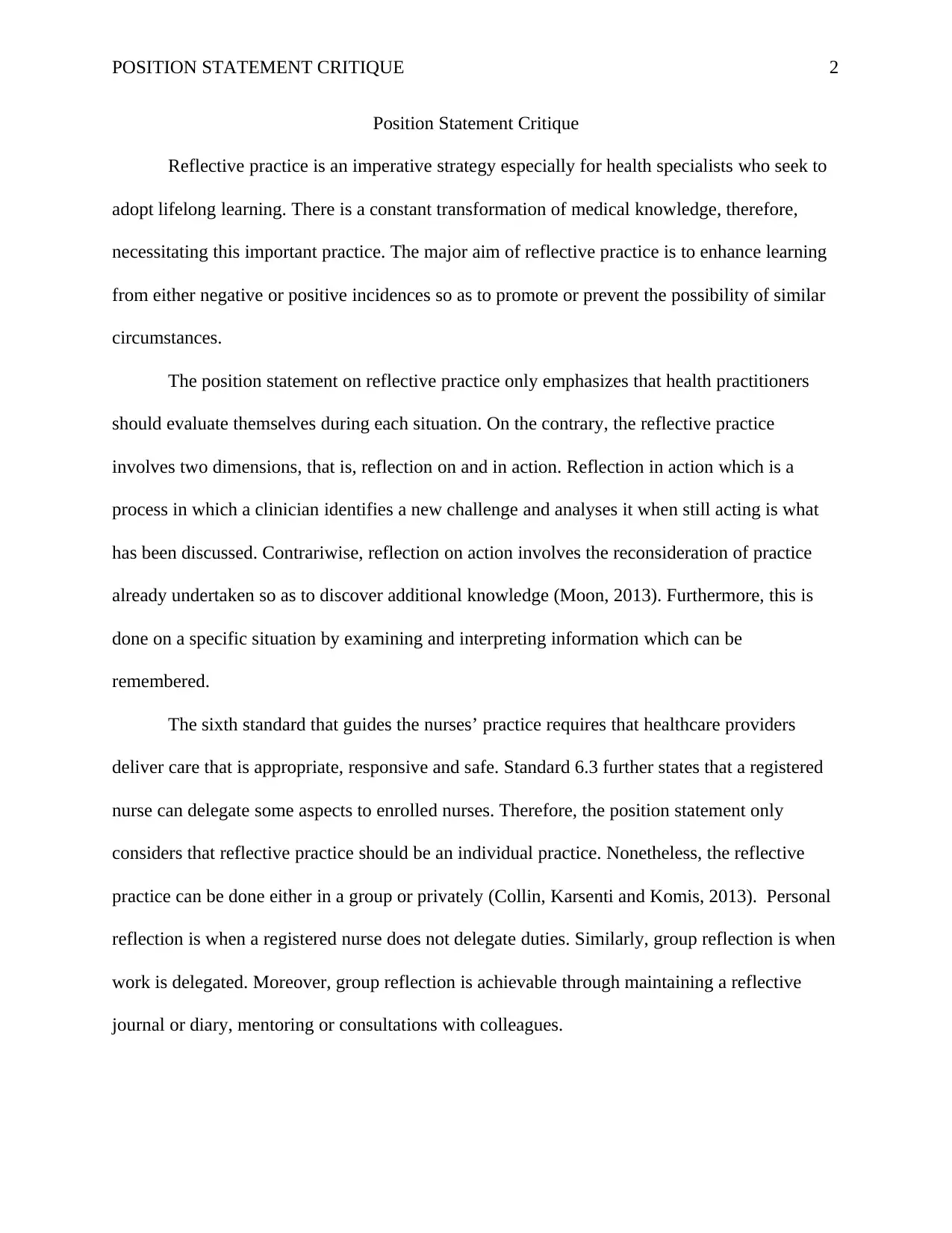
Reflective practice is an imperative strategy especially for health specialists who seek to
adopt lifelong learning. There is a constant transformation of medical knowledge, therefore,
necessitating this important practice. The major aim of reflective practice is to enhance learning
from either negative or positive incidences so as to promote or prevent the possibility of similar
circumstances.
The position statement on reflective practice only emphasizes that health practitioners
should evaluate themselves during each situation. On the contrary, the reflective practice
involves two dimensions, that is, reflection on and in action. Reflection in action which is a
process in which a clinician identifies a new challenge and analyses it when still acting is what
has been discussed. Contrariwise, reflection on action involves the reconsideration of practice
already undertaken so as to discover additional knowledge (Moon, 2013). Furthermore, this is
done on a specific situation by examining and interpreting information which can be
remembered.
The sixth standard that guides the nurses’ practice requires that healthcare providers
deliver care that is appropriate, responsive and safe. Standard 6.3 further states that a registered
nurse can delegate some aspects to enrolled nurses. Therefore, the position statement only
considers that reflective practice should be an individual practice. Nonetheless, the reflective
practice can be done either in a group or privately (Collin, Karsenti and Komis, 2013). Personal
reflection is when a registered nurse does not delegate duties. Similarly, group reflection is when
work is delegated. Moreover, group reflection is achievable through maintaining a reflective
journal or diary, mentoring or consultations with colleagues.
Document Page
POSITION STATEMENT CRITIQUE 3
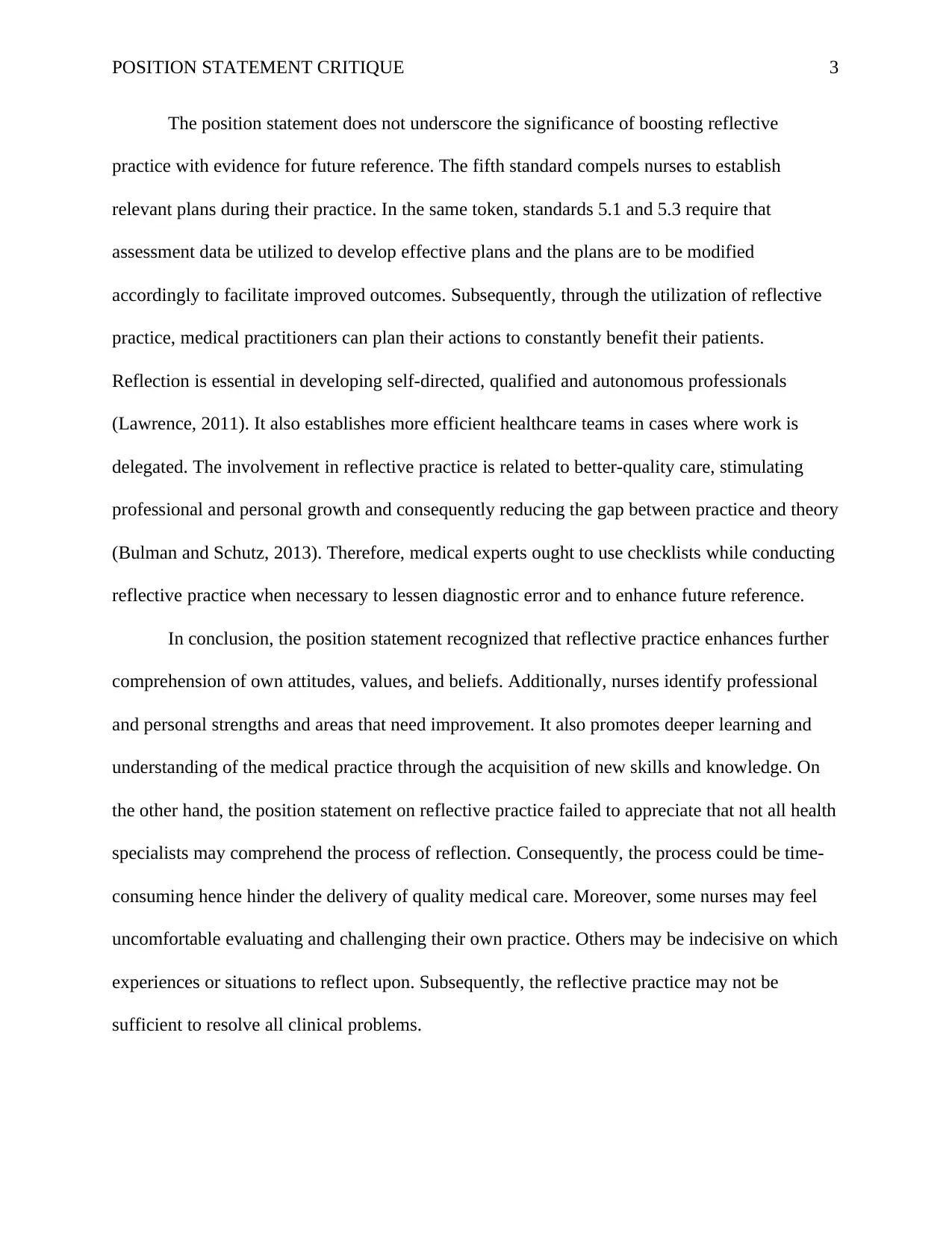
The position statement does not underscore the significance of boosting reflective
practice with evidence for future reference. The fifth standard compels nurses to establish
relevant plans during their practice. In the same token, standards 5.1 and 5.3 require that
assessment data be utilized to develop effective plans and the plans are to be modified
accordingly to facilitate improved outcomes. Subsequently, through the utilization of reflective
practice, medical practitioners can plan their actions to constantly benefit their patients.
Reflection is essential in developing self-directed, qualified and autonomous professionals
(Lawrence, 2011). It also establishes more efficient healthcare teams in cases where work is
delegated. The involvement in reflective practice is related to better-quality care, stimulating
professional and personal growth and consequently reducing the gap between practice and theory
(Bulman and Schutz, 2013). Therefore, medical experts ought to use checklists while conducting
reflective practice when necessary to lessen diagnostic error and to enhance future reference.
In conclusion, the position statement recognized that reflective practice enhances further
comprehension of own attitudes, values, and beliefs. Additionally, nurses identify professional
and personal strengths and areas that need improvement. It also promotes deeper learning and
understanding of the medical practice through the acquisition of new skills and knowledge. On
the other hand, the position statement on reflective practice failed to appreciate that not all health
specialists may comprehend the process of reflection. Consequently, the process could be time-
consuming hence hinder the delivery of quality medical care. Moreover, some nurses may feel
uncomfortable evaluating and challenging their own practice. Others may be indecisive on which
experiences or situations to reflect upon. Subsequently, the reflective practice may not be
sufficient to resolve all clinical problems.
Document Page
POSITION STATEMENT CRITIQUE 4
References
Bulman, C., & Schutz, S. (Eds.). (2013). Reflective practice in nursing. John Wiley & Sons.
Collin, S., Karsenti, T., & Komis, V. (2013). Reflective practice in initial teacher training:
Critiques and perspectives. Reflective practice, 14(1), 104-117.
Lawrence, L. A. (2011, October). Work engagement, moral distress, education level, and critical
reflective practice in intensive care nurses. In Nursing forum (Vol. 46, No. 4, pp. 256-
268). Blackwell Publishing Inc.
Moon, J. A. (2013). A handbook of reflective and experiential learning: Theory and practice.
Routledge.
chevron_up_icon
1 out of 4
circle_padding
hide_on_mobile
zoom_out_icon
[object Object]