N725: Post-Stroke Depression Screening & Translational Research

Verified

Added on  2023/06/04

|16
|901
|468
Presentation
AI Summary
This presentation addresses the critical issue of post-stroke depression and the importance of mandatory screening for patients. It highlights the prevalence of stroke and the significant neuropsychiatric sequelae, with a focus on post-stroke depression as the most common complication. The presentation emphasizes the adverse effects of post-stroke depression, including prolonged hospitalizations, increased suicidal ideation, and higher medication costs. It references treatment recommendations from organizations like the Canadian Best Practice Recommendations for Stroke and the World Health Organization. The presentation also assesses current compliance with screening recommendations, using the Planned Action Theory and Knowledge to Action Model to develop activities that initiate change. It identifies barriers to screening, such as cost and training, and proposes implementation strategies, including stakeholder discussions and referral system restructuring. The presentation concludes by emphasizing the significance of screening stroke patients for depression to ensure effective treatment and improved patient outcomes. Desklib offers a wealth of similar study resources for students.
Document Page
Neuropsychiatric Sequela of Stroke:
Mandatory Depression Screening on the
Post-Stroke Patient
Presented by:
tabler-icon-diamond-filled.svg

Paraphrase This Document

Need a fresh take? Get an instant paraphrase of this document with our AI Paraphraser
Document Page
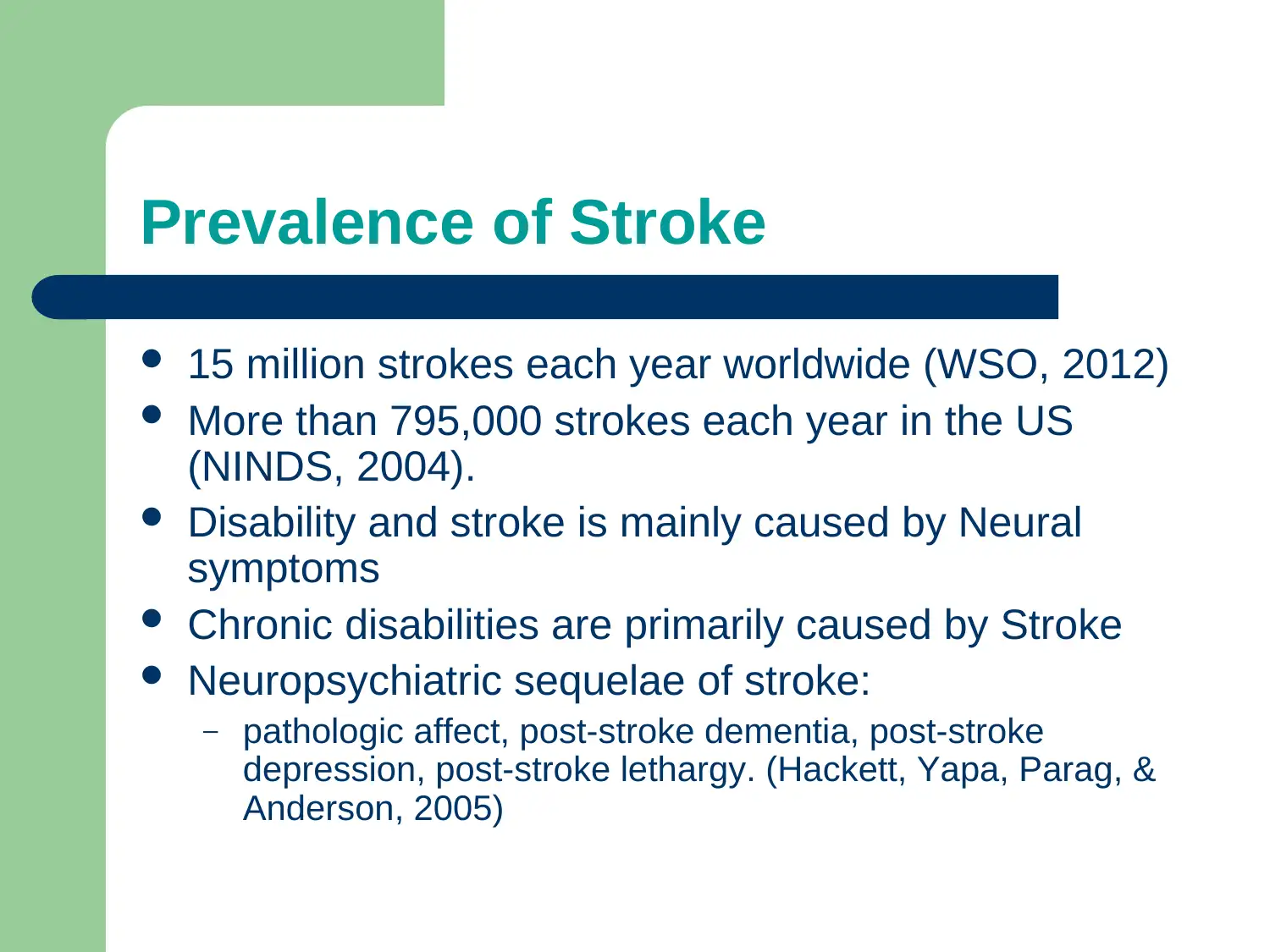
Prevalence of Stroke
15 million strokes each year worldwide (WSO, 2012)
More than 795,000 strokes each year in the US
(NINDS, 2004).
Disability and stroke is mainly caused by Neural
symptoms
Chronic disabilities are primarily caused by Stroke
Neuropsychiatric sequelae of stroke:
pathologic affect, post-stroke dementia, post-stroke
depression, post-stroke lethargy. (Hackett, Yapa, Parag, &
Anderson, 2005)
Document Page
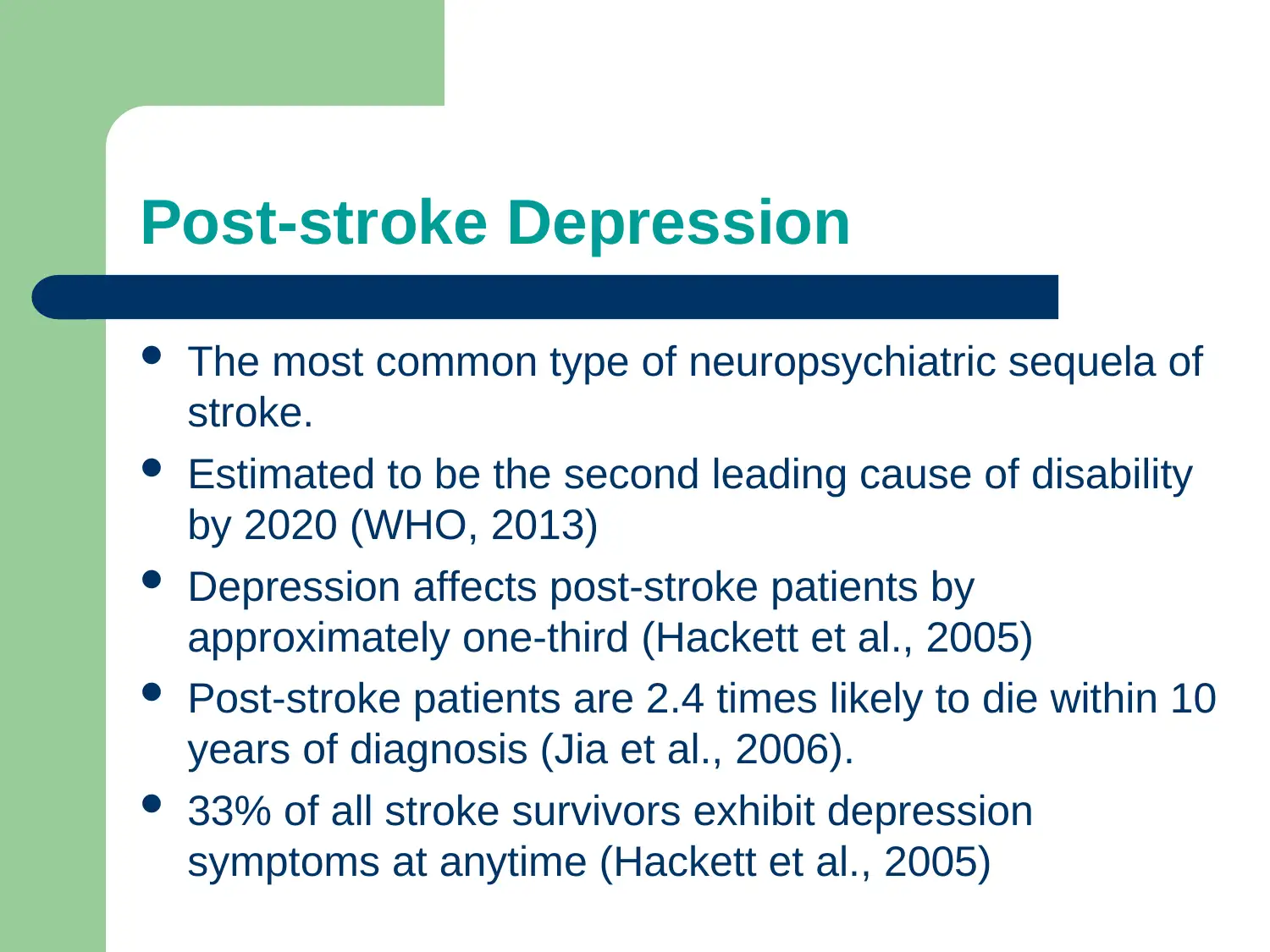
Post-stroke Depression
The most common type of neuropsychiatric sequela of
stroke.
Estimated to be the second leading cause of disability
by 2020 (WHO, 2013)
Depression affects post-stroke patients by
approximately one-third (Hackett et al., 2005)
Post-stroke patients are 2.4 times likely to die within 10
years of diagnosis (Jia et al., 2006).
33% of all stroke survivors exhibit depression
symptoms at anytime (Hackett et al., 2005)
Document Page
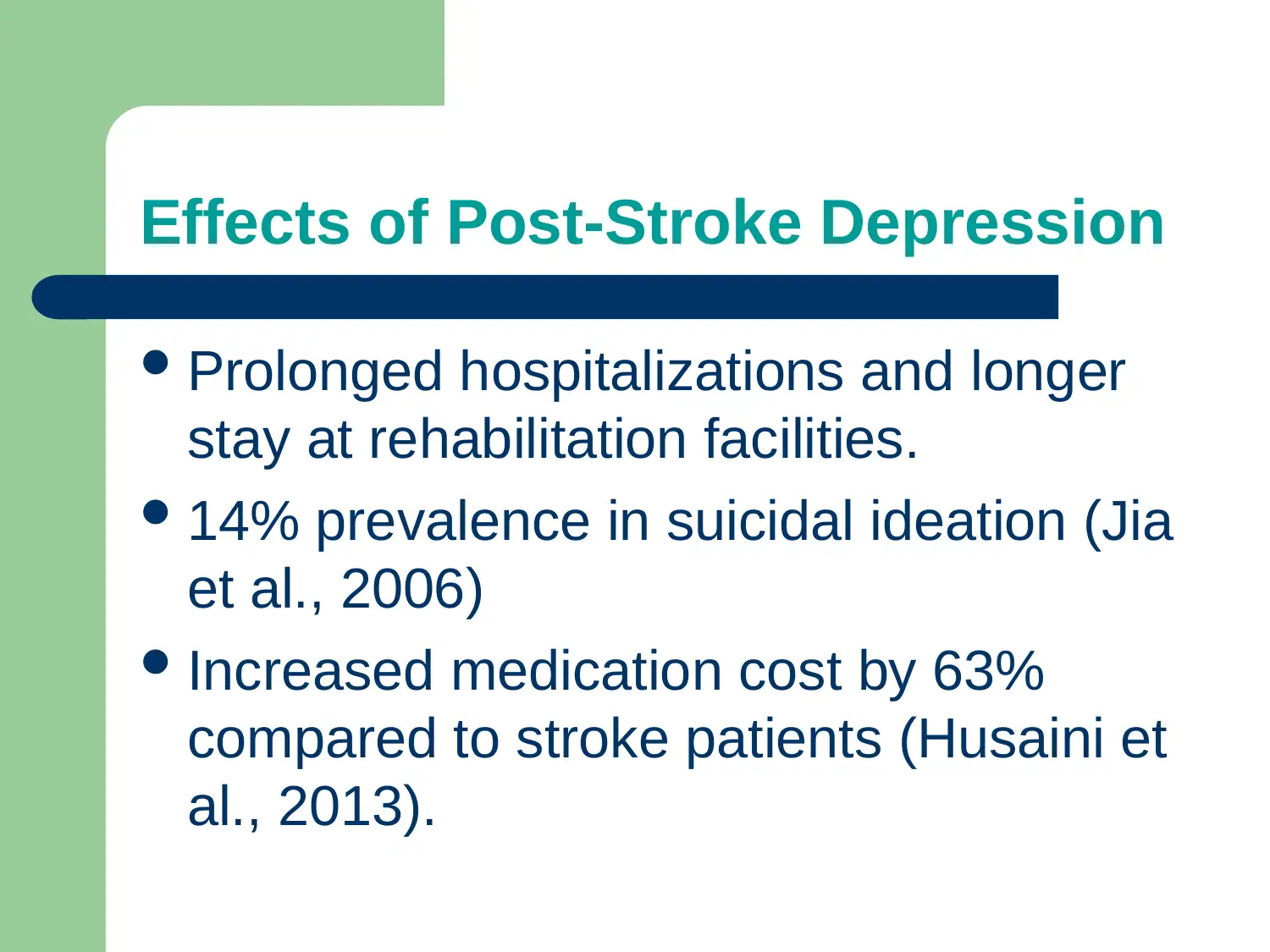
Effects of Post-Stroke Depression
Prolonged hospitalizations and longer
stay at rehabilitation facilities.
14% prevalence in suicidal ideation (Jia
et al., 2006)
Increased medication cost by 63%
compared to stroke patients (Husaini et
al., 2013).
tabler-icon-diamond-filled.svg

Paraphrase This Document

Need a fresh take? Get an instant paraphrase of this document with our AI Paraphraser
Document Page
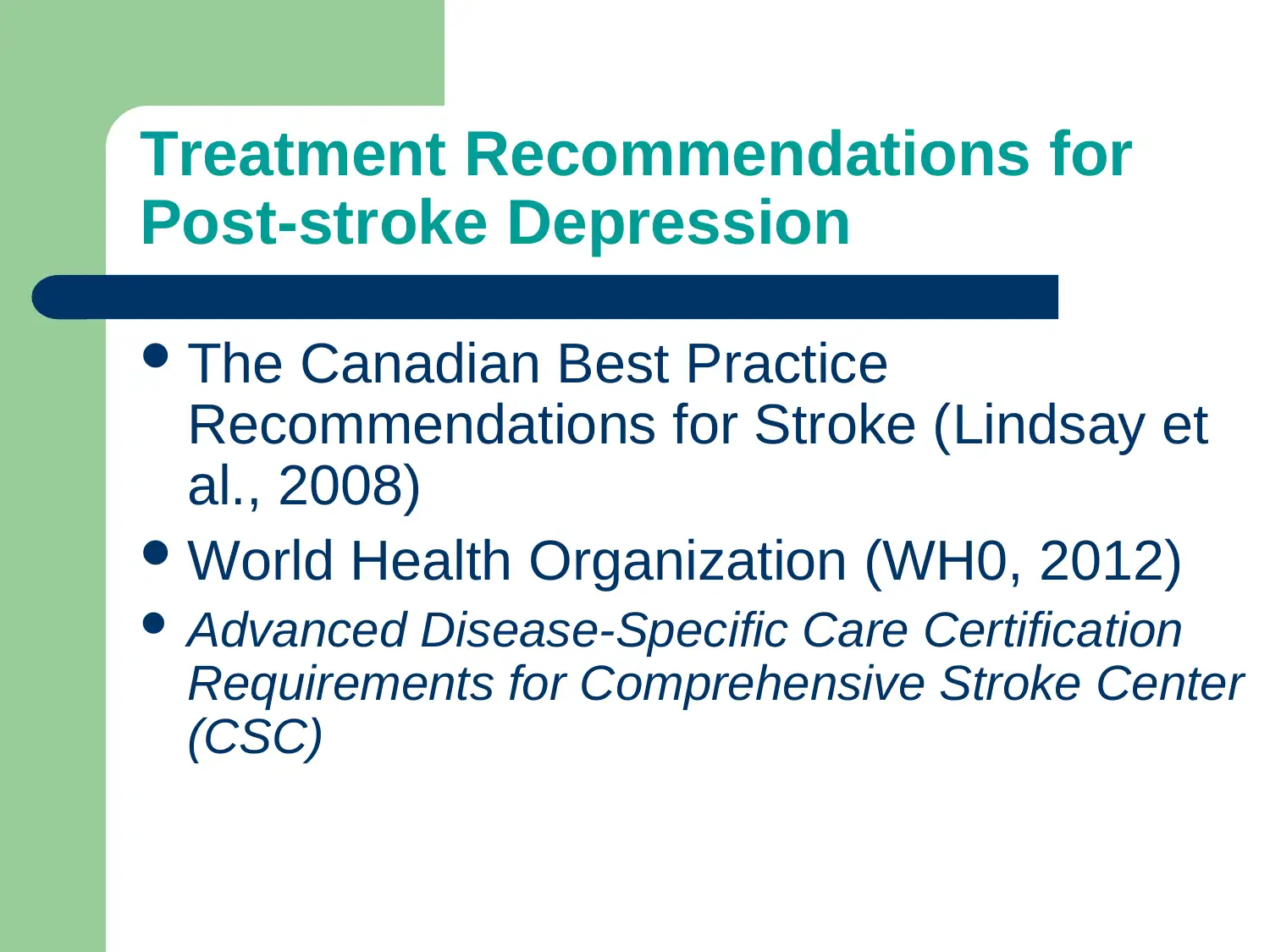
Treatment Recommendations for
Post-stroke Depression
The Canadian Best Practice
Recommendations for Stroke (Lindsay et
al., 2008)
World Health Organization (WH0, 2012)
Advanced Disease-Specific Care Certification
Requirements for Comprehensive Stroke Center
(CSC)
Document Page
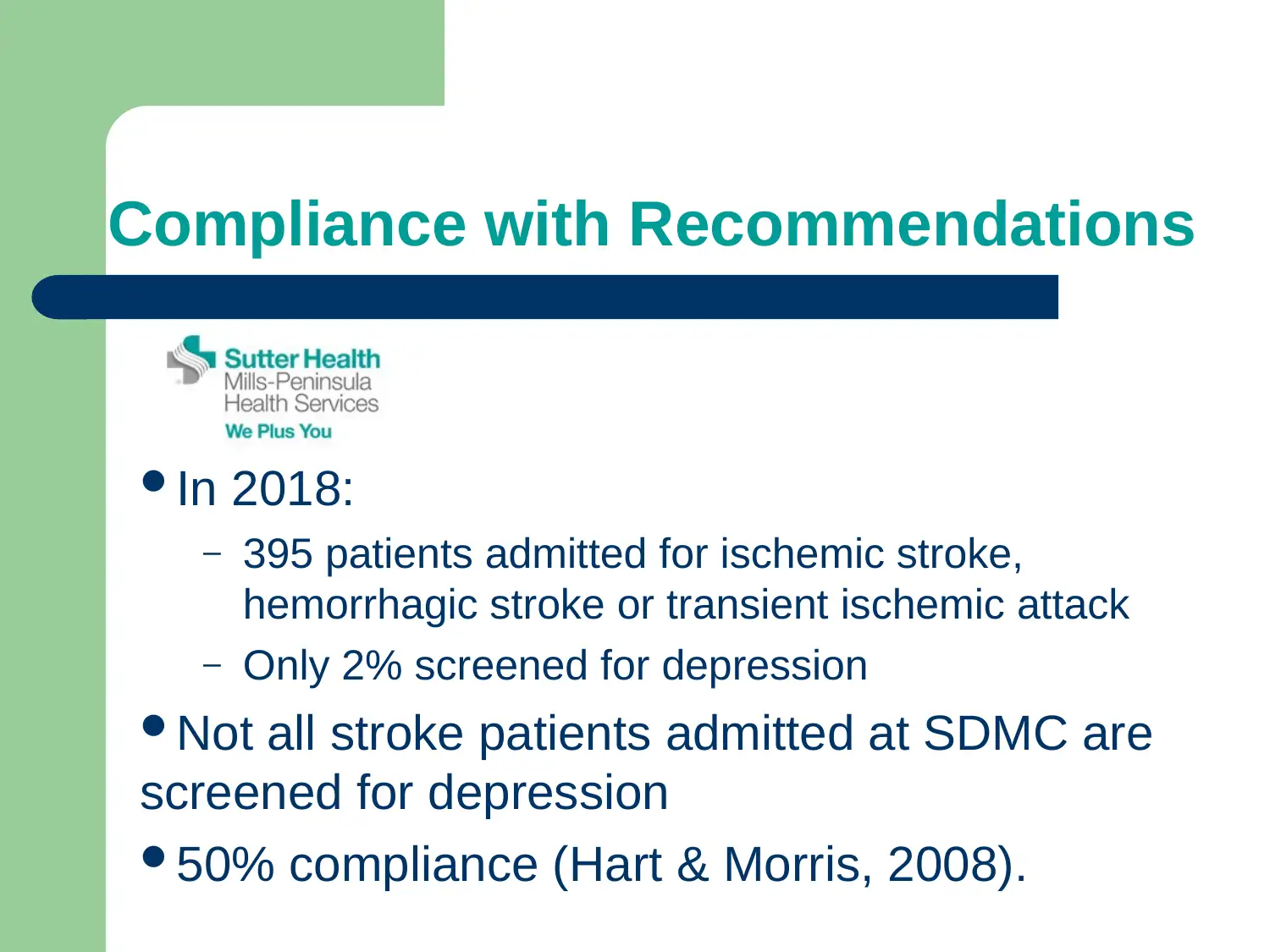
Compliance with Recommendations
In 2018:
395 patients admitted for ischemic stroke,
hemorrhagic stroke or transient ischemic attack
Only 2% screened for depression
Not all stroke patients admitted at SDMC are
screened for depression
50% compliance (Hart & Morris, 2008).
Document Page
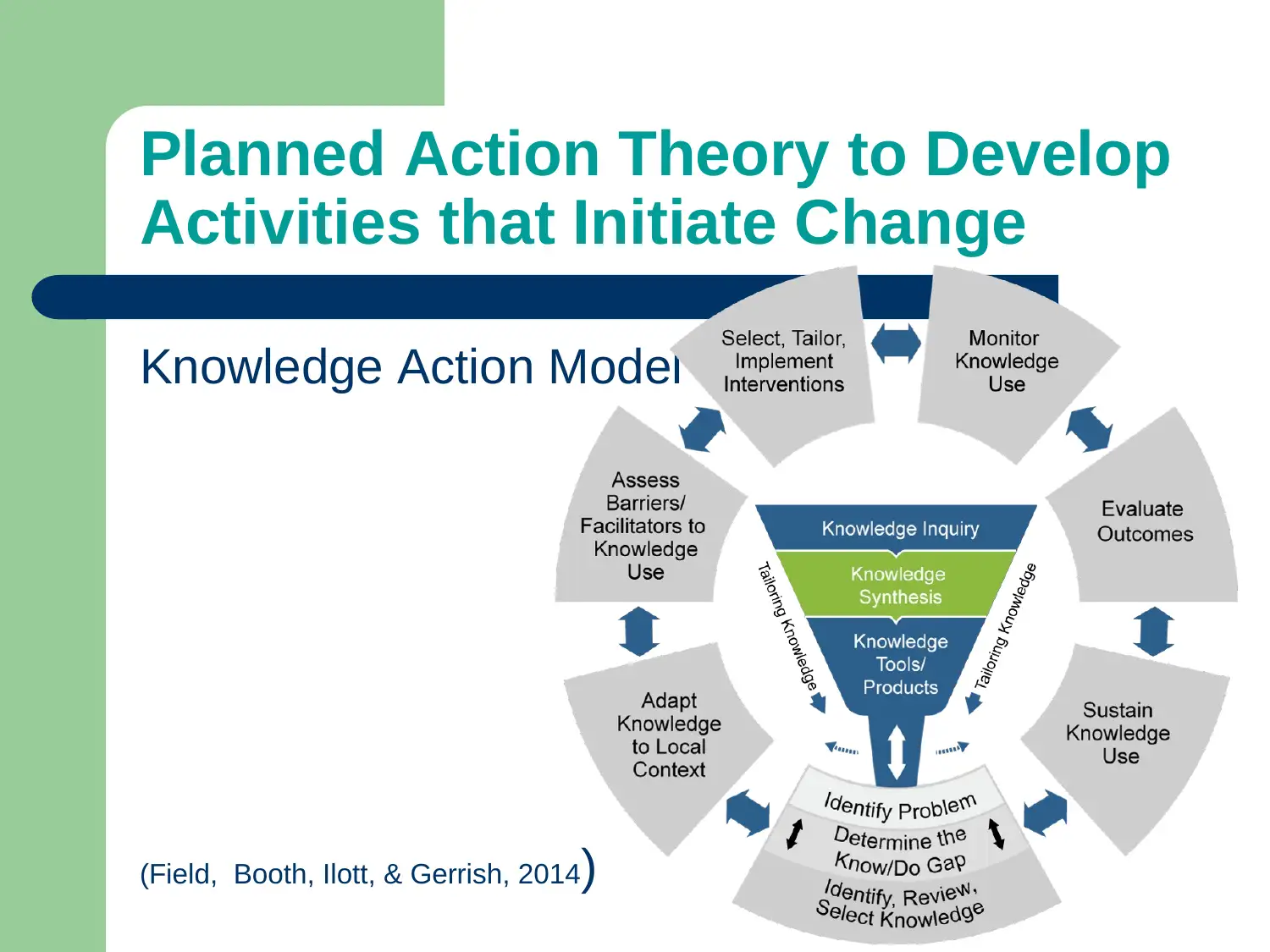
Planned Action Theory to Develop
Activities that Initiate Change
Knowledge Action Model
(Field, Booth, Ilott, & Gerrish, 2014)
tabler-icon-diamond-filled.svg

Paraphrase This Document

Need a fresh take? Get an instant paraphrase of this document with our AI Paraphraser
Document Page
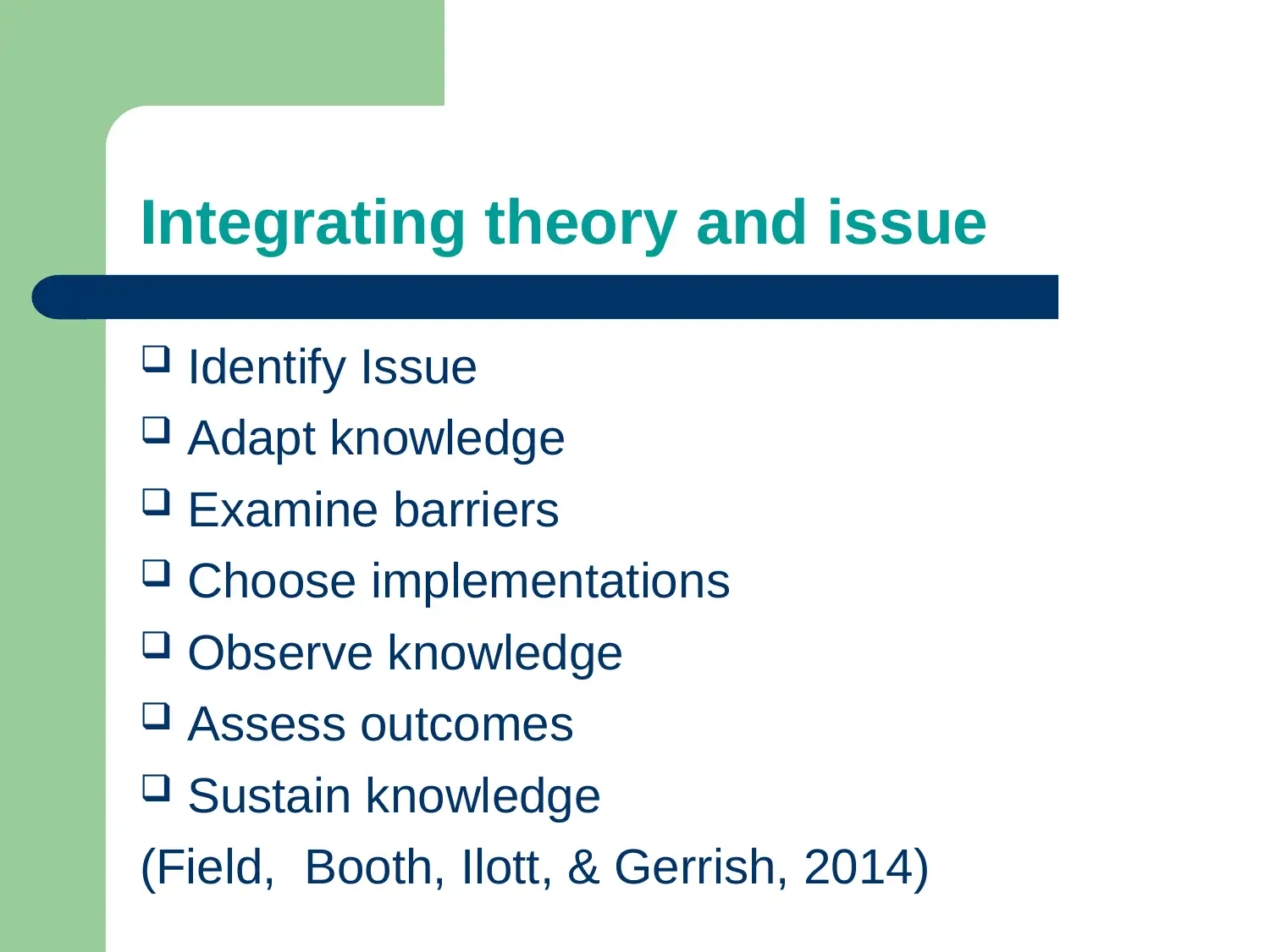
Integrating theory and issue
Identify Issue
Adapt knowledge
Examine barriers
Choose implementations
Observe knowledge
Assess outcomes
Sustain knowledge
(Field, Booth, Ilott, & Gerrish, 2014)
Document Page
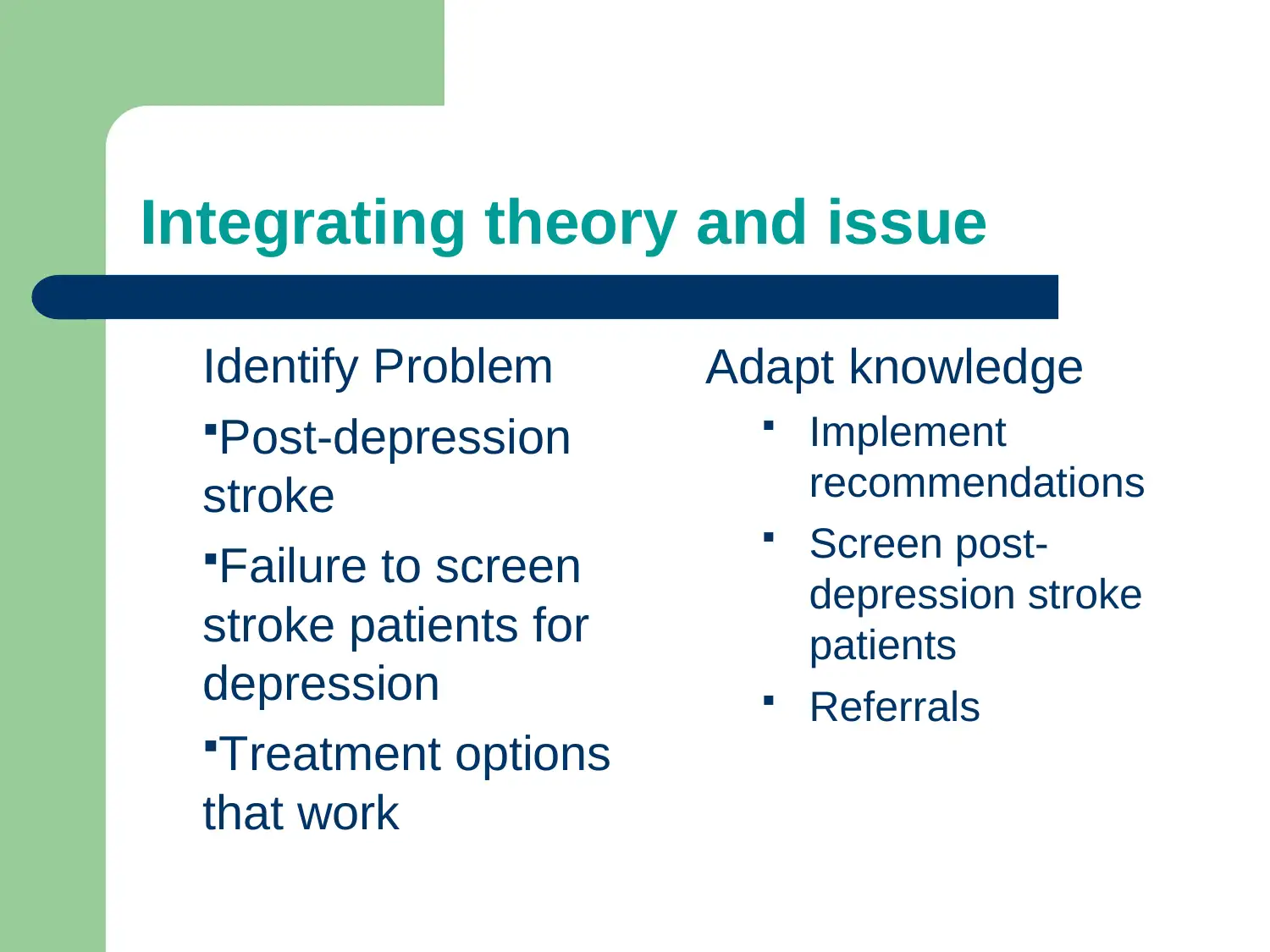
Integrating theory and issue
Identify Problem
Post-depression
stroke
Failure to screen
stroke patients for
depression
Treatment options
that work
Adapt knowledge
Implement
recommendations
Screen post-
depression stroke
patients
Referrals
Document Page
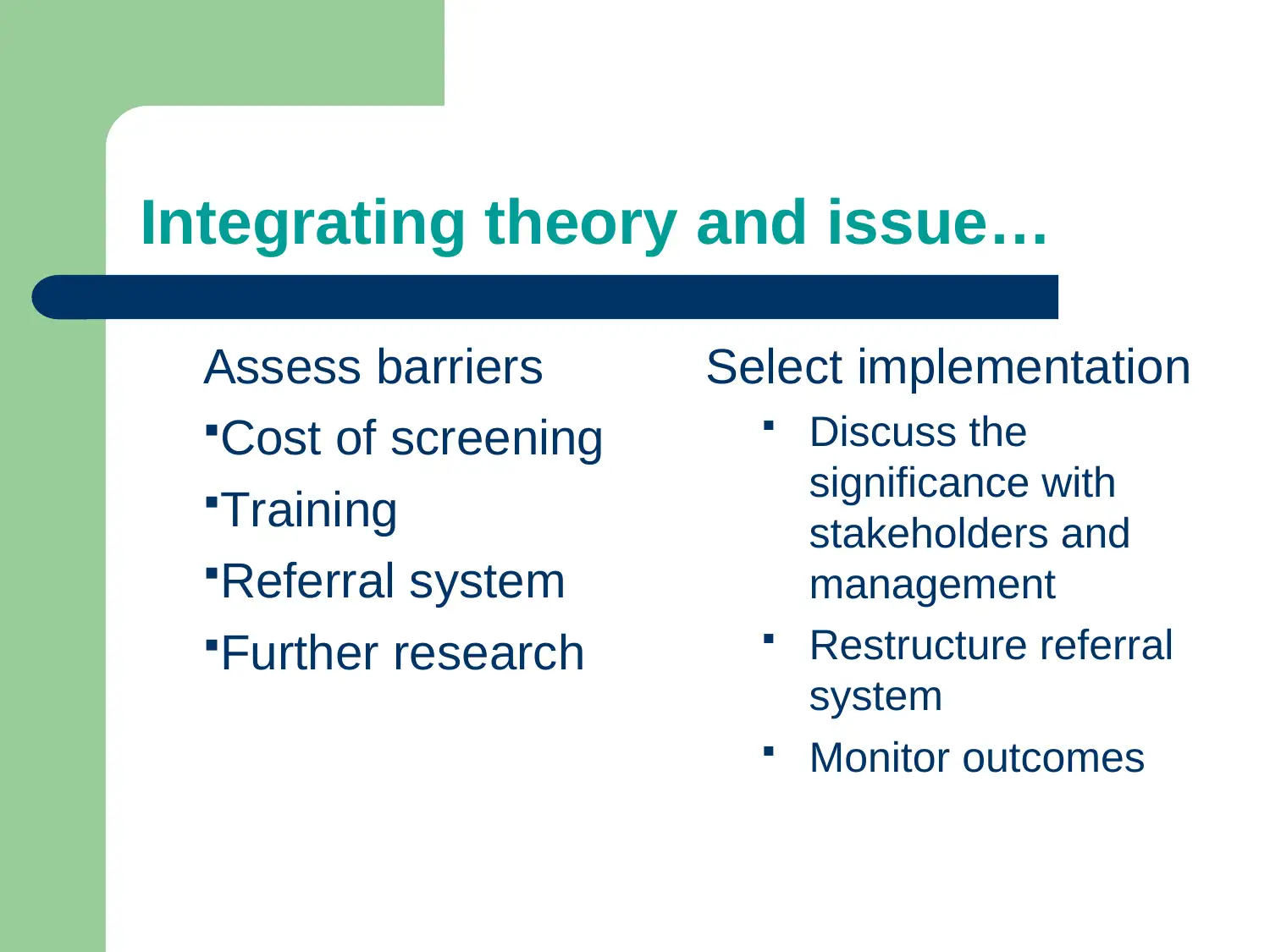
Integrating theory and issue…
Assess barriers
Cost of screening
Training
Referral system
Further research
Select implementation
Discuss the
significance with
stakeholders and
management
Restructure referral
system
Monitor outcomes
tabler-icon-diamond-filled.svg

Paraphrase This Document

Need a fresh take? Get an instant paraphrase of this document with our AI Paraphraser
Document Page
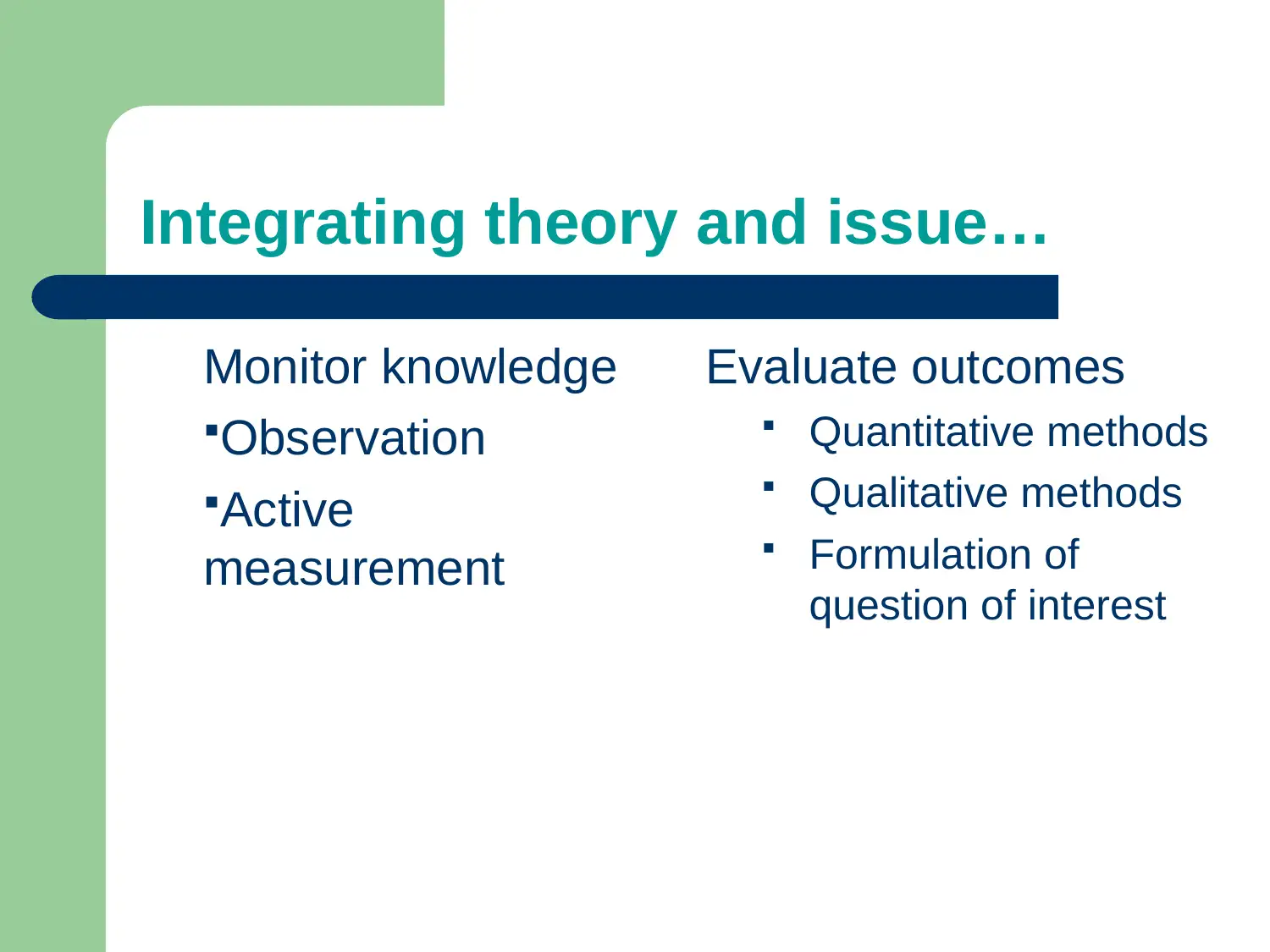
Integrating theory and issue…
Monitor knowledge
Observation
Active
measurement
Evaluate outcomes
Quantitative methods
Qualitative methods
Formulation of
question of interest
Document Page
Integrating theory and issue…
Sustain Knowledge
Resources
Policy integration
Leadership
Benefits and risks
chevron_up_icon
1 out of 16
circle_padding
hide_on_mobile
zoom_out_icon
[object Object]