Postmodern Architecture: Jameson, Jencks, and Quotation
VerifiedAdded on 2023/05/28
|10
|3474
|481
Essay
AI Summary
This essay critically evaluates the concept of 'quotation' within postmodern architecture and design, drawing on the theoretical frameworks of Fredric Jameson and Charles Jencks. The introduction establishes postmodern architecture as a reaction against modernism, highlighting its embrace of diverse styles and historical references. The analysis begins with Jameson's perspective, examining his critique of postmodernism's relationship to history, capitalism, and the blurring of cultural boundaries. The essay then explores Jencks' contributions, focusing on his views on postmodern architecture's continuation of modernism and its embrace of eclecticism. The essay incorporates figures and designs to illustrate the concepts discussed. The essay also analyzes the influence of postmodernism on design principles, including the rejection of pure forms and the adoption of multiple meanings, which is supported by the theories of both Jameson and Jencks. The conclusion synthesizes the key arguments, offering a comprehensive understanding of 'quotation's role in shaping postmodern architectural thought and practice.
Last Name, 1
Student Name, ID
Subject Name, ID
Professor Name
Date
Evaluation of the issue of ‘quotation’ in postmodern architecture and/or design, drawing from
Jameson and Jencks
Introduction
Postmodern architecture emerged as a style or movement which appeared in the 1960s1.
It appeared as a reaction contrary to austerity, lack of variety in modern architecture and
formality. It is an international style that is advocated by Ludwig Mies van der Rohe and Le
Cortbusier. The architecture appeared as a movement, which was introduced through urban
planner and architect Denise Scott Brwon and architectural theorists Robert Venturi. The style
flourished in the period 1980s and 1990s, with new tendencies arising in the 1990s. In the current
scope of analysis the issues of ‘quotation’ in postmodern architecture and design, drawing from
Jameson and Jencks have been evaluated2. Initially works of Jameson was evaluated then Jencks
had been undertaken along with designs. Postmodernism architecture is often perceived as a
failure of modern architecture and communication is done by quoting from past architectural
styles. Works of Jameson and Jencks provides critical insights into the various issues with the
quotation that are included in postmodernism architecture.
Analysis
Fredric Jameson, in the work of the Postmodernism Cultural Logic of Late Capitalism
(1991), analysed the situation particularly of impressive postmodern. As Jean Baudrillard,
believes Jameson is very critical of the current state of our history. He paints a bit dystopically,
especially in connection with the loss of connection with history. According to Jameson,
postmodernity changed the history with the view styling, which can be commercialized. The
result is the risk factors of capitalists against all other thoughts. Jameson's postmodern state was
a great modern state. Although modernism still or faith becomes old, lost and still cannot believe
1 Jean-Christophe Agnew, "Coming up for air: consumer culture in historical perspective." p. 26-
112
2 Ann Bermingham and John Brewer, "Introduction. The consumption of culture: image, object,
text”. p. 102-256
Student Name, ID
Subject Name, ID
Professor Name
Date
Evaluation of the issue of ‘quotation’ in postmodern architecture and/or design, drawing from
Jameson and Jencks
Introduction
Postmodern architecture emerged as a style or movement which appeared in the 1960s1.
It appeared as a reaction contrary to austerity, lack of variety in modern architecture and
formality. It is an international style that is advocated by Ludwig Mies van der Rohe and Le
Cortbusier. The architecture appeared as a movement, which was introduced through urban
planner and architect Denise Scott Brwon and architectural theorists Robert Venturi. The style
flourished in the period 1980s and 1990s, with new tendencies arising in the 1990s. In the current
scope of analysis the issues of ‘quotation’ in postmodern architecture and design, drawing from
Jameson and Jencks have been evaluated2. Initially works of Jameson was evaluated then Jencks
had been undertaken along with designs. Postmodernism architecture is often perceived as a
failure of modern architecture and communication is done by quoting from past architectural
styles. Works of Jameson and Jencks provides critical insights into the various issues with the
quotation that are included in postmodernism architecture.
Analysis
Fredric Jameson, in the work of the Postmodernism Cultural Logic of Late Capitalism
(1991), analysed the situation particularly of impressive postmodern. As Jean Baudrillard,
believes Jameson is very critical of the current state of our history. He paints a bit dystopically,
especially in connection with the loss of connection with history. According to Jameson,
postmodernity changed the history with the view styling, which can be commercialized. The
result is the risk factors of capitalists against all other thoughts. Jameson's postmodern state was
a great modern state. Although modernism still or faith becomes old, lost and still cannot believe
1 Jean-Christophe Agnew, "Coming up for air: consumer culture in historical perspective." p. 26-
112
2 Ann Bermingham and John Brewer, "Introduction. The consumption of culture: image, object,
text”. p. 102-256

Paraphrase This Document
Need a fresh take? Get an instant paraphrase of this document with our AI Paraphraser
Last Name, 2
that an individual can do things that change nature and work to change. Character of certain
zones by Postmodernism lost the distinction between cultures. Jameson postmodernity is of great
expansion in the culture field. Modernism is minimal and products tendentiously critical and
effort to transcendental self nonetheless, make postmodernism a clear victory deregulation in all
areas of life is characterized by postmodernity rely on. After fundamental economic thinking for
post modernity, Jameson continues to determine the number of signs he is associated with the
postmodern state.
Figure 1: Figure by Jameson
History depicted weakening signs, which in turn plays right in the hands of capitalism.
Postmodernism is not dominated culture entirely new social order but only a mirror that
advocates the other structural reforms of capitalism. Jameson instead for recovery story criticizes
history badly in the private configuration3. The difference is high and low culture, as Jameson
expresses various forms of postmodernism ‘in fact fascinated by all landscapes’ seems to be
destroyed by "potholder and kitsch, television programs and readers library, advertising and
guesthouses in the latter series and film called para-literature, airport categories of gothic and
romantic pocket-sized, popular biography, murder site, and sci-fi novel or fantasy. Though the
documents are no longer "accessible" such as Joyce or Mahler, but they are incorporated into
their own material (postmodern).’A new renewed modern theory and a new culture is the image
or simulation space’ (postmodernism) has emerged. This depth of despair naturally supports
3 David R Dickens and Andrea Fontana, Postmodernism and social inquiry. p. 62-95
that an individual can do things that change nature and work to change. Character of certain
zones by Postmodernism lost the distinction between cultures. Jameson postmodernity is of great
expansion in the culture field. Modernism is minimal and products tendentiously critical and
effort to transcendental self nonetheless, make postmodernism a clear victory deregulation in all
areas of life is characterized by postmodernity rely on. After fundamental economic thinking for
post modernity, Jameson continues to determine the number of signs he is associated with the
postmodern state.
Figure 1: Figure by Jameson
History depicted weakening signs, which in turn plays right in the hands of capitalism.
Postmodernism is not dominated culture entirely new social order but only a mirror that
advocates the other structural reforms of capitalism. Jameson instead for recovery story criticizes
history badly in the private configuration3. The difference is high and low culture, as Jameson
expresses various forms of postmodernism ‘in fact fascinated by all landscapes’ seems to be
destroyed by "potholder and kitsch, television programs and readers library, advertising and
guesthouses in the latter series and film called para-literature, airport categories of gothic and
romantic pocket-sized, popular biography, murder site, and sci-fi novel or fantasy. Though the
documents are no longer "accessible" such as Joyce or Mahler, but they are incorporated into
their own material (postmodern).’A new renewed modern theory and a new culture is the image
or simulation space’ (postmodernism) has emerged. This depth of despair naturally supports
3 David R Dickens and Andrea Fontana, Postmodernism and social inquiry. p. 62-95
Last Name, 3
point depth of despair appears in the letter levels (two-dimensional displays, skyscrapers full of
glass windows) and qualitative surface visibility. The theory manifests postmodern rejection of
the conviction that one can go to the surface of ideology or false consciousness to reach deeper
truth.
Figure 2: Figure by Jameson
The first thing to organize gathered on earth is that even if all elements of postmodernity
are the same and agreed on the former modernity a situation seems to be obvious. Only a more
complete analysis of modernity destroys the two phenomena of having a perfectly pure anti-
social function because it is in very different positions a postmodern economic culture system in
modern society. The postmodern concept described here is more historical than pure style. He
cannot stress too much. The radical difference between the postmodern perspectives is the style
(optional) many available and made for the dominant culture to understand the logic of
capitalism; the two methods produce two very different ways to grasp the phenomena. In
general, however, a moral judgment (whether positive or negative) and a true dialect on the other
hand. Some positive moral value judgments are little need, postmodernity, for example, a happy
face but misleading after the end of this new aesthetic of the world including the social and
economic dimensions, Jameson referred to the as enthusiastic title post-industrial society
completely unacceptable. Although the damage can be less clear with the power of imagination.
High-tech features the rescue robot chips have fun not only left and right of the governments of
point depth of despair appears in the letter levels (two-dimensional displays, skyscrapers full of
glass windows) and qualitative surface visibility. The theory manifests postmodern rejection of
the conviction that one can go to the surface of ideology or false consciousness to reach deeper
truth.
Figure 2: Figure by Jameson
The first thing to organize gathered on earth is that even if all elements of postmodernity
are the same and agreed on the former modernity a situation seems to be obvious. Only a more
complete analysis of modernity destroys the two phenomena of having a perfectly pure anti-
social function because it is in very different positions a postmodern economic culture system in
modern society. The postmodern concept described here is more historical than pure style. He
cannot stress too much. The radical difference between the postmodern perspectives is the style
(optional) many available and made for the dominant culture to understand the logic of
capitalism; the two methods produce two very different ways to grasp the phenomena. In
general, however, a moral judgment (whether positive or negative) and a true dialect on the other
hand. Some positive moral value judgments are little need, postmodernity, for example, a happy
face but misleading after the end of this new aesthetic of the world including the social and
economic dimensions, Jameson referred to the as enthusiastic title post-industrial society
completely unacceptable. Although the damage can be less clear with the power of imagination.
High-tech features the rescue robot chips have fun not only left and right of the governments of
⊘ This is a preview!⊘
Do you want full access?
Subscribe today to unlock all pages.

Trusted by 1+ million students worldwide
Last Name, 4
the problems, but in the bottom, many mental fantasies: the ground, post modernized often
forgives, especially in parts.
In case one only harms because it reflects the moral condemnation of the postmodern and
great severity, if juxtaposed against a very serious the great utopian modern man will judge the
radical left and right. And certainly, a logic simulator that changes the old reality television
picture, rather than just trying to copy it from the latest capitalist logic. It reinforces and
improves it. At the same time, political groups are actively involved in history and change the
dynamics of a passive opposite they can be transferred to another recreation regressive fantasies,
some past fantasies on social regeneration, which can only be a destructive and reprehensible
form of image culture. Employees of the visual turn in the past, the stereotypical text or a mirage,
the effective removal does not have practical sense in the future and joint projects, future
changes in thinking, simple inexplicable disasters and disasters, terror vision social level to
disastrous levels in humans personally4. But if postmodernism is a historical phenomenon, and
one should try to understand that what moral reasoning is, or a moralist finally identifies the
category. Each clarified when asked for cultural and critic station moralists. Most are occupied
with postmodern space, so heavily involved in both by infecting new cultural categories, luxury
critics of the old ideology, the evil moral destruction of others is not available.
The difference that he proposed, there is a single canonical form of differentiation of the
concept of individual moral or moral harm in the world get to know, which is very different from
the practice of social responsibility and values of Hegel. But he took shape in a concrete
manifestation of the dialectic of Marx, especially on classical pages shows that the hard lessons
of different dialectics rightly experience the historical evolution and change instead. The subject
of this lesson, of course, is the historical development of capitalism and the spread of certain
civilian cultures. In the famous part, Marx invites us to make it impossible to look at these
positive and negative developments. In other words, think of the way in which they break
capitalism as extremely dynamic and at the same time without affecting the mind's function of
the second potency of the study. We must somehow increase our thoughts to the point where it
can be, to understand that capitalism is at the same time the best thing that has happened to
people and the worst. The progress of this difficult dialect is important for the prevailing moral
status and the humanitarian attitude. However, the urgency of the problem requires damage.
4 Henry A. Giroux, Colin Lankshear, Peter McLaren, and Michael Peters, Counternarratives:
Cultural studies and critical pedagogies in postmodern spaces. p.202-272
the problems, but in the bottom, many mental fantasies: the ground, post modernized often
forgives, especially in parts.
In case one only harms because it reflects the moral condemnation of the postmodern and
great severity, if juxtaposed against a very serious the great utopian modern man will judge the
radical left and right. And certainly, a logic simulator that changes the old reality television
picture, rather than just trying to copy it from the latest capitalist logic. It reinforces and
improves it. At the same time, political groups are actively involved in history and change the
dynamics of a passive opposite they can be transferred to another recreation regressive fantasies,
some past fantasies on social regeneration, which can only be a destructive and reprehensible
form of image culture. Employees of the visual turn in the past, the stereotypical text or a mirage,
the effective removal does not have practical sense in the future and joint projects, future
changes in thinking, simple inexplicable disasters and disasters, terror vision social level to
disastrous levels in humans personally4. But if postmodernism is a historical phenomenon, and
one should try to understand that what moral reasoning is, or a moralist finally identifies the
category. Each clarified when asked for cultural and critic station moralists. Most are occupied
with postmodern space, so heavily involved in both by infecting new cultural categories, luxury
critics of the old ideology, the evil moral destruction of others is not available.
The difference that he proposed, there is a single canonical form of differentiation of the
concept of individual moral or moral harm in the world get to know, which is very different from
the practice of social responsibility and values of Hegel. But he took shape in a concrete
manifestation of the dialectic of Marx, especially on classical pages shows that the hard lessons
of different dialectics rightly experience the historical evolution and change instead. The subject
of this lesson, of course, is the historical development of capitalism and the spread of certain
civilian cultures. In the famous part, Marx invites us to make it impossible to look at these
positive and negative developments. In other words, think of the way in which they break
capitalism as extremely dynamic and at the same time without affecting the mind's function of
the second potency of the study. We must somehow increase our thoughts to the point where it
can be, to understand that capitalism is at the same time the best thing that has happened to
people and the worst. The progress of this difficult dialect is important for the prevailing moral
status and the humanitarian attitude. However, the urgency of the problem requires damage.
4 Henry A. Giroux, Colin Lankshear, Peter McLaren, and Michael Peters, Counternarratives:
Cultural studies and critical pedagogies in postmodern spaces. p.202-272
Paraphrase This Document
Need a fresh take? Get an instant paraphrase of this document with our AI Paraphraser
Last Name, 5
Some face difficulty in developing the capitalism of the cultural dialect capitalism with disasters
and books.
Such an effort proposes two immediate problems that conclude these reflections. There is
no end with the dialectical concept of historical development as mentioned; is it not normal for
us to go out of fashion and go systematically to passivity and impotence, to destroy the
possibilities of action of the impenetrable fog of historical inevitability. It is necessary to discuss
the thesis of two (related) problems related to the current possibilities of establishing effective
contemporary cultural policies and to build a real political culture5. The problems thus tackled
are, of course, more immediate and deal with real issues, such as the future of the cultural gene
and the function of culture as a social level or, for example, in the postmodern era. It is an
immediate change in your social function. Previous discussions about space, function or culture
especially Herbert Marcuse's classic essay on the culture of character, emphasized that there is
another language called "semi-autonomy" in the cultural field. There is a dreadful but utopian
existence of good and bad, its mirror image refers to a form of flattering legitimacy that
resembles a contentious demand for critical satire or utopian pain.
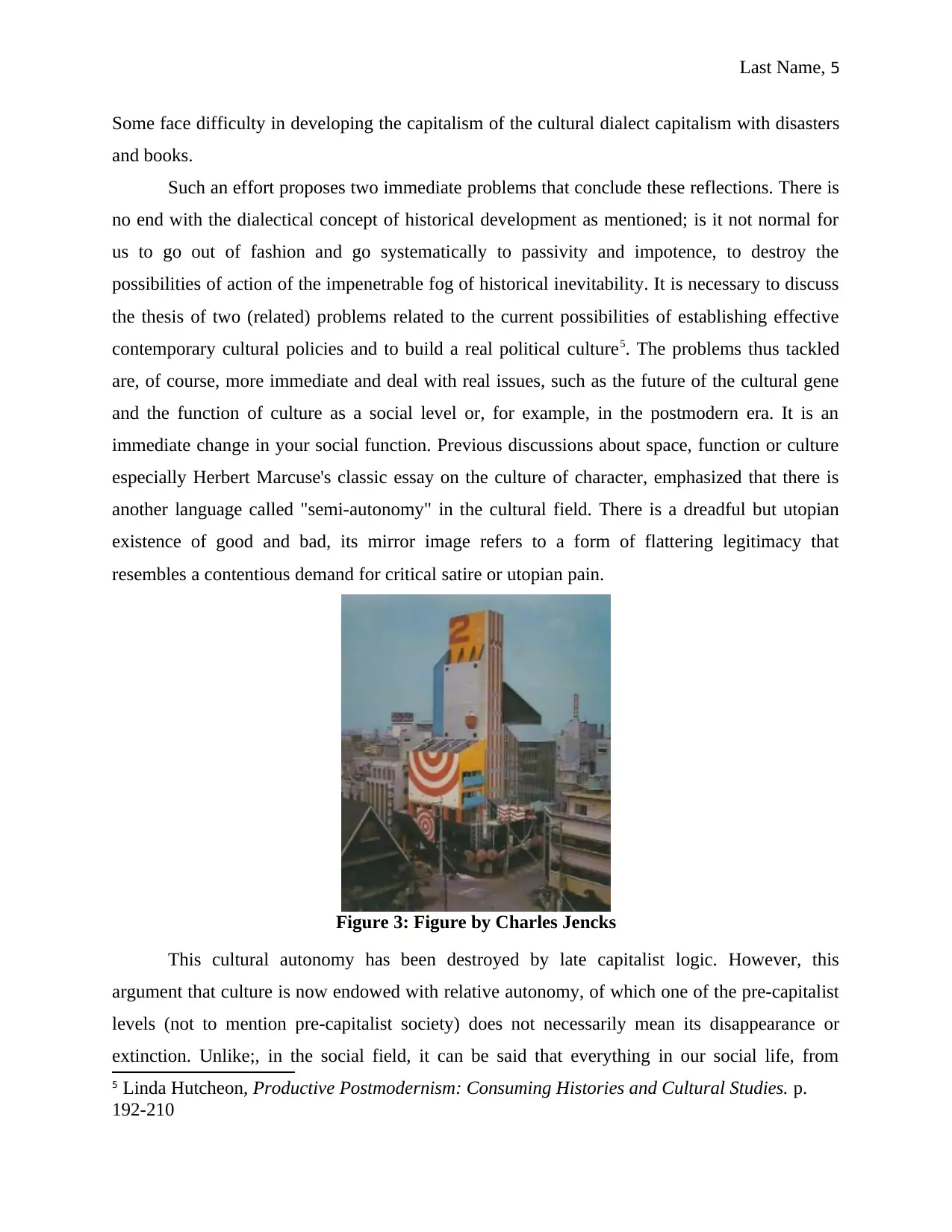
Figure 3: Figure by Charles Jencks
This cultural autonomy has been destroyed by late capitalist logic. However, this
argument that culture is now endowed with relative autonomy, of which one of the pre-capitalist
levels (not to mention pre-capitalist society) does not necessarily mean its disappearance or
extinction. Unlike;, in the social field, it can be said that everything in our social life, from
5 Linda Hutcheon, Productive Postmodernism: Consuming Histories and Cultural Studies. p.
192-210
Some face difficulty in developing the capitalism of the cultural dialect capitalism with disasters
and books.
Such an effort proposes two immediate problems that conclude these reflections. There is
no end with the dialectical concept of historical development as mentioned; is it not normal for
us to go out of fashion and go systematically to passivity and impotence, to destroy the
possibilities of action of the impenetrable fog of historical inevitability. It is necessary to discuss
the thesis of two (related) problems related to the current possibilities of establishing effective
contemporary cultural policies and to build a real political culture5. The problems thus tackled
are, of course, more immediate and deal with real issues, such as the future of the cultural gene
and the function of culture as a social level or, for example, in the postmodern era. It is an
immediate change in your social function. Previous discussions about space, function or culture
especially Herbert Marcuse's classic essay on the culture of character, emphasized that there is
another language called "semi-autonomy" in the cultural field. There is a dreadful but utopian
existence of good and bad, its mirror image refers to a form of flattering legitimacy that
resembles a contentious demand for critical satire or utopian pain.
Figure 3: Figure by Charles Jencks
This cultural autonomy has been destroyed by late capitalist logic. However, this
argument that culture is now endowed with relative autonomy, of which one of the pre-capitalist
levels (not to mention pre-capitalist society) does not necessarily mean its disappearance or
extinction. Unlike;, in the social field, it can be said that everything in our social life, from
5 Linda Hutcheon, Productive Postmodernism: Consuming Histories and Cultural Studies. p.
192-210
Last Name, 6
economic value to state power, through the very practice of the psyche, has become ‘cultural’ in
an original and theorized sense. But this law is really complete according to the previous
diagnosis of image or symmetry and the ‘real’ transformation in pseudo-actions.
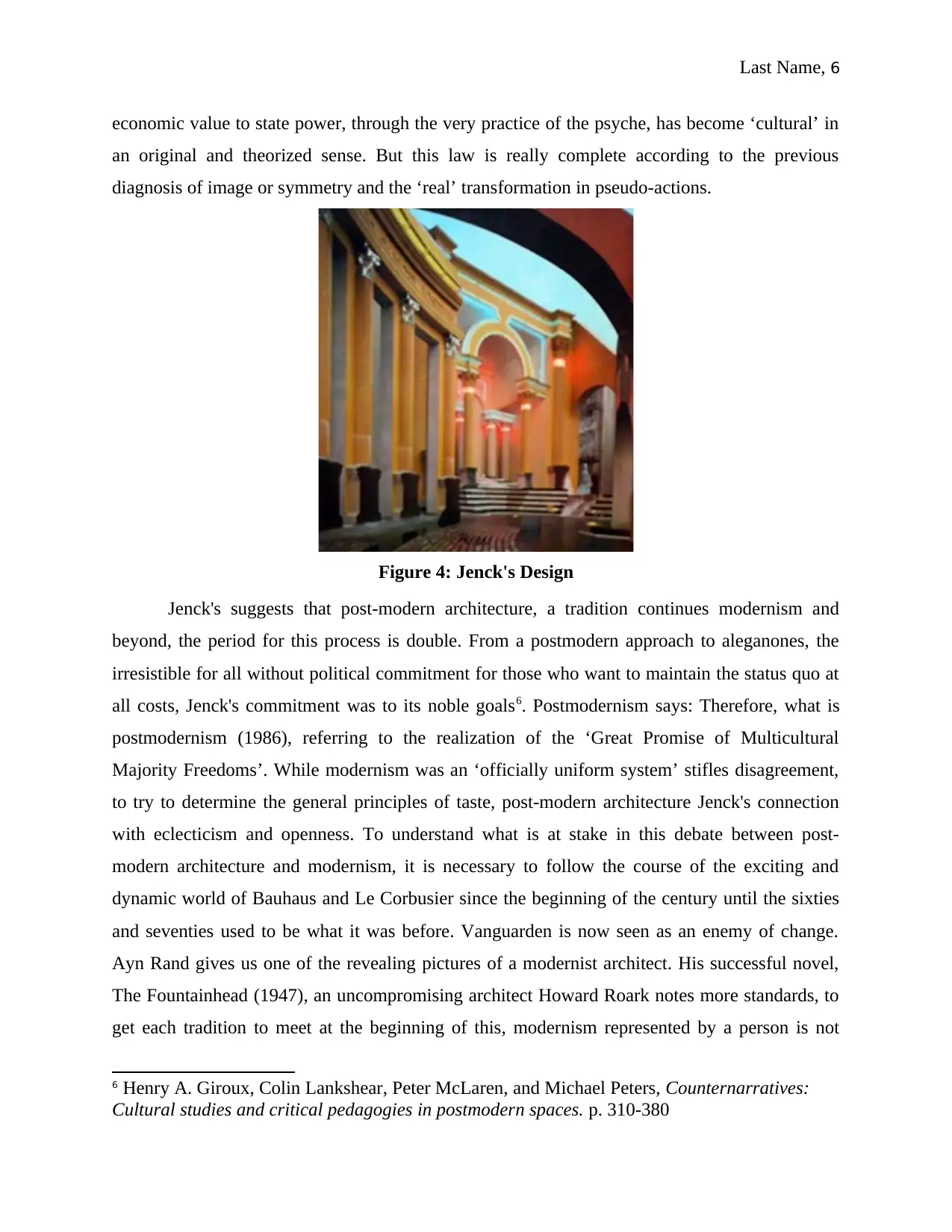
Figure 4: Jenck's Design
Jenck's suggests that post-modern architecture, a tradition continues modernism and
beyond, the period for this process is double. From a postmodern approach to aleganones, the
irresistible for all without political commitment for those who want to maintain the status quo at
all costs, Jenck's commitment was to its noble goals6. Postmodernism says: Therefore, what is
postmodernism (1986), referring to the realization of the ‘Great Promise of Multicultural
Majority Freedoms’. While modernism was an ‘officially uniform system’ stifles disagreement,
to try to determine the general principles of taste, post-modern architecture Jenck's connection
with eclecticism and openness. To understand what is at stake in this debate between post-
modern architecture and modernism, it is necessary to follow the course of the exciting and
dynamic world of Bauhaus and Le Corbusier since the beginning of the century until the sixties
and seventies used to be what it was before. Vanguarden is now seen as an enemy of change.
Ayn Rand gives us one of the revealing pictures of a modernist architect. His successful novel,
The Fountainhead (1947), an uncompromising architect Howard Roark notes more standards, to
get each tradition to meet at the beginning of this, modernism represented by a person is not
6 Henry A. Giroux, Colin Lankshear, Peter McLaren, and Michael Peters, Counternarratives:
Cultural studies and critical pedagogies in postmodern spaces. p. 310-380
economic value to state power, through the very practice of the psyche, has become ‘cultural’ in
an original and theorized sense. But this law is really complete according to the previous
diagnosis of image or symmetry and the ‘real’ transformation in pseudo-actions.
Figure 4: Jenck's Design
Jenck's suggests that post-modern architecture, a tradition continues modernism and
beyond, the period for this process is double. From a postmodern approach to aleganones, the
irresistible for all without political commitment for those who want to maintain the status quo at
all costs, Jenck's commitment was to its noble goals6. Postmodernism says: Therefore, what is
postmodernism (1986), referring to the realization of the ‘Great Promise of Multicultural
Majority Freedoms’. While modernism was an ‘officially uniform system’ stifles disagreement,
to try to determine the general principles of taste, post-modern architecture Jenck's connection
with eclecticism and openness. To understand what is at stake in this debate between post-
modern architecture and modernism, it is necessary to follow the course of the exciting and
dynamic world of Bauhaus and Le Corbusier since the beginning of the century until the sixties
and seventies used to be what it was before. Vanguarden is now seen as an enemy of change.
Ayn Rand gives us one of the revealing pictures of a modernist architect. His successful novel,
The Fountainhead (1947), an uncompromising architect Howard Roark notes more standards, to
get each tradition to meet at the beginning of this, modernism represented by a person is not
6 Henry A. Giroux, Colin Lankshear, Peter McLaren, and Michael Peters, Counternarratives:
Cultural studies and critical pedagogies in postmodern spaces. p. 310-380
⊘ This is a preview!⊘
Do you want full access?
Subscribe today to unlock all pages.
Trusted by 1+ million students worldwide
Last Name, 7
willing to customize their projects for the tastes of the audience. Prior to their time, individuals
were not satisfied with the massive demands of the recession because classic buildings simulated
pilastre, rolled and passed the leaves, buildings in absolute need for recognition. That
democracy, differences in negotiations are to match creativity.
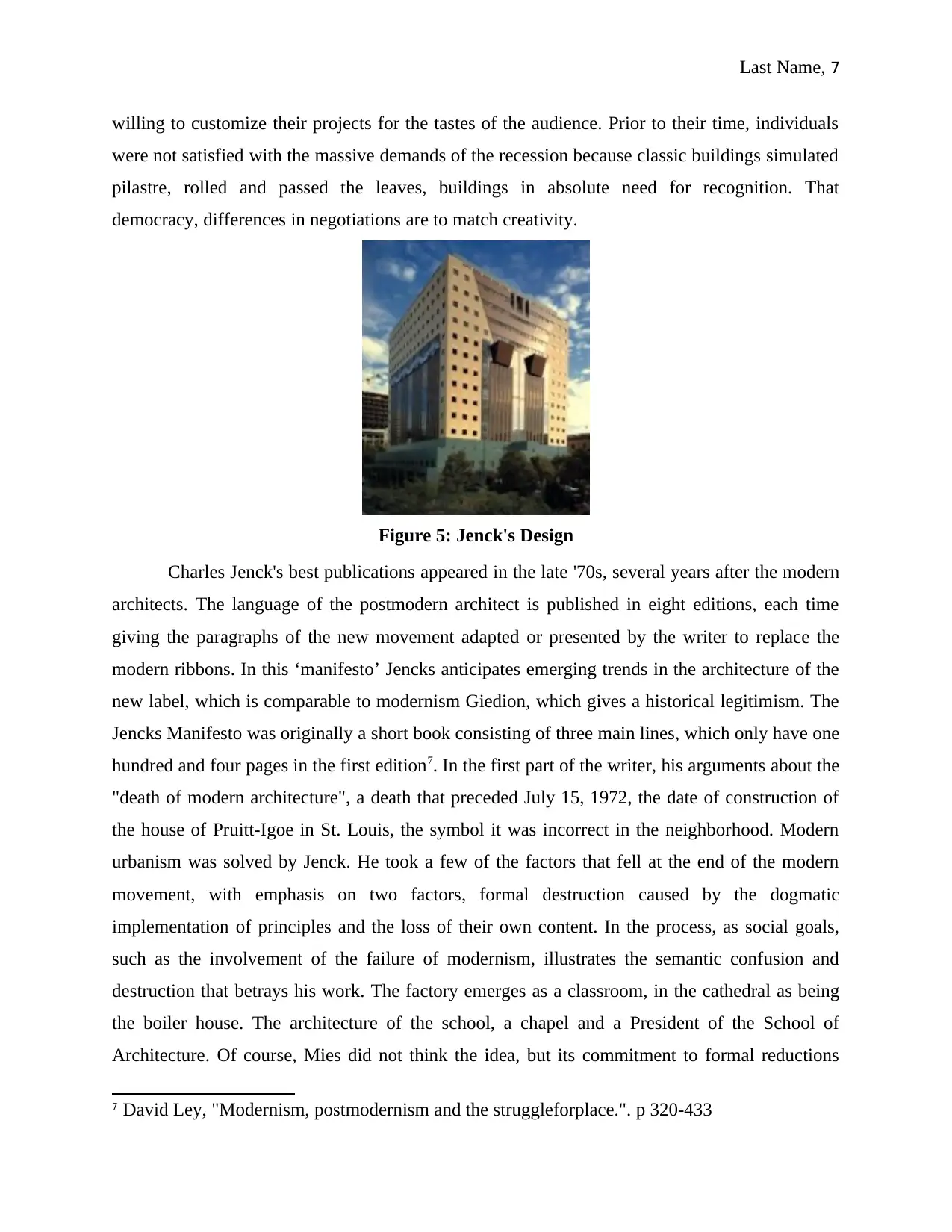
Figure 5: Jenck's Design
Charles Jenck's best publications appeared in the late '70s, several years after the modern
architects. The language of the postmodern architect is published in eight editions, each time
giving the paragraphs of the new movement adapted or presented by the writer to replace the
modern ribbons. In this ‘manifesto’ Jencks anticipates emerging trends in the architecture of the
new label, which is comparable to modernism Giedion, which gives a historical legitimism. The
Jencks Manifesto was originally a short book consisting of three main lines, which only have one
hundred and four pages in the first edition7. In the first part of the writer, his arguments about the
"death of modern architecture", a death that preceded July 15, 1972, the date of construction of
the house of Pruitt-Igoe in St. Louis, the symbol it was incorrect in the neighborhood. Modern
urbanism was solved by Jenck. He took a few of the factors that fell at the end of the modern
movement, with emphasis on two factors, formal destruction caused by the dogmatic
implementation of principles and the loss of their own content. In the process, as social goals,
such as the involvement of the failure of modernism, illustrates the semantic confusion and
destruction that betrays his work. The factory emerges as a classroom, in the cathedral as being
the boiler house. The architecture of the school, a chapel and a President of the School of
Architecture. Of course, Mies did not think the idea, but its commitment to formal reductions
7 David Ley, "Modernism, postmodernism and the struggleforplace.". p 320-433
willing to customize their projects for the tastes of the audience. Prior to their time, individuals
were not satisfied with the massive demands of the recession because classic buildings simulated
pilastre, rolled and passed the leaves, buildings in absolute need for recognition. That
democracy, differences in negotiations are to match creativity.
Figure 5: Jenck's Design
Charles Jenck's best publications appeared in the late '70s, several years after the modern
architects. The language of the postmodern architect is published in eight editions, each time
giving the paragraphs of the new movement adapted or presented by the writer to replace the
modern ribbons. In this ‘manifesto’ Jencks anticipates emerging trends in the architecture of the
new label, which is comparable to modernism Giedion, which gives a historical legitimism. The
Jencks Manifesto was originally a short book consisting of three main lines, which only have one
hundred and four pages in the first edition7. In the first part of the writer, his arguments about the
"death of modern architecture", a death that preceded July 15, 1972, the date of construction of
the house of Pruitt-Igoe in St. Louis, the symbol it was incorrect in the neighborhood. Modern
urbanism was solved by Jenck. He took a few of the factors that fell at the end of the modern
movement, with emphasis on two factors, formal destruction caused by the dogmatic
implementation of principles and the loss of their own content. In the process, as social goals,
such as the involvement of the failure of modernism, illustrates the semantic confusion and
destruction that betrays his work. The factory emerges as a classroom, in the cathedral as being
the boiler house. The architecture of the school, a chapel and a President of the School of
Architecture. Of course, Mies did not think the idea, but its commitment to formal reductions
7 David Ley, "Modernism, postmodernism and the struggleforplace.". p 320-433
Paraphrase This Document
Need a fresh take? Get an instant paraphrase of this document with our AI Paraphraser
Last Name, 8
betrays them. Some reformers also have goodwill projects for their ability to recover. Delay
connections between architecture and their audience, and ultimately "unable to speak" in
readable language has also been noted. As in the case of Alison and Peter Smithson, who offer
their project Robin Hood Gardens, focus on the community building of individual expressions
and identities, but they do not reach the goal. Repenting at the loss of interest in public projects,
the architects who have changed the accepted social values of injuries are those who criticize
Jencks. This is, for example, the case of Venturi, which states that this condition is found in his
dictatorship "Main Street is almost all right". Consumer Rating provides opportunity for
investment by visualization of values. For Jenck, the modern movement has taken into account
commercial interests that have provided their forms of original content a social care8. Until
members Semitism in the west and the capital of the state co-architect have no choice but to
restore a specific target for their jobs, but the use of a cultural language. The heroes of the
modernists to create a universal language to achieve and promote reverential social goals are
clearly misunderstood. After this diagnostic of what was wronged in architecture, Jencks in the
second chapter ‘modes of architectural communications’ largely based on his previous semiotic
interpretations in architecture.
Jencks began with the first episode of architecture, statue, with a series of images that
show how architects and the public can read projects. An example of the Sydney Opera House is
an indication of its abundance, which leads to different plans for the height of the home in
education and the public. Jencks recognizes another special model of Venturi, new and
decorative barrier for communication: Clear Sydney Opera House is Venturi's duck and wants to
play this form of expression because it feels an exaggerated modern activity9. He would not
approve this historical judgment, and there were more exceptions from the rest that strengthened.
Venturi, a typical modernist who wants to ban, use only the investment method. To avoid the
field of architectural relationships, retro-engineering (the symbol) is the preferred form,
ornamental tones (symbolic characters) are very powerful. Jencks explains the philosophy of
flexibility and tones. The more dramatic and invoking, the more the mysterious metaphor that all
Shakespeare students know, but they like sausages since giant sausages end up on all levels, but
they are not considered a rich source of images, but he do like a duck. A duck so complex with a
bad image, the terminal TWA of Saarinen rises as a ‘flight’ through its formal and local
8 Brian McHale, Constructing postmodernism. p 360-480
9 Hugh J. Silverman, Postmodernism: Philosophy and the arts. p. 370-492
betrays them. Some reformers also have goodwill projects for their ability to recover. Delay
connections between architecture and their audience, and ultimately "unable to speak" in
readable language has also been noted. As in the case of Alison and Peter Smithson, who offer
their project Robin Hood Gardens, focus on the community building of individual expressions
and identities, but they do not reach the goal. Repenting at the loss of interest in public projects,
the architects who have changed the accepted social values of injuries are those who criticize
Jencks. This is, for example, the case of Venturi, which states that this condition is found in his
dictatorship "Main Street is almost all right". Consumer Rating provides opportunity for
investment by visualization of values. For Jenck, the modern movement has taken into account
commercial interests that have provided their forms of original content a social care8. Until
members Semitism in the west and the capital of the state co-architect have no choice but to
restore a specific target for their jobs, but the use of a cultural language. The heroes of the
modernists to create a universal language to achieve and promote reverential social goals are
clearly misunderstood. After this diagnostic of what was wronged in architecture, Jencks in the
second chapter ‘modes of architectural communications’ largely based on his previous semiotic
interpretations in architecture.
Jencks began with the first episode of architecture, statue, with a series of images that
show how architects and the public can read projects. An example of the Sydney Opera House is
an indication of its abundance, which leads to different plans for the height of the home in
education and the public. Jencks recognizes another special model of Venturi, new and
decorative barrier for communication: Clear Sydney Opera House is Venturi's duck and wants to
play this form of expression because it feels an exaggerated modern activity9. He would not
approve this historical judgment, and there were more exceptions from the rest that strengthened.
Venturi, a typical modernist who wants to ban, use only the investment method. To avoid the
field of architectural relationships, retro-engineering (the symbol) is the preferred form,
ornamental tones (symbolic characters) are very powerful. Jencks explains the philosophy of
flexibility and tones. The more dramatic and invoking, the more the mysterious metaphor that all
Shakespeare students know, but they like sausages since giant sausages end up on all levels, but
they are not considered a rich source of images, but he do like a duck. A duck so complex with a
bad image, the terminal TWA of Saarinen rises as a ‘flight’ through its formal and local
8 Brian McHale, Constructing postmodernism. p 360-480
9 Hugh J. Silverman, Postmodernism: Philosophy and the arts. p. 370-492
Last Name, 9
characteristics10. Le Corbusier’s Chapel is an example to handle with this beautiful bell the water
of the boat, the hands in prayer, the nun or the hat with a rich staff.
Conclusion
Jameson provides in-depth criticism of the quotations from postmodernism architectural
era. Jencks also touches other aspects of architecture namely, words, syntax, and semantics. He
has analyzed words in this case, with elements such as doors, windows, columns, partitions, and
so on. This means that these factors place the origin. Also, digital interpretation is available to
identify symbols, symbols, and indicators. The work and syntax of the Michael Graves works,
Eisenman’s games, curve and, finally, the process are known to confuse the mind. For Jencks, it
is obvious that the decrease of language in one of its synonyms or semantic variables does not
create absolute communication. The modern architecture has developed own brand technology,
even if it is based on a personal style and a different architect describes the monotonous language
that expresses no variety of styles.
Bibliography
Agnew, Jean-Christophe. "Coming up for air: consumer culture in historical perspective."
In Consumption and the World of Goods, pp. 41-61. Routledge, 2013.
Bermingham, Ann, and John Brewer. "Introduction. The consumption of culture: image, object,
text." In Consumption Of Culture, pp. 17-36. Routledge, 2013.
10 Thomas Docherty, Postmodernism: A reader. p.415-525
characteristics10. Le Corbusier’s Chapel is an example to handle with this beautiful bell the water
of the boat, the hands in prayer, the nun or the hat with a rich staff.
Conclusion
Jameson provides in-depth criticism of the quotations from postmodernism architectural
era. Jencks also touches other aspects of architecture namely, words, syntax, and semantics. He
has analyzed words in this case, with elements such as doors, windows, columns, partitions, and
so on. This means that these factors place the origin. Also, digital interpretation is available to
identify symbols, symbols, and indicators. The work and syntax of the Michael Graves works,
Eisenman’s games, curve and, finally, the process are known to confuse the mind. For Jencks, it
is obvious that the decrease of language in one of its synonyms or semantic variables does not
create absolute communication. The modern architecture has developed own brand technology,
even if it is based on a personal style and a different architect describes the monotonous language
that expresses no variety of styles.
Bibliography
Agnew, Jean-Christophe. "Coming up for air: consumer culture in historical perspective."
In Consumption and the World of Goods, pp. 41-61. Routledge, 2013.
Bermingham, Ann, and John Brewer. "Introduction. The consumption of culture: image, object,
text." In Consumption Of Culture, pp. 17-36. Routledge, 2013.
10 Thomas Docherty, Postmodernism: A reader. p.415-525
⊘ This is a preview!⊘
Do you want full access?
Subscribe today to unlock all pages.
Trusted by 1+ million students worldwide
Last Name, 10
Dickens, David R., and Andrea Fontana. Postmodernism and social inquiry. Routledge, 2015.
Docherty, Thomas. Postmodernism: A reader. Routledge, 2016.
Giroux, Henry A., Colin Lankshear, Peter McLaren, and Michael Peters. Counternarratives:
Cultural studies and critical pedagogies in postmodern spaces. Routledge, 2013.
Giroux, Henry A., Colin Lankshear, Peter McLaren, and Michael Peters. Counternarratives:
Cultural studies and critical pedagogies in postmodern spaces. Routledge, 2013.
Hutcheon, Linda. Productive Postmodernism: Consuming Histories and Cultural Studies. SUNY
Press, 2012.
Ley, David. "Modernism, postmodernism and the struggleforplace." The Power of Place (RLE
Social & Cultural Geography): Bringing Together Geographical and Sociological
Imaginations (2014).
McHale, Brian. Constructing postmodernism. Routledge, 2012.
Silverman, Hugh J. Postmodernism: Philosophy and the arts. Routledge, 2017.
Dickens, David R., and Andrea Fontana. Postmodernism and social inquiry. Routledge, 2015.
Docherty, Thomas. Postmodernism: A reader. Routledge, 2016.
Giroux, Henry A., Colin Lankshear, Peter McLaren, and Michael Peters. Counternarratives:
Cultural studies and critical pedagogies in postmodern spaces. Routledge, 2013.
Giroux, Henry A., Colin Lankshear, Peter McLaren, and Michael Peters. Counternarratives:
Cultural studies and critical pedagogies in postmodern spaces. Routledge, 2013.
Hutcheon, Linda. Productive Postmodernism: Consuming Histories and Cultural Studies. SUNY
Press, 2012.
Ley, David. "Modernism, postmodernism and the struggleforplace." The Power of Place (RLE
Social & Cultural Geography): Bringing Together Geographical and Sociological
Imaginations (2014).
McHale, Brian. Constructing postmodernism. Routledge, 2012.
Silverman, Hugh J. Postmodernism: Philosophy and the arts. Routledge, 2017.

1 out of 10


Your All-in-One AI-Powered Toolkit for Academic Success.
+13062052269
info@desklib.com
Available 24*7 on WhatsApp / Email
![[object Object]](/_next/static/media/star-bottom.7253800d.svg)
Unlock your academic potential
Copyright © 2020–2026 A2Z Services. All Rights Reserved. Developed and managed by ZUCOL.