Poverty Project No. 2: Case Study Essay on Poverty in Australia
VerifiedAdded on 2023/01/05
|7
|2020
|43
Case Study
AI Summary
This case study essay examines poverty in Australia, defining poverty and its detrimental impacts, such as crime, inequality, and health decline. It identifies vulnerable groups like the unemployed, single parents, and the Indigenous population, detailing factors that contribute to their poverty, including lack of job opportunities, low wages, and health issues. The essay explores government approaches to poverty alleviation, contrasting Australia's focus on poverty alleviation schemes with the income-maintenance approach of the U.S. It also discusses the reasons behind the government's hesitance to introduce equity-based measures, such as concerns about company profits and challenges in implementing change. The essay suggests measures like providing basic resources, creating job opportunities, and investing in education and skills development to reduce poverty, particularly among the Indigenous population. It concludes by emphasizing the moral and fiduciary responsibility of the Australian government to ensure all citizens have opportunities to escape poverty and achieve a better life, highlighting the need for equity-based measures, skill development, and educational opportunities, and employment promotion to support vulnerable groups.
Case Study Essay:
Poverty
Poverty
Paraphrase This Document
Need a fresh take? Get an instant paraphrase of this document with our AI Paraphraser

Project No. 2 (Case study essay: Poverty)
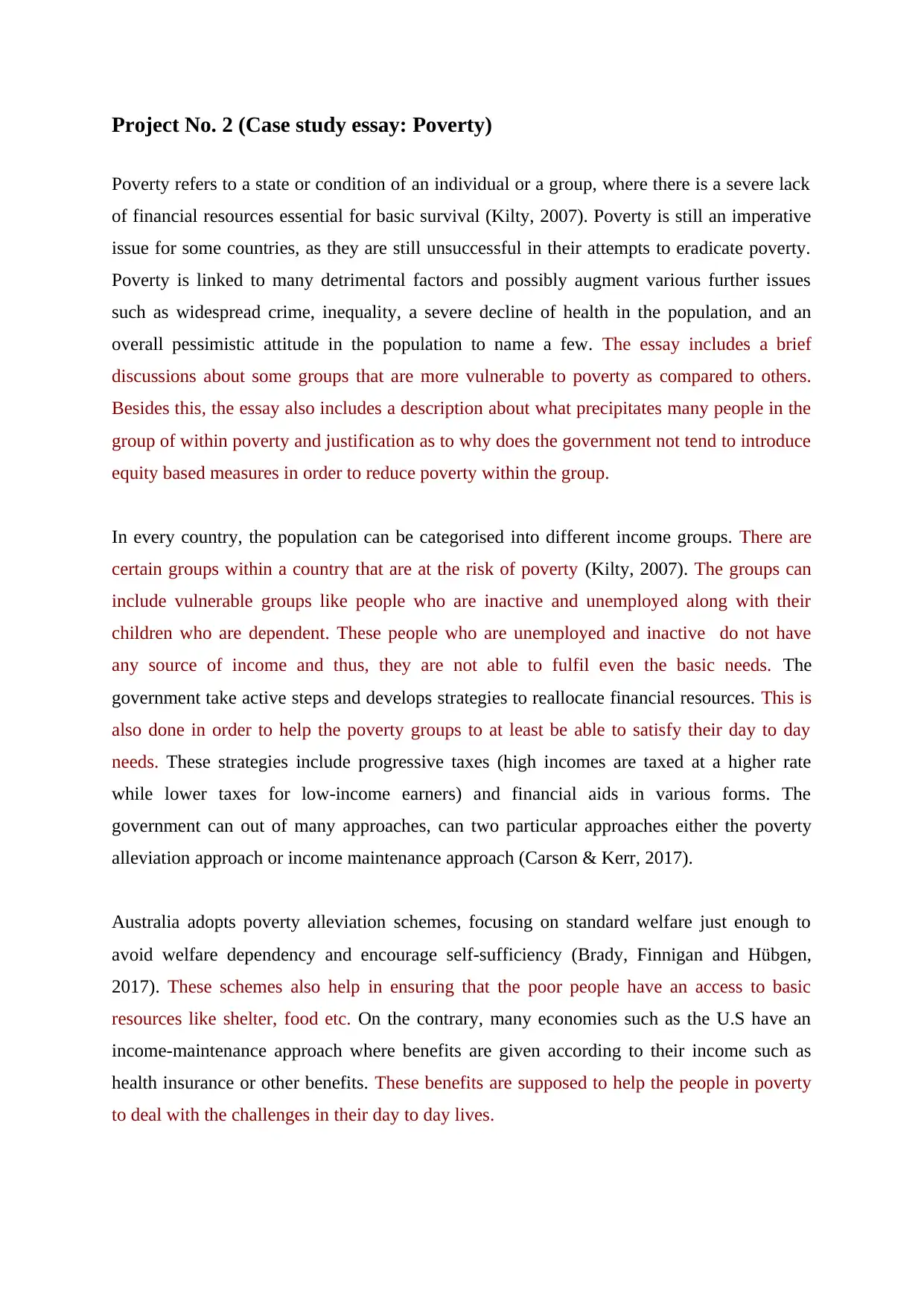
Poverty refers to a state or condition of an individual or a group, where there is a severe lack
of financial resources essential for basic survival (Kilty, 2007). Poverty is still an imperative
issue for some countries, as they are still unsuccessful in their attempts to eradicate poverty.
Poverty is linked to many detrimental factors and possibly augment various further issues
such as widespread crime, inequality, a severe decline of health in the population, and an
overall pessimistic attitude in the population to name a few. The essay includes a brief
discussions about some groups that are more vulnerable to poverty as compared to others.
Besides this, the essay also includes a description about what precipitates many people in the
group of within poverty and justification as to why does the government not tend to introduce
equity based measures in order to reduce poverty within the group.
In every country, the population can be categorised into different income groups. There are
certain groups within a country that are at the risk of poverty (Kilty, 2007). The groups can
include vulnerable groups like people who are inactive and unemployed along with their
children who are dependent. These people who are unemployed and inactive do not have
any source of income and thus, they are not able to fulfil even the basic needs. The
government take active steps and develops strategies to reallocate financial resources. This is
also done in order to help the poverty groups to at least be able to satisfy their day to day
needs. These strategies include progressive taxes (high incomes are taxed at a higher rate
while lower taxes for low-income earners) and financial aids in various forms. The
government can out of many approaches, can two particular approaches either the poverty
alleviation approach or income maintenance approach (Carson & Kerr, 2017).
Australia adopts poverty alleviation schemes, focusing on standard welfare just enough to
avoid welfare dependency and encourage self-sufficiency (Brady, Finnigan and Hübgen,
2017). These schemes also help in ensuring that the poor people have an access to basic
resources like shelter, food etc. On the contrary, many economies such as the U.S have an
income-maintenance approach where benefits are given according to their income such as
health insurance or other benefits. These benefits are supposed to help the people in poverty
to deal with the challenges in their day to day lives.
Poverty refers to a state or condition of an individual or a group, where there is a severe lack
of financial resources essential for basic survival (Kilty, 2007). Poverty is still an imperative
issue for some countries, as they are still unsuccessful in their attempts to eradicate poverty.
Poverty is linked to many detrimental factors and possibly augment various further issues
such as widespread crime, inequality, a severe decline of health in the population, and an
overall pessimistic attitude in the population to name a few. The essay includes a brief
discussions about some groups that are more vulnerable to poverty as compared to others.
Besides this, the essay also includes a description about what precipitates many people in the
group of within poverty and justification as to why does the government not tend to introduce
equity based measures in order to reduce poverty within the group.
In every country, the population can be categorised into different income groups. There are
certain groups within a country that are at the risk of poverty (Kilty, 2007). The groups can
include vulnerable groups like people who are inactive and unemployed along with their
children who are dependent. These people who are unemployed and inactive do not have
any source of income and thus, they are not able to fulfil even the basic needs. The
government take active steps and develops strategies to reallocate financial resources. This is
also done in order to help the poverty groups to at least be able to satisfy their day to day
needs. These strategies include progressive taxes (high incomes are taxed at a higher rate
while lower taxes for low-income earners) and financial aids in various forms. The
government can out of many approaches, can two particular approaches either the poverty
alleviation approach or income maintenance approach (Carson & Kerr, 2017).
Australia adopts poverty alleviation schemes, focusing on standard welfare just enough to
avoid welfare dependency and encourage self-sufficiency (Brady, Finnigan and Hübgen,
2017). These schemes also help in ensuring that the poor people have an access to basic
resources like shelter, food etc. On the contrary, many economies such as the U.S have an
income-maintenance approach where benefits are given according to their income such as
health insurance or other benefits. These benefits are supposed to help the people in poverty
to deal with the challenges in their day to day lives.

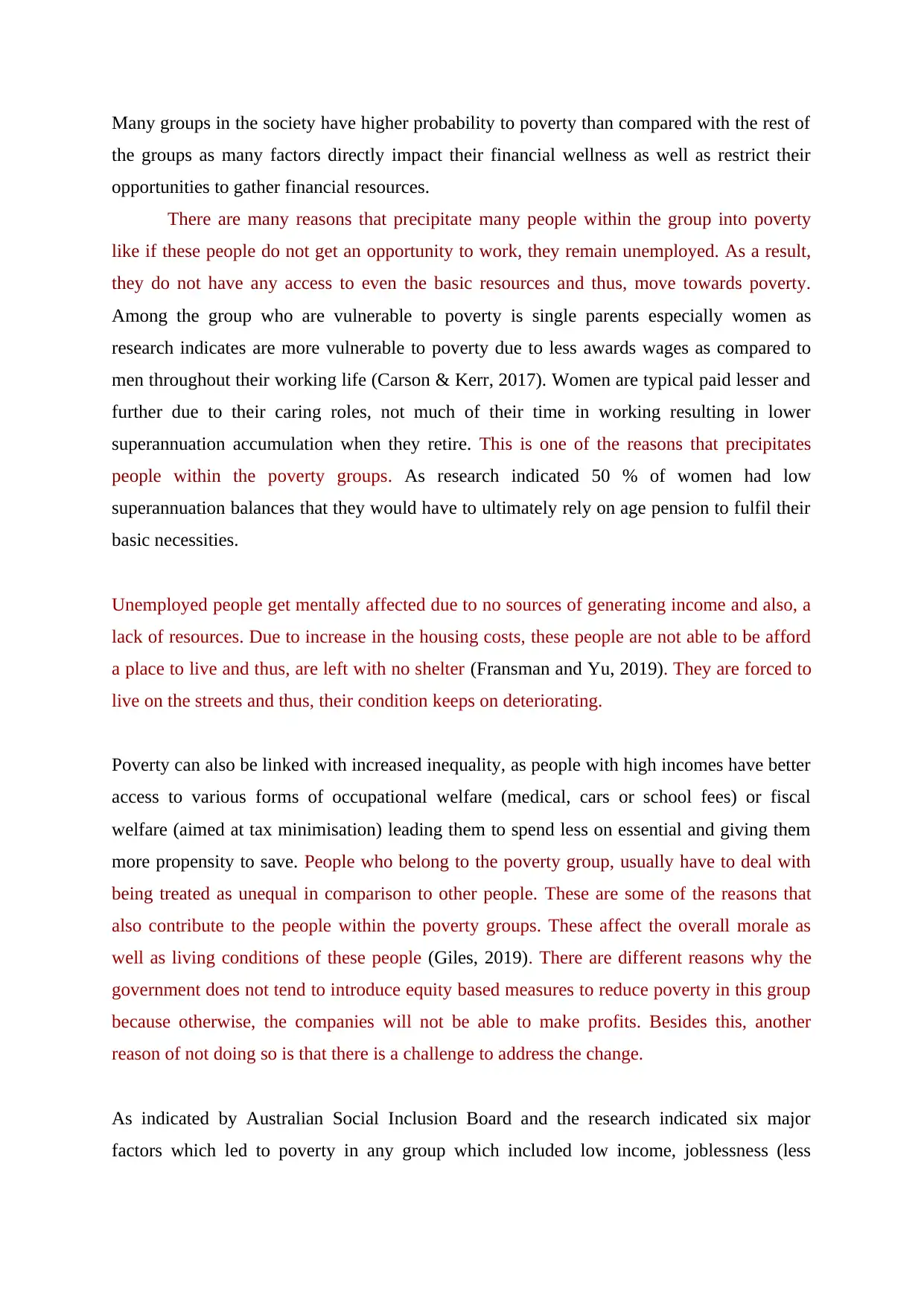
Many groups in the society have higher probability to poverty than compared with the rest of
the groups as many factors directly impact their financial wellness as well as restrict their
opportunities to gather financial resources.
There are many reasons that precipitate many people within the group into poverty
like if these people do not get an opportunity to work, they remain unemployed. As a result,
they do not have any access to even the basic resources and thus, move towards poverty.
Among the group who are vulnerable to poverty is single parents especially women as
research indicates are more vulnerable to poverty due to less awards wages as compared to
men throughout their working life (Carson & Kerr, 2017). Women are typical paid lesser and
further due to their caring roles, not much of their time in working resulting in lower
superannuation accumulation when they retire. This is one of the reasons that precipitates
people within the poverty groups. As research indicated 50 % of women had low
superannuation balances that they would have to ultimately rely on age pension to fulfil their
basic necessities.
Unemployed people get mentally affected due to no sources of generating income and also, a
lack of resources. Due to increase in the housing costs, these people are not able to be afford
a place to live and thus, are left with no shelter (Fransman and Yu, 2019). They are forced to
live on the streets and thus, their condition keeps on deteriorating.
Poverty can also be linked with increased inequality, as people with high incomes have better
access to various forms of occupational welfare (medical, cars or school fees) or fiscal
welfare (aimed at tax minimisation) leading them to spend less on essential and giving them
more propensity to save. People who belong to the poverty group, usually have to deal with
being treated as unequal in comparison to other people. These are some of the reasons that
also contribute to the people within the poverty groups. These affect the overall morale as
well as living conditions of these people (Giles, 2019). There are different reasons why the
government does not tend to introduce equity based measures to reduce poverty in this group
because otherwise, the companies will not be able to make profits. Besides this, another
reason of not doing so is that there is a challenge to address the change.
As indicated by Australian Social Inclusion Board and the research indicated six major
factors which led to poverty in any group which included low income, joblessness (less
the groups as many factors directly impact their financial wellness as well as restrict their
opportunities to gather financial resources.
There are many reasons that precipitate many people within the group into poverty
like if these people do not get an opportunity to work, they remain unemployed. As a result,
they do not have any access to even the basic resources and thus, move towards poverty.
Among the group who are vulnerable to poverty is single parents especially women as
research indicates are more vulnerable to poverty due to less awards wages as compared to
men throughout their working life (Carson & Kerr, 2017). Women are typical paid lesser and
further due to their caring roles, not much of their time in working resulting in lower
superannuation accumulation when they retire. This is one of the reasons that precipitates
people within the poverty groups. As research indicated 50 % of women had low
superannuation balances that they would have to ultimately rely on age pension to fulfil their
basic necessities.
Unemployed people get mentally affected due to no sources of generating income and also, a
lack of resources. Due to increase in the housing costs, these people are not able to be afford
a place to live and thus, are left with no shelter (Fransman and Yu, 2019). They are forced to
live on the streets and thus, their condition keeps on deteriorating.
Poverty can also be linked with increased inequality, as people with high incomes have better
access to various forms of occupational welfare (medical, cars or school fees) or fiscal
welfare (aimed at tax minimisation) leading them to spend less on essential and giving them
more propensity to save. People who belong to the poverty group, usually have to deal with
being treated as unequal in comparison to other people. These are some of the reasons that
also contribute to the people within the poverty groups. These affect the overall morale as
well as living conditions of these people (Giles, 2019). There are different reasons why the
government does not tend to introduce equity based measures to reduce poverty in this group
because otherwise, the companies will not be able to make profits. Besides this, another
reason of not doing so is that there is a challenge to address the change.
As indicated by Australian Social Inclusion Board and the research indicated six major
factors which led to poverty in any group which included low income, joblessness (less
⊘ This is a preview!⊘
Do you want full access?
Subscribe today to unlock all pages.

Trusted by 1+ million students worldwide

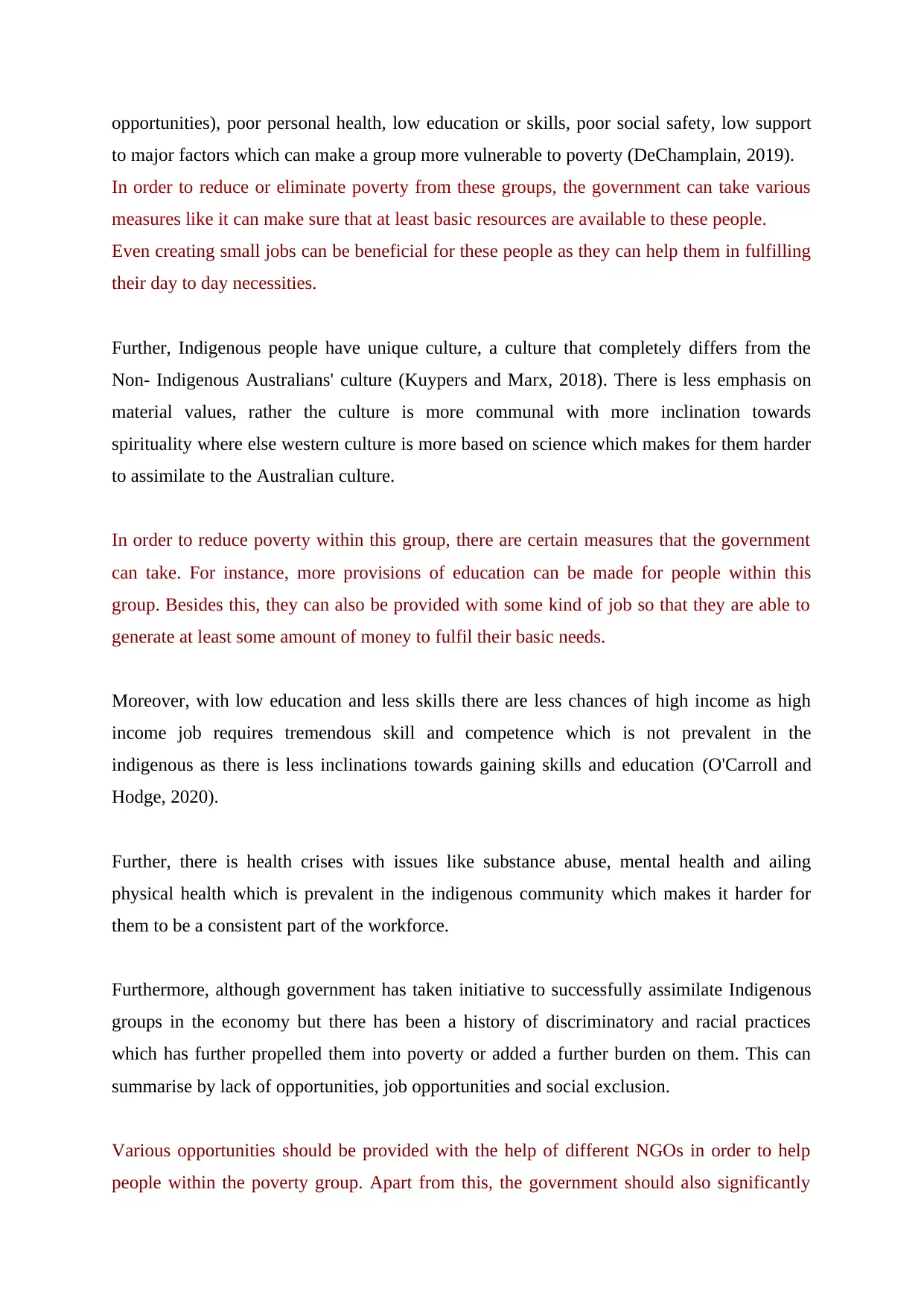
opportunities), poor personal health, low education or skills, poor social safety, low support
to major factors which can make a group more vulnerable to poverty (DeChamplain, 2019).
In order to reduce or eliminate poverty from these groups, the government can take various
measures like it can make sure that at least basic resources are available to these people.
Even creating small jobs can be beneficial for these people as they can help them in fulfilling
their day to day necessities.
Further, Indigenous people have unique culture, a culture that completely differs from the
Non- Indigenous Australians' culture (Kuypers and Marx, 2018). There is less emphasis on
material values, rather the culture is more communal with more inclination towards
spirituality where else western culture is more based on science which makes for them harder
to assimilate to the Australian culture.
In order to reduce poverty within this group, there are certain measures that the government
can take. For instance, more provisions of education can be made for people within this
group. Besides this, they can also be provided with some kind of job so that they are able to
generate at least some amount of money to fulfil their basic needs.
Moreover, with low education and less skills there are less chances of high income as high
income job requires tremendous skill and competence which is not prevalent in the
indigenous as there is less inclinations towards gaining skills and education (O'Carroll and
Hodge, 2020).
Further, there is health crises with issues like substance abuse, mental health and ailing
physical health which is prevalent in the indigenous community which makes it harder for
them to be a consistent part of the workforce.
Furthermore, although government has taken initiative to successfully assimilate Indigenous
groups in the economy but there has been a history of discriminatory and racial practices
which has further propelled them into poverty or added a further burden on them. This can
summarise by lack of opportunities, job opportunities and social exclusion.
Various opportunities should be provided with the help of different NGOs in order to help
people within the poverty group. Apart from this, the government should also significantly
to major factors which can make a group more vulnerable to poverty (DeChamplain, 2019).
In order to reduce or eliminate poverty from these groups, the government can take various
measures like it can make sure that at least basic resources are available to these people.
Even creating small jobs can be beneficial for these people as they can help them in fulfilling
their day to day necessities.
Further, Indigenous people have unique culture, a culture that completely differs from the
Non- Indigenous Australians' culture (Kuypers and Marx, 2018). There is less emphasis on
material values, rather the culture is more communal with more inclination towards
spirituality where else western culture is more based on science which makes for them harder
to assimilate to the Australian culture.
In order to reduce poverty within this group, there are certain measures that the government
can take. For instance, more provisions of education can be made for people within this
group. Besides this, they can also be provided with some kind of job so that they are able to
generate at least some amount of money to fulfil their basic needs.
Moreover, with low education and less skills there are less chances of high income as high
income job requires tremendous skill and competence which is not prevalent in the
indigenous as there is less inclinations towards gaining skills and education (O'Carroll and
Hodge, 2020).
Further, there is health crises with issues like substance abuse, mental health and ailing
physical health which is prevalent in the indigenous community which makes it harder for
them to be a consistent part of the workforce.
Furthermore, although government has taken initiative to successfully assimilate Indigenous
groups in the economy but there has been a history of discriminatory and racial practices
which has further propelled them into poverty or added a further burden on them. This can
summarise by lack of opportunities, job opportunities and social exclusion.
Various opportunities should be provided with the help of different NGOs in order to help
people within the poverty group. Apart from this, the government should also significantly
Paraphrase This Document
Need a fresh take? Get an instant paraphrase of this document with our AI Paraphraser

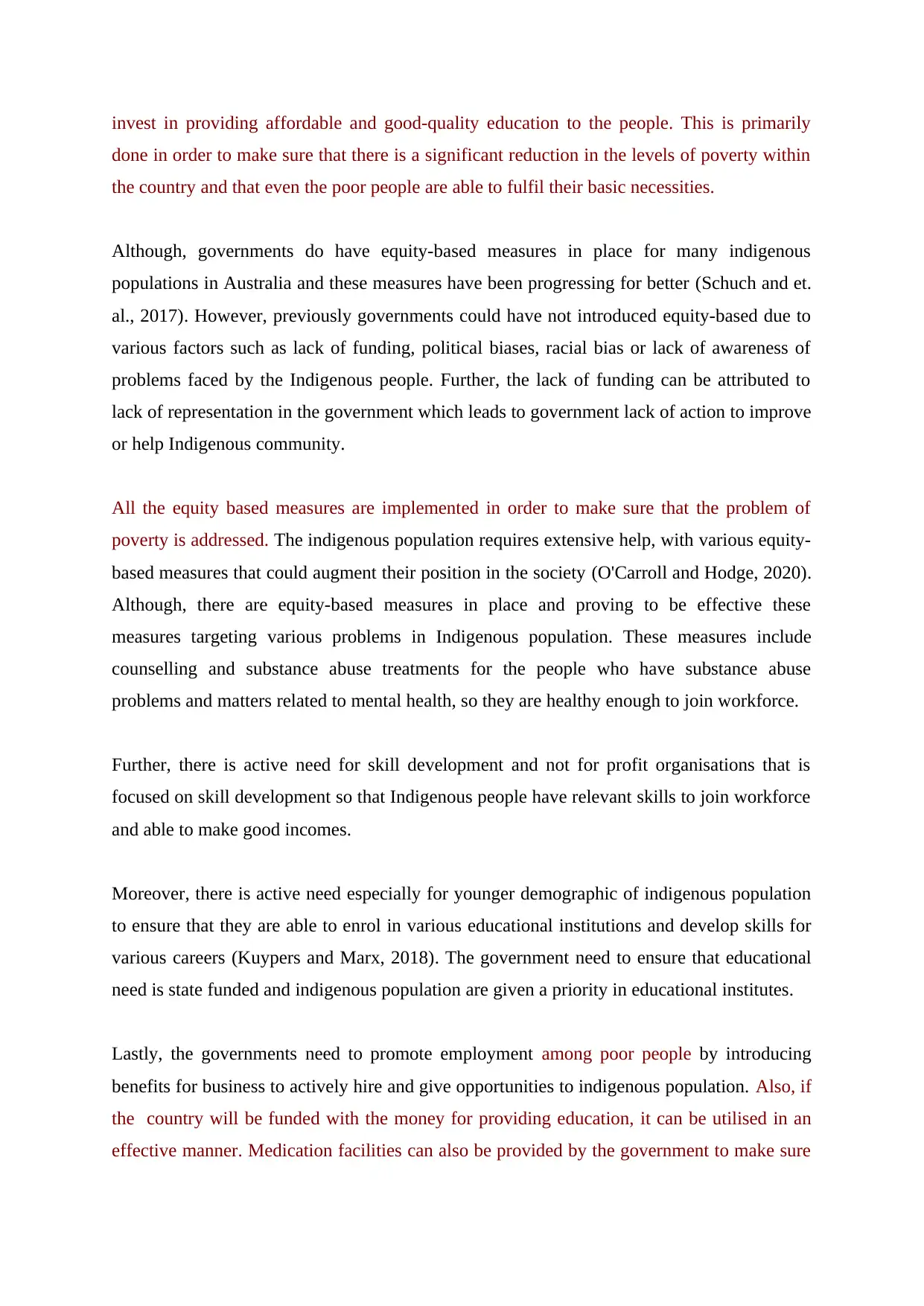
invest in providing affordable and good-quality education to the people. This is primarily
done in order to make sure that there is a significant reduction in the levels of poverty within
the country and that even the poor people are able to fulfil their basic necessities.
Although, governments do have equity-based measures in place for many indigenous
populations in Australia and these measures have been progressing for better (Schuch and et.
al., 2017). However, previously governments could have not introduced equity-based due to
various factors such as lack of funding, political biases, racial bias or lack of awareness of
problems faced by the Indigenous people. Further, the lack of funding can be attributed to
lack of representation in the government which leads to government lack of action to improve
or help Indigenous community.
All the equity based measures are implemented in order to make sure that the problem of
poverty is addressed. The indigenous population requires extensive help, with various equity-
based measures that could augment their position in the society (O'Carroll and Hodge, 2020).
Although, there are equity-based measures in place and proving to be effective these
measures targeting various problems in Indigenous population. These measures include
counselling and substance abuse treatments for the people who have substance abuse
problems and matters related to mental health, so they are healthy enough to join workforce.
Further, there is active need for skill development and not for profit organisations that is
focused on skill development so that Indigenous people have relevant skills to join workforce
and able to make good incomes.
Moreover, there is active need especially for younger demographic of indigenous population
to ensure that they are able to enrol in various educational institutions and develop skills for
various careers (Kuypers and Marx, 2018). The government need to ensure that educational
need is state funded and indigenous population are given a priority in educational institutes.
Lastly, the governments need to promote employment among poor people by introducing
benefits for business to actively hire and give opportunities to indigenous population. Also, if
the country will be funded with the money for providing education, it can be utilised in an
effective manner. Medication facilities can also be provided by the government to make sure
done in order to make sure that there is a significant reduction in the levels of poverty within
the country and that even the poor people are able to fulfil their basic necessities.
Although, governments do have equity-based measures in place for many indigenous
populations in Australia and these measures have been progressing for better (Schuch and et.
al., 2017). However, previously governments could have not introduced equity-based due to
various factors such as lack of funding, political biases, racial bias or lack of awareness of
problems faced by the Indigenous people. Further, the lack of funding can be attributed to
lack of representation in the government which leads to government lack of action to improve
or help Indigenous community.
All the equity based measures are implemented in order to make sure that the problem of
poverty is addressed. The indigenous population requires extensive help, with various equity-
based measures that could augment their position in the society (O'Carroll and Hodge, 2020).
Although, there are equity-based measures in place and proving to be effective these
measures targeting various problems in Indigenous population. These measures include
counselling and substance abuse treatments for the people who have substance abuse
problems and matters related to mental health, so they are healthy enough to join workforce.
Further, there is active need for skill development and not for profit organisations that is
focused on skill development so that Indigenous people have relevant skills to join workforce
and able to make good incomes.
Moreover, there is active need especially for younger demographic of indigenous population
to ensure that they are able to enrol in various educational institutions and develop skills for
various careers (Kuypers and Marx, 2018). The government need to ensure that educational
need is state funded and indigenous population are given a priority in educational institutes.
Lastly, the governments need to promote employment among poor people by introducing
benefits for business to actively hire and give opportunities to indigenous population. Also, if
the country will be funded with the money for providing education, it can be utilised in an
effective manner. Medication facilities can also be provided by the government to make sure

that the people within the poverty groups are able to live a decent life and the overall levels of
poverty are also reduced.
As Australia as a country has moral and fiduciary responsibility to ensure that every citizen
of country has all opportunities to evade poverty and towards better life.
poverty are also reduced.
As Australia as a country has moral and fiduciary responsibility to ensure that every citizen
of country has all opportunities to evade poverty and towards better life.
⊘ This is a preview!⊘
Do you want full access?
Subscribe today to unlock all pages.

Trusted by 1+ million students worldwide

References:
Brady, D., Finnigan, R. M. and Hübgen, S., 2017. Rethinking the risks of poverty: A
framework for analyzing prevalences and penalties. American Journal of Sociology.
123(3). pp.740-786.
Carson, E., & Kerr, L. (2017). Australian Social Policy and the Human Services (1st ed., pp.
171-199). Cambridge University Press.
DeChamplain, B. (2019). Prevalence of Psychological Disorders Among the Indigenous
Population of Canada. SURG Journal, 11. https://doi.org/10.21083/surg.v11i0.5232
Fransman, T. and Yu, D., 2019. Multidimensional poverty in South Africa in 2001–16.
Development Southern Africa. 36(1). pp.50-79.
Giles, E., 2019. Australia twice traversed. Good Press.
Kuypers, S. and Marx, I., 2018. Estimation of joint income-wealth poverty: A sensitivity
analysis. Social Indicators Research. 136(1). pp.117-137.
O'Carroll, J. and Hodge, B., 2020. Borderwork in multicultural Australia. Routledge.
Schuch, H. S. and et. al., 2017. The magnitude of Indigenous and non‐Indigenous oral health
inequalities in Brazil, New Zealand and Australia. Community Dentistry and Oral
Epidemiology. 45(5), pp.434-441.
Brady, D., Finnigan, R. M. and Hübgen, S., 2017. Rethinking the risks of poverty: A
framework for analyzing prevalences and penalties. American Journal of Sociology.
123(3). pp.740-786.
Carson, E., & Kerr, L. (2017). Australian Social Policy and the Human Services (1st ed., pp.
171-199). Cambridge University Press.
DeChamplain, B. (2019). Prevalence of Psychological Disorders Among the Indigenous
Population of Canada. SURG Journal, 11. https://doi.org/10.21083/surg.v11i0.5232
Fransman, T. and Yu, D., 2019. Multidimensional poverty in South Africa in 2001–16.
Development Southern Africa. 36(1). pp.50-79.
Giles, E., 2019. Australia twice traversed. Good Press.
Kuypers, S. and Marx, I., 2018. Estimation of joint income-wealth poverty: A sensitivity
analysis. Social Indicators Research. 136(1). pp.117-137.
O'Carroll, J. and Hodge, B., 2020. Borderwork in multicultural Australia. Routledge.
Schuch, H. S. and et. al., 2017. The magnitude of Indigenous and non‐Indigenous oral health
inequalities in Brazil, New Zealand and Australia. Community Dentistry and Oral
Epidemiology. 45(5), pp.434-441.
1 out of 7
Related Documents
Your All-in-One AI-Powered Toolkit for Academic Success.
+13062052269
info@desklib.com
Available 24*7 on WhatsApp / Email
Unlock your academic potential
Copyright © 2020–2025 A2Z Services. All Rights Reserved. Developed and managed by ZUCOL.