The Interplay of Extreme Poverty and Global Inequality: An Essay

Verified

Added on  2021/06/17

|6
|1715
|24
Essay
AI Summary
This essay delves into the intricate relationship between extreme poverty and global inequality, emphasizing their interconnectedness. It defines poverty as the deprivation of well-being and global inequality as income disparities worldwide. The essay highlights that income inequality exacerbates poverty, creating a vicious cycle where the poor become poorer. It explores various forms of inequality – cultural, social, and economic – and their impact on poverty rates, using examples like the UAE and India. The analysis references World Bank data, revealing the prevalence of extreme poverty globally and emphasizing that while both poverty and inequality are intertwined, reducing inequality can accelerate poverty reduction. The essay concludes by suggesting that addressing global inequality is crucial for achieving the Sustainable Development Goal of eradicating extreme poverty by 2030.
Document Page
Running Head: International Policy
International Policy
tabler-icon-diamond-filled.svg

Paraphrase This Document

Need a fresh take? Get an instant paraphrase of this document with our AI Paraphraser
Document Page
International Policy 1
Extreme poverty and global inequality
The purpose of this essay is to provide a brief description about the relationship between poverty
and global inequality. It also underlines the main point that whether the elimination of one factor
from the society should be prioritized or not. Poverty refers to the deprivation of well-being of
person. It refers to the state under which a person is unable to attain a sustainable living in the
environment. Every country forms their laws related to poverty, in a country where income of
people is below basic poverty line then they are called poor in the country. Whereas, global
inequality focuses on the aspect of income inequality across different parts of the world. The
aspect on income inequality in a country increases the level of poverty as if people in the society
will not receive minimum wages to earn basic necessities of life then they will be regarded as
poor. Income or consumption poverty refers to the lack of monetary resources with people to
meet the basic needs as well (The World Bank 2018).
Further, it should be noted that income inequality is one of the biggest reason due to which the
poor people faces poverty in the environment. Inequality has become a vicious circle in the
current as the poor is getting poorer and the rich person is becoming richer day by day. This is
due to the aspect of inequality as there is inequality distribution of income in the environment
due to which people do not gain the chances to earn money and live wisely. Both the aspects are
interrelated as poverty is strongly dependent on income inequality and income inequality is also
dependent upon poverty (Lakner, and Milanovic 2016).
The poor people in the society are deprived of earning a sustainable living not because they have
lack of money but there are various sources present in the environment that are health, social and
political life, education, low self-worth etc. At the same time, it is convenient for people to
compare poverty in terms of income, mainly at higher levels of aggregation across different
countries and nations. Further, talking about the relationship of both the aspects it should be
noted that there are three forms of inequalities present in the environment that creates or increase
the level of poverty in society, these three factors are cultural, social and economic factors. The
cultural factors talks about the differentiation between the cultures of people that gives a reason
to dominate poor people in the society (Kiggundu 2012).
Document Page
International Policy 2
There are two types of classes present in the society that upper class and lower class. The upper
class people have rich treated and are being treated properly in the society where as lower class
people are barred from attain basic amenities in life. This is one of the reasons that initiate
poverty in society. Further, another aspect is the social factor that initiates inequality in the
society that ultimately leads to poverty as well (Woodward 2015). Under the process of social
inequality the people do not receive equal distribution to resources in the society. Like, taking an
example of the country UAE and India, UAE is more prosperous country as it has petroleum
reserves with them that they export worldwide. Exporting of petroleum and earning with
increases the GDP of people that ultimately increase their per capita income as well (Ortiz, and
Cummins 2011). Whereas, on the other hand the country India does not have adequately
resources due to which they import it from UAE. This results in decrease in competence of the
company worldwide. Thus, in this way social inequality affects the poverty rate of the country
worldwide. Lastly, economic inequality talks about the unequal distribution of wealth and
healthcare facilities among people. This is one of the major reason that affect poverty worldwide.
As there is unequal distribution of wealth in different parts of world that makes it difficult for
people to earn basic human needs of life. This results in increase in the level of poverty in the
environment. Thus, it should be noted that both the aspects are linked to each other, as the factors
of poverty rely on inequality and inequality increases due to extreme poverty (Kaplinsky 2013).
The above mentioned stanza talks about the relationship between extreme poverty and global
inequality, thus it should be noted that poverty deeply affect the activities of nations worldwide.
According to the report given by World Bank, nearly half, more than 3 billion of people are
living with less than $2.50 per day. More than 1.3 billion children are facing extreme poverty
worldwide. According to the most recent estimate around 10.7 percent of world’s population
used to live with less than US$1.90 per day as compared to 12.4 percent in 2012. Further, half of
extreme poor people live in Sub-Saharan Africa. The data of poor in this area fell by very less
amount that is 4 million with 389 million people living on less than US$ 1.90 in 2013 (The
World Bank 2018).
Further, talking about the importance of one aspect over other, it should be noted that as
discussed above both the aspects rely on each other. As if poverty is caused due to presence of
inequality in the different aspects and inequality is caused to presence of poverty in the world.
Document Page
International Policy 3
However, according to the report stated by World Bank, it was declared that poverty although
depends upon many factors but if inequality is focused in the environment and the governments
of different countries focus on reducing inequality; then poverty will increase with faster pace
(Klasen 2016). Although elimination of inequality cannot complete eliminate poverty but it can
easily help the countries to reduce the rate of poverty faster as inequality is one of the major
reason of poverty. Further, the manifestations of poverty are inadequate poverty, lack of
healthcare facilities, lack of information, dependency on each other and lastly ignorance and
apathy towards the major issue. Apart of income inequality these are the major issues that affect
the rate of poverty in a society (Ferreira, and Ravallion 2009).
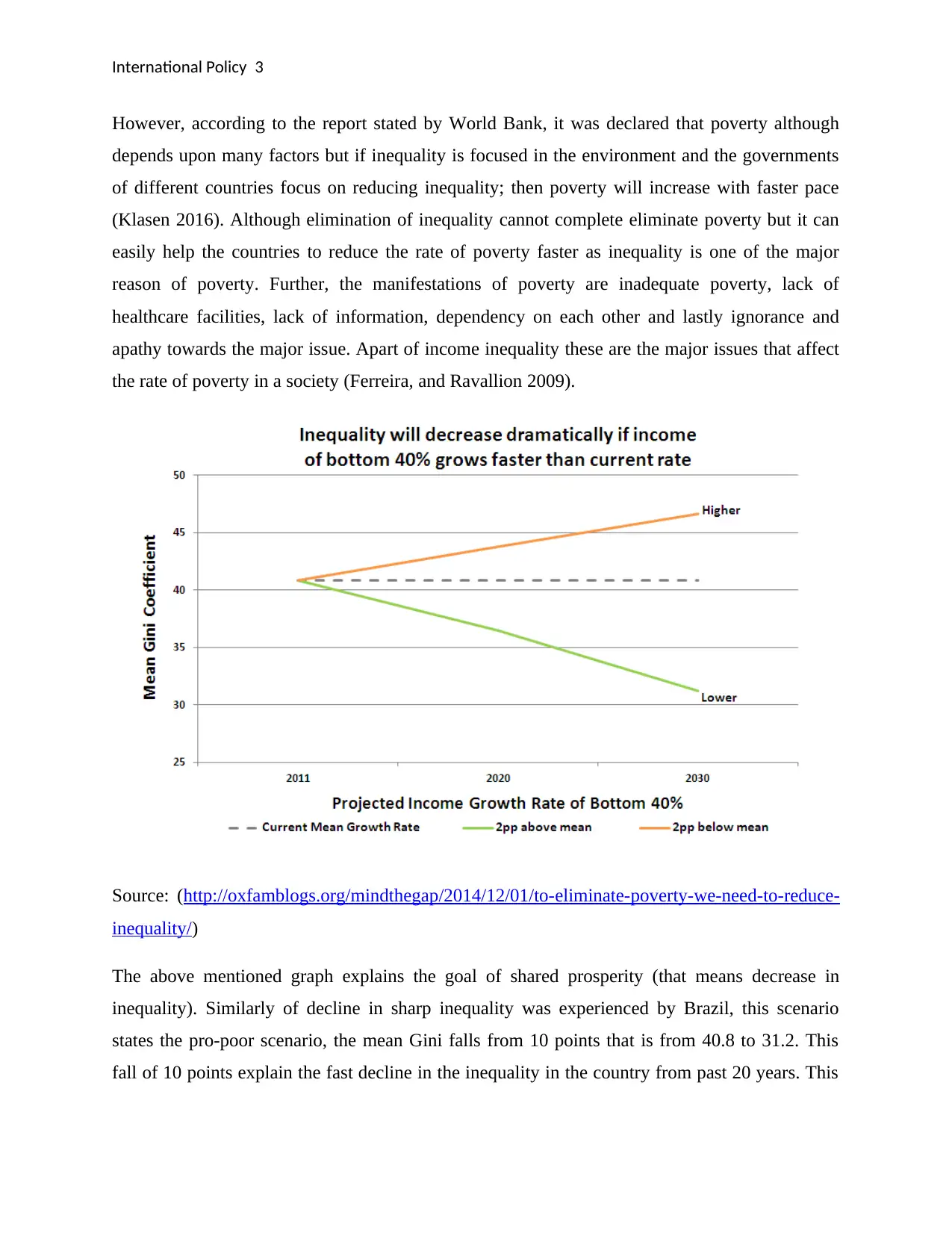
Source: (http://oxfamblogs.org/mindthegap/2014/12/01/to-eliminate-poverty-we-need-to-reduce-
inequality/)
The above mentioned graph explains the goal of shared prosperity (that means decrease in
inequality). Similarly of decline in sharp inequality was experienced by Brazil, this scenario
states the pro-poor scenario, the mean Gini falls from 10 points that is from 40.8 to 31.2. This
fall of 10 points explain the fast decline in the inequality in the country from past 20 years. This
tabler-icon-diamond-filled.svg

Paraphrase This Document

Need a fresh take? Get an instant paraphrase of this document with our AI Paraphraser
Document Page
International Policy 4
type of incident was happened with Brazil’s Gini when it fell from peak of 63.3 percent in 1989
to 53.9 in the year 2009 (Rist, Martin, and Fernandez 2015).
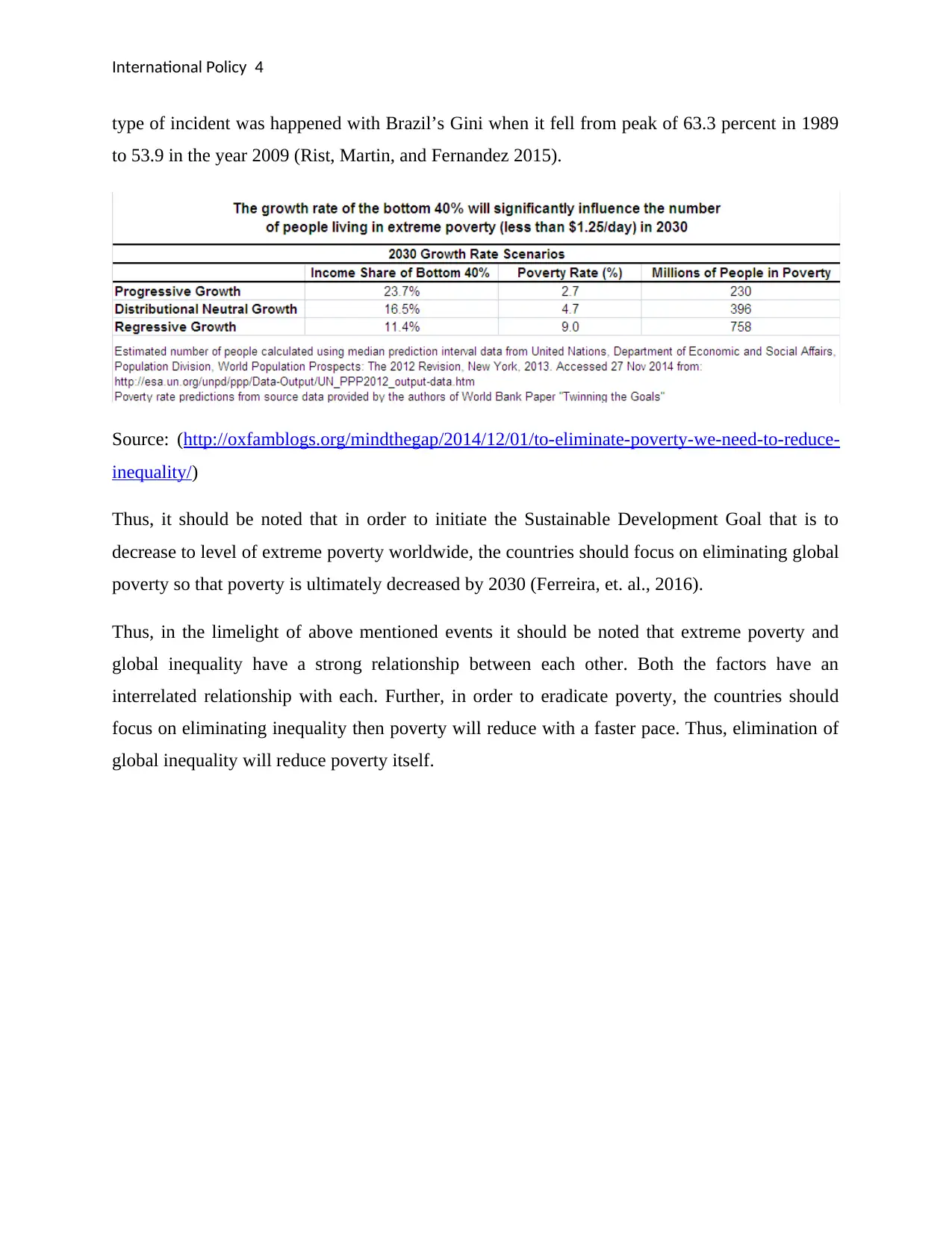
Source: (http://oxfamblogs.org/mindthegap/2014/12/01/to-eliminate-poverty-we-need-to-reduce-
inequality/)
Thus, it should be noted that in order to initiate the Sustainable Development Goal that is to
decrease to level of extreme poverty worldwide, the countries should focus on eliminating global
poverty so that poverty is ultimately decreased by 2030 (Ferreira, et. al., 2016).
Thus, in the limelight of above mentioned events it should be noted that extreme poverty and
global inequality have a strong relationship between each other. Both the factors have an
interrelated relationship with each. Further, in order to eradicate poverty, the countries should
focus on eliminating inequality then poverty will reduce with a faster pace. Thus, elimination of
global inequality will reduce poverty itself.
Document Page
International Policy 5
References
Ferreira, F. and Ravallion, M., 2009. Poverty and inequality: The global context.
Ferreira, F.H., Chen, S., Dabalen, A., Dikhanov, Y., Hamadeh, N., Jolliffe, D., Narayan, A.,
Prydz, E.B., Revenga, A., Sangraula, P. and Serajuddin, U., 2016. A global count of the extreme
poor in 2012: data issues, methodology and initial results. The Journal of Economic
Inequality, 14(2), pp.141-172.
Kaplinsky, R., 2013. Globalization, poverty and inequality: Between a rock and a hard place.
John Wiley & Sons.
Kiggundu, M.N., 2012. Anti-poverty and progressive social change in Brazil: lessons for other
emerging economies. International Review of Administrative Sciences, 78(4), pp.733-756.
Klasen, S., 2016. Levels and trends in absolute poverty in the world: What we know and what
we don’t. In Absolute poverty and global justice (pp. 43-58). Routledge.
Lakner, C. and Milanovic, B., 2016. Global income distribution: From the fall of the Berlin Wall
to the Great Recession. The World Bank Economic Review, 30(2), pp.203-232.
Ortiz, I. and Cummins, M., 2011. Global inequality: beyond the bottom billion–a rapid review of
income distribution in 141 countries.
Rist, R.C., Martin, F.P. and Fernandez, A.M. eds., 2015. Poverty, Inequality, and Evaluation:
Changing Perspectives. World Bank Publications.
The World Bank., 2018. Poverty [online]. Available from
http://www.worldbank.org/en/topic/poverty/overview Accessed on 12 May 2018.
Woodward, D., 2015. Incrementum ad absurdum: global growth, inequality and poverty
eradication in a carbon-constrained world. World Economic Review, 4, pp.43-62.
chevron_up_icon
1 out of 6
circle_padding
hide_on_mobile
zoom_out_icon
[object Object]