Aging Project: Powers of Attorney and Aging Older Adults in Canada

Verified

Added on  2023/06/14

|10
|684
|436
Presentation
AI Summary
This presentation discusses the importance of Power of Attorney (POA) for older adults in Canada, where the senior population is growing. It highlights that a POA allows seniors to choose someone to make decisions on their behalf when they are unable. The presentation addresses the increasing need for POAs due to potential emergencies and difficulties in obtaining medical and financial assistance without one. It outlines the adverse consequences of not having a POA, such as delays in healthcare decisions, and emphasizes the benefits of having separate POAs for financial and healthcare matters. The presentation concludes by noting that as the Canadian society ages, POAs will play an increasingly important role in strengthening the position of seniors and helping manage health and financial challenges.

Document Page
Powers of Attorney and
Aging Older Adults
The aging project assignment
tabler-icon-diamond-filled.svg

Paraphrase This Document

Need a fresh take? Get an instant paraphrase of this document with our AI Paraphraser
Document Page
Power of Attorney in Canada
Power of attorney is a legal document that provides the seniors with an opportunity to
chose someone, who will act or make decisions for them, when they will be unable to
do the same (Bischoff et al., 2013).
After receiving the Power of Attorney, the person will be able to take decision for the
older peoples investments, bills, payments and medical care as well.
Document Page
Aging population in Canada
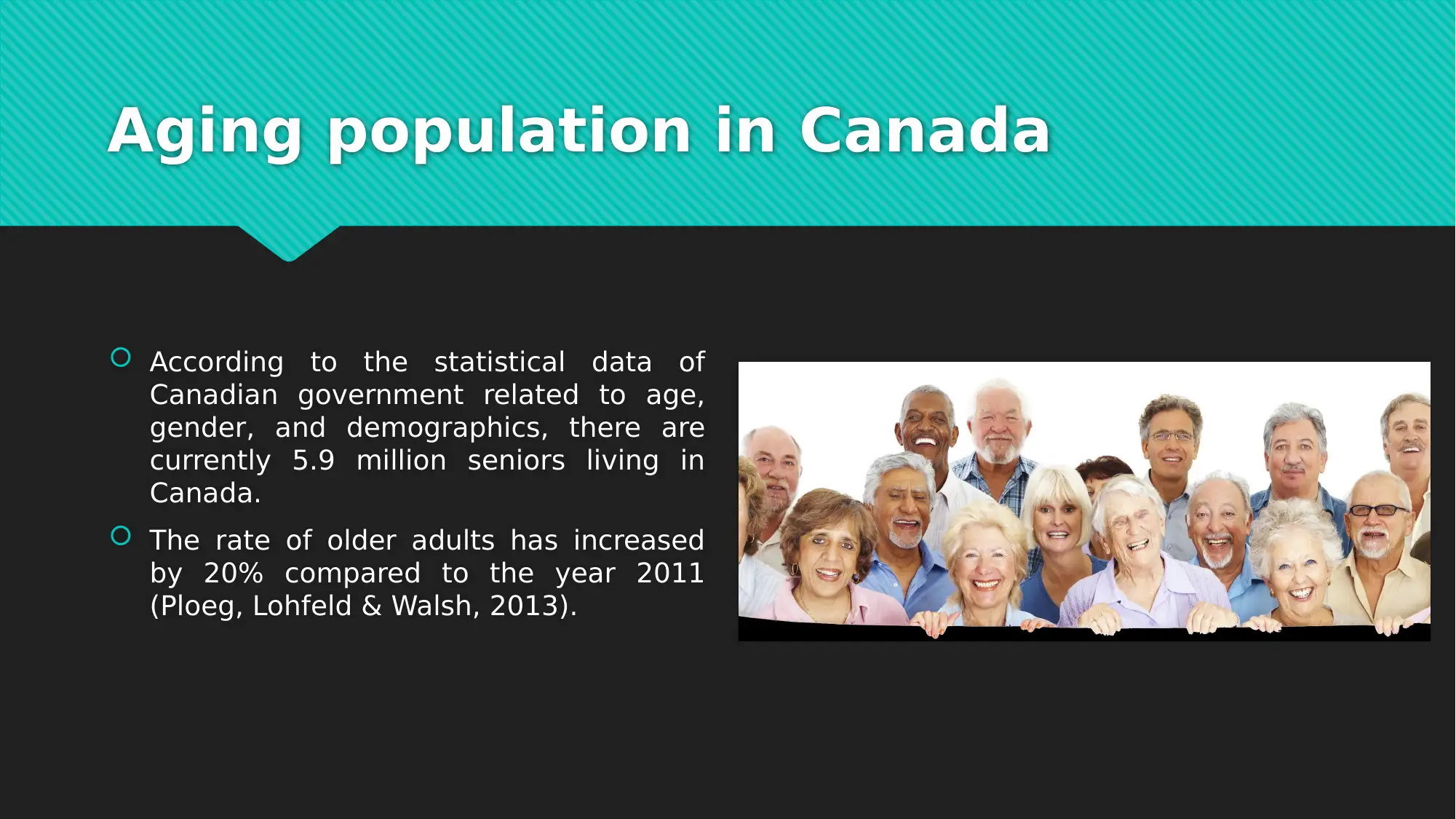
According to the statistical data of
Canadian government related to age,
gender, and demographics, there are
currently 5.9 million seniors living in
Canada.
The rate of older adults has increased
by 20% compared to the year 2011
(Ploeg, Lohfeld & Walsh, 2013).
Document Page
Thesis question
Why the seniors in Canada need a
Power of Attorney to strengthen their
presence in society?
tabler-icon-diamond-filled.svg

Paraphrase This Document

Need a fresh take? Get an instant paraphrase of this document with our AI Paraphraser
Document Page
Why it is important ?
As the number of seniors are increasing, there is a chance of emergency in any
situation for older people.
Getting medical and financial help might become difficult if the person does not have
any power of attorney.
Further, in any adverse situation, taking healthcare decisions and financial decision
becomes difficult.
Because the person helping the senior has to rush to court to claim the right of making
decision for the senior person (Hirschman et al., 2012).
Document Page
Adverse consequences
If the older adult does not have any power of attorney, no body else will be eligible to
make decision for that person even in the adverse condition.
During health emergency, healthcare experts will not be able to take quick and
necessary actions without the consent of the senior as he will be the only one who can
make decision for himself (Hirschman et al., 2012).
Document Page
Benefits
Two separate power of attorney, one for financial decisions and another one for
healthcare related decisions will help the older adults by making a reliable person
responsible for taking decision for the person.
Further, POA will provide all the important details, related to personal details that will
provide important details to the lawyer and the doctor to take healthcare or financial
decisions (Bischoff et al., 2013).
tabler-icon-diamond-filled.svg

Paraphrase This Document

Need a fresh take? Get an instant paraphrase of this document with our AI Paraphraser
Document Page
Future prospects
As the Canadian society is reaching old age, increasing health and financial
consequences can result in adverse situations.
Therefore financial and healthcare power of attorney will help them by strengthening
their position in the society 9Hirst, Lane & Stares, 2012).
Document Page
References
Bischoff, K. E., Sudore, R., Miao, Y., Boscardin, W. J., & Smith, A. K. (2013). Advance care
planning and the quality of end‐of‐life care in older adults. Journal of the American
Geriatrics Society, 61(2), 209-214.
Hirschman, K. B., Abbott, K. M., Hanlon, A. L., Bettger, J. P., & Naylor, M. D. (2012). What
factors are associated with having an advance directive among older adults who are new
to long term care services?. Journal of the American Medical Directors Association, 13(1),
82-e7.
Hirst, S. P., Lane, A. M., & Stares, B. (2012). Gerontological content in Canadian nursing and
social work programs. Canadian geriatrics journal: CGJ, 15(1), 8.
Ploeg, J., Lohfeld, L., & Walsh, C. A. (2013). What is “elder abuse”? Voices from the margin:
The views of underrepresented Canadian older adults. Journal of elder abuse &
neglect, 25(5), 396-424.
Document Page
chevron_up_icon
1 out of 10
circle_padding
hide_on_mobile
zoom_out_icon
[object Object]