Business Plan: Power-On Startup's Financial Viability and Projections
VerifiedAdded on 2023/04/25
|6
|1258
|196
AI Summary
This document presents a business plan focusing on the financial viability of Power-On, a digital startup venture in the power bank rental service industry. The plan assesses profitability by incorporating key revenue and expense projections over a specified trend period. It considers factors such as smartphone industry growth, product demand, and sales and marketing strategies. The initial capital structure involves a mix of equity and debt financing, aiming for an optimal balance. Financial viability is further evaluated through breakeven analysis, projecting positive cash flow and return on capital employed. The plan includes profit and loss forecasts, addressing operating and net profit margins, and considering macroeconomic factors like interest and inflation rates. Risk management strategies and various growth scenarios are incorporated to ensure sustainable financial growth and adaptability to internal and external factors. Cash flow statements and balance sheets are developed to monitor key performance areas, highlighting the importance of positive cash flow and rising profitability for long-term sustainability.

Running head: BUSINESS PLAN
Power-On
Name of the Student:
Name of the University:
Author’s Note:
Power-On
Name of the Student:
Name of the University:
Author’s Note:
Paraphrase This Document
Need a fresh take? Get an instant paraphrase of this document with our AI Paraphraser

1POWER-ON
Table of Contents
Financial Viability......................................................................................................................2
Reference....................................................................................................................................5
Table of Contents
Financial Viability......................................................................................................................2
Reference....................................................................................................................................5

2POWER-ON
Financial Viability
The financial viability of the project could be well assessed by the profitability of the
project. The profitability of the Power-On Company was assessed by incorporating the key
revenue and expenses that will be incurred by the company in the trend period that was
analysed for the company. The trend period or the financial plan for the Power-on Company
was prepared based on the sales and the volume of sales that will be done by the company
based on the demand expected by the company (Pearson & Elson, 2015). The product
demand was quite assessed with the growing smart phone industry and there was necessary
equipment’s and assets that will be brought by the company so that the operations of the
company runs effectively. The operations of the company is significantly dependent on the
sales and marketing activities and the various strategies that will be applied by the
management of the company for formulating the operations of the company (Lusardi &
Mitchell, 2014).
The initial capital requirement will be financed via the equity and debt sources where
the shareholders or the promoters of the company will be financing the company in the form
of equity capital. The other key source of financing will be the application of debt for
financing the operations of the company (Council, 2016). There should be an optimal balance
between the debt and equity in a company while assessing the capital structure of the
company and the same has been taken into consideration while deciding the same. Power-
One is expected to generate a positive cash flow for the company with the total return on
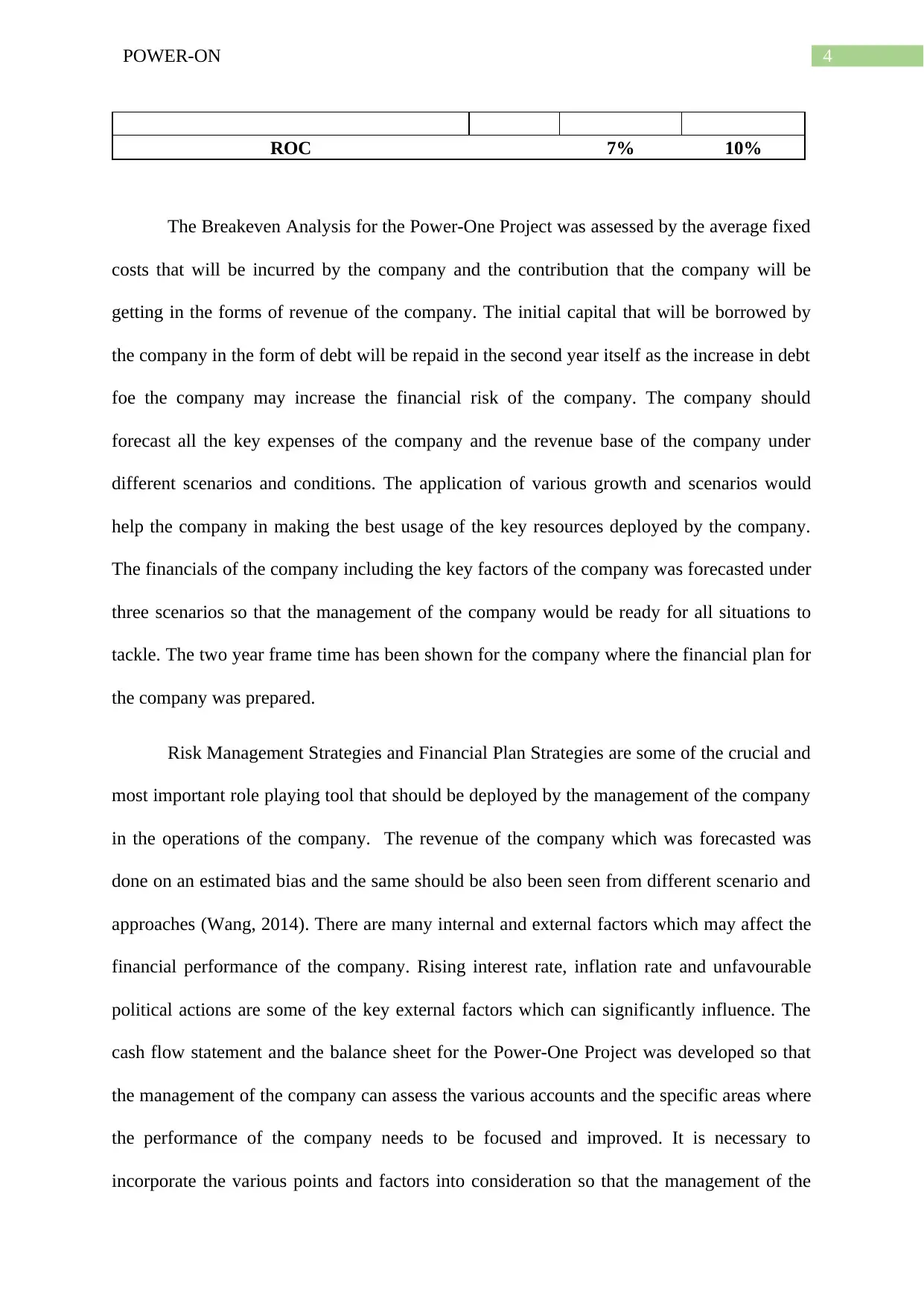
capital employed to be around 7% in the first year itself and 10% in the second year itself
(Fatoki, 2014). The financial viability of the project was also conducted with the help of the
breakeven analysis so that the management of the company the amount of products or
services it needs to render to remain profitable and sustainable in the business. The profit
Financial Viability
The financial viability of the project could be well assessed by the profitability of the
project. The profitability of the Power-On Company was assessed by incorporating the key
revenue and expenses that will be incurred by the company in the trend period that was
analysed for the company. The trend period or the financial plan for the Power-on Company
was prepared based on the sales and the volume of sales that will be done by the company
based on the demand expected by the company (Pearson & Elson, 2015). The product
demand was quite assessed with the growing smart phone industry and there was necessary
equipment’s and assets that will be brought by the company so that the operations of the
company runs effectively. The operations of the company is significantly dependent on the
sales and marketing activities and the various strategies that will be applied by the
management of the company for formulating the operations of the company (Lusardi &
Mitchell, 2014).
The initial capital requirement will be financed via the equity and debt sources where
the shareholders or the promoters of the company will be financing the company in the form
of equity capital. The other key source of financing will be the application of debt for
financing the operations of the company (Council, 2016). There should be an optimal balance
between the debt and equity in a company while assessing the capital structure of the
company and the same has been taken into consideration while deciding the same. Power-
One is expected to generate a positive cash flow for the company with the total return on
capital employed to be around 7% in the first year itself and 10% in the second year itself
(Fatoki, 2014). The financial viability of the project was also conducted with the help of the
breakeven analysis so that the management of the company the amount of products or
services it needs to render to remain profitable and sustainable in the business. The profit
⊘ This is a preview!⊘
Do you want full access?
Subscribe today to unlock all pages.

Trusted by 1+ million students worldwide

3POWER-ON
after tax for the first year was assessed to be around 39,500 and 66,400 in the second year.
The innovative project is expected to pay off with the rising revenue of the company and the
profitability of the company (Sridharan, 2015). Operating Profit and Net Profit plays n crucial
role for the long term sustainability and development of the project. The operating margin
and net margins of the company was assessed to be at a positive side which was well
addressed by taking several accounts and factors, which may directly attribute to the key
expenses/outflows for the company. Business Factors like revenue, costs and profitability and
macro-economic factors like interest rate and inflation rate are also some of the key factors
and role that should be accounted for the financial projection of the company (Chen, 2016).
(4) PROFIT AND LOSS FORECAST
Year 0 1 2
Revenue 0 1,50,000 1,80,000
Cost of Goods 0 52,500 63,000
Gross profit 0 97,500 1,17,000
Gross Margin 1,22,350 1,33,520
Expenses
Rent and Rates 20,000 22,000
Wages and salaries 8,500 9,350
General Exp. 500 550
Accountant Fees 1,000 1,100
Payroll Tax 2,000 2,200
Utilities 2,500 2,750
Sales and Marketing 8,000 8,800
Postage & Telephone 500 550
Repairs and Maintenance 1,000 1,100
Preliminary expenses 2,000 2,200
Lease Payments 12,000 13,200
Total expenses/overheads 58,000 50,600
Profit before tax 39,500 66,400
Tax @ 30% 11,850 19,920
Before tax net margin 26% 37%
Profit after tax 27,650 46,480
Transfer to reserves 39,500 66,400
after tax for the first year was assessed to be around 39,500 and 66,400 in the second year.
The innovative project is expected to pay off with the rising revenue of the company and the
profitability of the company (Sridharan, 2015). Operating Profit and Net Profit plays n crucial
role for the long term sustainability and development of the project. The operating margin
and net margins of the company was assessed to be at a positive side which was well
addressed by taking several accounts and factors, which may directly attribute to the key
expenses/outflows for the company. Business Factors like revenue, costs and profitability and
macro-economic factors like interest rate and inflation rate are also some of the key factors
and role that should be accounted for the financial projection of the company (Chen, 2016).
(4) PROFIT AND LOSS FORECAST
Year 0 1 2
Revenue 0 1,50,000 1,80,000
Cost of Goods 0 52,500 63,000
Gross profit 0 97,500 1,17,000
Gross Margin 1,22,350 1,33,520
Expenses
Rent and Rates 20,000 22,000
Wages and salaries 8,500 9,350
General Exp. 500 550
Accountant Fees 1,000 1,100
Payroll Tax 2,000 2,200
Utilities 2,500 2,750
Sales and Marketing 8,000 8,800
Postage & Telephone 500 550
Repairs and Maintenance 1,000 1,100
Preliminary expenses 2,000 2,200
Lease Payments 12,000 13,200
Total expenses/overheads 58,000 50,600
Profit before tax 39,500 66,400
Tax @ 30% 11,850 19,920
Before tax net margin 26% 37%
Profit after tax 27,650 46,480
Transfer to reserves 39,500 66,400
Paraphrase This Document
Need a fresh take? Get an instant paraphrase of this document with our AI Paraphraser

4POWER-ON
ROC 7% 10%
The Breakeven Analysis for the Power-One Project was assessed by the average fixed
costs that will be incurred by the company and the contribution that the company will be
getting in the forms of revenue of the company. The initial capital that will be borrowed by
the company in the form of debt will be repaid in the second year itself as the increase in debt
foe the company may increase the financial risk of the company. The company should
forecast all the key expenses of the company and the revenue base of the company under
different scenarios and conditions. The application of various growth and scenarios would
help the company in making the best usage of the key resources deployed by the company.
The financials of the company including the key factors of the company was forecasted under
three scenarios so that the management of the company would be ready for all situations to
tackle. The two year frame time has been shown for the company where the financial plan for
the company was prepared.
Risk Management Strategies and Financial Plan Strategies are some of the crucial and
most important role playing tool that should be deployed by the management of the company
in the operations of the company. The revenue of the company which was forecasted was
done on an estimated bias and the same should be also been seen from different scenario and
approaches (Wang, 2014). There are many internal and external factors which may affect the
financial performance of the company. Rising interest rate, inflation rate and unfavourable
political actions are some of the key external factors which can significantly influence. The
cash flow statement and the balance sheet for the Power-One Project was developed so that
the management of the company can assess the various accounts and the specific areas where
the performance of the company needs to be focused and improved. It is necessary to
incorporate the various points and factors into consideration so that the management of the
ROC 7% 10%
The Breakeven Analysis for the Power-One Project was assessed by the average fixed
costs that will be incurred by the company and the contribution that the company will be
getting in the forms of revenue of the company. The initial capital that will be borrowed by
the company in the form of debt will be repaid in the second year itself as the increase in debt
foe the company may increase the financial risk of the company. The company should
forecast all the key expenses of the company and the revenue base of the company under
different scenarios and conditions. The application of various growth and scenarios would
help the company in making the best usage of the key resources deployed by the company.
The financials of the company including the key factors of the company was forecasted under
three scenarios so that the management of the company would be ready for all situations to
tackle. The two year frame time has been shown for the company where the financial plan for
the company was prepared.
Risk Management Strategies and Financial Plan Strategies are some of the crucial and
most important role playing tool that should be deployed by the management of the company
in the operations of the company. The revenue of the company which was forecasted was
done on an estimated bias and the same should be also been seen from different scenario and
approaches (Wang, 2014). There are many internal and external factors which may affect the
financial performance of the company. Rising interest rate, inflation rate and unfavourable
political actions are some of the key external factors which can significantly influence. The
cash flow statement and the balance sheet for the Power-One Project was developed so that
the management of the company can assess the various accounts and the specific areas where
the performance of the company needs to be focused and improved. It is necessary to
incorporate the various points and factors into consideration so that the management of the

5POWER-ON
company can have a sustainable financial growth and plan for the company. The positive
cash flow and rising profitability for the company will be the key aspects that marks the long
term viability and sustainability of the Power-One Project.
Reference
Chen, S. (2016). Detection of fraudulent financial statements using the hybrid data mining
approach. SpringerPlus, 5(1), 89.
Council, G. T. C. (2016). Strategic Asset Management Plan.
Fatoki, O. (2014). The financial literacy of micro entrepreneurs in South Africa. Journal of
Social Sciences, 40(2), 151-158.
Lusardi, A., & Mitchell, O. S. (2014). The economic importance of financial literacy: Theory
and evidence. Journal of economic literature, 52(1), 5-44.
Pearson, R., & Elson, D. (2015). Transcending the impact of the financial crisis in the United
Kingdom: towards plan F—a feminist economic strategy. Feminist Review, 109(1), 8-
30.
Sridharan, S. A. (2015). Volatility forecasting using financial statement information. The
Accounting Review, 90(5), 2079-2106.
Wang, X. S. (2014). Financial management in the public sector: tools, applications and
cases. Routledge.
company can have a sustainable financial growth and plan for the company. The positive
cash flow and rising profitability for the company will be the key aspects that marks the long
term viability and sustainability of the Power-One Project.
Reference
Chen, S. (2016). Detection of fraudulent financial statements using the hybrid data mining
approach. SpringerPlus, 5(1), 89.
Council, G. T. C. (2016). Strategic Asset Management Plan.
Fatoki, O. (2014). The financial literacy of micro entrepreneurs in South Africa. Journal of
Social Sciences, 40(2), 151-158.
Lusardi, A., & Mitchell, O. S. (2014). The economic importance of financial literacy: Theory
and evidence. Journal of economic literature, 52(1), 5-44.
Pearson, R., & Elson, D. (2015). Transcending the impact of the financial crisis in the United
Kingdom: towards plan F—a feminist economic strategy. Feminist Review, 109(1), 8-
30.
Sridharan, S. A. (2015). Volatility forecasting using financial statement information. The
Accounting Review, 90(5), 2079-2106.
Wang, X. S. (2014). Financial management in the public sector: tools, applications and
cases. Routledge.
⊘ This is a preview!⊘
Do you want full access?
Subscribe today to unlock all pages.

Trusted by 1+ million students worldwide
1 out of 6
Related Documents
Your All-in-One AI-Powered Toolkit for Academic Success.
+13062052269
info@desklib.com
Available 24*7 on WhatsApp / Email
Unlock your academic potential
Copyright © 2020–2025 A2Z Services. All Rights Reserved. Developed and managed by ZUCOL.