Power and Sample Size Determination: A Public Health Analysis

Verified

Added on  2023/04/20

|6
|1023
|246
Report
AI Summary
This report examines the critical role of power and sample size determination in health research, emphasizing their impact on study validity and statistical significance. It analyzes two cross-sectional studies focused on health literacy among different populations, highlighting the consequences of inadequate or excessive sample sizes. The report discusses the effects of limited participant numbers, such as reduced statistical power and potential resource wastage, as well as the challenges associated with very large samples, including ethical concerns and exaggerated statistical power. Furthermore, it explores the influence of margin of error, effect size, and outcome variability on sample size computation, providing a comprehensive overview of the factors that contribute to effective and ethical research design. Desklib offers additional resources for students, including solved assignments and past papers.
Document Page
Running head: POWER AND SAMPLE SIZE 1
Power and Sample Size Determination
Name
Institutional Affiliation
1
tabler-icon-diamond-filled.svg

Paraphrase This Document

Need a fresh take? Get an instant paraphrase of this document with our AI Paraphraser
Document Page
POWER AND SAMPLE SIZE 2
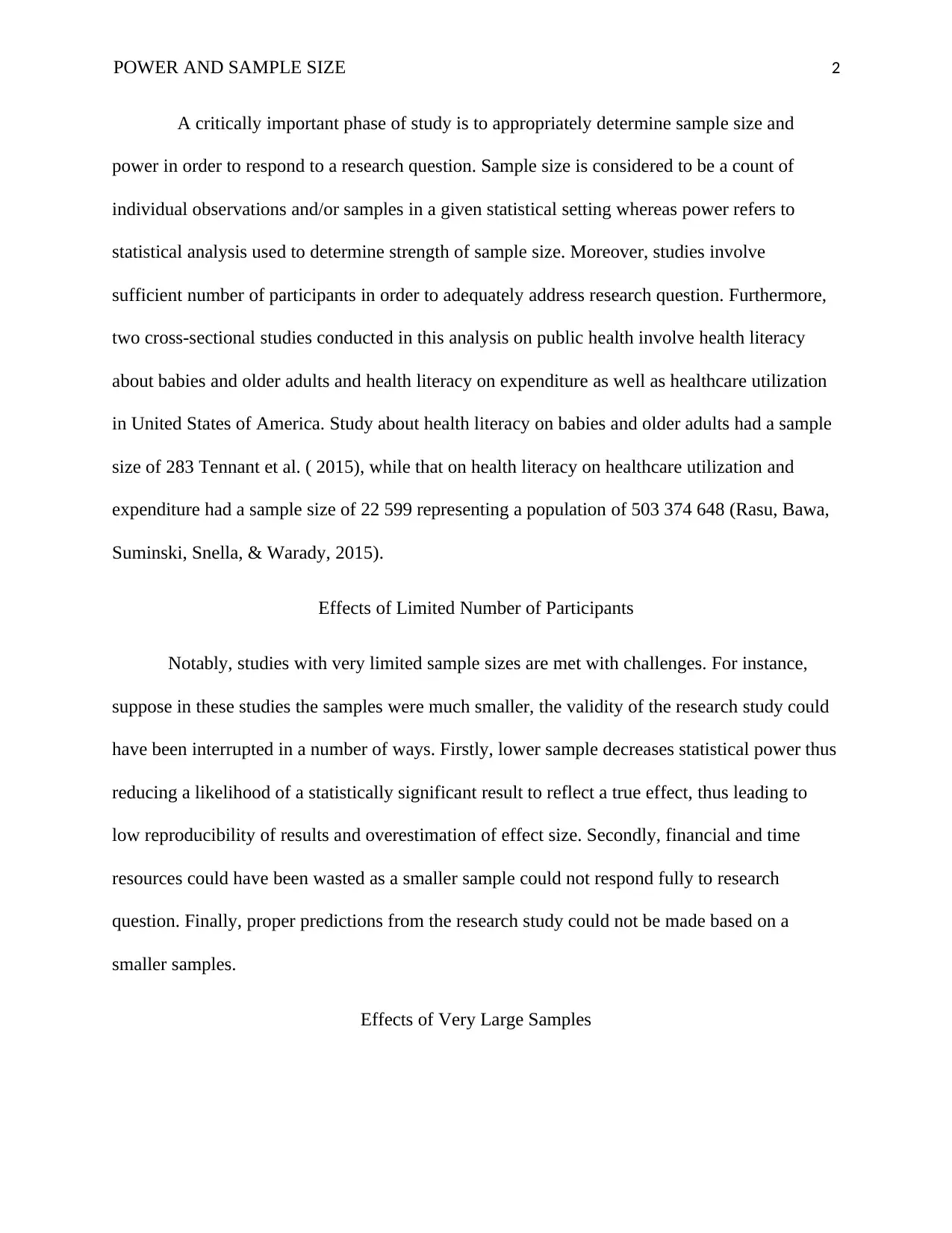
A critically important phase of study is to appropriately determine sample size and
power in order to respond to a research question. Sample size is considered to be a count of
individual observations and/or samples in a given statistical setting whereas power refers to
statistical analysis used to determine strength of sample size. Moreover, studies involve
sufficient number of participants in order to adequately address research question. Furthermore,
two cross-sectional studies conducted in this analysis on public health involve health literacy
about babies and older adults and health literacy on expenditure as well as healthcare utilization
in United States of America. Study about health literacy on babies and older adults had a sample
size of 283 Tennant et al. ( 2015), while that on health literacy on healthcare utilization and
expenditure had a sample size of 22 599 representing a population of 503 374 648 (Rasu, Bawa,
Suminski, Snella, & Warady, 2015).
Effects of Limited Number of Participants
Notably, studies with very limited sample sizes are met with challenges. For instance,
suppose in these studies the samples were much smaller, the validity of the research study could
have been interrupted in a number of ways. Firstly, lower sample decreases statistical power thus
reducing a likelihood of a statistically significant result to reflect a true effect, thus leading to
low reproducibility of results and overestimation of effect size. Secondly, financial and time
resources could have been wasted as a smaller sample could not respond fully to research
question. Finally, proper predictions from the research study could not be made based on a
smaller samples.
Effects of Very Large Samples
Document Page
POWER AND SAMPLE SIZE 3
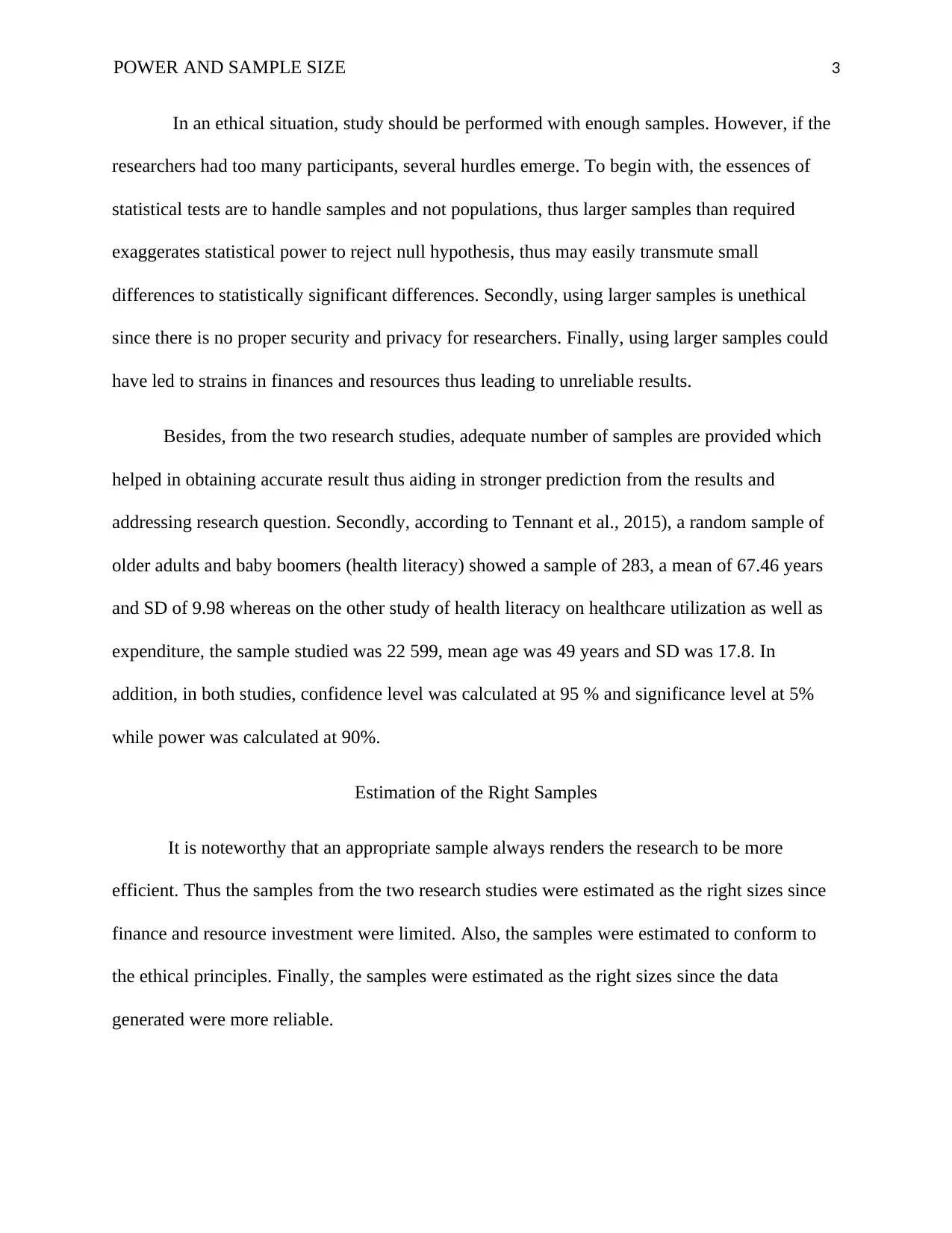
In an ethical situation, study should be performed with enough samples. However, if the
researchers had too many participants, several hurdles emerge. To begin with, the essences of
statistical tests are to handle samples and not populations, thus larger samples than required
exaggerates statistical power to reject null hypothesis, thus may easily transmute small
differences to statistically significant differences. Secondly, using larger samples is unethical
since there is no proper security and privacy for researchers. Finally, using larger samples could
have led to strains in finances and resources thus leading to unreliable results.
Besides, from the two research studies, adequate number of samples are provided which
helped in obtaining accurate result thus aiding in stronger prediction from the results and
addressing research question. Secondly, according to Tennant et al., 2015), a random sample of
older adults and baby boomers (health literacy) showed a sample of 283, a mean of 67.46 years
and SD of 9.98 whereas on the other study of health literacy on healthcare utilization as well as
expenditure, the sample studied was 22 599, mean age was 49 years and SD was 17.8. In
addition, in both studies, confidence level was calculated at 95 % and significance level at 5%
while power was calculated at 90%.
Estimation of the Right Samples
It is noteworthy that an appropriate sample always renders the research to be more
efficient. Thus the samples from the two research studies were estimated as the right sizes since
finance and resource investment were limited. Also, the samples were estimated to conform to
the ethical principles. Finally, the samples were estimated as the right sizes since the data
generated were more reliable.
Document Page
POWER AND SAMPLE SIZE 4
Effect of Margin of Error, Effect size and Variability of the Outcome to Sample Size
Computation
Margin of error refers to statistical means of expressing random sampling error from a
survey result. In addition, it is half the width of a confidence interval of a statistical survey.
Moreover, when the margin of error is larger, the less the confidence level of a statistical result.
On the other hand, effect size is a statistical concept aiding in measuring strength of the
relationship existing between two variables. In this research, it is calculated to show significance
of type II error. Meanwhile, variability shows the extent to which dataset diverges from the
central or average values as well as how much data points differ from each other. Example of
variability is the standard deviation.
Comparing and Contrasting
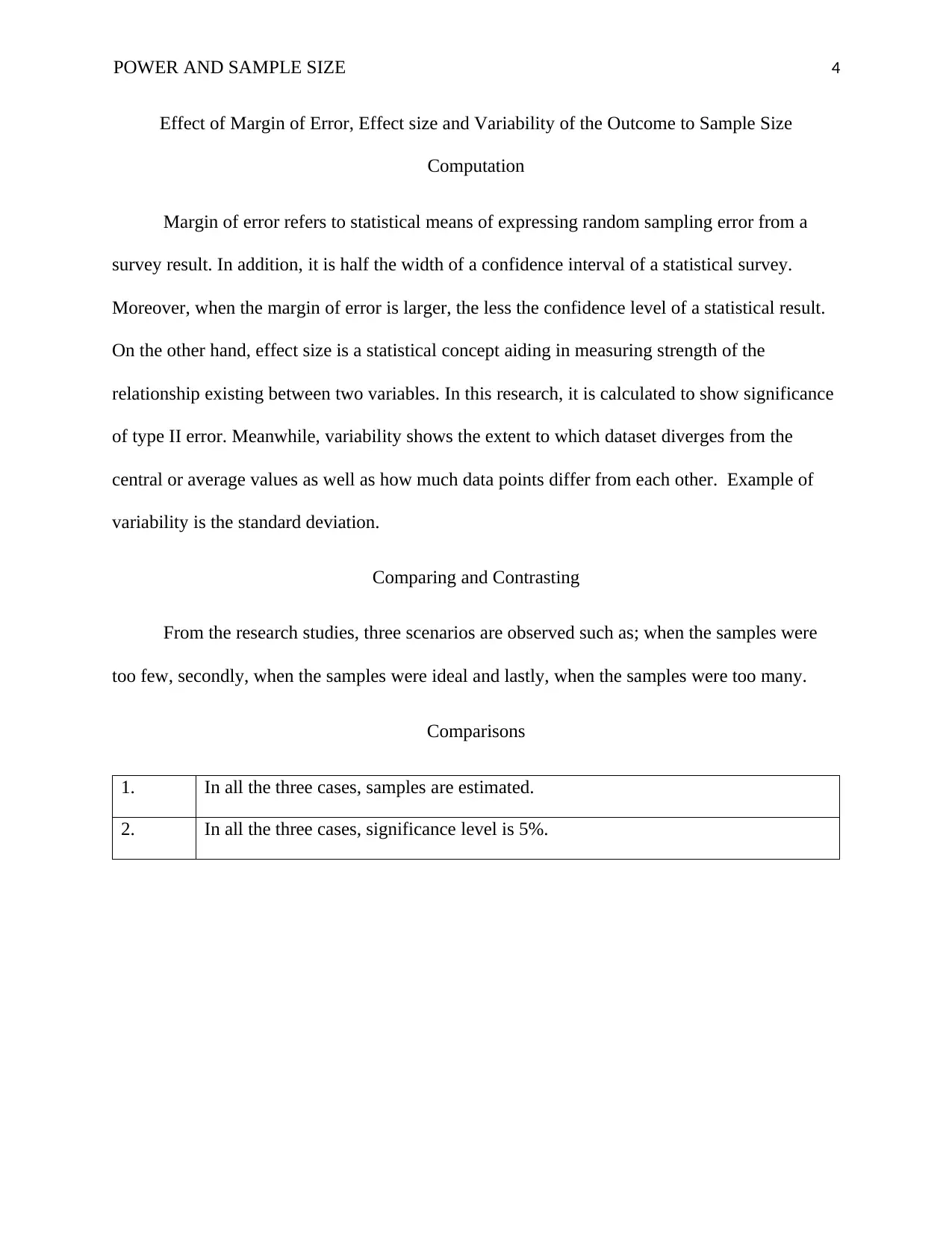
From the research studies, three scenarios are observed such as; when the samples were
too few, secondly, when the samples were ideal and lastly, when the samples were too many.
Comparisons
1. In all the three cases, samples are estimated.
2. In all the three cases, significance level is 5%.
tabler-icon-diamond-filled.svg

Paraphrase This Document

Need a fresh take? Get an instant paraphrase of this document with our AI Paraphraser
Document Page
POWER AND SAMPLE SIZE 5
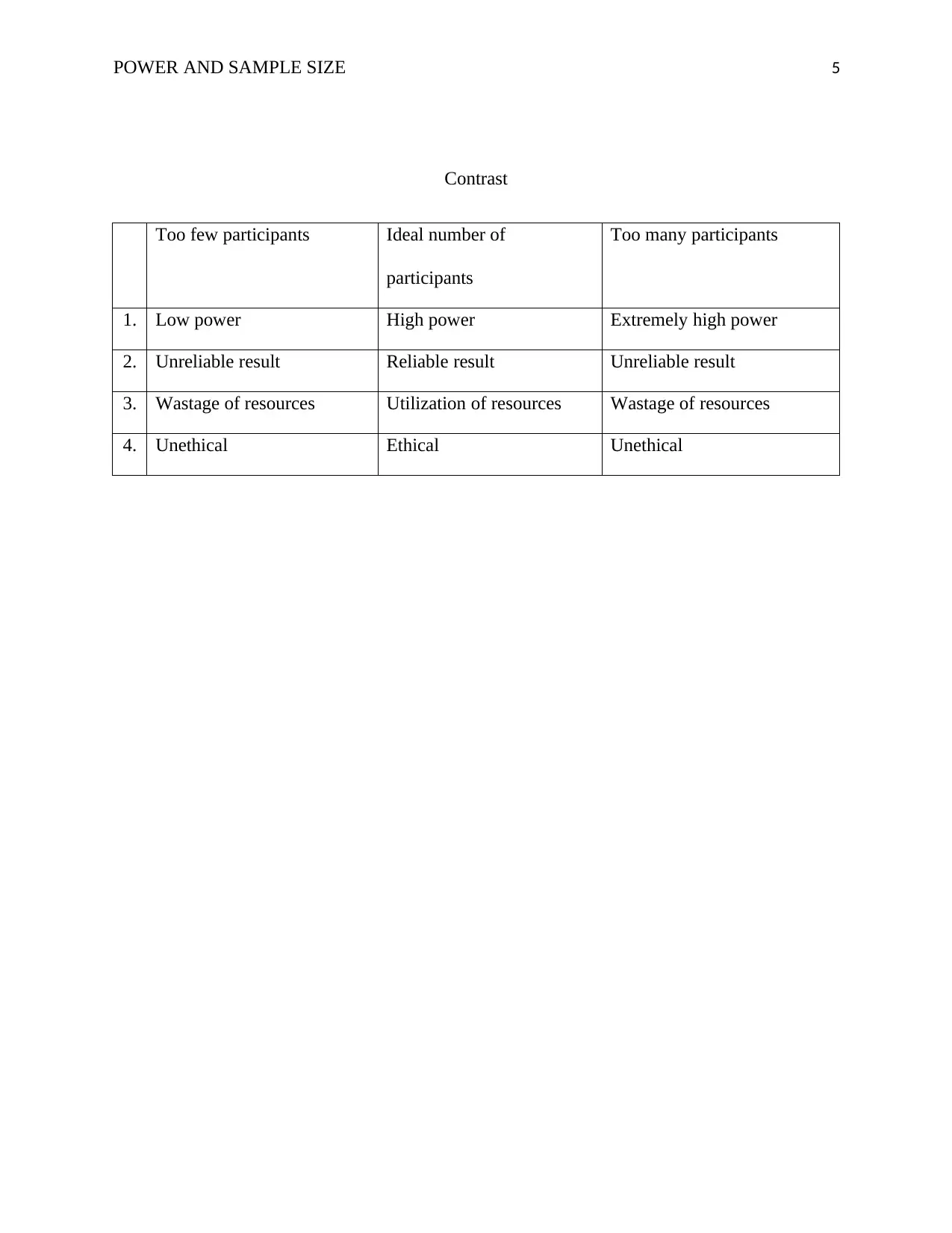
Contrast
Too few participants Ideal number of
participants
Too many participants
1. Low power High power Extremely high power
2. Unreliable result Reliable result Unreliable result
3. Wastage of resources Utilization of resources Wastage of resources
4. Unethical Ethical Unethical
Document Page
POWER AND SAMPLE SIZE 6
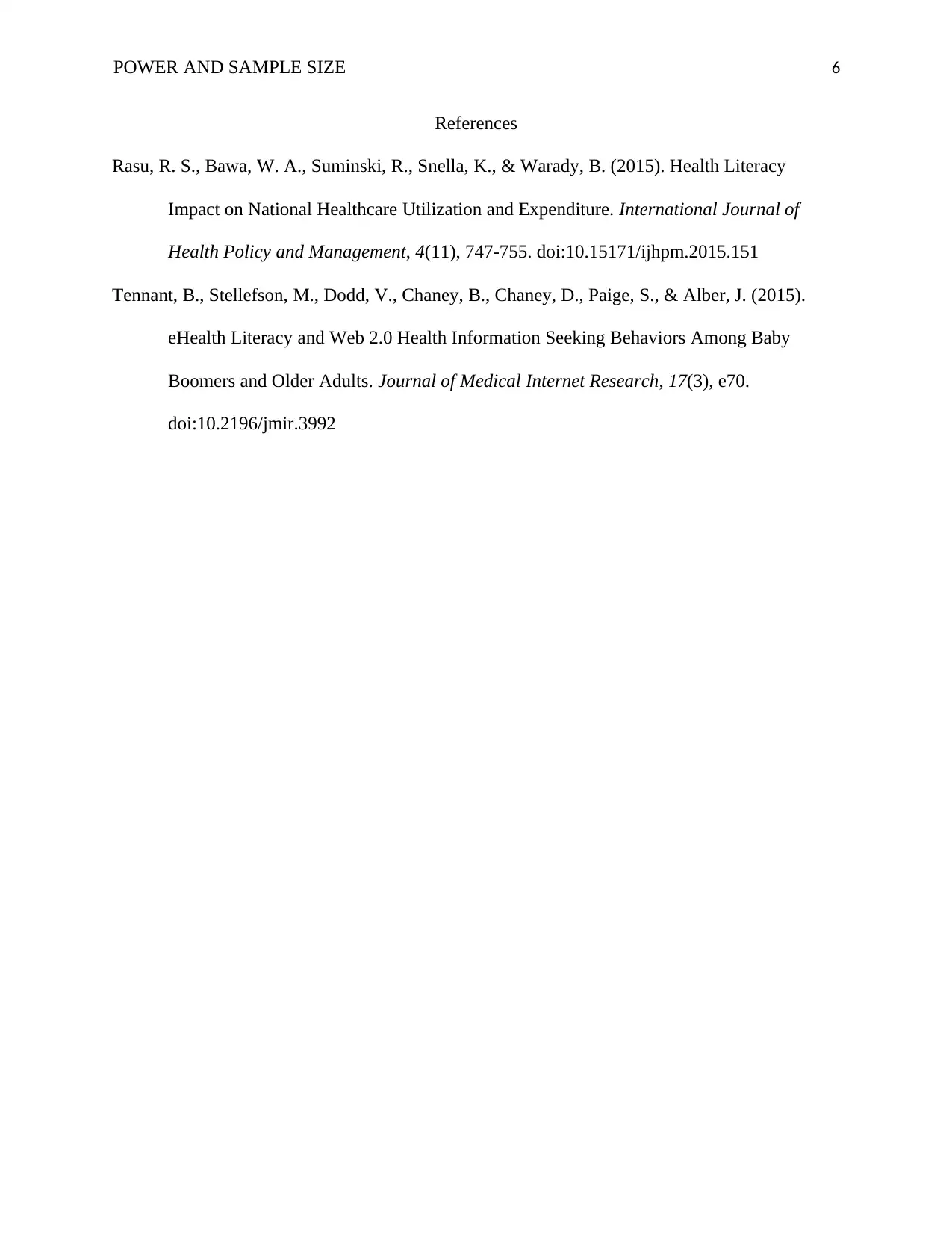
References
Rasu, R. S., Bawa, W. A., Suminski, R., Snella, K., & Warady, B. (2015). Health Literacy
Impact on National Healthcare Utilization and Expenditure. International Journal of
Health Policy and Management, 4(11), 747-755. doi:10.15171/ijhpm.2015.151
Tennant, B., Stellefson, M., Dodd, V., Chaney, B., Chaney, D., Paige, S., & Alber, J. (2015).
eHealth Literacy and Web 2.0 Health Information Seeking Behaviors Among Baby
Boomers and Older Adults. Journal of Medical Internet Research, 17(3), e70.
doi:10.2196/jmir.3992
chevron_up_icon
1 out of 6
circle_padding
hide_on_mobile
zoom_out_icon
[object Object]