Prairie Dress: A Historical Analysis of Fashion Design and Evolution
VerifiedAdded on 2022/12/30
|25
|6950
|43
Essay
AI Summary
This essay undertakes a comprehensive analysis of the prairie dress, tracing its evolution from the 19th century to the present day. It begins by examining the practical clothing worn by pioneer women in North America, focusing on the materials, styles, and functions of their garments. The study then explores the dress's transformation into a fashionable piece, particularly during the 1970s with designers like Laura Ashley and Gunne Sax, investigating the reasons behind its popularity and the design elements that defined this era. Finally, the essay analyzes how contemporary designers, such as Batsheva Hay, have reinterpreted the prairie dress, incorporating elements of its history and design into modern silhouettes. The research includes historical context, image analysis, and a discussion of the dress's enduring appeal and influence on fashion trends.

THE PRAIRIE DRESS
The development and exploration of the prairie dress from the
19th century to present day.
BA(Hons) fashion design
The development and exploration of the prairie dress from the
19th century to present day.
BA(Hons) fashion design

Paraphrase This Document
Need a fresh take? Get an instant paraphrase of this document with our AI Paraphraser

DECLARATION:
‘I declare that all of the written work in this document is from my own
words and I am very aware of the Plagiarism poly at the University of
Westminster.’
‘I declare that all of the written work in this document is from my own
words and I am very aware of the Plagiarism poly at the University of
Westminster.’

ABSTRACT
The prairie dress evoked from the past lives of 19th century pioneer
women from North America’s Western frontier. This definition has been
used to describe modern dresses from the 1970s to 21st century. This
dissertation will analyse the context of each period when the prairie dress
came to be popular and to understand how it’s been romanticised in the
197os and present day.
The prairie dress evoked from the past lives of 19th century pioneer
women from North America’s Western frontier. This definition has been
used to describe modern dresses from the 1970s to 21st century. This
dissertation will analyse the context of each period when the prairie dress
came to be popular and to understand how it’s been romanticised in the
197os and present day.
⊘ This is a preview!⊘
Do you want full access?
Subscribe today to unlock all pages.

Trusted by 1+ million students worldwide
CONTENTS
1.INTRODUCTION………………………………………………………………….5
2.LIFE OF PIONEER WOMEN………………………………………………. 6
1.1Domestic roles of women
Clothing worn on the frontier
Homesteading and journey west
Image appendix
3.THE PRAIRIE DRESS…………………………………………………
From peasant to prairie dress
Rise of romantic designers, Laura Ashley to Gunne Sax
Demand of Laura Ashley
Image appendix
4. 21st CENTURY PRAIRIE DRESS………………………
Batsheva Hay
The modern prairie dress
Conclusion.
1.INTRODUCTION………………………………………………………………….5
2.LIFE OF PIONEER WOMEN………………………………………………. 6
1.1Domestic roles of women
Clothing worn on the frontier
Homesteading and journey west
Image appendix
3.THE PRAIRIE DRESS…………………………………………………
From peasant to prairie dress
Rise of romantic designers, Laura Ashley to Gunne Sax
Demand of Laura Ashley
Image appendix
4. 21st CENTURY PRAIRIE DRESS………………………
Batsheva Hay
The modern prairie dress
Conclusion.
Paraphrase This Document
Need a fresh take? Get an instant paraphrase of this document with our AI Paraphraser
Image appendix
BIBLOGRAPHY …………………………………………………………...
IMAGE BIBLIOGRAPHY…………………………………………………
5
INTRODUCTION
The prairie dress is a modern interpretation of the dresses worn by pioneer women in the
19th century, the silhouette became incredibly popular in the 1970s with the rise of
designer Laura Ashley. This paper will research the historical and modern clothing behind
the prairie dress and styles that pioneer women wore in the 19th century which changed
over time.
Pioneer women who were working on the frontier had to endure hard physical work
needing practical clothing for daily wear. The climate and working conditions women would
often choose to wear calico cotton dresses, the first chapter will focus on this and explore
dresses worn for daily wear by pioneer women living in North America between the 1850s
to 1890s. The women who lived on the frontier wore their dresses for labor, I will study the
images of the garments to understand how they have evolved into a modern garment, and
there uses of practicality. Next, I will analyze the roles of the women when homesteading on
new land, how they would create a home on the frontier, the jobs involved when on new
land, expected for pioneer women.
There will be an analysis of the specific style that emerged into fashion in 1970, why it
gained popularity and how the dress became a fashionable piece of clothing. The prairie
BIBLOGRAPHY …………………………………………………………...
IMAGE BIBLIOGRAPHY…………………………………………………
5
INTRODUCTION
The prairie dress is a modern interpretation of the dresses worn by pioneer women in the
19th century, the silhouette became incredibly popular in the 1970s with the rise of
designer Laura Ashley. This paper will research the historical and modern clothing behind
the prairie dress and styles that pioneer women wore in the 19th century which changed
over time.
Pioneer women who were working on the frontier had to endure hard physical work
needing practical clothing for daily wear. The climate and working conditions women would
often choose to wear calico cotton dresses, the first chapter will focus on this and explore
dresses worn for daily wear by pioneer women living in North America between the 1850s
to 1890s. The women who lived on the frontier wore their dresses for labor, I will study the
images of the garments to understand how they have evolved into a modern garment, and
there uses of practicality. Next, I will analyze the roles of the women when homesteading on
new land, how they would create a home on the frontier, the jobs involved when on new
land, expected for pioneer women.
There will be an analysis of the specific style that emerged into fashion in 1970, why it
gained popularity and how the dress became a fashionable piece of clothing. The prairie
dress worn previously by pioneers for practical use had been adapted and developed into a
new style of prairie dress designed by designers such as Laura Ashley and Gunne Sax in
1970. The traditional dress never disappeared from the fashion industry once it had been
established by pioneer women however the research will explore the new modernized
silhouette during the 1970s. Then it will analyze how designers in the present day have
taken elements of the 1970s prairie dress to a romantic piece of fashionable clothing. The
imagery will explore how it has evolved into a modern dress designed by Batsheva Hay, who
takes elements of her 1970s Laura Ashley dresses to create new dress silhouettes.
This paper will investigate the three periods to gain an understanding of the intriguing
fashion history behind the dress and why it has gained popularity again in the 21st century.
These three periods of fashion will be analyzed in this paper to gain an understanding of the
history inspired by the prairie dress style by the use of describing items worn by the women
of the west during 19th century North America.
6
CHAPTER 1-
LIFE OF PIONEER WOMEN
Domestic roles of women
In the 19th century North America, women who lived in the west had to immerse
themselves into endless domesticated roles of being a mother, wife, and homemaker. This
was the place for women and their role, they were expected to work hard and due to the
lack of opportunities from education, women were tied to their home. They had chores
more than many women during this time and had to work hard alongside their husbands to
provide food, water, and clothing for their families. They lived lives that re-volved around
new style of prairie dress designed by designers such as Laura Ashley and Gunne Sax in
1970. The traditional dress never disappeared from the fashion industry once it had been
established by pioneer women however the research will explore the new modernized
silhouette during the 1970s. Then it will analyze how designers in the present day have
taken elements of the 1970s prairie dress to a romantic piece of fashionable clothing. The
imagery will explore how it has evolved into a modern dress designed by Batsheva Hay, who
takes elements of her 1970s Laura Ashley dresses to create new dress silhouettes.
This paper will investigate the three periods to gain an understanding of the intriguing
fashion history behind the dress and why it has gained popularity again in the 21st century.
These three periods of fashion will be analyzed in this paper to gain an understanding of the
history inspired by the prairie dress style by the use of describing items worn by the women
of the west during 19th century North America.
6
CHAPTER 1-
LIFE OF PIONEER WOMEN
Domestic roles of women
In the 19th century North America, women who lived in the west had to immerse
themselves into endless domesticated roles of being a mother, wife, and homemaker. This
was the place for women and their role, they were expected to work hard and due to the
lack of opportunities from education, women were tied to their home. They had chores
more than many women during this time and had to work hard alongside their husbands to
provide food, water, and clothing for their families. They lived lives that re-volved around
⊘ This is a preview!⊘
Do you want full access?
Subscribe today to unlock all pages.
Trusted by 1+ million students worldwide
the home, dedicated to their families, hard-working women that had many children, and
most families suffered from the life of hardship, miles of walking, meals cooked over open
fires in all weather conditions, all of which had an impact on women’s garments. While on
traveling close to their final destination women would do their hair and wear the least
damaged clothes from their travels to enhance their arrival on new land.
Due to shortage of labour on the frontier, families had to work together and needed all the
help they could get, the mothers and daughters assisted with traditionally male tasks of
harvesting, tending to the livestock and hauling water. For pioneer women, hauling the
water supply was a regular part of household chores, a housewife had to trudge a mile or
more to the nearest running stream. Filling wooden buckets or barrels and walk miles home.
Memories written from the life of pioneer women during this period describe
autobiographical manuscripts written by many pioneer women during 1854-1885 about
their frontier life and the wild west “How Pioneer Women Lived” discovered by Joanna L
Stratton and the stainless work they undertook and the clothes that they wore, suggested
that clothes were used for many uses “a yoke was made to place across the shoulder, so as
to carry at each end a bucket of water, and then water was brought a half mile from spring
to house..” (Stratton, 2013, page 61 This quotation suggests gathering water was the fuel
and a clear chore during the daily tasks. For heating and cooking they would hunt for
burnable wood, grass and dried sticks, relying on the environment of the prairie for all
supplies. The prairie housewife tended to work extremely long hours of doing tasks such as
washing clothes, sewing, cleaning and gardening with a limited supply and no mechanical
equipment to keep the household intact. The pioneer women and daughters would
regularly farm and cook, also devoted many hours sewing by hand, knitting jumpers and
embroidering linen cloth. (REFERENCE… )
Clothing worn on the frontier
Clothing was kept simple for daily wear working, women on the frontier had dresses made
for practical use and daily chores, fashion adapted to meet the needs of the families living
out in the West. (girls in the cult page-27)
most families suffered from the life of hardship, miles of walking, meals cooked over open
fires in all weather conditions, all of which had an impact on women’s garments. While on
traveling close to their final destination women would do their hair and wear the least
damaged clothes from their travels to enhance their arrival on new land.
Due to shortage of labour on the frontier, families had to work together and needed all the
help they could get, the mothers and daughters assisted with traditionally male tasks of
harvesting, tending to the livestock and hauling water. For pioneer women, hauling the
water supply was a regular part of household chores, a housewife had to trudge a mile or
more to the nearest running stream. Filling wooden buckets or barrels and walk miles home.
Memories written from the life of pioneer women during this period describe
autobiographical manuscripts written by many pioneer women during 1854-1885 about
their frontier life and the wild west “How Pioneer Women Lived” discovered by Joanna L
Stratton and the stainless work they undertook and the clothes that they wore, suggested
that clothes were used for many uses “a yoke was made to place across the shoulder, so as
to carry at each end a bucket of water, and then water was brought a half mile from spring
to house..” (Stratton, 2013, page 61 This quotation suggests gathering water was the fuel
and a clear chore during the daily tasks. For heating and cooking they would hunt for
burnable wood, grass and dried sticks, relying on the environment of the prairie for all
supplies. The prairie housewife tended to work extremely long hours of doing tasks such as
washing clothes, sewing, cleaning and gardening with a limited supply and no mechanical
equipment to keep the household intact. The pioneer women and daughters would
regularly farm and cook, also devoted many hours sewing by hand, knitting jumpers and
embroidering linen cloth. (REFERENCE… )
Clothing worn on the frontier
Clothing was kept simple for daily wear working, women on the frontier had dresses made
for practical use and daily chores, fashion adapted to meet the needs of the families living
out in the West. (girls in the cult page-27)
Paraphrase This Document
Need a fresh take? Get an instant paraphrase of this document with our AI Paraphraser
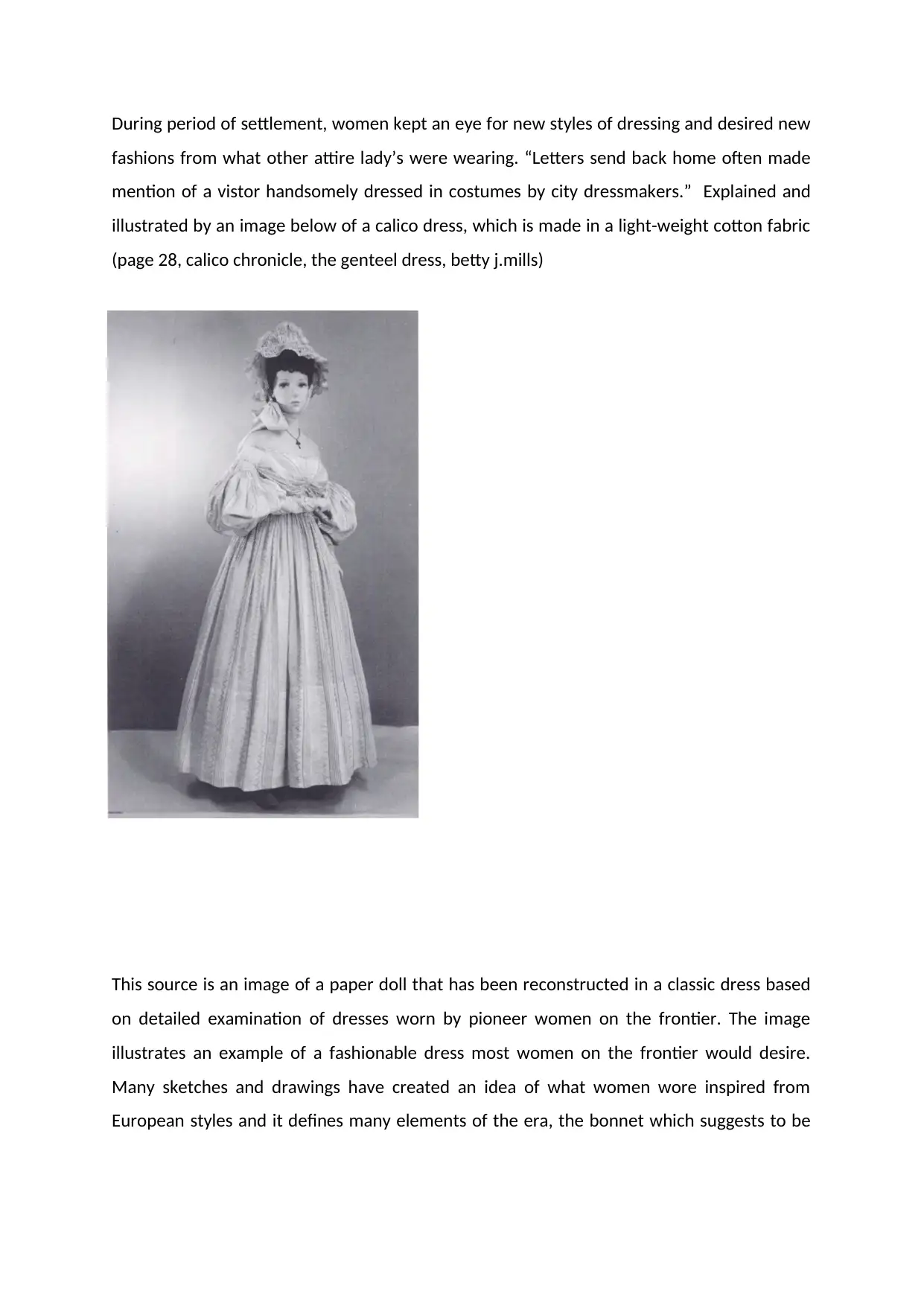
During period of settlement, women kept an eye for new styles of dressing and desired new
fashions from what other attire lady’s were wearing. “Letters send back home often made
mention of a vistor handsomely dressed in costumes by city dressmakers.” Explained and
illustrated by an image below of a calico dress, which is made in a light-weight cotton fabric
(page 28, calico chronicle, the genteel dress, betty j.mills)
This source is an image of a paper doll that has been reconstructed in a classic dress based
on detailed examination of dresses worn by pioneer women on the frontier. The image
illustrates an example of a fashionable dress most women on the frontier would desire.
Many sketches and drawings have created an idea of what women wore inspired from
European styles and it defines many elements of the era, the bonnet which suggests to be
fashions from what other attire lady’s were wearing. “Letters send back home often made
mention of a vistor handsomely dressed in costumes by city dressmakers.” Explained and
illustrated by an image below of a calico dress, which is made in a light-weight cotton fabric
(page 28, calico chronicle, the genteel dress, betty j.mills)
This source is an image of a paper doll that has been reconstructed in a classic dress based
on detailed examination of dresses worn by pioneer women on the frontier. The image
illustrates an example of a fashionable dress most women on the frontier would desire.
Many sketches and drawings have created an idea of what women wore inspired from
European styles and it defines many elements of the era, the bonnet which suggests to be

made in lace fabric, the dress in a bardot style neckline, large puff sleeves which are long in
length and gathered full skirt.
This image demonstrates a classic dress and on the frontier more of a desirable piece, this
may have been remade into a more practical garment clothing such as an apron or
children’s clothing for better use as supplies were low. “Records show that this frock was
worn by a lady in Dublin, Texas” and according to sources many elements of the dress
construction were taken from this example of earlier period frontier frock which is cited
above. The classic style of frontier dress became a garment trend of style among the
frontier, calico was an affordable fabric and many women admired stylish European dresses,
“Their style, were distinctively European” This suggests that the European style grew most
popular which retained element of the originally designed frontier dress. (PAGE 28, THE
GENTEEL DRESS, Calico chronicle, Texas women, betty j mills)
In comparison to the frontier dress, which tended to be made from home-spun calico or
muslin fabrics which was more popular style in fashion for many years on the frontier due to
practicality and material they could afford. This is demonstrated in the image below an
example of a frontier dress (calico chronicle)
The women only had a few working dresses, which were worn with a bonnet, an apron
which all were made in natural fabrics such as muslin, calico or gingham. The dress styles
were fitted bodices, sleeves were loose and held volume, mirrored by a high neck collar for
sun protection, the dresses had full skirts and due to the reality of daily tasks they tended to
be hemmed three inches shorter for practical wear and easier movement during domestic
chores. In addition to a small handful of day dresses for work and a Sunday dress, women on
the frontier would reserve a dress for socializing and important events such as weddings.
length and gathered full skirt.
This image demonstrates a classic dress and on the frontier more of a desirable piece, this
may have been remade into a more practical garment clothing such as an apron or
children’s clothing for better use as supplies were low. “Records show that this frock was
worn by a lady in Dublin, Texas” and according to sources many elements of the dress
construction were taken from this example of earlier period frontier frock which is cited
above. The classic style of frontier dress became a garment trend of style among the
frontier, calico was an affordable fabric and many women admired stylish European dresses,
“Their style, were distinctively European” This suggests that the European style grew most
popular which retained element of the originally designed frontier dress. (PAGE 28, THE
GENTEEL DRESS, Calico chronicle, Texas women, betty j mills)
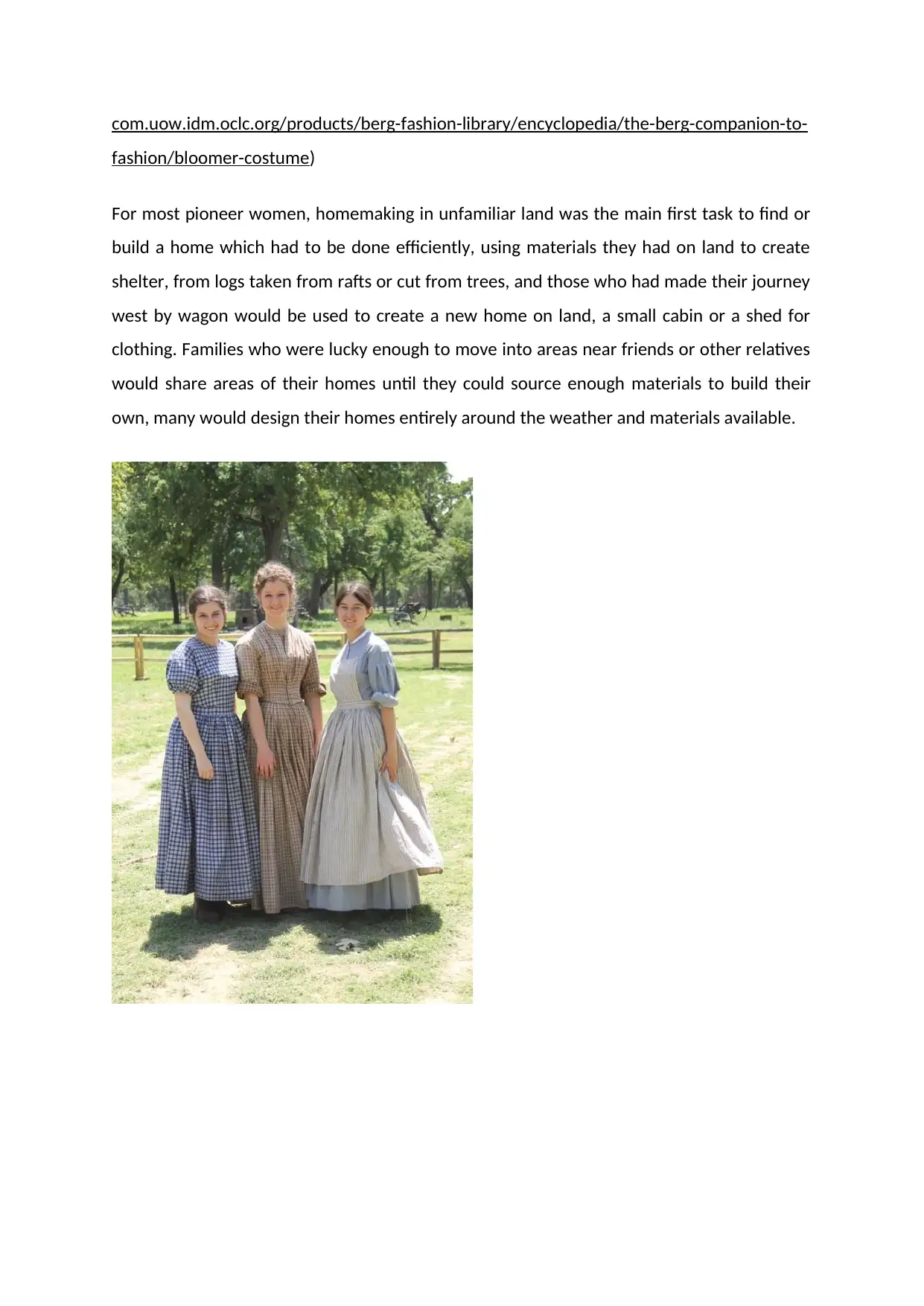
In comparison to the frontier dress, which tended to be made from home-spun calico or
muslin fabrics which was more popular style in fashion for many years on the frontier due to
practicality and material they could afford. This is demonstrated in the image below an
example of a frontier dress (calico chronicle)
The women only had a few working dresses, which were worn with a bonnet, an apron
which all were made in natural fabrics such as muslin, calico or gingham. The dress styles
were fitted bodices, sleeves were loose and held volume, mirrored by a high neck collar for
sun protection, the dresses had full skirts and due to the reality of daily tasks they tended to
be hemmed three inches shorter for practical wear and easier movement during domestic
chores. In addition to a small handful of day dresses for work and a Sunday dress, women on
the frontier would reserve a dress for socializing and important events such as weddings.
⊘ This is a preview!⊘
Do you want full access?
Subscribe today to unlock all pages.
Trusted by 1+ million students worldwide
“The family trunks were stripped of old dresses, suits and shawls for usable scraps of fabric.
Blankets, sheets and linens often provided material for new shirts, skirts and trousers”
(page 68 pioneer women) This suggests readymade fabrics and clothes were hard to source.
Women had to use their own skills due to the shortage of new garments and fabric to
restore clothing for the family. “To dress in style was not thought of in those days. Clothing
had to sufficient to protect the body from the cold of winter and from the heat of summer
was the only thing thought about when dressing themselves. (page 68 pioneer women)
Dresses were made for domestic work in the kitchen and the fields. Clothing worn by young
pioneers or newly married women were very different from the middle-age or elder
widowed women. The young women preferred wearing light, floaty garments made in light
pastel fabric or white colours. Older women chose darker, more subdued colours for
clothing. The fabrics consisted of cotton, linen and wool, the fabrics were available to
purchase at stores close by, but many were limited to what they could afford. If they were
too poor the women would spin or weave their own fabrics for new garments, they would
then dye the fabrics with natural dyes such as meadow flowers, fruit skins, berries and
barks.
(how the west was worn page 68, prairie styles)
Pioneer women relied on their own sewing skills to make clothing, and fabric was cut from
homemade patterns, old garments were also used for their pieces to create new patterns
for dress styles. While pioneer family’s trailed west there clothes would become worn and
beyond repair. The were so desperate for clothing, some pioneer women who wrote in their
diary’s about the issue “If family members passed away on the trip, their bodies would be
stripped first of their clothes” New garments were hard to source and this task shows a clear
sign of desperation. During the winter months, animal skins were carefully kept being used
for warm and upcycled into heavy leather coats, hats and shoes. (how the west was worn
page 69, prairie styles)
Homesteading and journey west
During the travels across west some women would remove their hoops from their dresses
as they were imaginably difficult and uncomfortable to wear, this meant they would get
Blankets, sheets and linens often provided material for new shirts, skirts and trousers”
(page 68 pioneer women) This suggests readymade fabrics and clothes were hard to source.
Women had to use their own skills due to the shortage of new garments and fabric to
restore clothing for the family. “To dress in style was not thought of in those days. Clothing
had to sufficient to protect the body from the cold of winter and from the heat of summer
was the only thing thought about when dressing themselves. (page 68 pioneer women)
Dresses were made for domestic work in the kitchen and the fields. Clothing worn by young
pioneers or newly married women were very different from the middle-age or elder
widowed women. The young women preferred wearing light, floaty garments made in light
pastel fabric or white colours. Older women chose darker, more subdued colours for
clothing. The fabrics consisted of cotton, linen and wool, the fabrics were available to
purchase at stores close by, but many were limited to what they could afford. If they were
too poor the women would spin or weave their own fabrics for new garments, they would
then dye the fabrics with natural dyes such as meadow flowers, fruit skins, berries and
barks.
(how the west was worn page 68, prairie styles)
Pioneer women relied on their own sewing skills to make clothing, and fabric was cut from
homemade patterns, old garments were also used for their pieces to create new patterns
for dress styles. While pioneer family’s trailed west there clothes would become worn and
beyond repair. The were so desperate for clothing, some pioneer women who wrote in their
diary’s about the issue “If family members passed away on the trip, their bodies would be
stripped first of their clothes” New garments were hard to source and this task shows a clear
sign of desperation. During the winter months, animal skins were carefully kept being used
for warm and upcycled into heavy leather coats, hats and shoes. (how the west was worn
page 69, prairie styles)
Homesteading and journey west
During the travels across west some women would remove their hoops from their dresses
as they were imaginably difficult and uncomfortable to wear, this meant they would get
Paraphrase This Document
Need a fresh take? Get an instant paraphrase of this document with our AI Paraphraser
caught with sticks and dirt as they would drag on the floor. The strong winds would blow up
their skirts in the strong winds so women pinned rocks to the hemlines of their dresses to
prevent this but sometimes the winds would be at such strong force that the stones would
hit their knees and cause much discomfort. (The lives of women / The journey west page 45)
The climate was a constant battle of survival, and the attempts to make clothing more
practical was showing to be an unsuccess. Many other women would invest in higher
fashion clothing for practicality, choosing fabrics thicker cottons with ample aprons.
However even when investing in higher-end fabrics the long skirts of their dresses were still
terribly unpractical as they would get caught in the fires on the camps or pulled under
passing wagons, daily fashion needed to adjust and other choices were made for women, in
1851 a woman name Amelia Bloomer’s invented a two piece of a skirt with trousers to
match, named bloomers which endured more freedom of movement and comfort
page 44 The journey west by linda s. peavy
(https://www.google.co.uk/books/edition/Pioneer_Women/q-j2hvr05G4C?
hl=en&gbpv=1&dq=pioneer+women+fashion&pg=PA45&printsec=frontcover)
Women received a lot of abuse and a scholar in women’s gender and sexuality studies
stated during the period “To us, it doesn’t look like a radical thing, but wearing pants was a
kind of flag of gender dissent.” (written by Amy Kesselman,DATE.. Smithsonian mag) – NEW
YORK TIMES SOURCE many women disapproved of this and some continued to wear
bloomers in public, mainly activists. Women wanted to lose the long heavy skirts but due to
the anxiousness caused by public opinion and harassment they could not.
They were only worn by a handful of women as of fears of gender roles, due to the society
views were male dominance, some suggest men found the bloomer pant threatening and by
the mid 1850s, most women’s right advocates no longer wore bloomers in public. Amelia
Bloomer, a suffragist opposed and continued to wear hers for several more years “Although
the number of women who wore such attire in public was very small, there are accounts of
women wearing it in private when doing housework, farming or traveling, especially in the
west.” (Bloomsbury – the berg companion to fashion, Valerie Steele, BLOOMER COSTUME
pages 82-84, written by colleen R. Callahan. https://www-bloomsburyfashioncentral-
their skirts in the strong winds so women pinned rocks to the hemlines of their dresses to
prevent this but sometimes the winds would be at such strong force that the stones would
hit their knees and cause much discomfort. (The lives of women / The journey west page 45)
The climate was a constant battle of survival, and the attempts to make clothing more
practical was showing to be an unsuccess. Many other women would invest in higher
fashion clothing for practicality, choosing fabrics thicker cottons with ample aprons.
However even when investing in higher-end fabrics the long skirts of their dresses were still
terribly unpractical as they would get caught in the fires on the camps or pulled under
passing wagons, daily fashion needed to adjust and other choices were made for women, in
1851 a woman name Amelia Bloomer’s invented a two piece of a skirt with trousers to
match, named bloomers which endured more freedom of movement and comfort
page 44 The journey west by linda s. peavy
(https://www.google.co.uk/books/edition/Pioneer_Women/q-j2hvr05G4C?
hl=en&gbpv=1&dq=pioneer+women+fashion&pg=PA45&printsec=frontcover)
Women received a lot of abuse and a scholar in women’s gender and sexuality studies
stated during the period “To us, it doesn’t look like a radical thing, but wearing pants was a
kind of flag of gender dissent.” (written by Amy Kesselman,DATE.. Smithsonian mag) – NEW
YORK TIMES SOURCE many women disapproved of this and some continued to wear
bloomers in public, mainly activists. Women wanted to lose the long heavy skirts but due to
the anxiousness caused by public opinion and harassment they could not.
They were only worn by a handful of women as of fears of gender roles, due to the society
views were male dominance, some suggest men found the bloomer pant threatening and by
the mid 1850s, most women’s right advocates no longer wore bloomers in public. Amelia
Bloomer, a suffragist opposed and continued to wear hers for several more years “Although
the number of women who wore such attire in public was very small, there are accounts of
women wearing it in private when doing housework, farming or traveling, especially in the
west.” (Bloomsbury – the berg companion to fashion, Valerie Steele, BLOOMER COSTUME
pages 82-84, written by colleen R. Callahan. https://www-bloomsburyfashioncentral-
com.uow.idm.oclc.org/products/berg-fashion-library/encyclopedia/the-berg-companion-to-
fashion/bloomer-costume)
For most pioneer women, homemaking in unfamiliar land was the main first task to find or
build a home which had to be done efficiently, using materials they had on land to create
shelter, from logs taken from rafts or cut from trees, and those who had made their journey
west by wagon would be used to create a new home on land, a small cabin or a shed for
clothing. Families who were lucky enough to move into areas near friends or other relatives
would share areas of their homes until they could source enough materials to build their
own, many would design their homes entirely around the weather and materials available.
fashion/bloomer-costume)
For most pioneer women, homemaking in unfamiliar land was the main first task to find or
build a home which had to be done efficiently, using materials they had on land to create
shelter, from logs taken from rafts or cut from trees, and those who had made their journey
west by wagon would be used to create a new home on land, a small cabin or a shed for
clothing. Families who were lucky enough to move into areas near friends or other relatives
would share areas of their homes until they could source enough materials to build their
own, many would design their homes entirely around the weather and materials available.
⊘ This is a preview!⊘
Do you want full access?
Subscribe today to unlock all pages.
Trusted by 1+ million students worldwide

1 out of 25


Your All-in-One AI-Powered Toolkit for Academic Success.
+13062052269
info@desklib.com
Available 24*7 on WhatsApp / Email
![[object Object]](/_next/static/media/star-bottom.7253800d.svg)
Unlock your academic potential
Copyright © 2020–2026 A2Z Services. All Rights Reserved. Developed and managed by ZUCOL.