Project on Pregnancy and Maternity Discrimination in the Workplace
VerifiedAdded on 2023/01/16
|30
|5902
|70
Project
AI Summary
This project delves into the critical issue of pregnancy and maternity discrimination within the workplace, specifically focusing on its impact on the productivity of Captify. The project meticulously outlines the aim and objectives, which include evaluating the impacts of discrimination, examining employee awareness of legal rights, and identifying strategies to mitigate negative impacts. It encompasses a comprehensive project management plan, detailing timeframes, scope, costs, and quality management strategies. The research methodology employs a qualitative approach, utilizing primary data collection methods such as questionnaires, and secondary data from literature reviews, to gather insights. The project includes a detailed literature review exploring themes such as the impact of discrimination, legal rights of employees, and strategies for overcoming negative impacts. The data analysis focuses on thematic analysis to interpret findings and present outcomes, followed by recommendations and a performance review. The project concludes with a summary of findings and suggestions for Captify to improve its practices and enhance productivity. The appendices contain the questionnaire and project logbook used in the research.

Managing a Successful Business
Project
Project

Paraphrase This Document
Need a fresh take? Get an instant paraphrase of this document with our AI Paraphraser
Table of Contents
INTRODUCTION.......................................................................................................................4
TASK...........................................................................................................................................4
A) Aim and objectives........................................................................................................4
B) Project management plan..............................................................................................6
C) Research methodology..................................................................................................8
D) Data Analyses..............................................................................................................10
E) Presenting outcome......................................................................................................21
F) Recommendation.........................................................................................................21
G) Performance review.....................................................................................................22
CONCLUSION..........................................................................................................................23
REFERENCES..........................................................................................................................25
APPENDIX................................................................................................................................27
Questionnaire....................................................................................................................27
Project Log Book..............................................................................................................29
INTRODUCTION.......................................................................................................................4
TASK...........................................................................................................................................4
A) Aim and objectives........................................................................................................4
B) Project management plan..............................................................................................6
C) Research methodology..................................................................................................8
D) Data Analyses..............................................................................................................10
E) Presenting outcome......................................................................................................21
F) Recommendation.........................................................................................................21
G) Performance review.....................................................................................................22
CONCLUSION..........................................................................................................................23
REFERENCES..........................................................................................................................25
APPENDIX................................................................................................................................27
Questionnaire....................................................................................................................27
Project Log Book..............................................................................................................29

⊘ This is a preview!⊘
Do you want full access?
Subscribe today to unlock all pages.

Trusted by 1+ million students worldwide
INTRODUCTION
Company having diverse level of workforce which is being increasing order and being
recognized as the worth full assets which is improving the performance of firm. It has been
well manner recognize by company that diversity adds more values on both at tangible and
intangible side. Pregnancy and maternity has been considered to be protected characteristics
under equality act,2010 which are having proper management of clear prohibition to undertake
the issues of discrimination which is been related to pregnancy and maternity insignificant
organization. Pregnancy discrimination in the workplace as been identified as the major level
of involvements of treating a female applicant or employee in more in appropriates manner
due to pregnancy, childbirth or any related medical condition. The present report will have
major consideration over the implementation of equality act with specification of better
understanding in term of awareness and knowledge of rights among employee.
TASK
A) Aim and objectives
Background
Pregnancy and maternity are being considered the protected level of characteristic
under the equality act 2010 which have the development of legislation in prohibition of
discrimination which are being related to pregnancy and maternity which have inclusion of
treating a woman less favorable as the reason she is pregnant or being in post pregnancy stage
or been in being or lactation. Under the equality acts the pregnancy and maternity is
considered to be protective characteristics which is being protected the employees from being
discrimination against the against or victimized due to maternity or pregnancy.
Aim
To study the impacts of pregnancy and maternity discrimination on productivity of
organization — A study on Captify
Objectives
To evaluate the impacts of pregnancy and maternity discrimination in company.
To examine the awareness and attitude towards the legal rights of employee in terms of
maternity provision.
To identify strategies to overcome the negative impact of discrimination on Captify
productivity
Company having diverse level of workforce which is being increasing order and being
recognized as the worth full assets which is improving the performance of firm. It has been
well manner recognize by company that diversity adds more values on both at tangible and
intangible side. Pregnancy and maternity has been considered to be protected characteristics
under equality act,2010 which are having proper management of clear prohibition to undertake
the issues of discrimination which is been related to pregnancy and maternity insignificant
organization. Pregnancy discrimination in the workplace as been identified as the major level
of involvements of treating a female applicant or employee in more in appropriates manner
due to pregnancy, childbirth or any related medical condition. The present report will have
major consideration over the implementation of equality act with specification of better
understanding in term of awareness and knowledge of rights among employee.
TASK
A) Aim and objectives
Background
Pregnancy and maternity are being considered the protected level of characteristic
under the equality act 2010 which have the development of legislation in prohibition of
discrimination which are being related to pregnancy and maternity which have inclusion of
treating a woman less favorable as the reason she is pregnant or being in post pregnancy stage
or been in being or lactation. Under the equality acts the pregnancy and maternity is
considered to be protective characteristics which is being protected the employees from being
discrimination against the against or victimized due to maternity or pregnancy.
Aim
To study the impacts of pregnancy and maternity discrimination on productivity of
organization — A study on Captify
Objectives
To evaluate the impacts of pregnancy and maternity discrimination in company.
To examine the awareness and attitude towards the legal rights of employee in terms of
maternity provision.
To identify strategies to overcome the negative impact of discrimination on Captify
productivity
Paraphrase This Document
Need a fresh take? Get an instant paraphrase of this document with our AI Paraphraser
Significance
Equality and diversity add more values on both at tangible and intangible side.
Pregnancy discrimination at the workplace as been identified as major level of involvements
of treating a female applicant or employee in more inappropriate manner. Under the acts of
quality women are considered as more protective characteristic which makes company to have
legal obligation regarding the development of women who has been pregnant, is pregnant or
having lactation period. This topic will help us to establishment better understanding in
relation to the awareness and attitude towards the legal rights of employee in terms of
maternity provision.
Rationale
Equality and diversity is being considered to be as important part which is needed to
have major level of consideration in more development of productivity of company to greater
extent of development. This issues of discrimination regarding maternity and pregnancy in
considered to have the major impacts of the society as well company development to greater
extent. I have chosen this topic as per my personal interest in developing impacts of pregnancy
and maternity discrimination on productivity of organization. This is also considered as the
major issue in terms of identifying various discrimination which are existing in a company up
to what level.
Literature review.
Theme 1: Impact of pregnancy and maternity discrimination on productivity of organisation
According to Hutchinson and Dhairyawan (2018) In an organisation there are women
employees which are working along with their other responsibilities as well. Women are
discriminated while working in company because of that they are not able to perform their
work in effective manner. Hence, women will be not completing their work with the quality
then it will have impact on performance of company. Productivity will be decreased along
with that company image will be also at stake in market. As per Scully, Davids and
Melnitchouk (2017) Women are working and even when they have skills and abilities to do
work they must be motivated to do work. Positive Behavior of company towards employees
will improve employee performance along with company performance.
Theme 2: Legal rights of employees in term of maternity provision
Equality and diversity add more values on both at tangible and intangible side.
Pregnancy discrimination at the workplace as been identified as major level of involvements
of treating a female applicant or employee in more inappropriate manner. Under the acts of
quality women are considered as more protective characteristic which makes company to have
legal obligation regarding the development of women who has been pregnant, is pregnant or
having lactation period. This topic will help us to establishment better understanding in
relation to the awareness and attitude towards the legal rights of employee in terms of
maternity provision.
Rationale
Equality and diversity is being considered to be as important part which is needed to
have major level of consideration in more development of productivity of company to greater
extent of development. This issues of discrimination regarding maternity and pregnancy in
considered to have the major impacts of the society as well company development to greater
extent. I have chosen this topic as per my personal interest in developing impacts of pregnancy
and maternity discrimination on productivity of organization. This is also considered as the
major issue in terms of identifying various discrimination which are existing in a company up
to what level.
Literature review.
Theme 1: Impact of pregnancy and maternity discrimination on productivity of organisation
According to Hutchinson and Dhairyawan (2018) In an organisation there are women
employees which are working along with their other responsibilities as well. Women are
discriminated while working in company because of that they are not able to perform their
work in effective manner. Hence, women will be not completing their work with the quality
then it will have impact on performance of company. Productivity will be decreased along
with that company image will be also at stake in market. As per Scully, Davids and
Melnitchouk (2017) Women are working and even when they have skills and abilities to do
work they must be motivated to do work. Positive Behavior of company towards employees
will improve employee performance along with company performance.
Theme 2: Legal rights of employees in term of maternity provision
As per author McCammon and Brockman (2019) Pregnant employees have certain
legal rights which must be provided by company to worker. Pregnant employees must be
provided with maternity leave and maternity pay. Employers have no right to change pregnant
employees contract terms and conditions. The change in contract will be regarded as breach of
company and company have to pay penalties for misconduct. Maternity leave must be
provided to employees because employees feel weak during maternity period. Workers have
right for maternity leave in case of 2 weak if baby is born and 4 weak if they are working in
factory. According to Hossain and Ahmed (2017) If employees are not provided proper leaves,
it will have negative impact on health of employees.
Theme 3: Strategies to overcome negative impact of discrimination on Captify productivity
According to Stone and et.al.,( 2019) companies can overcome these negative impact
by way of creating awareness among employees. Organization will look after employees and
behaviour of male employees towards other employees. Positive Behaviour of employees will
motivate employees and employees will improve their performance. Proper training and
awareness will spread awareness among employees regarding their rights. Workers are
provided proper training then they will be increasing productivity and also company image
will be improved in market as well. As per Li and et.al., (2017) If, company is not taking
effective measures it will not increase productivity.
B) Project management plan
Project management plan is important as like research methodologies in a research
because it consists of several important elements which are required for completing a project.
It works as like a guideline as it shows that how the project will be executed and controlled
(Eskerod and Jepsen, 2016). Estimation of all required elements are being done in this plan
such as:
Time: This element shows estimated time of comopleting the whole research. For
example: diversity is the broad topic and collecting data related to matrenity and preganancy,
forming charts and interpret results will take approximate 7 weeks.
Scope: Scope means a degree to which company can make itself beneficial with the
help of researching data relevant to the topic. The scope of this research and the main topic for
the company is it can increase performance of all employees by making them aware about
diversity and its importance.
legal rights which must be provided by company to worker. Pregnant employees must be
provided with maternity leave and maternity pay. Employers have no right to change pregnant
employees contract terms and conditions. The change in contract will be regarded as breach of
company and company have to pay penalties for misconduct. Maternity leave must be
provided to employees because employees feel weak during maternity period. Workers have
right for maternity leave in case of 2 weak if baby is born and 4 weak if they are working in
factory. According to Hossain and Ahmed (2017) If employees are not provided proper leaves,
it will have negative impact on health of employees.
Theme 3: Strategies to overcome negative impact of discrimination on Captify productivity
According to Stone and et.al.,( 2019) companies can overcome these negative impact
by way of creating awareness among employees. Organization will look after employees and
behaviour of male employees towards other employees. Positive Behaviour of employees will
motivate employees and employees will improve their performance. Proper training and
awareness will spread awareness among employees regarding their rights. Workers are
provided proper training then they will be increasing productivity and also company image
will be improved in market as well. As per Li and et.al., (2017) If, company is not taking
effective measures it will not increase productivity.
B) Project management plan
Project management plan is important as like research methodologies in a research
because it consists of several important elements which are required for completing a project.
It works as like a guideline as it shows that how the project will be executed and controlled
(Eskerod and Jepsen, 2016). Estimation of all required elements are being done in this plan
such as:
Time: This element shows estimated time of comopleting the whole research. For
example: diversity is the broad topic and collecting data related to matrenity and preganancy,
forming charts and interpret results will take approximate 7 weeks.
Scope: Scope means a degree to which company can make itself beneficial with the
help of researching data relevant to the topic. The scope of this research and the main topic for
the company is it can increase performance of all employees by making them aware about
diversity and its importance.
⊘ This is a preview!⊘
Do you want full access?
Subscribe today to unlock all pages.
Trusted by 1+ million students worldwide
Cost: Entire study is need budget of 1500 Pound, as scholar needs to invest in
transportation to get the relevant material and also need funds to use various software so that
analyses of data can be done properly.
Quality management: Quality is one of the most important element of project
management plan because quality helps an organization in accomplishing its goals and
influence others that researcher havbe good knowledge about teh topic. For managing quality
of this research, researcher has used KPI and other tools for measuring effectiveness (Newton,
2016).
Communication: Communication also plays an important role as it allows researcher
and company to get effective data by using communication skills and the best tool. It is
important for reserarcher to use the best communocation tool to interact with participants and
all stakeholders that are involved with this research directly and indirerctly. For this research,
researcher has made an effective use of E-mail, telephones and video conferencing.
Resources: For completing aproject and research in an efefctive manner, it is
important for researcher to make an effective use of resources. There is a requirement of
several resources for completing each step. For this study, researcher has made an effective
use of laptop, stationery, finance, HR, technology etc.
Risk: Risk is everwhere, completing and developing research is not an easy task as
resaercher has to follow several steps and there are several internal and external factors that
can impact on the performance of the resaetch such as environmental factors, lack of strengths
etc. In completing this research scholar faces several problems such as lack of effetive sources
of finance, lack of skilled workforce etc.
So, from the above it can be said that, project management plan plays an important role
as it helps a researcher in identifying and estimation of time, cost, resources which it will
require (Fleming and Koppelman, 2016).
Gantt chart and work break down structure
Gantt chart is considered to be the bar chart which have the easy level of illustration if
timeline that is used as a project management tool to illustrate how the project will run. You
can view individual tasks, their durations and the sequencing of these tasks. View the overall
timeline of the project and the expected completion date.
transportation to get the relevant material and also need funds to use various software so that
analyses of data can be done properly.
Quality management: Quality is one of the most important element of project
management plan because quality helps an organization in accomplishing its goals and
influence others that researcher havbe good knowledge about teh topic. For managing quality
of this research, researcher has used KPI and other tools for measuring effectiveness (Newton,
2016).
Communication: Communication also plays an important role as it allows researcher
and company to get effective data by using communication skills and the best tool. It is
important for reserarcher to use the best communocation tool to interact with participants and
all stakeholders that are involved with this research directly and indirerctly. For this research,
researcher has made an effective use of E-mail, telephones and video conferencing.
Resources: For completing aproject and research in an efefctive manner, it is
important for researcher to make an effective use of resources. There is a requirement of
several resources for completing each step. For this study, researcher has made an effective
use of laptop, stationery, finance, HR, technology etc.
Risk: Risk is everwhere, completing and developing research is not an easy task as
resaercher has to follow several steps and there are several internal and external factors that
can impact on the performance of the resaetch such as environmental factors, lack of strengths
etc. In completing this research scholar faces several problems such as lack of effetive sources
of finance, lack of skilled workforce etc.
So, from the above it can be said that, project management plan plays an important role
as it helps a researcher in identifying and estimation of time, cost, resources which it will
require (Fleming and Koppelman, 2016).
Gantt chart and work break down structure
Gantt chart is considered to be the bar chart which have the easy level of illustration if
timeline that is used as a project management tool to illustrate how the project will run. You
can view individual tasks, their durations and the sequencing of these tasks. View the overall
timeline of the project and the expected completion date.
Paraphrase This Document
Need a fresh take? Get an instant paraphrase of this document with our AI Paraphraser
activity Week 1 Week 2 Week 3 Week 4 Week 5 Week 6 Week 7
Identification of
need
Create aim and
objective
Project
management
plan
Research
methodology
Collection of
data
Analysis data
and
interpretation
Recommendatio
n and conclusion
C) Research methodology
Research methodologies is the key of the success of the research as it consists of several
elements which helps scholar in getting, analysing and interpreting relevant data. It refers
strategies that are being utilized in the collection of informations in order to create better
understanding of the topic.
Research types: This element shows the form in which data are being collected. There
are mainly 2 types of research such as qualitative and quantitative. Quantitative type of
research describes and resolves problems using numbers as researcher puts emphasizes on
collecting data in the form of numbers or numerical data (Caponecchia, Branch and Murray,
Identification of
need
Create aim and
objective
Project
management
plan
Research
methodology
Collection of
data
Analysis data
and
interpretation
Recommendatio
n and conclusion
C) Research methodology
Research methodologies is the key of the success of the research as it consists of several
elements which helps scholar in getting, analysing and interpreting relevant data. It refers
strategies that are being utilized in the collection of informations in order to create better
understanding of the topic.
Research types: This element shows the form in which data are being collected. There
are mainly 2 types of research such as qualitative and quantitative. Quantitative type of
research describes and resolves problems using numbers as researcher puts emphasizes on
collecting data in the form of numbers or numerical data (Caponecchia, Branch and Murray,
2019). On the other hand, qualitative type of research is based on words, emotions and
feelings or not related to numbers. In other words, it can be said that those data which cannot
be analysed by means of mathematical techniques are called qualitative research. For this
study, researcher uses qualitative research type.
Research approach: Research approach refers a plan which involves several steps of
broad assumptions to detailed method of collecting and interpretation of data. It also has 2
approaches like inductive and deductive. The selection of approach is based on the type which
is being taken by researcher. For example: qualitative research type requires inductive
approach and deductive is suitable for quantitative type. Inductive approach is starts with
observations to broader generalization in order to tenative hypothesis that can be observed. On
the other hand, deductive approach starts with thinking up a theory relevant to the topic. For
this study, researcher uses inductive approach.
Research philosophy: It is a belief in which informations should be collected and
analysed. Interpretivism and positivism are two philosophies of research. According to
positivism, researcher gather data and work with an observable social reality and outcomes. It
believes that certain knowledge is based on natural phenomenon. On the other hand,
interpretivism type of philosophy focuses on human interest into study (Yusuf, Adams and
Dingley, 2016). For this study, researcher makes an effective use of interpretivism whose main
aim is to increase knowledge regard to the topic.
Data collection: Data collection is one of the important element of research
methodologies by which scholar collects data and accomplish its goals. There are mainly 2
types and sources of collecting data such as primary and secondary. In primary type,
researcher collects first hand data which are not being used before by anyone and uses
different sources such as Questionnaire, survey, observations etc. On the other hand,
secondary type are called second had data because its sources are common such as books and
journals, articles etc. For this research, scholar mainly focuses on primary type of data
collection.
Data analysis: After collecting data, it is essential to analyse them in order to make
them reliable and qualitative. Qualitative and quantitative are 2 types of analysing
informations. Qualitative and quantitative data analysis are two types. As the main type of
research is qualitative so, researcher uses qualitative data analysis tools. With the help of
feelings or not related to numbers. In other words, it can be said that those data which cannot
be analysed by means of mathematical techniques are called qualitative research. For this
study, researcher uses qualitative research type.
Research approach: Research approach refers a plan which involves several steps of
broad assumptions to detailed method of collecting and interpretation of data. It also has 2
approaches like inductive and deductive. The selection of approach is based on the type which
is being taken by researcher. For example: qualitative research type requires inductive
approach and deductive is suitable for quantitative type. Inductive approach is starts with
observations to broader generalization in order to tenative hypothesis that can be observed. On
the other hand, deductive approach starts with thinking up a theory relevant to the topic. For
this study, researcher uses inductive approach.
Research philosophy: It is a belief in which informations should be collected and
analysed. Interpretivism and positivism are two philosophies of research. According to
positivism, researcher gather data and work with an observable social reality and outcomes. It
believes that certain knowledge is based on natural phenomenon. On the other hand,
interpretivism type of philosophy focuses on human interest into study (Yusuf, Adams and
Dingley, 2016). For this study, researcher makes an effective use of interpretivism whose main
aim is to increase knowledge regard to the topic.
Data collection: Data collection is one of the important element of research
methodologies by which scholar collects data and accomplish its goals. There are mainly 2
types and sources of collecting data such as primary and secondary. In primary type,
researcher collects first hand data which are not being used before by anyone and uses
different sources such as Questionnaire, survey, observations etc. On the other hand,
secondary type are called second had data because its sources are common such as books and
journals, articles etc. For this research, scholar mainly focuses on primary type of data
collection.
Data analysis: After collecting data, it is essential to analyse them in order to make
them reliable and qualitative. Qualitative and quantitative are 2 types of analysing
informations. Qualitative and quantitative data analysis are two types. As the main type of
research is qualitative so, researcher uses qualitative data analysis tools. With the help of
⊘ This is a preview!⊘
Do you want full access?
Subscribe today to unlock all pages.
Trusted by 1+ million students worldwide
thematic analysis tool, he/she analyse collected data. Quantitative is all about analysing
numerical data with the help of SPSS tool.
Sampling: Sample refers a group of people which are being selected in data analysis
part. Selecting a group of people among the large population also plays an important role as it
helps researcher in getting appropriate and reliable data. Probability and non-probability are
main types of sampling (Mihas, 2019). In probability type, scholar uses random sampling
techniques and select people randomly which reduces biasness. On the other hand, in non-
probability, non-random techniques are being used which may increase biasness. For this
study, researcher uses simple random or probability sampling.
Ethical consideration: Ethics also plays an important role in conducting research as it
helps a researcher in making qualitative and reliable research. By following codes of ethics,
researcher can influence and make people believe in the study. It also helps them in
identifying the differences between the right and the wrong. Some ethics which need to be
considered by researcher for making reliable research (Lohr, 2019).
To give equal opportunities to all participants to share their views.
To not force any participant to give answer.
To protect their sensitive and personal informations or not share with other
organizations.
To make them feel respected and valued.
To use effective communication tool for removing miscommunication barriers.
D) Data Analyses
1. Theme: Promoting diversity on the basis of gender or pregnancy, can be beneficial?
Particulars Participants
Yes 17
No 7
Neutral 6
numerical data with the help of SPSS tool.
Sampling: Sample refers a group of people which are being selected in data analysis
part. Selecting a group of people among the large population also plays an important role as it
helps researcher in getting appropriate and reliable data. Probability and non-probability are
main types of sampling (Mihas, 2019). In probability type, scholar uses random sampling
techniques and select people randomly which reduces biasness. On the other hand, in non-
probability, non-random techniques are being used which may increase biasness. For this
study, researcher uses simple random or probability sampling.
Ethical consideration: Ethics also plays an important role in conducting research as it
helps a researcher in making qualitative and reliable research. By following codes of ethics,
researcher can influence and make people believe in the study. It also helps them in
identifying the differences between the right and the wrong. Some ethics which need to be
considered by researcher for making reliable research (Lohr, 2019).
To give equal opportunities to all participants to share their views.
To not force any participant to give answer.
To protect their sensitive and personal informations or not share with other
organizations.
To make them feel respected and valued.
To use effective communication tool for removing miscommunication barriers.
D) Data Analyses
1. Theme: Promoting diversity on the basis of gender or pregnancy, can be beneficial?
Particulars Participants
Yes 17
No 7
Neutral 6
Paraphrase This Document
Need a fresh take? Get an instant paraphrase of this document with our AI Paraphraser
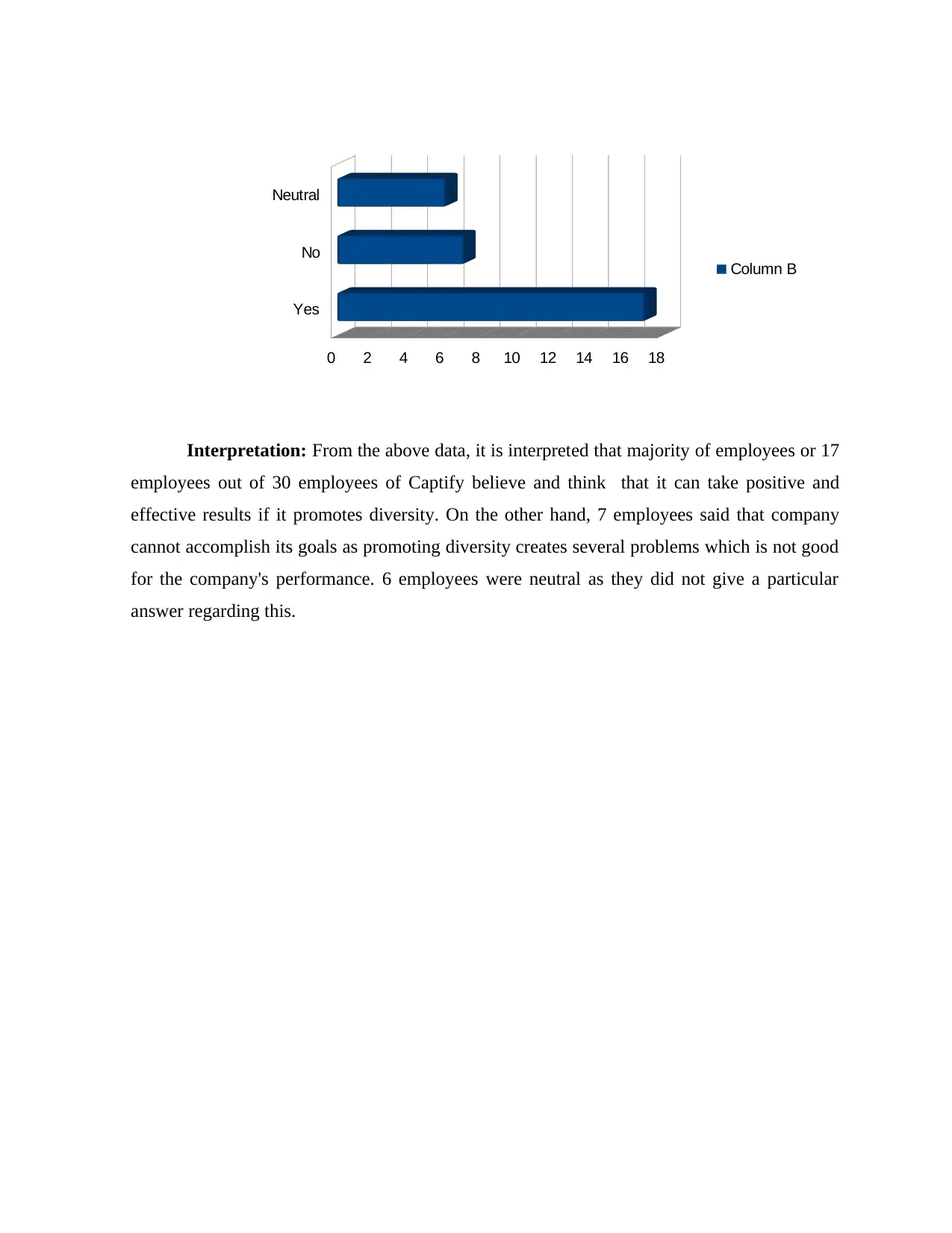
Interpretation: From the above data, it is interpreted that majority of employees or 17
employees out of 30 employees of Captify believe and think that it can take positive and
effective results if it promotes diversity. On the other hand, 7 employees said that company
cannot accomplish its goals as promoting diversity creates several problems which is not good
for the company's performance. 6 employees were neutral as they did not give a particular
answer regarding this.
Yes
No
Neutral
0 2 4 6 8 10 12 14 16 18
Column B
employees out of 30 employees of Captify believe and think that it can take positive and
effective results if it promotes diversity. On the other hand, 7 employees said that company
cannot accomplish its goals as promoting diversity creates several problems which is not good
for the company's performance. 6 employees were neutral as they did not give a particular
answer regarding this.
Yes
No
Neutral
0 2 4 6 8 10 12 14 16 18
Column B
2. Theme: Leadership style by Captify to promote diversity
Particulars Participants
Autocratic 14
Democratic 7
Transformational 9
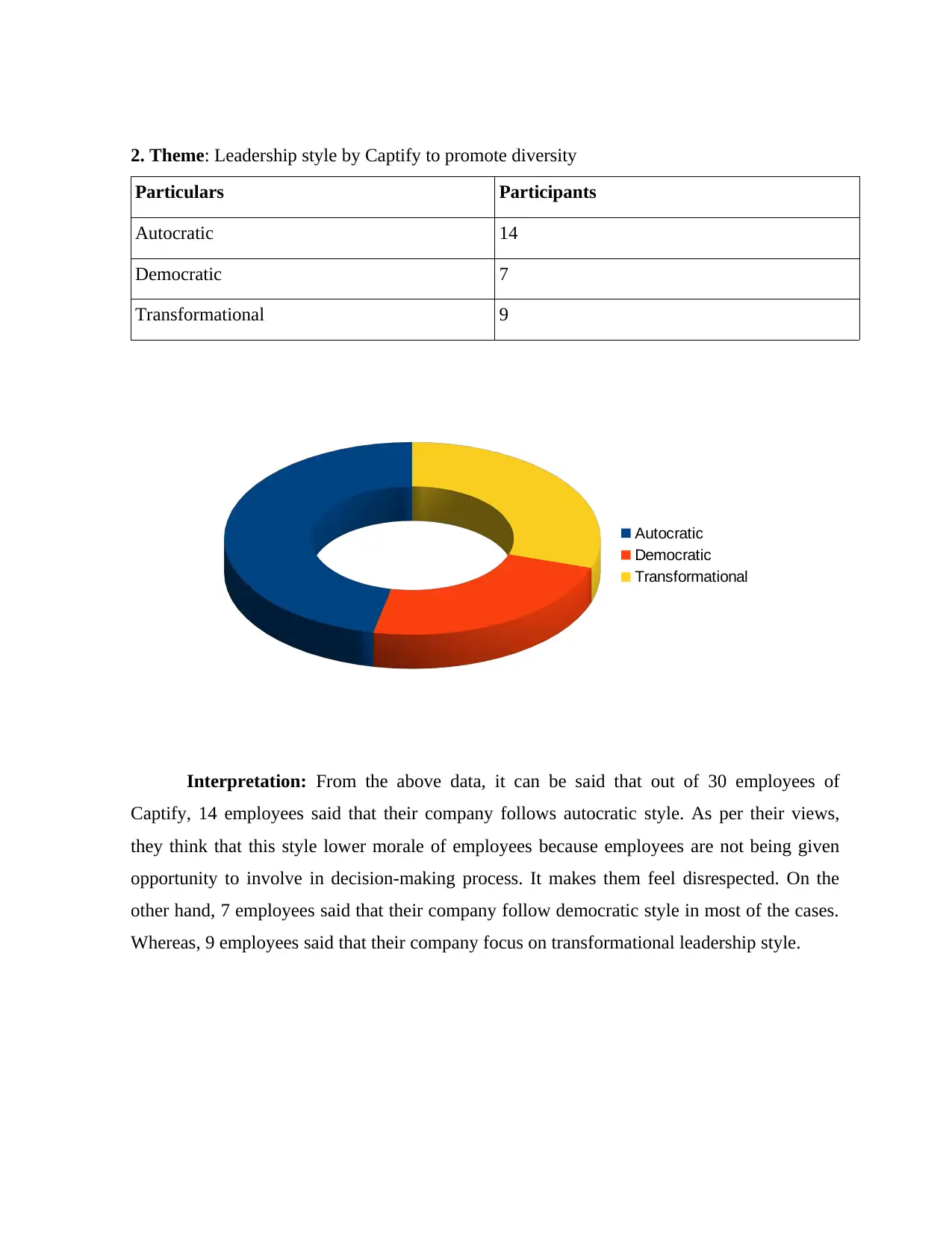
Interpretation: From the above data, it can be said that out of 30 employees of
Captify, 14 employees said that their company follows autocratic style. As per their views,
they think that this style lower morale of employees because employees are not being given
opportunity to involve in decision-making process. It makes them feel disrespected. On the
other hand, 7 employees said that their company follow democratic style in most of the cases.
Whereas, 9 employees said that their company focus on transformational leadership style.
Autocratic
Democratic
Transformational
Particulars Participants
Autocratic 14
Democratic 7
Transformational 9
Interpretation: From the above data, it can be said that out of 30 employees of
Captify, 14 employees said that their company follows autocratic style. As per their views,
they think that this style lower morale of employees because employees are not being given
opportunity to involve in decision-making process. It makes them feel disrespected. On the
other hand, 7 employees said that their company follow democratic style in most of the cases.
Whereas, 9 employees said that their company focus on transformational leadership style.
Autocratic
Democratic
Transformational
⊘ This is a preview!⊘
Do you want full access?
Subscribe today to unlock all pages.
Trusted by 1+ million students worldwide

1 out of 30


Related Documents


Your All-in-One AI-Powered Toolkit for Academic Success.
+13062052269
info@desklib.com
Available 24*7 on WhatsApp / Email
![[object Object]](/_next/static/media/star-bottom.7253800d.svg)
Unlock your academic potential
Copyright © 2020–2026 A2Z Services. All Rights Reserved. Developed and managed by ZUCOL.