Critical Analysis of Psychological Research and Theories of Prejudice
VerifiedAdded on 2020/07/22
|10
|1965
|109
Essay
AI Summary
This essay provides a comprehensive overview of psychological research and theories concerning prejudice. It begins by defining prejudice and tracing its development through various research phases. The essay delves into several psychological theories, including the knowledge, adjustive, value-expressive, and ego-defensive functions of attitudes, as well as the scapegoating theory and Tajfel's social identity theory. It explores how individuals learn to be prejudiced through various factors in their environment and discusses methods for overcoming prejudice, such as challenging self-biases and increasing social connections. The essay concludes by emphasizing the critical nature of prejudice in modern society, highlighting the importance of understanding its origins and the potential for mitigating its effects.
Psychological research and
theories of Prejudice
theories of Prejudice

Paraphrase This Document
Need a fresh take? Get an instant paraphrase of this document with our AI Paraphraser
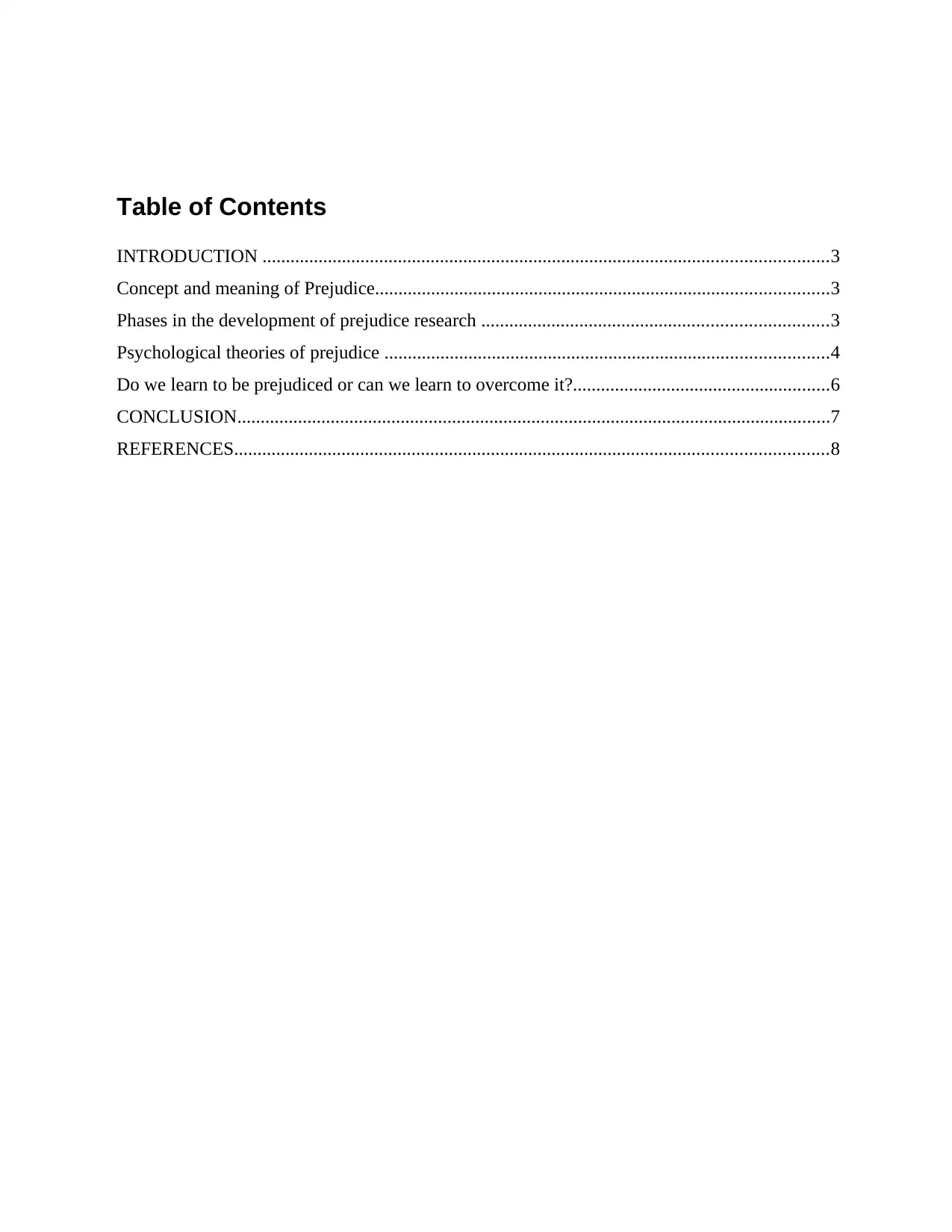
Table of Contents
INTRODUCTION .........................................................................................................................3
Concept and meaning of Prejudice.................................................................................................3
Phases in the development of prejudice research ..........................................................................3
Psychological theories of prejudice ...............................................................................................4
Do we learn to be prejudiced or can we learn to overcome it?.......................................................6
CONCLUSION...............................................................................................................................7
REFERENCES...............................................................................................................................8
INTRODUCTION .........................................................................................................................3
Concept and meaning of Prejudice.................................................................................................3
Phases in the development of prejudice research ..........................................................................3
Psychological theories of prejudice ...............................................................................................4
Do we learn to be prejudiced or can we learn to overcome it?.......................................................6
CONCLUSION...............................................................................................................................7
REFERENCES...............................................................................................................................8
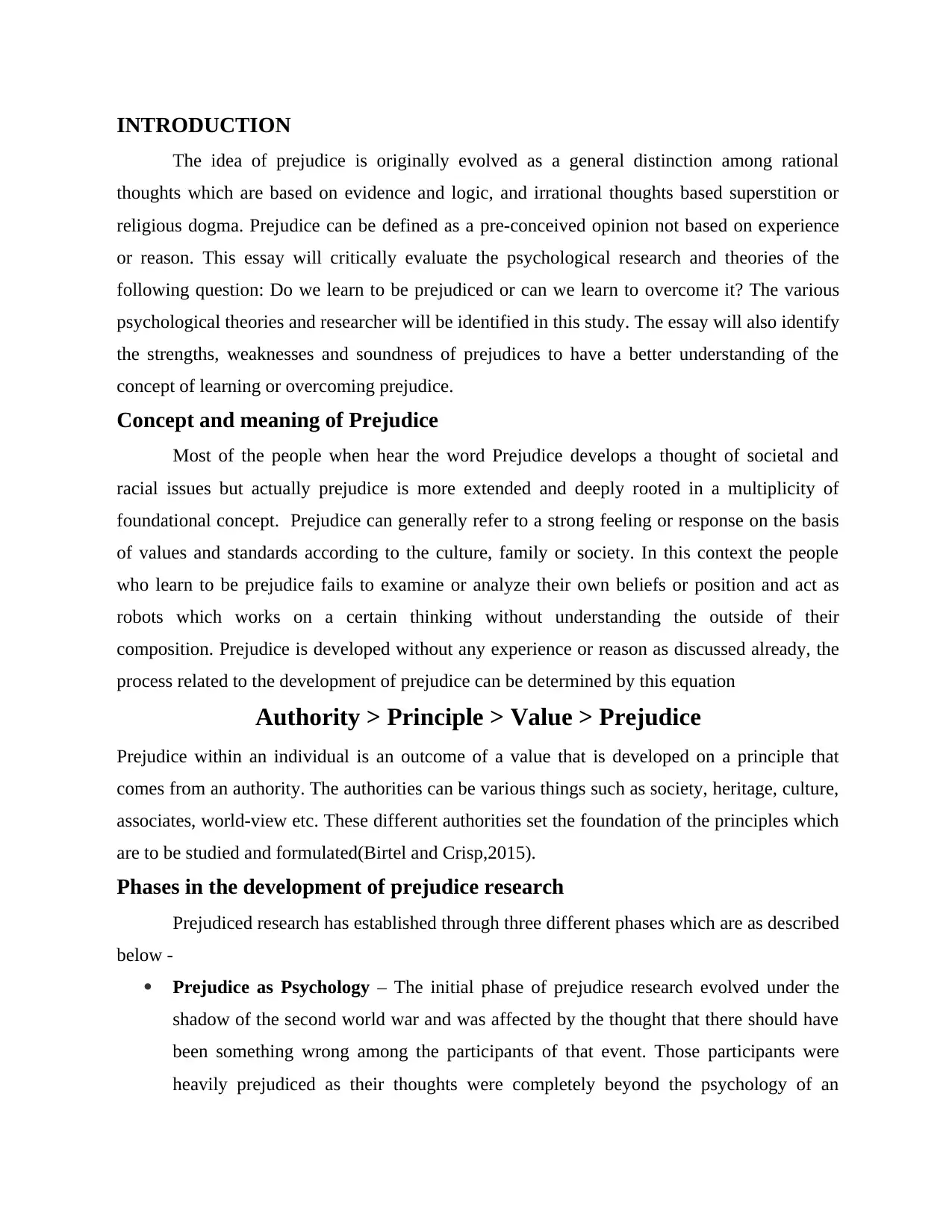
INTRODUCTION
The idea of prejudice is originally evolved as a general distinction among rational
thoughts which are based on evidence and logic, and irrational thoughts based superstition or
religious dogma. Prejudice can be defined as a pre-conceived opinion not based on experience
or reason. This essay will critically evaluate the psychological research and theories of the
following question: Do we learn to be prejudiced or can we learn to overcome it? The various
psychological theories and researcher will be identified in this study. The essay will also identify
the strengths, weaknesses and soundness of prejudices to have a better understanding of the
concept of learning or overcoming prejudice.
Concept and meaning of Prejudice
Most of the people when hear the word Prejudice develops a thought of societal and
racial issues but actually prejudice is more extended and deeply rooted in a multiplicity of
foundational concept. Prejudice can generally refer to a strong feeling or response on the basis
of values and standards according to the culture, family or society. In this context the people
who learn to be prejudice fails to examine or analyze their own beliefs or position and act as
robots which works on a certain thinking without understanding the outside of their
composition. Prejudice is developed without any experience or reason as discussed already, the
process related to the development of prejudice can be determined by this equation
Authority > Principle > Value > Prejudice
Prejudice within an individual is an outcome of a value that is developed on a principle that
comes from an authority. The authorities can be various things such as society, heritage, culture,
associates, world-view etc. These different authorities set the foundation of the principles which
are to be studied and formulated(Birtel and Crisp,2015).
Phases in the development of prejudice research
Prejudiced research has established through three different phases which are as described
below -
Prejudice as Psychology – The initial phase of prejudice research evolved under the
shadow of the second world war and was affected by the thought that there should have
been something wrong among the participants of that event. Those participants were
heavily prejudiced as their thoughts were completely beyond the psychology of an
The idea of prejudice is originally evolved as a general distinction among rational
thoughts which are based on evidence and logic, and irrational thoughts based superstition or
religious dogma. Prejudice can be defined as a pre-conceived opinion not based on experience
or reason. This essay will critically evaluate the psychological research and theories of the
following question: Do we learn to be prejudiced or can we learn to overcome it? The various
psychological theories and researcher will be identified in this study. The essay will also identify
the strengths, weaknesses and soundness of prejudices to have a better understanding of the
concept of learning or overcoming prejudice.
Concept and meaning of Prejudice
Most of the people when hear the word Prejudice develops a thought of societal and
racial issues but actually prejudice is more extended and deeply rooted in a multiplicity of
foundational concept. Prejudice can generally refer to a strong feeling or response on the basis
of values and standards according to the culture, family or society. In this context the people
who learn to be prejudice fails to examine or analyze their own beliefs or position and act as
robots which works on a certain thinking without understanding the outside of their
composition. Prejudice is developed without any experience or reason as discussed already, the
process related to the development of prejudice can be determined by this equation
Authority > Principle > Value > Prejudice
Prejudice within an individual is an outcome of a value that is developed on a principle that
comes from an authority. The authorities can be various things such as society, heritage, culture,
associates, world-view etc. These different authorities set the foundation of the principles which
are to be studied and formulated(Birtel and Crisp,2015).
Phases in the development of prejudice research
Prejudiced research has established through three different phases which are as described
below -
Prejudice as Psychology – The initial phase of prejudice research evolved under the
shadow of the second world war and was affected by the thought that there should have
been something wrong among the participants of that event. Those participants were
heavily prejudiced as their thoughts were completely beyond the psychology of an
⊘ This is a preview!⊘
Do you want full access?
Subscribe today to unlock all pages.

Trusted by 1+ million students worldwide
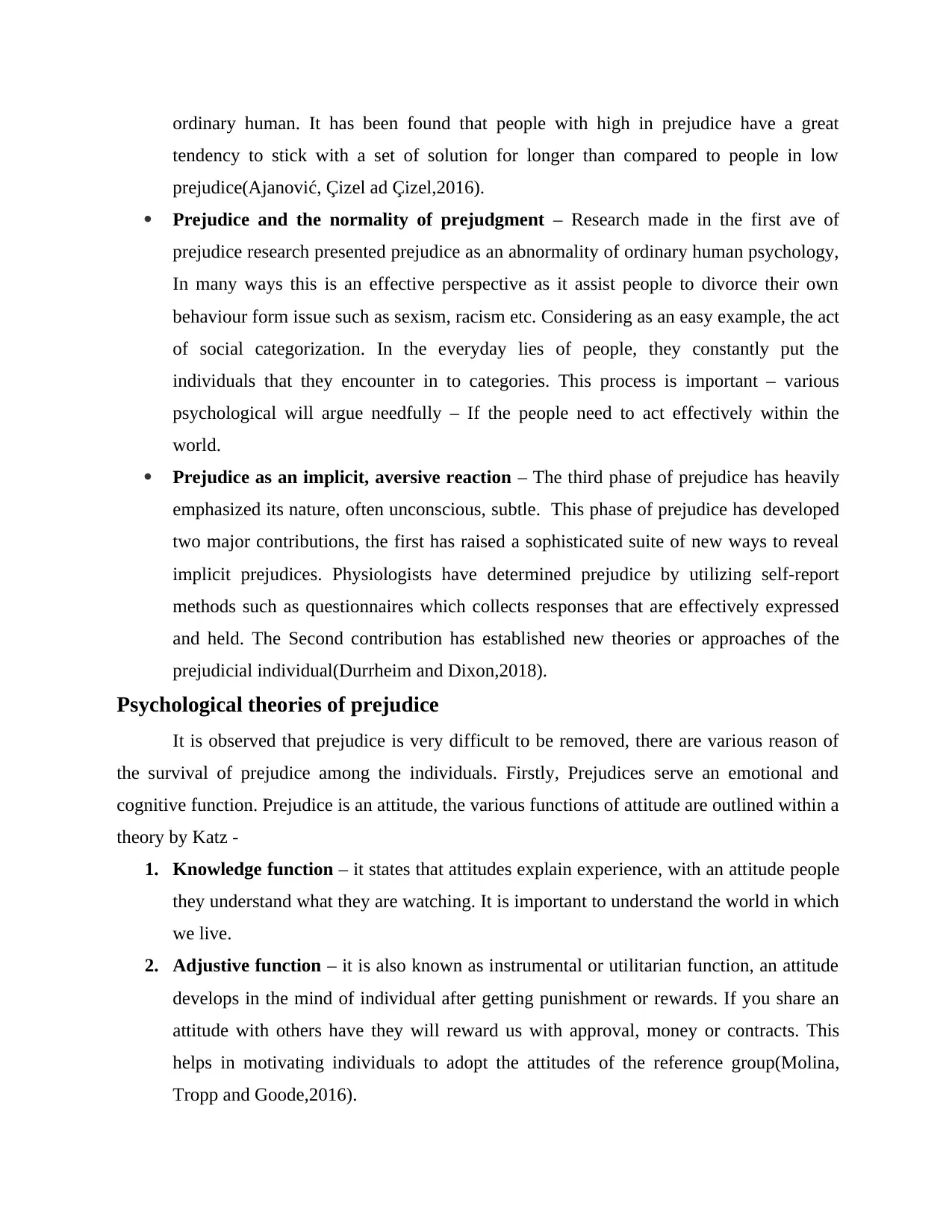
ordinary human. It has been found that people with high in prejudice have a great
tendency to stick with a set of solution for longer than compared to people in low
prejudice(Ajanović, Çizel ad Çizel,2016).
Prejudice and the normality of prejudgment – Research made in the first ave of
prejudice research presented prejudice as an abnormality of ordinary human psychology,
In many ways this is an effective perspective as it assist people to divorce their own
behaviour form issue such as sexism, racism etc. Considering as an easy example, the act
of social categorization. In the everyday lies of people, they constantly put the
individuals that they encounter in to categories. This process is important – various
psychological will argue needfully – If the people need to act effectively within the
world.
Prejudice as an implicit, aversive reaction – The third phase of prejudice has heavily
emphasized its nature, often unconscious, subtle. This phase of prejudice has developed
two major contributions, the first has raised a sophisticated suite of new ways to reveal
implicit prejudices. Physiologists have determined prejudice by utilizing self-report
methods such as questionnaires which collects responses that are effectively expressed
and held. The Second contribution has established new theories or approaches of the
prejudicial individual(Durrheim and Dixon,2018).
Psychological theories of prejudice
It is observed that prejudice is very difficult to be removed, there are various reason of
the survival of prejudice among the individuals. Firstly, Prejudices serve an emotional and
cognitive function. Prejudice is an attitude, the various functions of attitude are outlined within a
theory by Katz -
1. Knowledge function – it states that attitudes explain experience, with an attitude people
they understand what they are watching. It is important to understand the world in which
we live.
2. Adjustive function – it is also known as instrumental or utilitarian function, an attitude
develops in the mind of individual after getting punishment or rewards. If you share an
attitude with others have they will reward us with approval, money or contracts. This
helps in motivating individuals to adopt the attitudes of the reference group(Molina,
Tropp and Goode,2016).
tendency to stick with a set of solution for longer than compared to people in low
prejudice(Ajanović, Çizel ad Çizel,2016).
Prejudice and the normality of prejudgment – Research made in the first ave of
prejudice research presented prejudice as an abnormality of ordinary human psychology,
In many ways this is an effective perspective as it assist people to divorce their own
behaviour form issue such as sexism, racism etc. Considering as an easy example, the act
of social categorization. In the everyday lies of people, they constantly put the
individuals that they encounter in to categories. This process is important – various
psychological will argue needfully – If the people need to act effectively within the
world.
Prejudice as an implicit, aversive reaction – The third phase of prejudice has heavily
emphasized its nature, often unconscious, subtle. This phase of prejudice has developed
two major contributions, the first has raised a sophisticated suite of new ways to reveal
implicit prejudices. Physiologists have determined prejudice by utilizing self-report
methods such as questionnaires which collects responses that are effectively expressed
and held. The Second contribution has established new theories or approaches of the
prejudicial individual(Durrheim and Dixon,2018).
Psychological theories of prejudice
It is observed that prejudice is very difficult to be removed, there are various reason of
the survival of prejudice among the individuals. Firstly, Prejudices serve an emotional and
cognitive function. Prejudice is an attitude, the various functions of attitude are outlined within a
theory by Katz -
1. Knowledge function – it states that attitudes explain experience, with an attitude people
they understand what they are watching. It is important to understand the world in which
we live.
2. Adjustive function – it is also known as instrumental or utilitarian function, an attitude
develops in the mind of individual after getting punishment or rewards. If you share an
attitude with others have they will reward us with approval, money or contracts. This
helps in motivating individuals to adopt the attitudes of the reference group(Molina,
Tropp and Goode,2016).
Paraphrase This Document
Need a fresh take? Get an instant paraphrase of this document with our AI Paraphraser
3. Value-expressive functions – The attitudes can assist people to achieve self-expression,
it is a part of quest for the self actualization that the individual adopt an attitude. Fitting
into a framework of values can help people to achieve self-belief and integrity.
4. Ego-defensive function – Attitude assist to protect individual's delicate egos from self
criticism, A prejudice provides a sense of superiority to the holder over the discriminated
group, which is not at all justified.
Therefore, prejudices are connected to ego-defense, and this results to scape-goating. The scape-
goating theory was developed by Freud, the author made an argument that – People try to
displace their frustration and aggression on an element or objects when it is not possible to
express the aggression on the real cause., The author also argued in the favor of a frustration-
aggression hypothesis – which means aggression leads to frustration and frustration leads to
aggression. It states that when an individual or subject enters in to the path of scape-goating and
ego-defense he enters in to a circle that will cause an emotion to change into the other and vice-
versa(Liebkind and et.al, 2014).
The another significant part within the argument on maintenance and cause of prejudice
is the Tajfel's social identity theory. This describe that people strive for positive self-image
naturally and the social identity is improved by the procedure of segmenting individuals into
out-groups or in-groups. Hence, the want or need for social identity supports the development of
prejudice. According to a well-known experiment on a 15 year old boys from Bristol, the
investigator gave the boys an opportunity to give rewards to other boys on the basis of artificial
membership of a group. The boys were asked to form cubicles on themselves and they were
needed to distribute points to the members of others or their own groups. They can could give
points to the member of their own group, to themselves or to the members of the other
group(Paluck, 2016). The boys were unaware of the members in the other group, The points
were also allocated in the favor of the in-group members firstly, whereas in certain cases
awarding points to both the groups could increase the rewards for each and every member.
Tajfel made an argument that this represents that discrimination develop as soon as the people
are segmented or categorized. He also claimed that the difference in two groups is enough to
cause a classification of one group as an in-group and another group as an out-group. People
belonging to an in-group are observed to be conferred on members high self-esteem. With
it is a part of quest for the self actualization that the individual adopt an attitude. Fitting
into a framework of values can help people to achieve self-belief and integrity.
4. Ego-defensive function – Attitude assist to protect individual's delicate egos from self
criticism, A prejudice provides a sense of superiority to the holder over the discriminated
group, which is not at all justified.
Therefore, prejudices are connected to ego-defense, and this results to scape-goating. The scape-
goating theory was developed by Freud, the author made an argument that – People try to
displace their frustration and aggression on an element or objects when it is not possible to
express the aggression on the real cause., The author also argued in the favor of a frustration-
aggression hypothesis – which means aggression leads to frustration and frustration leads to
aggression. It states that when an individual or subject enters in to the path of scape-goating and
ego-defense he enters in to a circle that will cause an emotion to change into the other and vice-
versa(Liebkind and et.al, 2014).
The another significant part within the argument on maintenance and cause of prejudice
is the Tajfel's social identity theory. This describe that people strive for positive self-image
naturally and the social identity is improved by the procedure of segmenting individuals into
out-groups or in-groups. Hence, the want or need for social identity supports the development of
prejudice. According to a well-known experiment on a 15 year old boys from Bristol, the
investigator gave the boys an opportunity to give rewards to other boys on the basis of artificial
membership of a group. The boys were asked to form cubicles on themselves and they were
needed to distribute points to the members of others or their own groups. They can could give
points to the member of their own group, to themselves or to the members of the other
group(Paluck, 2016). The boys were unaware of the members in the other group, The points
were also allocated in the favor of the in-group members firstly, whereas in certain cases
awarding points to both the groups could increase the rewards for each and every member.
Tajfel made an argument that this represents that discrimination develop as soon as the people
are segmented or categorized. He also claimed that the difference in two groups is enough to
cause a classification of one group as an in-group and another group as an out-group. People
belonging to an in-group are observed to be conferred on members high self-esteem. With
respect to the social identity theory people try to maintain a positive self image in two ways – A
positive personal identity and a Positive social identity.
Do we learn to be prejudiced or can we learn to overcome it?
An individual can learn or become prejudiced from various factors in the surroundings,
these factors motivate him or her to develop an element of prejudice. The factors from which an
individual can learn to be prejudiced are schools, culture, family, friends etc from which we get
attracted to a group or thing as well as gets frustrated on aggressive with regards to the same.
The prejudice can be positive or negative which means an individual can get connected
positively to a group, individual, thought or thing and similarly he or she can develop hate for
the same(Walther and et.al, 2015). A person can learn to be prejudiced positively but does not
develop any negative prejudice for a thin, person or group as it can give rise to a conflict.
Therefore, it is better to overcome it with the following methods -
Challenging self Biases – This refers to the assessment of self biases such as feeling for
different people, groups of culture, recognizing the negative effect of the biases and
keeping control over self-stigma.
Increasing social connection to eliminate or reduce the biases – It can be done through
surrounding our-self by various types people, being around the people we admire,
avoiding disagreement while interacting with others.
Coping the prejudice of other by developing groups, taking help and support from
family, accept ourselves and being open and always expecting a positive result.
positive personal identity and a Positive social identity.
Do we learn to be prejudiced or can we learn to overcome it?
An individual can learn or become prejudiced from various factors in the surroundings,
these factors motivate him or her to develop an element of prejudice. The factors from which an
individual can learn to be prejudiced are schools, culture, family, friends etc from which we get
attracted to a group or thing as well as gets frustrated on aggressive with regards to the same.
The prejudice can be positive or negative which means an individual can get connected
positively to a group, individual, thought or thing and similarly he or she can develop hate for
the same(Walther and et.al, 2015). A person can learn to be prejudiced positively but does not
develop any negative prejudice for a thin, person or group as it can give rise to a conflict.
Therefore, it is better to overcome it with the following methods -
Challenging self Biases – This refers to the assessment of self biases such as feeling for
different people, groups of culture, recognizing the negative effect of the biases and
keeping control over self-stigma.
Increasing social connection to eliminate or reduce the biases – It can be done through
surrounding our-self by various types people, being around the people we admire,
avoiding disagreement while interacting with others.
Coping the prejudice of other by developing groups, taking help and support from
family, accept ourselves and being open and always expecting a positive result.
⊘ This is a preview!⊘
Do you want full access?
Subscribe today to unlock all pages.
Trusted by 1+ million students worldwide
CONCLUSION
The above essay concluded that prejudice is a critical element in the present world that
give rise to various conflicts and issues among individuals or groups. The study described the
various research approaches and theories related to prejudices along with arguments of various
authors or studies. Furthermore, the essay explained how an individual learns and developed
prejudices in himself and its impact on his or her attitude or behavior. In addition to this the
essay also described the various methods to eliminate prejudices. An explanation of overcoming
prejudice rather than learning it has been also includes in this essay.
The above essay concluded that prejudice is a critical element in the present world that
give rise to various conflicts and issues among individuals or groups. The study described the
various research approaches and theories related to prejudices along with arguments of various
authors or studies. Furthermore, the essay explained how an individual learns and developed
prejudices in himself and its impact on his or her attitude or behavior. In addition to this the
essay also described the various methods to eliminate prejudices. An explanation of overcoming
prejudice rather than learning it has been also includes in this essay.
Paraphrase This Document
Need a fresh take? Get an instant paraphrase of this document with our AI Paraphraser
REFERENCES
Books and Journals
Walther, J.B., Hoter, E., Ganayem, A. and Shonfeld, M., 2015. Computer-mediated
communication and the reduction of prejudice: A controlled longitudinal field
experiment among Jews and Arabs in Israel.Computers in Human Behavior, 52, pp.550-
558.
Liebkind, K., Mähönen, T.A., Solares, E., Solheim, E. and Jasinskaja‐Lahti, I., 2014. Prejudice‐
reduction in culturally mixed classrooms: The development and assessment of a theory‐
driven intervention among majority and minority youth in Finland. Journal of
Community & Applied Social Psychology, 24(4), pp.325-339.
Birtel, M.D. and Crisp, R.J., 2015. Psychotherapy and social change: Utilizing principles of
cognitive-behavioral therapy to help develop new prejudice-reduction
interventions. Frontiers in psychology, 6, p.1771.
Paluck, E.L., 2016. How to overcome prejudice.Science, 352(6282), pp.147-147.
Ajanović, E., Çizel, B. and Çizel, R., 2016. Effectiveness of Erasmus programme in prejudice
reduction: Contact theory perspective. Turističko poslovanje, (17), pp.47-60.
Durrheim, K. and Dixon, J., 2018. Intergroup contact and the struggle for social justice. The
Oxford handbook of social psychology and social justice, p.367.
Molina, L.E., Tropp, L.R. and Goode, C., 2016. Reflections on prejudice and intergroup
relations.Current Opinion in Psychology, 11, pp.120-124.
Books and Journals
Walther, J.B., Hoter, E., Ganayem, A. and Shonfeld, M., 2015. Computer-mediated
communication and the reduction of prejudice: A controlled longitudinal field
experiment among Jews and Arabs in Israel.Computers in Human Behavior, 52, pp.550-
558.
Liebkind, K., Mähönen, T.A., Solares, E., Solheim, E. and Jasinskaja‐Lahti, I., 2014. Prejudice‐
reduction in culturally mixed classrooms: The development and assessment of a theory‐
driven intervention among majority and minority youth in Finland. Journal of
Community & Applied Social Psychology, 24(4), pp.325-339.
Birtel, M.D. and Crisp, R.J., 2015. Psychotherapy and social change: Utilizing principles of
cognitive-behavioral therapy to help develop new prejudice-reduction
interventions. Frontiers in psychology, 6, p.1771.
Paluck, E.L., 2016. How to overcome prejudice.Science, 352(6282), pp.147-147.
Ajanović, E., Çizel, B. and Çizel, R., 2016. Effectiveness of Erasmus programme in prejudice
reduction: Contact theory perspective. Turističko poslovanje, (17), pp.47-60.
Durrheim, K. and Dixon, J., 2018. Intergroup contact and the struggle for social justice. The
Oxford handbook of social psychology and social justice, p.367.
Molina, L.E., Tropp, L.R. and Goode, C., 2016. Reflections on prejudice and intergroup
relations.Current Opinion in Psychology, 11, pp.120-124.

⊘ This is a preview!⊘
Do you want full access?
Subscribe today to unlock all pages.
Trusted by 1+ million students worldwide


1 out of 10


Related Documents


Your All-in-One AI-Powered Toolkit for Academic Success.
+13062052269
info@desklib.com
Available 24*7 on WhatsApp / Email
![[object Object]](/_next/static/media/star-bottom.7253800d.svg)
Unlock your academic potential
Copyright © 2020–2025 A2Z Services. All Rights Reserved. Developed and managed by ZUCOL.