Research Report: Managerial Job Stress Effect on Employee Performance
VerifiedAdded on 2024/05/20
|52
|9467
|392
Report
AI Summary
This research report investigates the impact of managerial job stress on employee performance at Premier Inn, focusing on various performance aspects and the relationship between stress and managerial roles. A mixed-methods approach was used for data collection and assessment. The study aims to identify the positive and negative impacts of stress on work performance and explore stress management techniques to improve employee well-being and performance. The expected outcome is the elevation of employee performance at Premier Inn through the implementation of innovative stress management techniques, leading to better work and health life management.
Page1
Research Project
The effect of managerial job stress on employee performance in Premier Inn hotel
Research Project
The effect of managerial job stress on employee performance in Premier Inn hotel

Paraphrase This Document
Need a fresh take? Get an instant paraphrase of this document with our AI Paraphraser
Page2
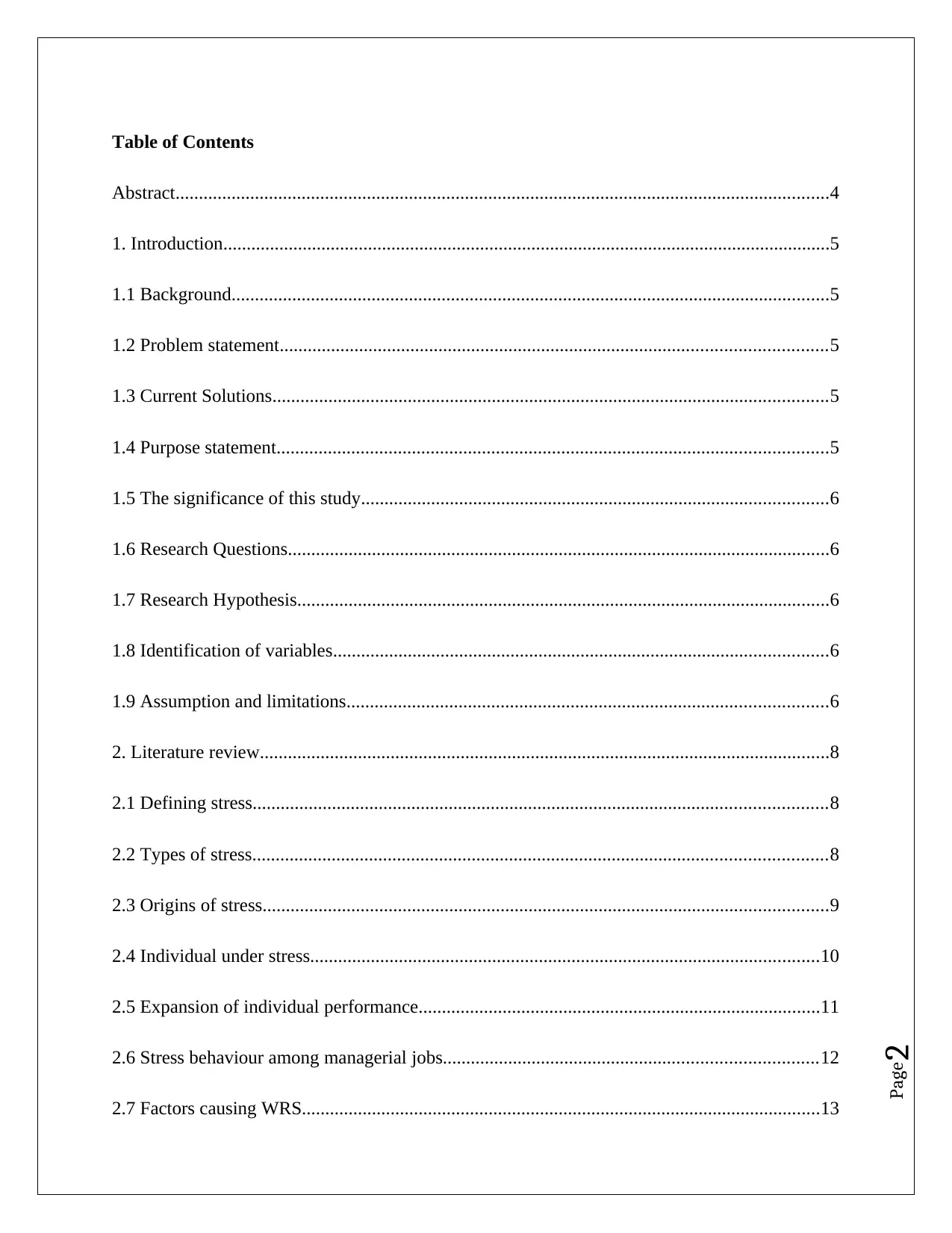
Table of Contents
Abstract............................................................................................................................................4
1. Introduction..................................................................................................................................5
1.1 Background................................................................................................................................5
1.2 Problem statement.....................................................................................................................5
1.3 Current Solutions.......................................................................................................................5
1.4 Purpose statement......................................................................................................................5
1.5 The significance of this study....................................................................................................6
1.6 Research Questions....................................................................................................................6
1.7 Research Hypothesis..................................................................................................................6
1.8 Identification of variables..........................................................................................................6
1.9 Assumption and limitations.......................................................................................................6
2. Literature review..........................................................................................................................8
2.1 Defining stress...........................................................................................................................8
2.2 Types of stress...........................................................................................................................8
2.3 Origins of stress.........................................................................................................................9
2.4 Individual under stress.............................................................................................................10
2.5 Expansion of individual performance......................................................................................11
2.6 Stress behaviour among managerial jobs................................................................................12
2.7 Factors causing WRS...............................................................................................................13
Table of Contents
Abstract............................................................................................................................................4
1. Introduction..................................................................................................................................5
1.1 Background................................................................................................................................5
1.2 Problem statement.....................................................................................................................5
1.3 Current Solutions.......................................................................................................................5
1.4 Purpose statement......................................................................................................................5
1.5 The significance of this study....................................................................................................6
1.6 Research Questions....................................................................................................................6
1.7 Research Hypothesis..................................................................................................................6
1.8 Identification of variables..........................................................................................................6
1.9 Assumption and limitations.......................................................................................................6
2. Literature review..........................................................................................................................8
2.1 Defining stress...........................................................................................................................8
2.2 Types of stress...........................................................................................................................8
2.3 Origins of stress.........................................................................................................................9
2.4 Individual under stress.............................................................................................................10
2.5 Expansion of individual performance......................................................................................11
2.6 Stress behaviour among managerial jobs................................................................................12
2.7 Factors causing WRS...............................................................................................................13
Page3
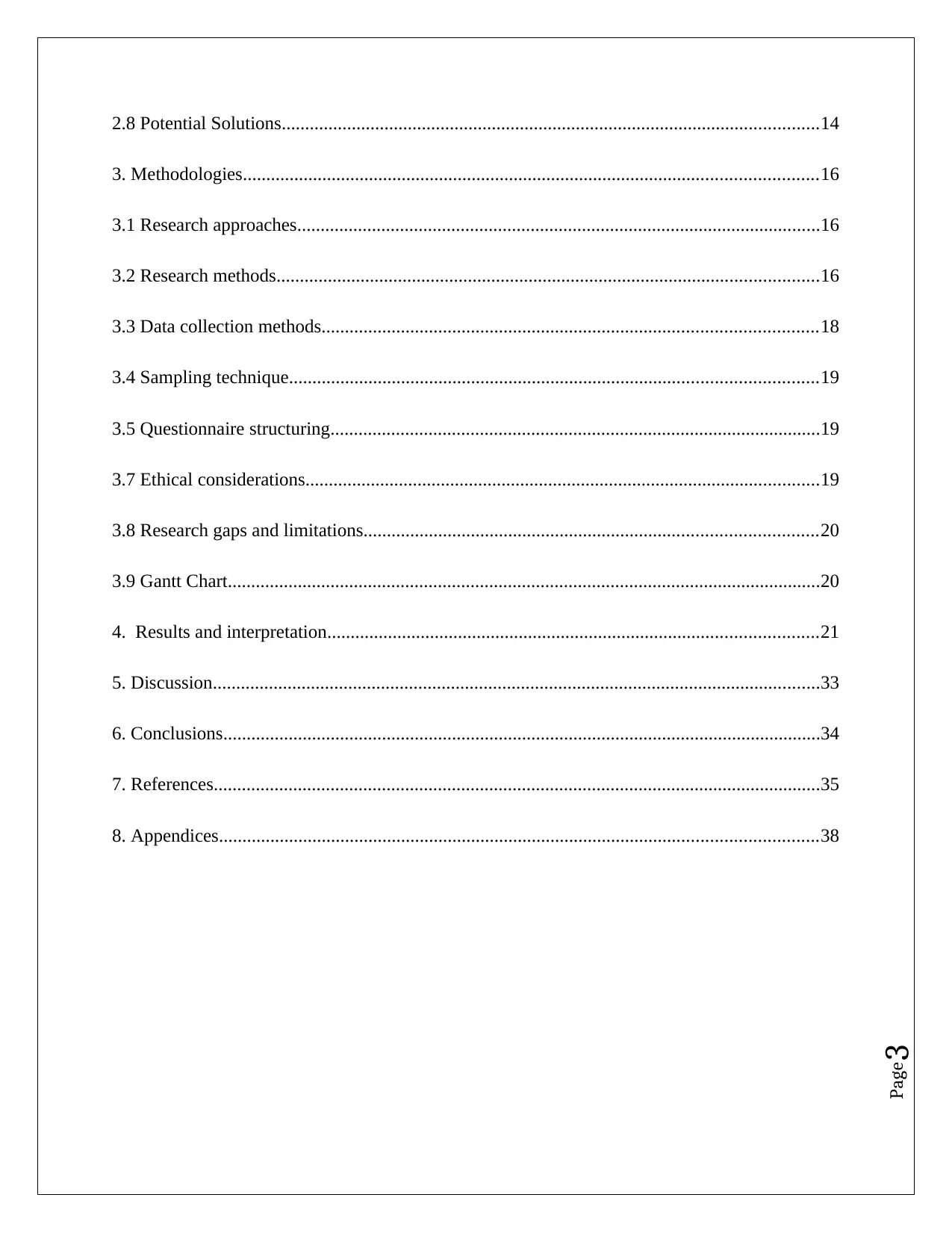
2.8 Potential Solutions...................................................................................................................14
3. Methodologies...........................................................................................................................16
3.1 Research approaches................................................................................................................16
3.2 Research methods....................................................................................................................16
3.3 Data collection methods..........................................................................................................18
3.4 Sampling technique.................................................................................................................19
3.5 Questionnaire structuring.........................................................................................................19
3.7 Ethical considerations..............................................................................................................19
3.8 Research gaps and limitations.................................................................................................20
3.9 Gantt Chart...............................................................................................................................20
4. Results and interpretation.........................................................................................................21
5. Discussion..................................................................................................................................33
6. Conclusions................................................................................................................................34
7. References..................................................................................................................................35
8. Appendices................................................................................................................................38
2.8 Potential Solutions...................................................................................................................14
3. Methodologies...........................................................................................................................16
3.1 Research approaches................................................................................................................16
3.2 Research methods....................................................................................................................16
3.3 Data collection methods..........................................................................................................18
3.4 Sampling technique.................................................................................................................19
3.5 Questionnaire structuring.........................................................................................................19
3.7 Ethical considerations..............................................................................................................19
3.8 Research gaps and limitations.................................................................................................20
3.9 Gantt Chart...............................................................................................................................20
4. Results and interpretation.........................................................................................................21
5. Discussion..................................................................................................................................33
6. Conclusions................................................................................................................................34
7. References..................................................................................................................................35
8. Appendices................................................................................................................................38
⊘ This is a preview!⊘
Do you want full access?
Subscribe today to unlock all pages.

Trusted by 1+ million students worldwide
Page4
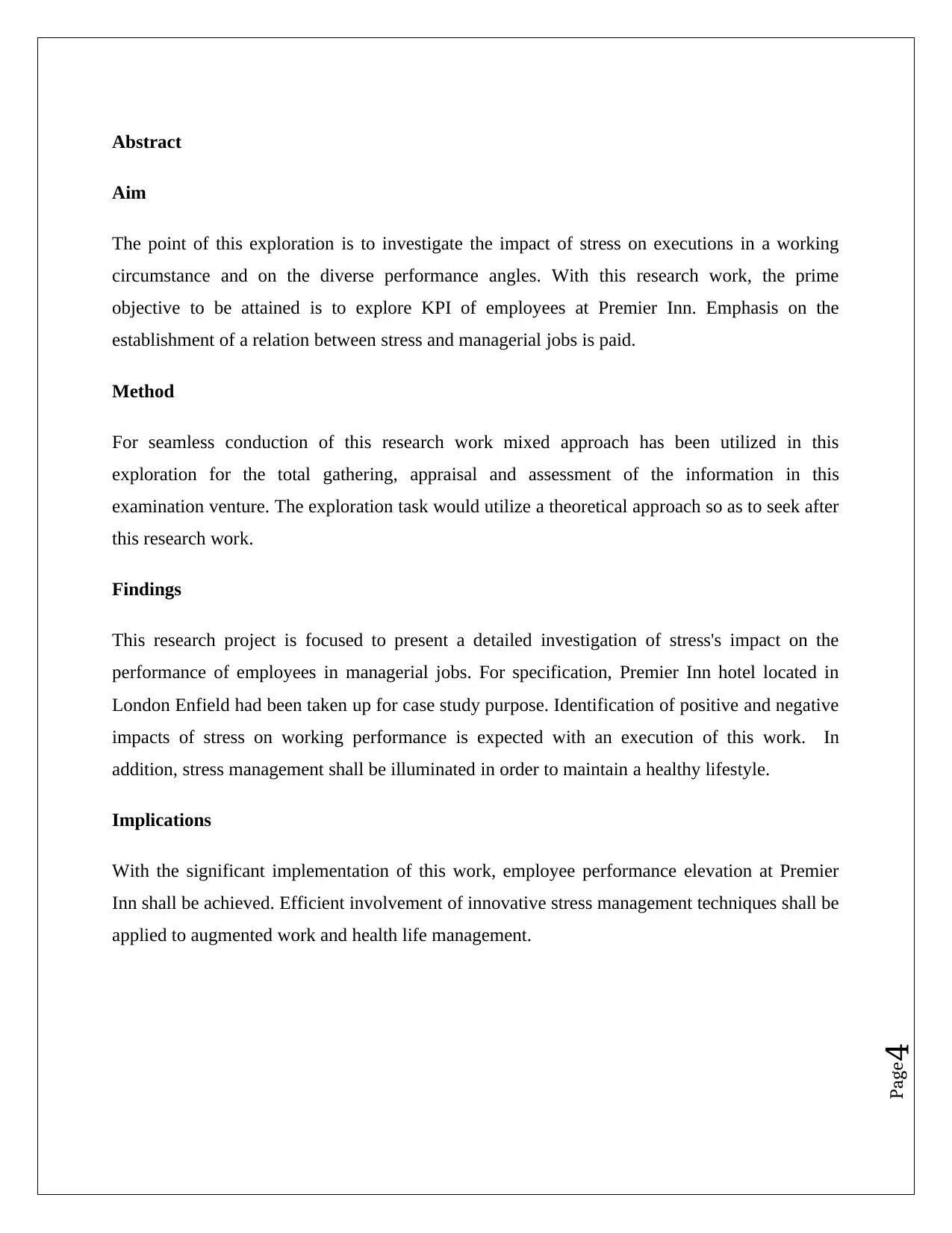
Abstract
Aim
The point of this exploration is to investigate the impact of stress on executions in a working
circumstance and on the diverse performance angles. With this research work, the prime
objective to be attained is to explore KPI of employees at Premier Inn. Emphasis on the
establishment of a relation between stress and managerial jobs is paid.
Method
For seamless conduction of this research work mixed approach has been utilized in this
exploration for the total gathering, appraisal and assessment of the information in this
examination venture. The exploration task would utilize a theoretical approach so as to seek after
this research work.
Findings
This research project is focused to present a detailed investigation of stress's impact on the
performance of employees in managerial jobs. For specification, Premier Inn hotel located in
London Enfield had been taken up for case study purpose. Identification of positive and negative
impacts of stress on working performance is expected with an execution of this work. In
addition, stress management shall be illuminated in order to maintain a healthy lifestyle.
Implications
With the significant implementation of this work, employee performance elevation at Premier
Inn shall be achieved. Efficient involvement of innovative stress management techniques shall be
applied to augmented work and health life management.
Abstract
Aim
The point of this exploration is to investigate the impact of stress on executions in a working
circumstance and on the diverse performance angles. With this research work, the prime
objective to be attained is to explore KPI of employees at Premier Inn. Emphasis on the
establishment of a relation between stress and managerial jobs is paid.
Method
For seamless conduction of this research work mixed approach has been utilized in this
exploration for the total gathering, appraisal and assessment of the information in this
examination venture. The exploration task would utilize a theoretical approach so as to seek after
this research work.
Findings
This research project is focused to present a detailed investigation of stress's impact on the
performance of employees in managerial jobs. For specification, Premier Inn hotel located in
London Enfield had been taken up for case study purpose. Identification of positive and negative
impacts of stress on working performance is expected with an execution of this work. In
addition, stress management shall be illuminated in order to maintain a healthy lifestyle.
Implications
With the significant implementation of this work, employee performance elevation at Premier
Inn shall be achieved. Efficient involvement of innovative stress management techniques shall be
applied to augmented work and health life management.
Paraphrase This Document
Need a fresh take? Get an instant paraphrase of this document with our AI Paraphraser
Page5
1. Introduction
1.1 Background
Stress has been defined as an inert feeling of immense pressure and strain as a result of certain
circumstances. In the working sector, work-related stress (WRS) can be experienced by a person
due to his inability to cope up with the work environment. Health and safety management at
work had been lately a prime concern for employers to maintain (LePine, et. al., 2016). Work-
related stress can often lead to cases where short-term stress becomes long term thereby
becoming a problem.
While a significant part of the pressure and stress encountered originates from common life
activities, infrequently, personal pressure related condition, which may result in sick wellbeing
and additional damage, can be caused by or exacerbated by work (Naseem, 2018). Work
likewise can possibly be valuable for individuals' emotional well-being and prosperity.
1.2 Problem statement
Inquiries on this issue originate from representatives, managers and delegate bodies and identify
with numerous parts of managing work environment stress; however, the fundamental source is
business employers who are searching for lucidity on potential causes, recommended remedies
and anticipation methodologies (Chia & Chu, 2016).
1.3 Current Solutions
In order to relevantly deal with the work-related stress, Premier Inn had hired a generic way of
establishing human resource which is often known as management intervention. For a preventive
form of intervention, positive work environment with specific standards are hired (LePine, et. al.,
2016). However, there is a need to further improvise this scheme.
1.4 Purpose statement
This research project had been formulated to illuminate the individual and relationship issues as
the principal wellspring of stress among working segment considering the case of Premier Inn
1. Introduction
1.1 Background
Stress has been defined as an inert feeling of immense pressure and strain as a result of certain
circumstances. In the working sector, work-related stress (WRS) can be experienced by a person
due to his inability to cope up with the work environment. Health and safety management at
work had been lately a prime concern for employers to maintain (LePine, et. al., 2016). Work-
related stress can often lead to cases where short-term stress becomes long term thereby
becoming a problem.
While a significant part of the pressure and stress encountered originates from common life
activities, infrequently, personal pressure related condition, which may result in sick wellbeing
and additional damage, can be caused by or exacerbated by work (Naseem, 2018). Work
likewise can possibly be valuable for individuals' emotional well-being and prosperity.
1.2 Problem statement
Inquiries on this issue originate from representatives, managers and delegate bodies and identify
with numerous parts of managing work environment stress; however, the fundamental source is
business employers who are searching for lucidity on potential causes, recommended remedies
and anticipation methodologies (Chia & Chu, 2016).
1.3 Current Solutions
In order to relevantly deal with the work-related stress, Premier Inn had hired a generic way of
establishing human resource which is often known as management intervention. For a preventive
form of intervention, positive work environment with specific standards are hired (LePine, et. al.,
2016). However, there is a need to further improvise this scheme.
1.4 Purpose statement
This research project had been formulated to illuminate the individual and relationship issues as
the principal wellspring of stress among working segment considering the case of Premier Inn
Page6
employees (Tao, et. al., 2017). With a well-presented link in between cases and results, a distant
aim of this project is to propose an intervention scheme that can seamlessly deal with short and
long-term alterations and thus reduce the effects of stress, rather converting it as a tool for
performance elevation.
1.5 The significance of this study
This study is projected to be affecting the management course with its efficient implication in
organisational sectors. Work-related stress faced by employees all over working sector shall be
able to manage their work and health life efficiently (Naseem, 2018). Employers are projected to
be accessing system practices and health management by following a healthy trend with this
work.
1.6 Research Questions
Q1. What are the major components considered for competent key performance indicator?
Q2. What are the methods through which people can be encouraged to actively deal with stress?
Q3. How can work-related stress be systematically approached for stress management within
organisations? (Bliese, et. al., 2017)
1.7 Research Hypothesis
A hypothetical consideration made in this research project is:
H0 - Premier Inn has no intentional approach or impedance with this research work.
1.8 Identification of variables
For an acceptable execution of this project report, analysis based on diverse governing variables
is inevitable. A few identified variables for stress and its impact are work schedules, workload,
interfaces, relationships, development, productivity, staff turnover, and culture, etc. (Accariya &
Khalil, 2016). Literature review had been conducted for selective information gathering and
functional improvisation in the screening of these attributes.
employees (Tao, et. al., 2017). With a well-presented link in between cases and results, a distant
aim of this project is to propose an intervention scheme that can seamlessly deal with short and
long-term alterations and thus reduce the effects of stress, rather converting it as a tool for
performance elevation.
1.5 The significance of this study
This study is projected to be affecting the management course with its efficient implication in
organisational sectors. Work-related stress faced by employees all over working sector shall be
able to manage their work and health life efficiently (Naseem, 2018). Employers are projected to
be accessing system practices and health management by following a healthy trend with this
work.
1.6 Research Questions
Q1. What are the major components considered for competent key performance indicator?
Q2. What are the methods through which people can be encouraged to actively deal with stress?
Q3. How can work-related stress be systematically approached for stress management within
organisations? (Bliese, et. al., 2017)
1.7 Research Hypothesis
A hypothetical consideration made in this research project is:
H0 - Premier Inn has no intentional approach or impedance with this research work.
1.8 Identification of variables
For an acceptable execution of this project report, analysis based on diverse governing variables
is inevitable. A few identified variables for stress and its impact are work schedules, workload,
interfaces, relationships, development, productivity, staff turnover, and culture, etc. (Accariya &
Khalil, 2016). Literature review had been conducted for selective information gathering and
functional improvisation in the screening of these attributes.
⊘ This is a preview!⊘
Do you want full access?
Subscribe today to unlock all pages.
Trusted by 1+ million students worldwide
Page7
1.9 Assumption and limitations
Some of the assumptions made for execution of this work are as listed:
The information sources and journal considered for data and theory gathering are assumed to be
legitimate and genuine.
Premier Inn illustrations had been assumed to be under work-related stress in particular for its
employees.
This research conduction shall impact no personal affaire
A few limitations of this research project are:
Results are deduced from illustrative analysis and real-time assessment is conducted on
theoretical based
The personalised work-related stress of Premier Inn had not been considered, rather a generalised
structure had been considered for issue statement.
Significant risk analysis could not be established due to lack of relevant time.
1.9 Assumption and limitations
Some of the assumptions made for execution of this work are as listed:
The information sources and journal considered for data and theory gathering are assumed to be
legitimate and genuine.
Premier Inn illustrations had been assumed to be under work-related stress in particular for its
employees.
This research conduction shall impact no personal affaire
A few limitations of this research project are:
Results are deduced from illustrative analysis and real-time assessment is conducted on
theoretical based
The personalised work-related stress of Premier Inn had not been considered, rather a generalised
structure had been considered for issue statement.
Significant risk analysis could not be established due to lack of relevant time.
Paraphrase This Document
Need a fresh take? Get an instant paraphrase of this document with our AI Paraphraser
Page8
2. Literature review
2.1 Defining stress
According to Australian Psychological Society (2012), stress arises when an individual reflects
the feel of being overloaded, tensed, worried, wound-up tight, etc. However, they also added that
in a few instances, this phenomenon can help enhance the motivation of person experiencing it
(Australian Psychological Society, 2012). They have categorised the stress as acute, episodic
acute and chronic stress. Provision of stress signs included headaches, Anxiety, Fatigue,
Weakened immune system, High blood pressure, Feeling moody, tearful, overwhelmed and out
of control etc.
2.2 Types of stress
Baranger, et. al. (2017) defined acute stress as being specific to demand and to the situational
pressure. In a working environment, the deadline can be a relevant example of acute stress
situation. It has also been often related to traumatic events that had led to disruption in daily
activities leading to acute stress. On the off chance that abnormal amounts of pressure proceed
for a drawn-out stretch of time, or are meddling with you getting a charge out of a solid life, they
had fitting to look for proficient help. Acute stress creates a sudden reaction on the human by a
change in behaviours and understandings. Irritation, depression, and anxiety are the most
common symptoms of the acute stress on the person which is suffering from this. Acute stress
can be a cause of cramp, back pain, headache and jaw pain in the people. Acute stress converts
into the episodic in which people who are influenced by this stress can be short-tempered,
anxious and being stressed. Chest pain, migraine, hyper tension and heart disease are the most
common symptoms of the episodic acute stressed people (Baranger, et. al., 2017). It is essential
for the people which are suffering from this stress to take an effective remedy of its. Family
members and friends play a crucial role in preventing and to get stressed out.
Siegrist & Li (2018) significantly linked chronic work stress to development of diseases. They
have presented research managing current working conditions and wellbeing to a great extent
those rely upon trans-disciplinary coordinated efforts, where learning from medicinal and
essential sciences is joined with ability from social, behavioural, and financial sciences (Siegrist
2. Literature review
2.1 Defining stress
According to Australian Psychological Society (2012), stress arises when an individual reflects
the feel of being overloaded, tensed, worried, wound-up tight, etc. However, they also added that
in a few instances, this phenomenon can help enhance the motivation of person experiencing it
(Australian Psychological Society, 2012). They have categorised the stress as acute, episodic
acute and chronic stress. Provision of stress signs included headaches, Anxiety, Fatigue,
Weakened immune system, High blood pressure, Feeling moody, tearful, overwhelmed and out
of control etc.
2.2 Types of stress
Baranger, et. al. (2017) defined acute stress as being specific to demand and to the situational
pressure. In a working environment, the deadline can be a relevant example of acute stress
situation. It has also been often related to traumatic events that had led to disruption in daily
activities leading to acute stress. On the off chance that abnormal amounts of pressure proceed
for a drawn-out stretch of time, or are meddling with you getting a charge out of a solid life, they
had fitting to look for proficient help. Acute stress creates a sudden reaction on the human by a
change in behaviours and understandings. Irritation, depression, and anxiety are the most
common symptoms of the acute stress on the person which is suffering from this. Acute stress
can be a cause of cramp, back pain, headache and jaw pain in the people. Acute stress converts
into the episodic in which people who are influenced by this stress can be short-tempered,
anxious and being stressed. Chest pain, migraine, hyper tension and heart disease are the most
common symptoms of the episodic acute stressed people (Baranger, et. al., 2017). It is essential
for the people which are suffering from this stress to take an effective remedy of its. Family
members and friends play a crucial role in preventing and to get stressed out.
Siegrist & Li (2018) significantly linked chronic work stress to development of diseases. They
have presented research managing current working conditions and wellbeing to a great extent
those rely upon trans-disciplinary coordinated efforts, where learning from medicinal and
essential sciences is joined with ability from social, behavioural, and financial sciences (Siegrist
Page9
& Li, 2018). On-going demands, worries, and pressures which projects to be sticking for a longer
duration with a little scope of resolution are major causes of chronic stress. Chronic stress can
occur in people when they do not find any way to be out of a sorrowful situation. This kind of
stress can destroy the lives of people and develop them as unhappy and demotivated person in
his life. Most of the people which are suffering from this stress are thoroughly hopeless to find
out an effective solution to come out from those situations which are making trouble in their life.
2.3 Origins of stress
According to the Rice, (2012), stress is a type of disease which decreases the mental working
capabilities in a particular situation. Most of the people which are suffering from the stress at the
workplace are influenced by many causes. It is found that most of the workplaces are stressful
which key elements to generate work from workforce are. But some of the time the stress level
crosses the limits which create a huge work pressure and workload on the managers. It is
essential for the managers to handle this work pressure and work load in an effective manner by
which they can diversify the workload in the team members to share the workload in the team
members. The high workload is the main reason for stress in the managers. These people are
responsible to generate work from the workforce according to the demands of the market.
Unexpected market demands create a huge work pressure in front of the managers which is the
key reason for the managers for stress. It is essential for the managers to manage their team
according to the targets. Some of the time managerial skills do not provide the significant
outcome for the team. It creates a doubt and question mark on the performance of the manager so
it is essential for the managers to work effectively to manage a balance in the team to generate
effective outcome from them.
Each and every person who is working in the team is having an individual target and team target
which has to be attained by them. Failure in the attainment creates frustration in the team
members and team managers also. Orders implementation is an essential task for the managers to
perform effectively which can help them to work effectively. A perfect team is required for each
and every manager which is his strength to perform according to the expected objectives of a
particular organisation (Rice, 2012). A perfect team has different types of people which are
having some significant skills to perform task and activities. Lack of variables in the team creates
& Li, 2018). On-going demands, worries, and pressures which projects to be sticking for a longer
duration with a little scope of resolution are major causes of chronic stress. Chronic stress can
occur in people when they do not find any way to be out of a sorrowful situation. This kind of
stress can destroy the lives of people and develop them as unhappy and demotivated person in
his life. Most of the people which are suffering from this stress are thoroughly hopeless to find
out an effective solution to come out from those situations which are making trouble in their life.
2.3 Origins of stress
According to the Rice, (2012), stress is a type of disease which decreases the mental working
capabilities in a particular situation. Most of the people which are suffering from the stress at the
workplace are influenced by many causes. It is found that most of the workplaces are stressful
which key elements to generate work from workforce are. But some of the time the stress level
crosses the limits which create a huge work pressure and workload on the managers. It is
essential for the managers to handle this work pressure and work load in an effective manner by
which they can diversify the workload in the team members to share the workload in the team
members. The high workload is the main reason for stress in the managers. These people are
responsible to generate work from the workforce according to the demands of the market.
Unexpected market demands create a huge work pressure in front of the managers which is the
key reason for the managers for stress. It is essential for the managers to manage their team
according to the targets. Some of the time managerial skills do not provide the significant
outcome for the team. It creates a doubt and question mark on the performance of the manager so
it is essential for the managers to work effectively to manage a balance in the team to generate
effective outcome from them.
Each and every person who is working in the team is having an individual target and team target
which has to be attained by them. Failure in the attainment creates frustration in the team
members and team managers also. Orders implementation is an essential task for the managers to
perform effectively which can help them to work effectively. A perfect team is required for each
and every manager which is his strength to perform according to the expected objectives of a
particular organisation (Rice, 2012). A perfect team has different types of people which are
having some significant skills to perform task and activities. Lack of variables in the team creates
⊘ This is a preview!⊘
Do you want full access?
Subscribe today to unlock all pages.
Trusted by 1+ million students worldwide
Page10
a problem for the team manager to generate an outcome in an effective manner. These are some
reasons for managers to get frustrated with the team and its performance. It creates a doubt on
the managerial skills of managers if they got filed in attaining their task objectives. It is a key
reason behind the beginning of frustration in the mangers. Personal issues are another possible
reason for the managers to get frustrated with the work. Salary, working hours, family problems
is some possible issues which can create personal frustration in the work (Rice, 2012).
Environmental frustration is an also factor which distracts the managers from their work so it is
essential for the managers to be involved in the work and team. Frustration converts in the
aggression in the attitude and behaviours of the managers. Continuous frustration and aggression
can be a cause of the stress.
2.4 Individual under stress
According to Parkes (2016), stress at work and its submissions for the mental and physical
wellbeing of people, and the profitability of industry all the more, for the most part, is as of now
a point of intrigue. He suggested that stress is not exclusively attributable to work conditions
(Parkes, 2016); other potential sources of stress include family, marital relations, transitions,
illness, and disasters etc. As an individual, behavioural management is required to be optimised.
Interaction can be the most conceptual approach for stress intervention.
For relevant decision-making abilities of the individual to be explored under stress, Salas &
Martin (2017) used state of art review of diverse psychological theories. In high innovative
society, new improvements are coordinated by progressively difficult dangers for the
associations who have overseen them. NDM is in need to be focused on tactical decision making
(Salas & Martin, 2017). TADMUS had been proposed to be implemented for individual and
group performance enhancement.
Hancock & Szalma (2017) had evaluated individual performance under stress. According to
them, people behave distinctively when are facing any kind of stress. They had presented that
some people reflect aggressiveness, without considering their behaviour towards other; some
find themselves exposed to threat (Hancock & Szalma, 2017). On the other hand, few who are
aware of their conditioning, are able to manage their stress and thus enjoy the challenges.
a problem for the team manager to generate an outcome in an effective manner. These are some
reasons for managers to get frustrated with the team and its performance. It creates a doubt on
the managerial skills of managers if they got filed in attaining their task objectives. It is a key
reason behind the beginning of frustration in the mangers. Personal issues are another possible
reason for the managers to get frustrated with the work. Salary, working hours, family problems
is some possible issues which can create personal frustration in the work (Rice, 2012).
Environmental frustration is an also factor which distracts the managers from their work so it is
essential for the managers to be involved in the work and team. Frustration converts in the
aggression in the attitude and behaviours of the managers. Continuous frustration and aggression
can be a cause of the stress.
2.4 Individual under stress
According to Parkes (2016), stress at work and its submissions for the mental and physical
wellbeing of people, and the profitability of industry all the more, for the most part, is as of now
a point of intrigue. He suggested that stress is not exclusively attributable to work conditions
(Parkes, 2016); other potential sources of stress include family, marital relations, transitions,
illness, and disasters etc. As an individual, behavioural management is required to be optimised.
Interaction can be the most conceptual approach for stress intervention.
For relevant decision-making abilities of the individual to be explored under stress, Salas &
Martin (2017) used state of art review of diverse psychological theories. In high innovative
society, new improvements are coordinated by progressively difficult dangers for the
associations who have overseen them. NDM is in need to be focused on tactical decision making
(Salas & Martin, 2017). TADMUS had been proposed to be implemented for individual and
group performance enhancement.
Hancock & Szalma (2017) had evaluated individual performance under stress. According to
them, people behave distinctively when are facing any kind of stress. They had presented that
some people reflect aggressiveness, without considering their behaviour towards other; some
find themselves exposed to threat (Hancock & Szalma, 2017). On the other hand, few who are
aware of their conditioning, are able to manage their stress and thus enjoy the challenges.
Paraphrase This Document
Need a fresh take? Get an instant paraphrase of this document with our AI Paraphraser
Page11
People feel happy with their actions when the activity enables them to satisfy their obligations in
their family life. The modern edge time has brought heavier responsibilities identified with both
work and family, according to Gözükara & Çolakoğlu (2016), individuals are encountering a
cover of work and family areas, bringing about more noteworthy individual pressure and
decreased employment fulfillment (Gözükara & Çolakoğlu, 2016).
2.5 Expansion of individual performance
As stated by the Hon, (2013), stress is an essential element which supports the work generation
from the workforce for the managers. Each and every manager have a target and objective for his
team to attain in a specific time period. This work target is distributed to the team members who
help to the managers in the attainment of the targets in an effective manner. An effective level of
stress is essential to motivate employees and managers to perform effectively against to targets.
Stress factor leads the managers to attain their targets and objective by performing on them.
Targets oriented, performance-oriented stress is effective for the employees and manager to work
better and perform better in their fields. It is also required for the managers and team members to
take stress in a positive manner which can help them to attain their targets at the time and
improve their performance. Organisations are having an expectation that individuals which are
working it have to perform according to the market demands. Flexibility is a significant thing for
the employees to contain them which can help them to adjust their efforts according to the
requirements of the organisation.
Individual of a team plays a significant role for the managers to attain the targets. Each and every
individual in a team is controlled and managed by the team manager. Either than this, team
manager decides the individual targets of each individual to perform accordingly. Managers have
analytical power to analyse his team member’s skills potentials to perform task and activity in a
day (Hon, 2013). According to this analysis, they determine the performance targets and
objective to each of the team members. Each and every individual wants freedom in the
workplace and free time from work which can create them lazier. Individual performance targets
also support employees to maximise their productivity and potentials to work in the workplace.
Higher productivity enhances the possibilities and opportunities for the team members to
People feel happy with their actions when the activity enables them to satisfy their obligations in
their family life. The modern edge time has brought heavier responsibilities identified with both
work and family, according to Gözükara & Çolakoğlu (2016), individuals are encountering a
cover of work and family areas, bringing about more noteworthy individual pressure and
decreased employment fulfillment (Gözükara & Çolakoğlu, 2016).
2.5 Expansion of individual performance
As stated by the Hon, (2013), stress is an essential element which supports the work generation
from the workforce for the managers. Each and every manager have a target and objective for his
team to attain in a specific time period. This work target is distributed to the team members who
help to the managers in the attainment of the targets in an effective manner. An effective level of
stress is essential to motivate employees and managers to perform effectively against to targets.
Stress factor leads the managers to attain their targets and objective by performing on them.
Targets oriented, performance-oriented stress is effective for the employees and manager to work
better and perform better in their fields. It is also required for the managers and team members to
take stress in a positive manner which can help them to attain their targets at the time and
improve their performance. Organisations are having an expectation that individuals which are
working it have to perform according to the market demands. Flexibility is a significant thing for
the employees to contain them which can help them to adjust their efforts according to the
requirements of the organisation.
Individual of a team plays a significant role for the managers to attain the targets. Each and every
individual in a team is controlled and managed by the team manager. Either than this, team
manager decides the individual targets of each individual to perform accordingly. Managers have
analytical power to analyse his team member’s skills potentials to perform task and activity in a
day (Hon, 2013). According to this analysis, they determine the performance targets and
objective to each of the team members. Each and every individual wants freedom in the
workplace and free time from work which can create them lazier. Individual performance targets
also support employees to maximise their productivity and potentials to work in the workplace.
Higher productivity enhances the possibilities and opportunities for the team members to
Page12
increase their monetary benefits which are the most expected thing for each and every employee
in an organisation.
It is essential for the managers to increase the performance of its team members which can help
them to determine higher objectives to perform. Most of the employees which are working in the
organisations are influenced by the individual and combined targets which provide an
opportunity to develop some monetary benefits by their performance. It is essential for the
individuals to perform better according to the team and task objectives (Hon, 2013). Quality and
quantity are the two most significant factors which are considered while analysing the
performance of an individual. It is required for the individuals who are working an organisation
to work better in terms quality and enhance their capabilities to develop a higher number of
effort in a better quality. Stress is the key factor behind the improvement of the performance
individuals. It is essential to take stress in a positive manner which can help the individuals as
well as to managers also to develop potential to perform better. It is required for the managers
and individuals to consider reflect on the stress in a positive manner which can help them to
decline the stress by enhancing quality and quantity in the performance.
2.6 Stress behavior among managerial jobs
Kasa & Hassan (2016) utilized Structural Equation Modelling (SEM) to determine factors that
lead to higher stress level among hotel employees. Organizational citizenship behavior
relationship with organisational workflow had been established, further, they had established
socio-cultural factor significance in between them. The connection amongst stream and OCB is
directed by socio-social components, as the relationship is noteworthy for the independence
gathering had been illuminated.
Self-determination theory inspires human to search out associations, relationship, and difficulties
that assistance humanistic development and to additionally improve the advancement of genuine
self. The self-determination theory (SDT), according to Deci, et. al. (2017) is a motivation theory
in view of commencing that individuals are development situated and currently looking for
chances to build up their fullest potential. Stream encounter is reflected in the inclusion of an
inherently propelling movement and could influence a man to feel in charge completing a
pleasant action, has beneficial outcomes, excitement (Deci, et. al., 2017). This high propensity
increase their monetary benefits which are the most expected thing for each and every employee
in an organisation.
It is essential for the managers to increase the performance of its team members which can help
them to determine higher objectives to perform. Most of the employees which are working in the
organisations are influenced by the individual and combined targets which provide an
opportunity to develop some monetary benefits by their performance. It is essential for the
individuals to perform better according to the team and task objectives (Hon, 2013). Quality and
quantity are the two most significant factors which are considered while analysing the
performance of an individual. It is required for the individuals who are working an organisation
to work better in terms quality and enhance their capabilities to develop a higher number of
effort in a better quality. Stress is the key factor behind the improvement of the performance
individuals. It is essential to take stress in a positive manner which can help the individuals as
well as to managers also to develop potential to perform better. It is required for the managers
and individuals to consider reflect on the stress in a positive manner which can help them to
decline the stress by enhancing quality and quantity in the performance.
2.6 Stress behavior among managerial jobs
Kasa & Hassan (2016) utilized Structural Equation Modelling (SEM) to determine factors that
lead to higher stress level among hotel employees. Organizational citizenship behavior
relationship with organisational workflow had been established, further, they had established
socio-cultural factor significance in between them. The connection amongst stream and OCB is
directed by socio-social components, as the relationship is noteworthy for the independence
gathering had been illuminated.
Self-determination theory inspires human to search out associations, relationship, and difficulties
that assistance humanistic development and to additionally improve the advancement of genuine
self. The self-determination theory (SDT), according to Deci, et. al. (2017) is a motivation theory
in view of commencing that individuals are development situated and currently looking for
chances to build up their fullest potential. Stream encounter is reflected in the inclusion of an
inherently propelling movement and could influence a man to feel in charge completing a
pleasant action, has beneficial outcomes, excitement (Deci, et. al., 2017). This high propensity
⊘ This is a preview!⊘
Do you want full access?
Subscribe today to unlock all pages.
Trusted by 1+ million students worldwide

1 out of 52


Related Documents


Your All-in-One AI-Powered Toolkit for Academic Success.
+13062052269
info@desklib.com
Available 24*7 on WhatsApp / Email
![[object Object]](/_next/static/media/star-bottom.7253800d.svg)
Unlock your academic potential
Copyright © 2020–2026 A2Z Services. All Rights Reserved. Developed and managed by ZUCOL.