Business Plan Report: Managing a Preschool and Nursery
VerifiedAdded on 2023/04/21
|26
|8968
|487
Report
AI Summary
This report presents a comprehensive business plan for managing a preschool and nursery during its initial two years of operation. The mission is to deliver high-quality education within a secure and stimulating environment, fostering creativity and innovation across the curriculum. Key values include lifelong learning, quality control, safety, trust, partnership, and creating an effective organizational environment. Strategies focus on early education and care, social and emotional health, family support, and enhancing service quality. Stakeholder analysis is considered crucial for organizational performance, with an emphasis on creating a robust supply chain management system to drive growth and profitability. The plan addresses legal obligations, human resource management, and resource allocation to optimize performance. Quality control measures are implemented and monitored, with corrective actions taken to address any discrepancies, ensuring continuous improvement in service quality and overall organizational performance.
Running Head: Enterprise Resource Planning
0
Enterprise Resource Planning
Student Name
Date
0
Enterprise Resource Planning
Student Name
Date

Paraphrase This Document
Need a fresh take? Get an instant paraphrase of this document with our AI Paraphraser
Report on business plan for managing Preschool & Nursery
1
Executive Summary –
A preschool is an education institutes which provides the services as childcare and education
to the children under the age of 8 years. Preschool helps the children and their parents in
building confidence and trust which will help them their whole school system. Children
interact with their peer group and create relations with them. So, for business plan for
managing a preschool in the first two years of trading, our mission is to provide high quality
education in a safe and effective environment with creative or innovative ideas and to provide
affordable child care and learning programs to meet to needs of children and their families
and to succeed in their future life. Values of our organization are life- long learning, quality
control, safe care, trust and confidence, partnership and creating an effective environment
within an organization. We will implement various strategies which will help the
organization in achieving the objectives of the organization such as early education and care,
social and emotional health and support to the family and fulfil their basic needs, effective
learning environment and increase the level of quality of services as well as staffs. We also
consider the stakeholder analysis because stakeholders impacts highly on the performance
and productivity of the organization. We will create better supply chain management which
will help the organization in increasing their growth and profit and achieving their objectives
and goals. There are various legal obligations which also help in managing a preschool.
Human resources and other resources also help the organization in increasing their
performance and productivity. We will set up quality control and performance then after
implementing quality then monitoring them by various methods and if we will find difference
then we will control such difference by taking various corrective steps for improving the
quality and performance of the organization.
1
Executive Summary –
A preschool is an education institutes which provides the services as childcare and education
to the children under the age of 8 years. Preschool helps the children and their parents in
building confidence and trust which will help them their whole school system. Children
interact with their peer group and create relations with them. So, for business plan for
managing a preschool in the first two years of trading, our mission is to provide high quality
education in a safe and effective environment with creative or innovative ideas and to provide
affordable child care and learning programs to meet to needs of children and their families
and to succeed in their future life. Values of our organization are life- long learning, quality
control, safe care, trust and confidence, partnership and creating an effective environment
within an organization. We will implement various strategies which will help the
organization in achieving the objectives of the organization such as early education and care,
social and emotional health and support to the family and fulfil their basic needs, effective
learning environment and increase the level of quality of services as well as staffs. We also
consider the stakeholder analysis because stakeholders impacts highly on the performance
and productivity of the organization. We will create better supply chain management which
will help the organization in increasing their growth and profit and achieving their objectives
and goals. There are various legal obligations which also help in managing a preschool.
Human resources and other resources also help the organization in increasing their
performance and productivity. We will set up quality control and performance then after
implementing quality then monitoring them by various methods and if we will find difference
then we will control such difference by taking various corrective steps for improving the
quality and performance of the organization.
Report on business plan for managing Preschool & Nursery
2
Table of Contents
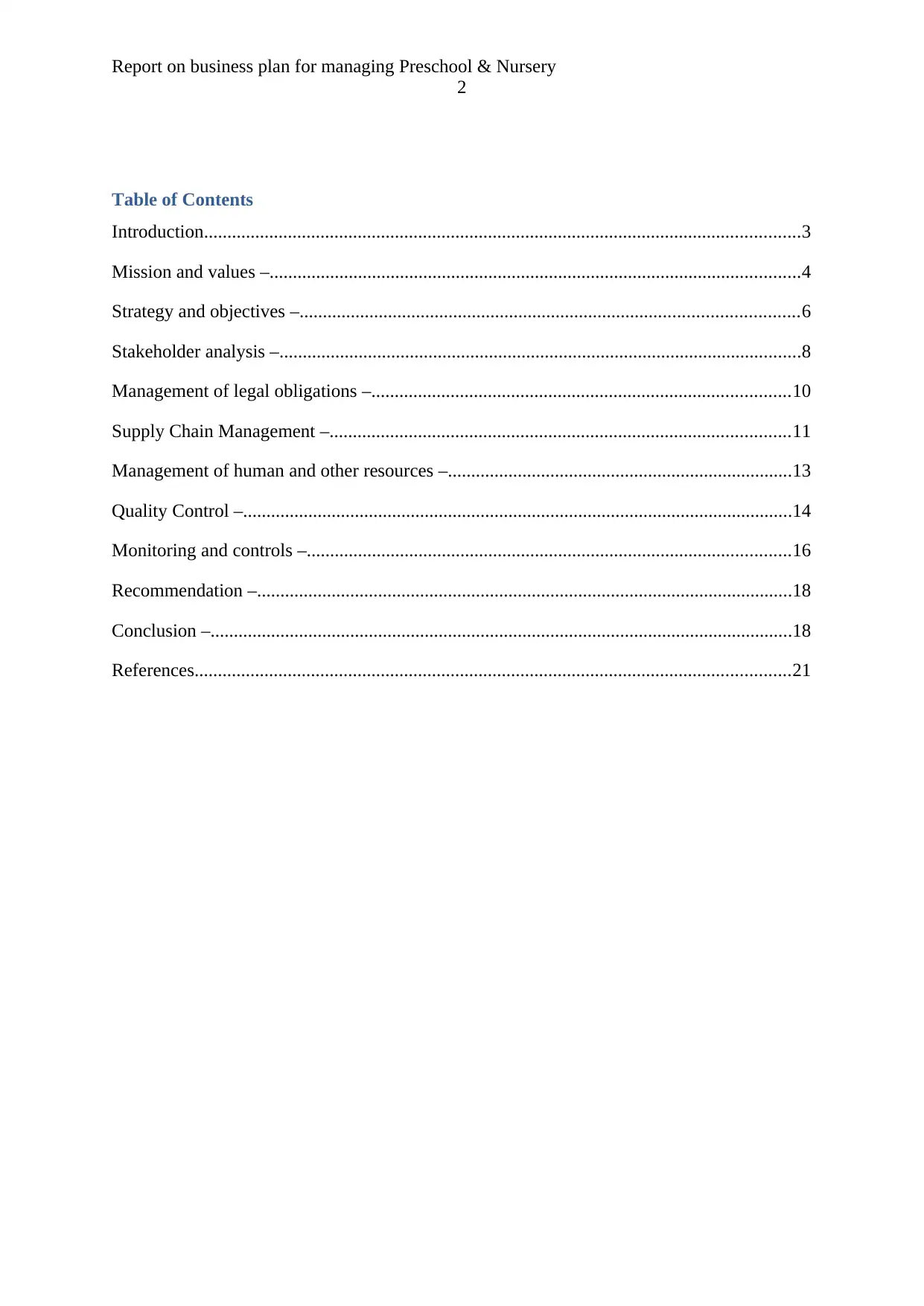
Introduction................................................................................................................................3
Mission and values –..................................................................................................................4
Strategy and objectives –...........................................................................................................6
Stakeholder analysis –................................................................................................................8
Management of legal obligations –..........................................................................................10
Supply Chain Management –...................................................................................................11
Management of human and other resources –..........................................................................13
Quality Control –......................................................................................................................14
Monitoring and controls –........................................................................................................16
Recommendation –...................................................................................................................18
Conclusion –.............................................................................................................................18
References................................................................................................................................21
2
Table of Contents
Introduction................................................................................................................................3
Mission and values –..................................................................................................................4
Strategy and objectives –...........................................................................................................6
Stakeholder analysis –................................................................................................................8
Management of legal obligations –..........................................................................................10
Supply Chain Management –...................................................................................................11
Management of human and other resources –..........................................................................13
Quality Control –......................................................................................................................14
Monitoring and controls –........................................................................................................16
Recommendation –...................................................................................................................18
Conclusion –.............................................................................................................................18
References................................................................................................................................21
⊘ This is a preview!⊘
Do you want full access?
Subscribe today to unlock all pages.

Trusted by 1+ million students worldwide
Report on business plan for managing Preschool & Nursery
3
Introduction
A Preschool is an educational institute or learning space which are offering early childhood
education to the students before students start their actual education from primary school and
secondary school. Preschool are also known as nursery school, play school and pre- primary
school. This school either operates privately or publicly or may be operated through
subsidized from the public funds. Preschool focuses on the children between the ages of 3 to
6 (Jazaieri, 2018). They offer an educational framework for them which contribute to the
development related to education of the children and they also addresses the needs of the
children at the start of their journey by education system. Education is very essential for
children for their development and for their effective career. Main objectives of preschool are
to develop language, social emotional skills, mathematics, physical, creative expression,
science and other basic knowledge. Preschool helps the children and their parents in building
confidence and trust which will help them their whole school system. Children interact with
their peer group and create relations with them (Kos and Jerman, 2012).
Preschool help the children in various ways such as they learn social mores, easily acceptable
different behaviour patterns of different children, it also helps children in the development of
empathy, awareness and sensitivity, moral values and integrity, also helps the children in
development of their social, physical, intellectual and emotional skills, lot of experience
related to fun and education and developing their self- confidence and independence, literacy,
team work, understanding related to basic education system, play, physical health, physical
development and it also help children in development of communication, listening and taking
skills (Guirguis, 2015). In United Kingdom, government are funding for a preschool or
nursery school or play schools or for children aged between 2 to 4. Education related to
preschool is provided by playgroups, centres which belong to child care and nursery schools.
There are also other sectors which are providing preschool education to children as private
voluntary or independent (Brassard and Boehm, 2009). There are various qualities of good
preschool such as good listening skills, follow rules and regulation of the company,
opportunities to learn persistence when provides education to children, focus on literacy skills
3
Introduction
A Preschool is an educational institute or learning space which are offering early childhood
education to the students before students start their actual education from primary school and
secondary school. Preschool are also known as nursery school, play school and pre- primary
school. This school either operates privately or publicly or may be operated through
subsidized from the public funds. Preschool focuses on the children between the ages of 3 to
6 (Jazaieri, 2018). They offer an educational framework for them which contribute to the
development related to education of the children and they also addresses the needs of the
children at the start of their journey by education system. Education is very essential for
children for their development and for their effective career. Main objectives of preschool are
to develop language, social emotional skills, mathematics, physical, creative expression,
science and other basic knowledge. Preschool helps the children and their parents in building
confidence and trust which will help them their whole school system. Children interact with
their peer group and create relations with them (Kos and Jerman, 2012).
Preschool help the children in various ways such as they learn social mores, easily acceptable
different behaviour patterns of different children, it also helps children in the development of
empathy, awareness and sensitivity, moral values and integrity, also helps the children in
development of their social, physical, intellectual and emotional skills, lot of experience
related to fun and education and developing their self- confidence and independence, literacy,
team work, understanding related to basic education system, play, physical health, physical
development and it also help children in development of communication, listening and taking
skills (Guirguis, 2015). In United Kingdom, government are funding for a preschool or
nursery school or play schools or for children aged between 2 to 4. Education related to
preschool is provided by playgroups, centres which belong to child care and nursery schools.
There are also other sectors which are providing preschool education to children as private
voluntary or independent (Brassard and Boehm, 2009). There are various qualities of good
preschool such as good listening skills, follow rules and regulation of the company,
opportunities to learn persistence when provides education to children, focus on literacy skills
Paraphrase This Document
Need a fresh take? Get an instant paraphrase of this document with our AI Paraphraser
Report on business plan for managing Preschool & Nursery
4
, language and interactive skills while reading books, problem solving skills between children
and teacher, helping and supporting to the children for expanding their skills and knowledge
and enhancing their vocabulary skills and opportunities to learn beginning skills which
involved numbers, alphabets and spatial awareness (Fisher and Seroussi, 2018).
There are various advantage of this business such as it develop ability or capabilities in
children for their future life or success, improving behaviour and achievement of children and
according to the research report, children who attend preschools or nursery schools earn more
money, more success in their future life, more experience, become more responsible
individual and more stable life as compare to the children who did not attend preschool
(Winnick and Porretta, 2017). A good preschool program help children to develop their
motor skills and knowledge, improve their communication with others or peer groups,
improve their language and also help them in enhancing their creativity skills. But there are
also some disadvantages of preschool such as cost of high quality preschool programs are
more than costs of other universities, greatest development of children in preschool who
belong to deprived background, they do not give individual attention to children, high risk
involved in this type of business, no one to one interaction with the children and their parents
and children experienced separation anxiety in preschool (Markstrom and Simonsson, 2017).
The report consists of business plan related to management of preschool and nursery, it
includes their mission, values, strategy and objectives, supply chain management, quality
control, human resource management, stakeholder analysis and recommendation on how
overseas expansion will be managed.
Mission and values –
Mission – To provide high quality education in a safe and effective environment with creative
or innovative ideas across the whole curriculum, maximising potential of individual,
empowering their learning through different education system and to provide affordable child
care and learning programs to meet to needs of children and their families and to succeed in
their future life (Nelid, 2016).
Vision – To provide best care and education to children, building trust, confidence and
independence for the children throughout their education programs, becoming independent
thinker by various meaningful activities related to learning and becoming them bright and
happy. To develop a community where all children can feel respected, loved, happy and
4
, language and interactive skills while reading books, problem solving skills between children
and teacher, helping and supporting to the children for expanding their skills and knowledge
and enhancing their vocabulary skills and opportunities to learn beginning skills which
involved numbers, alphabets and spatial awareness (Fisher and Seroussi, 2018).
There are various advantage of this business such as it develop ability or capabilities in
children for their future life or success, improving behaviour and achievement of children and
according to the research report, children who attend preschools or nursery schools earn more
money, more success in their future life, more experience, become more responsible
individual and more stable life as compare to the children who did not attend preschool
(Winnick and Porretta, 2017). A good preschool program help children to develop their
motor skills and knowledge, improve their communication with others or peer groups,
improve their language and also help them in enhancing their creativity skills. But there are
also some disadvantages of preschool such as cost of high quality preschool programs are
more than costs of other universities, greatest development of children in preschool who
belong to deprived background, they do not give individual attention to children, high risk
involved in this type of business, no one to one interaction with the children and their parents
and children experienced separation anxiety in preschool (Markstrom and Simonsson, 2017).
The report consists of business plan related to management of preschool and nursery, it
includes their mission, values, strategy and objectives, supply chain management, quality
control, human resource management, stakeholder analysis and recommendation on how
overseas expansion will be managed.
Mission and values –
Mission – To provide high quality education in a safe and effective environment with creative
or innovative ideas across the whole curriculum, maximising potential of individual,
empowering their learning through different education system and to provide affordable child
care and learning programs to meet to needs of children and their families and to succeed in
their future life (Nelid, 2016).
Vision – To provide best care and education to children, building trust, confidence and
independence for the children throughout their education programs, becoming independent
thinker by various meaningful activities related to learning and becoming them bright and
happy. To develop a community where all children can feel respected, loved, happy and
Report on business plan for managing Preschool & Nursery
5
encourage towards the development of their potential. To promotes positive growth in their
life and sustainable future of all children. To adopt a holistic approach which help all children
to develop their skills, abilities and knowledge as physical, social, communication, emotional,
language, learning, intellectual, mathematical, science and creative expression and give
attention to all children as we know that all children has different skills, knowledge, character
and unique behaviour. To promote and maintain a healthy or safe environment so that it
create an opportunity for all children to develop and grow and succeed in their future life
through appropriate role modelling in a positive manner (Vivanti, et al, 2017).
Values -
Life- long learning: We believe that all the members share the responsibility to help
and support to the all children and natural desire of the business to be life- long
learners. All the members of business put themselves and their learning on the same
level as child expect and commit to professional development of teacher and their
personal growth. We also learn along with children and their families and use the
opportunity to learn and grow from diverse children and their families on every day.
Quality and Safe care: We will provide high quality care and education to all children
and create safe and healthy environment. We will give our efforts to continuously
improvement of services and education system, try to create culture according to the
all children, create safe environment and improve quality of services through creative
and innovative techniques and ideas for all students (Fisher, Frey and Pumpian,
2012).
Trust and confidence: When parents are looking for preschool for their child then it is
necessary that they can trust on such schools or confident that they can send their
children in such type of schools. We will give continue efforts in improving our
services to meet the needs of parents of the children.
Inclusion: In our school, all children are welcomed as there is no bias as per caste,
religion and belief.
Positive learning environment: We will create a positive, engaging and well- equipped
learning environment for all children which also includes exceptional educators.
Quality employer: We will provide effective or positive environment and recruit
quality employer who has lot of skills and knowledge and specialized in this business,
so it will help in increasing productivity and growth.
5
encourage towards the development of their potential. To promotes positive growth in their
life and sustainable future of all children. To adopt a holistic approach which help all children
to develop their skills, abilities and knowledge as physical, social, communication, emotional,
language, learning, intellectual, mathematical, science and creative expression and give
attention to all children as we know that all children has different skills, knowledge, character
and unique behaviour. To promote and maintain a healthy or safe environment so that it
create an opportunity for all children to develop and grow and succeed in their future life
through appropriate role modelling in a positive manner (Vivanti, et al, 2017).
Values -
Life- long learning: We believe that all the members share the responsibility to help
and support to the all children and natural desire of the business to be life- long
learners. All the members of business put themselves and their learning on the same
level as child expect and commit to professional development of teacher and their
personal growth. We also learn along with children and their families and use the
opportunity to learn and grow from diverse children and their families on every day.
Quality and Safe care: We will provide high quality care and education to all children
and create safe and healthy environment. We will give our efforts to continuously
improvement of services and education system, try to create culture according to the
all children, create safe environment and improve quality of services through creative
and innovative techniques and ideas for all students (Fisher, Frey and Pumpian,
2012).
Trust and confidence: When parents are looking for preschool for their child then it is
necessary that they can trust on such schools or confident that they can send their
children in such type of schools. We will give continue efforts in improving our
services to meet the needs of parents of the children.
Inclusion: In our school, all children are welcomed as there is no bias as per caste,
religion and belief.
Positive learning environment: We will create a positive, engaging and well- equipped
learning environment for all children which also includes exceptional educators.
Quality employer: We will provide effective or positive environment and recruit
quality employer who has lot of skills and knowledge and specialized in this business,
so it will help in increasing productivity and growth.
⊘ This is a preview!⊘
Do you want full access?
Subscribe today to unlock all pages.
Trusted by 1+ million students worldwide
Report on business plan for managing Preschool & Nursery
6
Partnership: Our organization will operate on the principle of respectful and effective
relationship between teacher and children and their parents. Quality of care and
education will be measure by the level of relationship with children, their families,
school boards, employees, legislators, government and funders. We will ensure that
the above relations are equitable, fair, honest, warm, caring, open and respectful.
Fiscal responsibility: Our business is committed to sustainability and financial
prudence and to make decisions which will help the overall financial health and
financial performance of the organization and to meet or achieve the goals and
objectives of the business. We conduct our business in a professional manner and will
follow all rules and regulation which are imposed by the government and will run
business as per all business practices which are either ethical or legal (Carter and
Curtis, 2010).
Strategy and objectives –
In the mind of vision, mission and values of the organization, organization set the objectives
to achieve the mission and vision of the organization. Objectives are specific which are
derived from the goals of the organization. It should be clear and specific for achieving the
goals of the organization. Every organization set the objectives for achieving their goals and
increasing their performance and productivity as it is important for every organization is to
set proper and related objectives which help them in achieving their goals. It includes
measurable factors of performance, clearly stated quality and cost and approachable
deadlines. Strategies are made by the organization for achieving their objectives which are set
by them for achieving their goals (Bora, Borah and Chungyalpa, 2017).
1. Objective: Early education and care. It ensures that all children have access to high
quality education and safe care and they are ready to succeed in their life or in school
life. It provides a healthy, safe and nurturing environment for all children.
Strategy: For achieving the above objective, we can implement various strategies as
expand access to high quality and affordable education and child care for parents who
are attending school, work training and working elsewhere, ensure that cost of
education and care will be affordable to all children and their families, increase
awareness about quality education and care and early development and learning of
childhood and opportunity for success towards continuous education to the parents
6
Partnership: Our organization will operate on the principle of respectful and effective
relationship between teacher and children and their parents. Quality of care and
education will be measure by the level of relationship with children, their families,
school boards, employees, legislators, government and funders. We will ensure that
the above relations are equitable, fair, honest, warm, caring, open and respectful.
Fiscal responsibility: Our business is committed to sustainability and financial
prudence and to make decisions which will help the overall financial health and
financial performance of the organization and to meet or achieve the goals and
objectives of the business. We conduct our business in a professional manner and will
follow all rules and regulation which are imposed by the government and will run
business as per all business practices which are either ethical or legal (Carter and
Curtis, 2010).
Strategy and objectives –
In the mind of vision, mission and values of the organization, organization set the objectives
to achieve the mission and vision of the organization. Objectives are specific which are
derived from the goals of the organization. It should be clear and specific for achieving the
goals of the organization. Every organization set the objectives for achieving their goals and
increasing their performance and productivity as it is important for every organization is to
set proper and related objectives which help them in achieving their goals. It includes
measurable factors of performance, clearly stated quality and cost and approachable
deadlines. Strategies are made by the organization for achieving their objectives which are set
by them for achieving their goals (Bora, Borah and Chungyalpa, 2017).
1. Objective: Early education and care. It ensures that all children have access to high
quality education and safe care and they are ready to succeed in their life or in school
life. It provides a healthy, safe and nurturing environment for all children.
Strategy: For achieving the above objective, we can implement various strategies as
expand access to high quality and affordable education and child care for parents who
are attending school, work training and working elsewhere, ensure that cost of
education and care will be affordable to all children and their families, increase
awareness about quality education and care and early development and learning of
childhood and opportunity for success towards continuous education to the parents
Paraphrase This Document
Need a fresh take? Get an instant paraphrase of this document with our AI Paraphraser
Report on business plan for managing Preschool & Nursery
7
and guardians of children and increase community and agency support for increasing
services of early education and care (Nwokah and Sutterby, 2014) .
2. Objective: Social and Emotional Health. This is our second objective for achieving
the goals of organization. Although children and their parents are emotionally and
socially healthy but awareness among public is must about the importance of social
and emotional health (Merrell and Gueldner, 2010).
Strategies: For achieving the above objective, we will implement various strategies as
increase awareness or inform among parents about the how social and emotional
health is important, increase opportunities of emotional and social training and also
provide support services to the parents and their children, increase awareness of
information about age appropriate behaviours an milestones, promote agency
collaboration and complete a gap analysis of early childhood (Benson and Haith,
2009).
3. Objective: Support to the family and fulfil basic needs. We will provide support or
help to the families of all children which will help them in gaining economic stability.
Strategies: For achieving the above objective, we will implement various strategies as
try to fulfil the basic needs of all children such as food, safety, clothing, supplies and
safety, develop various programs for local assistance related to family support and for
fulfilling the basic needs of children and we have access to standard based
information related to various best practice for family- friendly.
4. Objective: Effective learning environment. It is another objective of our organization
for achieving a common goal of the organization. Effective learning environment is
important for every preschool business for increasing their performance and
productivity and achieving their goals (Walson, Emery and Bayliss, 2012).
Strategies: For achieving the above objective, we will implement the various
strategies as maintain good relationship between teacher and children, encouraging
positive relationship with the children and their families, using the approach of
physical environment such as proper set up of seating, try to create classroom
interactive and attractive and give proper attention to all children, encourage children
to ask question even a silly question, conduct various face to face communication
7
and guardians of children and increase community and agency support for increasing
services of early education and care (Nwokah and Sutterby, 2014) .
2. Objective: Social and Emotional Health. This is our second objective for achieving
the goals of organization. Although children and their parents are emotionally and
socially healthy but awareness among public is must about the importance of social
and emotional health (Merrell and Gueldner, 2010).
Strategies: For achieving the above objective, we will implement various strategies as
increase awareness or inform among parents about the how social and emotional
health is important, increase opportunities of emotional and social training and also
provide support services to the parents and their children, increase awareness of
information about age appropriate behaviours an milestones, promote agency
collaboration and complete a gap analysis of early childhood (Benson and Haith,
2009).
3. Objective: Support to the family and fulfil basic needs. We will provide support or
help to the families of all children which will help them in gaining economic stability.
Strategies: For achieving the above objective, we will implement various strategies as
try to fulfil the basic needs of all children such as food, safety, clothing, supplies and
safety, develop various programs for local assistance related to family support and for
fulfilling the basic needs of children and we have access to standard based
information related to various best practice for family- friendly.
4. Objective: Effective learning environment. It is another objective of our organization
for achieving a common goal of the organization. Effective learning environment is
important for every preschool business for increasing their performance and
productivity and achieving their goals (Walson, Emery and Bayliss, 2012).
Strategies: For achieving the above objective, we will implement the various
strategies as maintain good relationship between teacher and children, encouraging
positive relationship with the children and their families, using the approach of
physical environment such as proper set up of seating, try to create classroom
interactive and attractive and give proper attention to all children, encourage children
to ask question even a silly question, conduct various face to face communication
Report on business plan for managing Preschool & Nursery
8
sessions with all children, find the needs and expectation of children and try to fulfil
these needs of the children and conduct innovative activities related to games and
education from time to time (Hindman, Grant and Stronge, 2010).
5. Objective: To increase the level of quality and satisfaction of both employer and
employees. It is another objective of our organization which is set for achieiving the
common goal of the organization. Quality of employer and employees are very
important for every preschool business for increasing their performance and
productivity of the organization.
Strategies: For achieving the above objective, we will implement various strategies as
motivation theory, rewards and recognition, increase employee engagement, develop
their skills and knowledge through training and development programs and measure
the performance, so it will help in increasing motivation and encouraging them
towards their work and it will also help the organization in increasing their
performance and productivity.
Stakeholder analysis –
Stakeholder is a person, individual, group and organization which can affect to the actions,
objectives, policies and strategies of the every organization. Analysis of stakeholders are
essential for the improving productivity, performance, increasing their growth and achieving
their goals and objectives (Freeman, 2010). For preschool business, there are various
stakeholders who can affect the performance of the organization as associate professionals,
teachers, parents, policy maker and authority representative, peers, leadership, local
government, committee of management, local schools and school educators, members of
community, early years partnership and other local services related to early education and
care for children. Stakeholder analysis is essential technique which is sued by the
organization for identification of stakeholders and analysing their needs (Phillips, 2011)
Stakeholder analysis is the first and important step of the process of stakeholder management.
Stakeholder management is a process which involves identification of stakeholder,
documenting and finding their needs and expectation, analysing and assessing interest of
stakeholders, try to managing the expectation of them, taking corrective actions and
reviewing status. It is the process which is used by preschool for getting support from other in
achieiving their goals. Stakeholder management is important part for managing the preschool
8
sessions with all children, find the needs and expectation of children and try to fulfil
these needs of the children and conduct innovative activities related to games and
education from time to time (Hindman, Grant and Stronge, 2010).
5. Objective: To increase the level of quality and satisfaction of both employer and
employees. It is another objective of our organization which is set for achieiving the
common goal of the organization. Quality of employer and employees are very
important for every preschool business for increasing their performance and
productivity of the organization.
Strategies: For achieving the above objective, we will implement various strategies as
motivation theory, rewards and recognition, increase employee engagement, develop
their skills and knowledge through training and development programs and measure
the performance, so it will help in increasing motivation and encouraging them
towards their work and it will also help the organization in increasing their
performance and productivity.
Stakeholder analysis –
Stakeholder is a person, individual, group and organization which can affect to the actions,
objectives, policies and strategies of the every organization. Analysis of stakeholders are
essential for the improving productivity, performance, increasing their growth and achieving
their goals and objectives (Freeman, 2010). For preschool business, there are various
stakeholders who can affect the performance of the organization as associate professionals,
teachers, parents, policy maker and authority representative, peers, leadership, local
government, committee of management, local schools and school educators, members of
community, early years partnership and other local services related to early education and
care for children. Stakeholder analysis is essential technique which is sued by the
organization for identification of stakeholders and analysing their needs (Phillips, 2011)
Stakeholder analysis is the first and important step of the process of stakeholder management.
Stakeholder management is a process which involves identification of stakeholder,
documenting and finding their needs and expectation, analysing and assessing interest of
stakeholders, try to managing the expectation of them, taking corrective actions and
reviewing status. It is the process which is used by preschool for getting support from other in
achieiving their goals. Stakeholder management is important part for managing the preschool
⊘ This is a preview!⊘
Do you want full access?
Subscribe today to unlock all pages.
Trusted by 1+ million students worldwide
Report on business plan for managing Preschool & Nursery
9
and nursery and play school. It includes identification of stakeholders, analysis of
expectations and influences of stakeholders, development of various suitable strategies to
encouraging them towards their work and also developing appropriate strategies for
executing the process of management of stakeholders, so it will help the organization in
achieving their goals and objectives effectively and efficiently. Stakeholder management
helps the organization in various ways as it create positive learning environment, create
positive or healthy relationship between organization and their stakeholders, increasing
organization performance and productivity with the help and supports from other and
achieving the goals and objectives of the organization. So, stakeholder management is
important for our preschool for achieving visions, objectives and goals of the organization
(Jepsen and Eskerod, 2013). Stakeholder analysis is important step of stakeholder
management because it will help the organization in various ways:
Identifying the interest of all stakeholders who may affect the performance of the
organization
Identifying potential issues of the organization
It also helps in identifying the individual and group that should be encourage to
participate in their achievement
Reduce negative impacts because it will help in managing negative stakeholders
Helps in continuous improvement of the organization while delivering services to
children and it also help the organization in completing their goals and objectives
successfully
It gives opportunities to group or an individual to share their ideas and suggestions
while making decisions related to the achievement of their goals.
Stakeholder analysis gives a sense of accountability and it also help to enhance their
responsibilities.
It helps in identifying effective risk and helps in response planning to the
organization.
Stakeholder analysis also helps the organization in managing the organization
effectively and efficiently (Freeman, et al, 2010).
Our organization will use following steps for the analysis of stakeholders:
1. Identify stakeholders – This is the first step which is used by company for analysis of
stakeholders. They should identify who are the stakeholders that affect the
9
and nursery and play school. It includes identification of stakeholders, analysis of
expectations and influences of stakeholders, development of various suitable strategies to
encouraging them towards their work and also developing appropriate strategies for
executing the process of management of stakeholders, so it will help the organization in
achieving their goals and objectives effectively and efficiently. Stakeholder management
helps the organization in various ways as it create positive learning environment, create
positive or healthy relationship between organization and their stakeholders, increasing
organization performance and productivity with the help and supports from other and
achieving the goals and objectives of the organization. So, stakeholder management is
important for our preschool for achieving visions, objectives and goals of the organization
(Jepsen and Eskerod, 2013). Stakeholder analysis is important step of stakeholder
management because it will help the organization in various ways:
Identifying the interest of all stakeholders who may affect the performance of the
organization
Identifying potential issues of the organization
It also helps in identifying the individual and group that should be encourage to
participate in their achievement
Reduce negative impacts because it will help in managing negative stakeholders
Helps in continuous improvement of the organization while delivering services to
children and it also help the organization in completing their goals and objectives
successfully
It gives opportunities to group or an individual to share their ideas and suggestions
while making decisions related to the achievement of their goals.
Stakeholder analysis gives a sense of accountability and it also help to enhance their
responsibilities.
It helps in identifying effective risk and helps in response planning to the
organization.
Stakeholder analysis also helps the organization in managing the organization
effectively and efficiently (Freeman, et al, 2010).
Our organization will use following steps for the analysis of stakeholders:
1. Identify stakeholders – This is the first step which is used by company for analysis of
stakeholders. They should identify who are the stakeholders that affect the
Paraphrase This Document
Need a fresh take? Get an instant paraphrase of this document with our AI Paraphraser
Report on business plan for managing Preschool & Nursery
10
performance of the organization or who have an interest in the success of
organization. It also includes roles, interest, expectations and influence of
stakeholders. After we identify the key stakeholders then we will expand the list of
stakeholder.
2. Prioritize stakeholders or classifying them – After identifying the stakeholders who
affect the performance of the company then next step of stakeholder analysis is
classifying them on the basis of prioritize and their power and interest. So, we can
classifying our stakeholders in different categories as high power and highly
interested individual, high power and less interested individual, low power and highly
interested people and low power and less interested people.
3. Understand stakeholders and support to them – After identifying and classifying the
stakeholders then next step of stakeholder analysis is to understand them and give
support to them. In this step, organization needs to identify that at what extend their
stakeholders understand the goals and objectives and feel about the organization. It
can be analysis through various ways such as financial and emotional interest of them
towards organization and their work, their current opinion about organization, either
they are likely to be positive or not towards the organization and measure the level of
satisfaction of stakeholders (Kimmich, et al, 2012).
Management of legal obligations –
For managing a preschool and nursery there are various legal obligations or fundamental
aspects related to rules and regulations of the government in managing of preschool that need
to be followed while setting up preschool or while managing a preschool or nursery during
the first two years of trading. There is a regulatory system which is regulated by the
government in UK for setting up and managing a preschool nursery. So, preschools and
nurseries have to register with the above regulatory body and system and adhere to the legal
obligations (Burnham and Horton, 2013). So, following are the legal basis for regulation
system in managing a preschool and nurseries:
Childcare Act 2006 – This act states that childcare refer as any form of care for the children,
which includes education and any other activities related to childcare. So, our organization
will follow the above act. As per this act, they caring for children under the age of 8 years old
and for managing a preschool or setting up a preschool, every organization must register with
Ofsted or a child minder agency. This act establishes HMCI (Her Majesty’s Chief Inspector)
10
performance of the organization or who have an interest in the success of
organization. It also includes roles, interest, expectations and influence of
stakeholders. After we identify the key stakeholders then we will expand the list of
stakeholder.
2. Prioritize stakeholders or classifying them – After identifying the stakeholders who
affect the performance of the company then next step of stakeholder analysis is
classifying them on the basis of prioritize and their power and interest. So, we can
classifying our stakeholders in different categories as high power and highly
interested individual, high power and less interested individual, low power and highly
interested people and low power and less interested people.
3. Understand stakeholders and support to them – After identifying and classifying the
stakeholders then next step of stakeholder analysis is to understand them and give
support to them. In this step, organization needs to identify that at what extend their
stakeholders understand the goals and objectives and feel about the organization. It
can be analysis through various ways such as financial and emotional interest of them
towards organization and their work, their current opinion about organization, either
they are likely to be positive or not towards the organization and measure the level of
satisfaction of stakeholders (Kimmich, et al, 2012).
Management of legal obligations –
For managing a preschool and nursery there are various legal obligations or fundamental
aspects related to rules and regulations of the government in managing of preschool that need
to be followed while setting up preschool or while managing a preschool or nursery during
the first two years of trading. There is a regulatory system which is regulated by the
government in UK for setting up and managing a preschool nursery. So, preschools and
nurseries have to register with the above regulatory body and system and adhere to the legal
obligations (Burnham and Horton, 2013). So, following are the legal basis for regulation
system in managing a preschool and nurseries:
Childcare Act 2006 – This act states that childcare refer as any form of care for the children,
which includes education and any other activities related to childcare. So, our organization
will follow the above act. As per this act, they caring for children under the age of 8 years old
and for managing a preschool or setting up a preschool, every organization must register with
Ofsted or a child minder agency. This act establishes HMCI (Her Majesty’s Chief Inspector)
Report on business plan for managing Preschool & Nursery
11
of education, skills and services for the children. The act gives HMCI responsibility for the
registration, enforcement and inspection of providers who are managing a preschool and
nursery (Regulation of services on Childcare Register from March 2017, 2017). Organization
also complies with other provisions or legal obligations as The Childcare Regulation (General
Childcare Register) 2008 and Childcare Regulations 2014 (Welfare and Registration
Requirements).
Register with Ofsted – For setting up preschool or to providing childcare in UK, every
organization need to register with Ofsted, it has to be followed by every organization who
want to provide childcare or setting up a preschool and nursery for the children under the age
of 8 year old and providing children services for more than two hours per day. So, our
organization has to register with Ofsted. It is responsibility of Ofsted’s to ensure that only
those are registered who are ready to provide education and childcare to the children.
Early years Foundation Stage – The Early Years Foundation Stage is produced by the
Department of Education which includes requirements of the safeguarding and welfare for
the children and learning and development of their children, which all preschool or nursery
who want to start childcare or education for the children under the age of 8 year old on the
Early Years Register must meet. This act also provides guidance in managing a preschool and
nursery through good practices. So, to meet the needs of health and safety requirements for
our organization, we have a legal obligation as Early Years Foundation Stage to undertake a
safety and health risk assessment for children.
Early Years Childcare and Extended Schools Services – Our organization has to register with
EYCESS because it will help the organization in controlling their costs and help the
organization in funding in their investment while managing a preschool or nursery
(Fairbrother, 2019).
Supply Chain Management –
Supply chain management refer as the process from acquiring raw material to the delivering
of final services to the customers in the proper way and most cost effective way whichever is
possible. Development of supply chains are complex in the world. It ensures the delivery of
supplies to children in the situations of conflicts, difficulties and disaster, so these situations
requires technical knowledge, financial resources, collaboration and innovative solutions.
Supply chain management helps the organization increasing their revenues, profits,
11
of education, skills and services for the children. The act gives HMCI responsibility for the
registration, enforcement and inspection of providers who are managing a preschool and
nursery (Regulation of services on Childcare Register from March 2017, 2017). Organization
also complies with other provisions or legal obligations as The Childcare Regulation (General
Childcare Register) 2008 and Childcare Regulations 2014 (Welfare and Registration
Requirements).
Register with Ofsted – For setting up preschool or to providing childcare in UK, every
organization need to register with Ofsted, it has to be followed by every organization who
want to provide childcare or setting up a preschool and nursery for the children under the age
of 8 year old and providing children services for more than two hours per day. So, our
organization has to register with Ofsted. It is responsibility of Ofsted’s to ensure that only
those are registered who are ready to provide education and childcare to the children.
Early years Foundation Stage – The Early Years Foundation Stage is produced by the
Department of Education which includes requirements of the safeguarding and welfare for
the children and learning and development of their children, which all preschool or nursery
who want to start childcare or education for the children under the age of 8 year old on the
Early Years Register must meet. This act also provides guidance in managing a preschool and
nursery through good practices. So, to meet the needs of health and safety requirements for
our organization, we have a legal obligation as Early Years Foundation Stage to undertake a
safety and health risk assessment for children.
Early Years Childcare and Extended Schools Services – Our organization has to register with
EYCESS because it will help the organization in controlling their costs and help the
organization in funding in their investment while managing a preschool or nursery
(Fairbrother, 2019).
Supply Chain Management –
Supply chain management refer as the process from acquiring raw material to the delivering
of final services to the customers in the proper way and most cost effective way whichever is
possible. Development of supply chains are complex in the world. It ensures the delivery of
supplies to children in the situations of conflicts, difficulties and disaster, so these situations
requires technical knowledge, financial resources, collaboration and innovative solutions.
Supply chain management helps the organization increasing their revenues, profits,
⊘ This is a preview!⊘
Do you want full access?
Subscribe today to unlock all pages.
Trusted by 1+ million students worldwide

1 out of 26


Related Documents


Your All-in-One AI-Powered Toolkit for Academic Success.
+13062052269
info@desklib.com
Available 24*7 on WhatsApp / Email
![[object Object]](/_next/static/media/star-bottom.7253800d.svg)
Unlock your academic potential
Copyright © 2020–2026 A2Z Services. All Rights Reserved. Developed and managed by ZUCOL.