Analyzing Presidential Actions, Powers, and Succession: Assignment

Verified

Added on  2023/06/03

|4
|566
|326
Homework Assignment
AI Summary
This assignment delves into the intricacies of the US presidency, covering the presidential transition process, the significance of the first 100 days of a presidency with a focus on President Roosevelt's actions during the Great Depression, the importance of proposing legislation in the first year, and a review of President Trump's first 100 days. It also examines the historical line of succession in case of presidential death, the politics of impeachment, and the implications of disability on the office of the presidency. The assignment provides a comprehensive overview of the powers, responsibilities, and historical context surrounding the US presidency, drawing on relevant sources to support its analysis.
Document Page
Running head: THE PRESIDENT
THE PRESIDENT
Name of the Student
Name of the University
Author note:
tabler-icon-diamond-filled.svg

Paraphrase This Document

Need a fresh take? Get an instant paraphrase of this document with our AI Paraphraser
Document Page
1THE PRESIDENT
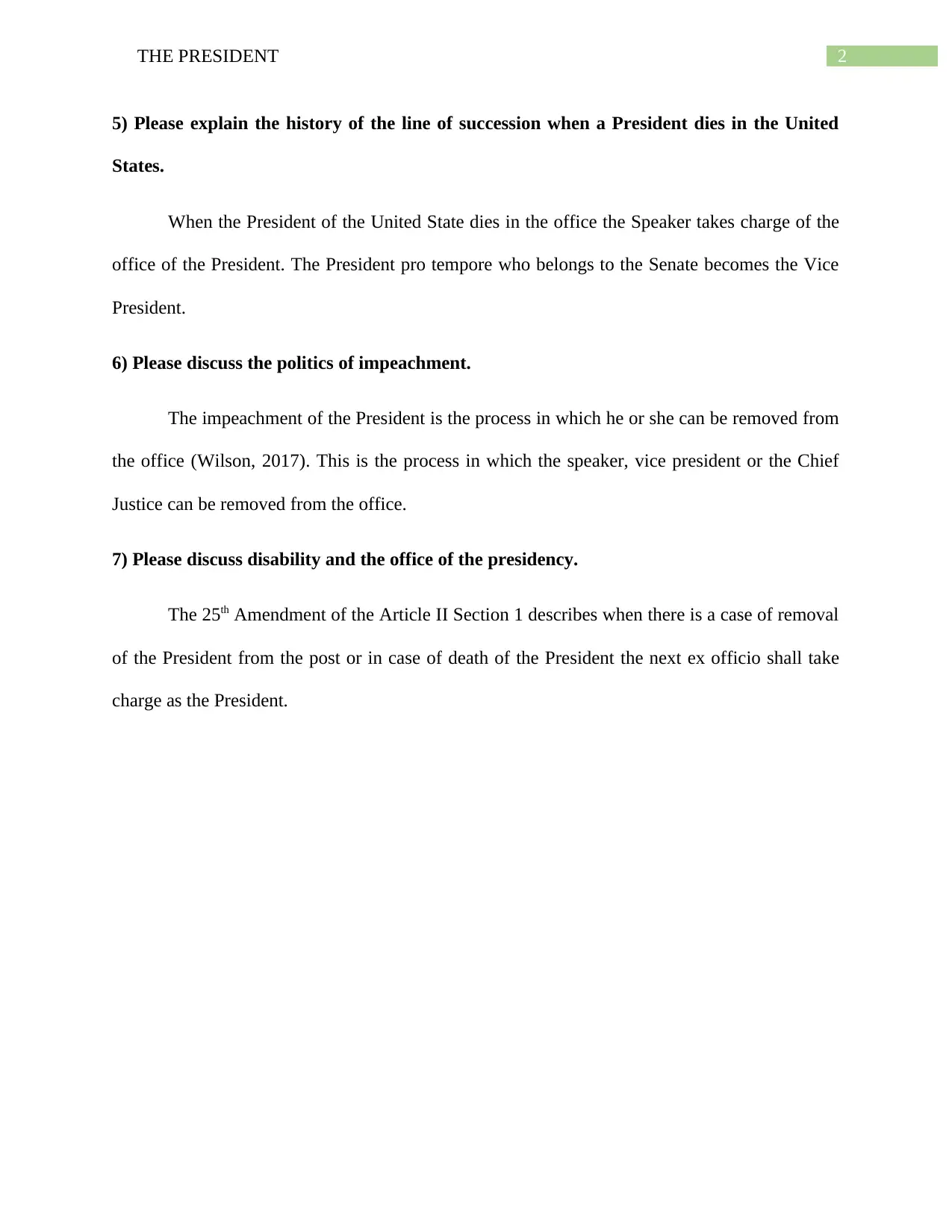
1. Please explain the presidential "transition" process.
The Presidential transition process is the transfer of power from the incumbent President
to the President who is elected in the government in the election process. The administrative
power of the former President is instated in the hands of the new President. The new
President takes power and ensures that all the important information can be now accessed by
his office and all the required military and nuclear codes are known.
2. Please explain President Roosevelt's First One Hundred Days.
The period of the first 100 days of the President began on 1933 March 4 and he was the
32nd President of the United States. He had to counteract the Great Depression (Shi & Tindall,
2016). He stated “I am prepared under my constitutional duty to recommend the measures that a
stricken nation in the midst of a stricken world may require.” The term first 100 days was also
coined by he himself and 15 important laws were enacted within these days.
3) Please explain the importance of proposing legislation in the first year of a presidency.
The first year legislations can also be termed as the agenda setting for the Presidency.
The party or more precisely the President who is in power sets the agenda for the rest of the three
years of his tenure. Therefore this is an important phase of legislation in the Presidential tenure.
4) Please explain the actions President Trump took in his first one hundred days.
The first 100 days of Donald Trump, the present President of the United States of
America, started on 20th January 2017. During the first 100 days Trump had successfully
appointed Neil Gorsuch as Associate Justice of the Supreme Court of the United States. He took
several economic reforms as well.
Document Page
2THE PRESIDENT
5) Please explain the history of the line of succession when a President dies in the United
States.
When the President of the United State dies in the office the Speaker takes charge of the
office of the President. The President pro tempore who belongs to the Senate becomes the Vice
President.
6) Please discuss the politics of impeachment.
The impeachment of the President is the process in which he or she can be removed from
the office (Wilson, 2017). This is the process in which the speaker, vice president or the Chief
Justice can be removed from the office.
7) Please discuss disability and the office of the presidency.
The 25th Amendment of the Article II Section 1 describes when there is a case of removal
of the President from the post or in case of death of the President the next ex officio shall take
charge as the President.
Document Page
3THE PRESIDENT
Reference:
Shi, D. E., & Tindall, G. B. (2016). America: A narrative history. WW Norton & Company.
Wilson, W. (2017). Constitutional government in the United States. Routledge.
chevron_up_icon
1 out of 4
circle_padding
hide_on_mobile
zoom_out_icon
[object Object]