Foundation in Nursing: Comparing Pressure Ulcer Risk Assessment Tools
VerifiedAdded on 2022/09/23
|11
|3465
|29
Report
AI Summary
This report, prepared for a foundation in nursing course, addresses the critical issue of pressure ulcer risk assessment in elderly patients. Guided by a PICO question comparing the Braden and Waterlow scales, the report begins with an introduction highlighting the prevalence, costs, and risks associated with pressure ulcers, particularly in the elderly population. A comprehensive literature search, utilizing databases like Google Scholar and CINAHL, is detailed, including the selection criteria for relevant articles published between 2011 and 2020. The report then provides a rationale for the selection of five key articles, which are then discussed in detail, analyzing their methodologies, findings, and authority. The discussion section compares the efficacy of the Braden, Norton, and Waterlow scales in assessing and predicting pressure ulcer development. The report also evaluates the authority of the cited articles, assessing the expertise and affiliations of the authors. The report concludes by synthesizing the findings and providing insights into the most effective risk assessment tools for pressure ulcer prevention in elderly care.

Running head: FOUNDATION IN NURSING
Foundation in Nursing
Name
Institution
Foundation in Nursing
Name
Institution

Paraphrase This Document
Need a fresh take? Get an instant paraphrase of this document with our AI Paraphraser
FOUNDATION IN NURSING
Introduction
It is important for a healthcare worker to identify the different pressure areas that are
likely to be prone areas for pressure ulcers/injuries/sores, as noted by Shah et al. (2016). The
prevalence of pressure ulcers based on 2015-16 data in Australian hospitals was 9.7 cases per
10, 000 hospitalizations, according to the Australian Commission on Safety and Quality in
Healthcare (2018). As per 2012-2013 data, treatment costs traversing the states was around
A$983 million, and this made up 1.9% of expenditure in public hospitals and 524661 beds
lost due to unnecessary length of hospital stays (Nguyen, Chaboyer, & Whitty, 2014). The
elderly are at an increased risk of pressure ulcers due to a poor immune system, hormonal
imbalance, altered blood perfusion, and degeneration are factors that make the elderly
population to be more vulnerable to pressure ulcers compared to the rest of the population
(Jaul, Barron, Rosenzwig, & Menczel, 2018). A study by Fullbrook, Miles, and Coyer shows
that the prevalence of pressure ulcers during admission is low and precipitated by poor
intervention during transportation and time at the ED (2018). As a move to aid in the
management of pressure ulcers, the current research project is guided by the following PICO
question: In elderly patients, does the use of Braden scale compared to Waterlow score a
better risk management tool for Pressure Ulcer Development (PUD).
Literature Search
The literature search was a daunting process, and the databases used during the search
were Google Scholar and CINAHL. The key terms used were “Braden Scale,” “Waterlow
Scale,” “Pressure Ulcers,” “Pressure Ulcer Development,” “Risk,” “Management,” and “Risk
Assessment.” Boolean operators, “AND” and “OR” were used. The keywords combined to
develop different search strings. The different search stings yielded different sets of hits that
were reviewed based on the title and abstract. The search process was also filtered on the
basis of year and inclusion of both Braden and Waterlow scores in an article. Articles that
Introduction
It is important for a healthcare worker to identify the different pressure areas that are
likely to be prone areas for pressure ulcers/injuries/sores, as noted by Shah et al. (2016). The
prevalence of pressure ulcers based on 2015-16 data in Australian hospitals was 9.7 cases per
10, 000 hospitalizations, according to the Australian Commission on Safety and Quality in
Healthcare (2018). As per 2012-2013 data, treatment costs traversing the states was around
A$983 million, and this made up 1.9% of expenditure in public hospitals and 524661 beds
lost due to unnecessary length of hospital stays (Nguyen, Chaboyer, & Whitty, 2014). The
elderly are at an increased risk of pressure ulcers due to a poor immune system, hormonal
imbalance, altered blood perfusion, and degeneration are factors that make the elderly
population to be more vulnerable to pressure ulcers compared to the rest of the population
(Jaul, Barron, Rosenzwig, & Menczel, 2018). A study by Fullbrook, Miles, and Coyer shows
that the prevalence of pressure ulcers during admission is low and precipitated by poor
intervention during transportation and time at the ED (2018). As a move to aid in the
management of pressure ulcers, the current research project is guided by the following PICO
question: In elderly patients, does the use of Braden scale compared to Waterlow score a
better risk management tool for Pressure Ulcer Development (PUD).
Literature Search
The literature search was a daunting process, and the databases used during the search
were Google Scholar and CINAHL. The key terms used were “Braden Scale,” “Waterlow
Scale,” “Pressure Ulcers,” “Pressure Ulcer Development,” “Risk,” “Management,” and “Risk
Assessment.” Boolean operators, “AND” and “OR” were used. The keywords combined to
develop different search strings. The different search stings yielded different sets of hits that
were reviewed based on the title and abstract. The search process was also filtered on the
basis of year and inclusion of both Braden and Waterlow scores in an article. Articles that
FOUNDATION IN NURSING
were reviewed were those published between 2011 and 2020. Due to the paucity of scientific
literature that is specific to Braden and Waterlow scales, articles focusing on the two and an
additional scale were included. On the other and, articles focusing on one scale or comparing
either one of the scales of interest with another not of interest were excluded from the review.
However, articles comparing more than three risk assessment tools were not included.
Articles included for the review were those published in the last ten years from 2011. Articles
adopting a primary research approach were included while reviews, expert opinions and
conferences were excluded from this review. Eventually, 30 articles met the inclusion criteria
but after thorough scrutiny, 5 articles were used for the review. The others were eliminated
based on the rationale of choice described below.
Rationale of Choice
The inclusion/exclusion criteria guided the selection of articles. Also, even though an
extra risk assessment scale was included, this did not prevent the selection of an article as
long as the other two were Braden and Waterlow scales. Articles were selected if they were
available apart for one that was a pilot and the reason for is inclusion was due to the fact that
it met the inclusion/exclusion criteria and had an elaborate abstract that was enough to extract
the needed information. Only those articles that provided results of primary research were
included in the review. The first article by Šáteková, Žiaková, and Zeleníková was selected
for inclusion because it was aligned with the PICO, assessing the efficacy of Waterlow and
Braden scales and the average age of the participants was 73 years. The second article by
Borghardt et al. aimed to answer the PICO question by included a third risk assessment tool:
the Norton Scale. The third article was by Kumari et al. also sought to address the PICO
question and used a similar approach to that of Šáteková. The fourth article by de Azevedo
Macena et al. sought to answer the PICO question but used a cross-sectional approach.
were reviewed were those published between 2011 and 2020. Due to the paucity of scientific
literature that is specific to Braden and Waterlow scales, articles focusing on the two and an
additional scale were included. On the other and, articles focusing on one scale or comparing
either one of the scales of interest with another not of interest were excluded from the review.
However, articles comparing more than three risk assessment tools were not included.
Articles included for the review were those published in the last ten years from 2011. Articles
adopting a primary research approach were included while reviews, expert opinions and
conferences were excluded from this review. Eventually, 30 articles met the inclusion criteria
but after thorough scrutiny, 5 articles were used for the review. The others were eliminated
based on the rationale of choice described below.
Rationale of Choice
The inclusion/exclusion criteria guided the selection of articles. Also, even though an
extra risk assessment scale was included, this did not prevent the selection of an article as
long as the other two were Braden and Waterlow scales. Articles were selected if they were
available apart for one that was a pilot and the reason for is inclusion was due to the fact that
it met the inclusion/exclusion criteria and had an elaborate abstract that was enough to extract
the needed information. Only those articles that provided results of primary research were
included in the review. The first article by Šáteková, Žiaková, and Zeleníková was selected
for inclusion because it was aligned with the PICO, assessing the efficacy of Waterlow and
Braden scales and the average age of the participants was 73 years. The second article by
Borghardt et al. aimed to answer the PICO question by included a third risk assessment tool:
the Norton Scale. The third article was by Kumari et al. also sought to address the PICO
question and used a similar approach to that of Šáteková. The fourth article by de Azevedo
Macena et al. sought to answer the PICO question but used a cross-sectional approach.
⊘ This is a preview!⊘
Do you want full access?
Subscribe today to unlock all pages.

Trusted by 1+ million students worldwide
FOUNDATION IN NURSING
Finally, the fifth article used a qualitative approach to obtain insight form healthcare
providers on the most effective risk assessment tool for application in a healthcare setting.
Discussion
Šáteková, L., Žiaková, K., & Zeleníková, R. (2014). Predictive Validity of the Braden Scale,
Norton Scale and Waterlow Scale in Slovak Republic.
The aim of the article is clear as it is to determine the efficacy of risk assessment tool
for pressure ulcers by focusing on Braden, Norton, and Water scales. A hundred patients
purposed to receive long term care for a period of 5 months were recruited in the study. The
participants were recruited for as long as they were above 18 years but eventually the average
age of the participants was 73 years. Šáteková et al. used a prospective study and showed that
the Braden Scale is the most effective, followed by the Norton Scale, and finally the
Waterlow Scale. However, due to a paucity of evidence in this field, there are few studies
with which to make a comparison and understand other researchers’ views.
Borghardt, A. T., Prado, T. N., Araújo, T. M., Rogenski, N. M., & Bringuente, M. E. (2015).
Evaluation of the pressure ulcers risk scales with critically ill patients: a prospective
cohort study. Revista latino-americana de enfermagem, 23(1), 28–35.
https://doi.org/10.1590/0104-1169.0144.2521.
Borghardt et al. (2015) takes on a similar approach to that of Šáteková et al. (2015)
but focuses on two risk assessment tools and distinguishes the Braden Scale as an effective
screening tool and the Waterlow Scale as an effective predictive tool. The article by
Borghardt et al. is of reasonably good quality as it is clear and adopts a reliable research
technique because a prospective cohort research design is the most ideal method when tracing
occurrence of an outcome after exposure to a perceived risk (Checkoway, Pearce, & Kriebel,
2007). The study participants consisted of 55 inpatients admitted at the Cassiano Antonio
Finally, the fifth article used a qualitative approach to obtain insight form healthcare
providers on the most effective risk assessment tool for application in a healthcare setting.
Discussion
Šáteková, L., Žiaková, K., & Zeleníková, R. (2014). Predictive Validity of the Braden Scale,
Norton Scale and Waterlow Scale in Slovak Republic.
The aim of the article is clear as it is to determine the efficacy of risk assessment tool
for pressure ulcers by focusing on Braden, Norton, and Water scales. A hundred patients
purposed to receive long term care for a period of 5 months were recruited in the study. The
participants were recruited for as long as they were above 18 years but eventually the average
age of the participants was 73 years. Šáteková et al. used a prospective study and showed that
the Braden Scale is the most effective, followed by the Norton Scale, and finally the
Waterlow Scale. However, due to a paucity of evidence in this field, there are few studies
with which to make a comparison and understand other researchers’ views.
Borghardt, A. T., Prado, T. N., Araújo, T. M., Rogenski, N. M., & Bringuente, M. E. (2015).
Evaluation of the pressure ulcers risk scales with critically ill patients: a prospective
cohort study. Revista latino-americana de enfermagem, 23(1), 28–35.
https://doi.org/10.1590/0104-1169.0144.2521.
Borghardt et al. (2015) takes on a similar approach to that of Šáteková et al. (2015)
but focuses on two risk assessment tools and distinguishes the Braden Scale as an effective
screening tool and the Waterlow Scale as an effective predictive tool. The article by
Borghardt et al. is of reasonably good quality as it is clear and adopts a reliable research
technique because a prospective cohort research design is the most ideal method when tracing
occurrence of an outcome after exposure to a perceived risk (Checkoway, Pearce, & Kriebel,
2007). The study participants consisted of 55 inpatients admitted at the Cassiano Antonio
Paraphrase This Document
Need a fresh take? Get an instant paraphrase of this document with our AI Paraphraser
FOUNDATION IN NURSING
Moraes University Hospital. Individuals from the age of 18 years were recruited but the
ultimate mean age was 59.4 years.
Kumari, S., Sharma, D., Rana, A., Pathak, R., Lal, R., Kumar, A., & Biswal, U. C. (2015).
Risk Assessment Tool for Pressure Ulcer Development in Indian Surgical Wards.
Kumari et al. (2012) used a prospective research design and evaluated three risk
assessment tools like Šáteková et al. but focused on a different parameter to measure efficacy.
While Šáteková used predictive ability, Kumari et al. focused on sensitivity; hence, unlike
Šáteková who showed that the Braden was the most effective, Kumari et al. indicated that the
Norton scale was the most effective. Participants were from 14 years without sores at the time
of admission, and comprised 100 out of the 240 admitted patients. The article was published
within the last 10 years, in 2012 unlike that of Šáteková, which is more recent, published in
2015. Thereby, additional research to obtain confirmatory results by relating the ROC curve,
in the context of both sensitivity and predictive power, to patient outcomes would be ideal.
de Azevedo Macena, M. S., da Costa Silva, R. S., Dias Fernandes, M., de Almeida Medeiros,
A. B., Batista Lúcio, K. D., & de Carvalho Lira, A. (2017). Pressure Ulcer Risk
Evaluation in Critical Patients: Clinical and Social Characteristics.
de Azevedo Macena et al. (2017) use a cross-sectional research design, which is
deemed to be of lower rigor as opposed to a prospective study; hence, its quality can be
perceived to be moderately fair. 78 patients from 18 years were recruited from the ICU in one
of the university hospitals in Northeastern Brazil. The study showed that the three risk
assessment tools under investigation were effective in different realms. Whereas the study’s
results are in alignment with the findings and views of most researchers and authoritative
figures, there is still a portion of researchers who have contrary views. Hence, such
inconsistencies warrant a holistic study that focuses on the different measures of efficacy of
these risk assessment tools to avoid discrepancies.
Moraes University Hospital. Individuals from the age of 18 years were recruited but the
ultimate mean age was 59.4 years.
Kumari, S., Sharma, D., Rana, A., Pathak, R., Lal, R., Kumar, A., & Biswal, U. C. (2015).
Risk Assessment Tool for Pressure Ulcer Development in Indian Surgical Wards.
Kumari et al. (2012) used a prospective research design and evaluated three risk
assessment tools like Šáteková et al. but focused on a different parameter to measure efficacy.
While Šáteková used predictive ability, Kumari et al. focused on sensitivity; hence, unlike
Šáteková who showed that the Braden was the most effective, Kumari et al. indicated that the
Norton scale was the most effective. Participants were from 14 years without sores at the time
of admission, and comprised 100 out of the 240 admitted patients. The article was published
within the last 10 years, in 2012 unlike that of Šáteková, which is more recent, published in
2015. Thereby, additional research to obtain confirmatory results by relating the ROC curve,
in the context of both sensitivity and predictive power, to patient outcomes would be ideal.
de Azevedo Macena, M. S., da Costa Silva, R. S., Dias Fernandes, M., de Almeida Medeiros,
A. B., Batista Lúcio, K. D., & de Carvalho Lira, A. (2017). Pressure Ulcer Risk
Evaluation in Critical Patients: Clinical and Social Characteristics.
de Azevedo Macena et al. (2017) use a cross-sectional research design, which is
deemed to be of lower rigor as opposed to a prospective study; hence, its quality can be
perceived to be moderately fair. 78 patients from 18 years were recruited from the ICU in one
of the university hospitals in Northeastern Brazil. The study showed that the three risk
assessment tools under investigation were effective in different realms. Whereas the study’s
results are in alignment with the findings and views of most researchers and authoritative
figures, there is still a portion of researchers who have contrary views. Hence, such
inconsistencies warrant a holistic study that focuses on the different measures of efficacy of
these risk assessment tools to avoid discrepancies.
FOUNDATION IN NURSING
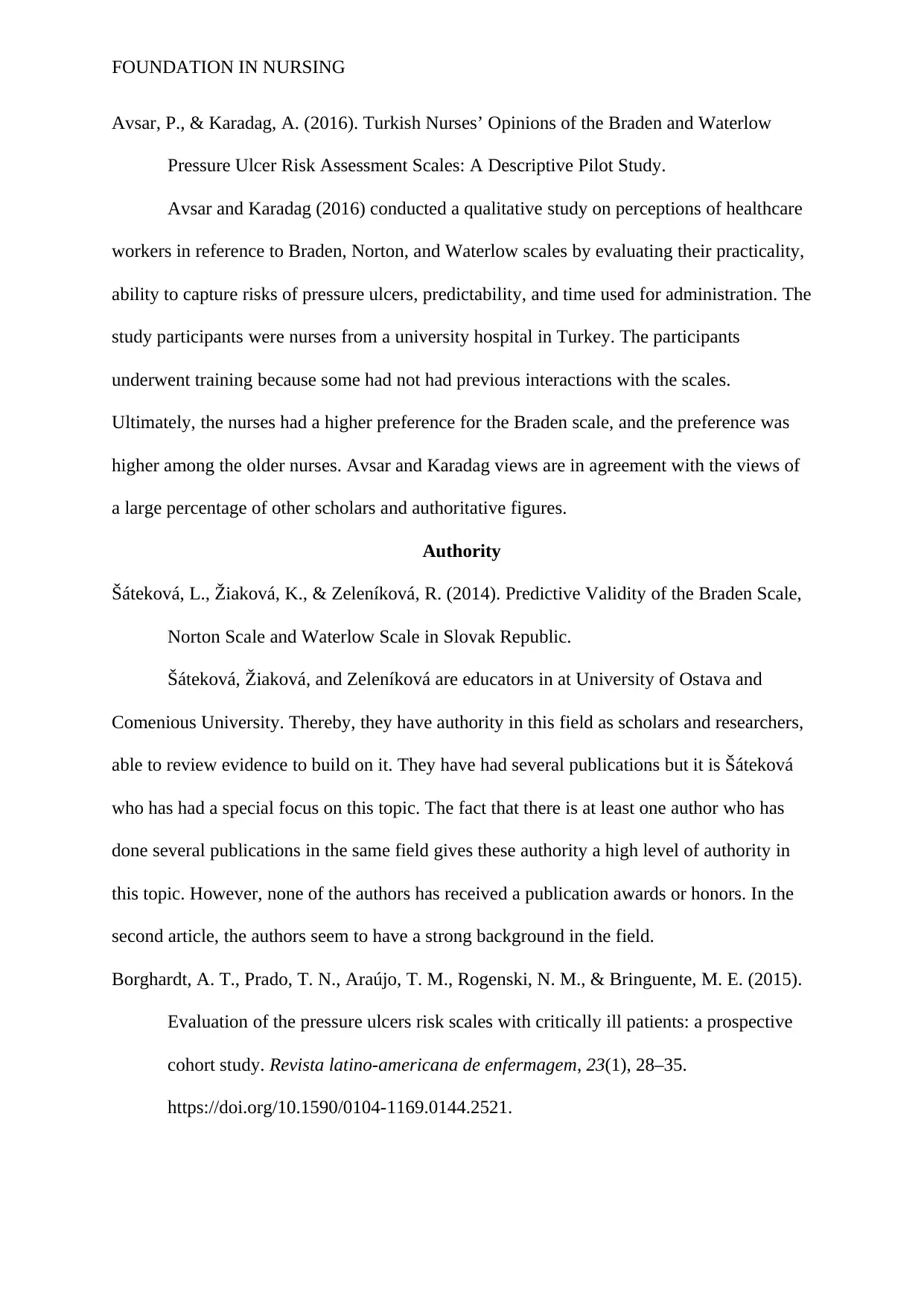
Avsar, P., & Karadag, A. (2016). Turkish Nurses’ Opinions of the Braden and Waterlow
Pressure Ulcer Risk Assessment Scales: A Descriptive Pilot Study.
Avsar and Karadag (2016) conducted a qualitative study on perceptions of healthcare
workers in reference to Braden, Norton, and Waterlow scales by evaluating their practicality,
ability to capture risks of pressure ulcers, predictability, and time used for administration. The
study participants were nurses from a university hospital in Turkey. The participants
underwent training because some had not had previous interactions with the scales.
Ultimately, the nurses had a higher preference for the Braden scale, and the preference was
higher among the older nurses. Avsar and Karadag views are in agreement with the views of
a large percentage of other scholars and authoritative figures.
Authority
Šáteková, L., Žiaková, K., & Zeleníková, R. (2014). Predictive Validity of the Braden Scale,
Norton Scale and Waterlow Scale in Slovak Republic.
Šáteková, Žiaková, and Zeleníková are educators in at University of Ostava and
Comenious University. Thereby, they have authority in this field as scholars and researchers,
able to review evidence to build on it. They have had several publications but it is Šáteková
who has had a special focus on this topic. The fact that there is at least one author who has
done several publications in the same field gives these authority a high level of authority in
this topic. However, none of the authors has received a publication awards or honors. In the
second article, the authors seem to have a strong background in the field.
Borghardt, A. T., Prado, T. N., Araújo, T. M., Rogenski, N. M., & Bringuente, M. E. (2015).
Evaluation of the pressure ulcers risk scales with critically ill patients: a prospective
cohort study. Revista latino-americana de enfermagem, 23(1), 28–35.
https://doi.org/10.1590/0104-1169.0144.2521.
Avsar, P., & Karadag, A. (2016). Turkish Nurses’ Opinions of the Braden and Waterlow
Pressure Ulcer Risk Assessment Scales: A Descriptive Pilot Study.
Avsar and Karadag (2016) conducted a qualitative study on perceptions of healthcare
workers in reference to Braden, Norton, and Waterlow scales by evaluating their practicality,
ability to capture risks of pressure ulcers, predictability, and time used for administration. The
study participants were nurses from a university hospital in Turkey. The participants
underwent training because some had not had previous interactions with the scales.
Ultimately, the nurses had a higher preference for the Braden scale, and the preference was
higher among the older nurses. Avsar and Karadag views are in agreement with the views of
a large percentage of other scholars and authoritative figures.
Authority
Šáteková, L., Žiaková, K., & Zeleníková, R. (2014). Predictive Validity of the Braden Scale,
Norton Scale and Waterlow Scale in Slovak Republic.
Šáteková, Žiaková, and Zeleníková are educators in at University of Ostava and
Comenious University. Thereby, they have authority in this field as scholars and researchers,
able to review evidence to build on it. They have had several publications but it is Šáteková
who has had a special focus on this topic. The fact that there is at least one author who has
done several publications in the same field gives these authority a high level of authority in
this topic. However, none of the authors has received a publication awards or honors. In the
second article, the authors seem to have a strong background in the field.
Borghardt, A. T., Prado, T. N., Araújo, T. M., Rogenski, N. M., & Bringuente, M. E. (2015).
Evaluation of the pressure ulcers risk scales with critically ill patients: a prospective
cohort study. Revista latino-americana de enfermagem, 23(1), 28–35.
https://doi.org/10.1590/0104-1169.0144.2521.
⊘ This is a preview!⊘
Do you want full access?
Subscribe today to unlock all pages.
Trusted by 1+ million students worldwide
FOUNDATION IN NURSING
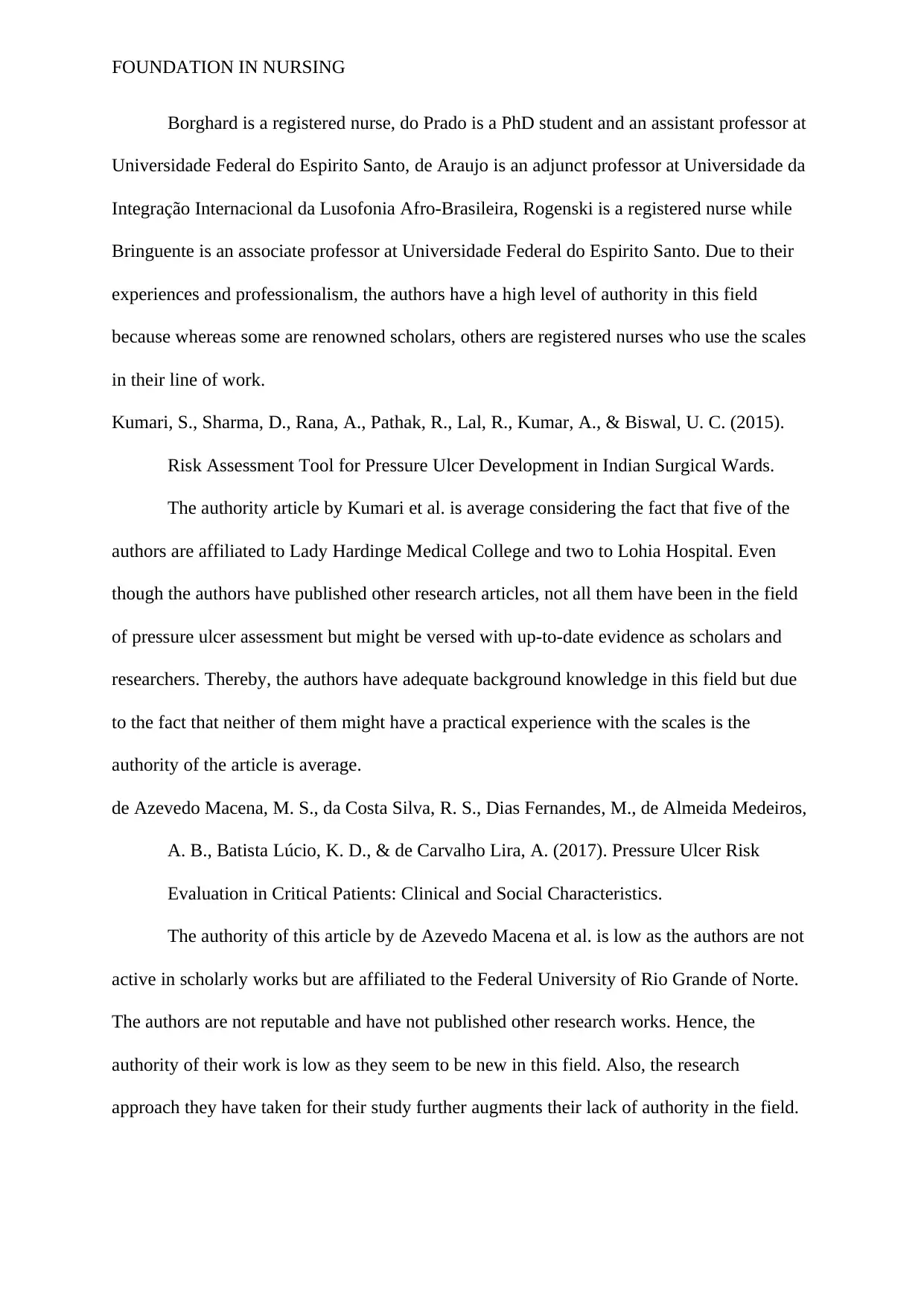
Borghard is a registered nurse, do Prado is a PhD student and an assistant professor at
Universidade Federal do Espirito Santo, de Araujo is an adjunct professor at Universidade da
Integração Internacional da Lusofonia Afro-Brasileira, Rogenski is a registered nurse while
Bringuente is an associate professor at Universidade Federal do Espirito Santo. Due to their
experiences and professionalism, the authors have a high level of authority in this field
because whereas some are renowned scholars, others are registered nurses who use the scales
in their line of work.
Kumari, S., Sharma, D., Rana, A., Pathak, R., Lal, R., Kumar, A., & Biswal, U. C. (2015).
Risk Assessment Tool for Pressure Ulcer Development in Indian Surgical Wards.
The authority article by Kumari et al. is average considering the fact that five of the
authors are affiliated to Lady Hardinge Medical College and two to Lohia Hospital. Even
though the authors have published other research articles, not all them have been in the field
of pressure ulcer assessment but might be versed with up-to-date evidence as scholars and
researchers. Thereby, the authors have adequate background knowledge in this field but due
to the fact that neither of them might have a practical experience with the scales is the
authority of the article is average.
de Azevedo Macena, M. S., da Costa Silva, R. S., Dias Fernandes, M., de Almeida Medeiros,
A. B., Batista Lúcio, K. D., & de Carvalho Lira, A. (2017). Pressure Ulcer Risk
Evaluation in Critical Patients: Clinical and Social Characteristics.
The authority of this article by de Azevedo Macena et al. is low as the authors are not
active in scholarly works but are affiliated to the Federal University of Rio Grande of Norte.
The authors are not reputable and have not published other research works. Hence, the
authority of their work is low as they seem to be new in this field. Also, the research
approach they have taken for their study further augments their lack of authority in the field.
Borghard is a registered nurse, do Prado is a PhD student and an assistant professor at
Universidade Federal do Espirito Santo, de Araujo is an adjunct professor at Universidade da
Integração Internacional da Lusofonia Afro-Brasileira, Rogenski is a registered nurse while
Bringuente is an associate professor at Universidade Federal do Espirito Santo. Due to their
experiences and professionalism, the authors have a high level of authority in this field
because whereas some are renowned scholars, others are registered nurses who use the scales
in their line of work.
Kumari, S., Sharma, D., Rana, A., Pathak, R., Lal, R., Kumar, A., & Biswal, U. C. (2015).
Risk Assessment Tool for Pressure Ulcer Development in Indian Surgical Wards.
The authority article by Kumari et al. is average considering the fact that five of the
authors are affiliated to Lady Hardinge Medical College and two to Lohia Hospital. Even
though the authors have published other research articles, not all them have been in the field
of pressure ulcer assessment but might be versed with up-to-date evidence as scholars and
researchers. Thereby, the authors have adequate background knowledge in this field but due
to the fact that neither of them might have a practical experience with the scales is the
authority of the article is average.
de Azevedo Macena, M. S., da Costa Silva, R. S., Dias Fernandes, M., de Almeida Medeiros,
A. B., Batista Lúcio, K. D., & de Carvalho Lira, A. (2017). Pressure Ulcer Risk
Evaluation in Critical Patients: Clinical and Social Characteristics.
The authority of this article by de Azevedo Macena et al. is low as the authors are not
active in scholarly works but are affiliated to the Federal University of Rio Grande of Norte.
The authors are not reputable and have not published other research works. Hence, the
authority of their work is low as they seem to be new in this field. Also, the research
approach they have taken for their study further augments their lack of authority in the field.
Paraphrase This Document
Need a fresh take? Get an instant paraphrase of this document with our AI Paraphraser
FOUNDATION IN NURSING
Avsar, P., & Karadag, A. (2016). Turkish Nurses’ Opinions of the Braden and Waterlow
Pressure Ulcer Risk Assessment Scales: A Descriptive Pilot Study.
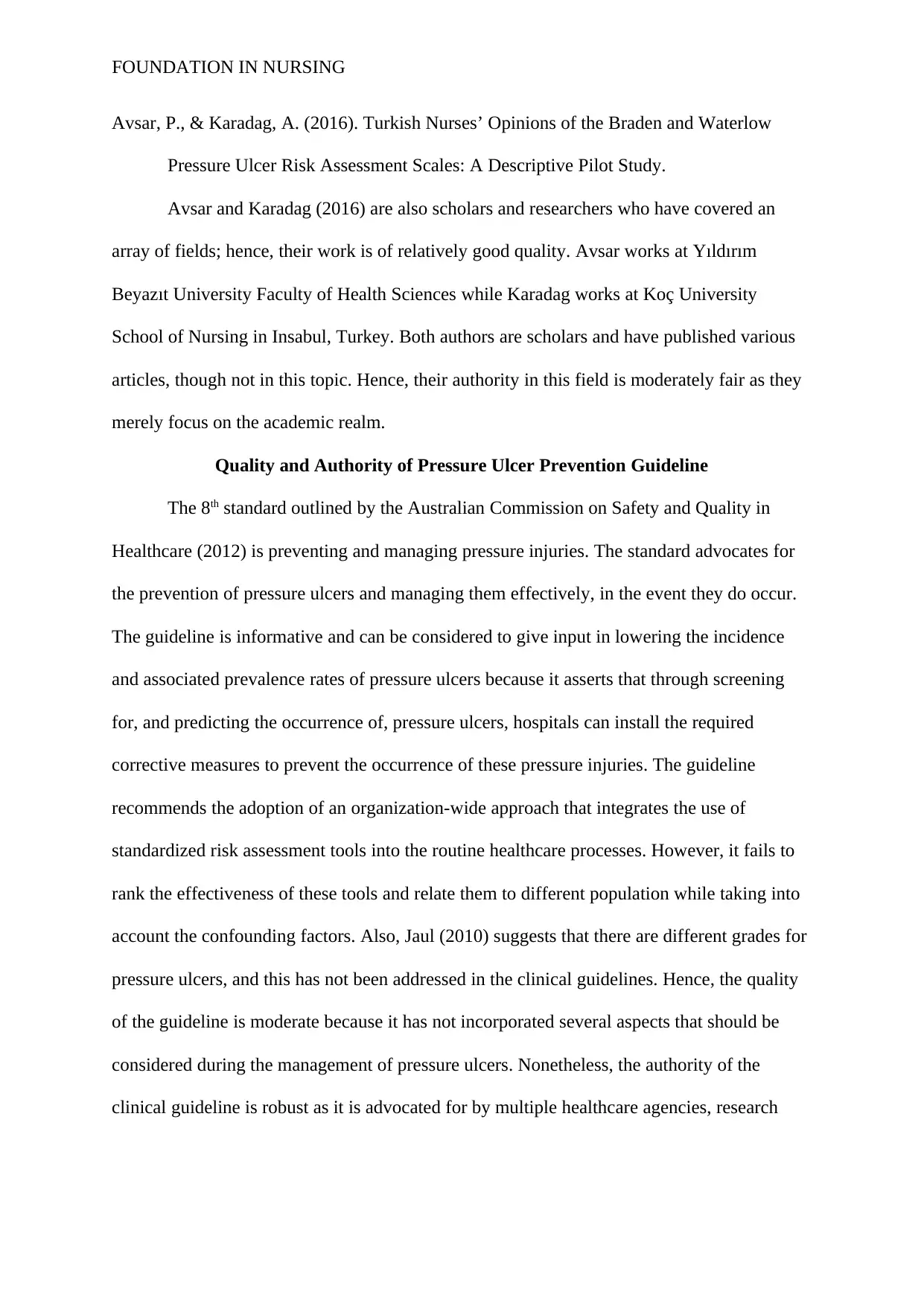
Avsar and Karadag (2016) are also scholars and researchers who have covered an
array of fields; hence, their work is of relatively good quality. Avsar works at Yıldırım
Beyazıt University Faculty of Health Sciences while Karadag works at Koç University
School of Nursing in Insabul, Turkey. Both authors are scholars and have published various
articles, though not in this topic. Hence, their authority in this field is moderately fair as they
merely focus on the academic realm.
Quality and Authority of Pressure Ulcer Prevention Guideline
The 8th standard outlined by the Australian Commission on Safety and Quality in
Healthcare (2012) is preventing and managing pressure injuries. The standard advocates for
the prevention of pressure ulcers and managing them effectively, in the event they do occur.
The guideline is informative and can be considered to give input in lowering the incidence
and associated prevalence rates of pressure ulcers because it asserts that through screening
for, and predicting the occurrence of, pressure ulcers, hospitals can install the required
corrective measures to prevent the occurrence of these pressure injuries. The guideline
recommends the adoption of an organization-wide approach that integrates the use of
standardized risk assessment tools into the routine healthcare processes. However, it fails to
rank the effectiveness of these tools and relate them to different population while taking into
account the confounding factors. Also, Jaul (2010) suggests that there are different grades for
pressure ulcers, and this has not been addressed in the clinical guidelines. Hence, the quality
of the guideline is moderate because it has not incorporated several aspects that should be
considered during the management of pressure ulcers. Nonetheless, the authority of the
clinical guideline is robust as it is advocated for by multiple healthcare agencies, research
Avsar, P., & Karadag, A. (2016). Turkish Nurses’ Opinions of the Braden and Waterlow
Pressure Ulcer Risk Assessment Scales: A Descriptive Pilot Study.
Avsar and Karadag (2016) are also scholars and researchers who have covered an
array of fields; hence, their work is of relatively good quality. Avsar works at Yıldırım
Beyazıt University Faculty of Health Sciences while Karadag works at Koç University
School of Nursing in Insabul, Turkey. Both authors are scholars and have published various
articles, though not in this topic. Hence, their authority in this field is moderately fair as they
merely focus on the academic realm.
Quality and Authority of Pressure Ulcer Prevention Guideline
The 8th standard outlined by the Australian Commission on Safety and Quality in
Healthcare (2012) is preventing and managing pressure injuries. The standard advocates for
the prevention of pressure ulcers and managing them effectively, in the event they do occur.
The guideline is informative and can be considered to give input in lowering the incidence
and associated prevalence rates of pressure ulcers because it asserts that through screening
for, and predicting the occurrence of, pressure ulcers, hospitals can install the required
corrective measures to prevent the occurrence of these pressure injuries. The guideline
recommends the adoption of an organization-wide approach that integrates the use of
standardized risk assessment tools into the routine healthcare processes. However, it fails to
rank the effectiveness of these tools and relate them to different population while taking into
account the confounding factors. Also, Jaul (2010) suggests that there are different grades for
pressure ulcers, and this has not been addressed in the clinical guidelines. Hence, the quality
of the guideline is moderate because it has not incorporated several aspects that should be
considered during the management of pressure ulcers. Nonetheless, the authority of the
clinical guideline is robust as it is advocated for by multiple healthcare agencies, research
FOUNDATION IN NURSING
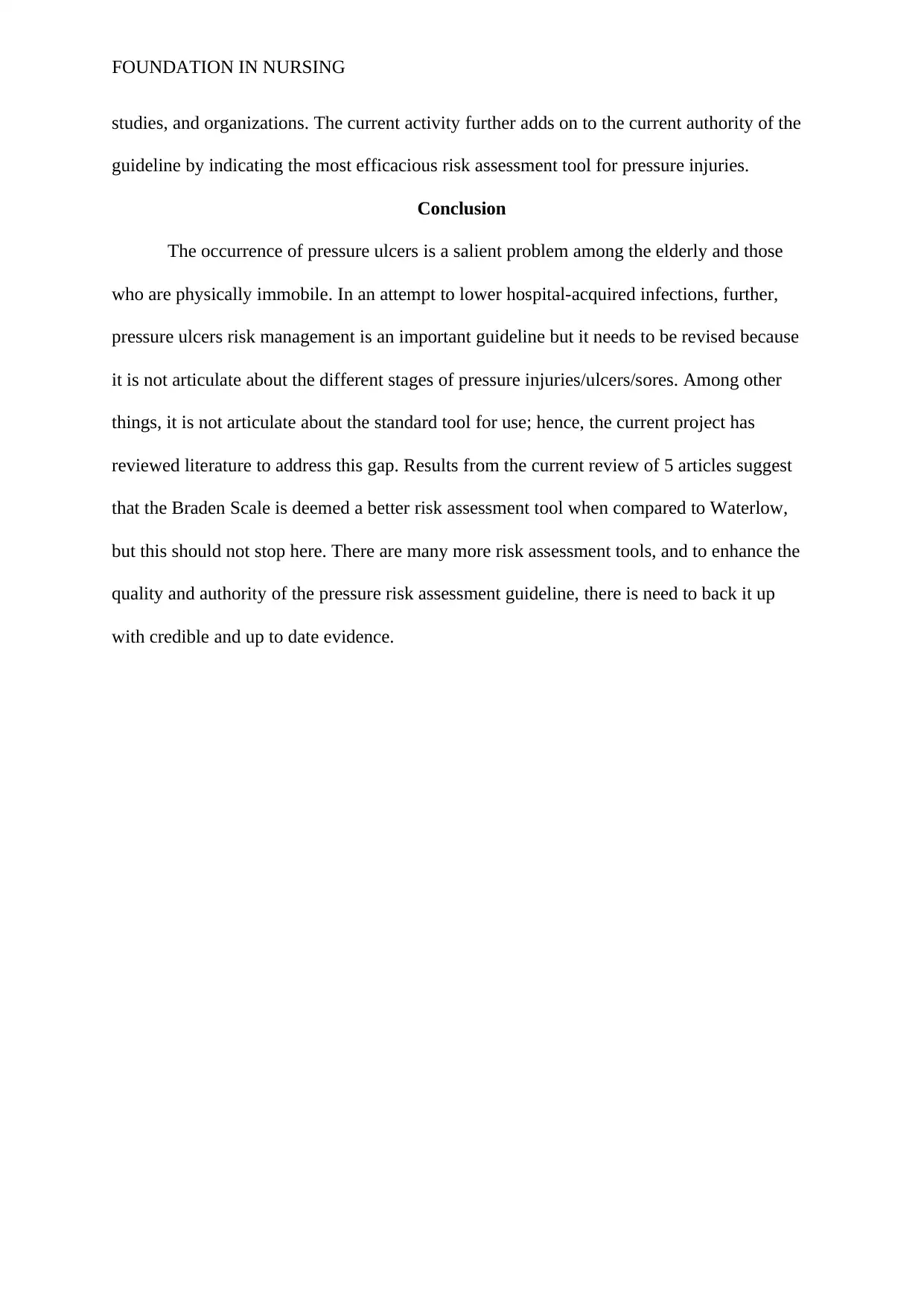
studies, and organizations. The current activity further adds on to the current authority of the
guideline by indicating the most efficacious risk assessment tool for pressure injuries.
Conclusion
The occurrence of pressure ulcers is a salient problem among the elderly and those
who are physically immobile. In an attempt to lower hospital-acquired infections, further,
pressure ulcers risk management is an important guideline but it needs to be revised because
it is not articulate about the different stages of pressure injuries/ulcers/sores. Among other
things, it is not articulate about the standard tool for use; hence, the current project has
reviewed literature to address this gap. Results from the current review of 5 articles suggest
that the Braden Scale is deemed a better risk assessment tool when compared to Waterlow,
but this should not stop here. There are many more risk assessment tools, and to enhance the
quality and authority of the pressure risk assessment guideline, there is need to back it up
with credible and up to date evidence.
studies, and organizations. The current activity further adds on to the current authority of the
guideline by indicating the most efficacious risk assessment tool for pressure injuries.
Conclusion
The occurrence of pressure ulcers is a salient problem among the elderly and those
who are physically immobile. In an attempt to lower hospital-acquired infections, further,
pressure ulcers risk management is an important guideline but it needs to be revised because
it is not articulate about the different stages of pressure injuries/ulcers/sores. Among other
things, it is not articulate about the standard tool for use; hence, the current project has
reviewed literature to address this gap. Results from the current review of 5 articles suggest
that the Braden Scale is deemed a better risk assessment tool when compared to Waterlow,
but this should not stop here. There are many more risk assessment tools, and to enhance the
quality and authority of the pressure risk assessment guideline, there is need to back it up
with credible and up to date evidence.
⊘ This is a preview!⊘
Do you want full access?
Subscribe today to unlock all pages.
Trusted by 1+ million students worldwide
FOUNDATION IN NURSING
References
Australian Commission on Safety and Quality in Healthcare. (2012). Safety and Quality
Improvement Guide. Retrieved from
https://www.safetyandquality.gov.au/sites/default/files/migrated/Standard8_Oct_2012
_WEB.pdf.
Australian Commission on Safety and Quality in Healthcare. (2018). Hospital-Acquired
Complication: Pressure Injury. Retrieved from
https://www.safetyandquality.gov.au/sites/default/files/migrated/Pressure-injury-
detailed-fact-sheet.pdf.
Avsar, P., & Karadag, A. (2016). Turkish Nurses’ Opinions of the Braden and Waterlow
Pressure Ulcer Risk Assessment Scales: A Descriptive Pilot Study. Ostomy/Wound
Management, 62(2), 34-40.
Borghardt, A. T., Prado, T. N., Araújo, T. M., Rogenski, N. M., & Bringuente, M. E. (2015).
Evaluation of the pressure ulcers risk scales with critically ill patients: a prospective
cohort study. Revista latino-americana de enfermagem, 23(1), 28–35.
https://doi.org/10.1590/0104-1169.0144.2521.
Checkoway, H., Pearce, N., & Kriebel, D. (2007). Selecting appropriate study designs to
address specific research questions in occupational epidemiology. Occupational and
environmental medicine, 64(9), 633–638. https://doi.org/10.1136/oem.2006.029967.
de Azevedo Macena, M. S., da Costa Silva, R. S., Dias Fernandes, M., de Almeida Medeiros,
A. B., Batista Lúcio, K. D., & de Carvalho Lira, A. (2017). Pressure Ulcer Risk
Evaluation in Critical Patients: Clinical and Social Characteristics. The open nursing
journal, 11, 91–97. https://doi.org/10.2174/1874434601711010091.
References
Australian Commission on Safety and Quality in Healthcare. (2012). Safety and Quality
Improvement Guide. Retrieved from
https://www.safetyandquality.gov.au/sites/default/files/migrated/Standard8_Oct_2012
_WEB.pdf.
Australian Commission on Safety and Quality in Healthcare. (2018). Hospital-Acquired
Complication: Pressure Injury. Retrieved from
https://www.safetyandquality.gov.au/sites/default/files/migrated/Pressure-injury-
detailed-fact-sheet.pdf.
Avsar, P., & Karadag, A. (2016). Turkish Nurses’ Opinions of the Braden and Waterlow
Pressure Ulcer Risk Assessment Scales: A Descriptive Pilot Study. Ostomy/Wound
Management, 62(2), 34-40.
Borghardt, A. T., Prado, T. N., Araújo, T. M., Rogenski, N. M., & Bringuente, M. E. (2015).
Evaluation of the pressure ulcers risk scales with critically ill patients: a prospective
cohort study. Revista latino-americana de enfermagem, 23(1), 28–35.
https://doi.org/10.1590/0104-1169.0144.2521.
Checkoway, H., Pearce, N., & Kriebel, D. (2007). Selecting appropriate study designs to
address specific research questions in occupational epidemiology. Occupational and
environmental medicine, 64(9), 633–638. https://doi.org/10.1136/oem.2006.029967.
de Azevedo Macena, M. S., da Costa Silva, R. S., Dias Fernandes, M., de Almeida Medeiros,
A. B., Batista Lúcio, K. D., & de Carvalho Lira, A. (2017). Pressure Ulcer Risk
Evaluation in Critical Patients: Clinical and Social Characteristics. The open nursing
journal, 11, 91–97. https://doi.org/10.2174/1874434601711010091.
Paraphrase This Document
Need a fresh take? Get an instant paraphrase of this document with our AI Paraphraser
FOUNDATION IN NURSING
Fullbrook, P., Miles, S., & Coyer, F. (2018). Prevalence of Pressure Injury in Adults
Presenting to the Emergency Department by Ambulance. Australian Critical Care,
32(6), 509-514.
Jaul, E. (2010). Assessment and Management of Pressure Ulcers in the Elderly: Current
Strategies. Drugs & Aging, 27(4), 311-325.
Jaul, E., Barron, J., Rosenzweig, J. P., & Menczel, J. (2018). An overview of co-morbidities
and the development of pressure ulcers among older adults. BMC Geriatrics, 18, 305.
https://doi.org/10.1186/s12877-018-0997-7.
Kumari, S., Sharma, D., Rana, A., Pathak, R., Lal, R., Kumar, A., & Biswal, U. C. (2015).
Risk Assessment Tool for Pressure Ulcer Development in Indian Surgical Wards. The
Indian journal of surgery, 77(3), 206–212. https://doi.org/10.1007/s12262-012-0779-
y.
Nguyen, K., Chaboyer, W., & Whitty, J. A. (2014). Pressure Injury in Australian Public
Hospitals: A Cost-of-Illness Study. Australian Health Review, 39(3), 329-336.
Šáteková, L., Žiaková, K., & Zeleníková, R. (2014). Predictive Validity of the Braden Scale,
Norton Scale and Waterlow Scale in Slovak Republic. Central European Journal of
Nursing and Midwifery, 6(3), 283-290.
Shah, S. A., Ren, A., Yang, X., Zhao, W., Zhao, N., Zhang, Z., & Yang, J. (2016). Posture
Recognition to Prevent Bedsores for Multiple Patients Using Leaking Coaxial Cable.
IEEE Access, 4, 8065-8072.
Fullbrook, P., Miles, S., & Coyer, F. (2018). Prevalence of Pressure Injury in Adults
Presenting to the Emergency Department by Ambulance. Australian Critical Care,
32(6), 509-514.
Jaul, E. (2010). Assessment and Management of Pressure Ulcers in the Elderly: Current
Strategies. Drugs & Aging, 27(4), 311-325.
Jaul, E., Barron, J., Rosenzweig, J. P., & Menczel, J. (2018). An overview of co-morbidities
and the development of pressure ulcers among older adults. BMC Geriatrics, 18, 305.
https://doi.org/10.1186/s12877-018-0997-7.
Kumari, S., Sharma, D., Rana, A., Pathak, R., Lal, R., Kumar, A., & Biswal, U. C. (2015).
Risk Assessment Tool for Pressure Ulcer Development in Indian Surgical Wards. The
Indian journal of surgery, 77(3), 206–212. https://doi.org/10.1007/s12262-012-0779-
y.
Nguyen, K., Chaboyer, W., & Whitty, J. A. (2014). Pressure Injury in Australian Public
Hospitals: A Cost-of-Illness Study. Australian Health Review, 39(3), 329-336.
Šáteková, L., Žiaková, K., & Zeleníková, R. (2014). Predictive Validity of the Braden Scale,
Norton Scale and Waterlow Scale in Slovak Republic. Central European Journal of
Nursing and Midwifery, 6(3), 283-290.
Shah, S. A., Ren, A., Yang, X., Zhao, W., Zhao, N., Zhang, Z., & Yang, J. (2016). Posture
Recognition to Prevent Bedsores for Multiple Patients Using Leaking Coaxial Cable.
IEEE Access, 4, 8065-8072.

1 out of 11


Related Documents


Your All-in-One AI-Powered Toolkit for Academic Success.
+13062052269
info@desklib.com
Available 24*7 on WhatsApp / Email
![[object Object]](/_next/static/media/star-bottom.7253800d.svg)
Unlock your academic potential
Copyright © 2020–2026 A2Z Services. All Rights Reserved. Developed and managed by ZUCOL.