Research Report: Obesity Prevalence in England Since 2010
VerifiedAdded on 2020/10/23
|10
|2626
|306
Report
AI Summary
This research report investigates the prevalence of obesity in England since 2010, exploring its definition, causes, and associated health problems. The report begins with an introduction defining obesity and outlining the research objectives, including determining the concept of obesity, evaluating its main causes, and identifying the health problems it causes. A literature review examines the concept of obesity, its measurement using Body Mass Index (BMI), and various factors contributing to it, such as excessive calorie intake, sedentary lifestyles, and endocrine disruptors. The report then delves into the main causes of obesity, citing data from the World Health Organization and discussing issues like Osteoarthritis, Diabetes, and Sleep Apnea. The research methodology employs a qualitative investigation approach, using secondary data collection methods to gather information from various sources. The discussion of the data highlights trends in England, showing increasing rates of overweight and obesity, particularly among older adults and deprived children. The findings emphasize that obesity is a significant concern in England, with various factors contributing to it. The reflection section discusses the research process, the chosen methodology, and the importance of addressing obesity to prevent serious health conditions. The report concludes with a list of references.

RESEARCH SKILLS
(PART 2)
(PART 2)

Paraphrase This Document
Need a fresh take? Get an instant paraphrase of this document with our AI Paraphraser
Table of Contents
INTRODUCTION...........................................................................................................................1
LITERATURE REVIEW................................................................................................................1
Concept of obesity.......................................................................................................................1
Main causes of obesity................................................................................................................2
Problems associated with obesity for an individual....................................................................2
RESEARCH METHODOLOGY.....................................................................................................3
DISCUSSION ON THE DATA......................................................................................................4
FINDINGS.......................................................................................................................................6
REFLECTION.................................................................................................................................7
REFERENCES................................................................................................................................8
INTRODUCTION...........................................................................................................................1
LITERATURE REVIEW................................................................................................................1
Concept of obesity.......................................................................................................................1
Main causes of obesity................................................................................................................2
Problems associated with obesity for an individual....................................................................2
RESEARCH METHODOLOGY.....................................................................................................3
DISCUSSION ON THE DATA......................................................................................................4
FINDINGS.......................................................................................................................................6
REFLECTION.................................................................................................................................7
REFERENCES................................................................................................................................8
TITLE: Prevalence of obesity in England since, 2010.
INTRODUCTION
Obesity, is defined as accumulation of body fact because of the consumption of large
number of calories other than the body requires. It can be determined when an individual is
having 20 percent increased weight than body weight (Gutiérrez‐Fisac and et. al., 2012). Obesity,
has become one of the significant contemporary health concern and it is becoming one of the
prominent reasons of causing deaths. This research is based on Prevalence of obesity in England
since, 2010. With the help of this research, researcher will get to know about the causes and why
it is increasing in large number in United Kingdom. Furthermore, the same will be supported by
literature review. Therefore, on the basis of this data analysis and conclusion will be evaluated.
Aims: “To determine the prevalence of obesity in England since, 2010.”
Research Objectives:
To determine the concept of obesity.
To evaluate the main causes of obesity.
To identify the problems that are associated with obesity in an individual's life.
Research Questions
What is the concept of obesity?
What are the main causes of obesity?
What are the problems that are associated with obesity in an individual's life?
LITERATURE REVIEW
Concept of obesity
Obesity, according to traditional definition it is stated as an increased body weight and it
is calculated through Body Mass Index. Thus, obesity is considered as an abnormal health issue
in which body weight is higher as compared to standard body weight. According to the view
points of Roberts and et. al., (2012) a person is clinically consider as obese when the ratio of fat
is more than body weight. Therefore, in order to determine this a certain Body Mass Index (BMI)
is set and a person should match the same if he/she wants to come into the category of a healthy
person. For example: BMI for adults which are over the age of 20 years comes between 25.0 and
29.9 equates along with overweight and 30.0 and above comes under the category of obesity.
1
INTRODUCTION
Obesity, is defined as accumulation of body fact because of the consumption of large
number of calories other than the body requires. It can be determined when an individual is
having 20 percent increased weight than body weight (Gutiérrez‐Fisac and et. al., 2012). Obesity,
has become one of the significant contemporary health concern and it is becoming one of the
prominent reasons of causing deaths. This research is based on Prevalence of obesity in England
since, 2010. With the help of this research, researcher will get to know about the causes and why
it is increasing in large number in United Kingdom. Furthermore, the same will be supported by
literature review. Therefore, on the basis of this data analysis and conclusion will be evaluated.
Aims: “To determine the prevalence of obesity in England since, 2010.”
Research Objectives:
To determine the concept of obesity.
To evaluate the main causes of obesity.
To identify the problems that are associated with obesity in an individual's life.
Research Questions
What is the concept of obesity?
What are the main causes of obesity?
What are the problems that are associated with obesity in an individual's life?
LITERATURE REVIEW
Concept of obesity
Obesity, according to traditional definition it is stated as an increased body weight and it
is calculated through Body Mass Index. Thus, obesity is considered as an abnormal health issue
in which body weight is higher as compared to standard body weight. According to the view
points of Roberts and et. al., (2012) a person is clinically consider as obese when the ratio of fat
is more than body weight. Therefore, in order to determine this a certain Body Mass Index (BMI)
is set and a person should match the same if he/she wants to come into the category of a healthy
person. For example: BMI for adults which are over the age of 20 years comes between 25.0 and
29.9 equates along with overweight and 30.0 and above comes under the category of obesity.
1
⊘ This is a preview!⊘
Do you want full access?
Subscribe today to unlock all pages.

Trusted by 1+ million students worldwide
Morbid Obesity, is another category of obesity which is extreme or severe and if a person
is having BMI more than 40.0 or higher. There can be multiple factors which can be the reason
of obesity. Thus, it is important that a person have control over food consumption and must
workout regularly in order to stay fit and healthy. Therefore, if it is not considered and taken care
of than it can leads to obesity.
Main causes of obesity
Obesity, is a medical condition in which a person gains excess weight which can further
hamper health and future activities as well. This can cause major health related issues such as
diabetes, cardiovascular diseases, cancer etc., According to the data published by (World Health
Organisation in 2016) 1.9 billion adults aged between 18 and above were overweight and it is
representing 13 percent of world's adult population (Obesity Epidemics, 2016). There are many
causes of obesity and these are consuming too many calories: If a person is consuming calories
than this can be further be used as energy for future activities but this can have some negative
impact as well because consuming more can leads to excess weight and obesity. Leading a
sedentary lifestyle: According to today's lifestyle people are proffering seating job rather than
manual labour. This is one of the reason why people are becoming obese and this their insulin
level is going higher as compared to people who do physical work. Endocrine disruptors:
People who are obese are more likely to prone with diseases such as diabetes, cardiovascular
disease and high blood pressure. Therefore, if liquid fructose which is a type of sugar is
increased in a human body than this can leads to endocrine disruptors. Medication and weight
gain: This is a common cause of obesity as substance used for making medicines by
pharmaceuticals such as atypical antipsychotics, quetiapine, some antidepressants etc., can leads
to weight gain which can further turn out to be serious health issues.
Problems associated with obesity for an individual
Over the past few decades the rate of obesity has increased and around 63 percent of
adults are overweight as per the data published by Organisation for Economic Co-operation and
Development (OECD) (UK most overweight country in Western Europe says OECD, 2019).
According to OECD, British obesity rates has increased to approximately 27 percent who are
aged between 25 and 30. Some of the problems that are related with Obesity and must be
concern and these are Osteoarthritis: It is caused with the ageing as people stop doing work
which gradually turn the same into obesity and then ultimately joint pains. Therefore, it is
2
is having BMI more than 40.0 or higher. There can be multiple factors which can be the reason
of obesity. Thus, it is important that a person have control over food consumption and must
workout regularly in order to stay fit and healthy. Therefore, if it is not considered and taken care
of than it can leads to obesity.
Main causes of obesity
Obesity, is a medical condition in which a person gains excess weight which can further
hamper health and future activities as well. This can cause major health related issues such as
diabetes, cardiovascular diseases, cancer etc., According to the data published by (World Health
Organisation in 2016) 1.9 billion adults aged between 18 and above were overweight and it is
representing 13 percent of world's adult population (Obesity Epidemics, 2016). There are many
causes of obesity and these are consuming too many calories: If a person is consuming calories
than this can be further be used as energy for future activities but this can have some negative
impact as well because consuming more can leads to excess weight and obesity. Leading a
sedentary lifestyle: According to today's lifestyle people are proffering seating job rather than
manual labour. This is one of the reason why people are becoming obese and this their insulin
level is going higher as compared to people who do physical work. Endocrine disruptors:
People who are obese are more likely to prone with diseases such as diabetes, cardiovascular
disease and high blood pressure. Therefore, if liquid fructose which is a type of sugar is
increased in a human body than this can leads to endocrine disruptors. Medication and weight
gain: This is a common cause of obesity as substance used for making medicines by
pharmaceuticals such as atypical antipsychotics, quetiapine, some antidepressants etc., can leads
to weight gain which can further turn out to be serious health issues.
Problems associated with obesity for an individual
Over the past few decades the rate of obesity has increased and around 63 percent of
adults are overweight as per the data published by Organisation for Economic Co-operation and
Development (OECD) (UK most overweight country in Western Europe says OECD, 2019).
According to OECD, British obesity rates has increased to approximately 27 percent who are
aged between 25 and 30. Some of the problems that are related with Obesity and must be
concern and these are Osteoarthritis: It is caused with the ageing as people stop doing work
which gradually turn the same into obesity and then ultimately joint pains. Therefore, it is
2
Paraphrase This Document
Need a fresh take? Get an instant paraphrase of this document with our AI Paraphraser
important that proper workout is being done so as to live healthy life. Diabetes: This is caused
when pancreas produces little insulin thus, obesity can increase the chances of this and further it
can create problem to an individual. Sleep Apnea: This is a condition when there is a disruption
in breathing while sleeping. This majorly happens with people who are obese and if it is not
treated than it can further leads to hypertension, stroke and heart failure.
RESEARCH METHODOLOGY
Types of investigation
Qualitative: This is a method which is basically designed for know the behaviour and
perception of targeted audiences with regards to a particular topic. This can be done with the in-
depth interview, content analysis, case study etc., Generally, results of qualitative methods are
descriptive in nature. Qualitative methods are basically derived from social science and its
behaviour. Therefore, Qualitative method defines what people think and what is the reason for
the same.
Quantitative: It is determined as a systematic process of investigating things with the
help of quantified data. As a result, it can be represented in a statistical, mathematical and
computation form. Mostly questionnaires that are developed are in objective form and in
structured method as well.
In order to do this research, qualitative type of investigation is being used in order to do
this research as it will assist researcher in having systematic observation so as to conclude things
effectively.
Methods of Data Collection
Primary Method: In this, data or information are collected directly from first hand
sources such as surveys, observations and experiments. Therefore, gathering of data is done by
the researcher manually without taking any help from books, journals and any other sources.
Furthermore, three methods can be used in this for collecting data and observation, experiment
and questionnaire. But most of the researcher avoid this method as it is costlier and time
consuming.
Secondary Method: There is a possibility that research which researcher is doing is
being done by someone else. Thus, there are common sources through which information are
collected in secondary method are books, journals, magazines etc.,. Data that are collected can be
in the form of qualitative and quantitative. Most of the researcher use this method because it is
3
when pancreas produces little insulin thus, obesity can increase the chances of this and further it
can create problem to an individual. Sleep Apnea: This is a condition when there is a disruption
in breathing while sleeping. This majorly happens with people who are obese and if it is not
treated than it can further leads to hypertension, stroke and heart failure.
RESEARCH METHODOLOGY
Types of investigation
Qualitative: This is a method which is basically designed for know the behaviour and
perception of targeted audiences with regards to a particular topic. This can be done with the in-
depth interview, content analysis, case study etc., Generally, results of qualitative methods are
descriptive in nature. Qualitative methods are basically derived from social science and its
behaviour. Therefore, Qualitative method defines what people think and what is the reason for
the same.
Quantitative: It is determined as a systematic process of investigating things with the
help of quantified data. As a result, it can be represented in a statistical, mathematical and
computation form. Mostly questionnaires that are developed are in objective form and in
structured method as well.
In order to do this research, qualitative type of investigation is being used in order to do
this research as it will assist researcher in having systematic observation so as to conclude things
effectively.
Methods of Data Collection
Primary Method: In this, data or information are collected directly from first hand
sources such as surveys, observations and experiments. Therefore, gathering of data is done by
the researcher manually without taking any help from books, journals and any other sources.
Furthermore, three methods can be used in this for collecting data and observation, experiment
and questionnaire. But most of the researcher avoid this method as it is costlier and time
consuming.
Secondary Method: There is a possibility that research which researcher is doing is
being done by someone else. Thus, there are common sources through which information are
collected in secondary method are books, journals, magazines etc.,. Data that are collected can be
in the form of qualitative and quantitative. Most of the researcher use this method because it is
3
cost effective and less time consuming as well. But their might be a possibility that whatever
information are gathered are not specific and cannot help researcher in having a valid conclusion.
Therefore, in order to do this research secondary method is being used and it will help
researcher in increasing knowledge regarding a specific topic.
DISCUSSION ON THE DATA
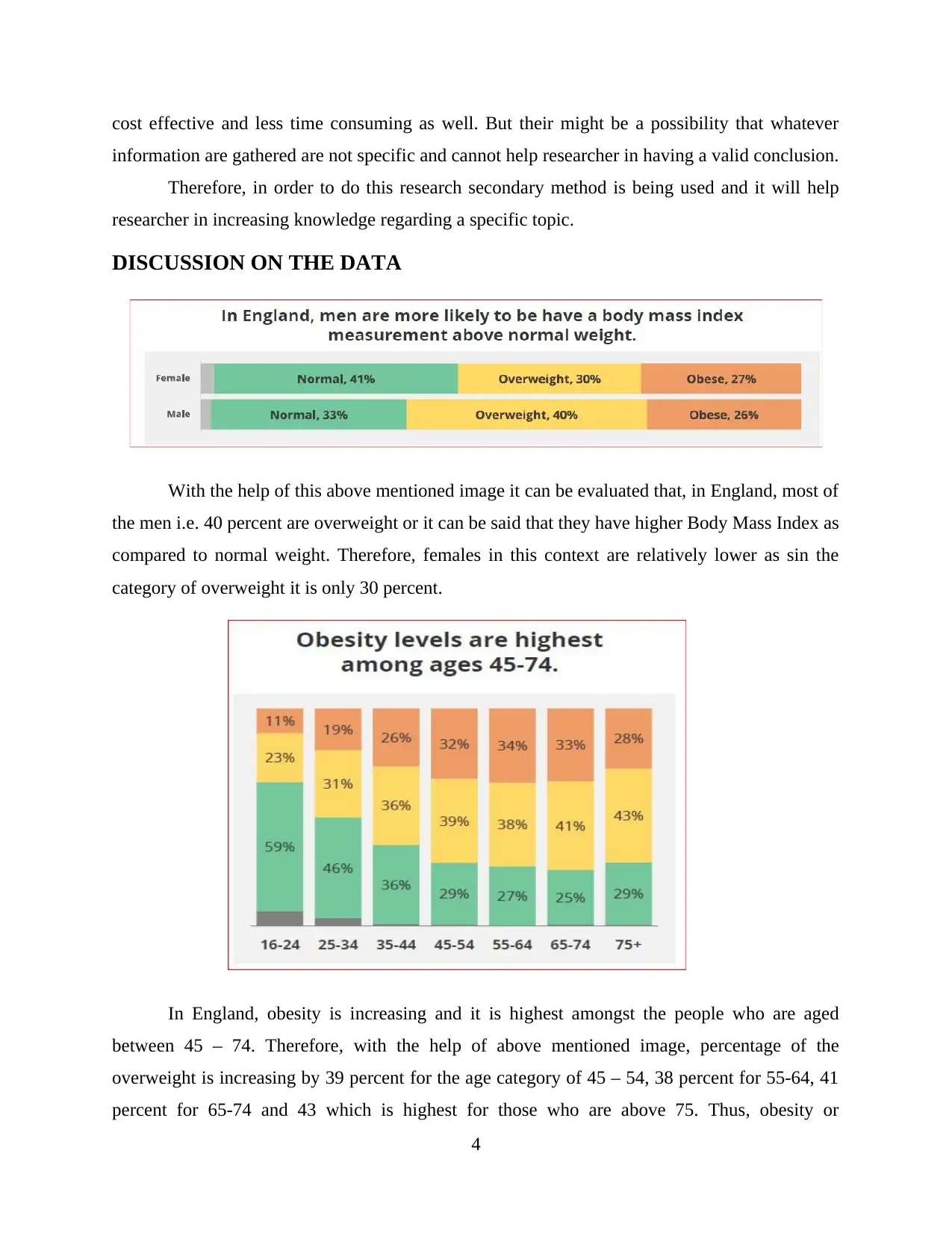
With the help of this above mentioned image it can be evaluated that, in England, most of
the men i.e. 40 percent are overweight or it can be said that they have higher Body Mass Index as
compared to normal weight. Therefore, females in this context are relatively lower as sin the
category of overweight it is only 30 percent.
In England, obesity is increasing and it is highest amongst the people who are aged
between 45 – 74. Therefore, with the help of above mentioned image, percentage of the
overweight is increasing by 39 percent for the age category of 45 – 54, 38 percent for 55-64, 41
percent for 65-74 and 43 which is highest for those who are above 75. Thus, obesity or
4
information are gathered are not specific and cannot help researcher in having a valid conclusion.
Therefore, in order to do this research secondary method is being used and it will help
researcher in increasing knowledge regarding a specific topic.
DISCUSSION ON THE DATA
With the help of this above mentioned image it can be evaluated that, in England, most of
the men i.e. 40 percent are overweight or it can be said that they have higher Body Mass Index as
compared to normal weight. Therefore, females in this context are relatively lower as sin the
category of overweight it is only 30 percent.
In England, obesity is increasing and it is highest amongst the people who are aged
between 45 – 74. Therefore, with the help of above mentioned image, percentage of the
overweight is increasing by 39 percent for the age category of 45 – 54, 38 percent for 55-64, 41
percent for 65-74 and 43 which is highest for those who are above 75. Thus, obesity or
4
⊘ This is a preview!⊘
Do you want full access?
Subscribe today to unlock all pages.
Trusted by 1+ million students worldwide
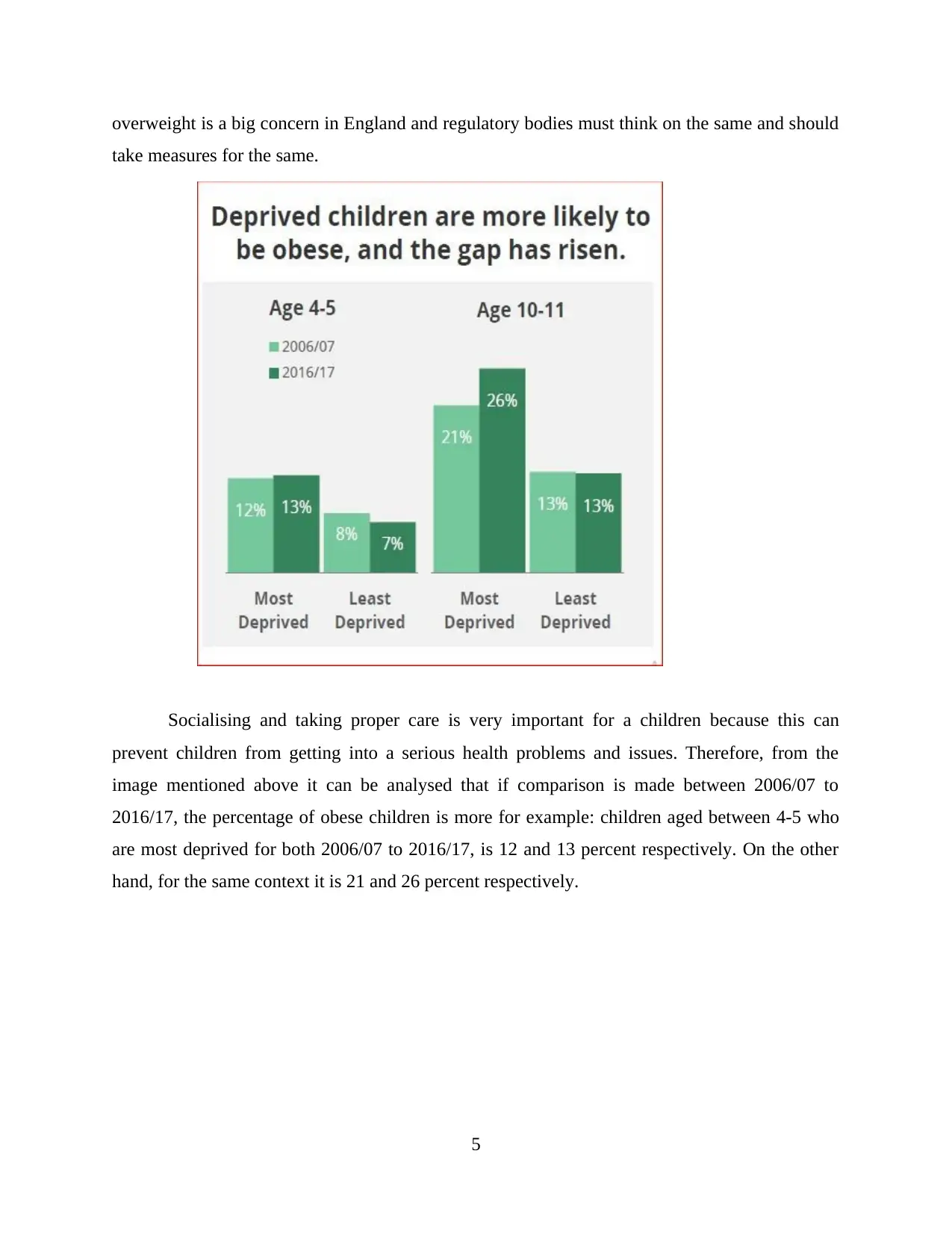
overweight is a big concern in England and regulatory bodies must think on the same and should
take measures for the same.
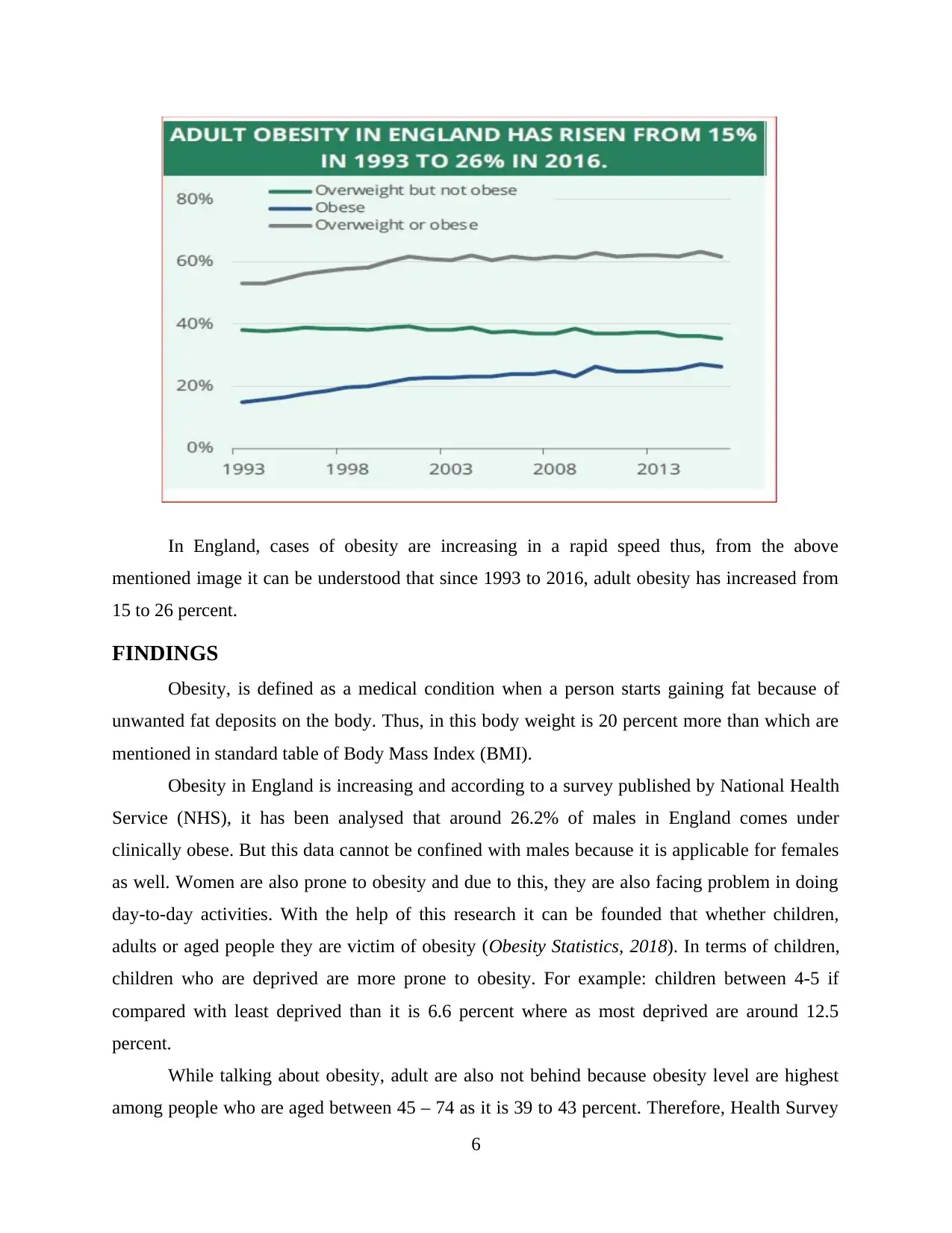
Socialising and taking proper care is very important for a children because this can
prevent children from getting into a serious health problems and issues. Therefore, from the
image mentioned above it can be analysed that if comparison is made between 2006/07 to
2016/17, the percentage of obese children is more for example: children aged between 4-5 who
are most deprived for both 2006/07 to 2016/17, is 12 and 13 percent respectively. On the other
hand, for the same context it is 21 and 26 percent respectively.
5
take measures for the same.
Socialising and taking proper care is very important for a children because this can
prevent children from getting into a serious health problems and issues. Therefore, from the
image mentioned above it can be analysed that if comparison is made between 2006/07 to
2016/17, the percentage of obese children is more for example: children aged between 4-5 who
are most deprived for both 2006/07 to 2016/17, is 12 and 13 percent respectively. On the other
hand, for the same context it is 21 and 26 percent respectively.
5
Paraphrase This Document
Need a fresh take? Get an instant paraphrase of this document with our AI Paraphraser
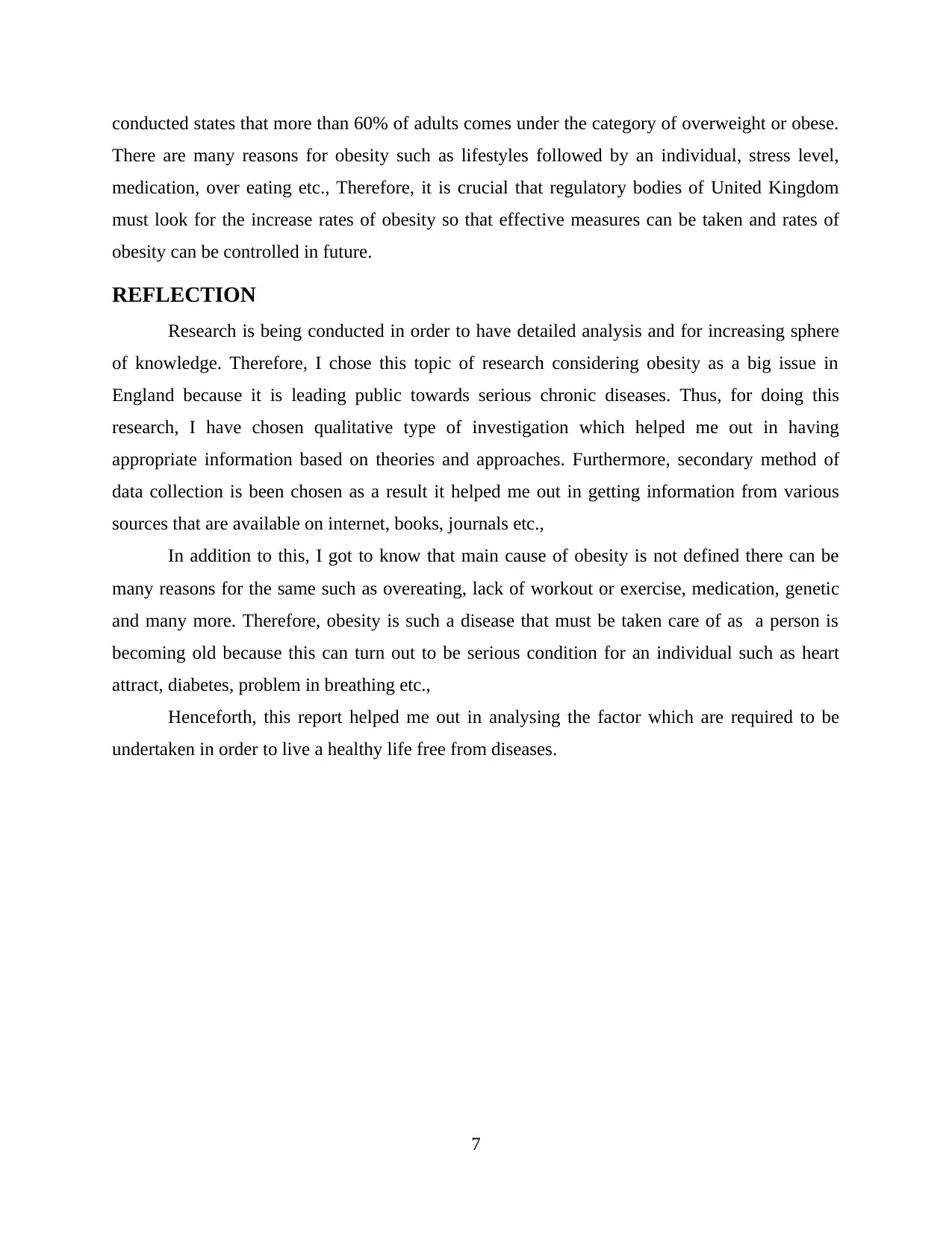
In England, cases of obesity are increasing in a rapid speed thus, from the above
mentioned image it can be understood that since 1993 to 2016, adult obesity has increased from
15 to 26 percent.
FINDINGS
Obesity, is defined as a medical condition when a person starts gaining fat because of
unwanted fat deposits on the body. Thus, in this body weight is 20 percent more than which are
mentioned in standard table of Body Mass Index (BMI).
Obesity in England is increasing and according to a survey published by National Health
Service (NHS), it has been analysed that around 26.2% of males in England comes under
clinically obese. But this data cannot be confined with males because it is applicable for females
as well. Women are also prone to obesity and due to this, they are also facing problem in doing
day-to-day activities. With the help of this research it can be founded that whether children,
adults or aged people they are victim of obesity (Obesity Statistics, 2018). In terms of children,
children who are deprived are more prone to obesity. For example: children between 4-5 if
compared with least deprived than it is 6.6 percent where as most deprived are around 12.5
percent.
While talking about obesity, adult are also not behind because obesity level are highest
among people who are aged between 45 – 74 as it is 39 to 43 percent. Therefore, Health Survey
6
mentioned image it can be understood that since 1993 to 2016, adult obesity has increased from
15 to 26 percent.
FINDINGS
Obesity, is defined as a medical condition when a person starts gaining fat because of
unwanted fat deposits on the body. Thus, in this body weight is 20 percent more than which are
mentioned in standard table of Body Mass Index (BMI).
Obesity in England is increasing and according to a survey published by National Health
Service (NHS), it has been analysed that around 26.2% of males in England comes under
clinically obese. But this data cannot be confined with males because it is applicable for females
as well. Women are also prone to obesity and due to this, they are also facing problem in doing
day-to-day activities. With the help of this research it can be founded that whether children,
adults or aged people they are victim of obesity (Obesity Statistics, 2018). In terms of children,
children who are deprived are more prone to obesity. For example: children between 4-5 if
compared with least deprived than it is 6.6 percent where as most deprived are around 12.5
percent.
While talking about obesity, adult are also not behind because obesity level are highest
among people who are aged between 45 – 74 as it is 39 to 43 percent. Therefore, Health Survey
6
conducted states that more than 60% of adults comes under the category of overweight or obese.
There are many reasons for obesity such as lifestyles followed by an individual, stress level,
medication, over eating etc., Therefore, it is crucial that regulatory bodies of United Kingdom
must look for the increase rates of obesity so that effective measures can be taken and rates of
obesity can be controlled in future.
REFLECTION
Research is being conducted in order to have detailed analysis and for increasing sphere
of knowledge. Therefore, I chose this topic of research considering obesity as a big issue in
England because it is leading public towards serious chronic diseases. Thus, for doing this
research, I have chosen qualitative type of investigation which helped me out in having
appropriate information based on theories and approaches. Furthermore, secondary method of
data collection is been chosen as a result it helped me out in getting information from various
sources that are available on internet, books, journals etc.,
In addition to this, I got to know that main cause of obesity is not defined there can be
many reasons for the same such as overeating, lack of workout or exercise, medication, genetic
and many more. Therefore, obesity is such a disease that must be taken care of as a person is
becoming old because this can turn out to be serious condition for an individual such as heart
attract, diabetes, problem in breathing etc.,
Henceforth, this report helped me out in analysing the factor which are required to be
undertaken in order to live a healthy life free from diseases.
7
There are many reasons for obesity such as lifestyles followed by an individual, stress level,
medication, over eating etc., Therefore, it is crucial that regulatory bodies of United Kingdom
must look for the increase rates of obesity so that effective measures can be taken and rates of
obesity can be controlled in future.
REFLECTION
Research is being conducted in order to have detailed analysis and for increasing sphere
of knowledge. Therefore, I chose this topic of research considering obesity as a big issue in
England because it is leading public towards serious chronic diseases. Thus, for doing this
research, I have chosen qualitative type of investigation which helped me out in having
appropriate information based on theories and approaches. Furthermore, secondary method of
data collection is been chosen as a result it helped me out in getting information from various
sources that are available on internet, books, journals etc.,
In addition to this, I got to know that main cause of obesity is not defined there can be
many reasons for the same such as overeating, lack of workout or exercise, medication, genetic
and many more. Therefore, obesity is such a disease that must be taken care of as a person is
becoming old because this can turn out to be serious condition for an individual such as heart
attract, diabetes, problem in breathing etc.,
Henceforth, this report helped me out in analysing the factor which are required to be
undertaken in order to live a healthy life free from diseases.
7
⊘ This is a preview!⊘
Do you want full access?
Subscribe today to unlock all pages.
Trusted by 1+ million students worldwide
REFERENCES
Books and Journals
Gutiérrez‐Fisac, J. L. and et. al., 2012. Prevalence of general and abdominal obesity in the adult
population of Spain, 2008–2010: the ENRICA study. Obesity reviews. 13(4). pp.388-
392.
Roberts, K. C. and et. al., 2012. Overweight and obesity in children and adolescents: results from
the 2009 to 2011 Canadian Health Measures Survey. Health rep. 23(3). pp.37-41.
Murray, C. J. and et. al., 2013. UK health performance: findings of the Global Burden of Disease
Study 2010. The lancet. 381(9871). pp.997-1020.
Gallus, S. and et. al., 2015. Overweight and obesity in 16 European countries.European journal
of nutrition. 54(5). pp.679-689.
Kennedy, S. and et. al., 2015. The healthy immigrant effect: patterns and evidence from four
countries. Journal of International Migration and Integration. 16(2). pp.317-332.
Coupland, V. H. and et. al., 2012. Incidence and survival for hepatic, pancreatic and biliary
cancers in England between 1998 and 2007. Cancer epidemiology. 36(4). pp.e207-e214.
Chung, A. and et. al., 2016. Trends in child and adolescent obesity prevalence in economically
advanced countries according to socioeconomic position: a systematic review. Obesity
reviews. 17(3). pp.276-295.
Moss, A. and et. al., 2012. Declining prevalence rates for overweight and obesity in German
children starting school. European journal of pediatrics. 171(2). pp.289-299.
Online
World Health Organisation. 2016. [Online]. Available Through:
<https://www.britannica.com/topic/World-Health-Organization>.
Obesity Epidemics. 2016. [Online]. Available Through:
<https://www.britannica.com/science/obesity>.
What is obesity and what causes it? 2019. [Online]. Available Through:
<https://www.medicalnewstoday.com/articles/323551.php>.
UK most overweight country in Western Europe says OECD. 2019. [Online]. Available Through:
<https://www.bbc.com/news/uk-41953530>.
Obesity Statistics. 2018. [Online]. Available through:
<file:///home/user/Downloads/SN03336%20.pdf>.
8
Books and Journals
Gutiérrez‐Fisac, J. L. and et. al., 2012. Prevalence of general and abdominal obesity in the adult
population of Spain, 2008–2010: the ENRICA study. Obesity reviews. 13(4). pp.388-
392.
Roberts, K. C. and et. al., 2012. Overweight and obesity in children and adolescents: results from
the 2009 to 2011 Canadian Health Measures Survey. Health rep. 23(3). pp.37-41.
Murray, C. J. and et. al., 2013. UK health performance: findings of the Global Burden of Disease
Study 2010. The lancet. 381(9871). pp.997-1020.
Gallus, S. and et. al., 2015. Overweight and obesity in 16 European countries.European journal
of nutrition. 54(5). pp.679-689.
Kennedy, S. and et. al., 2015. The healthy immigrant effect: patterns and evidence from four
countries. Journal of International Migration and Integration. 16(2). pp.317-332.
Coupland, V. H. and et. al., 2012. Incidence and survival for hepatic, pancreatic and biliary
cancers in England between 1998 and 2007. Cancer epidemiology. 36(4). pp.e207-e214.
Chung, A. and et. al., 2016. Trends in child and adolescent obesity prevalence in economically
advanced countries according to socioeconomic position: a systematic review. Obesity
reviews. 17(3). pp.276-295.
Moss, A. and et. al., 2012. Declining prevalence rates for overweight and obesity in German
children starting school. European journal of pediatrics. 171(2). pp.289-299.
Online
World Health Organisation. 2016. [Online]. Available Through:
<https://www.britannica.com/topic/World-Health-Organization>.
Obesity Epidemics. 2016. [Online]. Available Through:
<https://www.britannica.com/science/obesity>.
What is obesity and what causes it? 2019. [Online]. Available Through:
<https://www.medicalnewstoday.com/articles/323551.php>.
UK most overweight country in Western Europe says OECD. 2019. [Online]. Available Through:
<https://www.bbc.com/news/uk-41953530>.
Obesity Statistics. 2018. [Online]. Available through:
<file:///home/user/Downloads/SN03336%20.pdf>.
8

1 out of 10


Related Documents


Your All-in-One AI-Powered Toolkit for Academic Success.
+13062052269
info@desklib.com
Available 24*7 on WhatsApp / Email
![[object Object]](/_next/static/media/star-bottom.7253800d.svg)
Unlock your academic potential
Copyright © 2020–2026 A2Z Services. All Rights Reserved. Developed and managed by ZUCOL.