SNPG905 Project: Preventing Falls Among Hospitalized Older Adults
VerifiedAdded on 2023/03/20
|44
|8437
|20
Report
AI Summary
This report presents a rapid review of systematic reviews focused on fall prevention in older adults within hospital settings. The background highlights the significant risk of falls among this population, leading to increased morbidity, mortality, and healthcare costs. The review aims to identify effective interventions, including exergame technology, exercise, and step training, to reduce fall incidents. The methodology involves searching electronic databases like CINAHL and Medline, applying specific inclusion and exclusion criteria, and assessing the methodological quality of the included reviews using the AMSTAR tool. The results indicate that hospital-based multifactorial or single factorial approaches, such as exergame and exercise programs, can be effective in reducing falls. The report emphasizes the importance of visual assessment and patient empowerment in fall prevention strategies. The conclusion recommends implementing these interventions to improve patient safety and enhance the quality of nursing practice. The PICO question guided the review, focusing on hospital-based interventions for older adults (65+) to reduce falls compared to conventional strategies, with the primary outcome being reduced fall incidence and improved patient outcomes. The executive summary provides a concise overview of the review's purpose, procedures, findings, and conclusions, emphasizing the importance of fall prevention in the healthcare setting and the efficacy of various interventions.
Running head: PREVENTION OF FALL
Name of the student
Name of the university
Author note
Name of the student
Name of the university
Author note
Paraphrase This Document
Need a fresh take? Get an instant paraphrase of this document with our AI Paraphraser

1
PREVENTION OF FALL
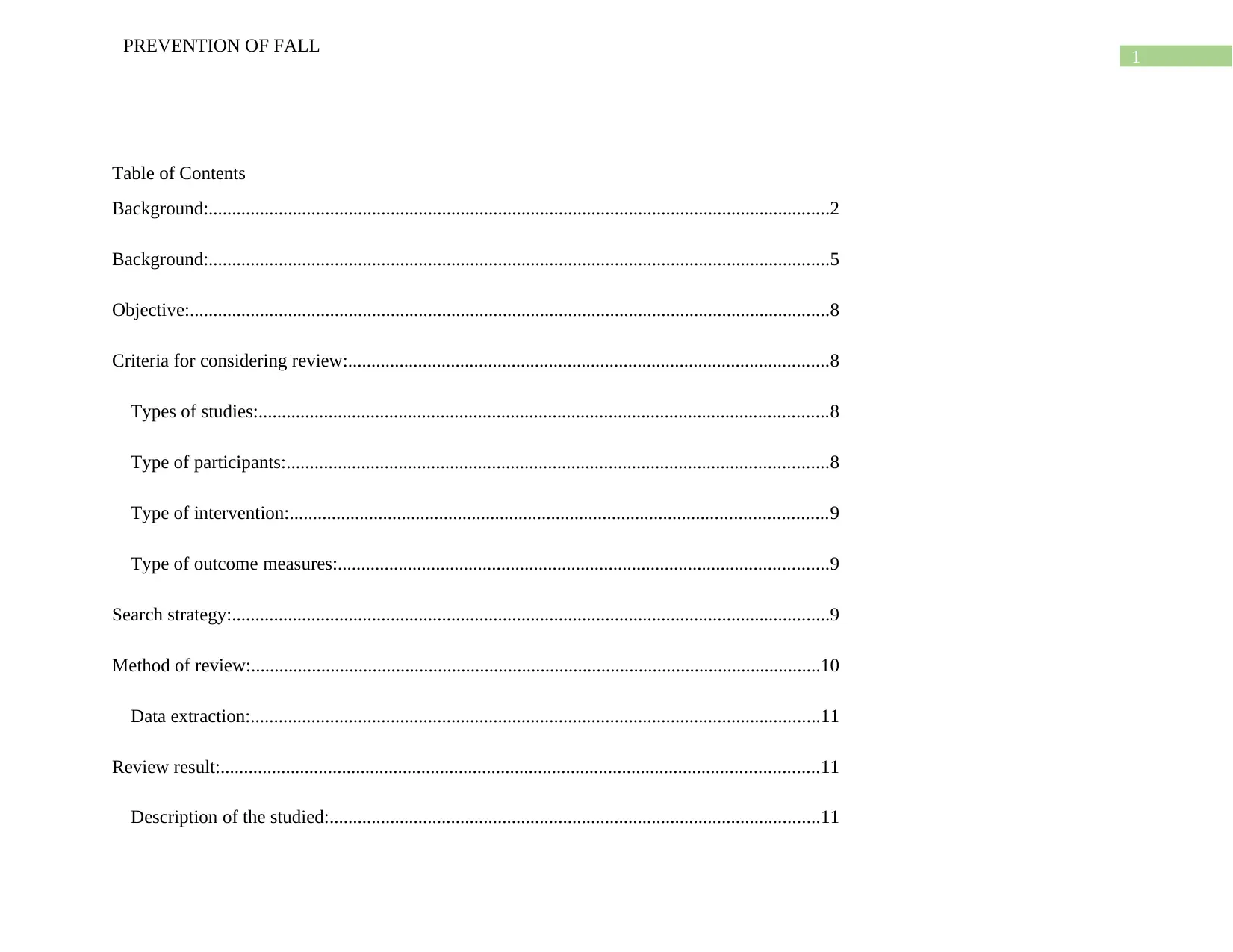
Table of Contents
Background:.....................................................................................................................................2
Background:.....................................................................................................................................5
Objective:.........................................................................................................................................8
Criteria for considering review:.......................................................................................................8
Types of studies:..........................................................................................................................8
Type of participants:....................................................................................................................8
Type of intervention:...................................................................................................................9
Type of outcome measures:.........................................................................................................9
Search strategy:................................................................................................................................9
Method of review:..........................................................................................................................10
Data extraction:..........................................................................................................................11
Review result:................................................................................................................................11
Description of the studied:.........................................................................................................11
PREVENTION OF FALL
Table of Contents
Background:.....................................................................................................................................2
Background:.....................................................................................................................................5
Objective:.........................................................................................................................................8
Criteria for considering review:.......................................................................................................8
Types of studies:..........................................................................................................................8
Type of participants:....................................................................................................................8
Type of intervention:...................................................................................................................9
Type of outcome measures:.........................................................................................................9
Search strategy:................................................................................................................................9
Method of review:..........................................................................................................................10
Data extraction:..........................................................................................................................11
Review result:................................................................................................................................11
Description of the studied:.........................................................................................................11

2
PREVENTION OF FALL
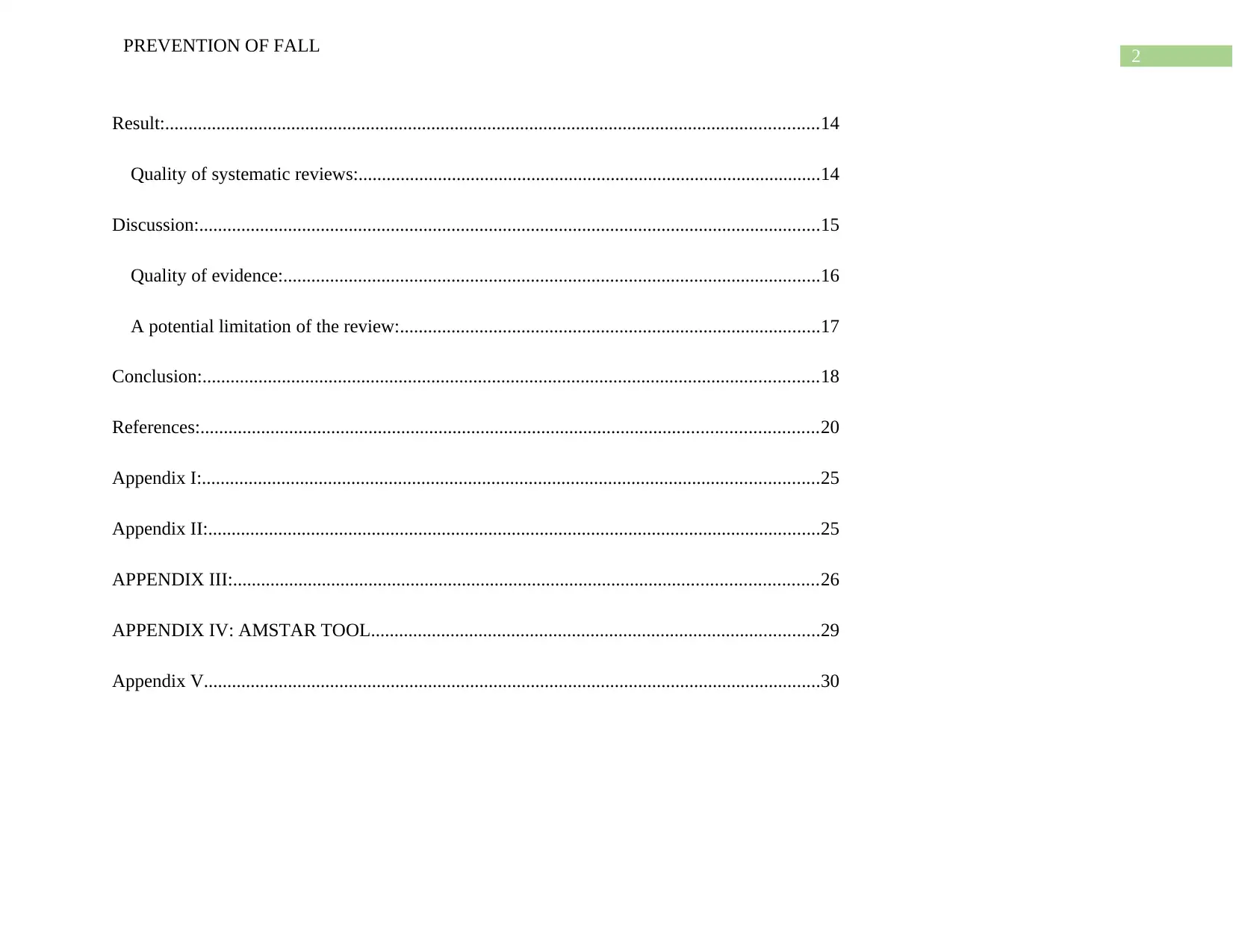
Result:............................................................................................................................................14
Quality of systematic reviews:...................................................................................................14
Discussion:.....................................................................................................................................15
Quality of evidence:...................................................................................................................16
A potential limitation of the review:..........................................................................................17
Conclusion:....................................................................................................................................18
References:....................................................................................................................................20
Appendix I:....................................................................................................................................25
Appendix II:...................................................................................................................................25
APPENDIX III:.............................................................................................................................26
APPENDIX IV: AMSTAR TOOL................................................................................................29
Appendix V....................................................................................................................................30
PREVENTION OF FALL
Result:............................................................................................................................................14
Quality of systematic reviews:...................................................................................................14
Discussion:.....................................................................................................................................15
Quality of evidence:...................................................................................................................16
A potential limitation of the review:..........................................................................................17
Conclusion:....................................................................................................................................18
References:....................................................................................................................................20
Appendix I:....................................................................................................................................25
Appendix II:...................................................................................................................................25
APPENDIX III:.............................................................................................................................26
APPENDIX IV: AMSTAR TOOL................................................................................................29
Appendix V....................................................................................................................................30
⊘ This is a preview!⊘
Do you want full access?
Subscribe today to unlock all pages.

Trusted by 1+ million students worldwide

3
PREVENTION OF FALL
PREVENTION OF FALL
Paraphrase This Document
Need a fresh take? Get an instant paraphrase of this document with our AI Paraphraser

4
PREVENTION OF FALL
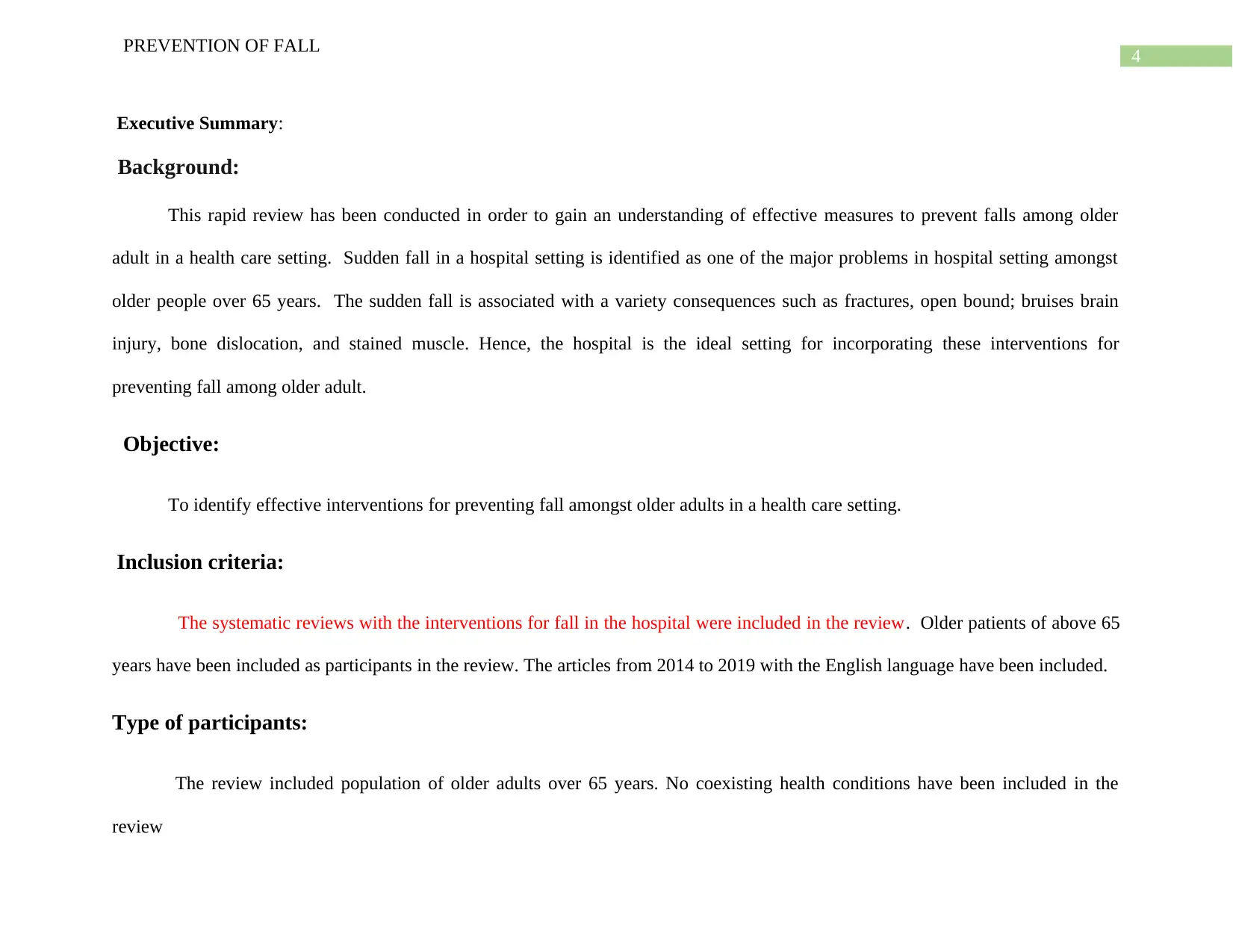
Executive Summary:
Background:
This rapid review has been conducted in order to gain an understanding of effective measures to prevent falls among older
adult in a health care setting. Sudden fall in a hospital setting is identified as one of the major problems in hospital setting amongst
older people over 65 years. The sudden fall is associated with a variety consequences such as fractures, open bound; bruises brain
injury, bone dislocation, and stained muscle. Hence, the hospital is the ideal setting for incorporating these interventions for
preventing fall among older adult.
Objective:
To identify effective interventions for preventing fall amongst older adults in a health care setting.
Inclusion criteria:
The systematic reviews with the interventions for fall in the hospital were included in the review. Older patients of above 65
years have been included as participants in the review. The articles from 2014 to 2019 with the English language have been included.
Type of participants:
The review included population of older adults over 65 years. No coexisting health conditions have been included in the
review
PREVENTION OF FALL
Executive Summary:
Background:
This rapid review has been conducted in order to gain an understanding of effective measures to prevent falls among older
adult in a health care setting. Sudden fall in a hospital setting is identified as one of the major problems in hospital setting amongst
older people over 65 years. The sudden fall is associated with a variety consequences such as fractures, open bound; bruises brain
injury, bone dislocation, and stained muscle. Hence, the hospital is the ideal setting for incorporating these interventions for
preventing fall among older adult.
Objective:
To identify effective interventions for preventing fall amongst older adults in a health care setting.
Inclusion criteria:
The systematic reviews with the interventions for fall in the hospital were included in the review. Older patients of above 65
years have been included as participants in the review. The articles from 2014 to 2019 with the English language have been included.
Type of participants:
The review included population of older adults over 65 years. No coexisting health conditions have been included in the
review

5
PREVENTION OF FALL
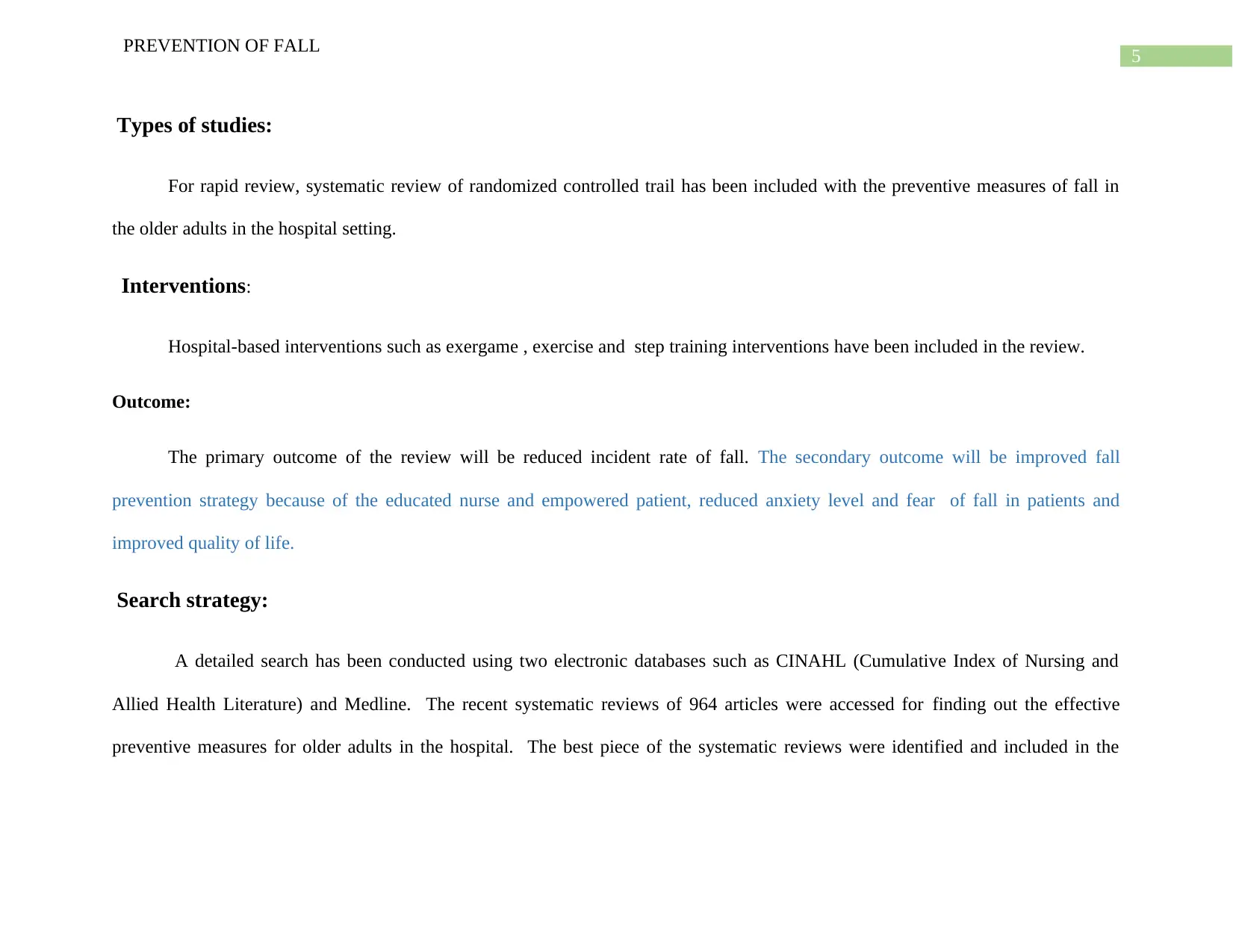
Types of studies:
For rapid review, systematic review of randomized controlled trail has been included with the preventive measures of fall in
the older adults in the hospital setting.
Interventions:
Hospital-based interventions such as exergame , exercise and step training interventions have been included in the review.
Outcome:
The primary outcome of the review will be reduced incident rate of fall. The secondary outcome will be improved fall
prevention strategy because of the educated nurse and empowered patient, reduced anxiety level and fear of fall in patients and
improved quality of life.
Search strategy:
A detailed search has been conducted using two electronic databases such as CINAHL (Cumulative Index of Nursing and
Allied Health Literature) and Medline. The recent systematic reviews of 964 articles were accessed for finding out the effective
preventive measures for older adults in the hospital. The best piece of the systematic reviews were identified and included in the
PREVENTION OF FALL
Types of studies:
For rapid review, systematic review of randomized controlled trail has been included with the preventive measures of fall in
the older adults in the hospital setting.
Interventions:
Hospital-based interventions such as exergame , exercise and step training interventions have been included in the review.
Outcome:
The primary outcome of the review will be reduced incident rate of fall. The secondary outcome will be improved fall
prevention strategy because of the educated nurse and empowered patient, reduced anxiety level and fear of fall in patients and
improved quality of life.
Search strategy:
A detailed search has been conducted using two electronic databases such as CINAHL (Cumulative Index of Nursing and
Allied Health Literature) and Medline. The recent systematic reviews of 964 articles were accessed for finding out the effective
preventive measures for older adults in the hospital. The best piece of the systematic reviews were identified and included in the
⊘ This is a preview!⊘
Do you want full access?
Subscribe today to unlock all pages.

Trusted by 1+ million students worldwide

6
PREVENTION OF FALL
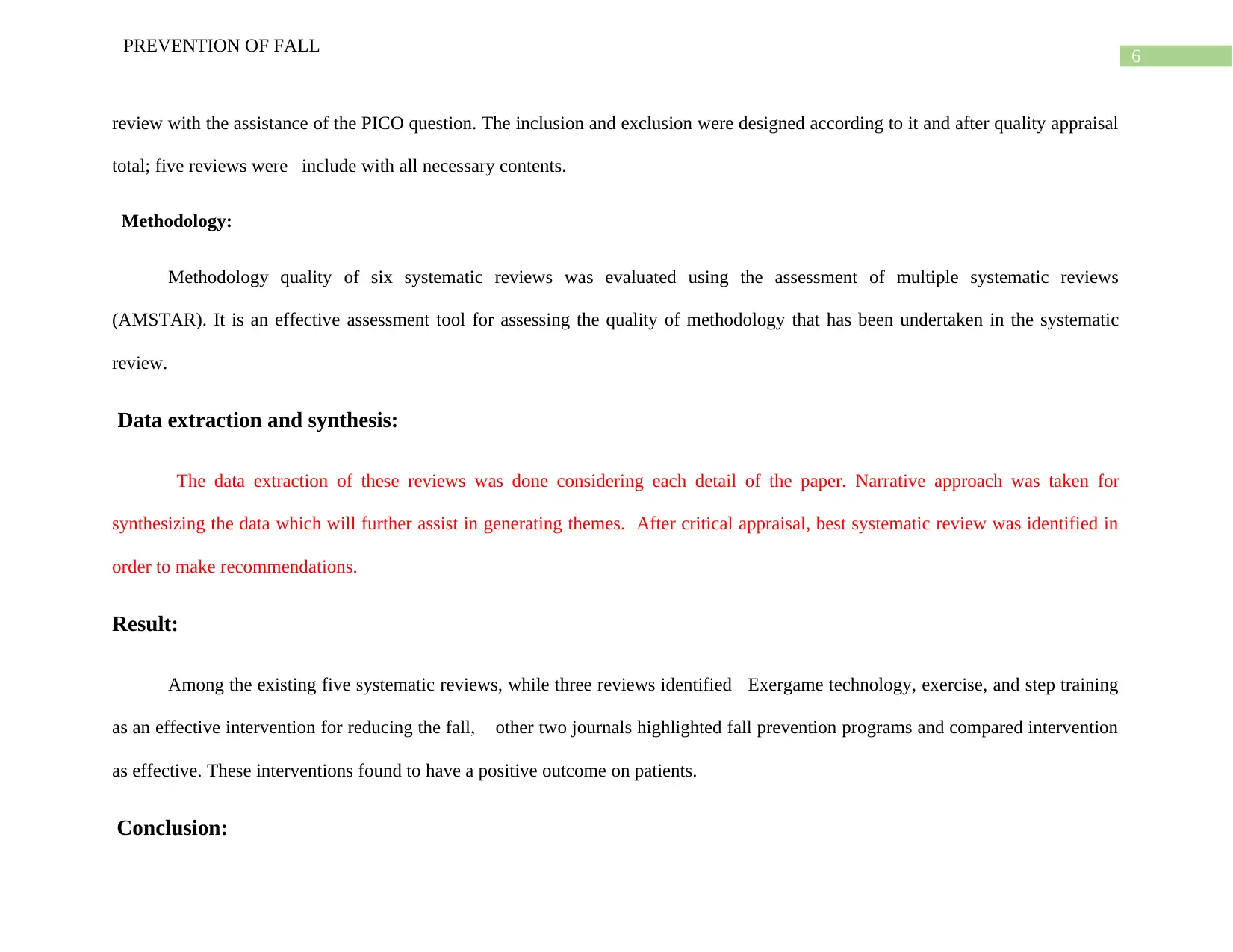
review with the assistance of the PICO question. The inclusion and exclusion were designed according to it and after quality appraisal
total; five reviews were include with all necessary contents.
Methodology:
Methodology quality of six systematic reviews was evaluated using the assessment of multiple systematic reviews
(AMSTAR). It is an effective assessment tool for assessing the quality of methodology that has been undertaken in the systematic
review.
Data extraction and synthesis:
The data extraction of these reviews was done considering each detail of the paper. Narrative approach was taken for
synthesizing the data which will further assist in generating themes. After critical appraisal, best systematic review was identified in
order to make recommendations.
Result:
Among the existing five systematic reviews, while three reviews identified Exergame technology, exercise, and step training
as an effective intervention for reducing the fall, other two journals highlighted fall prevention programs and compared intervention
as effective. These interventions found to have a positive outcome on patients.
Conclusion:
PREVENTION OF FALL
review with the assistance of the PICO question. The inclusion and exclusion were designed according to it and after quality appraisal
total; five reviews were include with all necessary contents.
Methodology:
Methodology quality of six systematic reviews was evaluated using the assessment of multiple systematic reviews
(AMSTAR). It is an effective assessment tool for assessing the quality of methodology that has been undertaken in the systematic
review.
Data extraction and synthesis:
The data extraction of these reviews was done considering each detail of the paper. Narrative approach was taken for
synthesizing the data which will further assist in generating themes. After critical appraisal, best systematic review was identified in
order to make recommendations.
Result:
Among the existing five systematic reviews, while three reviews identified Exergame technology, exercise, and step training
as an effective intervention for reducing the fall, other two journals highlighted fall prevention programs and compared intervention
as effective. These interventions found to have a positive outcome on patients.
Conclusion:
Paraphrase This Document
Need a fresh take? Get an instant paraphrase of this document with our AI Paraphraser

7
PREVENTION OF FALL
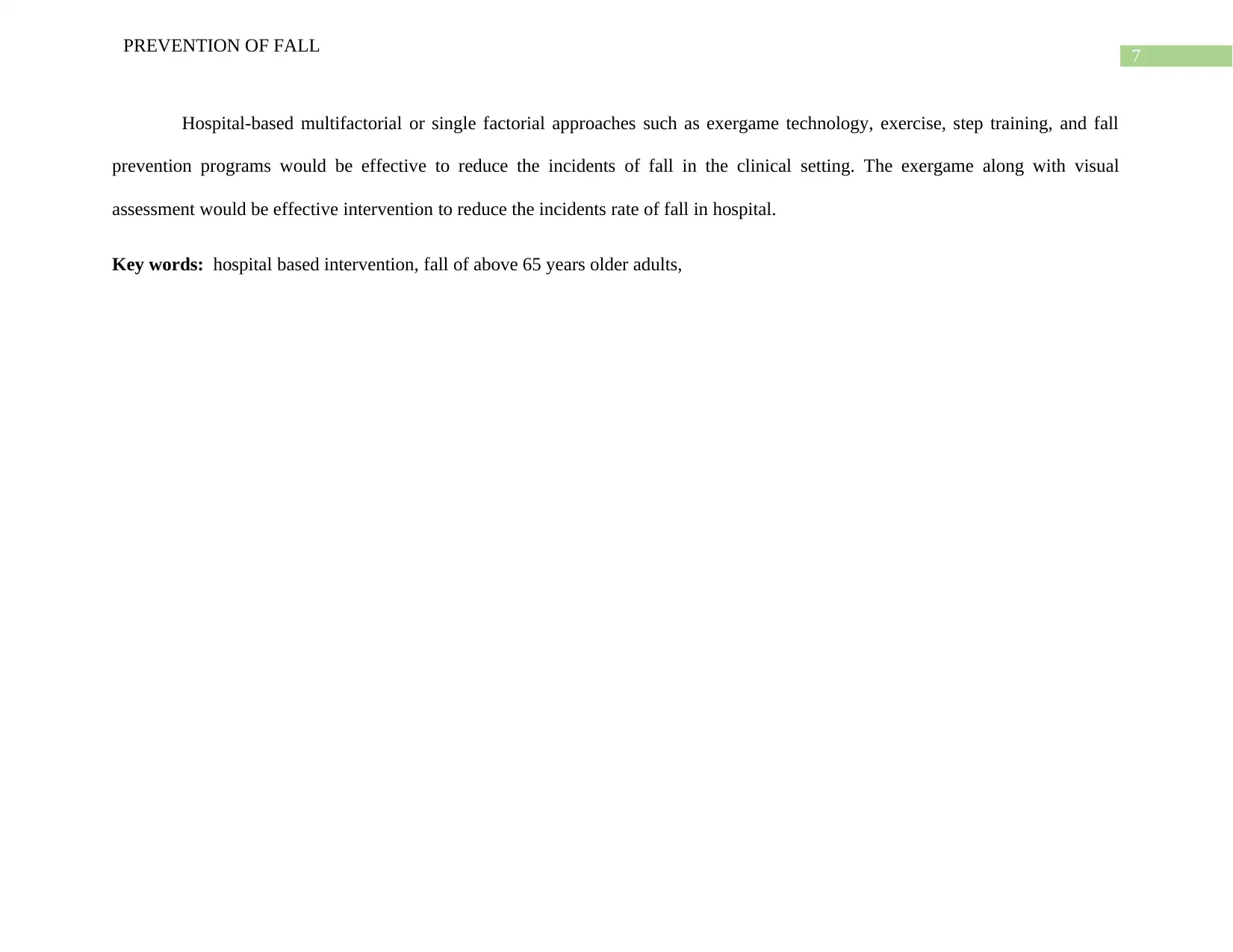
Hospital-based multifactorial or single factorial approaches such as exergame technology, exercise, step training, and fall
prevention programs would be effective to reduce the incidents of fall in the clinical setting. The exergame along with visual
assessment would be effective intervention to reduce the incidents rate of fall in hospital.
Key words: hospital based intervention, fall of above 65 years older adults,
PREVENTION OF FALL
Hospital-based multifactorial or single factorial approaches such as exergame technology, exercise, step training, and fall
prevention programs would be effective to reduce the incidents of fall in the clinical setting. The exergame along with visual
assessment would be effective intervention to reduce the incidents rate of fall in hospital.
Key words: hospital based intervention, fall of above 65 years older adults,

8
PREVENTION OF FALL
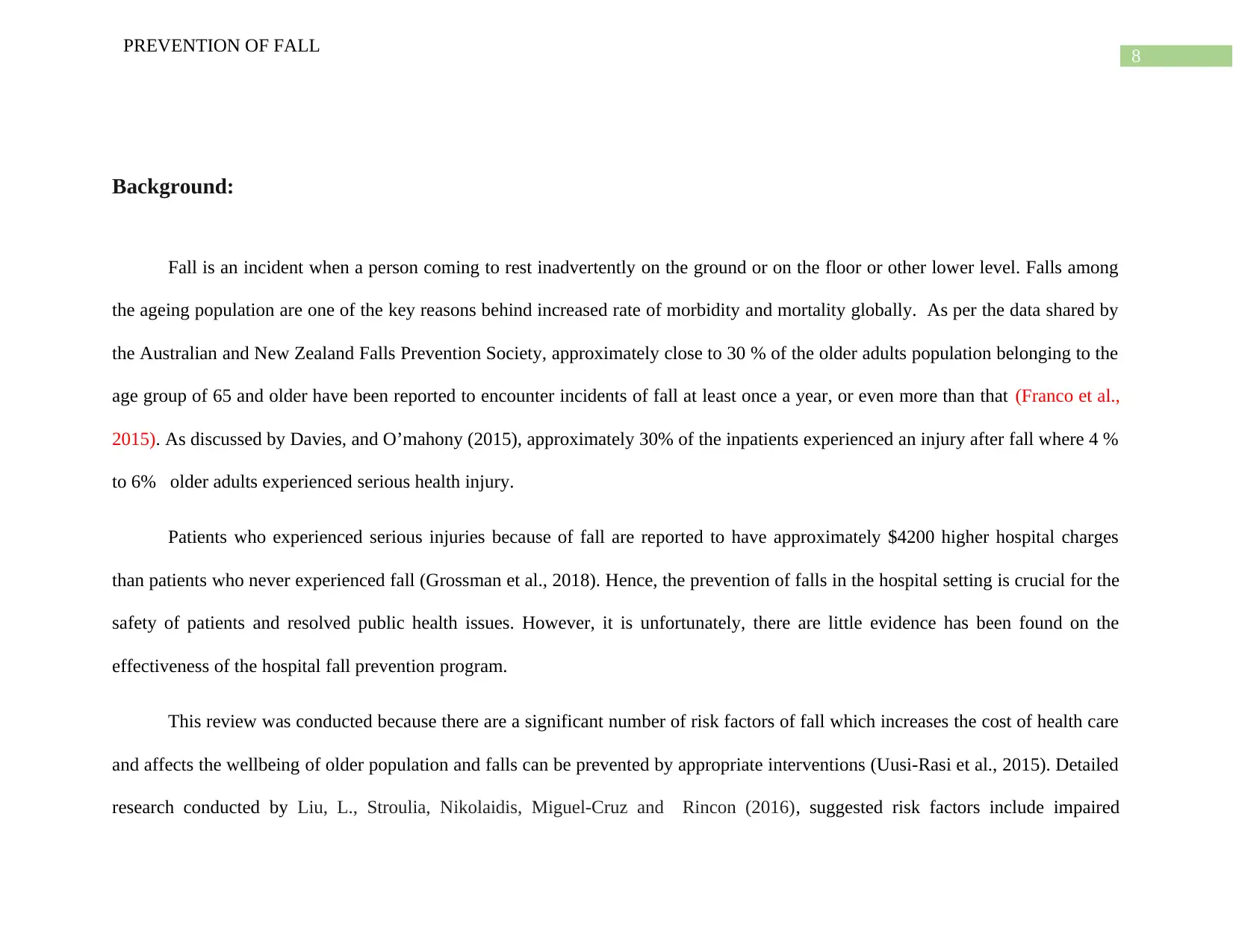
Background:
Fall is an incident when a person coming to rest inadvertently on the ground or on the floor or other lower level. Falls among
the ageing population are one of the key reasons behind increased rate of morbidity and mortality globally. As per the data shared by
the Australian and New Zealand Falls Prevention Society, approximately close to 30 % of the older adults population belonging to the
age group of 65 and older have been reported to encounter incidents of fall at least once a year, or even more than that (Franco et al.,
2015). As discussed by Davies, and O’mahony (2015), approximately 30% of the inpatients experienced an injury after fall where 4 %
to 6% older adults experienced serious health injury.
Patients who experienced serious injuries because of fall are reported to have approximately $4200 higher hospital charges
than patients who never experienced fall (Grossman et al., 2018). Hence, the prevention of falls in the hospital setting is crucial for the
safety of patients and resolved public health issues. However, it is unfortunately, there are little evidence has been found on the
effectiveness of the hospital fall prevention program.
This review was conducted because there are a significant number of risk factors of fall which increases the cost of health care
and affects the wellbeing of older population and falls can be prevented by appropriate interventions (Uusi-Rasi et al., 2015). Detailed
research conducted by Liu, L., Stroulia, Nikolaidis, Miguel-Cruz and Rincon (2016), suggested risk factors include impaired
PREVENTION OF FALL
Background:
Fall is an incident when a person coming to rest inadvertently on the ground or on the floor or other lower level. Falls among
the ageing population are one of the key reasons behind increased rate of morbidity and mortality globally. As per the data shared by
the Australian and New Zealand Falls Prevention Society, approximately close to 30 % of the older adults population belonging to the
age group of 65 and older have been reported to encounter incidents of fall at least once a year, or even more than that (Franco et al.,
2015). As discussed by Davies, and O’mahony (2015), approximately 30% of the inpatients experienced an injury after fall where 4 %
to 6% older adults experienced serious health injury.
Patients who experienced serious injuries because of fall are reported to have approximately $4200 higher hospital charges
than patients who never experienced fall (Grossman et al., 2018). Hence, the prevention of falls in the hospital setting is crucial for the
safety of patients and resolved public health issues. However, it is unfortunately, there are little evidence has been found on the
effectiveness of the hospital fall prevention program.
This review was conducted because there are a significant number of risk factors of fall which increases the cost of health care
and affects the wellbeing of older population and falls can be prevented by appropriate interventions (Uusi-Rasi et al., 2015). Detailed
research conducted by Liu, L., Stroulia, Nikolaidis, Miguel-Cruz and Rincon (2016), suggested risk factors include impaired
⊘ This is a preview!⊘
Do you want full access?
Subscribe today to unlock all pages.

Trusted by 1+ million students worldwide

9
PREVENTION OF FALL
balanced, altered mobility, history of falling, cognitive impairment, depression, dizziness, vertigo orthostatic hypotension, visual
impairment and side effects of certain medications (Edvinsson et al., 2015). On the other hand, few studies also identified specific
diagnosis as a potential risk factor of fall in the clinical setting. Most of the literature on falls mostly focused on the elderly adults
living in the community or long term care facilities. Very few research focused on the falls and associated preventive measure in the
hospital setting (Verma et al., 2016). Hence, this rapid review has been undertaken in order to identify preventive measures for older
patients in the hospital setting where patients of 65 years or more than 65 years have been included in the review.
Landi et al.( 2016), highlighted interventions of preventing fall such as exercise, dietary intervention, medication review,
multifactorial interventions or behavioral approaches can be effective. The randomized controlled trial also highlighted that there can
be a gap existed in knowledge whether single or multifactorial interventions can reduce incidents of falling and obstacles observed in
the implementation of these interventions in the hospital setting (Kojima, 2016). Hence, the aim of this rapid review is to obtain best
preventive measures for the older adults in the clinical setting with an intention of the reducing the frequent fall in the hospital setting
and recommend strategies to health professionals. The review also was conducted for evaluating whether physical assessment of risk
factor can reduce incidents of fall. In this case, specific fall prevention program is important to reduce fall risk then the fall prevention
can be reduced in the clinical setting.
The review would be crucial for identifying different measures for fall prevention that can be implemented in the hospital
setting which will result in improvement of nursing practice in reducing incidents of fall and improve quality of life. The designed
PREVENTION OF FALL
balanced, altered mobility, history of falling, cognitive impairment, depression, dizziness, vertigo orthostatic hypotension, visual
impairment and side effects of certain medications (Edvinsson et al., 2015). On the other hand, few studies also identified specific
diagnosis as a potential risk factor of fall in the clinical setting. Most of the literature on falls mostly focused on the elderly adults
living in the community or long term care facilities. Very few research focused on the falls and associated preventive measure in the
hospital setting (Verma et al., 2016). Hence, this rapid review has been undertaken in order to identify preventive measures for older
patients in the hospital setting where patients of 65 years or more than 65 years have been included in the review.
Landi et al.( 2016), highlighted interventions of preventing fall such as exercise, dietary intervention, medication review,
multifactorial interventions or behavioral approaches can be effective. The randomized controlled trial also highlighted that there can
be a gap existed in knowledge whether single or multifactorial interventions can reduce incidents of falling and obstacles observed in
the implementation of these interventions in the hospital setting (Kojima, 2016). Hence, the aim of this rapid review is to obtain best
preventive measures for the older adults in the clinical setting with an intention of the reducing the frequent fall in the hospital setting
and recommend strategies to health professionals. The review also was conducted for evaluating whether physical assessment of risk
factor can reduce incidents of fall. In this case, specific fall prevention program is important to reduce fall risk then the fall prevention
can be reduced in the clinical setting.
The review would be crucial for identifying different measures for fall prevention that can be implemented in the hospital
setting which will result in improvement of nursing practice in reducing incidents of fall and improve quality of life. The designed
Paraphrase This Document
Need a fresh take? Get an instant paraphrase of this document with our AI Paraphraser

10
PREVENTION OF FALL
PICO question for this review is that is hospital-based multifactorial or single factorial intervention effective to reduce the prevention
of fall in the patients of 65 years or above in the hospital setting?
P: the population is older patients of 65 years old in the hospital setting. The rationale behind conducting this population is that as the
population of this age experience most of the fall because of risk factors discussed above.
I: a hospital-based multifactorial or single factorial interventions for preventing fall. The reason behind these interventions is that it
would help to identify hospital based and implement in the clinical setting.
C: Conventional fall prevention strategy
O: The outcome would be reduced incidence of preventing fall in the hospital setting. The outcome may be associated with a reduced
number of hospital stays, the number of emergency visit and improved practice of health professionals.
Hence, this review summary would be able to close the gap of diverse literature by finding out the effectiveness of hospital-
based multifactorial or single factorial intervention approach such as exergame intervention, stepping training, person-centered
intervention. This paper will discuss effective preventive measures for the older adults of above 65 years in the clinical setting and
comparing in between them with the intention of providing the best possible recommendation for interventions.
PREVENTION OF FALL
PICO question for this review is that is hospital-based multifactorial or single factorial intervention effective to reduce the prevention
of fall in the patients of 65 years or above in the hospital setting?
P: the population is older patients of 65 years old in the hospital setting. The rationale behind conducting this population is that as the
population of this age experience most of the fall because of risk factors discussed above.
I: a hospital-based multifactorial or single factorial interventions for preventing fall. The reason behind these interventions is that it
would help to identify hospital based and implement in the clinical setting.
C: Conventional fall prevention strategy
O: The outcome would be reduced incidence of preventing fall in the hospital setting. The outcome may be associated with a reduced
number of hospital stays, the number of emergency visit and improved practice of health professionals.
Hence, this review summary would be able to close the gap of diverse literature by finding out the effectiveness of hospital-
based multifactorial or single factorial intervention approach such as exergame intervention, stepping training, person-centered
intervention. This paper will discuss effective preventive measures for the older adults of above 65 years in the clinical setting and
comparing in between them with the intention of providing the best possible recommendation for interventions.

11
PREVENTION OF FALL
Objective:
The purpose of providing a summative overview of the systematic reviews as well as analyzing the result is to find out best
possible Intervention for reducing the incidents of fall in older adults of 65 years. A research question such as “what is the most
effective intervention to prevent fall among older adult of above 65 years in health care setting” would use as road map for conducting
review.
Criteria for considering review:
Types of studies:
This rapid review considered any systematic review which evaluates the intervention s designed for preventing fall in older
adults, focusing on the health of older individuals of 65 years in the hospital setting. Systematic reviews included in the review
undertaken different studies required for the interventions.
Type of participants:
The review only considered those studies which undertaken the older adults of 65 years with the risk of fall in the hospital
setting. The prime reason behind it is that these target group is highly vulnerable to the risk factors such as impaired balanced, altered
PREVENTION OF FALL
Objective:
The purpose of providing a summative overview of the systematic reviews as well as analyzing the result is to find out best
possible Intervention for reducing the incidents of fall in older adults of 65 years. A research question such as “what is the most
effective intervention to prevent fall among older adult of above 65 years in health care setting” would use as road map for conducting
review.
Criteria for considering review:
Types of studies:
This rapid review considered any systematic review which evaluates the intervention s designed for preventing fall in older
adults, focusing on the health of older individuals of 65 years in the hospital setting. Systematic reviews included in the review
undertaken different studies required for the interventions.
Type of participants:
The review only considered those studies which undertaken the older adults of 65 years with the risk of fall in the hospital
setting. The prime reason behind it is that these target group is highly vulnerable to the risk factors such as impaired balanced, altered
⊘ This is a preview!⊘
Do you want full access?
Subscribe today to unlock all pages.

Trusted by 1+ million students worldwide
1 out of 44
Related Documents
Your All-in-One AI-Powered Toolkit for Academic Success.
+13062052269
info@desklib.com
Available 24*7 on WhatsApp / Email
Unlock your academic potential
Copyright © 2020–2025 A2Z Services. All Rights Reserved. Developed and managed by ZUCOL.