Preventive Maintenance Strategy Report: Software System Analysis
VerifiedAdded on 2022/08/11
|14
|2760
|21
Report
AI Summary
This report presents a comprehensive analysis of preventive maintenance strategies for software systems. It begins with an introduction that highlights the importance of software maintenance in today's risk-sensitive business environment, emphasizing the need to prevent system failures. The report then delves into the different types of maintenance methods, with a specific focus on preventive maintenance, which aims to improve future maintainability and prevent system breakdowns. The purpose of the study is to evaluate the effectiveness of preventive maintenance using Action Research, aiming to improve software system functionality by identifying and addressing potential failures and risks. The report outlines the expected outcomes, including the analysis of key stages in software system maintenance, understanding preventive maintenance strategies, and evaluating the role of comprehensive activities on the maintenance process. A literature review is included, presenting recent preventive maintenance strategies, policies, and applications. The methodology section explains the use of Mean Time Between Failures (MTBF) and Mean Time to Restore (MTTR) as parameters to assess software functionality. The report also includes a Gantt chart for project planning, a risk assessment based on HSE five steps, and concludes by emphasizing the importance of preventive maintenance in software system development and the need for improved methodologies.
Preventive Maintenance Strategy 1
Name of student
Professor
Date
Name of student
Professor
Date

Paraphrase This Document
Need a fresh take? Get an instant paraphrase of this document with our AI Paraphraser
Preventive Maintenance Strategy 2
Introduction
Background
In the modern risk-sensitive business world, the employment of software has become one of the
most valuable assets to businesses. Activities driven by the use of various software have become
critical to the success of businesses and have ensured continuity in managing risks and other
disasters within the organization, (Ahuja and Khamba 2015). Therefore, it is critical that
extensive research is done to ensure a better understanding of various problems that affect the
software. And how these problems can be prevented in relation to software maintenance which is
necessary to prevent system failures, (Besnard 2013). An increase in the levels of technological
maturity has ensured that more and more software systems enter the maintenance stage which
calls for disciplined and meticulously scheduled maintenance processes.
Software systems maintenance processes account for more than any other software engineering
process. although it has been neglected for quite some time in the software engineering process
(Huei, Liang, and Lo, 2017). software maintainability is crucial in guiding its production process.
Software maintainability refers to the degree in which it can be clearly understood, its functions
corrected, adapted to various desired processes and enhanced to achieve maximum results.
Software system maintenance can emanate from any kind of system failure such as performance
failure, system failure, and software implementation failure. In order to properly manage
software system failure, there are four types of maintenance methods that can be adapted to
address each. They include;
a. Corrective maintenance- it is adopted to correct the functionality related errors that are
identified while using the software.
Introduction
Background
In the modern risk-sensitive business world, the employment of software has become one of the
most valuable assets to businesses. Activities driven by the use of various software have become
critical to the success of businesses and have ensured continuity in managing risks and other
disasters within the organization, (Ahuja and Khamba 2015). Therefore, it is critical that
extensive research is done to ensure a better understanding of various problems that affect the
software. And how these problems can be prevented in relation to software maintenance which is
necessary to prevent system failures, (Besnard 2013). An increase in the levels of technological
maturity has ensured that more and more software systems enter the maintenance stage which
calls for disciplined and meticulously scheduled maintenance processes.
Software systems maintenance processes account for more than any other software engineering
process. although it has been neglected for quite some time in the software engineering process
(Huei, Liang, and Lo, 2017). software maintainability is crucial in guiding its production process.
Software maintainability refers to the degree in which it can be clearly understood, its functions
corrected, adapted to various desired processes and enhanced to achieve maximum results.
Software system maintenance can emanate from any kind of system failure such as performance
failure, system failure, and software implementation failure. In order to properly manage
software system failure, there are four types of maintenance methods that can be adapted to
address each. They include;
a. Corrective maintenance- it is adopted to correct the functionality related errors that are
identified while using the software.
Preventive Maintenance Strategy 3
b. Adaptive maintenance- it is a maintenance technique adopted to address the functionality
of the software due to external changes in the environment
c. Perfective maintenance- it includes various system enhancements to the current system
functionality
d. Preventive maintenance- this technique focuses on improving future maintainability and
creates a platform for future system enhancements.
However, maintenance cost is not evenly distributed across all the four types of maintenance.
According to the study by Aghezzaf, Khatab, and Le. (2016) 4% of the maintenance cost is
associated with preventive maintenance, 50% to perfective maintenance, 25% to adaptive
maintenance and 21% to corrective software system maintenance. Most researchers have sparked
numerous debates on the classification of these four types of software system maintenance. This
is hugely due to the fact that most of the activities performed using software systems are hard to
classify.
This report will address the preventive software system maintenance technique. However, this
technique is rarely implemented due to the minimal pressure derived from the software system
development process which renders any preventive maintenance measures of minimal
importance. Preventive maintenance measures focus on preventing any system breakdown and
possible failures during the operation of the system (Eti and Ogaji 2016). It is implemented
during the predetermined stages and is intended to minimize the possible likelihood of the
software system not meeting the required conditions. The primary objective of this maintenance
approach is to prevent any possible software failure before it occurs. The ideal strategy will
address all possible software system failures before they occur (Huei, Kao, and Liang, 2014). In
most firms, the strategy is paper-based as well as manual based.
b. Adaptive maintenance- it is a maintenance technique adopted to address the functionality
of the software due to external changes in the environment
c. Perfective maintenance- it includes various system enhancements to the current system
functionality
d. Preventive maintenance- this technique focuses on improving future maintainability and
creates a platform for future system enhancements.
However, maintenance cost is not evenly distributed across all the four types of maintenance.
According to the study by Aghezzaf, Khatab, and Le. (2016) 4% of the maintenance cost is
associated with preventive maintenance, 50% to perfective maintenance, 25% to adaptive
maintenance and 21% to corrective software system maintenance. Most researchers have sparked
numerous debates on the classification of these four types of software system maintenance. This
is hugely due to the fact that most of the activities performed using software systems are hard to
classify.
This report will address the preventive software system maintenance technique. However, this
technique is rarely implemented due to the minimal pressure derived from the software system
development process which renders any preventive maintenance measures of minimal
importance. Preventive maintenance measures focus on preventing any system breakdown and
possible failures during the operation of the system (Eti and Ogaji 2016). It is implemented
during the predetermined stages and is intended to minimize the possible likelihood of the
software system not meeting the required conditions. The primary objective of this maintenance
approach is to prevent any possible software failure before it occurs. The ideal strategy will
address all possible software system failures before they occur (Huei, Kao, and Liang, 2014). In
most firms, the strategy is paper-based as well as manual based.
⊘ This is a preview!⊘
Do you want full access?
Subscribe today to unlock all pages.

Trusted by 1+ million students worldwide
Preventive Maintenance Strategy 4
Preventive maintenance strategy has also been linked as an essential element in managing
various risks in the company’s operations. various risks and hazards are analyzed and identified
and the required mitigation measures are undertaken to prevent losses in the future.
Purpose
The main purpose of this study involves an active evaluation of preventive maintenance strategy
using the qualitative approach of Action Research in order to identify the effectiveness of using
preventive maintenance strategy. It is to be achieved by monitoring various measures that will be
adopted in different phases of software system development and operation in monitoring possible
failure and ineffectiveness, (Chen and Chen 2014).
The objective of the research will be to improve the overall software system functionality
through the adoption of preventive maintenance measures in identifying and addressing possible
failures and risks. a comparative analysis was conducted to comprehensively evaluate preventive
maintenance strategy in this study, (Chang 2014). Action Research will be used to improve the
system of preventive maintenance strategy. This is to be used away from the traditional form of
maintenance employed by most of the firms.
Outcome
Based on the purpose of the study illustrated above, the aim of the research is to conduct an
investigation on software system maintenance strategy. As aforementioned, software systems are
made up of system codes and relevant documentation, it is apparent that the relevant
documentation is unavailable or insufficient and the personnel responsible for maintenance
majorly rely on the source codes, (Chang and Lo 2017). Therefore, the scope of this study will be
Preventive maintenance strategy has also been linked as an essential element in managing
various risks in the company’s operations. various risks and hazards are analyzed and identified
and the required mitigation measures are undertaken to prevent losses in the future.
Purpose
The main purpose of this study involves an active evaluation of preventive maintenance strategy
using the qualitative approach of Action Research in order to identify the effectiveness of using
preventive maintenance strategy. It is to be achieved by monitoring various measures that will be
adopted in different phases of software system development and operation in monitoring possible
failure and ineffectiveness, (Chen and Chen 2014).
The objective of the research will be to improve the overall software system functionality
through the adoption of preventive maintenance measures in identifying and addressing possible
failures and risks. a comparative analysis was conducted to comprehensively evaluate preventive
maintenance strategy in this study, (Chang 2014). Action Research will be used to improve the
system of preventive maintenance strategy. This is to be used away from the traditional form of
maintenance employed by most of the firms.
Outcome
Based on the purpose of the study illustrated above, the aim of the research is to conduct an
investigation on software system maintenance strategy. As aforementioned, software systems are
made up of system codes and relevant documentation, it is apparent that the relevant
documentation is unavailable or insufficient and the personnel responsible for maintenance
majorly rely on the source codes, (Chang and Lo 2017). Therefore, the scope of this study will be
Paraphrase This Document
Need a fresh take? Get an instant paraphrase of this document with our AI Paraphraser
Preventive Maintenance Strategy 5
restricted to the preventive maintenance of the software system failure. The following are some
of the expected results;
a. Analysis of key stages in software system maintenance and evaluation of its life cycle.
b. Understand the preventive maintenance strategy in relation to software system
management
c. Evaluating the role played by the software comprehensive activities on the maintenance
process and its evaluation
d. Understanding the related problems faced by the software maintenance team
e. Analyzing the overall importance of utilizing preventive maintenance measures in the
software system maintenance.
Literature review
In this literature review, I present recent and relevant preventive maintenance strategies, policies,
and applications. Ding and Kamaruddin (2015) explored the idea of maintaining or not to
maintain? What should be done by a risk-conscious manager? In the engineering application,
software system maintenance personnel always encounter complex and sophisticated problems
that require prompt decisions to be made under uncertainty. This becomes difficult when more
than two conflict objectives have to be considered. A review of the available literature indicates
that previous approaches consider software system repairable dependent on the random system
failure and a comprehensive analysis is conducted to determine the present tradeoffs between the
cost of maintenance and the benefits to be realized from the undertaking.
restricted to the preventive maintenance of the software system failure. The following are some
of the expected results;
a. Analysis of key stages in software system maintenance and evaluation of its life cycle.
b. Understand the preventive maintenance strategy in relation to software system
management
c. Evaluating the role played by the software comprehensive activities on the maintenance
process and its evaluation
d. Understanding the related problems faced by the software maintenance team
e. Analyzing the overall importance of utilizing preventive maintenance measures in the
software system maintenance.
Literature review
In this literature review, I present recent and relevant preventive maintenance strategies, policies,
and applications. Ding and Kamaruddin (2015) explored the idea of maintaining or not to
maintain? What should be done by a risk-conscious manager? In the engineering application,
software system maintenance personnel always encounter complex and sophisticated problems
that require prompt decisions to be made under uncertainty. This becomes difficult when more
than two conflict objectives have to be considered. A review of the available literature indicates
that previous approaches consider software system repairable dependent on the random system
failure and a comprehensive analysis is conducted to determine the present tradeoffs between the
cost of maintenance and the benefits to be realized from the undertaking.
Preventive Maintenance Strategy 6
The present risk aversion of the responsible person may not be clearly underlined. An attempt to
undertaken to determine the attitude of a neutral decision-making party against that of the risk-
averse decision-making manager. Azadeh, Asadzadeh, Salehi, and Firoozi (2015) proposed a
more hybrid 2-metaheuristic algorithms; simulated annealing and tabu search which are used in
calculating a combinatorial; optimization problem. (Dalgic, Lazakis, Dinwoodie, Mcmillan, and
Revie (2015) proposed a maintenance audit approach in servicing software systems. It is in line
with the weighting approach; Simple Multiple Attribute Rating Technique (SMART)which is a
value analysis technique based on rules generated by experts, (Do, Voisin, Levrat, and Iung,
2014). This research will illustrate that an increase in software competitiveness in relation to its
requirements which include quality, safety, availability and the level of services provided has led
to the need for changing the maintenance concept from tactical maintenance to a more strategic
approach which involves presenting possible failures and risks.
Methodology
It is essential to know the effects of available failures and risks will have on the overall system.
in most cases, it is important to maintain or even improve the functionality of the software. the
most common way to achieve this is to avoid possible failures and try to mitigate possible risks
the software is exposed to in advance. This study will adopt two parameters affect the overall
functionality and the availability of the software system as suggested by Hamidi, Liao, and
Szidarovszky, (2016). They two parameters include; Mean Time Between Failures (MTBF)
which measures the average time a software system will be functional before experiencing an
unplanned failure. It also measures the overall reliability of the software. Mean Time to Restore
(MTTR), it measures the average time required to bring the system to full operations if it fails. It
also measures the overall system maintainability.
The present risk aversion of the responsible person may not be clearly underlined. An attempt to
undertaken to determine the attitude of a neutral decision-making party against that of the risk-
averse decision-making manager. Azadeh, Asadzadeh, Salehi, and Firoozi (2015) proposed a
more hybrid 2-metaheuristic algorithms; simulated annealing and tabu search which are used in
calculating a combinatorial; optimization problem. (Dalgic, Lazakis, Dinwoodie, Mcmillan, and
Revie (2015) proposed a maintenance audit approach in servicing software systems. It is in line
with the weighting approach; Simple Multiple Attribute Rating Technique (SMART)which is a
value analysis technique based on rules generated by experts, (Do, Voisin, Levrat, and Iung,
2014). This research will illustrate that an increase in software competitiveness in relation to its
requirements which include quality, safety, availability and the level of services provided has led
to the need for changing the maintenance concept from tactical maintenance to a more strategic
approach which involves presenting possible failures and risks.
Methodology
It is essential to know the effects of available failures and risks will have on the overall system.
in most cases, it is important to maintain or even improve the functionality of the software. the
most common way to achieve this is to avoid possible failures and try to mitigate possible risks
the software is exposed to in advance. This study will adopt two parameters affect the overall
functionality and the availability of the software system as suggested by Hamidi, Liao, and
Szidarovszky, (2016). They two parameters include; Mean Time Between Failures (MTBF)
which measures the average time a software system will be functional before experiencing an
unplanned failure. It also measures the overall reliability of the software. Mean Time to Restore
(MTTR), it measures the average time required to bring the system to full operations if it fails. It
also measures the overall system maintainability.
⊘ This is a preview!⊘
Do you want full access?
Subscribe today to unlock all pages.
Trusted by 1+ million students worldwide
Preventive Maintenance Strategy 7
A system with an increased rate of failure is more likely to continue functioning even if it is
experiencing failure. When the software system fails at a given time, t1, the surviving failure rate
of the software components will be ⅄1. And the full functionality of the system is restored at t2
and the system will have aged by t2-t1. This translates to the failure rate of the software being
2. Besides, some of the components in the system do not function during the system failure.⅄
This means the surviving components being at the same failure rate of 1 when the system⅄
becomes fully functional.
In order to optimally monitor the software, the model will make the following assumptions
i. The system under study is new to the market and its application is being implemented
for the first time
ii. State of the software can be monitored, diagnosed and evaluated in real-time basis
and the instances of failure or risks are random
iii. Minor and nontechnical repairs which are unplanned for are done when the software
system fails during the preventive maintenance
iv. During the functional service life of the software, the maintenance strategy applied
for the software is only a preventive maintenance strategy that is largely unplanned
and does not require new additions to the system.
v. System failure can be illustrated through a mathematical function and the two
proponents of the model can be applied to the functions
vi. The software system has sufficient maintenance resources and can be implemented in
time to return it to full functionality.
Activity Gantt-chart
A system with an increased rate of failure is more likely to continue functioning even if it is
experiencing failure. When the software system fails at a given time, t1, the surviving failure rate
of the software components will be ⅄1. And the full functionality of the system is restored at t2
and the system will have aged by t2-t1. This translates to the failure rate of the software being
2. Besides, some of the components in the system do not function during the system failure.⅄
This means the surviving components being at the same failure rate of 1 when the system⅄
becomes fully functional.
In order to optimally monitor the software, the model will make the following assumptions
i. The system under study is new to the market and its application is being implemented
for the first time
ii. State of the software can be monitored, diagnosed and evaluated in real-time basis
and the instances of failure or risks are random
iii. Minor and nontechnical repairs which are unplanned for are done when the software
system fails during the preventive maintenance
iv. During the functional service life of the software, the maintenance strategy applied
for the software is only a preventive maintenance strategy that is largely unplanned
and does not require new additions to the system.
v. System failure can be illustrated through a mathematical function and the two
proponents of the model can be applied to the functions
vi. The software system has sufficient maintenance resources and can be implemented in
time to return it to full functionality.
Activity Gantt-chart
Paraphrase This Document
Need a fresh take? Get an instant paraphrase of this document with our AI Paraphraser
Preventive Maintenance Strategy 8
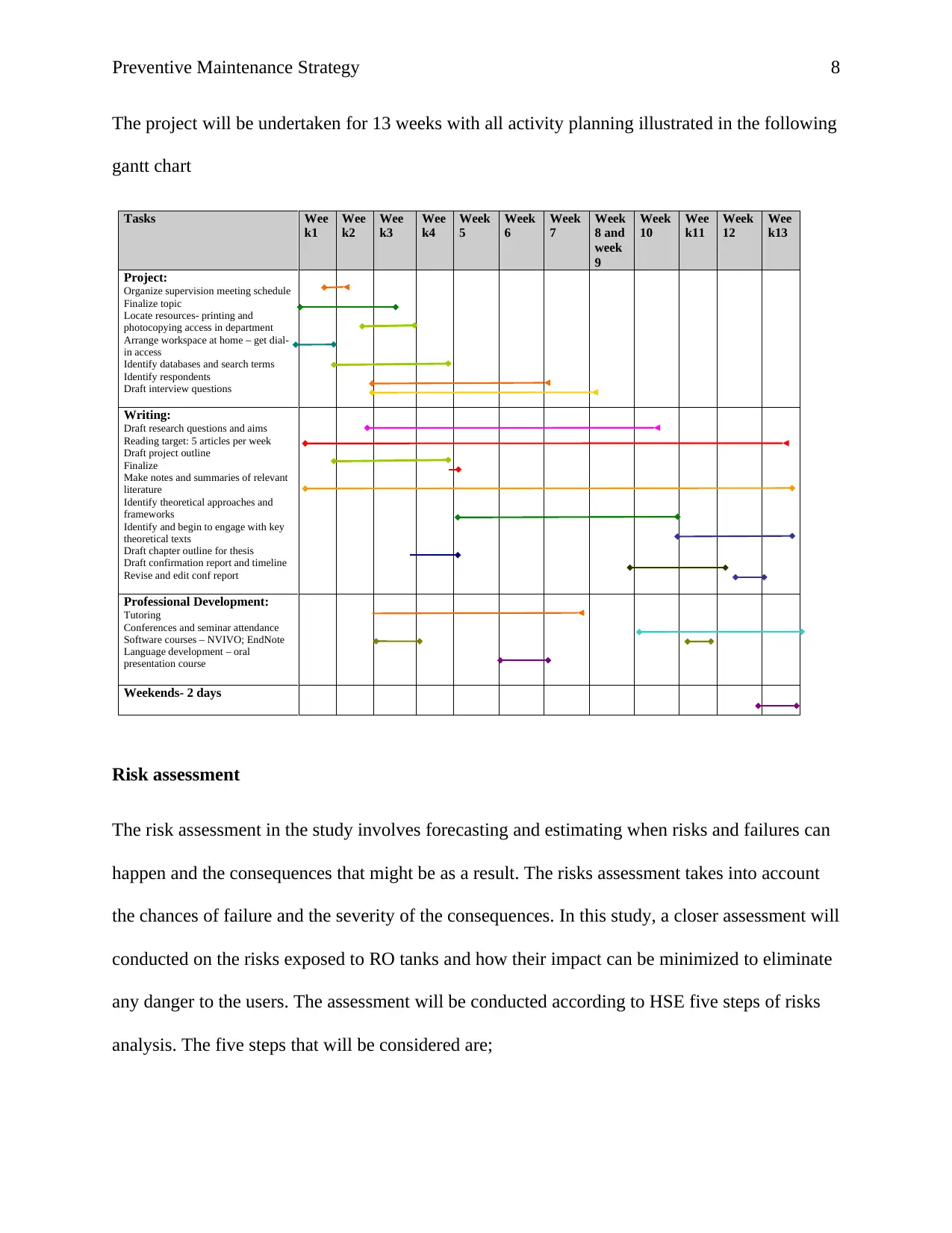
The project will be undertaken for 13 weeks with all activity planning illustrated in the following
gantt chart
Tasks Wee
k1
Wee
k2
Wee
k3
Wee
k4
Week
5
Week
6
Week
7
Week
8 and
week
9
Week
10
Wee
k11
Week
12
Wee
k13
Project:
Organize supervision meeting schedule
Finalize topic
Locate resources- printing and
photocopying access in department
Arrange workspace at home – get dial-
in access
Identify databases and search terms
Identify respondents
Draft interview questions
Writing:
Draft research questions and aims
Reading target: 5 articles per week
Draft project outline
Finalize
Make notes and summaries of relevant
literature
Identify theoretical approaches and
frameworks
Identify and begin to engage with key
theoretical texts
Draft chapter outline for thesis
Draft confirmation report and timeline
Revise and edit conf report
Professional Development:
Tutoring
Conferences and seminar attendance
Software courses – NVIVO; EndNote
Language development – oral
presentation course
Weekends- 2 days
Risk assessment
The risk assessment in the study involves forecasting and estimating when risks and failures can
happen and the consequences that might be as a result. The risks assessment takes into account
the chances of failure and the severity of the consequences. In this study, a closer assessment will
conducted on the risks exposed to RO tanks and how their impact can be minimized to eliminate
any danger to the users. The assessment will be conducted according to HSE five steps of risks
analysis. The five steps that will be considered are;
The project will be undertaken for 13 weeks with all activity planning illustrated in the following
gantt chart
Tasks Wee
k1
Wee
k2
Wee
k3
Wee
k4
Week
5
Week
6
Week
7
Week
8 and
week
9
Week
10
Wee
k11
Week
12
Wee
k13
Project:
Organize supervision meeting schedule
Finalize topic
Locate resources- printing and
photocopying access in department
Arrange workspace at home – get dial-
in access
Identify databases and search terms
Identify respondents
Draft interview questions
Writing:
Draft research questions and aims
Reading target: 5 articles per week
Draft project outline
Finalize
Make notes and summaries of relevant
literature
Identify theoretical approaches and
frameworks
Identify and begin to engage with key
theoretical texts
Draft chapter outline for thesis
Draft confirmation report and timeline
Revise and edit conf report
Professional Development:
Tutoring
Conferences and seminar attendance
Software courses – NVIVO; EndNote
Language development – oral
presentation course
Weekends- 2 days
Risk assessment
The risk assessment in the study involves forecasting and estimating when risks and failures can
happen and the consequences that might be as a result. The risks assessment takes into account
the chances of failure and the severity of the consequences. In this study, a closer assessment will
conducted on the risks exposed to RO tanks and how their impact can be minimized to eliminate
any danger to the users. The assessment will be conducted according to HSE five steps of risks
analysis. The five steps that will be considered are;
Preventive Maintenance Strategy 9
i. Risk identification- area visit to the tank to be done to identify the processes taking
place and look for possible scenarios that could cause harm.
ii. Risk estimation- the harmful scenario is estimated to gauge its seriousness and
prioritization and mitigation measures put in place according to their priority
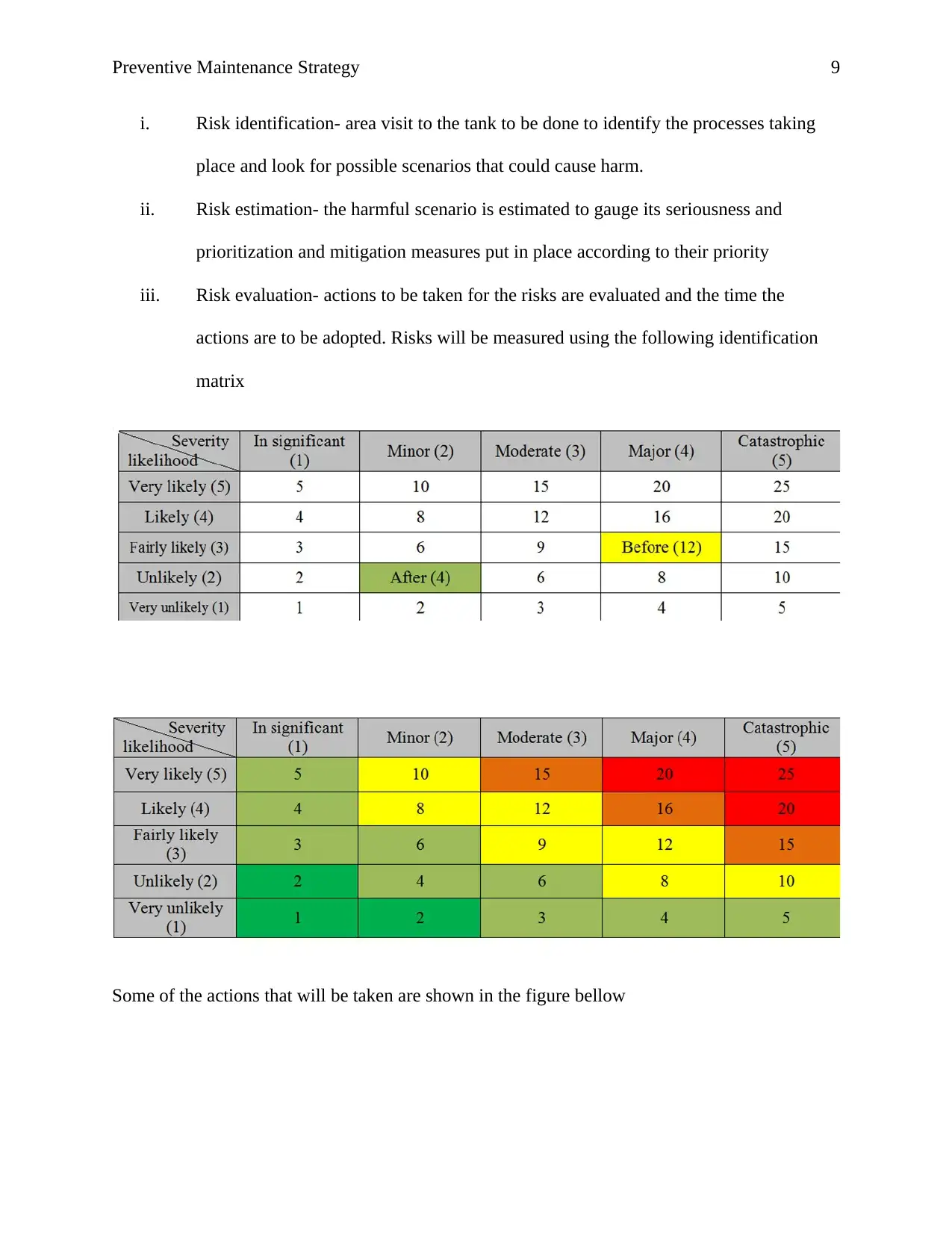
iii. Risk evaluation- actions to be taken for the risks are evaluated and the time the
actions are to be adopted. Risks will be measured using the following identification
matrix
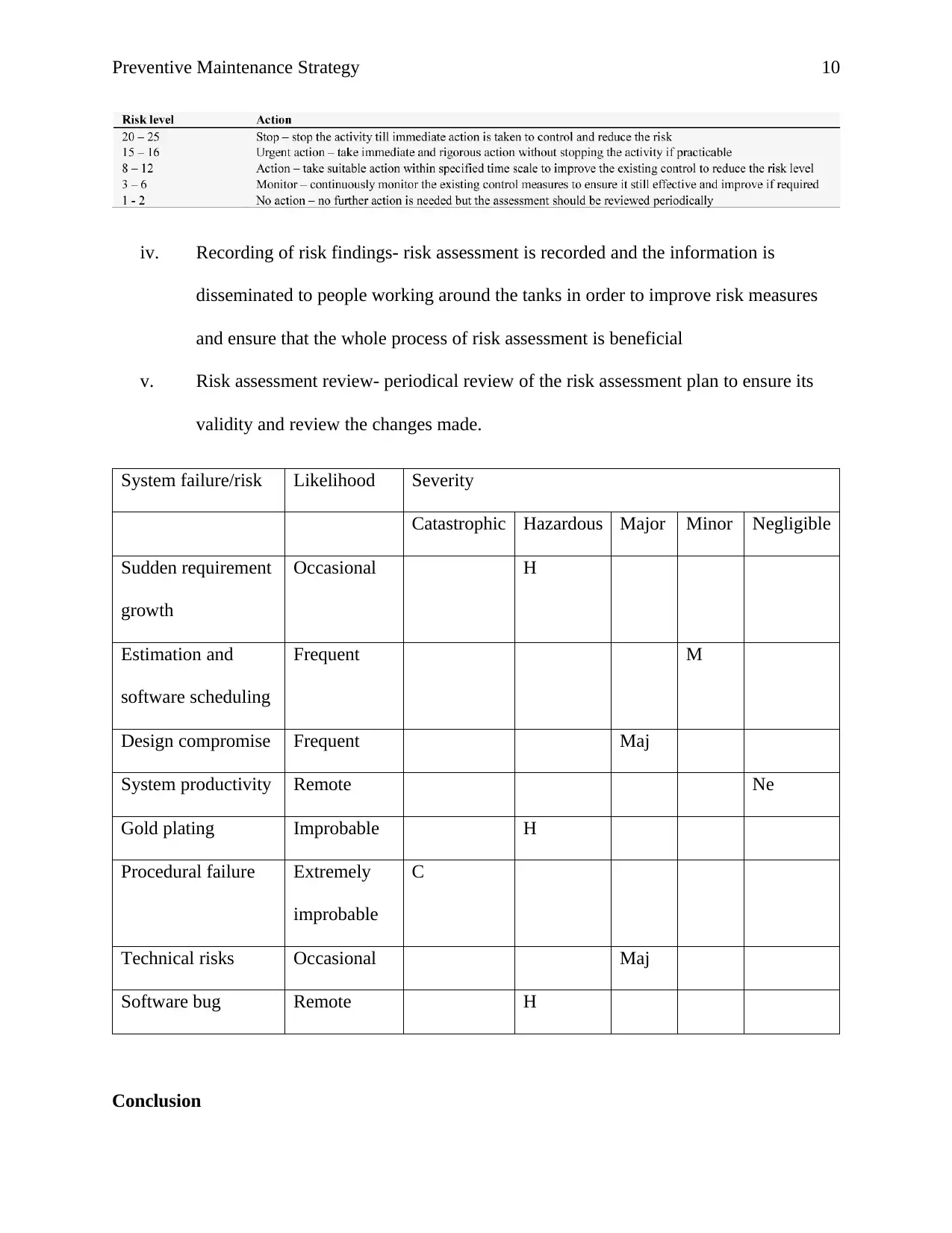
Some of the actions that will be taken are shown in the figure bellow
i. Risk identification- area visit to the tank to be done to identify the processes taking
place and look for possible scenarios that could cause harm.
ii. Risk estimation- the harmful scenario is estimated to gauge its seriousness and
prioritization and mitigation measures put in place according to their priority
iii. Risk evaluation- actions to be taken for the risks are evaluated and the time the
actions are to be adopted. Risks will be measured using the following identification
matrix
Some of the actions that will be taken are shown in the figure bellow
⊘ This is a preview!⊘
Do you want full access?
Subscribe today to unlock all pages.
Trusted by 1+ million students worldwide
Preventive Maintenance Strategy 10
iv. Recording of risk findings- risk assessment is recorded and the information is
disseminated to people working around the tanks in order to improve risk measures
and ensure that the whole process of risk assessment is beneficial
v. Risk assessment review- periodical review of the risk assessment plan to ensure its
validity and review the changes made.
System failure/risk Likelihood Severity
Catastrophic Hazardous Major Minor Negligible
Sudden requirement
growth
Occasional H
Estimation and
software scheduling
Frequent M
Design compromise Frequent Maj
System productivity Remote Ne
Gold plating Improbable H
Procedural failure Extremely
improbable
C
Technical risks Occasional Maj
Software bug Remote H
Conclusion
iv. Recording of risk findings- risk assessment is recorded and the information is
disseminated to people working around the tanks in order to improve risk measures
and ensure that the whole process of risk assessment is beneficial
v. Risk assessment review- periodical review of the risk assessment plan to ensure its
validity and review the changes made.
System failure/risk Likelihood Severity
Catastrophic Hazardous Major Minor Negligible
Sudden requirement
growth
Occasional H
Estimation and
software scheduling
Frequent M
Design compromise Frequent Maj
System productivity Remote Ne
Gold plating Improbable H
Procedural failure Extremely
improbable
C
Technical risks Occasional Maj
Software bug Remote H
Conclusion
Paraphrase This Document
Need a fresh take? Get an instant paraphrase of this document with our AI Paraphraser
Preventive Maintenance Strategy 11
In this study, the primary focus will be on the methods employed and the and the possible
problem optimization during the preventive maintenance strategy. Furthermore, this study will
dwell on exploring various avenues required to improve various maintenance approaches. A
number of literature materials have proofed that a preventive maintenance strategy is of great
concern in the world of software system development. It also portrays the overall industry
interests. In the literature review, it is clear that several studies have been conducted but the
methodologies used have been difficult to implement. In this study, a more traditional and
reserved method will be adopted in analyzing the available variables. the methodology will help
in comprehensively analyzing preventive maintenance strategy with ease taking into action the
life span of the software.
In this study, the primary focus will be on the methods employed and the and the possible
problem optimization during the preventive maintenance strategy. Furthermore, this study will
dwell on exploring various avenues required to improve various maintenance approaches. A
number of literature materials have proofed that a preventive maintenance strategy is of great
concern in the world of software system development. It also portrays the overall industry
interests. In the literature review, it is clear that several studies have been conducted but the
methodologies used have been difficult to implement. In this study, a more traditional and
reserved method will be adopted in analyzing the available variables. the methodology will help
in comprehensively analyzing preventive maintenance strategy with ease taking into action the
life span of the software.
Preventive Maintenance Strategy 12
References
Aghezzaf, E., Khatab, A., and Le, P. (2016). Optimizing production and imperfect preventive
maintenance planning ’ s integration in failure-prone manufacturing systems, 145, 190–198.
Ahuja, I. P. S., and Khamba, J. S. (2015). Strategies and success factors for overcoming
challenges in TPM implementation in Indian manufacturing industry. Journal of Quality in
Maintenance Engineering, 14(2), 123–147.
Azadeh, A., Asadzadeh, S. M., Salehi, N., and Firoozi, M. (2015). Condition-based
maintenance effectiveness for series – parallel power generation system — A combined
Markovian simulation model. Reliability Engineering and System Safety, 142, 357–368.
Besnard, F. (2013). On maintenance optimization for offshore wind farms. Retrieved from
http://www.elforsk.se/Global/Vindforsk/Rapporter VFIII/V_327_Besnard_Phd_thesis.pdf
137 The 7th International Conference on Operations and Supply Chain Management 2016,
Phuket Thailand
Chang, C. (2014). Optimum preventive maintenance policies for systems subject to random
working times , replacement , and minimal repair q. Computers and Industrial Engineering, 67,
185–194.
Chang, W., and Lo, H. (2017). Joint determination of lease period and preventive maintenance
policy for leased equipment with residual value. Computers and Industrial Engineering, 61(3),
489–496.
References
Aghezzaf, E., Khatab, A., and Le, P. (2016). Optimizing production and imperfect preventive
maintenance planning ’ s integration in failure-prone manufacturing systems, 145, 190–198.
Ahuja, I. P. S., and Khamba, J. S. (2015). Strategies and success factors for overcoming
challenges in TPM implementation in Indian manufacturing industry. Journal of Quality in
Maintenance Engineering, 14(2), 123–147.
Azadeh, A., Asadzadeh, S. M., Salehi, N., and Firoozi, M. (2015). Condition-based
maintenance effectiveness for series – parallel power generation system — A combined
Markovian simulation model. Reliability Engineering and System Safety, 142, 357–368.
Besnard, F. (2013). On maintenance optimization for offshore wind farms. Retrieved from
http://www.elforsk.se/Global/Vindforsk/Rapporter VFIII/V_327_Besnard_Phd_thesis.pdf
137 The 7th International Conference on Operations and Supply Chain Management 2016,
Phuket Thailand
Chang, C. (2014). Optimum preventive maintenance policies for systems subject to random
working times , replacement , and minimal repair q. Computers and Industrial Engineering, 67,
185–194.
Chang, W., and Lo, H. (2017). Joint determination of lease period and preventive maintenance
policy for leased equipment with residual value. Computers and Industrial Engineering, 61(3),
489–496.
⊘ This is a preview!⊘
Do you want full access?
Subscribe today to unlock all pages.
Trusted by 1+ million students worldwide

1 out of 14


Related Documents


![Stakeholder Meeting and Issue Analysis Project Report - [Course Name]](/_next/image/?url=https%3A%2F%2Fdesklib.com%2Fmedia%2Fimages%2Frc%2F709198fbc6594ba387713f230747590f.jpg&w=256&q=75)


Your All-in-One AI-Powered Toolkit for Academic Success.
+13062052269
info@desklib.com
Available 24*7 on WhatsApp / Email
![[object Object]](/_next/static/media/star-bottom.7253800d.svg)
Unlock your academic potential
Copyright © 2020–2025 A2Z Services. All Rights Reserved. Developed and managed by ZUCOL.