Quantitative Research Methods in Psychology: Ambiguous Figures Report

Verified

Added on  2022/08/29

|6
|945
|20
Report
AI Summary
This report investigates the effect of priming on the perception of ambiguous figures, focusing on an experiment conducted to determine whether priming influences how individuals interpret ambiguous images. The study involved two conditions: a priming condition where participants were shown an image related to one aspect of the ambiguous figure, and a control condition with an unrelated image. Participants were then presented with the ambiguous image and asked to identify what they saw first. The report analyzes the experimental design, including the independent and dependent variables (priming condition and the participant's response), hypothesis, and methodology, and reviews relevant literature on ambiguous figures and visual perception. The study's aim is to explore how prior exposure to an image (priming) affects the initial interpretation of ambiguous figures, and this report examines the theoretical basis for this effect, including the cognitive processes involved. It also includes the references from the journals and books used in the study.
Document Page
RUNNING HEAD: - Perception of Ambiguous Figures 1 | P a g e
Perception of
ambiguous figures
tabler-icon-diamond-filled.svg

Paraphrase This Document

Need a fresh take? Get an instant paraphrase of this document with our AI Paraphraser
Document Page
Perception of Ambiguous Figures 2 | P a g e
Document Page
Perception of Ambiguous Figures 1 | P a g e
INTRODUCTION
Ambiguous images are also known as reversible figures which represent the single image
into different modes due to which it’s very hard to determine the picture in a corrective manner.
However, pictures can be interpreted in more than one way because several sensory and
cognitive processes are engaged in explaining exactly how a similar image is going to be
organized in multiple ways. These processes always work in both top-down and bottom-up ways
for influencing what an individual has seen. Thus the main purpose of the study is to analyse the
initial perspective of a person after seeing the “ambiguous figure”. This help the researcher in
forecasting the psychology by considering several articles related to the illusion of ambiguous
figures (Meeter, & Olivers, 2016). For example; Nathalia Gjersoe is an author who has
expressed her opinion on pictures that represent multiple meanings and the name of her
article is “Ambiguous figure illusions: do they offer a window on the mind?
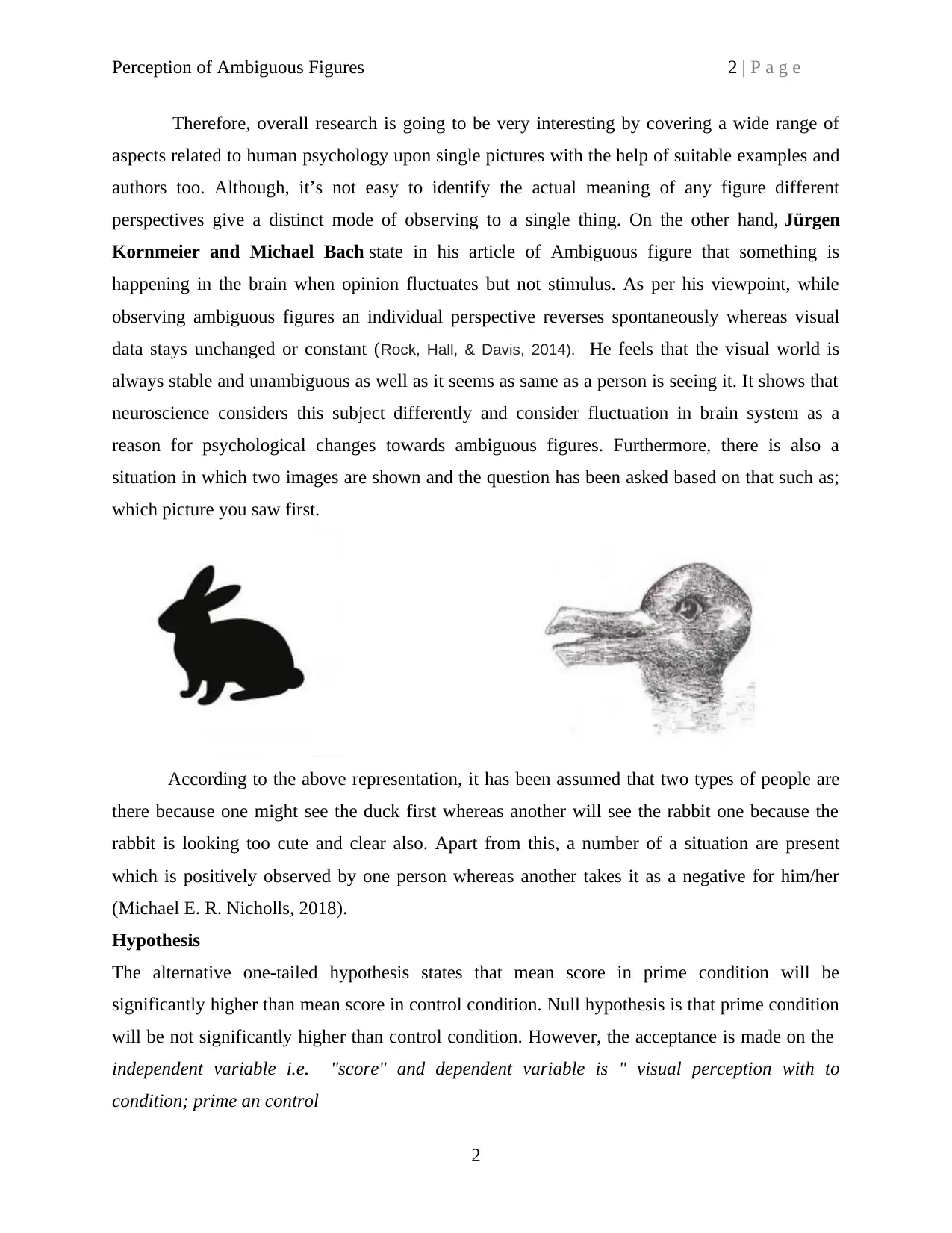
Figure 1Ambiguous figure illusions: do they offer a window on the mind?
(Source: - Nathalia Gjersoe, 2016)
According to the opinion of the author, this above image is also known as “My wife and
my Mother-in-law” which shows that the picture has been depicted in two different ways. One
side of the figure highlights a new lady observing back over her shoulder whereas another side
represents the profile of an elder lady who is looking down (Meng, & Tong, 2014).
1
Document Page
Perception of Ambiguous Figures 2 | P a g e
Therefore, overall research is going to be very interesting by covering a wide range of
aspects related to human psychology upon single pictures with the help of suitable examples and
authors too. Although, it’s not easy to identify the actual meaning of any figure different
perspectives give a distinct mode of observing to a single thing. On the other hand, Jürgen
Kornmeier and Michael Bach state in his article of Ambiguous figure that something is
happening in the brain when opinion fluctuates but not stimulus. As per his viewpoint, while
observing ambiguous figures an individual perspective reverses spontaneously whereas visual
data stays unchanged or constant (Rock, Hall, & Davis, 2014). He feels that the visual world is
always stable and unambiguous as well as it seems as same as a person is seeing it. It shows that
neuroscience considers this subject differently and consider fluctuation in brain system as a
reason for psychological changes towards ambiguous figures. Furthermore, there is also a
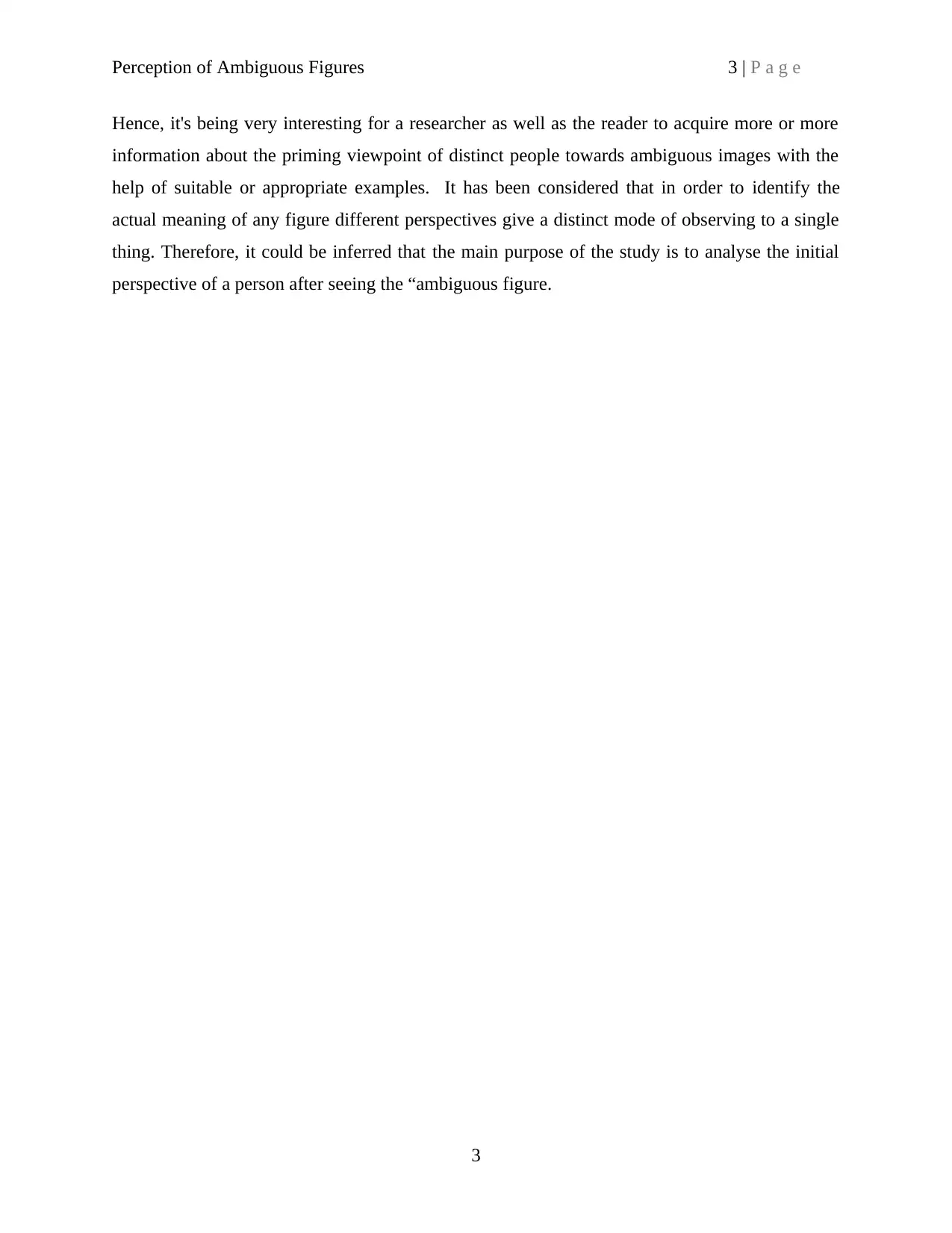
situation in which two images are shown and the question has been asked based on that such as;
which picture you saw first.
According to the above representation, it has been assumed that two types of people are
there because one might see the duck first whereas another will see the rabbit one because the
rabbit is looking too cute and clear also. Apart from this, a number of a situation are present
which is positively observed by one person whereas another takes it as a negative for him/her
(Michael E. R. Nicholls, 2018).
Hypothesis
The alternative one-tailed hypothesis states that mean score in prime condition will be
significantly higher than mean score in control condition. Null hypothesis is that prime condition
will be not significantly higher than control condition. However, the acceptance is made on the
independent variable i.e. "score" and dependent variable is " visual perception with to
condition; prime an control
2
tabler-icon-diamond-filled.svg

Paraphrase This Document

Need a fresh take? Get an instant paraphrase of this document with our AI Paraphraser
Document Page
Perception of Ambiguous Figures 3 | P a g e
Hence, it's being very interesting for a researcher as well as the reader to acquire more or more
information about the priming viewpoint of distinct people towards ambiguous images with the
help of suitable or appropriate examples. It has been considered that in order to identify the
actual meaning of any figure different perspectives give a distinct mode of observing to a single
thing. Therefore, it could be inferred that the main purpose of the study is to analyse the initial
perspective of a person after seeing the “ambiguous figure.
3
Document Page
Perception of Ambiguous Figures 4 | P a g e
REFERENCES
Books and Journals:
Jürgen Kornmeier and Michael Bach, 2012. Ambiguous figures – what happens in the brain
when perception changes but not the stimulus. [Online]. Available through<
https://www.frontiersin.org/articles/10.3389/fnhum.2012.00051/full >.
Nathalia Gjersoe, 2016. Ambiguous figure illusions: do they offer a window on the mind?
[Online]. Available through<https://www.theguardian.com/science/head-quarters/2016/oct/03/
ambiguous-figure-illusions-do-they-offer-a-window-on-the-mind >.
Michael E. R. Nicholls, 2018. Perception of an ambiguous figure is affected by own-age social
biases. [Online]. Available through<https://www.nature.com/articles/s41598-018-31129-7 >.
Meeter, M., & Olivers, C. N. (2016). Intertrial priming stemming from ambiguity: A new account of priming
in visual search. Visual Cognition, 13(2), 202-222.
Meng, M., & Tong, F. (2014). Can attention selectively bias bistable perception? Differences between
binocular rivalry and ambiguous figures. Journal of vision, 4(7), 2-2.
Rock, I., Hall, S., & Davis, J. (2014). Why do ambiguous figures reverse?. Acta psychologica, 87(1), 33-
59.
4
chevron_up_icon
1 out of 6
circle_padding
hide_on_mobile
zoom_out_icon
[object Object]