Principles of Administration Report: Legal and Management Aspects
VerifiedAdded on 2020/07/23
|13
|3030
|305
Report
AI Summary
This report delves into the core principles of administration, outlining the legal requirements and management practices essential for organizational success. It explores various aspects, including the Equality and Discrimination Act, Employment Rights Act, and Data Protection Act, emphasizing the importance of adhering to legal norms. The report covers document preparation, data entry, accounting, and workplace safety, highlighting the responsibilities of both managers and employees. It further examines resource planning, meeting facilitation, and the roles of chairpersons and participants in formal and informal meetings. The report also discusses the significance of accurate minute-taking and the tools used by managers during meetings, providing a comprehensive overview of effective administration.

Principles of administration

Paraphrase This Document
Need a fresh take? Get an instant paraphrase of this document with our AI Paraphraser
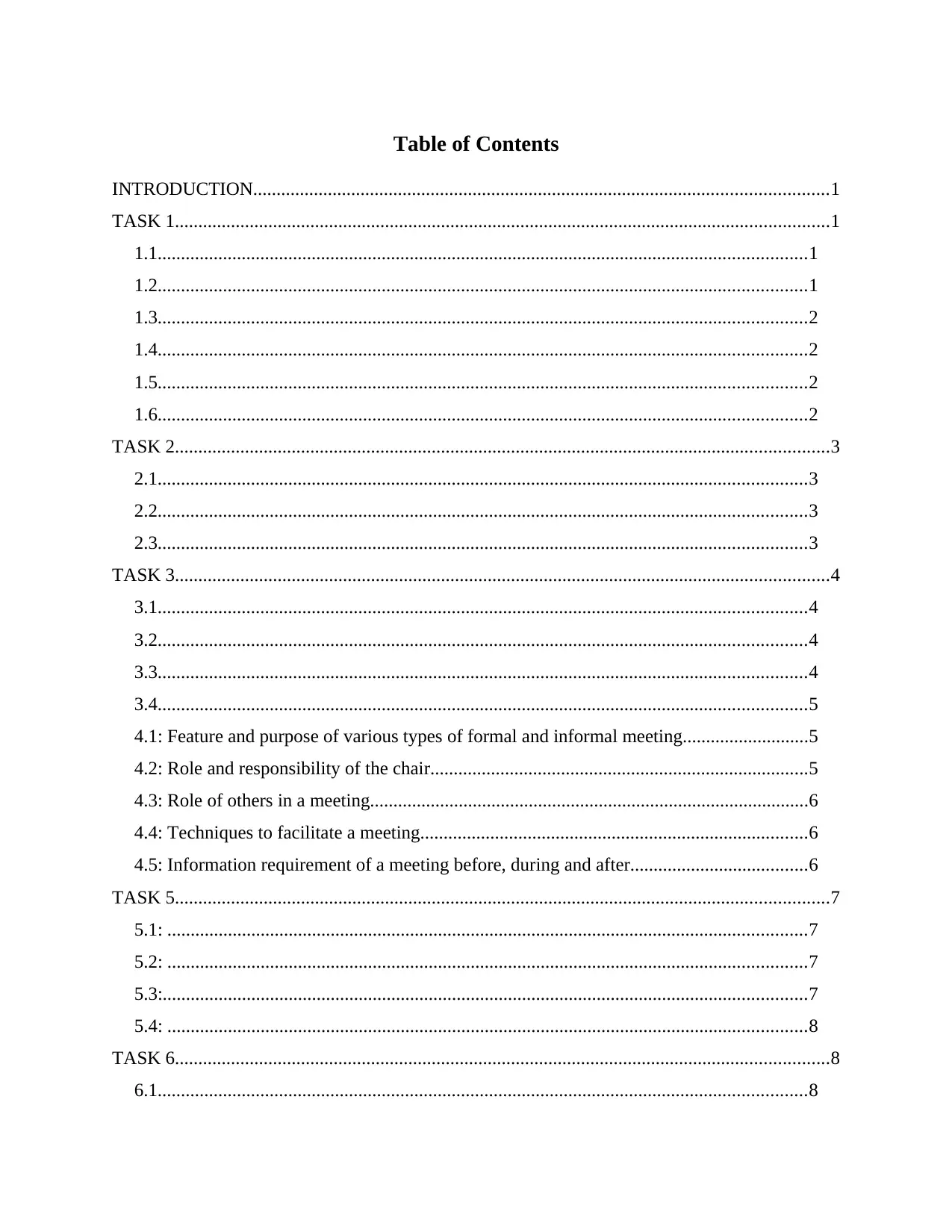
Table of Contents
INTRODUCTION...........................................................................................................................1
TASK 1............................................................................................................................................1
1.1...........................................................................................................................................1
1.2...........................................................................................................................................1
1.3...........................................................................................................................................2
1.4...........................................................................................................................................2
1.5...........................................................................................................................................2
1.6...........................................................................................................................................2
TASK 2............................................................................................................................................3
2.1...........................................................................................................................................3
2.2...........................................................................................................................................3
2.3...........................................................................................................................................3
TASK 3............................................................................................................................................4
3.1...........................................................................................................................................4
3.2...........................................................................................................................................4
3.3...........................................................................................................................................4
3.4...........................................................................................................................................5
4.1: Feature and purpose of various types of formal and informal meeting...........................5
4.2: Role and responsibility of the chair.................................................................................5
4.3: Role of others in a meeting..............................................................................................6
4.4: Techniques to facilitate a meeting...................................................................................6
4.5: Information requirement of a meeting before, during and after......................................6
TASK 5............................................................................................................................................7
5.1: .........................................................................................................................................7
5.2: .........................................................................................................................................7
5.3:..........................................................................................................................................7
5.4: .........................................................................................................................................8
TASK 6............................................................................................................................................8
6.1...........................................................................................................................................8
INTRODUCTION...........................................................................................................................1
TASK 1............................................................................................................................................1
1.1...........................................................................................................................................1
1.2...........................................................................................................................................1
1.3...........................................................................................................................................2
1.4...........................................................................................................................................2
1.5...........................................................................................................................................2
1.6...........................................................................................................................................2
TASK 2............................................................................................................................................3
2.1...........................................................................................................................................3
2.2...........................................................................................................................................3
2.3...........................................................................................................................................3
TASK 3............................................................................................................................................4
3.1...........................................................................................................................................4
3.2...........................................................................................................................................4
3.3...........................................................................................................................................4
3.4...........................................................................................................................................5
4.1: Feature and purpose of various types of formal and informal meeting...........................5
4.2: Role and responsibility of the chair.................................................................................5
4.3: Role of others in a meeting..............................................................................................6
4.4: Techniques to facilitate a meeting...................................................................................6
4.5: Information requirement of a meeting before, during and after......................................6
TASK 5............................................................................................................................................7
5.1: .........................................................................................................................................7
5.2: .........................................................................................................................................7
5.3:..........................................................................................................................................7
5.4: .........................................................................................................................................8
TASK 6............................................................................................................................................8
6.1...........................................................................................................................................8

6.2...........................................................................................................................................8
6.3...........................................................................................................................................8
CONCLUSION................................................................................................................................8
REFERENCES................................................................................................................................9
6.3...........................................................................................................................................8
CONCLUSION................................................................................................................................8
REFERENCES................................................................................................................................9
⊘ This is a preview!⊘
Do you want full access?
Subscribe today to unlock all pages.

Trusted by 1+ million students worldwide
INTRODUCTION
Principles of administrations are the set of standards principles which helps the firm to
identify the work of the management in a firm. The key responsibilities of the administers is to
renders an effective performance of entire department in a company. This report comprises legal
needs and tools which the firm to adhere.
TASK 1
1.1
Every company needs to adhere the legal norms and policies in an organisation by way of
management. There are certain legal requirements which are needed to required by the
management.
Equality and discrimination Act: All firms are required to adhere Equlity and
discrimination act for sustainability purposes and also eliminating the prosecution ( Forrow, and
et. al., 2012).
Employment Rights Act 1996: The Employment Rights Act 1996 is as an Act of
Parliament go by the British government to formally classify the current law on singular worker
rights in the United Kingdom.
Employment Relations Act 2004: An Act to alter the law identifying with the acknowledgement
of exchange unions and the making of mechanical move; to make arrangement about methods
for voting in tallies under the Trade Union and Labor Relations (Consolidation) Act 1992.
Data Protection Act 1998: This law is a United Kingdom Act of parliament intended to
secure individual information put away on PCs or in a sorted out paper documenting framework.
1.2
Report creation: Document Preparation is the way toward planning archives for
imaging. Records that are not appropriately arranged can harm costly imaging gear and
can adversely influence the general nature of pictures.
Data Entry: An information section assistant, like a typist, is an individual from staff
utilized to enter or refresh information into a PC framework database, frequently from
paper archives utilizing a console, optical scanner, or information recorder.
Accounting: It is the chronicle of money related exchanges, and is a piece of the way
toward bookkeeping in business.
1
Principles of administrations are the set of standards principles which helps the firm to
identify the work of the management in a firm. The key responsibilities of the administers is to
renders an effective performance of entire department in a company. This report comprises legal
needs and tools which the firm to adhere.
TASK 1
1.1
Every company needs to adhere the legal norms and policies in an organisation by way of
management. There are certain legal requirements which are needed to required by the
management.
Equality and discrimination Act: All firms are required to adhere Equlity and
discrimination act for sustainability purposes and also eliminating the prosecution ( Forrow, and
et. al., 2012).
Employment Rights Act 1996: The Employment Rights Act 1996 is as an Act of
Parliament go by the British government to formally classify the current law on singular worker
rights in the United Kingdom.
Employment Relations Act 2004: An Act to alter the law identifying with the acknowledgement
of exchange unions and the making of mechanical move; to make arrangement about methods
for voting in tallies under the Trade Union and Labor Relations (Consolidation) Act 1992.
Data Protection Act 1998: This law is a United Kingdom Act of parliament intended to
secure individual information put away on PCs or in a sorted out paper documenting framework.
1.2
Report creation: Document Preparation is the way toward planning archives for
imaging. Records that are not appropriately arranged can harm costly imaging gear and
can adversely influence the general nature of pictures.
Data Entry: An information section assistant, like a typist, is an individual from staff
utilized to enter or refresh information into a PC framework database, frequently from
paper archives utilizing a console, optical scanner, or information recorder.
Accounting: It is the chronicle of money related exchanges, and is a piece of the way
toward bookkeeping in business.
1
Paraphrase This Document
Need a fresh take? Get an instant paraphrase of this document with our AI Paraphraser
1.3
Work Safety and Security: Each representative has to know the area of the crisis exits,first-help
packs, fire extinguishers and other security devices and in addition departure methodology. It's
additionally critical to train workers on security methods at the workplace.
Supply ordering: Each representative ought to have finish data on your standard providers for
different necessities at the organization and recognition with the way toward creating buy orders
(Nolan, 2014).
Invoice processing: When merchants send solicitations to your organization's records payable
division, you ought to have a clear method for confirming these solicitations and submitting
instalment on time.
1.4
The assets, for example, Equipment, Materials, Staff and Members which are utilized by an
association is basically required to oversee them in following ways:
Set a benchmark to work out your present execution.
Benchmark your execution against comparable associations
Make an activity intend to accomplish your recognized changes
1.5
Communication: It is of the utmost importance for any business to run easily. It is basic
everybody in the workplace comprehends the principles and procedures. An effective
business urges representatives to let each other recognize what they are really going after,
answer any inquiries others may have and habitually answer to their administrator.
Efficient Employees: Staying on task seems to be a challenge for many employees.
There are many distractions they face each day including Facebook, text messages and
social interactions.
Frequent Training: When employees are trained on the rules and processes of your
company, they will feel more comfortable and less intimidated by their work.
1.6 Counselling: Consultation is a two-way process, allowing staff to raise concerns and
influence decisions on the management of health and safety.
2
Work Safety and Security: Each representative has to know the area of the crisis exits,first-help
packs, fire extinguishers and other security devices and in addition departure methodology. It's
additionally critical to train workers on security methods at the workplace.
Supply ordering: Each representative ought to have finish data on your standard providers for
different necessities at the organization and recognition with the way toward creating buy orders
(Nolan, 2014).
Invoice processing: When merchants send solicitations to your organization's records payable
division, you ought to have a clear method for confirming these solicitations and submitting
instalment on time.
1.4
The assets, for example, Equipment, Materials, Staff and Members which are utilized by an
association is basically required to oversee them in following ways:
Set a benchmark to work out your present execution.
Benchmark your execution against comparable associations
Make an activity intend to accomplish your recognized changes
1.5
Communication: It is of the utmost importance for any business to run easily. It is basic
everybody in the workplace comprehends the principles and procedures. An effective
business urges representatives to let each other recognize what they are really going after,
answer any inquiries others may have and habitually answer to their administrator.
Efficient Employees: Staying on task seems to be a challenge for many employees.
There are many distractions they face each day including Facebook, text messages and
social interactions.
Frequent Training: When employees are trained on the rules and processes of your
company, they will feel more comfortable and less intimidated by their work.
1.6 Counselling: Consultation is a two-way process, allowing staff to raise concerns and
influence decisions on the management of health and safety.
2
Staff discounts : Employee discount means the discount given in the original price of the
goods or services by the company to their employees. Generally an employee discount is
given as one of the fringe benefits.
Provide training and information: Everyone who works for you needs to know how to
work safely and without risks to health. You must provide clear instructions and
information, and adequate training, for your employees.
TASK 2
2.1
Managers have obligations under well-being and security law to evaluate chances in the
working environment. Hazard evaluations ought to be completed that address all dangers that
may cause hurt in your working environment.
Managers must give you data about the dangers in your work environment and how you are
ensured, likewise educate and prepare you on the most proficient method to manage the dangers.
2.2
Obligations of representatives for well-being and security in the work put are as per the
following:
Take sensible care inside the work environment: this implies you have to limit well-being
and dangers. For instance, you should ensure there are no trailing wires around your workstation
and that you don't make any excursion perils in walkways (Sinha, and Labi, 2011).
Make appropriate utilization of gear: Employer ought to give preparing to you to utilize
any master hardware. It is your obligation to ensure you utilize the hardware in a legitimate and
safe way.
Collaborate with your boss: Employer may have work environment arrangements to
decrease well-being and dangers, report mischances, and so on., and it is your duty to follow
these.
2.3
Rescue: If you are involved in or close to a major incident and there is immediate danger to:- yourself - move to safety, first, above all else.
3
goods or services by the company to their employees. Generally an employee discount is
given as one of the fringe benefits.
Provide training and information: Everyone who works for you needs to know how to
work safely and without risks to health. You must provide clear instructions and
information, and adequate training, for your employees.
TASK 2
2.1
Managers have obligations under well-being and security law to evaluate chances in the
working environment. Hazard evaluations ought to be completed that address all dangers that
may cause hurt in your working environment.
Managers must give you data about the dangers in your work environment and how you are
ensured, likewise educate and prepare you on the most proficient method to manage the dangers.
2.2
Obligations of representatives for well-being and security in the work put are as per the
following:
Take sensible care inside the work environment: this implies you have to limit well-being
and dangers. For instance, you should ensure there are no trailing wires around your workstation
and that you don't make any excursion perils in walkways (Sinha, and Labi, 2011).
Make appropriate utilization of gear: Employer ought to give preparing to you to utilize
any master hardware. It is your obligation to ensure you utilize the hardware in a legitimate and
safe way.
Collaborate with your boss: Employer may have work environment arrangements to
decrease well-being and dangers, report mischances, and so on., and it is your duty to follow
these.
2.3
Rescue: If you are involved in or close to a major incident and there is immediate danger to:- yourself - move to safety, first, above all else.
3
⊘ This is a preview!⊘
Do you want full access?
Subscribe today to unlock all pages.
Trusted by 1+ million students worldwide
somebody else – if it does not pose a threat to yourself assist any casualty. Assess
condition and administer appropriate first aid and/or inform First Aid Officers and
Security.
Alarm: If you are involved in or close to a major incident contact Security on their emergency
phone number 4950. Report the:-
Exact location
Type
Extent
of the emergency. Also give name and designation. If possible, locate a Building warden and
inform him/her of the incident.
TASK 3
3.1
The fundamental object is initially to record Action Points, i.e., what activities have been
chosen, who is mindful and what the developments and due dates are. Also they record rundown
of the dialogues held at the gathering. Taking minutes is a gifted activity in light of the fact that
the moment taker needs to take after what can be befuddling and incoherent level headed
discussions and compress precisely information disclosed.
3.2
Organisational requirements will probably dictate that minutes are taken at formal
meetings while some meeting this will be compulsory due to a legal; requirement under the
Freedom of Information act 2000 or Companies Act. In effect public authorities have 20working
days to respond to an information request.
3.3
Significance of precision in minute taking:
Lawful Protection: In critical lawful or conferences, recording the gathering minutes
offers insurance. Minutes record the activities of the board and the authority, which is the
reason they are viewed as authoritative reports by courts, inspectors, and the Internal
Revenue Service (IRS).
4
condition and administer appropriate first aid and/or inform First Aid Officers and
Security.
Alarm: If you are involved in or close to a major incident contact Security on their emergency
phone number 4950. Report the:-
Exact location
Type
Extent
of the emergency. Also give name and designation. If possible, locate a Building warden and
inform him/her of the incident.
TASK 3
3.1
The fundamental object is initially to record Action Points, i.e., what activities have been
chosen, who is mindful and what the developments and due dates are. Also they record rundown
of the dialogues held at the gathering. Taking minutes is a gifted activity in light of the fact that
the moment taker needs to take after what can be befuddling and incoherent level headed
discussions and compress precisely information disclosed.
3.2
Organisational requirements will probably dictate that minutes are taken at formal
meetings while some meeting this will be compulsory due to a legal; requirement under the
Freedom of Information act 2000 or Companies Act. In effect public authorities have 20working
days to respond to an information request.
3.3
Significance of precision in minute taking:
Lawful Protection: In critical lawful or conferences, recording the gathering minutes
offers insurance. Minutes record the activities of the board and the authority, which is the
reason they are viewed as authoritative reports by courts, inspectors, and the Internal
Revenue Service (IRS).
4
Paraphrase This Document
Need a fresh take? Get an instant paraphrase of this document with our AI Paraphraser
Structure: Detailed gathering minutes will add structure to a gathering as it is occurring.
On the off chance that you take minutes at each gathering and record them a short time
later, you will have an accumulation of efficient archives that can be alluded to for quite a
long time and decades to come (Andrews, 2010).
Planning: Because very much recorded minutes add clearness and association to
conferences, administration groups and workers can utilize the minutes to make
objectives and activity designs.
3.4
Utilize pen and paper: Using pen and paper is less meddling and less demanding to
utilize. Utilizing a tablet, scratch pad or PC while taking notes can make a divider
amongst you and the individual talking.
Learn shorthand: It's not only for court representatives or secretaries. Shorthand is as
yet important particularly when you're tuning in to a speaker who talks quick.
Simply feature the key focuses: Plot the diagram of your notes even before the
gathering begins. A decent beginning stage is to check the gathering's motivation (Goode,
2011). Approach the secretary or your supervisor for a duplicate so you would already be
able to isolate your notes as indicated by the plan's primary focuses even before the
gathering begins.
4.1:
A formal meeting is a pre-planned gathering of two or more people who have assembled
for the purpose of achieving a common goal through verbal interaction. The formal meeting
should meet all reporting functions of the organisation and provide leaders with a top down
strategy, while informal meetings can solve issues quickly if within the framework of the scope
of work. Informal meetings should not replace formal meetings but should enhance the
organisational goals not hinder. Both style of meetings should provide a positive progressive
approach to achieving the objectives of the organisational goals.
4.2:
The principal role of the Chairman of the Board is to manage and to provide leadership to
the Board of Directors of the Company. The Chairperson must ensure that the Management
Committee functions properly, that there is full participation during meetings, that all relevant
5
On the off chance that you take minutes at each gathering and record them a short time
later, you will have an accumulation of efficient archives that can be alluded to for quite a
long time and decades to come (Andrews, 2010).
Planning: Because very much recorded minutes add clearness and association to
conferences, administration groups and workers can utilize the minutes to make
objectives and activity designs.
3.4
Utilize pen and paper: Using pen and paper is less meddling and less demanding to
utilize. Utilizing a tablet, scratch pad or PC while taking notes can make a divider
amongst you and the individual talking.
Learn shorthand: It's not only for court representatives or secretaries. Shorthand is as
yet important particularly when you're tuning in to a speaker who talks quick.
Simply feature the key focuses: Plot the diagram of your notes even before the
gathering begins. A decent beginning stage is to check the gathering's motivation (Goode,
2011). Approach the secretary or your supervisor for a duplicate so you would already be
able to isolate your notes as indicated by the plan's primary focuses even before the
gathering begins.
4.1:
A formal meeting is a pre-planned gathering of two or more people who have assembled
for the purpose of achieving a common goal through verbal interaction. The formal meeting
should meet all reporting functions of the organisation and provide leaders with a top down
strategy, while informal meetings can solve issues quickly if within the framework of the scope
of work. Informal meetings should not replace formal meetings but should enhance the
organisational goals not hinder. Both style of meetings should provide a positive progressive
approach to achieving the objectives of the organisational goals.
4.2:
The principal role of the Chairman of the Board is to manage and to provide leadership to
the Board of Directors of the Company. The Chairperson must ensure that the Management
Committee functions properly, that there is full participation during meetings, that all relevant
5
matters are discussed and that effective decisions are made and carried out. The chair acts as an
important link between the board and the organisation's management via the CEO.
4.3:
It have been noticed that every company and organization conducts meetings regularly.
The chair will ask other participants for their input on the agenda.
Once the agenda is complete the chair/facilitator will ensure it is sent to all participants
before the meeting to review and prepare (Andrews, 2010).
Everyone has a role to play and responsibilities to perform in order to achieve meeting
success. The facilitator should try to remain neutral.
4.4:
There are necessary steps which are required to be taken in order to make effective
meeting. Some of them are:
Design a good agenda.
Be aware of both content and process.
Keep the group moving towards its aims.
Use a variety of facilitation tools to keep everyone interested.
Create a safe and empowering atmosphere to get the best contribution from everyone.
4.5:
During the meeting, managers uses the tools of a speaker's trade: openings, transitions,
closings. Although it may vary by committee, department or unit, there are seven key
responsibilities expected of chairs or team leaders before a meeting takes place (Goode, 2011).
After a meeting:
Distribute minutes. Ensure that minutes are produced and promptly distributed to all
attendees including guests.
Archive meeting documents.
Check on action.
Before meeting:
Clarify purpose and aims.
Create an agenda
Schedule the meeting.
6
important link between the board and the organisation's management via the CEO.
4.3:
It have been noticed that every company and organization conducts meetings regularly.
The chair will ask other participants for their input on the agenda.
Once the agenda is complete the chair/facilitator will ensure it is sent to all participants
before the meeting to review and prepare (Andrews, 2010).
Everyone has a role to play and responsibilities to perform in order to achieve meeting
success. The facilitator should try to remain neutral.
4.4:
There are necessary steps which are required to be taken in order to make effective
meeting. Some of them are:
Design a good agenda.
Be aware of both content and process.
Keep the group moving towards its aims.
Use a variety of facilitation tools to keep everyone interested.
Create a safe and empowering atmosphere to get the best contribution from everyone.
4.5:
During the meeting, managers uses the tools of a speaker's trade: openings, transitions,
closings. Although it may vary by committee, department or unit, there are seven key
responsibilities expected of chairs or team leaders before a meeting takes place (Goode, 2011).
After a meeting:
Distribute minutes. Ensure that minutes are produced and promptly distributed to all
attendees including guests.
Archive meeting documents.
Check on action.
Before meeting:
Clarify purpose and aims.
Create an agenda
Schedule the meeting.
6
⊘ This is a preview!⊘
Do you want full access?
Subscribe today to unlock all pages.
Trusted by 1+ million students worldwide
Post and send out agenda
Circulate supporting information
Arrange for recorder
TASK 5
5.1:
It is useful to have a physical plan on paper or electronically that you can use as reference
and to keep track of things you have and haven't done yet. Resource Planning can revolutionize
the way resources can be managed by employees, projects, and budget. They also motivate
employees to deliver a high quality service to all stakeholders as they understand the impact their
actions will have on the company's organisational targets.
5.2:
There are five criteria to think about as you think about distributing work. Some of them
are discussed underneath:
Priority: Priority needs to drive everything. If you’ve been rigorous in prioritization
process, start at the top of the list and begin allocating work from there (Hayek, 2012).
Availability: It is related with start shifting resources around between projects when
managers have available resources elsewhere, company is going to lose momentum on
that first project and that project might fail.
5.3:
Quality management ensures that an organization, product or service is consistent. It has
four main components:
Quality planning
Quality assurance
Quality control and
Quality improvement.
Quality administration is focused not only on product and service quality, but also on the
means to achieve it.
5.4:
The effective use of these tools and techniques requires useful communication tools that
help improvement teams understand the process and identify.
7
Circulate supporting information
Arrange for recorder
TASK 5
5.1:
It is useful to have a physical plan on paper or electronically that you can use as reference
and to keep track of things you have and haven't done yet. Resource Planning can revolutionize
the way resources can be managed by employees, projects, and budget. They also motivate
employees to deliver a high quality service to all stakeholders as they understand the impact their
actions will have on the company's organisational targets.
5.2:
There are five criteria to think about as you think about distributing work. Some of them
are discussed underneath:
Priority: Priority needs to drive everything. If you’ve been rigorous in prioritization
process, start at the top of the list and begin allocating work from there (Hayek, 2012).
Availability: It is related with start shifting resources around between projects when
managers have available resources elsewhere, company is going to lose momentum on
that first project and that project might fail.
5.3:
Quality management ensures that an organization, product or service is consistent. It has
four main components:
Quality planning
Quality assurance
Quality control and
Quality improvement.
Quality administration is focused not only on product and service quality, but also on the
means to achieve it.
5.4:
The effective use of these tools and techniques requires useful communication tools that
help improvement teams understand the process and identify.
7
Paraphrase This Document
Need a fresh take? Get an instant paraphrase of this document with our AI Paraphraser
Brainstorming: Brainstorming is done with a group of people who focus on
identification of risk for the project.
Delphi Technique: A team of experts is consulted anonymously. A list of required
information is sent to experts, responses are compiled, and results are sent back to them
for further review until a consensus is reached.
TASK 6
6.1:
Characteristics:
Great Interpersonal Skills.
Flexibility.
Energetic.
Creative and Innovative.
Keen Eye for Details.
Purpose:
Excellent organisation skills.
The ability to carry out a number of tasks at the same time.
Good communication and people skills.
A creative approach to problem-solving.
A high level of attention to detail.
6.2:
Information can come from virtually anywhere: personal experiences, books, articles,
expert opinions, encyclopedias, the Web. The type of information needed will change depending
on its application. Individuals generate information on a daily basis as they go about their work.
Primary
Secondary
Tertiary
8
identification of risk for the project.
Delphi Technique: A team of experts is consulted anonymously. A list of required
information is sent to experts, responses are compiled, and results are sent back to them
for further review until a consensus is reached.
TASK 6
6.1:
Characteristics:
Great Interpersonal Skills.
Flexibility.
Energetic.
Creative and Innovative.
Keen Eye for Details.
Purpose:
Excellent organisation skills.
The ability to carry out a number of tasks at the same time.
Good communication and people skills.
A creative approach to problem-solving.
A high level of attention to detail.
6.2:
Information can come from virtually anywhere: personal experiences, books, articles,
expert opinions, encyclopedias, the Web. The type of information needed will change depending
on its application. Individuals generate information on a daily basis as they go about their work.
Primary
Secondary
Tertiary
8
6.3:
Planning an event can be a daunting effort. Any missteps can have critical repercussions
for your mission and your brand down the line, so it is important to develop a strategic checklist
while you are in your planning phase, and then refine the details later (Hayek, 2012).
6.4:
Set Clear Objectives. In order to understand whether you made the right moves, you need
to have SMART objectives.
1.Pick the Right Team.
2.Do your Marketing.
3.Think Ahead.
4.Do your Targeting.
5.Promote Well.
6.Understand your Stakeholders.
7.Prioritize your Stakeholders.
6.5:
Before the event. Event content, and content in general, has two main purposes:
distribution of information and marketing. This is an ideal opportunity for you to network with
other delegates, receive current information about your organization's new projects, and to travel.
Before person leave for this meeting, it is important to know what role you as a delegate will
have.
CONCLUSION
According to this report it can be concluded that an organisation need to conduct an event
and meeting which help them in eliminating issues and problem in an effective and efficient
manner so that the sustainability can be achieved..
9
Planning an event can be a daunting effort. Any missteps can have critical repercussions
for your mission and your brand down the line, so it is important to develop a strategic checklist
while you are in your planning phase, and then refine the details later (Hayek, 2012).
6.4:
Set Clear Objectives. In order to understand whether you made the right moves, you need
to have SMART objectives.
1.Pick the Right Team.
2.Do your Marketing.
3.Think Ahead.
4.Do your Targeting.
5.Promote Well.
6.Understand your Stakeholders.
7.Prioritize your Stakeholders.
6.5:
Before the event. Event content, and content in general, has two main purposes:
distribution of information and marketing. This is an ideal opportunity for you to network with
other delegates, receive current information about your organization's new projects, and to travel.
Before person leave for this meeting, it is important to know what role you as a delegate will
have.
CONCLUSION
According to this report it can be concluded that an organisation need to conduct an event
and meeting which help them in eliminating issues and problem in an effective and efficient
manner so that the sustainability can be achieved..
9
⊘ This is a preview!⊘
Do you want full access?
Subscribe today to unlock all pages.
Trusted by 1+ million students worldwide

1 out of 13


Related Documents


Your All-in-One AI-Powered Toolkit for Academic Success.
+13062052269
info@desklib.com
Available 24*7 on WhatsApp / Email
![[object Object]](/_next/static/media/star-bottom.7253800d.svg)
Unlock your academic potential
Copyright © 2020–2026 A2Z Services. All Rights Reserved. Developed and managed by ZUCOL.