3CO02 Principles of Analytics Assignment - People Practice
VerifiedAdded on 2023/02/07
|15
|3200
|35
Homework Assignment
AI Summary
This assignment solution for 3CO02 Principles of Analytics, a Level 3 Foundation Certificate in People Practice, provides a comprehensive overview of evidence-based practice, data analysis, and stakeholder management within an organizational context. The solution begins by defining evidence-based practice and outlining its four sources: research evidence, work-based research, feedback, and practitioner expertise. It then details the five stages of evidence-based practice, emphasizing the importance of data in organizational improvements, highlighting the need for timely, ethical, and accurate data. The solution also explains two types of data measurements (nominal and interval scales) used by people professionals, and describes how organizational policies and procedures support decision-making. It explores the range of internal and external customers and stakeholders, and the role of influencing within those relationships. Furthermore, it clarifies the concept of creating value as a people professional, and identifies benefits for customers and stakeholders. The assignment also discusses the use of social media in the workplace, including its benefits and risks. Finally, it outlines how people professionals can support good practice, open cultures, commitment, and engagement, along with strategies to achieve and maintain a customer-focused attitude.

Version 2021. 1 February 2021
Level 3
FoundationCertificatein
People Practice
3
C
O
0
2
P
r
i
n
c
i
p
l
e
s
o
f
a
n
a
l
y
Level 3
FoundationCertificatein
People Practice
3
C
O
0
2
P
r
i
n
c
i
p
l
e
s
o
f
a
n
a
l
y

Paraphrase This Document
Need a fresh take? Get an instant paraphrase of this document with our AI Paraphraser
TASK ONE: Presenter notes
1.1. Review evidence-based practice and how it is applied within an organisation
One of the more widely-accepted definitions of evidence-based practice is provided by Dr. David
Sackettdefines it as “the conscientious, explicit and judicious use of current best evidence in
making decisions about the care of the individual patient. It means integrating individual clinical
expertise with the best available external clinical evidence from systematic research.”(Sackett et
al., 1996)
The four sources of evidence for evidence-based practice
There are four sources of evidence for EBP:
Research evidence - preferably peer reviewed research / scientific literature
Work-based research (trial and error testing)
Feedback from the organisation and customers / clients / stakeholders
Practitioner experience and expertise
The basic 5 stages or steps of evidence-based practice
Over the past 20 years of so, the research into the foundational principals of EBP has developed
into a coherent framework of steps or stages for EBP (Straus et al., 2018) They are as follows:
1. First of all, EBP requires an assessment of the given situation and formulation of the
basic question or questions (hypotheses) that need to be answered in order to address the
problem.
2. Secondly, the evidence should be acquired
through a systematic search of online
resources, books and, in many cases,
specialist journals/databases in the field.
3. An assessment and appraisal of the
materials/evidence needs to take place to
1.1. Review evidence-based practice and how it is applied within an organisation
One of the more widely-accepted definitions of evidence-based practice is provided by Dr. David
Sackettdefines it as “the conscientious, explicit and judicious use of current best evidence in
making decisions about the care of the individual patient. It means integrating individual clinical
expertise with the best available external clinical evidence from systematic research.”(Sackett et
al., 1996)
The four sources of evidence for evidence-based practice
There are four sources of evidence for EBP:
Research evidence - preferably peer reviewed research / scientific literature
Work-based research (trial and error testing)
Feedback from the organisation and customers / clients / stakeholders
Practitioner experience and expertise
The basic 5 stages or steps of evidence-based practice
Over the past 20 years of so, the research into the foundational principals of EBP has developed
into a coherent framework of steps or stages for EBP (Straus et al., 2018) They are as follows:
1. First of all, EBP requires an assessment of the given situation and formulation of the
basic question or questions (hypotheses) that need to be answered in order to address the
problem.
2. Secondly, the evidence should be acquired
through a systematic search of online
resources, books and, in many cases,
specialist journals/databases in the field.
3. An assessment and appraisal of the
materials/evidence needs to take place to
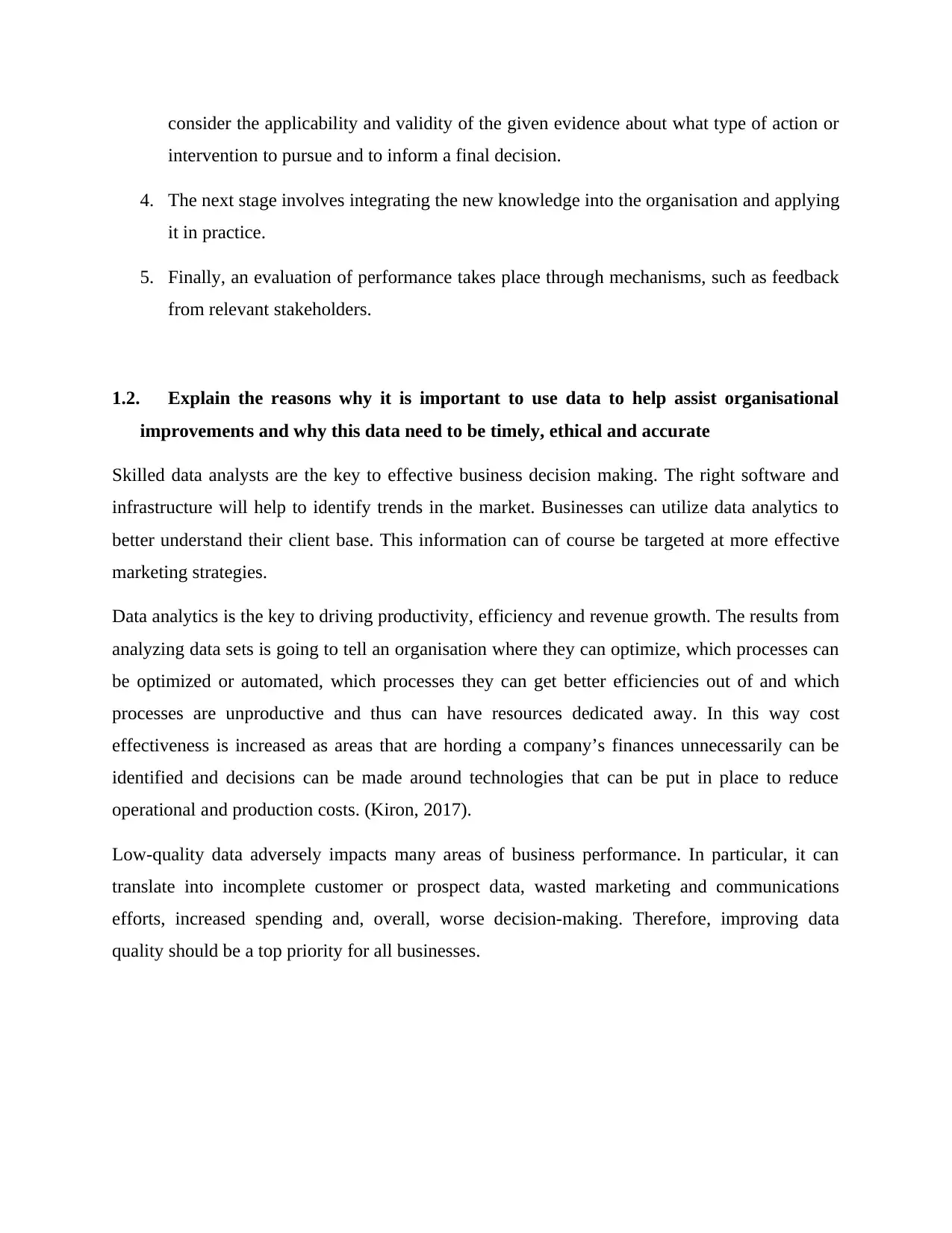
consider the applicability and validity of the given evidence about what type of action or
intervention to pursue and to inform a final decision.
4. The next stage involves integrating the new knowledge into the organisation and applying
it in practice.
5. Finally, an evaluation of performance takes place through mechanisms, such as feedback
from relevant stakeholders.
1.2. Explain the reasons why it is important to use data to help assist organisational
improvements and why this data need to be timely, ethical and accurate
Skilled data analysts are the key to effective business decision making. The right software and
infrastructure will help to identify trends in the market. Businesses can utilize data analytics to
better understand their client base. This information can of course be targeted at more effective
marketing strategies.
Data analytics is the key to driving productivity, efficiency and revenue growth. The results from
analyzing data sets is going to tell an organisation where they can optimize, which processes can
be optimized or automated, which processes they can get better efficiencies out of and which
processes are unproductive and thus can have resources dedicated away. In this way cost
effectiveness is increased as areas that are hording a company’s finances unnecessarily can be
identified and decisions can be made around technologies that can be put in place to reduce
operational and production costs. (Kiron, 2017).
Low-quality data adversely impacts many areas of business performance. In particular, it can
translate into incomplete customer or prospect data, wasted marketing and communications
efforts, increased spending and, overall, worse decision-making. Therefore, improving data
quality should be a top priority for all businesses.
intervention to pursue and to inform a final decision.
4. The next stage involves integrating the new knowledge into the organisation and applying
it in practice.
5. Finally, an evaluation of performance takes place through mechanisms, such as feedback
from relevant stakeholders.
1.2. Explain the reasons why it is important to use data to help assist organisational
improvements and why this data need to be timely, ethical and accurate
Skilled data analysts are the key to effective business decision making. The right software and
infrastructure will help to identify trends in the market. Businesses can utilize data analytics to
better understand their client base. This information can of course be targeted at more effective
marketing strategies.
Data analytics is the key to driving productivity, efficiency and revenue growth. The results from
analyzing data sets is going to tell an organisation where they can optimize, which processes can
be optimized or automated, which processes they can get better efficiencies out of and which
processes are unproductive and thus can have resources dedicated away. In this way cost
effectiveness is increased as areas that are hording a company’s finances unnecessarily can be
identified and decisions can be made around technologies that can be put in place to reduce
operational and production costs. (Kiron, 2017).
Low-quality data adversely impacts many areas of business performance. In particular, it can
translate into incomplete customer or prospect data, wasted marketing and communications
efforts, increased spending and, overall, worse decision-making. Therefore, improving data
quality should be a top priority for all businesses.
⊘ This is a preview!⊘
Do you want full access?
Subscribe today to unlock all pages.

Trusted by 1+ million students worldwide
1.3. Explain two different types of data measurements and information that can be used
by people professionals, and how they are each used to collect and collate information
to support effective decision making.
Level of measurement or scale of measure is a classification that describes the nature of
information within the numbers assigned to variables. Psychologist Stanley Smith Stevens
developed the best known classification with four levels or scales of measurement: nominal,
ordinal, interval, and ratio.
Nominal Scale:A nominal scale of measurement deals with variables that are non-numeric or
where the numbers have no value. The lowest measurement level you can use, from a statistical
point of view, is a nominal scale. A nominal scale, as the name implies, is simply some placing
of data into categories, without any order or structure. A physical example of a nominal scale is
the terms we use for colours. The underlying spectrum is ordered but the names are nominal. In
research activities a YES/NO scale is nominal. It has no order and there is no distance between
YES and NO. (Velleman, & Wilkinson, 2011).
Interval Scale:Interval scales are numeric scales in which we know not only the order, but also
the exact differences between the values. The classic example of an interval scale is Celsius
temperature because the difference between each value is the same. For example, the difference
between 60 and 50 degrees is a measurable 10 degrees, as is the difference between 80 and 70
degrees. Time is another good example of an interval scale in which the increments are known,
consistent, and measurable. (Velleman, & Wilkinson, 2011).
1.5. Explain how organisational policies, procedures and other forms of evidence can be
used to support appropriate choices and decisions.
Organisational policies and procedures provide guidelines for decision making processes and the
way that work in an organisation should be carried out. The result of having clear, well-written
policies and procedures are increased transparency, accountability, uniformity and stability.
by people professionals, and how they are each used to collect and collate information
to support effective decision making.
Level of measurement or scale of measure is a classification that describes the nature of
information within the numbers assigned to variables. Psychologist Stanley Smith Stevens
developed the best known classification with four levels or scales of measurement: nominal,
ordinal, interval, and ratio.
Nominal Scale:A nominal scale of measurement deals with variables that are non-numeric or
where the numbers have no value. The lowest measurement level you can use, from a statistical
point of view, is a nominal scale. A nominal scale, as the name implies, is simply some placing
of data into categories, without any order or structure. A physical example of a nominal scale is
the terms we use for colours. The underlying spectrum is ordered but the names are nominal. In
research activities a YES/NO scale is nominal. It has no order and there is no distance between
YES and NO. (Velleman, & Wilkinson, 2011).
Interval Scale:Interval scales are numeric scales in which we know not only the order, but also
the exact differences between the values. The classic example of an interval scale is Celsius
temperature because the difference between each value is the same. For example, the difference
between 60 and 50 degrees is a measurable 10 degrees, as is the difference between 80 and 70
degrees. Time is another good example of an interval scale in which the increments are known,
consistent, and measurable. (Velleman, & Wilkinson, 2011).
1.5. Explain how organisational policies, procedures and other forms of evidence can be
used to support appropriate choices and decisions.
Organisational policies and procedures provide guidelines for decision making processes and the
way that work in an organisation should be carried out. The result of having clear, well-written
policies and procedures are increased transparency, accountability, uniformity and stability.
Paraphrase This Document
Need a fresh take? Get an instant paraphrase of this document with our AI Paraphraser
CEBMa research indicates that an evidence-based approach is more effective in various ways
than less structured decision-making processes which often favour personal experience over
sound research :
Risk assessments based on the accumulated experience of many people are generally
more accurate than those based on one person’s experience, ensuring forecasts are made
independently before being combined.
Judgements based on hard data and statistics are more accurate than those based on
individual experience.
Knowledge from scientific literature is more accurate than expert opinions.
Decisions made through a combination of critically-appraised evidence from multiple
sources yield more effective outcomes than those based on a single source of evidence.
2.1. Explain the range of internal and external customers and stakeholders, that people
professionals work with, and the part that influencing plays within the relationships
Internal Stakeholders:
Internal stakeholders are individuals or groups who are directly and/or financially involved in the
operational process. This includes :
Employees: Employees are primary internal stakeholders. Employees have significant financial
and time investments in the organization, and play a defining role in the strategy, tactics, and
operations the organization carries out.
Managers: Managers play a substantial role in determining the strategy of the organization, and
a significant voice in operational decisions. Managers are also accountable for the decisions
made, and act as a point of contact between shareholders, the board of directors, and the
organization itself.
Owners: Owners (who in publicly traded organizations can include shareholders) are the
individuals who hold significant shares of the firm. Owners are liable for the impacts the
than less structured decision-making processes which often favour personal experience over
sound research :
Risk assessments based on the accumulated experience of many people are generally
more accurate than those based on one person’s experience, ensuring forecasts are made
independently before being combined.
Judgements based on hard data and statistics are more accurate than those based on
individual experience.
Knowledge from scientific literature is more accurate than expert opinions.
Decisions made through a combination of critically-appraised evidence from multiple
sources yield more effective outcomes than those based on a single source of evidence.
2.1. Explain the range of internal and external customers and stakeholders, that people
professionals work with, and the part that influencing plays within the relationships
Internal Stakeholders:
Internal stakeholders are individuals or groups who are directly and/or financially involved in the
operational process. This includes :
Employees: Employees are primary internal stakeholders. Employees have significant financial
and time investments in the organization, and play a defining role in the strategy, tactics, and
operations the organization carries out.
Managers: Managers play a substantial role in determining the strategy of the organization, and
a significant voice in operational decisions. Managers are also accountable for the decisions
made, and act as a point of contact between shareholders, the board of directors, and the
organization itself.
Owners: Owners (who in publicly traded organizations can include shareholders) are the
individuals who hold significant shares of the firm. Owners are liable for the impacts the
organization has, and have a significant role in strategy. Owners often make substantial
decisions regarding both internal and external stakeholders.
External Stakeholders
There are quite a few external stakeholders for businesses to keep in mind when making
decisions and carrying out operations. These include but are not limited to:
Customers: The primary purpose of providing goods and services is to fill needs. Understanding
the needs of an organization’s core customer base, and optimizing operations to best fill those
needs, is therefore a significant part of managing a business.
Suppliers: Suppliers and other strategic alliances are interdependent, where the success of one
will impact the success of another. As a result, suppliers are closely related to organizations as
key external stakeholders. Timely payments, shipments, communication, and operational
processes are key to maintaining a strong relationship with this stakeholder group.
Local community: A business can be a great benefit to a community, providing tax money,
local access to unique goods and services, jobs, and community development programs.
Businesses must look at the needs of the community, and ensure that negative repercussions are
minimized while community engagement is maximized.
Government: Governments tax businesses, and therefore have a firm stake in their success.
Governments also provide regulatory oversight, ensuring that accounting procedures, ethical
practices, and legal concerns are being handled responsibly by business representatives.
2.2. Explain what is meant by creating value as a people professional, and identify
benefits of providing value to customers and stakeholders.
What do we mean by value creation? For the customer, it entails making products and providing
services that customers find consistently useful. In today’s economy, such value creation is based
typically on product and process innovation and on understanding unique customer needs with
ever-increasing speed and precision. But companies can innovate and deliver outstanding service
only if they tap the commitment, energy, and imagination of their employees. Value must
therefore be created for those employees in order to motivate and enable them. Value for
decisions regarding both internal and external stakeholders.
External Stakeholders
There are quite a few external stakeholders for businesses to keep in mind when making
decisions and carrying out operations. These include but are not limited to:
Customers: The primary purpose of providing goods and services is to fill needs. Understanding
the needs of an organization’s core customer base, and optimizing operations to best fill those
needs, is therefore a significant part of managing a business.
Suppliers: Suppliers and other strategic alliances are interdependent, where the success of one
will impact the success of another. As a result, suppliers are closely related to organizations as
key external stakeholders. Timely payments, shipments, communication, and operational
processes are key to maintaining a strong relationship with this stakeholder group.
Local community: A business can be a great benefit to a community, providing tax money,
local access to unique goods and services, jobs, and community development programs.
Businesses must look at the needs of the community, and ensure that negative repercussions are
minimized while community engagement is maximized.
Government: Governments tax businesses, and therefore have a firm stake in their success.
Governments also provide regulatory oversight, ensuring that accounting procedures, ethical
practices, and legal concerns are being handled responsibly by business representatives.
2.2. Explain what is meant by creating value as a people professional, and identify
benefits of providing value to customers and stakeholders.
What do we mean by value creation? For the customer, it entails making products and providing
services that customers find consistently useful. In today’s economy, such value creation is based
typically on product and process innovation and on understanding unique customer needs with
ever-increasing speed and precision. But companies can innovate and deliver outstanding service
only if they tap the commitment, energy, and imagination of their employees. Value must
therefore be created for those employees in order to motivate and enable them. Value for
⊘ This is a preview!⊘
Do you want full access?
Subscribe today to unlock all pages.
Trusted by 1+ million students worldwide
employees includes being treated respectfully and being involved in decision-making.
Employees also value meaningful work; excellent compensation opportunities; and continued
training and development. Creating value for investors means delivering consistently high
returns on their capital. This generally requires both strong revenue growth and attractive profit
margins. These, in turn, can be achieved only if a company delivers sustained value for
customers. (Tantalo& Priem,2016)
2.3. Explain how social media can be used internally and externally in workplaces to
improve communication and organisational practices, highlighting the risks in a work
context.
Social media is online communication that allows you to interact with your customers and share
information in real time. This can help you to reach your customers better, create online
networks and sell and promote your products and services.
Benefits of social media Risks of social media
attract customers, get customer feedback
and build customer loyalty
increase your market reach, including
international markets
do market research and reduce marketing
costs
increase revenue by building customer
networks and advertising
develop your brand
exchange ideas to improve the way you
do business
recruit skilled staff for example through
job networking sites like LinkedIn
increase traffic to your website and
improve its search engine ranking
if you don't actively manage your social
media presence, you may not see any real
benefits
you may get unwanted or inappropriate
behaviour on your site, including bullying
and harassment
online exposure could attract risks such as
negative feedback, information leaks or
hacking
false or misleading claims made on your
social media (by your business or a
customer) can be subject to consumer law.
You could be fined if a customer fan posts
misleading or deceptive information,
particularly about competitor products or
services.
Employees also value meaningful work; excellent compensation opportunities; and continued
training and development. Creating value for investors means delivering consistently high
returns on their capital. This generally requires both strong revenue growth and attractive profit
margins. These, in turn, can be achieved only if a company delivers sustained value for
customers. (Tantalo& Priem,2016)
2.3. Explain how social media can be used internally and externally in workplaces to
improve communication and organisational practices, highlighting the risks in a work
context.
Social media is online communication that allows you to interact with your customers and share
information in real time. This can help you to reach your customers better, create online
networks and sell and promote your products and services.
Benefits of social media Risks of social media
attract customers, get customer feedback
and build customer loyalty
increase your market reach, including
international markets
do market research and reduce marketing
costs
increase revenue by building customer
networks and advertising
develop your brand
exchange ideas to improve the way you
do business
recruit skilled staff for example through
job networking sites like LinkedIn
increase traffic to your website and
improve its search engine ranking
if you don't actively manage your social
media presence, you may not see any real
benefits
you may get unwanted or inappropriate
behaviour on your site, including bullying
and harassment
online exposure could attract risks such as
negative feedback, information leaks or
hacking
false or misleading claims made on your
social media (by your business or a
customer) can be subject to consumer law.
You could be fined if a customer fan posts
misleading or deceptive information,
particularly about competitor products or
services.
Paraphrase This Document
Need a fresh take? Get an instant paraphrase of this document with our AI Paraphraser
keep an eye on your competitors.
2.4. Drawing on good practice examples, explain how the work that people professionals
perform benefits others within an organisation in supporting good practice, open
cultures, commitment and engagement.
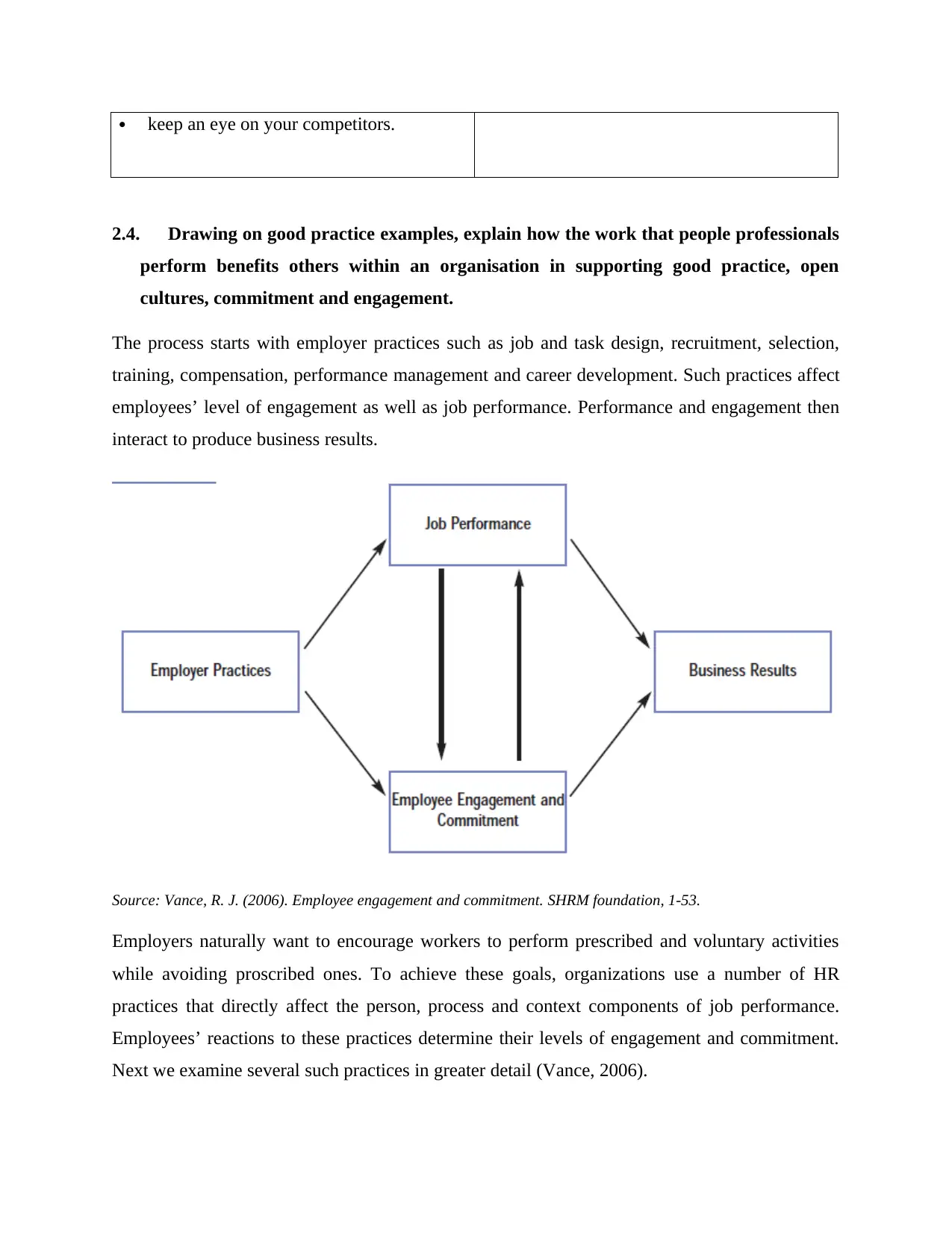
The process starts with employer practices such as job and task design, recruitment, selection,
training, compensation, performance management and career development. Such practices affect
employees’ level of engagement as well as job performance. Performance and engagement then
interact to produce business results.
Source: Vance, R. J. (2006). Employee engagement and commitment. SHRM foundation, 1-53.
Employers naturally want to encourage workers to perform prescribed and voluntary activities
while avoiding proscribed ones. To achieve these goals, organizations use a number of HR
practices that directly affect the person, process and context components of job performance.
Employees’ reactions to these practices determine their levels of engagement and commitment.
Next we examine several such practices in greater detail (Vance, 2006).
2.4. Drawing on good practice examples, explain how the work that people professionals
perform benefits others within an organisation in supporting good practice, open
cultures, commitment and engagement.
The process starts with employer practices such as job and task design, recruitment, selection,
training, compensation, performance management and career development. Such practices affect
employees’ level of engagement as well as job performance. Performance and engagement then
interact to produce business results.
Source: Vance, R. J. (2006). Employee engagement and commitment. SHRM foundation, 1-53.
Employers naturally want to encourage workers to perform prescribed and voluntary activities
while avoiding proscribed ones. To achieve these goals, organizations use a number of HR
practices that directly affect the person, process and context components of job performance.
Employees’ reactions to these practices determine their levels of engagement and commitment.
Next we examine several such practices in greater detail (Vance, 2006).
2.5. Outline how you can, in your own work or a voluntary role, achieve and maintain a
customer focused attitude to ensure consistent high standards and customer
satisfaction.
Customer focus means putting your customers’ needs first. Customer-focused businesses foster a
company culture dedicated to enhancing customer satisfaction and building strong customer
relationships.A customer-focused culture puts the customer as the center point of everything the
company does. More than profits, shareholder expectations, or growth, the main goal of these
companies is customer satisfaction. Instead of relying solely on a strong product, a customer-
focused model is much more sustainable because it is built to move with the changes and trends
of the customers. Without a culture firmly centered on customers, great customer experience can
never be achieved. It can ebb and flow depending on the employee who customers interact with,
but it needs to be engrained in the culture to be a consistent hallmark of the organization. Here
are some practices to ensure customer satisfaction:
Encourage collaboration
Make customers feel heard
Use feedback to get better
customer focused attitude to ensure consistent high standards and customer
satisfaction.
Customer focus means putting your customers’ needs first. Customer-focused businesses foster a
company culture dedicated to enhancing customer satisfaction and building strong customer
relationships.A customer-focused culture puts the customer as the center point of everything the
company does. More than profits, shareholder expectations, or growth, the main goal of these
companies is customer satisfaction. Instead of relying solely on a strong product, a customer-
focused model is much more sustainable because it is built to move with the changes and trends
of the customers. Without a culture firmly centered on customers, great customer experience can
never be achieved. It can ebb and flow depending on the employee who customers interact with,
but it needs to be engrained in the culture to be a consistent hallmark of the organization. Here
are some practices to ensure customer satisfaction:
Encourage collaboration
Make customers feel heard
Use feedback to get better
⊘ This is a preview!⊘
Do you want full access?
Subscribe today to unlock all pages.
Trusted by 1+ million students worldwide
TASK TWO: Example of analysis of data to inform practice
Introduction:
Analytics allow you to quantify the effects of making a change to your marketing strategy, and
that’s invaluable to the process of improving and optimizing online marketing campaigns. The
biggest benefit of utilizing proper analytics is being able to identify strengths and weaknesses.
QUESTION 1 (Convert to Percentages)
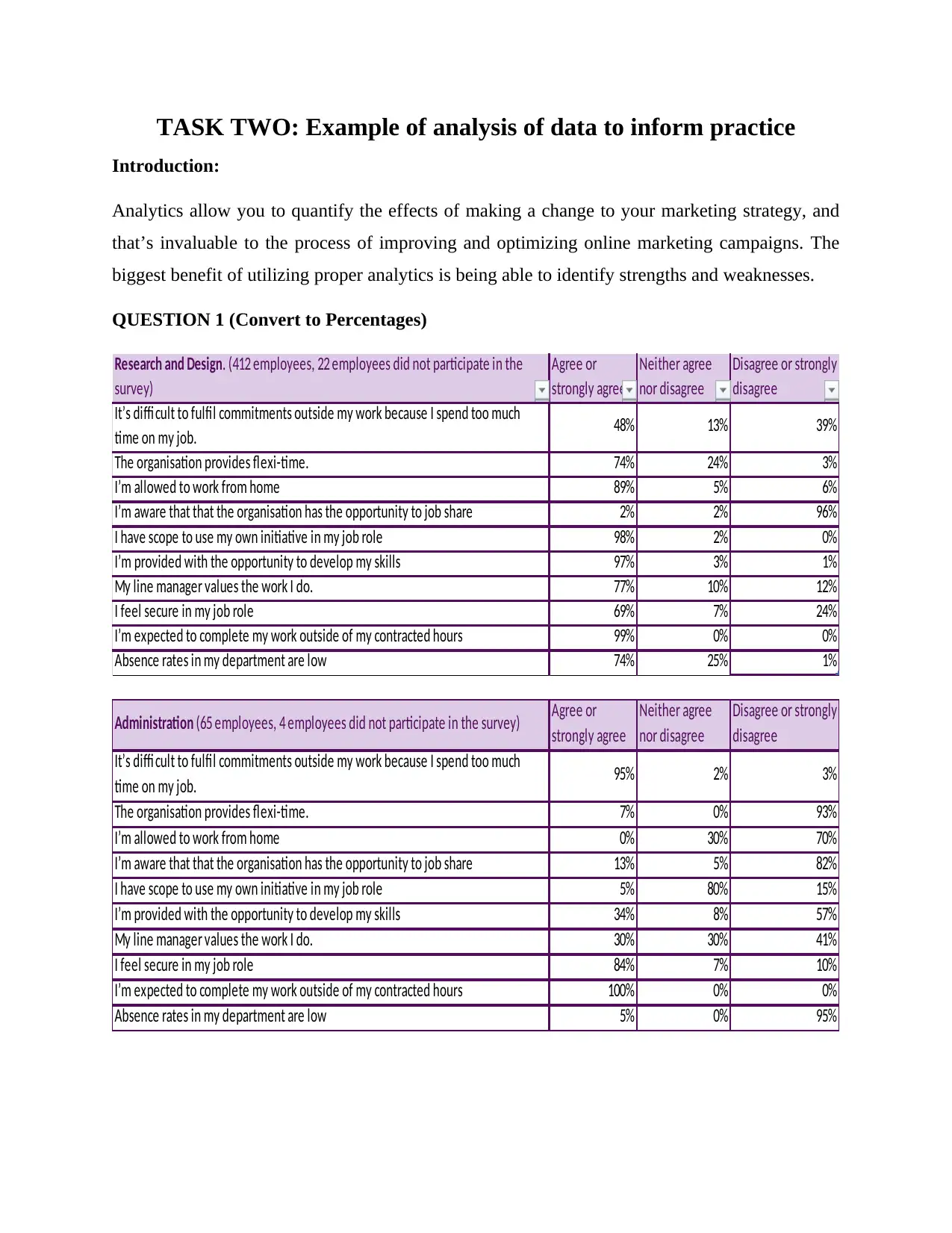
Research and Design. (412 employees, 22 employees did not participate in the
survey)
Agree or
strongly agree
Neither agree
nor disagree
Disagree or strongly
disagree
It’s diffi cult to fulfil commitments outside my work because I spend too much
time on my job. 48% 13% 39%
The organisation provides flexi-time. 74% 24% 3%
I’m allowed to work from home 89% 5% 6%
I’m aware that that the organisation has the opportunity to job share 2% 2% 96%
I have scope to use my own initiative in my job role 98% 2% 0%
I’m provided with the opportunity to develop my skills 97% 3% 1%
My line manager values the work I do. 77% 10% 12%
I feel secure in my job role 69% 7% 24%
I’m expected to complete my work outside of my contracted hours 99% 0% 0%
Absence rates in my department are low 74% 25% 1%
Administration (65 employees, 4 employees did not participate in the survey) Agree or
strongly agree
Neither agree
nor disagree
Disagree or strongly
disagree
It’s diffi cult to fulfil commitments outside my work because I spend too much
time on my job. 95% 2% 3%
The organisation provides flexi-time. 7% 0% 93%
I’m allowed to work from home 0% 30% 70%
I’m aware that that the organisation has the opportunity to job share 13% 5% 82%
I have scope to use my own initiative in my job role 5% 80% 15%
I’m provided with the opportunity to develop my skills 34% 8% 57%
My line manager values the work I do. 30% 30% 41%
I feel secure in my job role 84% 7% 10%
I’m expected to complete my work outside of my contracted hours 100% 0% 0%
Absence rates in my department are low 5% 0% 95%
Introduction:
Analytics allow you to quantify the effects of making a change to your marketing strategy, and
that’s invaluable to the process of improving and optimizing online marketing campaigns. The
biggest benefit of utilizing proper analytics is being able to identify strengths and weaknesses.
QUESTION 1 (Convert to Percentages)
Research and Design. (412 employees, 22 employees did not participate in the
survey)
Agree or
strongly agree
Neither agree
nor disagree
Disagree or strongly
disagree
It’s diffi cult to fulfil commitments outside my work because I spend too much
time on my job. 48% 13% 39%
The organisation provides flexi-time. 74% 24% 3%
I’m allowed to work from home 89% 5% 6%
I’m aware that that the organisation has the opportunity to job share 2% 2% 96%
I have scope to use my own initiative in my job role 98% 2% 0%
I’m provided with the opportunity to develop my skills 97% 3% 1%
My line manager values the work I do. 77% 10% 12%
I feel secure in my job role 69% 7% 24%
I’m expected to complete my work outside of my contracted hours 99% 0% 0%
Absence rates in my department are low 74% 25% 1%
Administration (65 employees, 4 employees did not participate in the survey) Agree or
strongly agree
Neither agree
nor disagree
Disagree or strongly
disagree
It’s diffi cult to fulfil commitments outside my work because I spend too much
time on my job. 95% 2% 3%
The organisation provides flexi-time. 7% 0% 93%
I’m allowed to work from home 0% 30% 70%
I’m aware that that the organisation has the opportunity to job share 13% 5% 82%
I have scope to use my own initiative in my job role 5% 80% 15%
I’m provided with the opportunity to develop my skills 34% 8% 57%
My line manager values the work I do. 30% 30% 41%
I feel secure in my job role 84% 7% 10%
I’m expected to complete my work outside of my contracted hours 100% 0% 0%
Absence rates in my department are low 5% 0% 95%
Paraphrase This Document
Need a fresh take? Get an instant paraphrase of this document with our AI Paraphraser
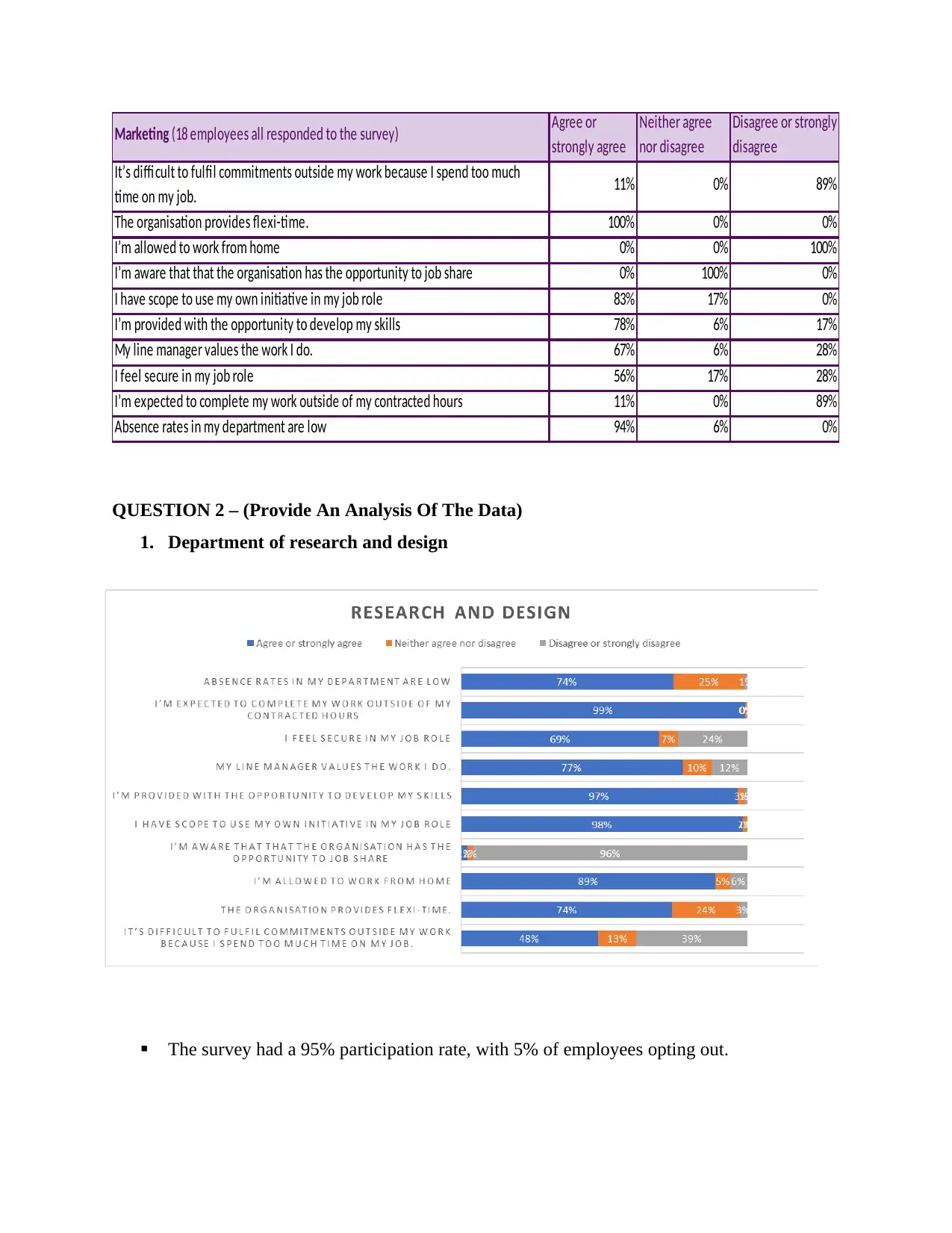
Marketing (18 employees all responded to the survey) Agree or
strongly agree
Neither agree
nor disagree
Disagree or strongly
disagree
It’s diffi cult to fulfil commitments outside my work because I spend too much
time on my job. 11% 0% 89%
The organisation provides flexi-time. 100% 0% 0%
I’m allowed to work from home 0% 0% 100%
I’m aware that that the organisation has the opportunity to job share 0% 100% 0%
I have scope to use my own initiative in my job role 83% 17% 0%
I’m provided with the opportunity to develop my skills 78% 6% 17%
My line manager values the work I do. 67% 6% 28%
I feel secure in my job role 56% 17% 28%
I’m expected to complete my work outside of my contracted hours 11% 0% 89%
Absence rates in my department are low 94% 6% 0%
QUESTION 2 – (Provide An Analysis Of The Data)
1. Department of research and design
The survey had a 95% participation rate, with 5% of employees opting out.
strongly agree
Neither agree
nor disagree
Disagree or strongly
disagree
It’s diffi cult to fulfil commitments outside my work because I spend too much
time on my job. 11% 0% 89%
The organisation provides flexi-time. 100% 0% 0%
I’m allowed to work from home 0% 0% 100%
I’m aware that that the organisation has the opportunity to job share 0% 100% 0%
I have scope to use my own initiative in my job role 83% 17% 0%
I’m provided with the opportunity to develop my skills 78% 6% 17%
My line manager values the work I do. 67% 6% 28%
I feel secure in my job role 56% 17% 28%
I’m expected to complete my work outside of my contracted hours 11% 0% 89%
Absence rates in my department are low 94% 6% 0%
QUESTION 2 – (Provide An Analysis Of The Data)
1. Department of research and design
The survey had a 95% participation rate, with 5% of employees opting out.
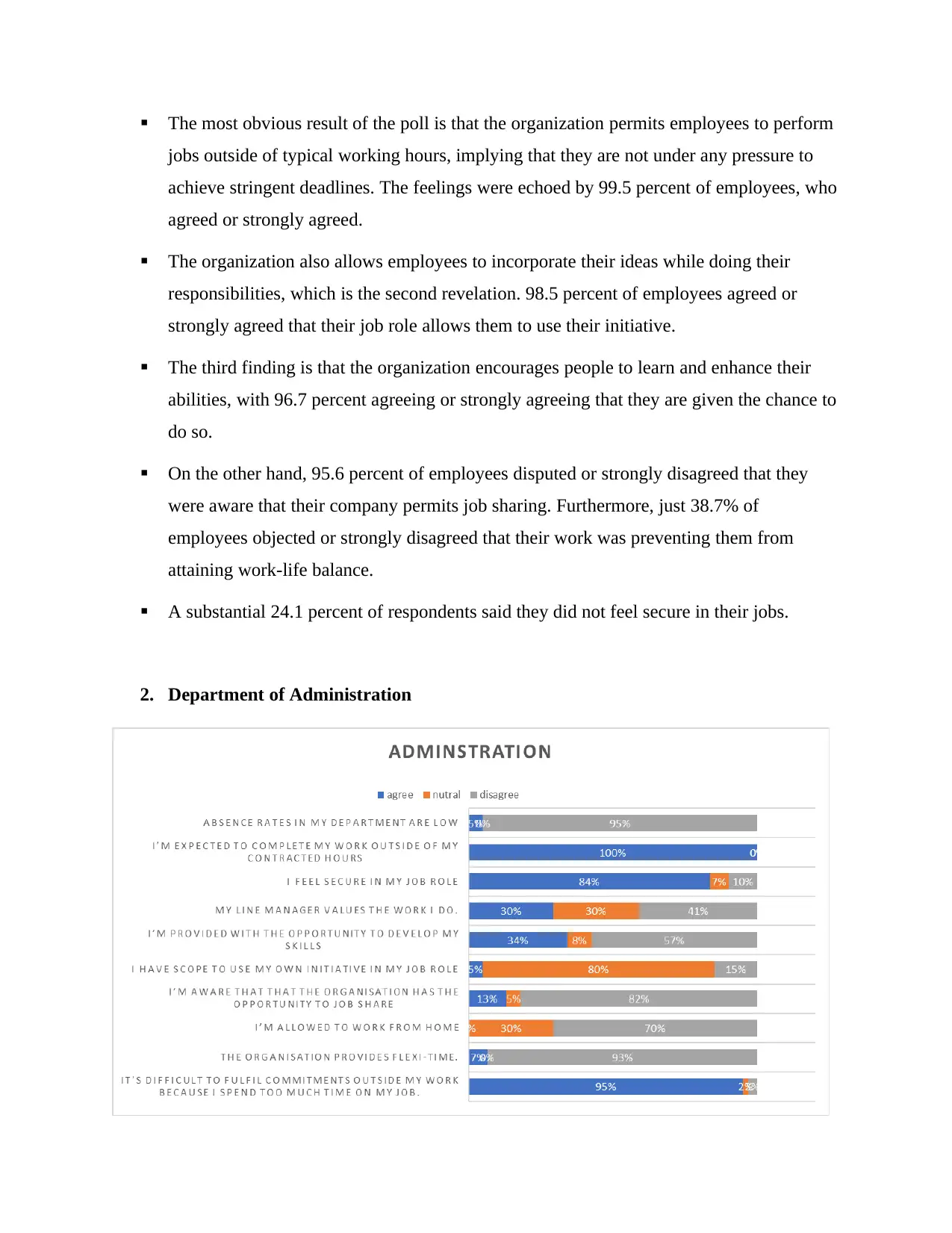
The most obvious result of the poll is that the organization permits employees to perform
jobs outside of typical working hours, implying that they are not under any pressure to
achieve stringent deadlines. The feelings were echoed by 99.5 percent of employees, who
agreed or strongly agreed.
The organization also allows employees to incorporate their ideas while doing their
responsibilities, which is the second revelation. 98.5 percent of employees agreed or
strongly agreed that their job role allows them to use their initiative.
The third finding is that the organization encourages people to learn and enhance their
abilities, with 96.7 percent agreeing or strongly agreeing that they are given the chance to
do so.
On the other hand, 95.6 percent of employees disputed or strongly disagreed that they
were aware that their company permits job sharing. Furthermore, just 38.7% of
employees objected or strongly disagreed that their work was preventing them from
attaining work-life balance.
A substantial 24.1 percent of respondents said they did not feel secure in their jobs.
2. Department of Administration
jobs outside of typical working hours, implying that they are not under any pressure to
achieve stringent deadlines. The feelings were echoed by 99.5 percent of employees, who
agreed or strongly agreed.
The organization also allows employees to incorporate their ideas while doing their
responsibilities, which is the second revelation. 98.5 percent of employees agreed or
strongly agreed that their job role allows them to use their initiative.
The third finding is that the organization encourages people to learn and enhance their
abilities, with 96.7 percent agreeing or strongly agreeing that they are given the chance to
do so.
On the other hand, 95.6 percent of employees disputed or strongly disagreed that they
were aware that their company permits job sharing. Furthermore, just 38.7% of
employees objected or strongly disagreed that their work was preventing them from
attaining work-life balance.
A substantial 24.1 percent of respondents said they did not feel secure in their jobs.
2. Department of Administration
⊘ This is a preview!⊘
Do you want full access?
Subscribe today to unlock all pages.
Trusted by 1+ million students worldwide

1 out of 15


Related Documents


Your All-in-One AI-Powered Toolkit for Academic Success.
+13062052269
info@desklib.com
Available 24*7 on WhatsApp / Email
![[object Object]](/_next/static/media/star-bottom.7253800d.svg)
Unlock your academic potential
Copyright © 2020–2026 A2Z Services. All Rights Reserved. Developed and managed by ZUCOL.