OPAIC Principles of Change: Kovacs Design Furniture Proposal Report
VerifiedAdded on 2022/09/17
|17
|4372
|20
Report
AI Summary
This report presents a change proposal for Kovacs Design Furniture in New Zealand, addressing the need for business restructuring to combat market competition and outdated manufacturing equipment. The report, prepared by a Trainee Manager, outlines the company's background, mission, vision, and target market, highlighting the challenges of declining sales and profits. The proposal focuses on implementing sustainable practices, including upgrading production to be "clean and green", to improve brand reputation and environmental responsibility. The report includes a risk assessment, cost/benefit analysis, SWOT and PESTEL analyses, and a discussion of the payback period. The proposed changes aim to enhance innovation, reduce operational costs, and improve the company's competitive advantage, ultimately returning the company to profitability within approximately one year. The report emphasizes the importance of adapting to environmental concerns and customer demands for sustainable products.
<Kovacs Design Furniture>
Proposal for Change
Your name:
Student ID:
Date of Submission:
Principles of Change Management - Assessment 1 - Business Case for Change - Block 2 - 2018 Page 1 of 17
Proposal for Change
Your name:
Student ID:
Date of Submission:
Principles of Change Management - Assessment 1 - Business Case for Change - Block 2 - 2018 Page 1 of 17

Paraphrase This Document
Need a fresh take? Get an instant paraphrase of this document with our AI Paraphraser
1.0 EXECUTIVE SUMMARY/PURPOSE
The report demonstrates the need for change to restructure the business and ensure sustenance in the competitive business
environment along with the aim of creating a positive impact on the bottom line of the company, i.e., Kovacs Design Furniture in
New Zealand. There has been stiff competition in the marketplace, because of which, the sales revenue have fallen for the
organisation and also the profit level declined with the reduced value of the NZ dollar too. The manufacturing equipment and
machineries were outdated, which not only hindered the production level, but also had not been environment friendly, which also
deteriorated the brand image and reputation.
Thus, the change has been to remain sustainable and be “clean and green” by following the various business
sustainability principles, furthermore, manage sustainable measures to become successful in the competitive business environment.
This is basically about managing up-gradation of existing production to a clean and green production system for managing sustainable
behaviours and promote betterment of community and the environment. The benefits of this change management could be the
management of business sustainability, which could bring innovation and at the same time, resolve the risks associated with the
business functioning effectively too. Therefore, this change would bring sustainability and also facilitate the management of business
principles, thereby, ensure proper restructuring of business along with increased production and sales for maintaining a positive brand
reputation.
The report is presented to discuss about the management of change within the furniture manufacturing company to facilitate
innovation and ensure meeting the demands and expectations of the customers largely too. The topic will demonstrate the various
benefits that will be attained with the management of this change, furthermore, ensure creating a positive impact on the business
functioning in terms of higher revenue generation along with attaining competitive advantage in business too. I have been the Trainee
Manager and have been appointed with the task of managing a proposal to restructure the business and ensure implementation of
successful change for gaining sustained competitive advantage in business.
2.0 BUSINESS OUTLINE
The background of the organisation, i.e., Kovacs Design Furniture in New Zealand has operated in New Zealand for the past
20 years and the business operations have been consistent considering the fact that it has managed its functions and processes all over
New Zealand and off shore. The company consists of a stable workforce and thus the production and sales have been consistent, which
has helped in enhancing the skills and knowledge of the workers as well as prevented any negative impact on the brand reputation and
image. The industry within which the company has operated is the furniture goods industry and the furniture products are of good
qualities too, which are mainly targeted at the middle and premium segments of market comprising of the customers (Doppelt, 2017).
The mission of the organisation is to design furniture by hand that can be known by heart and liked by everyone. The company is
specialised in the designing and construction of good quality luxury furniture that are delivered to cater the need and preferences of
people all over New Zealand (Kovacs.co.nz, 2019). The company has remained true to its ethics and values and has inspired people to
uphold and endure.
Principles of Change Management - Assessment 1 - Business Case for Change - Block 2 - 2018 Page 2 of 17
The report demonstrates the need for change to restructure the business and ensure sustenance in the competitive business
environment along with the aim of creating a positive impact on the bottom line of the company, i.e., Kovacs Design Furniture in
New Zealand. There has been stiff competition in the marketplace, because of which, the sales revenue have fallen for the
organisation and also the profit level declined with the reduced value of the NZ dollar too. The manufacturing equipment and
machineries were outdated, which not only hindered the production level, but also had not been environment friendly, which also
deteriorated the brand image and reputation.
Thus, the change has been to remain sustainable and be “clean and green” by following the various business
sustainability principles, furthermore, manage sustainable measures to become successful in the competitive business environment.
This is basically about managing up-gradation of existing production to a clean and green production system for managing sustainable
behaviours and promote betterment of community and the environment. The benefits of this change management could be the
management of business sustainability, which could bring innovation and at the same time, resolve the risks associated with the
business functioning effectively too. Therefore, this change would bring sustainability and also facilitate the management of business
principles, thereby, ensure proper restructuring of business along with increased production and sales for maintaining a positive brand
reputation.
The report is presented to discuss about the management of change within the furniture manufacturing company to facilitate
innovation and ensure meeting the demands and expectations of the customers largely too. The topic will demonstrate the various
benefits that will be attained with the management of this change, furthermore, ensure creating a positive impact on the business
functioning in terms of higher revenue generation along with attaining competitive advantage in business too. I have been the Trainee
Manager and have been appointed with the task of managing a proposal to restructure the business and ensure implementation of
successful change for gaining sustained competitive advantage in business.
2.0 BUSINESS OUTLINE
The background of the organisation, i.e., Kovacs Design Furniture in New Zealand has operated in New Zealand for the past
20 years and the business operations have been consistent considering the fact that it has managed its functions and processes all over
New Zealand and off shore. The company consists of a stable workforce and thus the production and sales have been consistent, which
has helped in enhancing the skills and knowledge of the workers as well as prevented any negative impact on the brand reputation and
image. The industry within which the company has operated is the furniture goods industry and the furniture products are of good
qualities too, which are mainly targeted at the middle and premium segments of market comprising of the customers (Doppelt, 2017).
The mission of the organisation is to design furniture by hand that can be known by heart and liked by everyone. The company is
specialised in the designing and construction of good quality luxury furniture that are delivered to cater the need and preferences of
people all over New Zealand (Kovacs.co.nz, 2019). The company has remained true to its ethics and values and has inspired people to
uphold and endure.
Principles of Change Management - Assessment 1 - Business Case for Change - Block 2 - 2018 Page 2 of 17
Vision and values
The vision of the company represents that the “True artisan furniture is made by hand and known by heart”, which has also allowed
the company to remain true to its ethos and manage good quality furniture goods that are produced to inspire, uphold and endure.
According to the organisation, the values are managed with the focus to build “brand reputation”, which also ensures that care has
been taken for maintaining the tradition of hand made and artisan focus all throughout the various stages of production. This is
something about the company that makes it special (Kaufman, 2017).
The target market consisting of the customers are mostly the luxury segment clients who prefer to enjoy a luxurious lifestyle by
buying luxury furniture goods and improve their life style furthermore. The company has also targeted the customers who are in need
of value for money furniture goods that could not only meet their needs, but would also present a good ambience and excellent
outlook within the house when the furniture is placed alongside other goods present. The primary target market has been the premium
market segment comprising of the customers, who prefer to acquire good quality furniture goods with the latest in technological
aspects and also the goods that have been combined with the old fashioned sense and feel of fine woods (Howard-Grenville et al.,
2014). The products and services are provided for home purposes and also could be used at offices and these products have shared a
common bond of quality appreciation though lacking the price constraints too. This should also provide an excellent outlook within
the house when the furniture is placed alongside other goods present (Kovacs.co.nz, 2019).
The planned future markets include the market segments comprising of the customers who prefer environment friendly goods
and also the lower class segments where customers need value for money products and services to cater their needs and preferences.
To resolve the business sustainability issues and overcome the problems of maintenance to remain competitive, the business needs to
follow the principles of sustainability management and at the same time, Transfer the Invercargill based maintenance team members to
Auckland for supporting the maintenance team present in Auckland (Kohlborn et al., 2014).
3.0 THE CASE FOR CHANGE
From the case study, it could be understood that the company was facing high competition with the presence of multiple
rivalries that delivered similar kinds of furniture products and services in the marketplace. The manufacturing equipment and
machineries lacked up gradation, due to which there have been increased costs of maintenance associated with the business functions
and processes. These equipment and machineries’ usage often resulted in being unable to meet the sustainable requirements and
thereby failed to become environmentally responsible, which also damaged the brand image and reputation. Due to the high
competition within the industry, there has been high level of pressure from the companies within the competitive industry and thus
there is need to facilitate innovation by following the best practice principles of business sustainability by focusing on the “clean and
green” aspects to remain sustainable within the concerned industry (Lewis, Cantore & Passmore, 2016). These major issues can often
be associated with the lack of ability to manage sustainability and at the same time, could experience lack of innovation and creativity,
which should enable the company unable to deliver the expected outcomes and also fail to meet up to the demands and expectations of
the clients largely too (Kovacs.co.nz, 2019).
Principles of Change Management - Assessment 1 - Business Case for Change - Block 2 - 2018 Page 3 of 17
The vision of the company represents that the “True artisan furniture is made by hand and known by heart”, which has also allowed
the company to remain true to its ethos and manage good quality furniture goods that are produced to inspire, uphold and endure.
According to the organisation, the values are managed with the focus to build “brand reputation”, which also ensures that care has
been taken for maintaining the tradition of hand made and artisan focus all throughout the various stages of production. This is
something about the company that makes it special (Kaufman, 2017).
The target market consisting of the customers are mostly the luxury segment clients who prefer to enjoy a luxurious lifestyle by
buying luxury furniture goods and improve their life style furthermore. The company has also targeted the customers who are in need
of value for money furniture goods that could not only meet their needs, but would also present a good ambience and excellent
outlook within the house when the furniture is placed alongside other goods present. The primary target market has been the premium
market segment comprising of the customers, who prefer to acquire good quality furniture goods with the latest in technological
aspects and also the goods that have been combined with the old fashioned sense and feel of fine woods (Howard-Grenville et al.,
2014). The products and services are provided for home purposes and also could be used at offices and these products have shared a
common bond of quality appreciation though lacking the price constraints too. This should also provide an excellent outlook within
the house when the furniture is placed alongside other goods present (Kovacs.co.nz, 2019).
The planned future markets include the market segments comprising of the customers who prefer environment friendly goods
and also the lower class segments where customers need value for money products and services to cater their needs and preferences.
To resolve the business sustainability issues and overcome the problems of maintenance to remain competitive, the business needs to
follow the principles of sustainability management and at the same time, Transfer the Invercargill based maintenance team members to
Auckland for supporting the maintenance team present in Auckland (Kohlborn et al., 2014).
3.0 THE CASE FOR CHANGE
From the case study, it could be understood that the company was facing high competition with the presence of multiple
rivalries that delivered similar kinds of furniture products and services in the marketplace. The manufacturing equipment and
machineries lacked up gradation, due to which there have been increased costs of maintenance associated with the business functions
and processes. These equipment and machineries’ usage often resulted in being unable to meet the sustainable requirements and
thereby failed to become environmentally responsible, which also damaged the brand image and reputation. Due to the high
competition within the industry, there has been high level of pressure from the companies within the competitive industry and thus
there is need to facilitate innovation by following the best practice principles of business sustainability by focusing on the “clean and
green” aspects to remain sustainable within the concerned industry (Lewis, Cantore & Passmore, 2016). These major issues can often
be associated with the lack of ability to manage sustainability and at the same time, could experience lack of innovation and creativity,
which should enable the company unable to deliver the expected outcomes and also fail to meet up to the demands and expectations of
the clients largely too (Kovacs.co.nz, 2019).
Principles of Change Management - Assessment 1 - Business Case for Change - Block 2 - 2018 Page 3 of 17
⊘ This is a preview!⊘
Do you want full access?
Subscribe today to unlock all pages.

Trusted by 1+ million students worldwide
Due to this, the management of change is necessary, that too, by focusing on the sustainable approaches to remain green and at
the same time, improve the business functioning by focusing on the environmental friendly aspects too.
It has also been found that the profit level declined in the past few years for Kovacs Design Furniture in New Zealand, which has also
resulted in ensuring that the manufacturing equipment and machineries are updated by aligning with the sustainability management
principles to remain environmentally responsible and even reduce the costs of operations and processes to a large extent (Frankland et
al., 2013).
The time that might be taken for the company to payback or shift to profitability would be about 10 to 12 months.
3.1 RISK ASSESSMENT - BENEFITS ASSOCIATED WITH MAKING THIS CHANGE ARE
It is anticipated that the following benefits will arise from making this change. They are:
The management of change at Kovacs Design Furniture in New Zealand considering focus on the sustainable measures would
ensure sustainability management and ensure higher revenue generation too
The management of change would also enable reduction of costs associated with the management of business functions and
processes
The other major benefit or advantage could be the management of this change according to the sustainability and financial
requirements should result in accomplishment of the project undertaken within the allocated budget.
The up-gradation of the machineries and equipment would be possible which could also reduce the costs associated with the
maintenance
The organisation would achieve sustainability by becoming environmentally responsible as well as adopt environmental
friendly measures to create lesser harmful impact on the environment too.
3.2 RISKS ASSOCIATED WITH MAINTAINING THE STATUS QUO
There are a number of risks to us as a Company if we do not make this change. These are:
The most important risk could be the lack of innovation and creativity, which would make the company unable to attain the
desired level of competitive advantage when compared with its competitors in business
The bills and costs associated with the maintenance of business functions and processes would keep on increasing, ultimately
leading to business loss
Another drawback could be the negative impact on the environment and also failing to manage the sustainable measures
needed to remain environmentally responsible (Hayes, 2018).
Service support might be complex as some of the business functions and processes have been supported from the Head
Office in Auckland only
The level of profit would decline consistency and prevent the company to attain a competitive edge over its competitors too.
Principles of Change Management - Assessment 1 - Business Case for Change - Block 2 - 2018 Page 4 of 17
the same time, improve the business functioning by focusing on the environmental friendly aspects too.
It has also been found that the profit level declined in the past few years for Kovacs Design Furniture in New Zealand, which has also
resulted in ensuring that the manufacturing equipment and machineries are updated by aligning with the sustainability management
principles to remain environmentally responsible and even reduce the costs of operations and processes to a large extent (Frankland et
al., 2013).
The time that might be taken for the company to payback or shift to profitability would be about 10 to 12 months.
3.1 RISK ASSESSMENT - BENEFITS ASSOCIATED WITH MAKING THIS CHANGE ARE
It is anticipated that the following benefits will arise from making this change. They are:
The management of change at Kovacs Design Furniture in New Zealand considering focus on the sustainable measures would
ensure sustainability management and ensure higher revenue generation too
The management of change would also enable reduction of costs associated with the management of business functions and
processes
The other major benefit or advantage could be the management of this change according to the sustainability and financial
requirements should result in accomplishment of the project undertaken within the allocated budget.
The up-gradation of the machineries and equipment would be possible which could also reduce the costs associated with the
maintenance
The organisation would achieve sustainability by becoming environmentally responsible as well as adopt environmental
friendly measures to create lesser harmful impact on the environment too.
3.2 RISKS ASSOCIATED WITH MAINTAINING THE STATUS QUO
There are a number of risks to us as a Company if we do not make this change. These are:
The most important risk could be the lack of innovation and creativity, which would make the company unable to attain the
desired level of competitive advantage when compared with its competitors in business
The bills and costs associated with the maintenance of business functions and processes would keep on increasing, ultimately
leading to business loss
Another drawback could be the negative impact on the environment and also failing to manage the sustainable measures
needed to remain environmentally responsible (Hayes, 2018).
Service support might be complex as some of the business functions and processes have been supported from the Head
Office in Auckland only
The level of profit would decline consistency and prevent the company to attain a competitive edge over its competitors too.
Principles of Change Management - Assessment 1 - Business Case for Change - Block 2 - 2018 Page 4 of 17
Paraphrase This Document
Need a fresh take? Get an instant paraphrase of this document with our AI Paraphraser
There might also be risks when the employees of the organisation are unable to adapt to the change, furthermore, result in
hindering the successful management of business functioning too
3.3 RETURNING THE COMPANY TO PROFITABILITY (COST/BENEFIT ANALYSIS)
Considering the case study of the organisation, it would be viable to think that overall an entire year would take for the
company to return to profitability. It is not possible for defining an average time that would be taken for the company to return back to
profitability, but because of the management of change to bring back sustainable measures and focus on the green aspects, it is evident
that the entire change management process would be time and effort consuming as well. The entire project for change management
would also take significant amount of time as the change management procedure need proper assessment of feasibility along with the
identification of various aspects needed to make the change management process successful and noteworthy (Doppelt, 2017). The
future plans for the company include making changes to the functions and processes by focusing on the sustainable aspects to facilitate
the greener approaches and ensure creating lesser impact on the environment negatively (Kovacs.co.nz, 2019).
The new direction that Kovacs Design Furniture in New Zealand could likely take are the green manufacturing practices tough few
constraints must be taken into consideration such as the high cost of adopting the business practices and lack of premium pricing too.
The green manufacturing or environmental measures wold not only reduce the production of wastes, but would also meet the criteria
and requirements for the Total quality management or TQM approach. To ensure sustainable production of environment friendly
furniture products and services, Kovacs Design Furniture, New Zealand could also create a certain level of awareness of the
environmental issues and then make people believe to understand the importance of acquiring environment friendly goods and
services required to maintain sustainability all throughout (Goetsch & Davis, 2014). The payback period is actually the evaluation of
investments done for a project and related costs associated with it. The payback period is actually the calculation of initial investment
divided by annual cash inflow, based on which, the company, i.e., Kovacs Design Furniture, could understand whether to invest on a
project or not. This is basically the capability of the organisation to understand how much feasible it would be to invest on the
management of the project and how could it bring positive outcomes for the organization.
Principles of Change Management - Assessment 1 - Business Case for Change - Block 2 - 2018 Page 5 of 17
hindering the successful management of business functioning too
3.3 RETURNING THE COMPANY TO PROFITABILITY (COST/BENEFIT ANALYSIS)
Considering the case study of the organisation, it would be viable to think that overall an entire year would take for the
company to return to profitability. It is not possible for defining an average time that would be taken for the company to return back to
profitability, but because of the management of change to bring back sustainable measures and focus on the green aspects, it is evident
that the entire change management process would be time and effort consuming as well. The entire project for change management
would also take significant amount of time as the change management procedure need proper assessment of feasibility along with the
identification of various aspects needed to make the change management process successful and noteworthy (Doppelt, 2017). The
future plans for the company include making changes to the functions and processes by focusing on the sustainable aspects to facilitate
the greener approaches and ensure creating lesser impact on the environment negatively (Kovacs.co.nz, 2019).
The new direction that Kovacs Design Furniture in New Zealand could likely take are the green manufacturing practices tough few
constraints must be taken into consideration such as the high cost of adopting the business practices and lack of premium pricing too.
The green manufacturing or environmental measures wold not only reduce the production of wastes, but would also meet the criteria
and requirements for the Total quality management or TQM approach. To ensure sustainable production of environment friendly
furniture products and services, Kovacs Design Furniture, New Zealand could also create a certain level of awareness of the
environmental issues and then make people believe to understand the importance of acquiring environment friendly goods and
services required to maintain sustainability all throughout (Goetsch & Davis, 2014). The payback period is actually the evaluation of
investments done for a project and related costs associated with it. The payback period is actually the calculation of initial investment
divided by annual cash inflow, based on which, the company, i.e., Kovacs Design Furniture, could understand whether to invest on a
project or not. This is basically the capability of the organisation to understand how much feasible it would be to invest on the
management of the project and how could it bring positive outcomes for the organization.
Principles of Change Management - Assessment 1 - Business Case for Change - Block 2 - 2018 Page 5 of 17
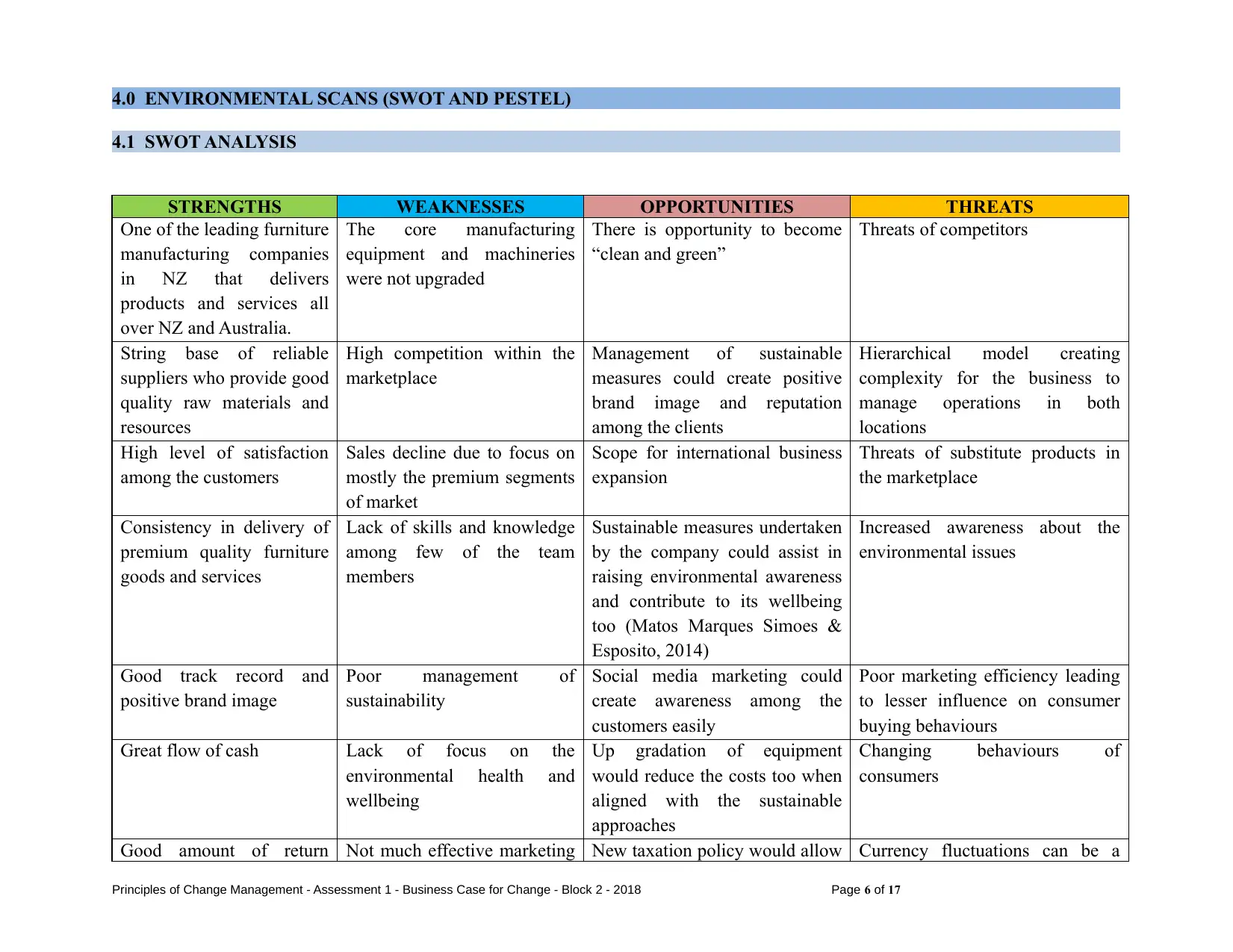
4.0 ENVIRONMENTAL SCANS (SWOT AND PESTEL)
4.1 SWOT ANALYSIS
STRENGTHS WEAKNESSES OPPORTUNITIES THREATS
One of the leading furniture
manufacturing companies
in NZ that delivers
products and services all
over NZ and Australia.
The core manufacturing
equipment and machineries
were not upgraded
There is opportunity to become
“clean and green”
Threats of competitors
String base of reliable
suppliers who provide good
quality raw materials and
resources
High competition within the
marketplace
Management of sustainable
measures could create positive
brand image and reputation
among the clients
Hierarchical model creating
complexity for the business to
manage operations in both
locations
High level of satisfaction
among the customers
Sales decline due to focus on
mostly the premium segments
of market
Scope for international business
expansion
Threats of substitute products in
the marketplace
Consistency in delivery of
premium quality furniture
goods and services
Lack of skills and knowledge
among few of the team
members
Sustainable measures undertaken
by the company could assist in
raising environmental awareness
and contribute to its wellbeing
too (Matos Marques Simoes &
Esposito, 2014)
Increased awareness about the
environmental issues
Good track record and
positive brand image
Poor management of
sustainability
Social media marketing could
create awareness among the
customers easily
Poor marketing efficiency leading
to lesser influence on consumer
buying behaviours
Great flow of cash Lack of focus on the
environmental health and
wellbeing
Up gradation of equipment
would reduce the costs too when
aligned with the sustainable
approaches
Changing behaviours of
consumers
Good amount of return Not much effective marketing New taxation policy would allow Currency fluctuations can be a
Principles of Change Management - Assessment 1 - Business Case for Change - Block 2 - 2018 Page 6 of 17
4.1 SWOT ANALYSIS
STRENGTHS WEAKNESSES OPPORTUNITIES THREATS
One of the leading furniture
manufacturing companies
in NZ that delivers
products and services all
over NZ and Australia.
The core manufacturing
equipment and machineries
were not upgraded
There is opportunity to become
“clean and green”
Threats of competitors
String base of reliable
suppliers who provide good
quality raw materials and
resources
High competition within the
marketplace
Management of sustainable
measures could create positive
brand image and reputation
among the clients
Hierarchical model creating
complexity for the business to
manage operations in both
locations
High level of satisfaction
among the customers
Sales decline due to focus on
mostly the premium segments
of market
Scope for international business
expansion
Threats of substitute products in
the marketplace
Consistency in delivery of
premium quality furniture
goods and services
Lack of skills and knowledge
among few of the team
members
Sustainable measures undertaken
by the company could assist in
raising environmental awareness
and contribute to its wellbeing
too (Matos Marques Simoes &
Esposito, 2014)
Increased awareness about the
environmental issues
Good track record and
positive brand image
Poor management of
sustainability
Social media marketing could
create awareness among the
customers easily
Poor marketing efficiency leading
to lesser influence on consumer
buying behaviours
Great flow of cash Lack of focus on the
environmental health and
wellbeing
Up gradation of equipment
would reduce the costs too when
aligned with the sustainable
approaches
Changing behaviours of
consumers
Good amount of return Not much effective marketing New taxation policy would allow Currency fluctuations can be a
Principles of Change Management - Assessment 1 - Business Case for Change - Block 2 - 2018 Page 6 of 17
⊘ This is a preview!⊘
Do you want full access?
Subscribe today to unlock all pages.
Trusted by 1+ million students worldwide
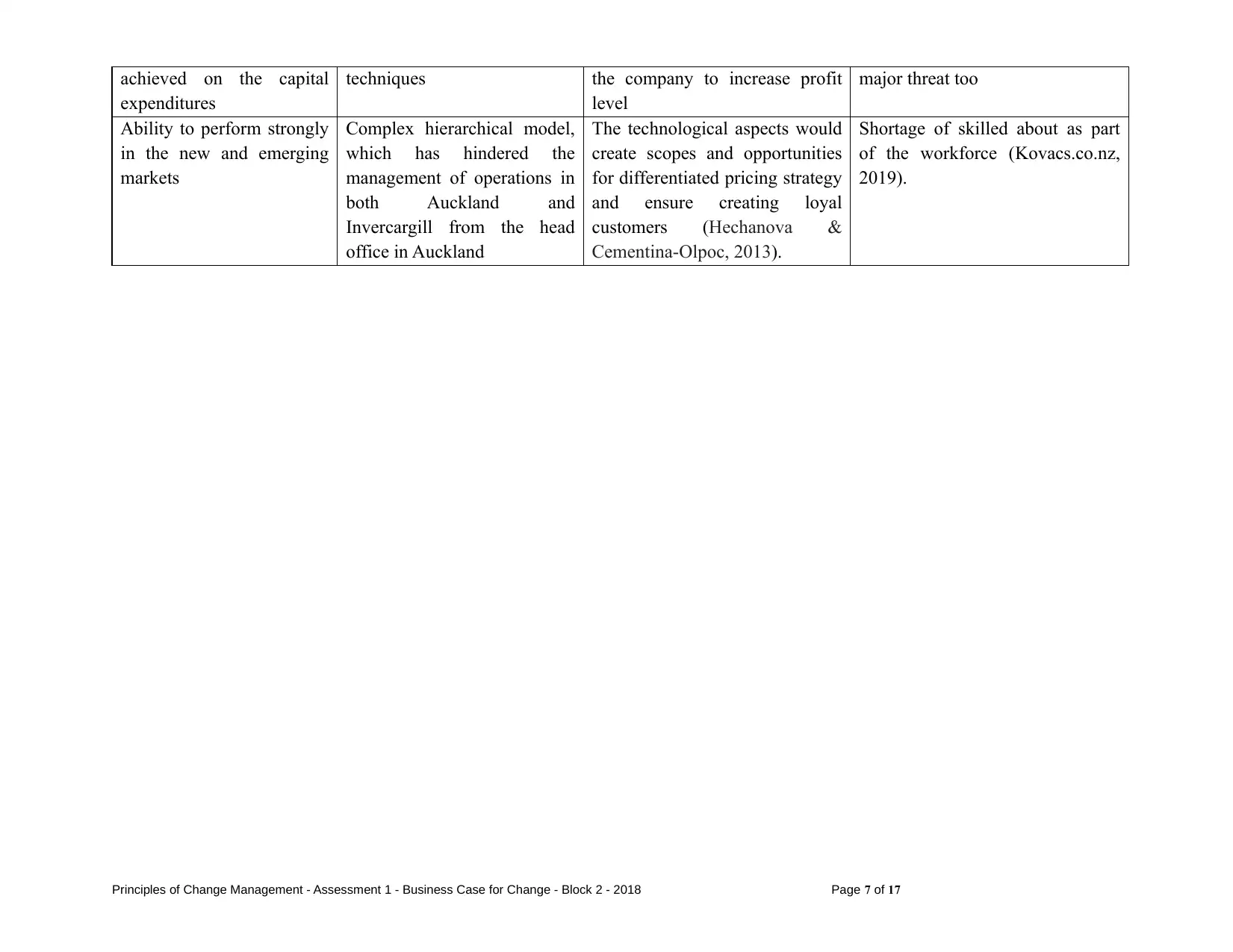
achieved on the capital
expenditures
techniques the company to increase profit
level
major threat too
Ability to perform strongly
in the new and emerging
markets
Complex hierarchical model,
which has hindered the
management of operations in
both Auckland and
Invercargill from the head
office in Auckland
The technological aspects would
create scopes and opportunities
for differentiated pricing strategy
and ensure creating loyal
customers (Hechanova &
Cementina-Olpoc, 2013).
Shortage of skilled about as part
of the workforce (Kovacs.co.nz,
2019).
Principles of Change Management - Assessment 1 - Business Case for Change - Block 2 - 2018 Page 7 of 17
expenditures
techniques the company to increase profit
level
major threat too
Ability to perform strongly
in the new and emerging
markets
Complex hierarchical model,
which has hindered the
management of operations in
both Auckland and
Invercargill from the head
office in Auckland
The technological aspects would
create scopes and opportunities
for differentiated pricing strategy
and ensure creating loyal
customers (Hechanova &
Cementina-Olpoc, 2013).
Shortage of skilled about as part
of the workforce (Kovacs.co.nz,
2019).
Principles of Change Management - Assessment 1 - Business Case for Change - Block 2 - 2018 Page 7 of 17
Paraphrase This Document
Need a fresh take? Get an instant paraphrase of this document with our AI Paraphraser
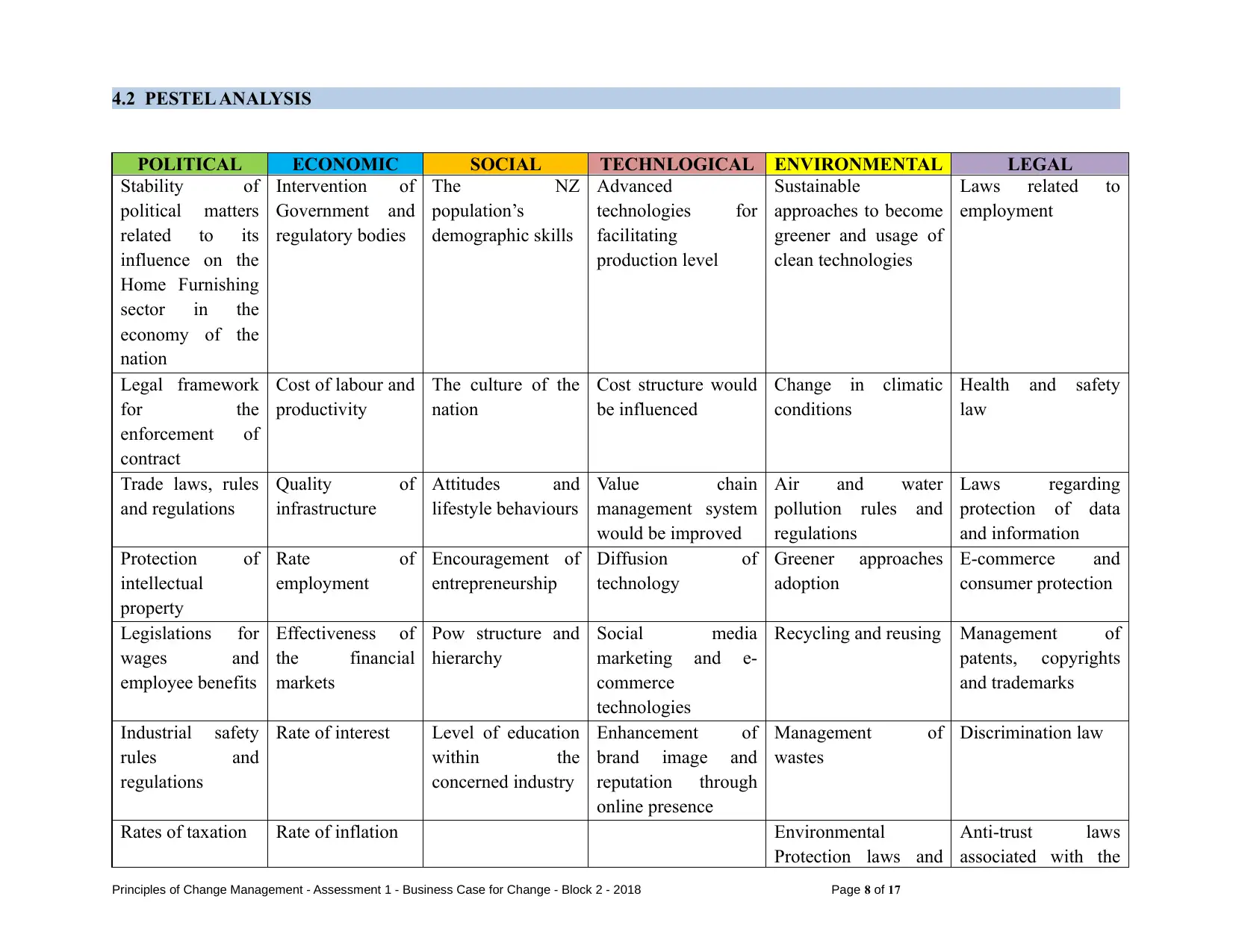
4.2 PESTEL ANALYSIS
POLITICAL ECONOMIC SOCIAL TECHNLOGICAL ENVIRONMENTAL LEGAL
Stability of
political matters
related to its
influence on the
Home Furnishing
sector in the
economy of the
nation
Intervention of
Government and
regulatory bodies
The NZ
population’s
demographic skills
Advanced
technologies for
facilitating
production level
Sustainable
approaches to become
greener and usage of
clean technologies
Laws related to
employment
Legal framework
for the
enforcement of
contract
Cost of labour and
productivity
The culture of the
nation
Cost structure would
be influenced
Change in climatic
conditions
Health and safety
law
Trade laws, rules
and regulations
Quality of
infrastructure
Attitudes and
lifestyle behaviours
Value chain
management system
would be improved
Air and water
pollution rules and
regulations
Laws regarding
protection of data
and information
Protection of
intellectual
property
Rate of
employment
Encouragement of
entrepreneurship
Diffusion of
technology
Greener approaches
adoption
E-commerce and
consumer protection
Legislations for
wages and
employee benefits
Effectiveness of
the financial
markets
Pow structure and
hierarchy
Social media
marketing and e-
commerce
technologies
Recycling and reusing Management of
patents, copyrights
and trademarks
Industrial safety
rules and
regulations
Rate of interest Level of education
within the
concerned industry
Enhancement of
brand image and
reputation through
online presence
Management of
wastes
Discrimination law
Rates of taxation Rate of inflation Environmental
Protection laws and
Anti-trust laws
associated with the
Principles of Change Management - Assessment 1 - Business Case for Change - Block 2 - 2018 Page 8 of 17
POLITICAL ECONOMIC SOCIAL TECHNLOGICAL ENVIRONMENTAL LEGAL
Stability of
political matters
related to its
influence on the
Home Furnishing
sector in the
economy of the
nation
Intervention of
Government and
regulatory bodies
The NZ
population’s
demographic skills
Advanced
technologies for
facilitating
production level
Sustainable
approaches to become
greener and usage of
clean technologies
Laws related to
employment
Legal framework
for the
enforcement of
contract
Cost of labour and
productivity
The culture of the
nation
Cost structure would
be influenced
Change in climatic
conditions
Health and safety
law
Trade laws, rules
and regulations
Quality of
infrastructure
Attitudes and
lifestyle behaviours
Value chain
management system
would be improved
Air and water
pollution rules and
regulations
Laws regarding
protection of data
and information
Protection of
intellectual
property
Rate of
employment
Encouragement of
entrepreneurship
Diffusion of
technology
Greener approaches
adoption
E-commerce and
consumer protection
Legislations for
wages and
employee benefits
Effectiveness of
the financial
markets
Pow structure and
hierarchy
Social media
marketing and e-
commerce
technologies
Recycling and reusing Management of
patents, copyrights
and trademarks
Industrial safety
rules and
regulations
Rate of interest Level of education
within the
concerned industry
Enhancement of
brand image and
reputation through
online presence
Management of
wastes
Discrimination law
Rates of taxation Rate of inflation Environmental
Protection laws and
Anti-trust laws
associated with the
Principles of Change Management - Assessment 1 - Business Case for Change - Block 2 - 2018 Page 8 of 17
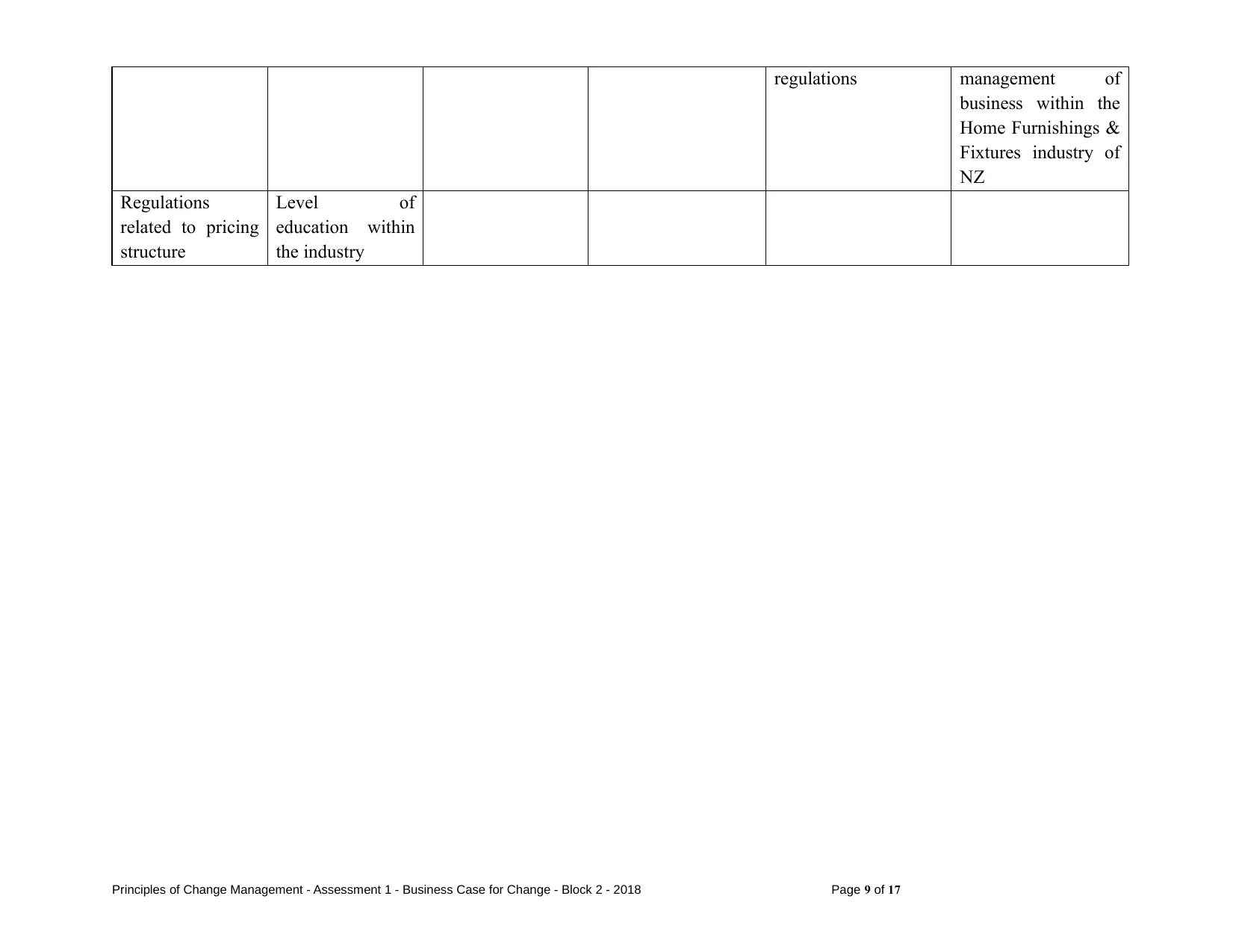
regulations management of
business within the
Home Furnishings &
Fixtures industry of
NZ
Regulations
related to pricing
structure
Level of
education within
the industry
Principles of Change Management - Assessment 1 - Business Case for Change - Block 2 - 2018 Page 9 of 17
business within the
Home Furnishings &
Fixtures industry of
NZ
Regulations
related to pricing
structure
Level of
education within
the industry
Principles of Change Management - Assessment 1 - Business Case for Change - Block 2 - 2018 Page 9 of 17
⊘ This is a preview!⊘
Do you want full access?
Subscribe today to unlock all pages.
Trusted by 1+ million students worldwide
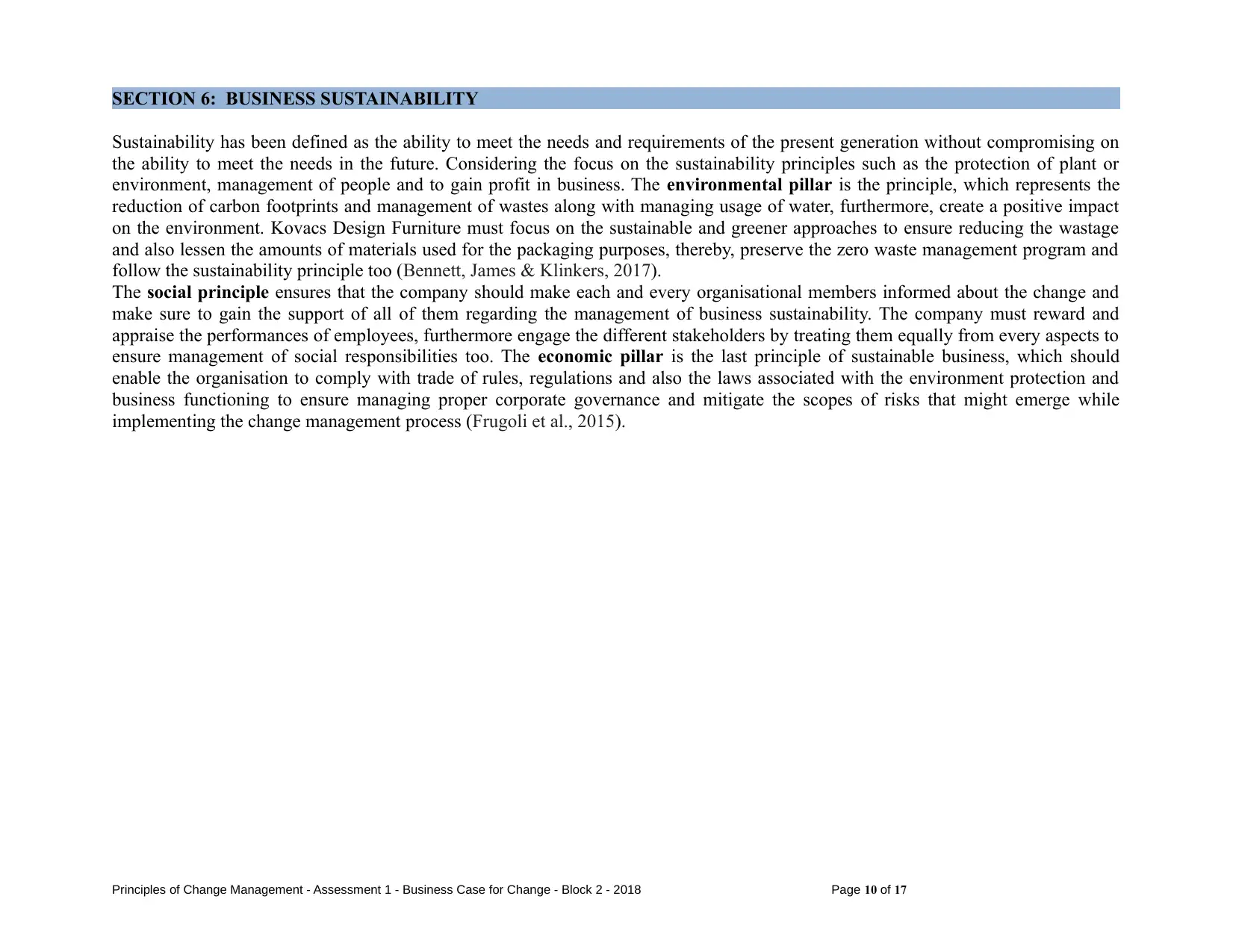
SECTION 6: BUSINESS SUSTAINABILITY
Sustainability has been defined as the ability to meet the needs and requirements of the present generation without compromising on
the ability to meet the needs in the future. Considering the focus on the sustainability principles such as the protection of plant or
environment, management of people and to gain profit in business. The environmental pillar is the principle, which represents the
reduction of carbon footprints and management of wastes along with managing usage of water, furthermore, create a positive impact
on the environment. Kovacs Design Furniture must focus on the sustainable and greener approaches to ensure reducing the wastage
and also lessen the amounts of materials used for the packaging purposes, thereby, preserve the zero waste management program and
follow the sustainability principle too (Bennett, James & Klinkers, 2017).
The social principle ensures that the company should make each and every organisational members informed about the change and
make sure to gain the support of all of them regarding the management of business sustainability. The company must reward and
appraise the performances of employees, furthermore engage the different stakeholders by treating them equally from every aspects to
ensure management of social responsibilities too. The economic pillar is the last principle of sustainable business, which should
enable the organisation to comply with trade of rules, regulations and also the laws associated with the environment protection and
business functioning to ensure managing proper corporate governance and mitigate the scopes of risks that might emerge while
implementing the change management process (Frugoli et al., 2015).
Principles of Change Management - Assessment 1 - Business Case for Change - Block 2 - 2018 Page 10 of 17
Sustainability has been defined as the ability to meet the needs and requirements of the present generation without compromising on
the ability to meet the needs in the future. Considering the focus on the sustainability principles such as the protection of plant or
environment, management of people and to gain profit in business. The environmental pillar is the principle, which represents the
reduction of carbon footprints and management of wastes along with managing usage of water, furthermore, create a positive impact
on the environment. Kovacs Design Furniture must focus on the sustainable and greener approaches to ensure reducing the wastage
and also lessen the amounts of materials used for the packaging purposes, thereby, preserve the zero waste management program and
follow the sustainability principle too (Bennett, James & Klinkers, 2017).
The social principle ensures that the company should make each and every organisational members informed about the change and
make sure to gain the support of all of them regarding the management of business sustainability. The company must reward and
appraise the performances of employees, furthermore engage the different stakeholders by treating them equally from every aspects to
ensure management of social responsibilities too. The economic pillar is the last principle of sustainable business, which should
enable the organisation to comply with trade of rules, regulations and also the laws associated with the environment protection and
business functioning to ensure managing proper corporate governance and mitigate the scopes of risks that might emerge while
implementing the change management process (Frugoli et al., 2015).
Principles of Change Management - Assessment 1 - Business Case for Change - Block 2 - 2018 Page 10 of 17
Paraphrase This Document
Need a fresh take? Get an instant paraphrase of this document with our AI Paraphraser
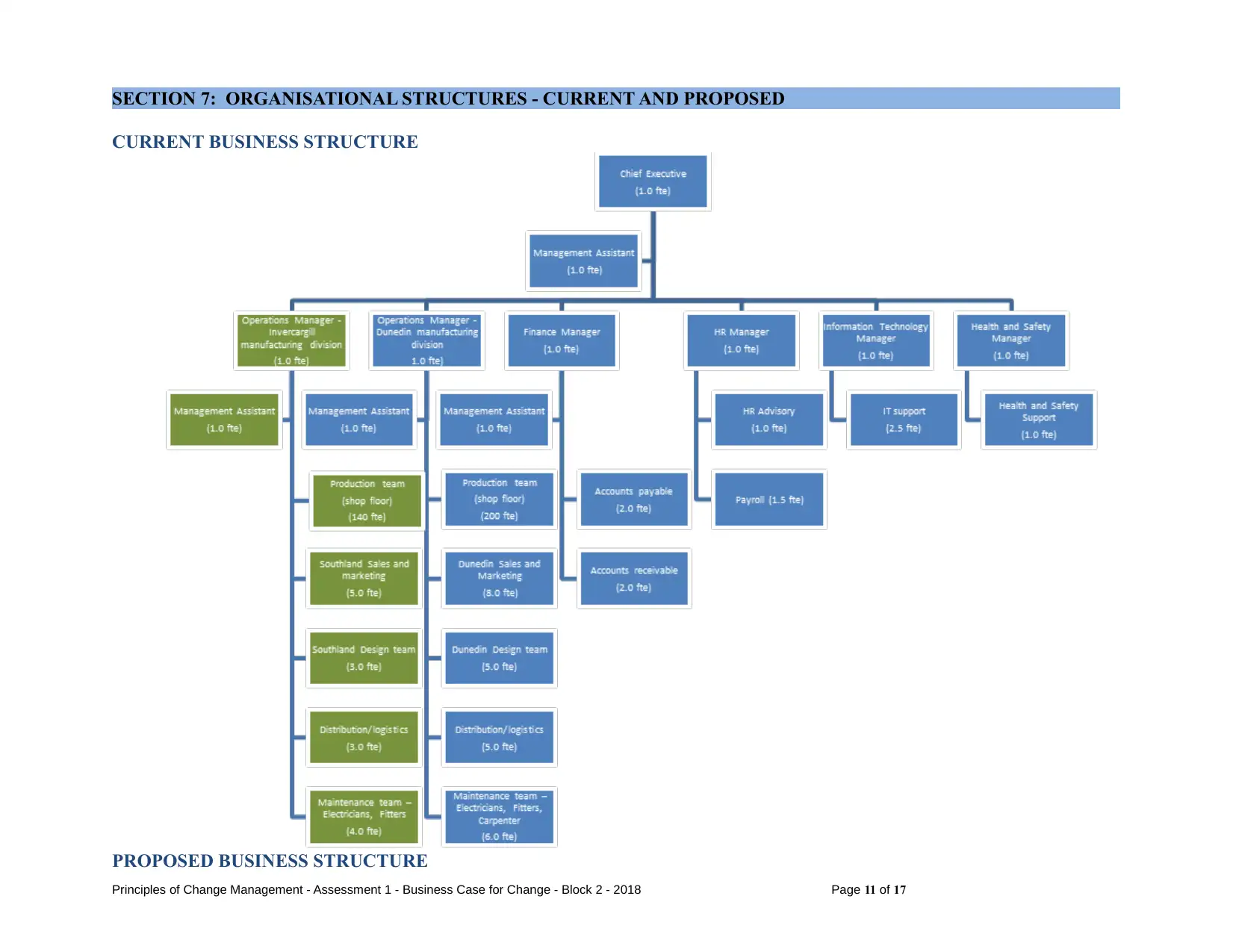
SECTION 7: ORGANISATIONAL STRUCTURES - CURRENT AND PROPOSED
CURRENT BUSINESS STRUCTURE
PROPOSED BUSINESS STRUCTURE
Principles of Change Management - Assessment 1 - Business Case for Change - Block 2 - 2018 Page 11 of 17
CURRENT BUSINESS STRUCTURE
PROPOSED BUSINESS STRUCTURE
Principles of Change Management - Assessment 1 - Business Case for Change - Block 2 - 2018 Page 11 of 17
Principles of Change Management - Assessment 1 - Business Case for Change - Block 2 - 2018 Page 12 of 17
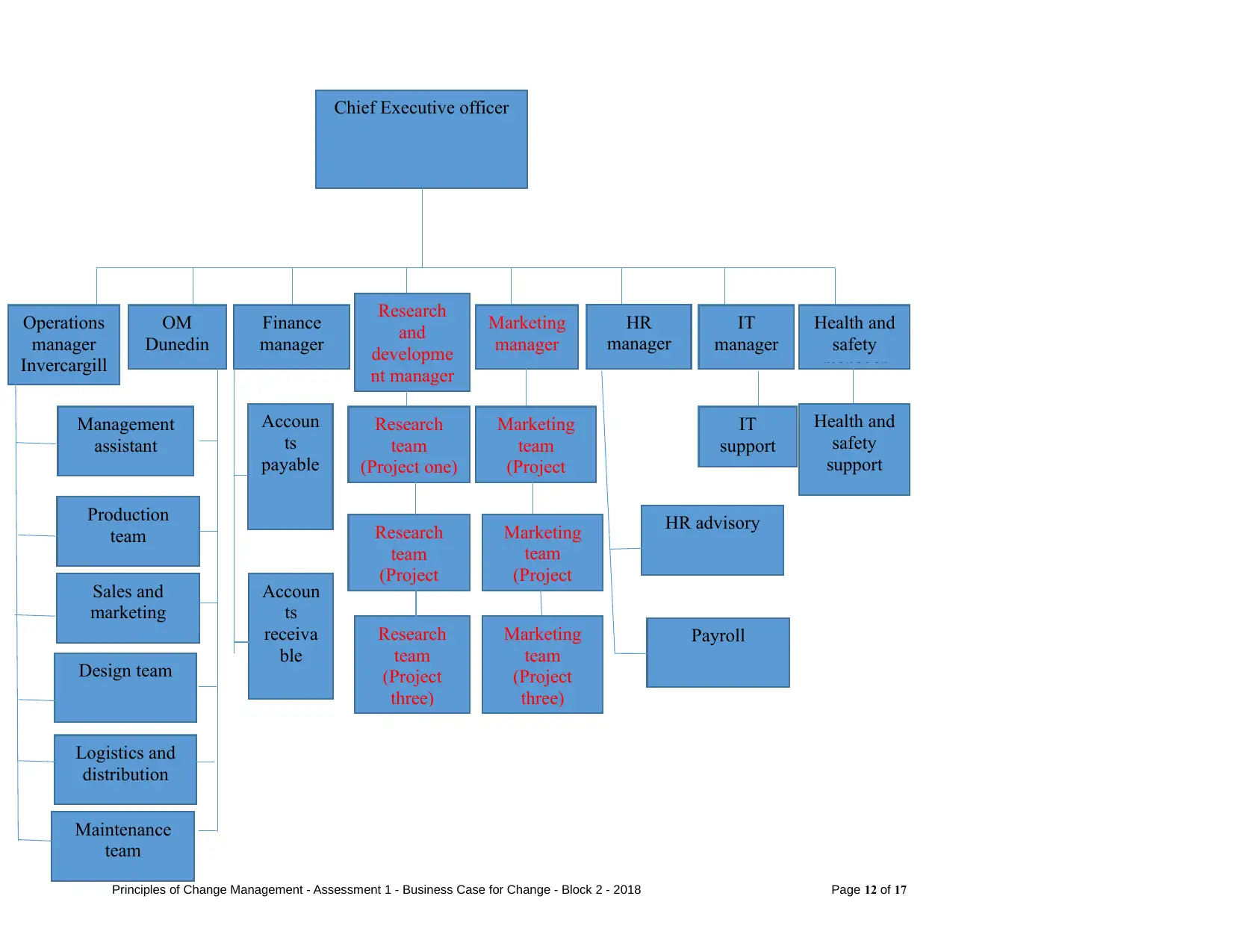
Chief Executive officer
Operations
manager
Invercargill
Research
and
developme
nt manager
Finance
manager
OM
Dunedin
Health and
safety
manager
IT
manager
HR
manager
Marketing
manager
Research
team
(Project one)
Research
team
(Project
Research
team
(Project
three)
Marketing
team
(Project
Marketing
team
(Project
Marketing
team
(Project
three)
Management
assistant
Production
team
Sales and
marketing
Design team
Logistics and
distribution
Maintenance
team
Accoun
ts
payable
Accoun
ts
receiva
ble
IT
support
Health and
safety
support
HR advisory
Payroll
Chief Executive officer
Operations
manager
Invercargill
Research
and
developme
nt manager
Finance
manager
OM
Dunedin
Health and
safety
manager
IT
manager
HR
manager
Marketing
manager
Research
team
(Project one)
Research
team
(Project
Research
team
(Project
three)
Marketing
team
(Project
Marketing
team
(Project
Marketing
team
(Project
three)
Management
assistant
Production
team
Sales and
marketing
Design team
Logistics and
distribution
Maintenance
team
Accoun
ts
payable
Accoun
ts
receiva
ble
IT
support
Health and
safety
support
HR advisory
Payroll
⊘ This is a preview!⊘
Do you want full access?
Subscribe today to unlock all pages.
Trusted by 1+ million students worldwide

1 out of 17


Related Documents


Your All-in-One AI-Powered Toolkit for Academic Success.
+13062052269
info@desklib.com
Available 24*7 on WhatsApp / Email
![[object Object]](/_next/static/media/star-bottom.7253800d.svg)
Unlock your academic potential
Copyright © 2020–2026 A2Z Services. All Rights Reserved. Developed and managed by ZUCOL.