Evaluating PFI Contracts: Risk, Allocation, and Construction Outcomes
VerifiedAdded on 2021/02/19
|8
|2694
|348
Report
AI Summary
This report provides a comprehensive analysis of the Private Finance Initiative (PFI), examining its principles, risk allocation strategies, and the rationale behind its abolishment. It delves into the advantages and disadvantages of PFI, including the financial burdens and safety concerns associated with the contracts. The report explores the principles of risk allocation within PFI projects, highlighting the shift of responsibilities to the private sector and the potential impacts on construction quality and timelines. A significant portion of the report is dedicated to the case overview of Carillion plc, a major construction company whose collapse served as a catalyst for the review and abolishment of PFI. The study further investigates the consequences of PFI abolishment on construction activities, considering both the positive and negative implications for public sector infrastructure development. The report concludes by summarizing the key findings and implications of PFI, emphasizing the importance of effective risk management in public-private partnerships and the need for careful consideration of the long-term financial and operational impacts of such initiatives.
Management of Risk and
Scheduling
Scheduling

Paraphrase This Document
Need a fresh take? Get an instant paraphrase of this document with our AI Paraphraser
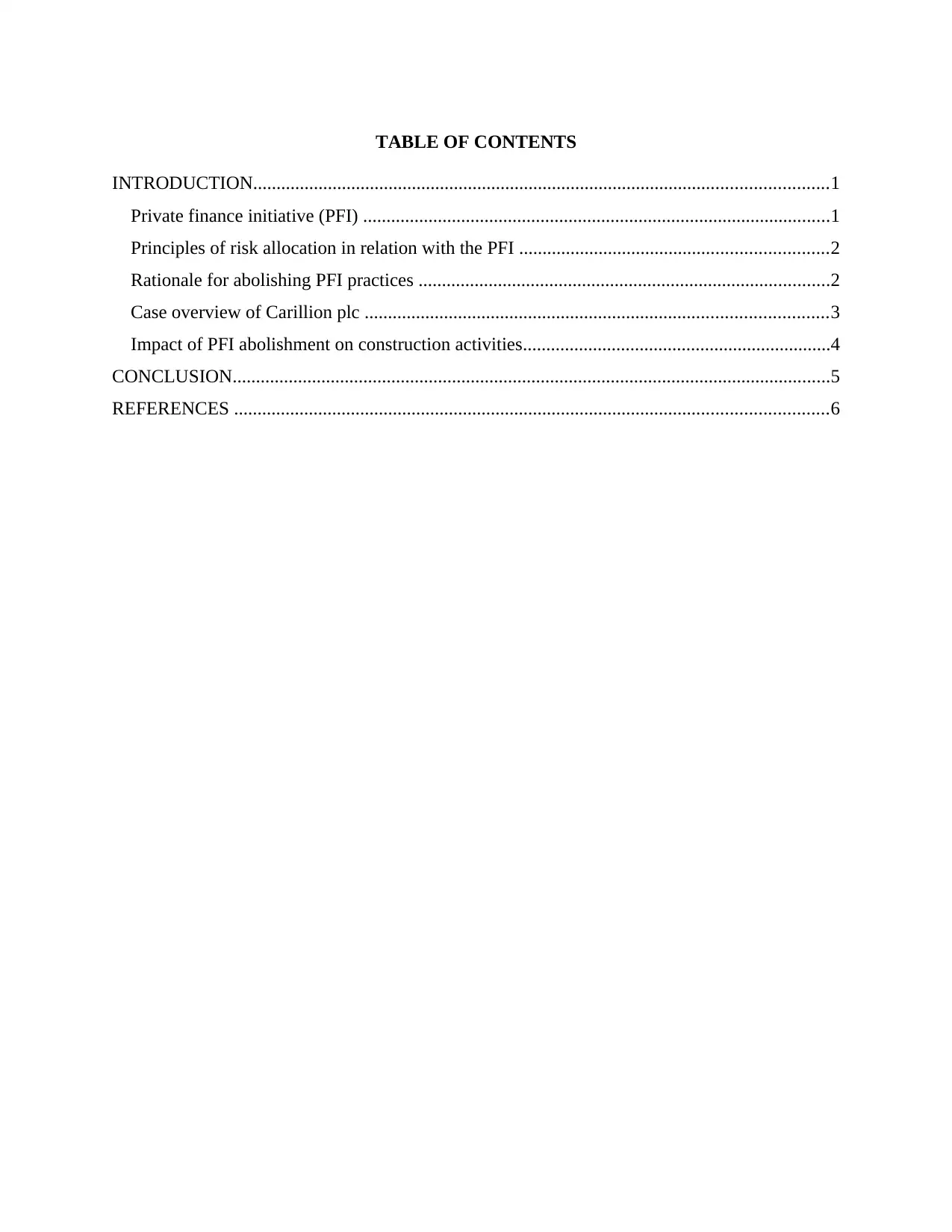
TABLE OF CONTENTS
INTRODUCTION...........................................................................................................................1
Private finance initiative (PFI) ....................................................................................................1
Principles of risk allocation in relation with the PFI ..................................................................2
Rationale for abolishing PFI practices ........................................................................................2
Case overview of Carillion plc ...................................................................................................3
Impact of PFI abolishment on construction activities..................................................................4
CONCLUSION................................................................................................................................5
REFERENCES ...............................................................................................................................6
INTRODUCTION...........................................................................................................................1
Private finance initiative (PFI) ....................................................................................................1
Principles of risk allocation in relation with the PFI ..................................................................2
Rationale for abolishing PFI practices ........................................................................................2
Case overview of Carillion plc ...................................................................................................3
Impact of PFI abolishment on construction activities..................................................................4
CONCLUSION................................................................................................................................5
REFERENCES ...............................................................................................................................6
INTRODUCTION
Private finance initiative (PFI) is defined as the financing of public sector projects by
private sector organisations so that capital related burden on taxpayers and government can be
reduced. In PFI projects up front cost of building or the government projects is handled by
private companies which then lease it to public. In return annual payments are delivered to
private company and thus this types of contract represents effective examples of public private
partnerships (Demirag, 2018). However, recently UK chancellor took the decision to abolish the
PFI contracts deals in response to risk allocation in such projects. The study will analyse the
rationale for incorporating such decisions and its impact on risk management objectives.
Private finance initiative (PFI)
PFI were implemented in 1992 in UK and are used for public works such as hospitals,
schools, prison and other public infrastructures. PFI contracts are usually 25-30 years long and
for these projects funds are provided by private firms instead of receiving it from taxpayers.
Along with the funds private companies are also given the responsibility to manage and complete
the project (Lop, Ismail and Isa, 2018). One of the advantage of using such projects is that
government is not required to pay huge amount of investments at once for funding large public
projects while the private companies can gain benefits through interest received from
government along with the long term repayments.
There are various projects in UK which are subjected to PFI such as main road, NHS,
airports and bridges. The key advantage of such popularity of PFI projects in UK is that for
accomplishments of public infrastructure projects government may need huge volume of amount
and thus instead of borrowing sum from the bond market private firms are employed for funding
the project (Freedland, 2018). In addition to this when responsibility is shifted from public sector
to private sector then a sense of responsibility to complete projects on time by minimising the
construction risk of the buildings is also shared.
In long term such types of projects helps to improve the relationship between private and
public sector by encouraging the resource and knowledge sharing with each other. However,
recently the PFI is facing huge criticism in UK. There has been constant debate and evidences
that repayment terms include heavy interest rates which is ultimately shifted to taxpayers. In
addition to this ongoing maintenance also enhances tax burden and cost of the project. Thus, for
1
Private finance initiative (PFI) is defined as the financing of public sector projects by
private sector organisations so that capital related burden on taxpayers and government can be
reduced. In PFI projects up front cost of building or the government projects is handled by
private companies which then lease it to public. In return annual payments are delivered to
private company and thus this types of contract represents effective examples of public private
partnerships (Demirag, 2018). However, recently UK chancellor took the decision to abolish the
PFI contracts deals in response to risk allocation in such projects. The study will analyse the
rationale for incorporating such decisions and its impact on risk management objectives.
Private finance initiative (PFI)
PFI were implemented in 1992 in UK and are used for public works such as hospitals,
schools, prison and other public infrastructures. PFI contracts are usually 25-30 years long and
for these projects funds are provided by private firms instead of receiving it from taxpayers.
Along with the funds private companies are also given the responsibility to manage and complete
the project (Lop, Ismail and Isa, 2018). One of the advantage of using such projects is that
government is not required to pay huge amount of investments at once for funding large public
projects while the private companies can gain benefits through interest received from
government along with the long term repayments.
There are various projects in UK which are subjected to PFI such as main road, NHS,
airports and bridges. The key advantage of such popularity of PFI projects in UK is that for
accomplishments of public infrastructure projects government may need huge volume of amount
and thus instead of borrowing sum from the bond market private firms are employed for funding
the project (Freedland, 2018). In addition to this when responsibility is shifted from public sector
to private sector then a sense of responsibility to complete projects on time by minimising the
construction risk of the buildings is also shared.
In long term such types of projects helps to improve the relationship between private and
public sector by encouraging the resource and knowledge sharing with each other. However,
recently the PFI is facing huge criticism in UK. There has been constant debate and evidences
that repayment terms include heavy interest rates which is ultimately shifted to taxpayers. In
addition to this ongoing maintenance also enhances tax burden and cost of the project. Thus, for
1
⊘ This is a preview!⊘
Do you want full access?
Subscribe today to unlock all pages.

Trusted by 1+ million students worldwide
achieving the profit goals private organisations often neglect the safety and quality standards
related to construction projects leading to increased safety risks.
Principles of risk allocation in relation with the PFI
The PFI contracts allocates the majority of risks to private sector instead of public sector.
Through this type of arrangements government authorities shifts the safety and construction
responsibility of the buildings on the private firm owners. For example the construction
document must provide the information of the pre-site conditions so that private firms taking
responsibility must have complete information regarding estimated facts (Badi and Pryke, 2016).
However, in present PFI scheme contractors does not have ideas before bidding. It creates a huge
gap in the actual site characteristics and bidding prices. The contractors also liable for
completing the projects on time without any delay and damages.
Since private organisations are very firm regarding their brand value, most of the projects
under PFI are completed on time. Another critical risk which is evident in PFI projects is to
assure the sufficiency of the contract documents for the contractors. Though it is vital that
participating firms must have sufficient cash flow and requirements for eligibility but in many
cases powerful private firms tie up with the authorities and are successful to get contract without
meeting such needs (Ahmad, Connolly and Demirag, 2018) . Such negligence enhances the risk
of poor quality of construction. For instance due to lack of documentation it is possible that
many projects may initiate but they are dismissed prior to their completion and thus projects are
not completed and it leads to resource waste (Lop, Ismail and Isa, 2018). The workplace safety is
also responsibility of the private firms performing construction so that on-site accidents can be
avoided.
Rationale for abolishing PFI practices
The year 2000, witnessed several scandals highlighting the mismanagements in PFI
projects. It was revealed that for providing advantage to specific private firms government was
spending more amount on PFI projects which was not worthy. Thus, gradually such types of
investments were becoming accounting tool for minimising evidence of public sector borrowing.
It is analysed that repayments for the PFI projects are for long years and thus large debts were
also liable for the future taxpayers. As per the reports of National audit office for a project of
worth £52.9 billion private firms were charging taxpayers total of £121.4 billion (Private
2
related to construction projects leading to increased safety risks.
Principles of risk allocation in relation with the PFI
The PFI contracts allocates the majority of risks to private sector instead of public sector.
Through this type of arrangements government authorities shifts the safety and construction
responsibility of the buildings on the private firm owners. For example the construction
document must provide the information of the pre-site conditions so that private firms taking
responsibility must have complete information regarding estimated facts (Badi and Pryke, 2016).
However, in present PFI scheme contractors does not have ideas before bidding. It creates a huge
gap in the actual site characteristics and bidding prices. The contractors also liable for
completing the projects on time without any delay and damages.
Since private organisations are very firm regarding their brand value, most of the projects
under PFI are completed on time. Another critical risk which is evident in PFI projects is to
assure the sufficiency of the contract documents for the contractors. Though it is vital that
participating firms must have sufficient cash flow and requirements for eligibility but in many
cases powerful private firms tie up with the authorities and are successful to get contract without
meeting such needs (Ahmad, Connolly and Demirag, 2018) . Such negligence enhances the risk
of poor quality of construction. For instance due to lack of documentation it is possible that
many projects may initiate but they are dismissed prior to their completion and thus projects are
not completed and it leads to resource waste (Lop, Ismail and Isa, 2018). The workplace safety is
also responsibility of the private firms performing construction so that on-site accidents can be
avoided.
Rationale for abolishing PFI practices
The year 2000, witnessed several scandals highlighting the mismanagements in PFI
projects. It was revealed that for providing advantage to specific private firms government was
spending more amount on PFI projects which was not worthy. Thus, gradually such types of
investments were becoming accounting tool for minimising evidence of public sector borrowing.
It is analysed that repayments for the PFI projects are for long years and thus large debts were
also liable for the future taxpayers. As per the reports of National audit office for a project of
worth £52.9 billion private firms were charging taxpayers total of £121.4 billion (Private
2
Paraphrase This Document
Need a fresh take? Get an instant paraphrase of this document with our AI Paraphraser
Finance Initiative: where did all go wrong?,2011). Such high differences lead to the foundation
of controversies regarding public projects funded by PFI.
In addition to this many private organisations joined hands and tie ups with the expensive
contracts or agencies so that huge profits can be earned by laying more tax burden on taxpayers
in the form of repayment interest (Ismail and et.al., 2018). Despite observance of such
mismanagement and discrepancies it was very difficult for the government schools and hospitals
to break the clause or to terminate the contract with PFI. Such issues become extremely critical
when conflicts regarding services began to arise all over UK. For example a public school in
Belfast was closed in just 7 years but due to PFI contract government was liable to pay the
amount of £970,000 for next 16 years. Similarly, public hospital in Bromley, London cost £1.2
billion to NHS which is 10 times higher than it s actual worth (Private Finance Initiative: where
did all go wrong?,2011). The high interest rates more than the actual cost of the operational and
construction cost of the buildings leads to closure of many hospitals, buildings and schools.
The 2011 report of National audit office stated that financing prices with PFI are
extremely higher than the actual expected cost. Anohter critical impact obseved with PFI
servcies was that organisations such as hospitals began to cut their service quality to balance
with the repayment cost. For example 2% of the NHS budget is used for the repayment and by
2017 there were around 127 PFI schemes. However, in 2012 there were 7 hospitals which were
not able to manage the patient services with repayment cost (Lasa, Ahmad and Takim, 2016).
Thus, to help them in service continuity emergency funds of worth £1.5 billion were provided.
Increasing debt, mismanagement, resource wastage, delays and negligence to the welfare of tax
payers in shifting risk from public to private sectors leads to the abolishment of the scheme. One
of the critical event which caused the immediate action to review and abolish the PFI was
collapse of Carillion plc (Hodkinson and Essen, 2015). The event can be considered as the
triggering force for taking decision of abolishment.
Case overview of Carillion plc
Carillion plc was one of the largest construction organisation of UK which came in light
when it announced its liquidation. THE company operates all over UK and also operates
thousands of PFI projects constructing and managing schools, prisons and courthouses. The
immediate and quick liquidation suggested that a very little assets have been left with the
company (Shaw, 2018). The balance sheet of Carillion had debt of around £900 million and
3
of controversies regarding public projects funded by PFI.
In addition to this many private organisations joined hands and tie ups with the expensive
contracts or agencies so that huge profits can be earned by laying more tax burden on taxpayers
in the form of repayment interest (Ismail and et.al., 2018). Despite observance of such
mismanagement and discrepancies it was very difficult for the government schools and hospitals
to break the clause or to terminate the contract with PFI. Such issues become extremely critical
when conflicts regarding services began to arise all over UK. For example a public school in
Belfast was closed in just 7 years but due to PFI contract government was liable to pay the
amount of £970,000 for next 16 years. Similarly, public hospital in Bromley, London cost £1.2
billion to NHS which is 10 times higher than it s actual worth (Private Finance Initiative: where
did all go wrong?,2011). The high interest rates more than the actual cost of the operational and
construction cost of the buildings leads to closure of many hospitals, buildings and schools.
The 2011 report of National audit office stated that financing prices with PFI are
extremely higher than the actual expected cost. Anohter critical impact obseved with PFI
servcies was that organisations such as hospitals began to cut their service quality to balance
with the repayment cost. For example 2% of the NHS budget is used for the repayment and by
2017 there were around 127 PFI schemes. However, in 2012 there were 7 hospitals which were
not able to manage the patient services with repayment cost (Lasa, Ahmad and Takim, 2016).
Thus, to help them in service continuity emergency funds of worth £1.5 billion were provided.
Increasing debt, mismanagement, resource wastage, delays and negligence to the welfare of tax
payers in shifting risk from public to private sectors leads to the abolishment of the scheme. One
of the critical event which caused the immediate action to review and abolish the PFI was
collapse of Carillion plc (Hodkinson and Essen, 2015). The event can be considered as the
triggering force for taking decision of abolishment.
Case overview of Carillion plc
Carillion plc was one of the largest construction organisation of UK which came in light
when it announced its liquidation. THE company operates all over UK and also operates
thousands of PFI projects constructing and managing schools, prisons and courthouses. The
immediate and quick liquidation suggested that a very little assets have been left with the
company (Shaw, 2018). The balance sheet of Carillion had debt of around £900 million and
3
majority of the debts were result of long term contract with UK government under PFI program
(Inman., 2018). In order to win the government contract the organisation used to bid at lower
prices, however when the debt increases over the limit it did not receive any support neither from
UK government nor from banks (Ahmad, Connolly and Demirag, 2018).
Thus, it also raises the question that it was responsibility of government to review the
minimum bidding prices and if any of PFI company was investing at abnormally lower prices
then it must be reviewed instead of offering it deals. The organisation also had some contracts of
NHS and UK defence ministry. Carillion in order to remain in the competition used to bid at
abnormally lower prices. However, in the operational front it becomes challenging for the
organisation to operate and fulfil the safety and quality criteria. For example in one of the public
building in Aberdeen after winning the contract organisation found that building was unsafe and
thus additional cost was bear by company to shore it up (Inman., 2018).
Similarly, in Royal Liverpool University Hospital presence of cracks in the building
created additional financial burdens. The PFI companies gain huge profits and in order to seek
them construction companies neglect the safety check and pre evaluation of the site. The same
approach lead to the collapse of Carillion. The sudden collapse of such huge company gained the
attention of government authorities as well as other stakeholders associated with the PFI
(Kamise, Takahashi and Yano, 2017). The event gave a significant conclusion that instead of
allowing private organisations to blindly operate government must also consider the risk
assessments of such schemes as it could have affect the quality of buildings and safety of people.
Impact of PFI abolishment on construction activities
Private financial initiative is abolished by government cause it is causing many problems
to government and different areas of public sector. The private financial initiative is expensive
way to build infrastructure for government. These private organization were charging high
money from public sector companies that is not good for the economy of organization. To
generate high profit private construction were charging irrelevant amount form, companies that
is causing financial trouble to both organization and government (Ahmad, Connolly and
Demirag, 2018). It has both positive and negative effect. The positive impact of this abolishment
help the public sector organization and government in different ways. This provide greater
opportunity to government sector companies to develop their infrastructure for future
development of construction business. If the infrastructure of public sector company is made by
4
(Inman., 2018). In order to win the government contract the organisation used to bid at lower
prices, however when the debt increases over the limit it did not receive any support neither from
UK government nor from banks (Ahmad, Connolly and Demirag, 2018).
Thus, it also raises the question that it was responsibility of government to review the
minimum bidding prices and if any of PFI company was investing at abnormally lower prices
then it must be reviewed instead of offering it deals. The organisation also had some contracts of
NHS and UK defence ministry. Carillion in order to remain in the competition used to bid at
abnormally lower prices. However, in the operational front it becomes challenging for the
organisation to operate and fulfil the safety and quality criteria. For example in one of the public
building in Aberdeen after winning the contract organisation found that building was unsafe and
thus additional cost was bear by company to shore it up (Inman., 2018).
Similarly, in Royal Liverpool University Hospital presence of cracks in the building
created additional financial burdens. The PFI companies gain huge profits and in order to seek
them construction companies neglect the safety check and pre evaluation of the site. The same
approach lead to the collapse of Carillion. The sudden collapse of such huge company gained the
attention of government authorities as well as other stakeholders associated with the PFI
(Kamise, Takahashi and Yano, 2017). The event gave a significant conclusion that instead of
allowing private organisations to blindly operate government must also consider the risk
assessments of such schemes as it could have affect the quality of buildings and safety of people.
Impact of PFI abolishment on construction activities
Private financial initiative is abolished by government cause it is causing many problems
to government and different areas of public sector. The private financial initiative is expensive
way to build infrastructure for government. These private organization were charging high
money from public sector companies that is not good for the economy of organization. To
generate high profit private construction were charging irrelevant amount form, companies that
is causing financial trouble to both organization and government (Ahmad, Connolly and
Demirag, 2018). It has both positive and negative effect. The positive impact of this abolishment
help the public sector organization and government in different ways. This provide greater
opportunity to government sector companies to develop their infrastructure for future
development of construction business. If the infrastructure of public sector company is made by
4
⊘ This is a preview!⊘
Do you want full access?
Subscribe today to unlock all pages.
Trusted by 1+ million students worldwide
government this will provide better convenience to them to perform action with high cost
effectiveness. The process of construction will be more accurate and efficient because it is
monitored by government officials. This is an easy procedure for government to develop
different buildings. This will minimise the problems to government that are causing by extra
charges of private sector loans. This will provide authority to government to work accordingly.
There are some negative impact of this abolishment and this impact are. The employees hired by
government don't have that many skills and knowledge of the latest technology so this is major
problem for them. The other issues with the government are fewer employees, less skilled
employees and operational problems. The employees related issues are more about the skilled
employees (Badi and Pryke, 2016). Government don't have employees. So, government needs to
recruit new employees to develop new infrastructure for government sector. The most of the
technology that are used in construction business in current time comes with the latest
technology and government employees are not able to work on this technology cause of less
experience. The next problem faced by government are related to the operational capability.
Cause of low experience in construction business public sector company can face failure in
initially level. This is how the abolishment affect the government in diofferent manner.
CONCLUSION
This study is analysing the private finance initiative method to develop infrastructure of
different government buildings. Principle of risk allocation are evaluated in report to calculate
the risk in the private finance initiative method. The rational abolishment is analysed for the PFI.
The case study of carillon public limited company has been studied in report. The reasons of
abolishing the PFI method has been studied to find different advantages and disadvantages of
this action for government. The impact of Private Finance Initiative has been studied in report to
solve various issue related to it.
5
effectiveness. The process of construction will be more accurate and efficient because it is
monitored by government officials. This is an easy procedure for government to develop
different buildings. This will minimise the problems to government that are causing by extra
charges of private sector loans. This will provide authority to government to work accordingly.
There are some negative impact of this abolishment and this impact are. The employees hired by
government don't have that many skills and knowledge of the latest technology so this is major
problem for them. The other issues with the government are fewer employees, less skilled
employees and operational problems. The employees related issues are more about the skilled
employees (Badi and Pryke, 2016). Government don't have employees. So, government needs to
recruit new employees to develop new infrastructure for government sector. The most of the
technology that are used in construction business in current time comes with the latest
technology and government employees are not able to work on this technology cause of less
experience. The next problem faced by government are related to the operational capability.
Cause of low experience in construction business public sector company can face failure in
initially level. This is how the abolishment affect the government in diofferent manner.
CONCLUSION
This study is analysing the private finance initiative method to develop infrastructure of
different government buildings. Principle of risk allocation are evaluated in report to calculate
the risk in the private finance initiative method. The rational abolishment is analysed for the PFI.
The case study of carillon public limited company has been studied in report. The reasons of
abolishing the PFI method has been studied to find different advantages and disadvantages of
this action for government. The impact of Private Finance Initiative has been studied in report to
solve various issue related to it.
5
Paraphrase This Document
Need a fresh take? Get an instant paraphrase of this document with our AI Paraphraser
REFERENCES
Books and Journals
Ahmad, S., Connolly, C. and Demirag, I., 2018. A study of the operationalization of management
controls in United Kingdom Private Finance Initiative contracts. Public Administration.
Badi, S.M. and Pryke, S., 2016. Assessing the impact of risk allocation on sustainable energy
innovation (SEI) The case of private finance initiative (PFI) school projects. International
Journal of Managing Projects in Business. 9(2). pp.259-281.
Demirag, I., 2018. A study of the operationalization of management controls in UK's Private
Finance Initiative (PFI) contracts. Public Administration.
Freedland, M., 2018. Public law and private finance—placing the Private Finance Initiative in a
public law frame. In Administrative Law (pp. 377-396). Routledge.
Hodkinson, S. and Essen, C., 2015. Grounding accumulation by dispossession in everyday life:
the unjust geographies of urban regeneration under the private finance
initiative. International Journal of Law in the Built Environment. 7(1). pp.72-91.
Ismail, K., and et.al., 2018. Critical Success Factors in Operation Phase of Private Finance
Initiative (PFI) Projects. International Journal of Academic Research in Business and
Social Sciences. 8(1). pp.878-888.
Kamise, Y., Takahashi, N. and Yano, E., 2017. The promotion of social inclusion by adoption of
the Private Finance Initiative on a correctional institution. Shinrigaku kenkyu: The
Japanese journal of psychology. 87(6). pp.579-589.
Lasa, Y.M., Ahmad, N. and Takim, R., 2016. Financing Preference Behaviour for Private
Finance Initiative (PFI) Projects. Environment-Behaviour Proceedings Journal. 1(1).
pp.11-20.
Lop, N.S., Ismail, K. and Isa, H.M., 2018. A Conceptual Framework of Performance
Measurement Tool for Private Finance Initiative Projects in Malaysia. Journal of
Building Performance. 9(1).
Shaw, E., 2018. What matters is what works: the Third Way and the case of the Private Finance
Initiative. In The Third Way and Beyond. Manchester University Press.
Online
Inman., P., 2018. After Carillion and Capita, is PFI itself on the critical list?. [Online]. Accessed
through <https://www.theguardian.com/politics/2018/feb/03/pfi-carillion-capita-critical-
list-outsourcing>
Private Finance Initiative: where did all go wrong?.2011. [Online]. Accessed through
<https://www.telegraph.co.uk/news/health/news/8779598/Private-Finance-Initiative-
where-did-all-go-wrong.html>
6
Books and Journals
Ahmad, S., Connolly, C. and Demirag, I., 2018. A study of the operationalization of management
controls in United Kingdom Private Finance Initiative contracts. Public Administration.
Badi, S.M. and Pryke, S., 2016. Assessing the impact of risk allocation on sustainable energy
innovation (SEI) The case of private finance initiative (PFI) school projects. International
Journal of Managing Projects in Business. 9(2). pp.259-281.
Demirag, I., 2018. A study of the operationalization of management controls in UK's Private
Finance Initiative (PFI) contracts. Public Administration.
Freedland, M., 2018. Public law and private finance—placing the Private Finance Initiative in a
public law frame. In Administrative Law (pp. 377-396). Routledge.
Hodkinson, S. and Essen, C., 2015. Grounding accumulation by dispossession in everyday life:
the unjust geographies of urban regeneration under the private finance
initiative. International Journal of Law in the Built Environment. 7(1). pp.72-91.
Ismail, K., and et.al., 2018. Critical Success Factors in Operation Phase of Private Finance
Initiative (PFI) Projects. International Journal of Academic Research in Business and
Social Sciences. 8(1). pp.878-888.
Kamise, Y., Takahashi, N. and Yano, E., 2017. The promotion of social inclusion by adoption of
the Private Finance Initiative on a correctional institution. Shinrigaku kenkyu: The
Japanese journal of psychology. 87(6). pp.579-589.
Lasa, Y.M., Ahmad, N. and Takim, R., 2016. Financing Preference Behaviour for Private
Finance Initiative (PFI) Projects. Environment-Behaviour Proceedings Journal. 1(1).
pp.11-20.
Lop, N.S., Ismail, K. and Isa, H.M., 2018. A Conceptual Framework of Performance
Measurement Tool for Private Finance Initiative Projects in Malaysia. Journal of
Building Performance. 9(1).
Shaw, E., 2018. What matters is what works: the Third Way and the case of the Private Finance
Initiative. In The Third Way and Beyond. Manchester University Press.
Online
Inman., P., 2018. After Carillion and Capita, is PFI itself on the critical list?. [Online]. Accessed
through <https://www.theguardian.com/politics/2018/feb/03/pfi-carillion-capita-critical-
list-outsourcing>
Private Finance Initiative: where did all go wrong?.2011. [Online]. Accessed through
<https://www.telegraph.co.uk/news/health/news/8779598/Private-Finance-Initiative-
where-did-all-go-wrong.html>
6

1 out of 8


Related Documents


Your All-in-One AI-Powered Toolkit for Academic Success.
+13062052269
info@desklib.com
Available 24*7 on WhatsApp / Email
![[object Object]](/_next/static/media/star-bottom.7253800d.svg)
Unlock your academic potential
Copyright © 2020–2025 A2Z Services. All Rights Reserved. Developed and managed by ZUCOL.