International Tourism and Hospitality: Private Sector's Impact
VerifiedAdded on 2020/10/22
|12
|2836
|273
Report
AI Summary
This report delves into the significant role of the private sector in boosting tourism products within the international tourism and hospitality sector. It examines how private enterprises contribute to economic development through case studies, including the Tinapa Business Resort in Nigeria, the tourism sector in Rwanda, and the tourism industry in South Africa. The report highlights the involvement of the private sector in various aspects, such as marketing, finance, infrastructure development, and service enhancement. It also discusses the importance of partnerships between private and public sectors, as well as the role of private investment in driving tourism growth, creating jobs, and improving the quality of life for local communities. The analysis covers the impact of private sector involvement in tourism development, including the challenges and opportunities associated with it, and emphasizes the need for sustainable practices and community involvement to ensure long-term success. The report concludes by underscoring the value of private sector participation in tourism and the importance of governments' regulatory roles, along with the benefits of voluntary contributions and collaborative projects in enhancing destination attractiveness.
International Tourism
and Hospitality
Management
and Hospitality
Management

Paraphrase This Document
Need a fresh take? Get an instant paraphrase of this document with our AI Paraphraser
Table of Contents
INTRODUCTION...........................................................................................................................3
MAIN BODY...................................................................................................................................3
Private enterprise boosting tourism products with reference to case studies.........................3
CONCLUSION................................................................................................................................8
REFERENCES..............................................................................................................................10
Online...................................................................................................................................10
BIBLIOGRAPHY..........................................................................................................................12
INTRODUCTION...........................................................................................................................3
MAIN BODY...................................................................................................................................3
Private enterprise boosting tourism products with reference to case studies.........................3
CONCLUSION................................................................................................................................8
REFERENCES..............................................................................................................................10
Online...................................................................................................................................10
BIBLIOGRAPHY..........................................................................................................................12
INTRODUCTION
Tourism has become an important sector that has a great impact on economic
development of a country (1Eja and et.al., 2011). The appeal of a destination and its attractive
image attracts visitors of other countries towards it. Thus, it has become one of the most
significant source income generation and job creation for many countries all over the world.
Thus, private sector is a part of national economy that does not come under direct state control. It
is runned by private individuals or groups in order to generate profits. In following essay, the
contribution of private sector in order to boost tourism product has been discussed.
MAIN BODY
Private enterprise boosting tourism products with reference to case studies.
Tourism refers to movement in people from one place to another. Tourism
development is sustainable development in tourism (ANIAH and EUGENE, 2009). In order to
keep everything balanced with increase in tourist numbers, the development according to such
situation is known as tourism development. The tourism product development and management
is related closely with policies that mainly affects local development and their creation in
destination. A tourism destination requires good product portfolio in order to increase ability in
tourism development and create specialisation in existing supply of destination. The acceptance
is growing that innovative approaches has to be adopted in order to maintain economic health of
number of countries, communities and regions. Tourism has become an important form in
development of economy of a particular country (Czernek, 2017). There is rise and fall in
popularity due to demand and supply side problems faced by tourists. Its guidelines and
management practices are applicable to all forms of tourism in different types of destination. In
order to improve tourism product they have to advertise in press in large quantities to bring
tourist over a particular place. It will help tourist to arrive in large quantities. Hence, private
sector is involved in tourism area by offering support services as are guiding, finance, marketing,
private education and training establishments etc. Furthermore, involvement of private sector in
tourism development increases profit of a particular industry. Private sector is an engine of
growth in tourism sector as it provides economic growth that helps in reducing poverty of a
particular company. The private sector is encouraged mainly to involve stakeholders in a
particular community and other organisations of tourism planning and implementation. They
contribute capital management expertise, skill transfer etc.
Tourism has become an important sector that has a great impact on economic
development of a country (1Eja and et.al., 2011). The appeal of a destination and its attractive
image attracts visitors of other countries towards it. Thus, it has become one of the most
significant source income generation and job creation for many countries all over the world.
Thus, private sector is a part of national economy that does not come under direct state control. It
is runned by private individuals or groups in order to generate profits. In following essay, the
contribution of private sector in order to boost tourism product has been discussed.
MAIN BODY
Private enterprise boosting tourism products with reference to case studies.
Tourism refers to movement in people from one place to another. Tourism
development is sustainable development in tourism (ANIAH and EUGENE, 2009). In order to
keep everything balanced with increase in tourist numbers, the development according to such
situation is known as tourism development. The tourism product development and management
is related closely with policies that mainly affects local development and their creation in
destination. A tourism destination requires good product portfolio in order to increase ability in
tourism development and create specialisation in existing supply of destination. The acceptance
is growing that innovative approaches has to be adopted in order to maintain economic health of
number of countries, communities and regions. Tourism has become an important form in
development of economy of a particular country (Czernek, 2017). There is rise and fall in
popularity due to demand and supply side problems faced by tourists. Its guidelines and
management practices are applicable to all forms of tourism in different types of destination. In
order to improve tourism product they have to advertise in press in large quantities to bring
tourist over a particular place. It will help tourist to arrive in large quantities. Hence, private
sector is involved in tourism area by offering support services as are guiding, finance, marketing,
private education and training establishments etc. Furthermore, involvement of private sector in
tourism development increases profit of a particular industry. Private sector is an engine of
growth in tourism sector as it provides economic growth that helps in reducing poverty of a
particular company. The private sector is encouraged mainly to involve stakeholders in a
particular community and other organisations of tourism planning and implementation. They
contribute capital management expertise, skill transfer etc.
⊘ This is a preview!⊘
Do you want full access?
Subscribe today to unlock all pages.

Trusted by 1+ million students worldwide
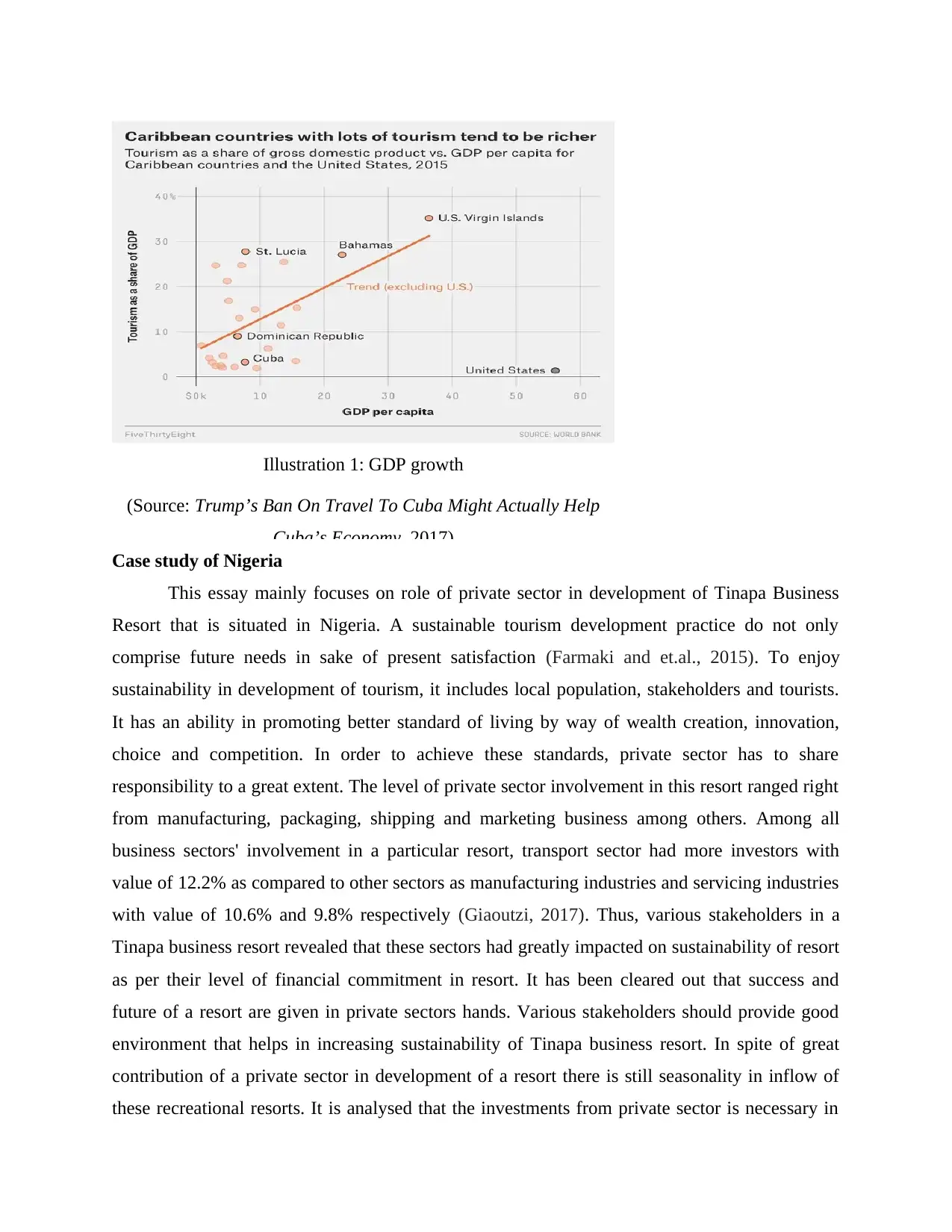
Illustration 1: GDP growth
(Source: Trump’s Ban On Travel To Cuba Might Actually Help
Cuba’s Economy, 2017)
Case study of Nigeria
This essay mainly focuses on role of private sector in development of Tinapa Business
Resort that is situated in Nigeria. A sustainable tourism development practice do not only
comprise future needs in sake of present satisfaction (Farmaki and et.al., 2015). To enjoy
sustainability in development of tourism, it includes local population, stakeholders and tourists.
It has an ability in promoting better standard of living by way of wealth creation, innovation,
choice and competition. In order to achieve these standards, private sector has to share
responsibility to a great extent. The level of private sector involvement in this resort ranged right
from manufacturing, packaging, shipping and marketing business among others. Among all
business sectors' involvement in a particular resort, transport sector had more investors with
value of 12.2% as compared to other sectors as manufacturing industries and servicing industries
with value of 10.6% and 9.8% respectively (Giaoutzi, 2017). Thus, various stakeholders in a
Tinapa business resort revealed that these sectors had greatly impacted on sustainability of resort
as per their level of financial commitment in resort. It has been cleared out that success and
future of a resort are given in private sectors hands. Various stakeholders should provide good
environment that helps in increasing sustainability of Tinapa business resort. In spite of great
contribution of a private sector in development of a resort there is still seasonality in inflow of
these recreational resorts. It is analysed that the investments from private sector is necessary in
(Source: Trump’s Ban On Travel To Cuba Might Actually Help
Cuba’s Economy, 2017)
Case study of Nigeria
This essay mainly focuses on role of private sector in development of Tinapa Business
Resort that is situated in Nigeria. A sustainable tourism development practice do not only
comprise future needs in sake of present satisfaction (Farmaki and et.al., 2015). To enjoy
sustainability in development of tourism, it includes local population, stakeholders and tourists.
It has an ability in promoting better standard of living by way of wealth creation, innovation,
choice and competition. In order to achieve these standards, private sector has to share
responsibility to a great extent. The level of private sector involvement in this resort ranged right
from manufacturing, packaging, shipping and marketing business among others. Among all
business sectors' involvement in a particular resort, transport sector had more investors with
value of 12.2% as compared to other sectors as manufacturing industries and servicing industries
with value of 10.6% and 9.8% respectively (Giaoutzi, 2017). Thus, various stakeholders in a
Tinapa business resort revealed that these sectors had greatly impacted on sustainability of resort
as per their level of financial commitment in resort. It has been cleared out that success and
future of a resort are given in private sectors hands. Various stakeholders should provide good
environment that helps in increasing sustainability of Tinapa business resort. In spite of great
contribution of a private sector in development of a resort there is still seasonality in inflow of
these recreational resorts. It is analysed that the investments from private sector is necessary in
Paraphrase This Document
Need a fresh take? Get an instant paraphrase of this document with our AI Paraphraser
order to growth of the economy and it is a very transparent and necessary ingredients that is
required to turn the way of economy from non performing to performing a growth. Thus, their
role has to be encouraged so that it leads to increase in tourism facilities like game reserves,
resorts etc. tourism development differs from country to country and its development is not
uniform in nature (Judd, 2015). Therefore, it has been analysed that participation of private
sectors plays a crucial role in maintaining operations of tourism globally and they have created
trust factor in various service market that in turn benefits their country.
Case study of Rwanda
With reference to other case studies it has been analysed the contribution of private sector
in promoting tourism. Rwandas tourism sector has recorded its growth significantly and this is
just because of number of initiatives that has been putted in a place in order to realize potential of
such unique and powerful sector. It is taking shape as one of East Africa's premier business
tourism destinations. Thus, growing private sector in meetings, incentives, conferences, and
events in market. Private and public sectors are increasingly interested in economic impacts of
tourism at national levels and local levels. The private sectors Federation was established as a
part of governments efforts to position private sector at top of journey of development of country
(Jung and et.al., 2015). Along with various chambers, tourism was set up and it was dedicated to
activities of tourism as separate extreme body of entities of tourism sector. Thus, most activities
were given to private sectors and many of them have been done by them. Furthermore, private
sector has also promoted products of Rwanda to various markets including regional and
international by highlighting it as Made In Rwanda product. Private sectors also took small
businesses to the point from where they can compete with others (Lee, Hampton and Jeyacheya,
2015). They also work hard in increasing incomes of disposal personal and empower the
business in order to help them in competing with member business. The growth in tourism sector
has been revealed with help of statistical data that the revenue from tourists has been increased
with help of private sector from $26 million in 2005 to $300 million in 2015. Thus, private sector
played significant role in increasing this figures. RDB has revised annual tourism of a country
within a month by increasing price of mountain treckinhg permits to 1500 dollars for each
tourists visiting there.
required to turn the way of economy from non performing to performing a growth. Thus, their
role has to be encouraged so that it leads to increase in tourism facilities like game reserves,
resorts etc. tourism development differs from country to country and its development is not
uniform in nature (Judd, 2015). Therefore, it has been analysed that participation of private
sectors plays a crucial role in maintaining operations of tourism globally and they have created
trust factor in various service market that in turn benefits their country.
Case study of Rwanda
With reference to other case studies it has been analysed the contribution of private sector
in promoting tourism. Rwandas tourism sector has recorded its growth significantly and this is
just because of number of initiatives that has been putted in a place in order to realize potential of
such unique and powerful sector. It is taking shape as one of East Africa's premier business
tourism destinations. Thus, growing private sector in meetings, incentives, conferences, and
events in market. Private and public sectors are increasingly interested in economic impacts of
tourism at national levels and local levels. The private sectors Federation was established as a
part of governments efforts to position private sector at top of journey of development of country
(Jung and et.al., 2015). Along with various chambers, tourism was set up and it was dedicated to
activities of tourism as separate extreme body of entities of tourism sector. Thus, most activities
were given to private sectors and many of them have been done by them. Furthermore, private
sector has also promoted products of Rwanda to various markets including regional and
international by highlighting it as Made In Rwanda product. Private sectors also took small
businesses to the point from where they can compete with others (Lee, Hampton and Jeyacheya,
2015). They also work hard in increasing incomes of disposal personal and empower the
business in order to help them in competing with member business. The growth in tourism sector
has been revealed with help of statistical data that the revenue from tourists has been increased
with help of private sector from $26 million in 2005 to $300 million in 2015. Thus, private sector
played significant role in increasing this figures. RDB has revised annual tourism of a country
within a month by increasing price of mountain treckinhg permits to 1500 dollars for each
tourists visiting there.
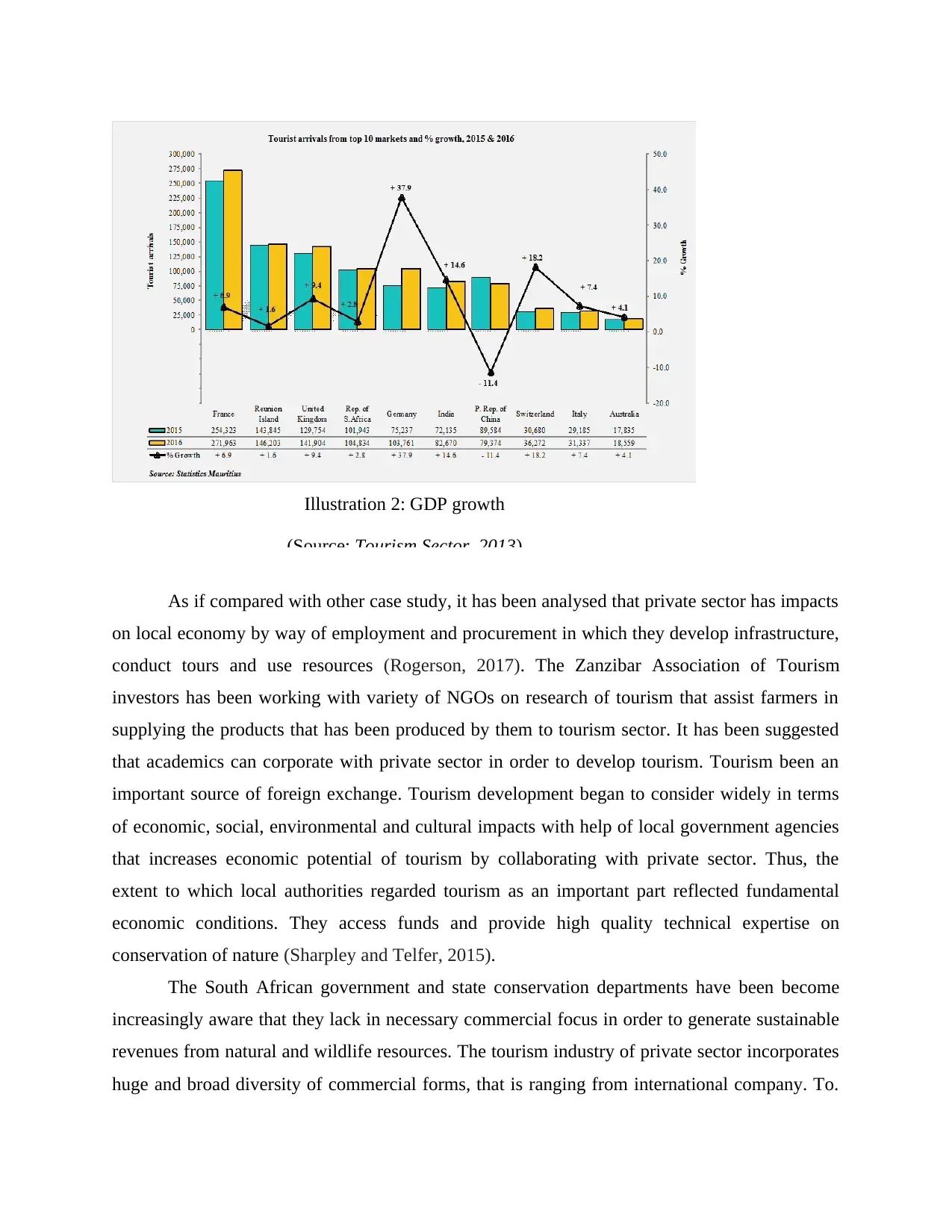
Illustration 2: GDP growth
(Source: Tourism Sector, 2013)
As if compared with other case study, it has been analysed that private sector has impacts
on local economy by way of employment and procurement in which they develop infrastructure,
conduct tours and use resources (Rogerson, 2017). The Zanzibar Association of Tourism
investors has been working with variety of NGOs on research of tourism that assist farmers in
supplying the products that has been produced by them to tourism sector. It has been suggested
that academics can corporate with private sector in order to develop tourism. Tourism been an
important source of foreign exchange. Tourism development began to consider widely in terms
of economic, social, environmental and cultural impacts with help of local government agencies
that increases economic potential of tourism by collaborating with private sector. Thus, the
extent to which local authorities regarded tourism as an important part reflected fundamental
economic conditions. They access funds and provide high quality technical expertise on
conservation of nature (Sharpley and Telfer, 2015).
The South African government and state conservation departments have been become
increasingly aware that they lack in necessary commercial focus in order to generate sustainable
revenues from natural and wildlife resources. The tourism industry of private sector incorporates
huge and broad diversity of commercial forms, that is ranging from international company. To.
(Source: Tourism Sector, 2013)
As if compared with other case study, it has been analysed that private sector has impacts
on local economy by way of employment and procurement in which they develop infrastructure,
conduct tours and use resources (Rogerson, 2017). The Zanzibar Association of Tourism
investors has been working with variety of NGOs on research of tourism that assist farmers in
supplying the products that has been produced by them to tourism sector. It has been suggested
that academics can corporate with private sector in order to develop tourism. Tourism been an
important source of foreign exchange. Tourism development began to consider widely in terms
of economic, social, environmental and cultural impacts with help of local government agencies
that increases economic potential of tourism by collaborating with private sector. Thus, the
extent to which local authorities regarded tourism as an important part reflected fundamental
economic conditions. They access funds and provide high quality technical expertise on
conservation of nature (Sharpley and Telfer, 2015).
The South African government and state conservation departments have been become
increasingly aware that they lack in necessary commercial focus in order to generate sustainable
revenues from natural and wildlife resources. The tourism industry of private sector incorporates
huge and broad diversity of commercial forms, that is ranging from international company. To.
⊘ This is a preview!⊘
Do you want full access?
Subscribe today to unlock all pages.
Trusted by 1+ million students worldwide
operate enterprises of tourism in a responsible manner, programmes of tourism development in
South Africa have focused increasingly on encouraging private sector. It has been known that
private sector addresses national empowerment and poverty alleviation objectives through
economic growth sustainability (Sheehan and et.al., 2016). Thus, by increasing area of land and
natural resources under control of private sector has fundamental implications for rural poor. It
has also been noted that if promotion of involvement of local communities is done by private
sectors in tourism ventures with help of establishing partnership tourism ventures with them, the
private sector was expected to fulfil. It has been oriented towards generating revenue and profit
from selling tourism products and services. Along with these it has also been indicated that
tourism private sector is also playing important and critical role in ecotourism in south Africa.
Hence, along with private sectors, partnership of the public nature conservation sector has also
been forced because of reduced public financial support. If rural poor take ownership also join
hands with private sector in order to develop tourism facilities and operations accordingly.
Privately owned tourism enterprises are booming in South Africa although their commitment
varies from sincere to superficial. However, within parts of state conservation sector there are
fears and concerns regarding private sector tourism development and truth of tourism industry.
Thus, there is a clear demand for nature based tourism in South Africa that results around 60% of
all foreign visitors that experience wildlife during their visit. Country has a board with private
sector in order to develop tourism products. They finally recommended that private sector should
direct their attention towards high spending of international tourists in order to increase foreign
exchange earnings. Their packages of travelling and other required facilities should be oriented
towards them who are accounted for high spenders ([SPONSORED]: Private sector’s
contribution to the growth of tourism, 2016). Thus, number of different mechanisms exist in
which private sectors helps in achieving such objectives that is based frequently on voluntary
support from private sector in order to major infrastructure and development of attraction
projects. The participation of this sector occur in wide array of activities, among that of
significant experience in participation which are-
1. marketing and promotion
2. developments of products as
Infrastructure development.
Attraction development.
South Africa have focused increasingly on encouraging private sector. It has been known that
private sector addresses national empowerment and poverty alleviation objectives through
economic growth sustainability (Sheehan and et.al., 2016). Thus, by increasing area of land and
natural resources under control of private sector has fundamental implications for rural poor. It
has also been noted that if promotion of involvement of local communities is done by private
sectors in tourism ventures with help of establishing partnership tourism ventures with them, the
private sector was expected to fulfil. It has been oriented towards generating revenue and profit
from selling tourism products and services. Along with these it has also been indicated that
tourism private sector is also playing important and critical role in ecotourism in south Africa.
Hence, along with private sectors, partnership of the public nature conservation sector has also
been forced because of reduced public financial support. If rural poor take ownership also join
hands with private sector in order to develop tourism facilities and operations accordingly.
Privately owned tourism enterprises are booming in South Africa although their commitment
varies from sincere to superficial. However, within parts of state conservation sector there are
fears and concerns regarding private sector tourism development and truth of tourism industry.
Thus, there is a clear demand for nature based tourism in South Africa that results around 60% of
all foreign visitors that experience wildlife during their visit. Country has a board with private
sector in order to develop tourism products. They finally recommended that private sector should
direct their attention towards high spending of international tourists in order to increase foreign
exchange earnings. Their packages of travelling and other required facilities should be oriented
towards them who are accounted for high spenders ([SPONSORED]: Private sector’s
contribution to the growth of tourism, 2016). Thus, number of different mechanisms exist in
which private sectors helps in achieving such objectives that is based frequently on voluntary
support from private sector in order to major infrastructure and development of attraction
projects. The participation of this sector occur in wide array of activities, among that of
significant experience in participation which are-
1. marketing and promotion
2. developments of products as
Infrastructure development.
Attraction development.
Paraphrase This Document
Need a fresh take? Get an instant paraphrase of this document with our AI Paraphraser
Enhanced productivity and service.
Development of community.
Protection of culture and heritage.
Protection of environment.
As it is said that private involvement in tourism industry is valuable, but it will always remain
governments responsibility to-
Determine and approve tourism strategy
contract for major projects of infrastructure
Approvals for grant projects.
Permits and licences that are required.
Evaluation and monitoring services that are contracted.
Approval of payment for services that are contracted.
Act as a regulator.
Thus, partnerships range from simple and fewer efforts to large and complex projects that
requires important investments.
For example: there are many destinations of tourists that use voluntary contribution of finance
and local citizens and various business in order to improve destination attractiveness.
Therefore, it is analysed that participation or involvement of private sector is very much
important which is provided on a voluntary basis. This involvement occurs because of all size of
business has potential to see revenue due to increased tourism as per provision of attractive,
secure or approachable destination. Such get together are practicable when investment that is
required is corresponding with increased revenue (Tourism, Local Livelihoods, and the Private
Sector in South Africa: Case Studies on the Growing
Role of the Private Sector in Natural Resources Management, 2003). Similar to this, citizens also
participate in neighbourhood projects of improvement not for just indirect benefits of rising
tourism but because their life is enhanced through secure local environment. They came forward
in an effort of sharing information about integrated and positive tourism experience.
CONCLUSION
Thus, from above essay it has been concluded that private sector plays significant role in
increasing tourism products. It has been analysed that the main objective of a particular country
is to improve populations quality of life and physical territory where experience of tourism takes
Development of community.
Protection of culture and heritage.
Protection of environment.
As it is said that private involvement in tourism industry is valuable, but it will always remain
governments responsibility to-
Determine and approve tourism strategy
contract for major projects of infrastructure
Approvals for grant projects.
Permits and licences that are required.
Evaluation and monitoring services that are contracted.
Approval of payment for services that are contracted.
Act as a regulator.
Thus, partnerships range from simple and fewer efforts to large and complex projects that
requires important investments.
For example: there are many destinations of tourists that use voluntary contribution of finance
and local citizens and various business in order to improve destination attractiveness.
Therefore, it is analysed that participation or involvement of private sector is very much
important which is provided on a voluntary basis. This involvement occurs because of all size of
business has potential to see revenue due to increased tourism as per provision of attractive,
secure or approachable destination. Such get together are practicable when investment that is
required is corresponding with increased revenue (Tourism, Local Livelihoods, and the Private
Sector in South Africa: Case Studies on the Growing
Role of the Private Sector in Natural Resources Management, 2003). Similar to this, citizens also
participate in neighbourhood projects of improvement not for just indirect benefits of rising
tourism but because their life is enhanced through secure local environment. They came forward
in an effort of sharing information about integrated and positive tourism experience.
CONCLUSION
Thus, from above essay it has been concluded that private sector plays significant role in
increasing tourism products. It has been analysed that the main objective of a particular country
is to improve populations quality of life and physical territory where experience of tourism takes

place. Private sector guides by giving support in case of financial, marketing, private education
and establish trainings. In order to promote tourism by private sectors it has to take some
elements into consideration like attractions, services, tourism organisation and marketing
promotion. Thus, to develop tourism a memorandum of association has signed private sector and
they are likely in achieving goals by developing good centres of economic tourisms.
and establish trainings. In order to promote tourism by private sectors it has to take some
elements into consideration like attractions, services, tourism organisation and marketing
promotion. Thus, to develop tourism a memorandum of association has signed private sector and
they are likely in achieving goals by developing good centres of economic tourisms.
⊘ This is a preview!⊘
Do you want full access?
Subscribe today to unlock all pages.
Trusted by 1+ million students worldwide
REFERENCES
Books and Journal
1Eja. and et.al., 2011. The Role of Private Sector Participation in Sustainable Tourism
Development in Cross River State, Nigeria. International Journal of Business and Social
Science. 2(2). pp.153-160.
ANIAH, EUGENE J., 2009. Tinapa Business Resort: A Strategy for Sustainable Rural
Livelihood in Cross River State, Nigeria. International Journal of Business and
Management. 4(6). pp.121-130.
Czernek, K., 2017. Tourism features as determinants of knowledge transfer in the process of
tourist cooperation. Current Issues in Tourism. 20(2). pp.204-220.
Farmaki, A. and et.al., 2015. Politics and sustainable tourism: The case of Cyprus. Tourism
management. 47. pp.178-190.
Giaoutzi, M., 2017. Tourism and regional development: New pathways. Routledge.
Judd, D.R., 2015. The Infrastructure of Play: Building the Tourist City: Building the Tourist
City. Routledge.
Jung, T.H. and et.al., 2015. The role of stakeholder collaboration in culture-led urban
regeneration: A case study of the Gwangju project, Korea. Cities. 44. pp.29-39.
Lee, D., Hampton, M. and Jeyacheya, J., 2015. The political economy of precarious work in the
tourism industry in small island developing states. Review of International Political
Economy. 22(1). pp.194-223.
Rogerson, C.M., 2017. Tourism–a new economic driver for South Africa. In Geography and
economy in South Africa and its neighbours (pp. 95-110). Routledge.
Sharpley, R. and Telfer, D.J., 2015. Tourism and development in the developing world.
Routledge.
Sheehan, L. and et.al., 2016. The use of intelligence in tourism destination management: An
emerging role for DMOs. International Journal of Tourism Research. 18(6). pp.549-557.
Online
Private sector’s contribution to the growth of tourism. 2016. [Online] Available through:
<https://www.newtimes.co.rw/section/read/205696>
Books and Journal
1Eja. and et.al., 2011. The Role of Private Sector Participation in Sustainable Tourism
Development in Cross River State, Nigeria. International Journal of Business and Social
Science. 2(2). pp.153-160.
ANIAH, EUGENE J., 2009. Tinapa Business Resort: A Strategy for Sustainable Rural
Livelihood in Cross River State, Nigeria. International Journal of Business and
Management. 4(6). pp.121-130.
Czernek, K., 2017. Tourism features as determinants of knowledge transfer in the process of
tourist cooperation. Current Issues in Tourism. 20(2). pp.204-220.
Farmaki, A. and et.al., 2015. Politics and sustainable tourism: The case of Cyprus. Tourism
management. 47. pp.178-190.
Giaoutzi, M., 2017. Tourism and regional development: New pathways. Routledge.
Judd, D.R., 2015. The Infrastructure of Play: Building the Tourist City: Building the Tourist
City. Routledge.
Jung, T.H. and et.al., 2015. The role of stakeholder collaboration in culture-led urban
regeneration: A case study of the Gwangju project, Korea. Cities. 44. pp.29-39.
Lee, D., Hampton, M. and Jeyacheya, J., 2015. The political economy of precarious work in the
tourism industry in small island developing states. Review of International Political
Economy. 22(1). pp.194-223.
Rogerson, C.M., 2017. Tourism–a new economic driver for South Africa. In Geography and
economy in South Africa and its neighbours (pp. 95-110). Routledge.
Sharpley, R. and Telfer, D.J., 2015. Tourism and development in the developing world.
Routledge.
Sheehan, L. and et.al., 2016. The use of intelligence in tourism destination management: An
emerging role for DMOs. International Journal of Tourism Research. 18(6). pp.549-557.
Online
Private sector’s contribution to the growth of tourism. 2016. [Online] Available through:
<https://www.newtimes.co.rw/section/read/205696>
Paraphrase This Document
Need a fresh take? Get an instant paraphrase of this document with our AI Paraphraser
Tourism, Local Livelihoods, and the Private Sector in South Africa: Case Studies on the
Growing Role of the Private Sector in Natural Resources Management. 2003. [PDF]
Available through: <https://www.rmportal.net/framelib/wrp08.pdf>
Trump’s Ban On Travel To Cuba Might Actually Help Cuba’s Economy. 2017. [Online]
Available through: <https://fivethirtyeight.com/features/trumps-ban-on-travel-to-cuba-
might-actually-help-cubas-economy/>
Tourism Sector. 2013. [Online] Available through: <http://tourism.govmu.org/English/Tourism
%20sector/Pages/Tourism-Sector.aspx>
Growing Role of the Private Sector in Natural Resources Management. 2003. [PDF]
Available through: <https://www.rmportal.net/framelib/wrp08.pdf>
Trump’s Ban On Travel To Cuba Might Actually Help Cuba’s Economy. 2017. [Online]
Available through: <https://fivethirtyeight.com/features/trumps-ban-on-travel-to-cuba-
might-actually-help-cubas-economy/>
Tourism Sector. 2013. [Online] Available through: <http://tourism.govmu.org/English/Tourism
%20sector/Pages/Tourism-Sector.aspx>
BIBLIOGRAPHY
https://www.newtimes.co.rw/section/read/205696
https://www.rmportal.net/framelib/wrp08.pdf
https://www.tandfonline.com/doi/abs/10.1080/14724049.2016.1226318
https://www.taylorfrancis.com/books/9781317117049
https://bib.irb.hr/prikazi-rad?rad=836832
https://www.emeraldinsight.com/doi/abs/10.1108/WHATT-11-2015-0047
https://books.google.co.in/books?
hl=en&lr=&id=hWNaDwAAQBAJ&oi=fnd&pg=PA136&dq=tourism+product+boosted+by+pri
vate+enterprise+cast+study+of+nigeria&ots=CkqVjyrba0&sig=8b9j05a4HP0rnw9vHVWJObGs
XIw#v=onepage&q&f=false
https://www.newtimes.co.rw/section/read/205696
https://www.rmportal.net/framelib/wrp08.pdf
https://www.tandfonline.com/doi/abs/10.1080/14724049.2016.1226318
https://www.taylorfrancis.com/books/9781317117049
https://bib.irb.hr/prikazi-rad?rad=836832
https://www.emeraldinsight.com/doi/abs/10.1108/WHATT-11-2015-0047
https://books.google.co.in/books?
hl=en&lr=&id=hWNaDwAAQBAJ&oi=fnd&pg=PA136&dq=tourism+product+boosted+by+pri
vate+enterprise+cast+study+of+nigeria&ots=CkqVjyrba0&sig=8b9j05a4HP0rnw9vHVWJObGs
XIw#v=onepage&q&f=false
⊘ This is a preview!⊘
Do you want full access?
Subscribe today to unlock all pages.
Trusted by 1+ million students worldwide

1 out of 12


Related Documents


Your All-in-One AI-Powered Toolkit for Academic Success.
+13062052269
info@desklib.com
Available 24*7 on WhatsApp / Email
![[object Object]](/_next/static/media/star-bottom.7253800d.svg)
Unlock your academic potential
Copyright © 2020–2026 A2Z Services. All Rights Reserved. Developed and managed by ZUCOL.