Privatisation, Risk, Fear, Insecurity: The Private Security Industry
VerifiedAdded on 2023/06/11
|9
|2710
|354
Essay
AI Summary
This essay explores the relationship between privatisation and societal anxieties such as risk, fear, and insecurity, using the growth of the private security industry as a case study. It discusses how the shift from an industrial to an information society, increasing crime rates and fear of crime, public funding cuts leading to self-help initiatives, and rapid land development for private commercial purposes have all contributed to the expansion of the private security sector. The essay also addresses concerns regarding training, regulation, and accountability within the industry, as well as the need for a more intelligent and scientific approach to security and crime prevention. It concludes by highlighting the importance of police control and effective regulation to ensure professionalism and address deviance within the private security industry.
Discuss how the process of privatisation can be seen as related to risk, fear and insecurity
using the example of the growth of the private security industry.
Introduction: Quite different meanings of the concept of privatization are present in different
societies. It needs to be noted that as compared with the privatization of other state in business,
the notion of privatizing criminal justice and security is much less ambitious in its scope and has
much more potential in symbolism. This can be particularly true regarding certain aspects of
criminal justice system like youth detention centers or private prisons. But in the field of
policing, traditionally a major role has been plagued by private interests. The private security
industry that has been broadly described as the industry that is devoted to preventing crime, is set
to grow significantly during the next decade. The reason behind this growth is that it will be
ensured by immutable social forces that this industry develops, probably more than any other
industry or field of employment.
Privatization refers to the act of transferring ownership of particular property or business
operations from a government organization to privately owned entity and also the transition of
ownership from publicly traded company to privately owned company.
To start with, along with other industrialized nations, Australia is shifting towards an information
society from an industrial society. More than 60,000 people in the Australia will be working with
information like programmers, clerks, accountants, insurance, lawyers, bankers etc. As a result of
this trend, significant implications are present for the private security industry (COAG, 2005). It
has been expected by the experts that industry is going to witness significant growth as more and
more organizations from the private and public sector will be hiring security firms for the
using the example of the growth of the private security industry.
Introduction: Quite different meanings of the concept of privatization are present in different
societies. It needs to be noted that as compared with the privatization of other state in business,
the notion of privatizing criminal justice and security is much less ambitious in its scope and has
much more potential in symbolism. This can be particularly true regarding certain aspects of
criminal justice system like youth detention centers or private prisons. But in the field of
policing, traditionally a major role has been plagued by private interests. The private security
industry that has been broadly described as the industry that is devoted to preventing crime, is set
to grow significantly during the next decade. The reason behind this growth is that it will be
ensured by immutable social forces that this industry develops, probably more than any other
industry or field of employment.
Privatization refers to the act of transferring ownership of particular property or business
operations from a government organization to privately owned entity and also the transition of
ownership from publicly traded company to privately owned company.
To start with, along with other industrialized nations, Australia is shifting towards an information
society from an industrial society. More than 60,000 people in the Australia will be working with
information like programmers, clerks, accountants, insurance, lawyers, bankers etc. As a result of
this trend, significant implications are present for the private security industry (COAG, 2005). It
has been expected by the experts that industry is going to witness significant growth as more and
more organizations from the private and public sector will be hiring security firms for the

Paraphrase This Document
Need a fresh take? Get an instant paraphrase of this document with our AI Paraphraser
protection of their most valuable asset, which is information. Another related but generally
overlooked social trend is the fast pace of social change, which also needs to be mentioned.
Electronic data transfer, computers, genetic engineering and space satellites, all are created such
a world where conceptual space (that is increasingly connected by electronics and biology)
instead of physical space is becoming prevalent. As a result of these changes as well as related
social changes, will have a significant impact on the agenda related with the nature of work and
also the ways in which the members of society are going to relate with each other and to
authority (CRC, 2008).
For example, how can the police considers censoring the often ingenious but explicit
pornography that is present across the electronic mail systems like Viatel? Similarly police find it
difficult to keep pace with sophisticated computer hackers that breach, financial records on data
banks. Under these circumstances, the question arises, the police can be described as the most
suitable agency for investigating the theft of body parts for donor surgery. Such electronic and
genetic crimes will become common in near future (Centre for International Economics, 2007).
All the police forces have been trying to change in order to be the dynamic regions, but they
have to face a lot of obstacles that are common in any large bureaucratic organization. Some of
these obstacles include resistance to change by certain sections of bureaucracy, the size of the
organization and the rules related with recruiting that generally deny a rightful place to the
specialists in the hierarchy of the organization (Ferguson,et al., 2011).
In this way, a void exists, while dealing with the new types of crime. This file can be filled by
private security agencies and innovative public authorities, who are not going to be like them to
offer relatively favorable resolution for the persons having cutting-edge technology, for their
services. Another trend is related with the fear of crime and crime itself. At this point it needs to
overlooked social trend is the fast pace of social change, which also needs to be mentioned.
Electronic data transfer, computers, genetic engineering and space satellites, all are created such
a world where conceptual space (that is increasingly connected by electronics and biology)
instead of physical space is becoming prevalent. As a result of these changes as well as related
social changes, will have a significant impact on the agenda related with the nature of work and
also the ways in which the members of society are going to relate with each other and to
authority (CRC, 2008).
For example, how can the police considers censoring the often ingenious but explicit
pornography that is present across the electronic mail systems like Viatel? Similarly police find it
difficult to keep pace with sophisticated computer hackers that breach, financial records on data
banks. Under these circumstances, the question arises, the police can be described as the most
suitable agency for investigating the theft of body parts for donor surgery. Such electronic and
genetic crimes will become common in near future (Centre for International Economics, 2007).
All the police forces have been trying to change in order to be the dynamic regions, but they
have to face a lot of obstacles that are common in any large bureaucratic organization. Some of
these obstacles include resistance to change by certain sections of bureaucracy, the size of the
organization and the rules related with recruiting that generally deny a rightful place to the
specialists in the hierarchy of the organization (Ferguson,et al., 2011).
In this way, a void exists, while dealing with the new types of crime. This file can be filled by
private security agencies and innovative public authorities, who are not going to be like them to
offer relatively favorable resolution for the persons having cutting-edge technology, for their
services. Another trend is related with the fear of crime and crime itself. At this point it needs to
be stated that the people in Australia are not overwhelmed by crime. It is true that there has been
a rise in certain offenses like car theft, breaking and entering offenses and serious assault
(Australian Bureau of Statistics, 2012). However, the murder rate in Australia has remained
relatively constant during the last 15 years. Irrespective of the crime trends in reality, the fear
related with crime, has outstripped the reality related with the growth of crime due to several
reasons (Australian Crime Commission, 2008a). However due to certain reasons like higher rate
of youth unemployment, drugs, and a significant rise in the number of weapons in the
community, it can be expected that property offenses including armed robbery, are going to
increase significantly in the future. The result is that public policy will be overstretched.
Consequently, there will be an increase in the demand from the private sector to take on the
responsibilities that the earlier the responsibilities of the police (Australian Institute of
Criminology, 2013).
However, it is unfortunate that the number of crime will be exaggerated by the public as well as
the private police in their efforts to achieve more state and corporate funds for security and
policing. This stress on exaggerating crime will be further increased as a result of opportunistic
political parties, who want to win votes on the issue of law and order (Allard and Prenzler,
2009).
At the same time, it is also significant to consider general social and economic trends. As these
trends have reinforced public spending cuts in community services and at the same time
maximized what can be called as “self-help” movements. The other generally speaking during
the last two decades, the expenditure is available to police forces have increased considerably in
reality (Button, 2012). However in the future, it is unlikely that the situation is going to continue.
As a result of the rising cost of policing and in view of the indefinite fiscal crisis faced by the
a rise in certain offenses like car theft, breaking and entering offenses and serious assault
(Australian Bureau of Statistics, 2012). However, the murder rate in Australia has remained
relatively constant during the last 15 years. Irrespective of the crime trends in reality, the fear
related with crime, has outstripped the reality related with the growth of crime due to several
reasons (Australian Crime Commission, 2008a). However due to certain reasons like higher rate
of youth unemployment, drugs, and a significant rise in the number of weapons in the
community, it can be expected that property offenses including armed robbery, are going to
increase significantly in the future. The result is that public policy will be overstretched.
Consequently, there will be an increase in the demand from the private sector to take on the
responsibilities that the earlier the responsibilities of the police (Australian Institute of
Criminology, 2013).
However, it is unfortunate that the number of crime will be exaggerated by the public as well as
the private police in their efforts to achieve more state and corporate funds for security and
policing. This stress on exaggerating crime will be further increased as a result of opportunistic
political parties, who want to win votes on the issue of law and order (Allard and Prenzler,
2009).
At the same time, it is also significant to consider general social and economic trends. As these
trends have reinforced public spending cuts in community services and at the same time
maximized what can be called as “self-help” movements. The other generally speaking during
the last two decades, the expenditure is available to police forces have increased considerably in
reality (Button, 2012). However in the future, it is unlikely that the situation is going to continue.
As a result of the rising cost of policing and in view of the indefinite fiscal crisis faced by the
⊘ This is a preview!⊘
Do you want full access?
Subscribe today to unlock all pages.

Trusted by 1+ million students worldwide
government in Australia, the police exhibited in Australia will be under pressure to justify their
budgeting requests (Australian National Occupational Health and Safety Commission, 1999).
Therefore, instead of activity, productivity will be the hallmark of the success of the police.
The proliferation of initiatives taking place in public as well as private sphere will lay stress on
“self-help” movements and as a result, the areas traditionally handled by the police will be
reduced. For example, there has been a rising specialist agencies like the NSW Anti-Corruption
and Drug Enforcement Agencies, Independent Commission Against Corruption, the National
Crime Authority and so on (Harvey, 2012). Apart from it, several public and private
organizations are also considering to set up their own crime prevention and investigation teams.
For example, a crime prevention unit has been set up recently by Telecom. The Federal Aviation
Corporation and their security operations were also streamlined. Similarly, fraud investigation
units and security personnel are being established by some of the banks (Australian Security
Industry Association Ltd., 2013). The situation reflects the “self-help” philosophy adopted by
community movements like Neighborhood Watch. These organizations believe that they can do
it better than the police. However the fact that there may not be necessarily successful in doing
so is beside the point (Hucklesby, 2011). As a result of the increasing funds for police forces, and
moved towards privatization, as well as the decentralized movement for controlling state
organizations, there has been a trend of maximizing a bleak and private security development at
the expense of police forces.
Another trend that is present in this regard is related with the way in which the public and private
land use is facing changes. There has been a rise in the number of large commercial shopping
centers which cover acres and acres of prime land in the city and suburbs. These developments
also result in causing major problems of trying public safety. As a result of the privatization of
budgeting requests (Australian National Occupational Health and Safety Commission, 1999).
Therefore, instead of activity, productivity will be the hallmark of the success of the police.
The proliferation of initiatives taking place in public as well as private sphere will lay stress on
“self-help” movements and as a result, the areas traditionally handled by the police will be
reduced. For example, there has been a rising specialist agencies like the NSW Anti-Corruption
and Drug Enforcement Agencies, Independent Commission Against Corruption, the National
Crime Authority and so on (Harvey, 2012). Apart from it, several public and private
organizations are also considering to set up their own crime prevention and investigation teams.
For example, a crime prevention unit has been set up recently by Telecom. The Federal Aviation
Corporation and their security operations were also streamlined. Similarly, fraud investigation
units and security personnel are being established by some of the banks (Australian Security
Industry Association Ltd., 2013). The situation reflects the “self-help” philosophy adopted by
community movements like Neighborhood Watch. These organizations believe that they can do
it better than the police. However the fact that there may not be necessarily successful in doing
so is beside the point (Hucklesby, 2011). As a result of the increasing funds for police forces, and
moved towards privatization, as well as the decentralized movement for controlling state
organizations, there has been a trend of maximizing a bleak and private security development at
the expense of police forces.
Another trend that is present in this regard is related with the way in which the public and private
land use is facing changes. There has been a rise in the number of large commercial shopping
centers which cover acres and acres of prime land in the city and suburbs. These developments
also result in causing major problems of trying public safety. As a result of the privatization of
Paraphrase This Document
Need a fresh take? Get an instant paraphrase of this document with our AI Paraphraser
land space, there are certain special problems related with security that need particular expertise.
Although it is possible for the police to develop such an expertise, but it is likely (particularly in
view of the past experience) that developers and the management of these commercial centers
will need their own security personnel for handling these issues that arise within the center. It has
been seen that generally there is an increase in the incidents of robbery in the communities
surrounding shopping centers. Therefore, the police have to deal with these issues, and in this
way. It is further reinforced that the public-private division criss-crosses policing as well as land
use.
In this way, the factors that are responsible for the rapid growth of private security industry can
be described as follows. The first is the move from industrialized to information Society. The
second factor is the rise in crime and the fear of crime. The third factor is the cuts being made in
public funding and the move towards “self-help”. The fourth factor is the fast pace of land
development for private commercial purposes.
Under the circumstances, it can be said that the private security industry in Australia appears to
be very much like the public policy as it was present in most of his country's nearly 40 years ago.
A classic example of this approach can be seen in the case of United States, where a city mayor
was asked why he had appointed a particular person as the chief of police, and he replied that the
new chief of police was his personal tailored for several years and as he was a good tailor, the
mayor was sure that he will also prove to be the chief of police. When private policing started in
Australia as well as America, generally personnel were hired guns were working for their
employers. Therefore it can be stated that there is little doubt that in the early days of private
policing, there were demands from private interests for more order, a defense against the
Although it is possible for the police to develop such an expertise, but it is likely (particularly in
view of the past experience) that developers and the management of these commercial centers
will need their own security personnel for handling these issues that arise within the center. It has
been seen that generally there is an increase in the incidents of robbery in the communities
surrounding shopping centers. Therefore, the police have to deal with these issues, and in this
way. It is further reinforced that the public-private division criss-crosses policing as well as land
use.
In this way, the factors that are responsible for the rapid growth of private security industry can
be described as follows. The first is the move from industrialized to information Society. The
second factor is the rise in crime and the fear of crime. The third factor is the cuts being made in
public funding and the move towards “self-help”. The fourth factor is the fast pace of land
development for private commercial purposes.
Under the circumstances, it can be said that the private security industry in Australia appears to
be very much like the public policy as it was present in most of his country's nearly 40 years ago.
A classic example of this approach can be seen in the case of United States, where a city mayor
was asked why he had appointed a particular person as the chief of police, and he replied that the
new chief of police was his personal tailored for several years and as he was a good tailor, the
mayor was sure that he will also prove to be the chief of police. When private policing started in
Australia as well as America, generally personnel were hired guns were working for their
employers. Therefore it can be stated that there is little doubt that in the early days of private
policing, there were demands from private interests for more order, a defense against the
organizations with whom they had ideological conflicts or which were considered as the against
the capital interests.
Regardless of the amount of training and regulation, it is not possible to inhibit the employers
from using their own security personnel. However, these training and regulation can help in
controlling criminal and unstable individuals from working in the industry that is increasingly
coming in contact with the large number of people. Therefore, in spite of the potential for
corporate sections of industry to become politicized, most of the security personnel are going to
be involved in mundane jobs of protection and business security mainly for middle-class houses
and clients. The anti-intellectual attitude that can be seen in several parts of security industry also
needs to be addressed. Corporations, individuals and government agencies are probably not
receiving value for money in several aspects of this work. By adopting an intelligent or scientific
approach towards the issue of security, a systemic identification of risk is possible, as well as the
meticulous collection of relevant data and applying the most recent and effective methods of
controlling the crime. Some experts have pointed out that situational prevention of crime can
offer a lot of security. However, it appears that there is little knowledge, let alone the application
of the techniques of situational crime prevention by the private security personnel in Australia.
Such a situation is particularly depressing, in view of the fact that most of the security personnel
are involved in dealing with small and sometimes insignificant “incremental crime” like
shoplifting, vandalism, incivility, that have been stated by experts “to feed upon each other and
in this we become a significant problem in aggregate”.
In the end, it can be stated that although certain security organizations that have changed their
approach from militaristic, law enforcement paradigm towards the professional managerialism,
there are a large number of members of the security industry was still show deviance and a lack
the capital interests.
Regardless of the amount of training and regulation, it is not possible to inhibit the employers
from using their own security personnel. However, these training and regulation can help in
controlling criminal and unstable individuals from working in the industry that is increasingly
coming in contact with the large number of people. Therefore, in spite of the potential for
corporate sections of industry to become politicized, most of the security personnel are going to
be involved in mundane jobs of protection and business security mainly for middle-class houses
and clients. The anti-intellectual attitude that can be seen in several parts of security industry also
needs to be addressed. Corporations, individuals and government agencies are probably not
receiving value for money in several aspects of this work. By adopting an intelligent or scientific
approach towards the issue of security, a systemic identification of risk is possible, as well as the
meticulous collection of relevant data and applying the most recent and effective methods of
controlling the crime. Some experts have pointed out that situational prevention of crime can
offer a lot of security. However, it appears that there is little knowledge, let alone the application
of the techniques of situational crime prevention by the private security personnel in Australia.
Such a situation is particularly depressing, in view of the fact that most of the security personnel
are involved in dealing with small and sometimes insignificant “incremental crime” like
shoplifting, vandalism, incivility, that have been stated by experts “to feed upon each other and
in this we become a significant problem in aggregate”.
In the end, it can be stated that although certain security organizations that have changed their
approach from militaristic, law enforcement paradigm towards the professional managerialism,
there are a large number of members of the security industry was still show deviance and a lack
⊘ This is a preview!⊘
Do you want full access?
Subscribe today to unlock all pages.
Trusted by 1+ million students worldwide
of professionalism. Although the Australian States have significant differences in regulations that
govern the private security industry, a large number of security personnel are not accountable
publicly and have not received a good training. Under these circumstances, a compelling
argument is present for the police to control effective and efficient registration procedures for the
persona from the security industry. Apart from it, although the training should be provided by the
industry itself, but the training standards should be legislated by the government.
govern the private security industry, a large number of security personnel are not accountable
publicly and have not received a good training. Under these circumstances, a compelling
argument is present for the police to control effective and efficient registration procedures for the
persona from the security industry. Apart from it, although the training should be provided by the
industry itself, but the training standards should be legislated by the government.
Paraphrase This Document
Need a fresh take? Get an instant paraphrase of this document with our AI Paraphraser
References
Allard, T., & Prenzler, T. (2009) A Summary Analysis of Police Deaths in Australia:
Implications for Prevention. International Journal of Comparative and Applied Criminal Justice,
33(1), 61–81.
Australian Bureau of Statistics (ABS). (2012). 2011 Census of Population and Housing,
Customised Data Report, Table 1: Count of Employed Persons by Selected Occupations.
Canberra: Australian Bureau of Statistics.
Australian Crime Commission (ACC). (2008a). Annual Report 2007–08. Canberra: Australian
Crime Commission.
Australian Crime Prevention Council. (2012, June). A Case Study in Valuing Crime Prevention
Outcomes: The National Motor Vehicle Theft Reduction Council. Newsletter, pp. 1–4.
Australian Institute of Criminology. (2013). Australian Crime: Facts and Figures 2012.
Canberra: AIC.
Australian National Occupational Health and Safety Commission. (1999). Work Related
Fatalities Involving Emergency Service Workers in Australia, 1989–1992. Sydney: Australian
National Occupational Health and Safety Commission.
Australian Security Industry Association Limited (ASIAL). (2013). Expenditure on Private
Security in Australia, 2012–2013. Sydney: Australian Security Industry Association Limited.
Button, M. (2012). Optimizing Security Through Effective Regulation: Lessons from Around the
Globe. In T. Prenzler (Ed.), Policing and Security in Practice (pp. 204–220). Houndmills:
Palgrave Macmillan.
Allard, T., & Prenzler, T. (2009) A Summary Analysis of Police Deaths in Australia:
Implications for Prevention. International Journal of Comparative and Applied Criminal Justice,
33(1), 61–81.
Australian Bureau of Statistics (ABS). (2012). 2011 Census of Population and Housing,
Customised Data Report, Table 1: Count of Employed Persons by Selected Occupations.
Canberra: Australian Bureau of Statistics.
Australian Crime Commission (ACC). (2008a). Annual Report 2007–08. Canberra: Australian
Crime Commission.
Australian Crime Prevention Council. (2012, June). A Case Study in Valuing Crime Prevention
Outcomes: The National Motor Vehicle Theft Reduction Council. Newsletter, pp. 1–4.
Australian Institute of Criminology. (2013). Australian Crime: Facts and Figures 2012.
Canberra: AIC.
Australian National Occupational Health and Safety Commission. (1999). Work Related
Fatalities Involving Emergency Service Workers in Australia, 1989–1992. Sydney: Australian
National Occupational Health and Safety Commission.
Australian Security Industry Association Limited (ASIAL). (2013). Expenditure on Private
Security in Australia, 2012–2013. Sydney: Australian Security Industry Association Limited.
Button, M. (2012). Optimizing Security Through Effective Regulation: Lessons from Around the
Globe. In T. Prenzler (Ed.), Policing and Security in Practice (pp. 204–220). Houndmills:
Palgrave Macmillan.
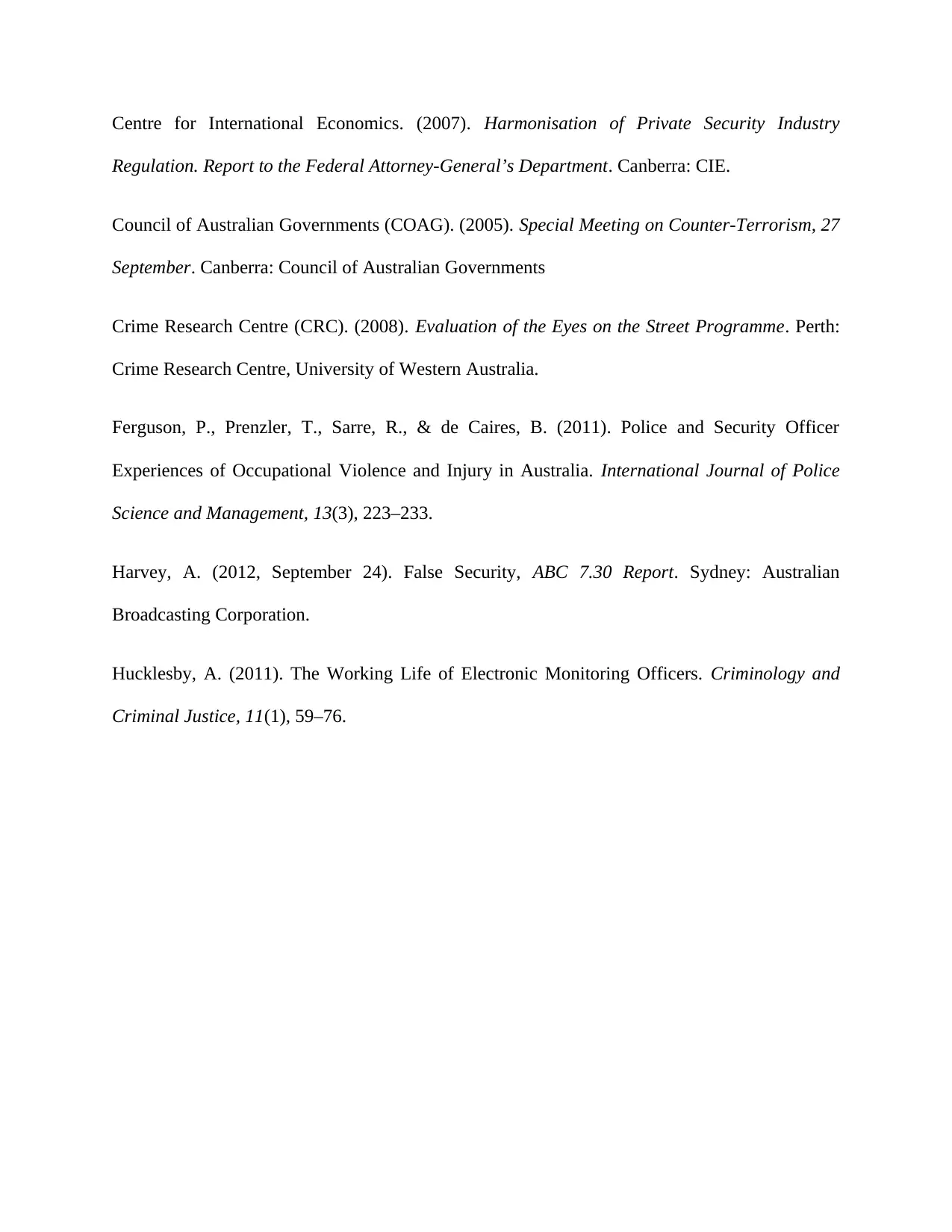
Centre for International Economics. (2007). Harmonisation of Private Security Industry
Regulation. Report to the Federal Attorney-General’s Department. Canberra: CIE.
Council of Australian Governments (COAG). (2005). Special Meeting on Counter-Terrorism, 27
September. Canberra: Council of Australian Governments
Crime Research Centre (CRC). (2008). Evaluation of the Eyes on the Street Programme. Perth:
Crime Research Centre, University of Western Australia.
Ferguson, P., Prenzler, T., Sarre, R., & de Caires, B. (2011). Police and Security Officer
Experiences of Occupational Violence and Injury in Australia. International Journal of Police
Science and Management, 13(3), 223–233.
Harvey, A. (2012, September 24). False Security, ABC 7.30 Report. Sydney: Australian
Broadcasting Corporation.
Hucklesby, A. (2011). The Working Life of Electronic Monitoring Officers. Criminology and
Criminal Justice, 11(1), 59–76.
Regulation. Report to the Federal Attorney-General’s Department. Canberra: CIE.
Council of Australian Governments (COAG). (2005). Special Meeting on Counter-Terrorism, 27
September. Canberra: Council of Australian Governments
Crime Research Centre (CRC). (2008). Evaluation of the Eyes on the Street Programme. Perth:
Crime Research Centre, University of Western Australia.
Ferguson, P., Prenzler, T., Sarre, R., & de Caires, B. (2011). Police and Security Officer
Experiences of Occupational Violence and Injury in Australia. International Journal of Police
Science and Management, 13(3), 223–233.
Harvey, A. (2012, September 24). False Security, ABC 7.30 Report. Sydney: Australian
Broadcasting Corporation.
Hucklesby, A. (2011). The Working Life of Electronic Monitoring Officers. Criminology and
Criminal Justice, 11(1), 59–76.
⊘ This is a preview!⊘
Do you want full access?
Subscribe today to unlock all pages.
Trusted by 1+ million students worldwide

1 out of 9


Related Documents


Your All-in-One AI-Powered Toolkit for Academic Success.
+13062052269
info@desklib.com
Available 24*7 on WhatsApp / Email
![[object Object]](/_next/static/media/star-bottom.7253800d.svg)
Unlock your academic potential
Copyright © 2020–2026 A2Z Services. All Rights Reserved. Developed and managed by ZUCOL.