Analyzing the Privatization of the NHS: Economic and Social Factors

Verified

Added on  2020/03/04

|6
|1305
|60
Essay
AI Summary
This essay presents an argument against the privatization of the National Health Service (NHS). It highlights the importance of healthcare as a basic need accessible to all citizens, emphasizing that privatization would likely increase costs, making healthcare less accessible. The essay explores economic factors, such as government funding versus reliance on donations, and social factors, including patient choice and potential discrimination. The author argues that privatization could lead to a decline in service quality and transparency, ultimately harming the integrity of the healthcare sector. The conclusion reinforces the stance against privatization, citing the negative impacts on both economic and social aspects of healthcare, and suggesting that partial privatization might be considered to balance the advantages with government control over essential services.

Document Page
Running head: PRIVATIZATION OF NHS
Privatization of NHS
Name of the student:
Name of the University:
Author Note:
tabler-icon-diamond-filled.svg

Paraphrase This Document

Need a fresh take? Get an instant paraphrase of this document with our AI Paraphraser
Document Page
1
PRIVATIZATION OF NHS
Introduction
One of the most debated topics that the world is concerned about is the privatization of
the National Health Service (NHS). The health sector is one of the most important sectors and
among the necessity of the citizens. However, with the privatization in various sectors such as
education, the question has arisen, whether privatization of the NHS should be done or not.
Experts all around the world differ a lot in their opinion. Many of the experts opine that the NHS
should not be privatised, while others feel that privatization is essential in the NHS as well. In
this assignment, I opined that privatization of the NHS should not be done. This essay has been
structured in two main parts. The first part of the discussion focuses on the economic factors and
the next discussion is on the social factors. Finally, a conclusion summarizing the main
discussion has been included.
Economic factors
The health care sector is one of the major sectors and the healthcare facilities have to be
accessible by all the people. Since good healthcare facilities are among the basic needs of the
citizens, hence a low cost healthcare facility has to be provided to all people (Almeida, 2017).
However, privatization of the NHS will result in increase in the cost of the health care facilities,
thus making it inaccessible by the citizens. Moreover, if the privatization of the NHS takes place,
the funding will depend solely on the donations or people and charitable trusts. This will make
the sector unstable (Davis et al., 2014). However, without privatization, the government will be
funding the NHS, thus ensuring a steady flow of funds. The main economic issue with the
privatization of the NHS is the increased cost of healthcare facilities. Without being privatised,
free services are often provided to the citizens as a duty of the government (Powell & Miller,
2016). However, private companies mainly focuses on business and profits, thus the free service
Document Page
2
PRIVATIZATION OF NHS
facilities will be mitigated. The quality of the healthcare services and facilities that are provided
by the government remains same throughout and does not depend on the profit earned (Powell &
Miller, 2016). Thus, equal quality of the healthcare facilities, along with equal quality is
provided to the citizens, irrespective of the profit earned.
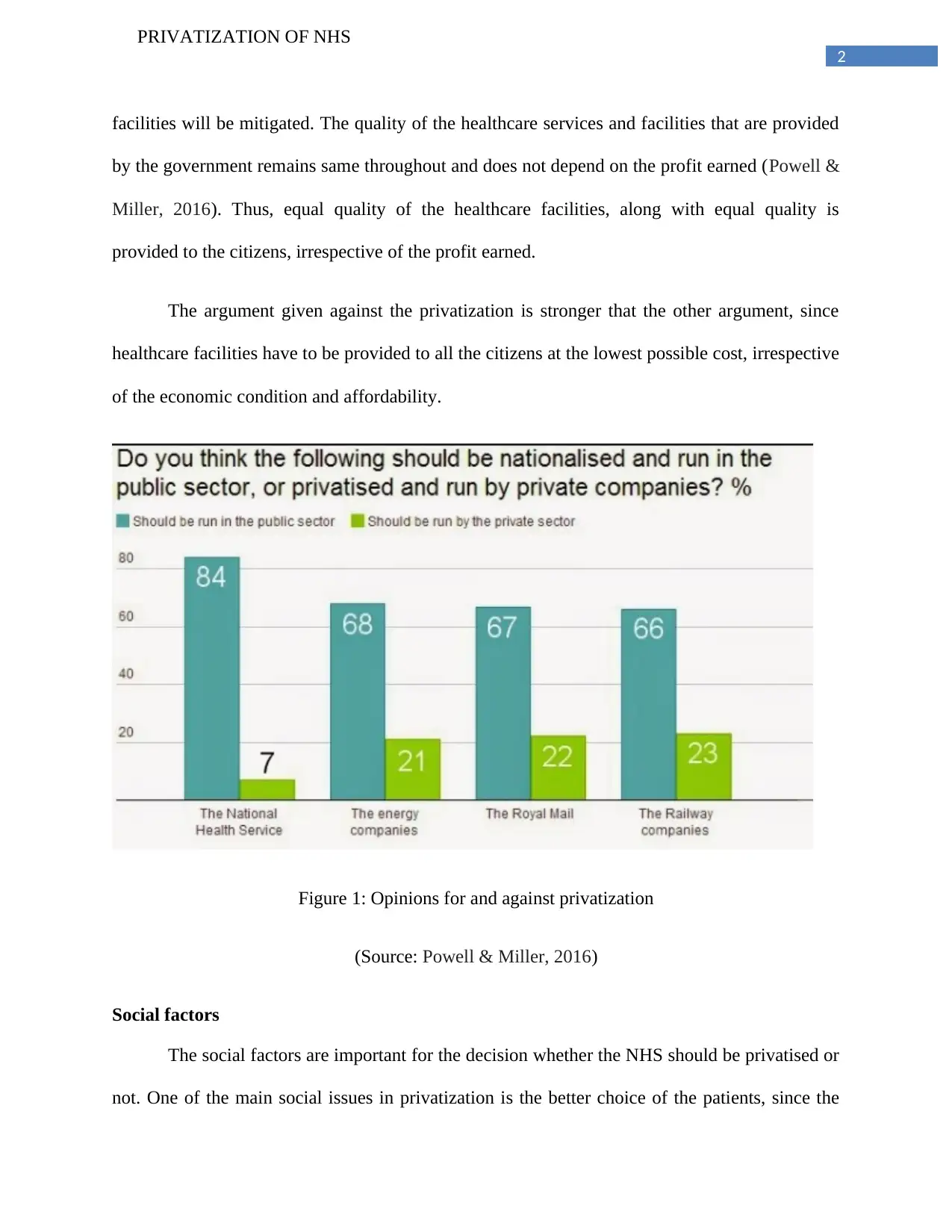
The argument given against the privatization is stronger that the other argument, since
healthcare facilities have to be provided to all the citizens at the lowest possible cost, irrespective
of the economic condition and affordability.
Figure 1: Opinions for and against privatization
(Source: Powell & Miller, 2016)
Social factors
The social factors are important for the decision whether the NHS should be privatised or
not. One of the main social issues in privatization is the better choice of the patients, since the
Document Page
3
PRIVATIZATION OF NHS
privatization will increase the cost of the healthcare facilities and patients belonging to elite class
will be able to avail the facilities, thus filtering the choice of the patients admitted (Johnstone,
2016). However, the healthcare facility is among the basic needs and hence discrimination
against the choice of the patients should not be done (Nuffield Trust, 2016). Moreover, the social
status is a major factor for the privatised healthcare organizations, thus imposing discrimination
on the necessity of every citizen (Pollock, 2014). Outsourcing of the essential sectors such as
healthcare the competition among the healthcare institutes’ increases, with the decrease in the
quality of the services being provided (Powell & Miller, 2016). Thus, along with social
discrimination, the privatization of the NHS is likely to put an end to the facilities that the
citizens are suppose to receive for low cost (NHS, 2016). Lack of transparency is also a seen if
the NHS is privatised. The private companies are not liable and accountable for various decisions
and activities, thus causing social deterioration. This means that the patients will not be able to
hold the private companies as accountable for any of the faults and flaws. However, in case NHS
is not privatised, then the government is accountable for any dispute with the patients.
The arguments given against the privatization of the NHS is stronger since the
discrimination in the healthcare is not acceptable in any society. The government has a certain
liability towards the citizens and that itself is hampered with the privatization of the NHS.
Conclusion
This assignment highlights the opinion against the privatization of the NHS. The health
care services are the basic needs of all citizens, hence facilities such as superior quality care and
free health care services. However, with privatization such facilities will be unavailable. The
privatized sector is highly competitive and their services vary widely with the amount of profit
earned. Thus, the healthcare sector is unstable and varies with competition. Thus, privatization
tabler-icon-diamond-filled.svg

Paraphrase This Document

Need a fresh take? Get an instant paraphrase of this document with our AI Paraphraser
Document Page
4
PRIVATIZATION OF NHS
hampers the integrity of the healthcare sector and thus, privatization is not desirable in the NHS.
Finally, from the above-mentioned discussion, it is concluded that the economic as well as the
social factors are hampered if the privatization of the NHS takes place. The cost of the health-
care services are likely to be increased if privatization takes place, along with the deterioration of
the healthcare facilities. Thus, it could be recommended that partial privatization of the NHS
could be done in order to take the advantage of privatization, along with government healthcare
sector. The essential facilities could be kept under the control of the government; however, the
other subsidiary activities could be privatized.
Document Page
5
PRIVATIZATION OF NHS
References
Almeida, Á. S. (2017). The role of private non-profit healthcare organizations in NHS systems:
Implications for the Portuguese hospital devolution program. Health Policy, 121(6),
699-707.
Davis, K., Stemikis, K., Squires, D. & Schoen, C. (2014) Mirror, mirror on the wall: how the
performance of the U.S. health care system compares internationally. Available at:
http://www.commonwealthfund.org/~/media/files/publications/fund-report/2014/jun/
1755_davis_mirror_mirror_2014.pdf (Accessed 22nd September 2016).
Johnstone, I. (2016). ‘Creeping privatisation of healthcare is damaging the NHS, study finds’.
Independent,28th July. Available at: http://www.independent.co.uk/life-style/health-and-
families/health-news/nhs-health-service-healthcare-privatisation-
a7160771.html(Accessed 22nd September 2016).
NHS (2016) NHS England: Health and high quality care for all, now and for future
generations. Available at: https://www.england.nhs.uk/ (Accessed 22nd September 2016).
Nuffield Trust (2016) Nuffield Trust: Evidence for better health care. Available at:
http://www.nuffieldtrust.org.uk/ (Accessed 22nd September 2016).
Pollock, A. (2014). Privatisation of the NHS. Available at:
http://tedxtalks.ted.com/video/Privatisation-of-the-NHS-%7C-Allys;search%3APollock
(Accessed 22nd September 2016).
Powell, M., & Miller, R. (2016). Seventy years of privatizing the British national health
service?. Social Policy & Administration, 50(1), 99-118.
chevron_up_icon
1 out of 6
circle_padding
hide_on_mobile
zoom_out_icon
[object Object]