Communication Channels: Probability Distribution Functions Analysis
VerifiedAdded on 2020/02/19
|14
|3314
|154
Report
AI Summary
This report delves into the significance of probability distribution functions (PDFs) within communication channels. It initiates with an introduction and literature review, followed by in-depth explanations of cumulative distribution functions (CDF), probability mass functions (PMF), and probability density functions (PDF). The report further examines mixture distribution functions, random variables, and channel distribution functions. It explores the practical application of these functions in channel modeling, including wired and wireless communications, analog and digital signals, and the influence of factors such as noise, interference, and distortion. The report concludes by highlighting the importance of PDFs in optimizing communication system performance.
Probability distribution functions for communication channels

Paraphrase This Document
Need a fresh take? Get an instant paraphrase of this document with our AI Paraphraser
Contents
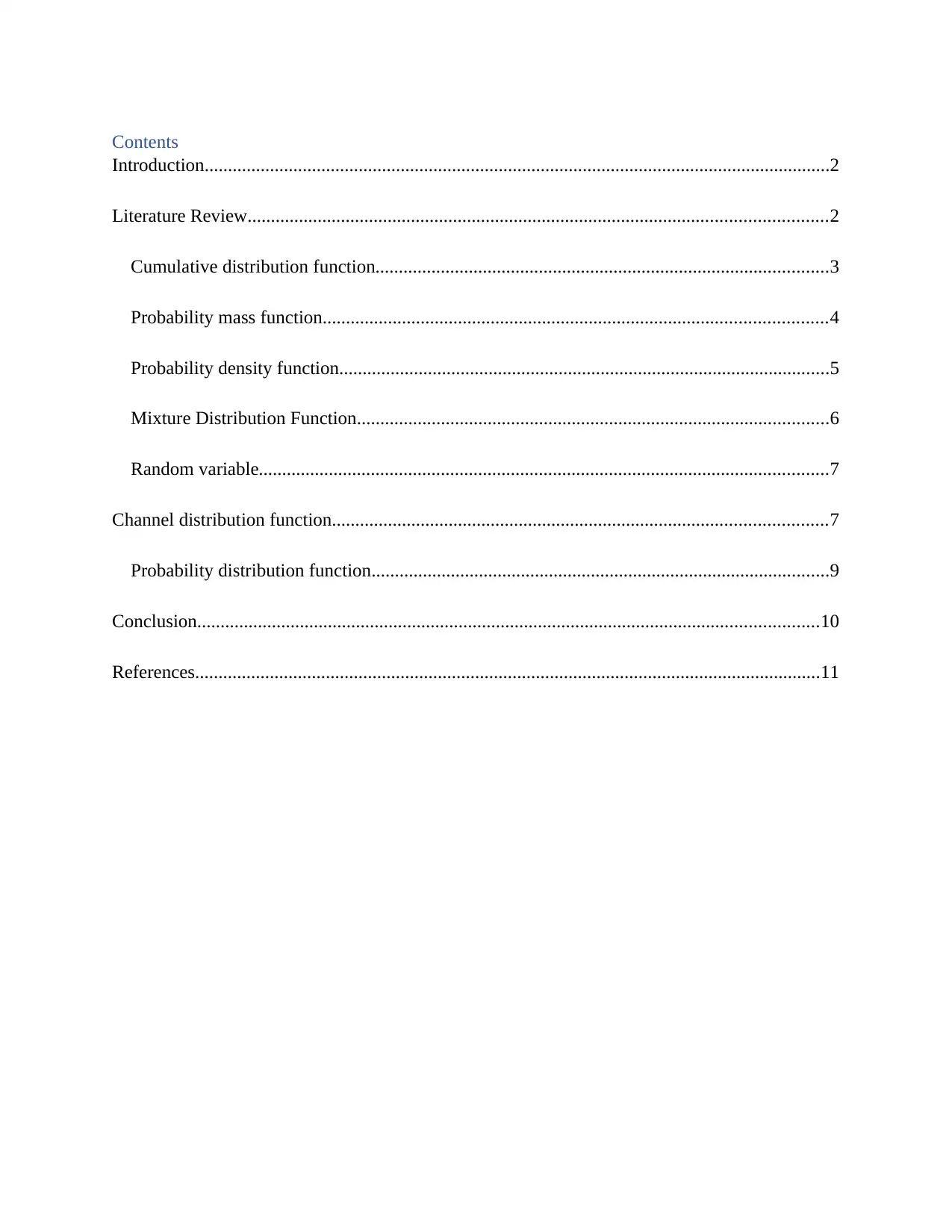
Introduction......................................................................................................................................2
Literature Review............................................................................................................................2
Cumulative distribution function.................................................................................................3
Probability mass function............................................................................................................4
Probability density function.........................................................................................................5
Mixture Distribution Function.....................................................................................................6
Random variable..........................................................................................................................7
Channel distribution function..........................................................................................................7
Probability distribution function..................................................................................................9
Conclusion.....................................................................................................................................10
References......................................................................................................................................11
Introduction......................................................................................................................................2
Literature Review............................................................................................................................2
Cumulative distribution function.................................................................................................3
Probability mass function............................................................................................................4
Probability density function.........................................................................................................5
Mixture Distribution Function.....................................................................................................6
Random variable..........................................................................................................................7
Channel distribution function..........................................................................................................7
Probability distribution function..................................................................................................9
Conclusion.....................................................................................................................................10
References......................................................................................................................................11
Introduction
The communication channels are mainly considered of a greater interest for the different
telecommunication operators, with the manufactures of the radio and the microwave equipment.
The focus is on making the decisions and the direction flow which is important in the
organisation. The communication has to be done with the breakdown channel which leads to the
ineffective flow of information. [1] Here, the focus is on evaluating and optimising the
productivity of the worker of the organisation. The video conferencing, mobile technology are
some of the better new possibilities which are based on determining which channel type needs to
be carried out with the effective communication.
Literature Review
The PDF which is probability distribution function, has been mainly for handling the randomised
sample spaces. This also includes that there are different variables which are set in the random
form. The relative likelihood is for holding different standards where there are variables that are
found to be in the random positions. It is set with the proper value setup and how the possible
values are administered with the set of different samples. The pdf is for the specification to
handle the different random variable functions which falls under a particular range of values. [5]
The functions of the probability are depending upon the discretised sets of the variables which
come in the random manner. They are used to be set in context with the other forms of the
continuous variables. The communication channels are set with the advancement in the
technology with the different progressive approaches that are based to make sure that the
messages are sent. With this, the categories also fall under the formal, informal and the unofficial
codes to send the information which include the goals, policies and the procedures of the
The communication channels are mainly considered of a greater interest for the different
telecommunication operators, with the manufactures of the radio and the microwave equipment.
The focus is on making the decisions and the direction flow which is important in the
organisation. The communication has to be done with the breakdown channel which leads to the
ineffective flow of information. [1] Here, the focus is on evaluating and optimising the
productivity of the worker of the organisation. The video conferencing, mobile technology are
some of the better new possibilities which are based on determining which channel type needs to
be carried out with the effective communication.
Literature Review
The PDF which is probability distribution function, has been mainly for handling the randomised
sample spaces. This also includes that there are different variables which are set in the random
form. The relative likelihood is for holding different standards where there are variables that are
found to be in the random positions. It is set with the proper value setup and how the possible
values are administered with the set of different samples. The pdf is for the specification to
handle the different random variable functions which falls under a particular range of values. [5]
The functions of the probability are depending upon the discretised sets of the variables which
come in the random manner. They are used to be set in context with the other forms of the
continuous variables. The communication channels are set with the advancement in the
technology with the different progressive approaches that are based to make sure that the
messages are sent. With this, the categories also fall under the formal, informal and the unofficial
codes to send the information which include the goals, policies and the procedures of the
⊘ This is a preview!⊘
Do you want full access?
Subscribe today to unlock all pages.

Trusted by 1+ million students worldwide
organisation. The hierarchical web of communication is mainly existing based on the command
chain and handling the level of how much communication needs to be done.
Cumulative distribution function
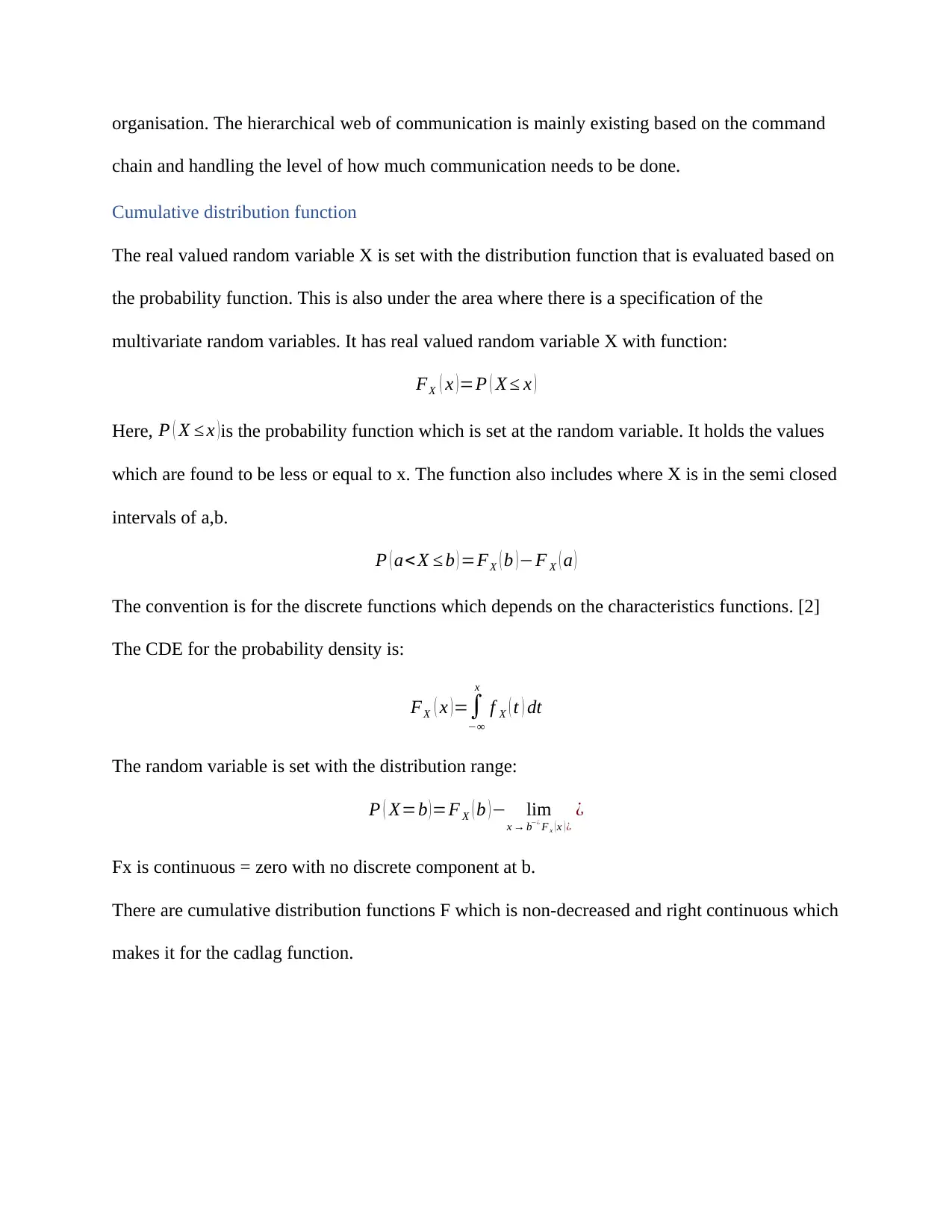
The real valued random variable X is set with the distribution function that is evaluated based on
the probability function. This is also under the area where there is a specification of the
multivariate random variables. It has real valued random variable X with function:
FX ( x )=P ( X ≤ x )
Here, P ( X ≤ x )is the probability function which is set at the random variable. It holds the values
which are found to be less or equal to x. The function also includes where X is in the semi closed
intervals of a,b.
P ( a< X ≤ b ) =FX ( b ) −F X ( a )
The convention is for the discrete functions which depends on the characteristics functions. [2]
The CDE for the probability density is:
FX ( x ) =∫
−∞
x
f X ( t ) dt
The random variable is set with the distribution range:
P ( X=b )=F X ( b )− lim
x → b−¿ F x (x )¿
¿
Fx is continuous = zero with no discrete component at b.
There are cumulative distribution functions F which is non-decreased and right continuous which
makes it for the cadlag function.
chain and handling the level of how much communication needs to be done.
Cumulative distribution function
The real valued random variable X is set with the distribution function that is evaluated based on
the probability function. This is also under the area where there is a specification of the
multivariate random variables. It has real valued random variable X with function:
FX ( x )=P ( X ≤ x )
Here, P ( X ≤ x )is the probability function which is set at the random variable. It holds the values
which are found to be less or equal to x. The function also includes where X is in the semi closed
intervals of a,b.
P ( a< X ≤ b ) =FX ( b ) −F X ( a )
The convention is for the discrete functions which depends on the characteristics functions. [2]
The CDE for the probability density is:
FX ( x ) =∫
−∞
x
f X ( t ) dt
The random variable is set with the distribution range:
P ( X=b )=F X ( b )− lim
x → b−¿ F x (x )¿
¿
Fx is continuous = zero with no discrete component at b.
There are cumulative distribution functions F which is non-decreased and right continuous which
makes it for the cadlag function.
Paraphrase This Document
Need a fresh take? Get an instant paraphrase of this document with our AI Paraphraser
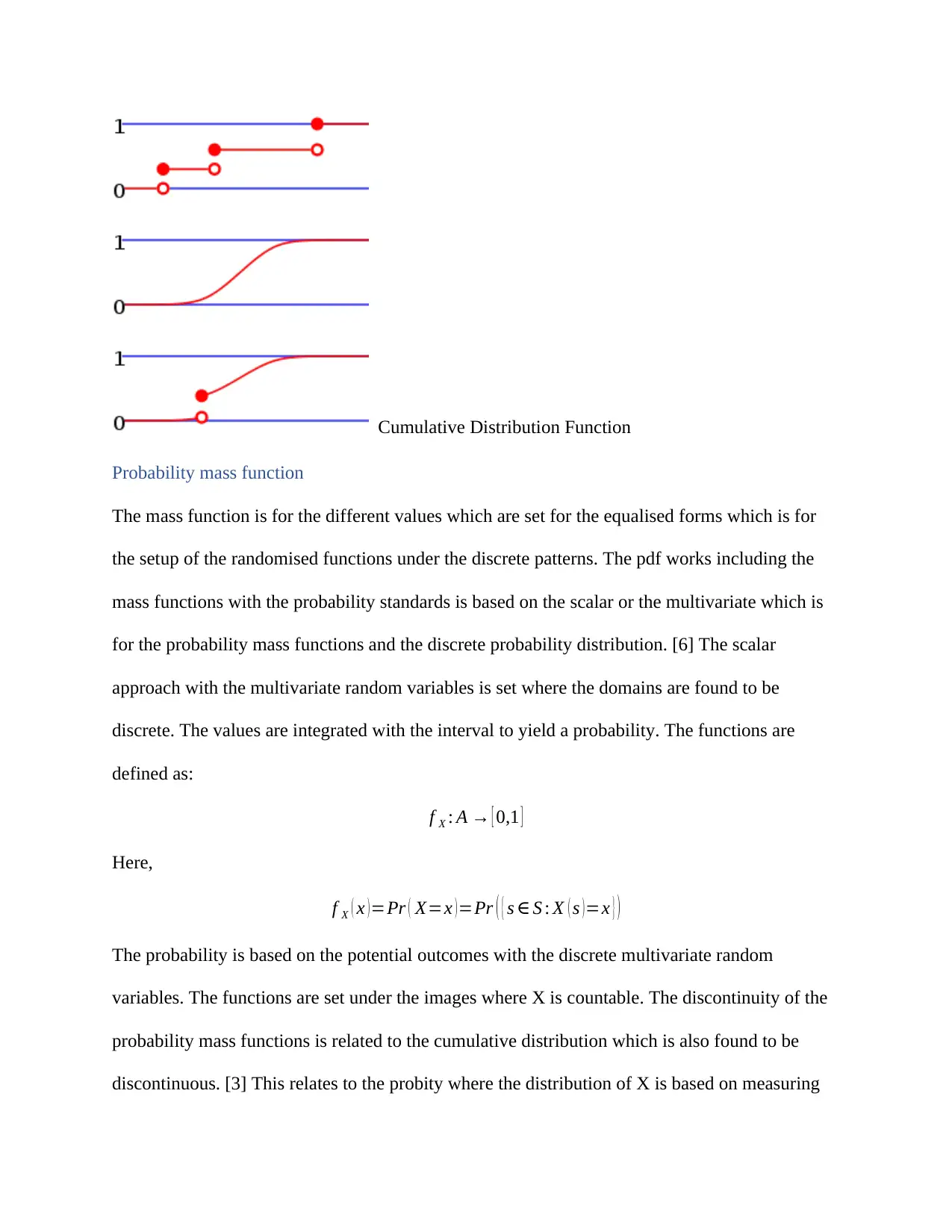
Cumulative Distribution Function
Probability mass function
The mass function is for the different values which are set for the equalised forms which is for
the setup of the randomised functions under the discrete patterns. The pdf works including the
mass functions with the probability standards is based on the scalar or the multivariate which is
for the probability mass functions and the discrete probability distribution. [6] The scalar
approach with the multivariate random variables is set where the domains are found to be
discrete. The values are integrated with the interval to yield a probability. The functions are
defined as:
f X : A → [ 0,1 ]
Here,
f X ( x )=Pr ( X=x )=Pr ( { s ∈ S : X ( s )=x } )
The probability is based on the potential outcomes with the discrete multivariate random
variables. The functions are set under the images where X is countable. The discontinuity of the
probability mass functions is related to the cumulative distribution which is also found to be
discontinuous. [3] This relates to the probity where the distribution of X is based on measuring
Probability mass function
The mass function is for the different values which are set for the equalised forms which is for
the setup of the randomised functions under the discrete patterns. The pdf works including the
mass functions with the probability standards is based on the scalar or the multivariate which is
for the probability mass functions and the discrete probability distribution. [6] The scalar
approach with the multivariate random variables is set where the domains are found to be
discrete. The values are integrated with the interval to yield a probability. The functions are
defined as:
f X : A → [ 0,1 ]
Here,
f X ( x )=Pr ( X=x )=Pr ( { s ∈ S : X ( s )=x } )
The probability is based on the potential outcomes with the discrete multivariate random
variables. The functions are set under the images where X is countable. The discontinuity of the
probability mass functions is related to the cumulative distribution which is also found to be
discontinuous. [3] This relates to the probity where the distribution of X is based on measuring
the counting values with the probability spacing and the measurable space that is set for the
variable X: A->B. The example for this is the multivariate discrete distribution with the
probability mass function that works on the multinomial distribution process. It works on the
researches with the handling of the different functions with the use of the mass of the non-zero
probability with the different combinations of the success categories.
Probability density function
The function includes the description of the relative random variable which includes the:
P ( a ≤ X ≤ b ) =∫
a
b
f ( x ) dx
Here, the random variables take on the uncountable infinite number values based on the finite or
the countable infinite numbers of the different possible values. The probability density is based
on focusing all the discrete, continuous and the mixed functions. It is important to focus on the
domains of the densities and the parameters, where the values are set with the sample space
which is set for the distribution of the functions. The perspectives are based on the normalisation
factor with the probability to check the domains. The parameters are consistent with the
reparametrizing of the density for the different parameters. It includes the parameter values with
the change in the domains that include the density function associated with the set as a whole,
which is called to be the joint probability density function. The uniform distribution is set with
the data functions, and the graph in the lists to state about the random variables which also
includes the lowering or setting the higher chances with the probability patterns. The uniform
distributions are mainly to understand the bell curve distribution with the achievement of the set
of variables. The uniform distribution is displayed with the bar graph that includes the variable
with the infinite number of the possibilities. The binomial distribution, normal and the normal
variable X: A->B. The example for this is the multivariate discrete distribution with the
probability mass function that works on the multinomial distribution process. It works on the
researches with the handling of the different functions with the use of the mass of the non-zero
probability with the different combinations of the success categories.
Probability density function
The function includes the description of the relative random variable which includes the:
P ( a ≤ X ≤ b ) =∫
a
b
f ( x ) dx
Here, the random variables take on the uncountable infinite number values based on the finite or
the countable infinite numbers of the different possible values. The probability density is based
on focusing all the discrete, continuous and the mixed functions. It is important to focus on the
domains of the densities and the parameters, where the values are set with the sample space
which is set for the distribution of the functions. The perspectives are based on the normalisation
factor with the probability to check the domains. The parameters are consistent with the
reparametrizing of the density for the different parameters. It includes the parameter values with
the change in the domains that include the density function associated with the set as a whole,
which is called to be the joint probability density function. The uniform distribution is set with
the data functions, and the graph in the lists to state about the random variables which also
includes the lowering or setting the higher chances with the probability patterns. The uniform
distributions are mainly to understand the bell curve distribution with the achievement of the set
of variables. The uniform distribution is displayed with the bar graph that includes the variable
with the infinite number of the possibilities. The binomial distribution, normal and the normal
⊘ This is a preview!⊘
Do you want full access?
Subscribe today to unlock all pages.
Trusted by 1+ million students worldwide
distribution models. The standards are set which include the probability density with the moment
generating functions.
Mixture Distribution Function
This includes pdf for the variable that are set at the random positions which is from the collection
of the other random variables. This also includes the methods which are selected with the chance
that holds the probability of selection with the random real numbers. The mixture distribution is
the multivariate distribution were there are cases related to properly handling the convex
combinations, with the weighted sum and the non-negative weights. [7] The distinction needs to
be taken care of. This is mainly through considering that there are factors which are set for the
randomised forms of the variables. It also includes the variable factors and the other distribution
where the mixtures density that is created. The patterns are based on the forms which include the
different forms of the distribution functions that are set with the representation of:
F ( x )=∑
i =1
n
wi Pi (x)
f ( x )=∑
i=1
n
wi pi ( x )
The mixture is finite with the unqualified reference which is for the finite mixture and set under
countable infinite set of components.
The probability distribution functions are considered under the component distributions with the
other forms of the formalised summation. [4] The construction is based on the formal similarity
with the infinite summations or the integrals that tend to replace the finite summations which are
used. The consideration functions are set with the density with the variable x under cumulative
distribution function.
f ( x ) ¿a∫ w ( a ) p ( x , a ) da
generating functions.
Mixture Distribution Function
This includes pdf for the variable that are set at the random positions which is from the collection
of the other random variables. This also includes the methods which are selected with the chance
that holds the probability of selection with the random real numbers. The mixture distribution is
the multivariate distribution were there are cases related to properly handling the convex
combinations, with the weighted sum and the non-negative weights. [7] The distinction needs to
be taken care of. This is mainly through considering that there are factors which are set for the
randomised forms of the variables. It also includes the variable factors and the other distribution
where the mixtures density that is created. The patterns are based on the forms which include the
different forms of the distribution functions that are set with the representation of:
F ( x )=∑
i =1
n
wi Pi (x)
f ( x )=∑
i=1
n
wi pi ( x )
The mixture is finite with the unqualified reference which is for the finite mixture and set under
countable infinite set of components.
The probability distribution functions are considered under the component distributions with the
other forms of the formalised summation. [4] The construction is based on the formal similarity
with the infinite summations or the integrals that tend to replace the finite summations which are
used. The consideration functions are set with the density with the variable x under cumulative
distribution function.
f ( x ) ¿a∫ w ( a ) p ( x , a ) da
Paraphrase This Document
Need a fresh take? Get an instant paraphrase of this document with our AI Paraphraser
This is the probability density function where there are generalised functions to handle the
discrete distributions. [8]
Random variable
The random variable is the probability distribution where the specifications are related to the
value related to a particular given interval. The random variables are found to be discrete with
the specific counter of the finite lists of the values. The distribution function is also taken into
consideration for the different sets of intervals through the numerical values. The association is
with the independence or the other random variables, where the distribution is also for the
random variables. The random variable X :Ω → E which is a measurable function to handle the
different outcomes with the probability space. The distribution is based on X with the focus on
how the different continuous functions are able to handle the pdf. [4] For this, the mixture is
analysed.
The probability is based on the output ranges with the real valued random variable that is set to
yield a better level of the probability, for X. The distribution of the random variable which is
characterised in the different number of the expected moments with standard deviation.
Channel distribution function
The channel distribution communication is based on the exchange of the information with the
use of High Frequency of band between 2 to 30 MHz which is considered to be important for the
sight communication. [9] The high frequency is based on the economic and the flexible function
which is set with the properties that are defined under the modification of transmitted signals.
The channels include the wired and the wireless channels for the transmission of the data and
information like the twisted pair, coaxial and fibre optic cable. The high frequency propagation
range is in between 3 and 30 MHz
discrete distributions. [8]
Random variable
The random variable is the probability distribution where the specifications are related to the
value related to a particular given interval. The random variables are found to be discrete with
the specific counter of the finite lists of the values. The distribution function is also taken into
consideration for the different sets of intervals through the numerical values. The association is
with the independence or the other random variables, where the distribution is also for the
random variables. The random variable X :Ω → E which is a measurable function to handle the
different outcomes with the probability space. The distribution is based on X with the focus on
how the different continuous functions are able to handle the pdf. [4] For this, the mixture is
analysed.
The probability is based on the output ranges with the real valued random variable that is set to
yield a better level of the probability, for X. The distribution of the random variable which is
characterised in the different number of the expected moments with standard deviation.
Channel distribution function
The channel distribution communication is based on the exchange of the information with the
use of High Frequency of band between 2 to 30 MHz which is considered to be important for the
sight communication. [9] The high frequency is based on the economic and the flexible function
which is set with the properties that are defined under the modification of transmitted signals.
The channels include the wired and the wireless channels for the transmission of the data and
information like the twisted pair, coaxial and fibre optic cable. The high frequency propagation
range is in between 3 and 30 MHz
The standards are set for the path loss with the sight channel which has no object between the
receiver or the transmitter. The case is related to the energy and how it is spread for the
transmission of the antenna. [10] The ground wave propagation, shadowing of the objects is
mainly along with the signal path that leads through the absorption, reflection and the scattering.
The effect is called on the middle building where the power is received at the different points.
The channel model is also for the transmission of data with the wireless communication. In the
wired communication, it is found to be constant at any time. There are different types of the
channel models which are for the digital and the analog signals that are for handling the
transmission of the audio and the video signals. The binary symmetric channel is based on how
the errors to the signal are sent through. The analog channels are for the data transmission and
then this is converted into analog. The fast fading and the flat fading functions are for handling
the distribution with the backbone of the channel modelling. When the components are set with
the probability density functions then there are other Line of Sight parameters which are able to
take hold of the different transmissions. [15] Hence, for this, the focus is also on handling the
high frequency propagation is for the interrelated characteristics that involves the high variable
medium, where the variability is defined as the channel for the people to properly design and
work on the implementation of the high effective speed of the digital communication. The
channel modelling is considered to play and important role which is mainly in between the
sender and the receiver. This is through handling the sending of the data with the invariable
medium with properties changing over the time, till there is a wired medium. The contribution is
also to the efforts with the development of a proper modelling of the sophisticated systems.
receiver or the transmitter. The case is related to the energy and how it is spread for the
transmission of the antenna. [10] The ground wave propagation, shadowing of the objects is
mainly along with the signal path that leads through the absorption, reflection and the scattering.
The effect is called on the middle building where the power is received at the different points.
The channel model is also for the transmission of data with the wireless communication. In the
wired communication, it is found to be constant at any time. There are different types of the
channel models which are for the digital and the analog signals that are for handling the
transmission of the audio and the video signals. The binary symmetric channel is based on how
the errors to the signal are sent through. The analog channels are for the data transmission and
then this is converted into analog. The fast fading and the flat fading functions are for handling
the distribution with the backbone of the channel modelling. When the components are set with
the probability density functions then there are other Line of Sight parameters which are able to
take hold of the different transmissions. [15] Hence, for this, the focus is also on handling the
high frequency propagation is for the interrelated characteristics that involves the high variable
medium, where the variability is defined as the channel for the people to properly design and
work on the implementation of the high effective speed of the digital communication. The
channel modelling is considered to play and important role which is mainly in between the
sender and the receiver. This is through handling the sending of the data with the invariable
medium with properties changing over the time, till there is a wired medium. The contribution is
also to the efforts with the development of a proper modelling of the sophisticated systems.
⊘ This is a preview!⊘
Do you want full access?
Subscribe today to unlock all pages.
Trusted by 1+ million students worldwide
Probability distribution function
The channel communication is based on the correspondence with the analog to digital and then
digital to analog blocks which are mainly for the control of the designer. The forms are set with
the channels that include the underlying protocol layers with the physical layer transmission
techniques which is replaced by the simplified model structures. The measures are based on the
bit rate, bit errors with latency and the delay. The binary symmetric channels are also set with the
bit error probability. The analog model has been for the handling of the system with some
structures that are measured through the techniques related to the linear or the non-linear
systems, time continuous and the time discrete functions. [14] The analog channel models are
defined with the interference model, noise and the distortion models with the frequency response
that includes the attenuation and the phase shifts. The probability distribution function works on
the multipath fading channels which are set in the wireless communication with the statistics that
are based on the absolute value. [13] The focus is on how it is easy to work on the real and the
imaginary parts which corresponds to the complex random variable. The functions are related to
the many to one and the one to one transformations with assigned density of the probability
functions at a particular interval. This is mainly to measure the probability of the functions which
is defined at the different points. Through this, there is a possibility to focus on the different
channels which could be measured by not only the single points but also with the discrete forms
of the distributions. The discrete probability is also referred for handling the coverage of the
discrete and the continuous distributions where there are applications related to the density that is
measured with the probability mass functions.
The channel communication is based on the correspondence with the analog to digital and then
digital to analog blocks which are mainly for the control of the designer. The forms are set with
the channels that include the underlying protocol layers with the physical layer transmission
techniques which is replaced by the simplified model structures. The measures are based on the
bit rate, bit errors with latency and the delay. The binary symmetric channels are also set with the
bit error probability. The analog model has been for the handling of the system with some
structures that are measured through the techniques related to the linear or the non-linear
systems, time continuous and the time discrete functions. [14] The analog channel models are
defined with the interference model, noise and the distortion models with the frequency response
that includes the attenuation and the phase shifts. The probability distribution function works on
the multipath fading channels which are set in the wireless communication with the statistics that
are based on the absolute value. [13] The focus is on how it is easy to work on the real and the
imaginary parts which corresponds to the complex random variable. The functions are related to
the many to one and the one to one transformations with assigned density of the probability
functions at a particular interval. This is mainly to measure the probability of the functions which
is defined at the different points. Through this, there is a possibility to focus on the different
channels which could be measured by not only the single points but also with the discrete forms
of the distributions. The discrete probability is also referred for handling the coverage of the
discrete and the continuous distributions where there are applications related to the density that is
measured with the probability mass functions.
Paraphrase This Document
Need a fresh take? Get an instant paraphrase of this document with our AI Paraphraser
The distribution functions with the distribution is set with the discrete, continuous and the mixed
patterns. It is based on determining the distribution with the light shading that is intended to
represent the continuous distribution of probability.
Conclusion
The pdf is based on the specifications with enveloping the distribution where there are different
characteristics related to the multipath fading channels to envelop the pdf and correlation. [12]
The characterisation of the angle of arrival is also set with the other distribution channel which
validates and are based on the Rayleigh functions. The communication channel is based on
modelling procedures which is set to calculate the reflection of the objects that need to be added
with the simulation of the external interferenc. The communication is based on modelling the
transition probability with the combination by the random attenuation of the transmitted signal.
The forms are including the simplification of the physical processes and then capturing the
changes over the course of the transmission. The statistics of the random attenuation is based on
measuring the twisted and the broadcasted wire cable. They are for the information theory for the
storage which also includes the calculations and the modifications of the transmitted signal. The
wireless communication in the channel could easily be set and modelled by the calculation of the
reflection in the different object environment. The communication channel is modelled with the
input, output and the pair of input and output elements. Here, the communication is mainly set
through the fading of the transmitted signal which is then set by the additive noise. The
communication channels are described with the settings that include the output distribution for
the sequence of the channel inputs. With this, the probability distribution depends on the current
channel input.
patterns. It is based on determining the distribution with the light shading that is intended to
represent the continuous distribution of probability.
Conclusion
The pdf is based on the specifications with enveloping the distribution where there are different
characteristics related to the multipath fading channels to envelop the pdf and correlation. [12]
The characterisation of the angle of arrival is also set with the other distribution channel which
validates and are based on the Rayleigh functions. The communication channel is based on
modelling procedures which is set to calculate the reflection of the objects that need to be added
with the simulation of the external interferenc. The communication is based on modelling the
transition probability with the combination by the random attenuation of the transmitted signal.
The forms are including the simplification of the physical processes and then capturing the
changes over the course of the transmission. The statistics of the random attenuation is based on
measuring the twisted and the broadcasted wire cable. They are for the information theory for the
storage which also includes the calculations and the modifications of the transmitted signal. The
wireless communication in the channel could easily be set and modelled by the calculation of the
reflection in the different object environment. The communication channel is modelled with the
input, output and the pair of input and output elements. Here, the communication is mainly set
through the fading of the transmitted signal which is then set by the additive noise. The
communication channels are described with the settings that include the output distribution for
the sequence of the channel inputs. With this, the probability distribution depends on the current
channel input.
References
[1.]Lista, L., 2016. Probability Distribution Functions. In Statistical Methods for Data
Analysis in Particle Physics (pp. 21-51). Springer International Publishing.
[2.]Ossenkopf-Okada, V., Csengeri, T., Schneider, N., Federrath, C. and Klessen, R.S., 2016.
The reliability of observational measurements of column density probability distribution
functions. Astronomy & Astrophysics, 590, p.A104.
[3.]Buehler, E.A., Paulson, J.A. and Mesbah, A., 2016, July. Lyapunov-based stochastic
nonlinear model predictive control: Shaping the state probability distribution functions.
In American Control Conference (ACC), 2016 (pp. 5389-5394). IEEE.
[4.]Schneider, N., Bontemps, S., Motte, F., Ossenkopf, V., Klessen, R.S., Simon, R.,
Fechtenbaum, S., Herpin, F., Tremblin, P., Csengeri, T. and Myers, P.C., 2016.
Understanding star formation in molecular clouds-III. Probability distribution functions
of molecular lines in Cygnus X. Astronomy & Astrophysics, 587, p.A74.
[5.]Allevato, V., Civano, F., Finoguenov, A., Marchesi, S., Shankar, F., Zamorani, G.,
Hasinger, G., Salvato, M., Miyaji, T., Gilli, R. and Cappelluti, N., 2016. The Chandra
COSMOS Legacy survey: clustering of X-ray-selected AGNs at 2.9≤ z≤ 5.5 using
photometric redshift probability distribution functions. The Astrophysical
Journal, 832(1), p.70.
[6.]Dyachenko, A.I., Kachulin, D.I. and Zakharov, V.E., 2016. Probability Distribution
Functions of Freak Waves: Nonlinear Versus Linear Model. Studies in Applied
Mathematics, 137(2), pp.189-198.
[1.]Lista, L., 2016. Probability Distribution Functions. In Statistical Methods for Data
Analysis in Particle Physics (pp. 21-51). Springer International Publishing.
[2.]Ossenkopf-Okada, V., Csengeri, T., Schneider, N., Federrath, C. and Klessen, R.S., 2016.
The reliability of observational measurements of column density probability distribution
functions. Astronomy & Astrophysics, 590, p.A104.
[3.]Buehler, E.A., Paulson, J.A. and Mesbah, A., 2016, July. Lyapunov-based stochastic
nonlinear model predictive control: Shaping the state probability distribution functions.
In American Control Conference (ACC), 2016 (pp. 5389-5394). IEEE.
[4.]Schneider, N., Bontemps, S., Motte, F., Ossenkopf, V., Klessen, R.S., Simon, R.,
Fechtenbaum, S., Herpin, F., Tremblin, P., Csengeri, T. and Myers, P.C., 2016.
Understanding star formation in molecular clouds-III. Probability distribution functions
of molecular lines in Cygnus X. Astronomy & Astrophysics, 587, p.A74.
[5.]Allevato, V., Civano, F., Finoguenov, A., Marchesi, S., Shankar, F., Zamorani, G.,
Hasinger, G., Salvato, M., Miyaji, T., Gilli, R. and Cappelluti, N., 2016. The Chandra
COSMOS Legacy survey: clustering of X-ray-selected AGNs at 2.9≤ z≤ 5.5 using
photometric redshift probability distribution functions. The Astrophysical
Journal, 832(1), p.70.
[6.]Dyachenko, A.I., Kachulin, D.I. and Zakharov, V.E., 2016. Probability Distribution
Functions of Freak Waves: Nonlinear Versus Linear Model. Studies in Applied
Mathematics, 137(2), pp.189-198.
⊘ This is a preview!⊘
Do you want full access?
Subscribe today to unlock all pages.
Trusted by 1+ million students worldwide

1 out of 14


Related Documents


Your All-in-One AI-Powered Toolkit for Academic Success.
+13062052269
info@desklib.com
Available 24*7 on WhatsApp / Email
![[object Object]](/_next/static/media/star-bottom.7253800d.svg)
Unlock your academic potential
Copyright © 2020–2026 A2Z Services. All Rights Reserved. Developed and managed by ZUCOL.