Probability and Statistics Homework Assignment: Mathematics Course
VerifiedAdded on 2022/08/25
|6
|972
|18
Homework Assignment
AI Summary
This document presents solutions to a mathematics assignment focusing on probability and statistics. The assignment covers several key concepts, including Bernoulli random variables, conditional probability, and permutations. The solutions detail the steps taken to solve each problem, such as calculating expected values and standard deviations. The assignment also explores various scenarios, like the probability of certain events occurring and the analysis of independent variables. Furthermore, it addresses problems involving combinations and probability calculations in different contexts, providing a comprehensive understanding of the subject matter. This assignment is designed to help students learn the core concepts of probability and statistics.
Running head: MATHEMATICS
MATHEMATICS
Name of the Student:
Name of the University:
Author Note
MATHEMATICS
Name of the Student:
Name of the University:
Author Note
Paraphrase This Document
Need a fresh take? Get an instant paraphrase of this document with our AI Paraphraser

1
MATHEMATICS
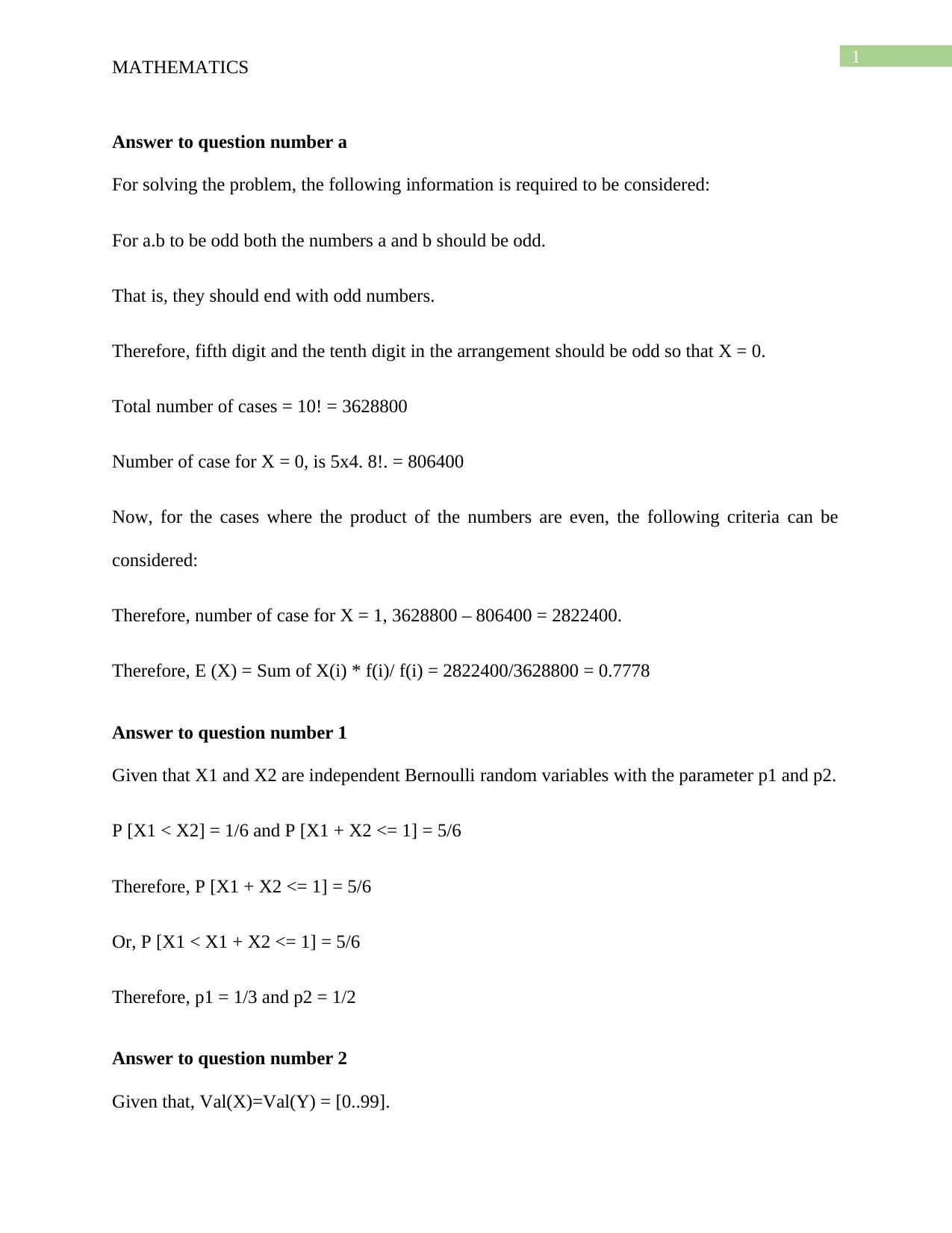
Answer to question number a
For solving the problem, the following information is required to be considered:
For a.b to be odd both the numbers a and b should be odd.
That is, they should end with odd numbers.
Therefore, fifth digit and the tenth digit in the arrangement should be odd so that X = 0.
Total number of cases = 10! = 3628800
Number of case for X = 0, is 5x4. 8!. = 806400
Now, for the cases where the product of the numbers are even, the following criteria can be
considered:
Therefore, number of case for X = 1, 3628800 – 806400 = 2822400.
Therefore, E (X) = Sum of X(i) * f(i)/ f(i) = 2822400/3628800 = 0.7778
Answer to question number 1
Given that X1 and X2 are independent Bernoulli random variables with the parameter p1 and p2.
P [X1 < X2] = 1/6 and P [X1 + X2 <= 1] = 5/6
Therefore, P [X1 + X2 <= 1] = 5/6
Or, P [X1 < X1 + X2 <= 1] = 5/6
Therefore, p1 = 1/3 and p2 = 1/2
Answer to question number 2
Given that, Val(X)=Val(Y) = [0..99].
MATHEMATICS
Answer to question number a
For solving the problem, the following information is required to be considered:
For a.b to be odd both the numbers a and b should be odd.
That is, they should end with odd numbers.
Therefore, fifth digit and the tenth digit in the arrangement should be odd so that X = 0.
Total number of cases = 10! = 3628800
Number of case for X = 0, is 5x4. 8!. = 806400
Now, for the cases where the product of the numbers are even, the following criteria can be
considered:
Therefore, number of case for X = 1, 3628800 – 806400 = 2822400.
Therefore, E (X) = Sum of X(i) * f(i)/ f(i) = 2822400/3628800 = 0.7778
Answer to question number 1
Given that X1 and X2 are independent Bernoulli random variables with the parameter p1 and p2.
P [X1 < X2] = 1/6 and P [X1 + X2 <= 1] = 5/6
Therefore, P [X1 + X2 <= 1] = 5/6
Or, P [X1 < X1 + X2 <= 1] = 5/6
Therefore, p1 = 1/3 and p2 = 1/2
Answer to question number 2
Given that, Val(X)=Val(Y) = [0..99].

2
MATHEMATICS
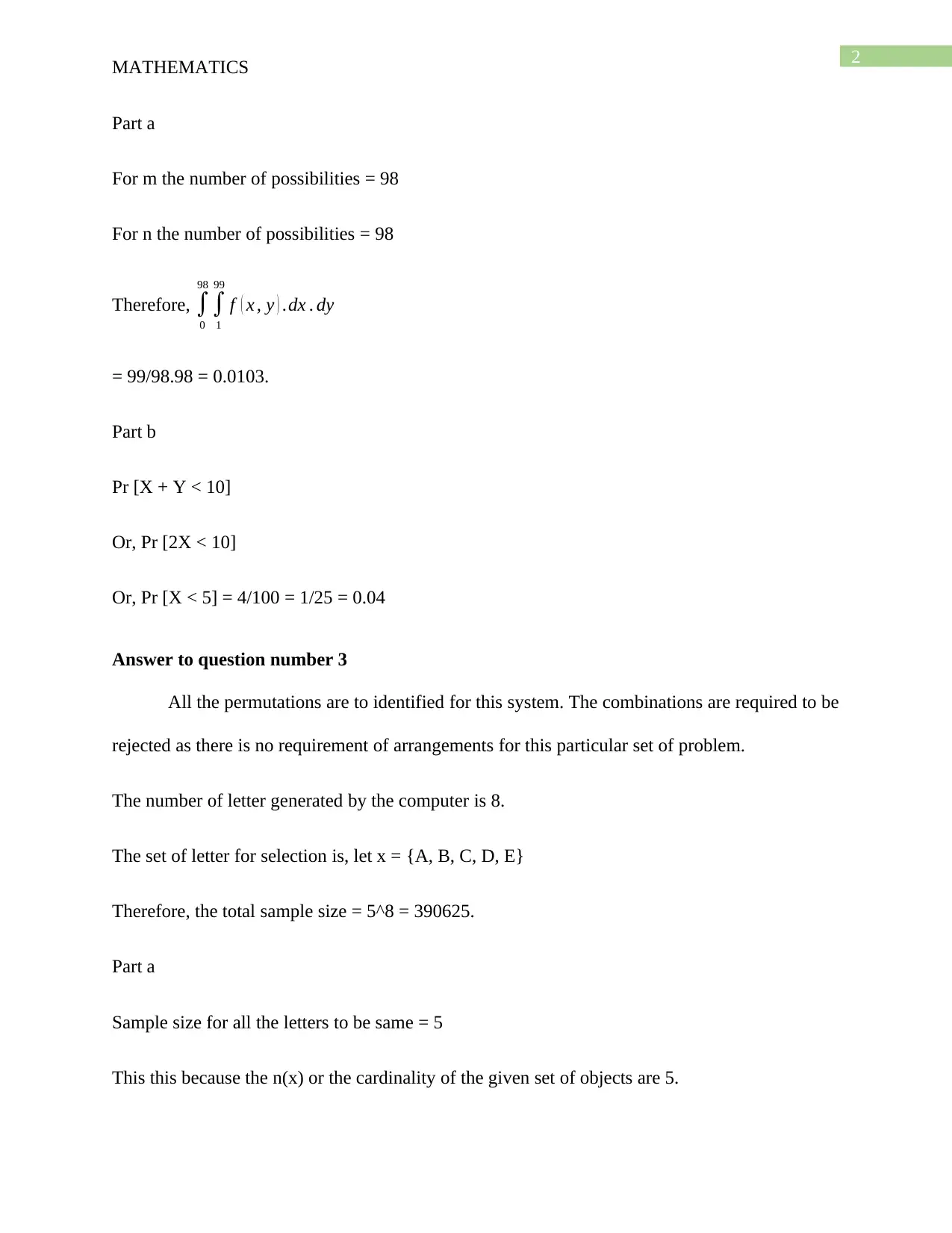
Part a
For m the number of possibilities = 98
For n the number of possibilities = 98
Therefore, ∫
0
98
∫
1
99
f ( x , y ) .dx . dy
= 99/98.98 = 0.0103.
Part b
Pr [X + Y < 10]
Or, Pr [2X < 10]
Or, Pr [X < 5] = 4/100 = 1/25 = 0.04
Answer to question number 3
All the permutations are to identified for this system. The combinations are required to be
rejected as there is no requirement of arrangements for this particular set of problem.
The number of letter generated by the computer is 8.
The set of letter for selection is, let x = {A, B, C, D, E}
Therefore, the total sample size = 5^8 = 390625.
Part a
Sample size for all the letters to be same = 5
This this because the n(x) or the cardinality of the given set of objects are 5.
MATHEMATICS
Part a
For m the number of possibilities = 98
For n the number of possibilities = 98
Therefore, ∫
0
98
∫
1
99
f ( x , y ) .dx . dy
= 99/98.98 = 0.0103.
Part b
Pr [X + Y < 10]
Or, Pr [2X < 10]
Or, Pr [X < 5] = 4/100 = 1/25 = 0.04
Answer to question number 3
All the permutations are to identified for this system. The combinations are required to be
rejected as there is no requirement of arrangements for this particular set of problem.
The number of letter generated by the computer is 8.
The set of letter for selection is, let x = {A, B, C, D, E}
Therefore, the total sample size = 5^8 = 390625.
Part a
Sample size for all the letters to be same = 5
This this because the n(x) or the cardinality of the given set of objects are 5.
⊘ This is a preview!⊘
Do you want full access?
Subscribe today to unlock all pages.

Trusted by 1+ million students worldwide

3
MATHEMATICS
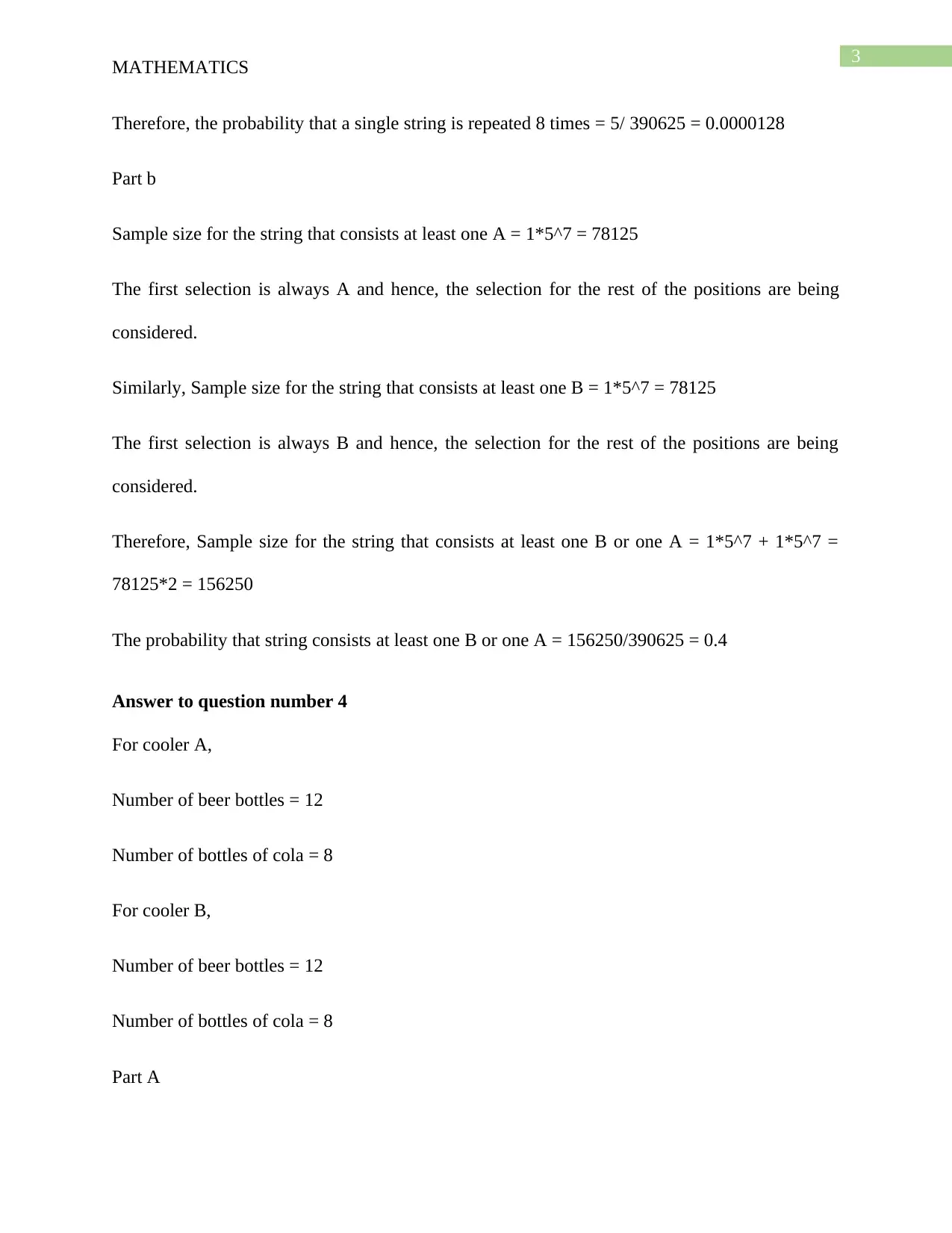
Therefore, the probability that a single string is repeated 8 times = 5/ 390625 = 0.0000128
Part b
Sample size for the string that consists at least one A = 1*5^7 = 78125
The first selection is always A and hence, the selection for the rest of the positions are being
considered.
Similarly, Sample size for the string that consists at least one B = 1*5^7 = 78125
The first selection is always B and hence, the selection for the rest of the positions are being
considered.
Therefore, Sample size for the string that consists at least one B or one A = 1*5^7 + 1*5^7 =
78125*2 = 156250
The probability that string consists at least one B or one A = 156250/390625 = 0.4
Answer to question number 4
For cooler A,
Number of beer bottles = 12
Number of bottles of cola = 8
For cooler B,
Number of beer bottles = 12
Number of bottles of cola = 8
Part A
MATHEMATICS
Therefore, the probability that a single string is repeated 8 times = 5/ 390625 = 0.0000128
Part b
Sample size for the string that consists at least one A = 1*5^7 = 78125
The first selection is always A and hence, the selection for the rest of the positions are being
considered.
Similarly, Sample size for the string that consists at least one B = 1*5^7 = 78125
The first selection is always B and hence, the selection for the rest of the positions are being
considered.
Therefore, Sample size for the string that consists at least one B or one A = 1*5^7 + 1*5^7 =
78125*2 = 156250
The probability that string consists at least one B or one A = 156250/390625 = 0.4
Answer to question number 4
For cooler A,
Number of beer bottles = 12
Number of bottles of cola = 8
For cooler B,
Number of beer bottles = 12
Number of bottles of cola = 8
Part A
Paraphrase This Document
Need a fresh take? Get an instant paraphrase of this document with our AI Paraphraser

4
MATHEMATICS
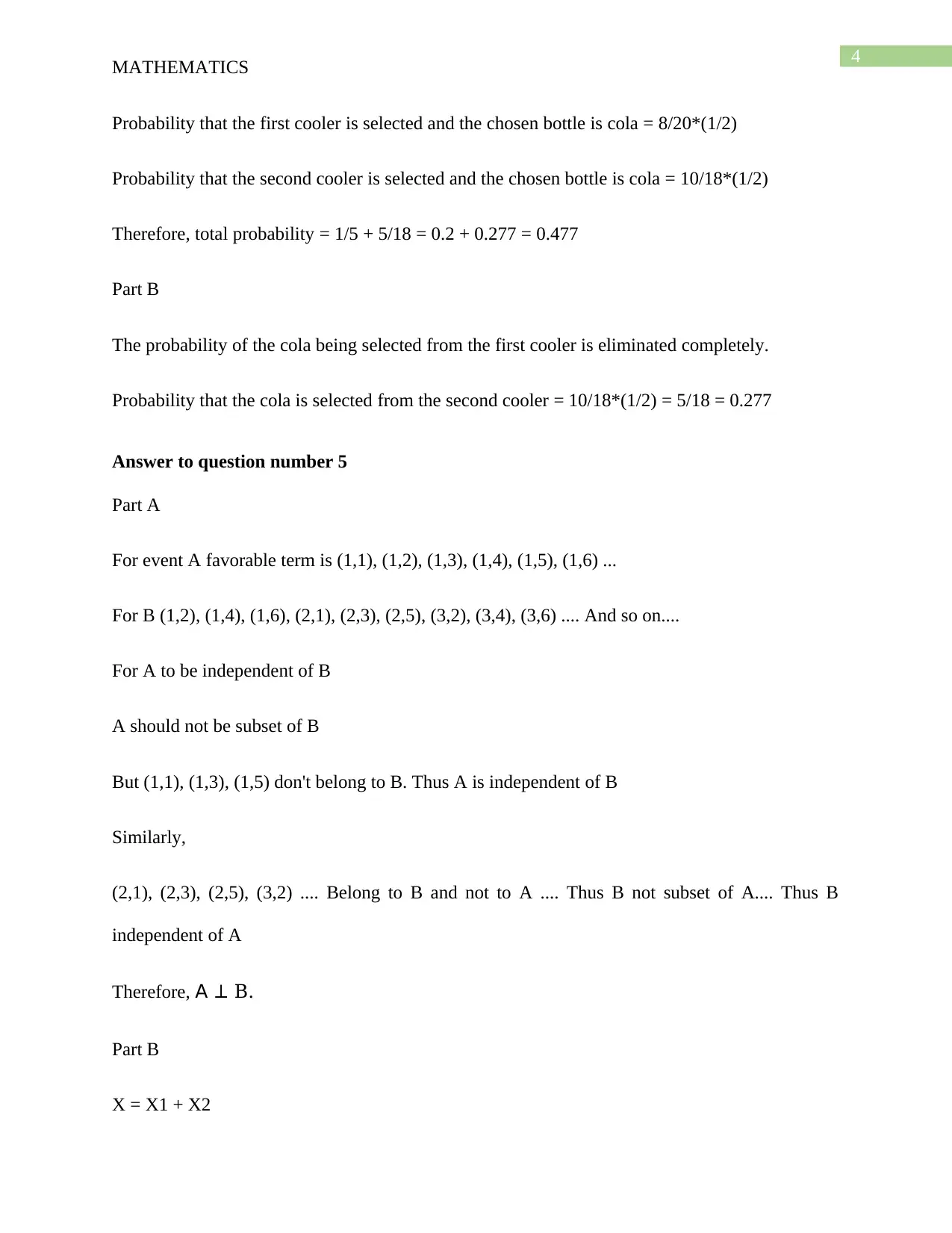
Probability that the first cooler is selected and the chosen bottle is cola = 8/20*(1/2)
Probability that the second cooler is selected and the chosen bottle is cola = 10/18*(1/2)
Therefore, total probability = 1/5 + 5/18 = 0.2 + 0.277 = 0.477
Part B
The probability of the cola being selected from the first cooler is eliminated completely.
Probability that the cola is selected from the second cooler = 10/18*(1/2) = 5/18 = 0.277
Answer to question number 5
Part A
For event A favorable term is (1,1), (1,2), (1,3), (1,4), (1,5), (1,6) ...
For B (1,2), (1,4), (1,6), (2,1), (2,3), (2,5), (3,2), (3,4), (3,6) .... And so on....
For A to be independent of B
A should not be subset of B
But (1,1), (1,3), (1,5) don't belong to B. Thus A is independent of B
Similarly,
(2,1), (2,3), (2,5), (3,2) .... Belong to B and not to A .... Thus B not subset of A.... Thus B
independent of A
Therefore, A ⊥ B.
Part B
X = X1 + X2
MATHEMATICS
Probability that the first cooler is selected and the chosen bottle is cola = 8/20*(1/2)
Probability that the second cooler is selected and the chosen bottle is cola = 10/18*(1/2)
Therefore, total probability = 1/5 + 5/18 = 0.2 + 0.277 = 0.477
Part B
The probability of the cola being selected from the first cooler is eliminated completely.
Probability that the cola is selected from the second cooler = 10/18*(1/2) = 5/18 = 0.277
Answer to question number 5
Part A
For event A favorable term is (1,1), (1,2), (1,3), (1,4), (1,5), (1,6) ...
For B (1,2), (1,4), (1,6), (2,1), (2,3), (2,5), (3,2), (3,4), (3,6) .... And so on....
For A to be independent of B
A should not be subset of B
But (1,1), (1,3), (1,5) don't belong to B. Thus A is independent of B
Similarly,
(2,1), (2,3), (2,5), (3,2) .... Belong to B and not to A .... Thus B not subset of A.... Thus B
independent of A
Therefore, A ⊥ B.
Part B
X = X1 + X2

5
MATHEMATICS
X = {1, 2, 3, 5, 6, 7……12}
X1 = {1, 2, 3, 5, 6}
Therefore, X1 belongs to X and hence, X ⊥ X1 is not true
Answer to question number 6
Part a
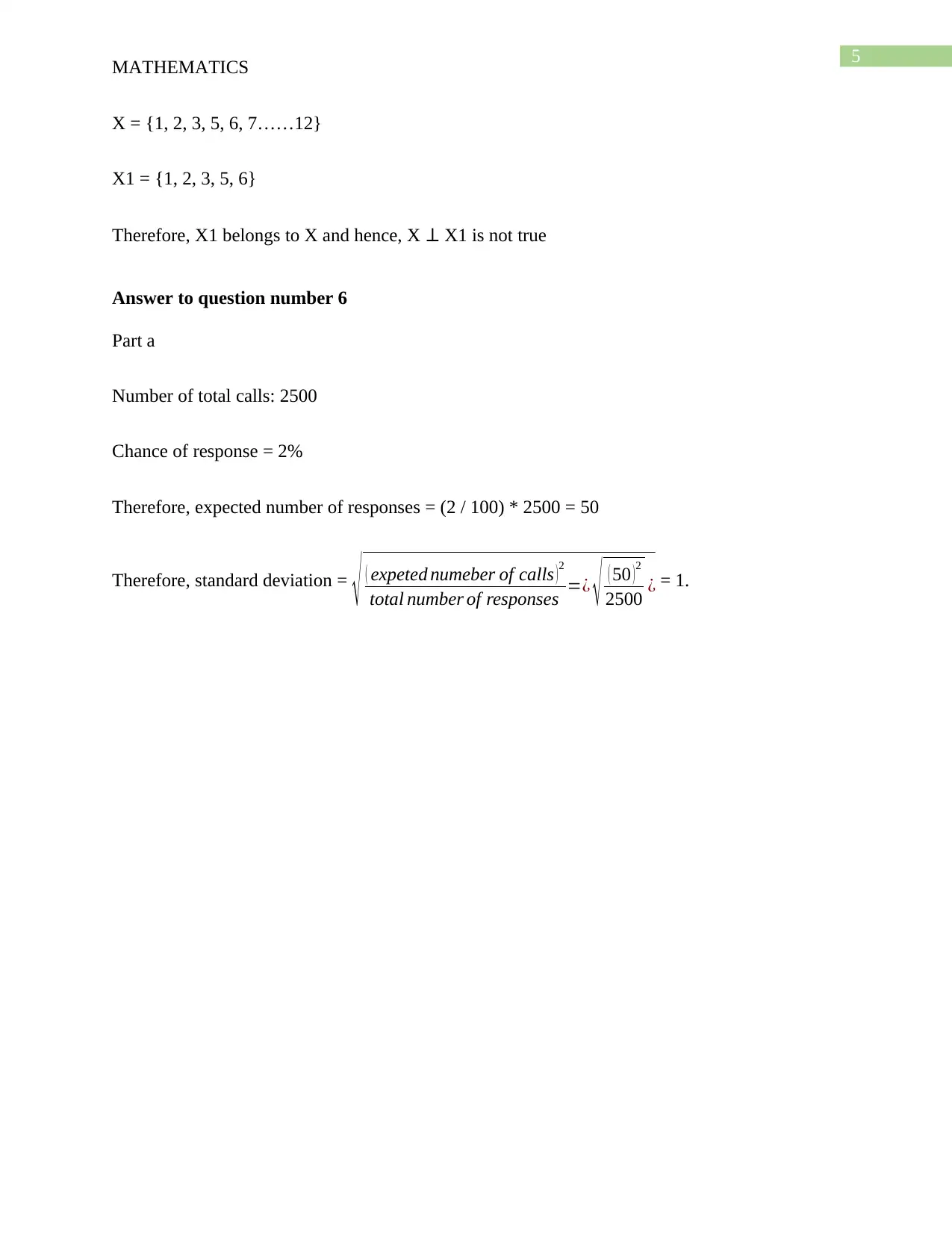
Number of total calls: 2500
Chance of response = 2%
Therefore, expected number of responses = (2 / 100) * 2500 = 50
Therefore, standard deviation =
√ ( expeted numeber of calls ) 2
total number of responses =¿ √ ( 50 ) 2
2500 ¿ = 1.
MATHEMATICS
X = {1, 2, 3, 5, 6, 7……12}
X1 = {1, 2, 3, 5, 6}
Therefore, X1 belongs to X and hence, X ⊥ X1 is not true
Answer to question number 6
Part a
Number of total calls: 2500
Chance of response = 2%
Therefore, expected number of responses = (2 / 100) * 2500 = 50
Therefore, standard deviation =
√ ( expeted numeber of calls ) 2
total number of responses =¿ √ ( 50 ) 2
2500 ¿ = 1.
⊘ This is a preview!⊘
Do you want full access?
Subscribe today to unlock all pages.

Trusted by 1+ million students worldwide
1 out of 6
Related Documents
Your All-in-One AI-Powered Toolkit for Academic Success.
+13062052269
info@desklib.com
Available 24*7 on WhatsApp / Email
Unlock your academic potential
Copyright © 2020–2026 A2Z Services. All Rights Reserved. Developed and managed by ZUCOL.