PHIL200: Investigating the Problem of Evil and Divine Attributes

Verified

Added on  2022/08/23

|4
|860
|14
Essay
AI Summary
This essay delves into the philosophical problem of evil, examining the challenges it poses to the existence of a benevolent, omnipotent, and omniscient God. It begins by defining moral and natural evil, providing examples of suffering and injustice that appear to contradict the concept of a perfect divine being. The essay explores the arguments surrounding the problem of evil, including how the presence of suffering and evil can conflict with the theistic claim of a perfect God. The student's perspective is offered, drawing on Process Theology to suggest that God's power is persuasive rather than coercive, influencing creation through attraction to values. The essay references key scholarly works that discuss the problem of evil and different perspectives on addressing it. It considers the implications of divine attributes like omniscience, omnipotence, and moral perfection in light of the widespread existence of suffering and evil in the world, and how these apparent contradictions challenge the theistic perspective.
Document Page
Running head: PROBLEM OF EVIL
Problem of Evil
Name of the student:
Name of the university:
Author Note
tabler-icon-diamond-filled.svg

Paraphrase This Document

Need a fresh take? Get an instant paraphrase of this document with our AI Paraphraser
Document Page
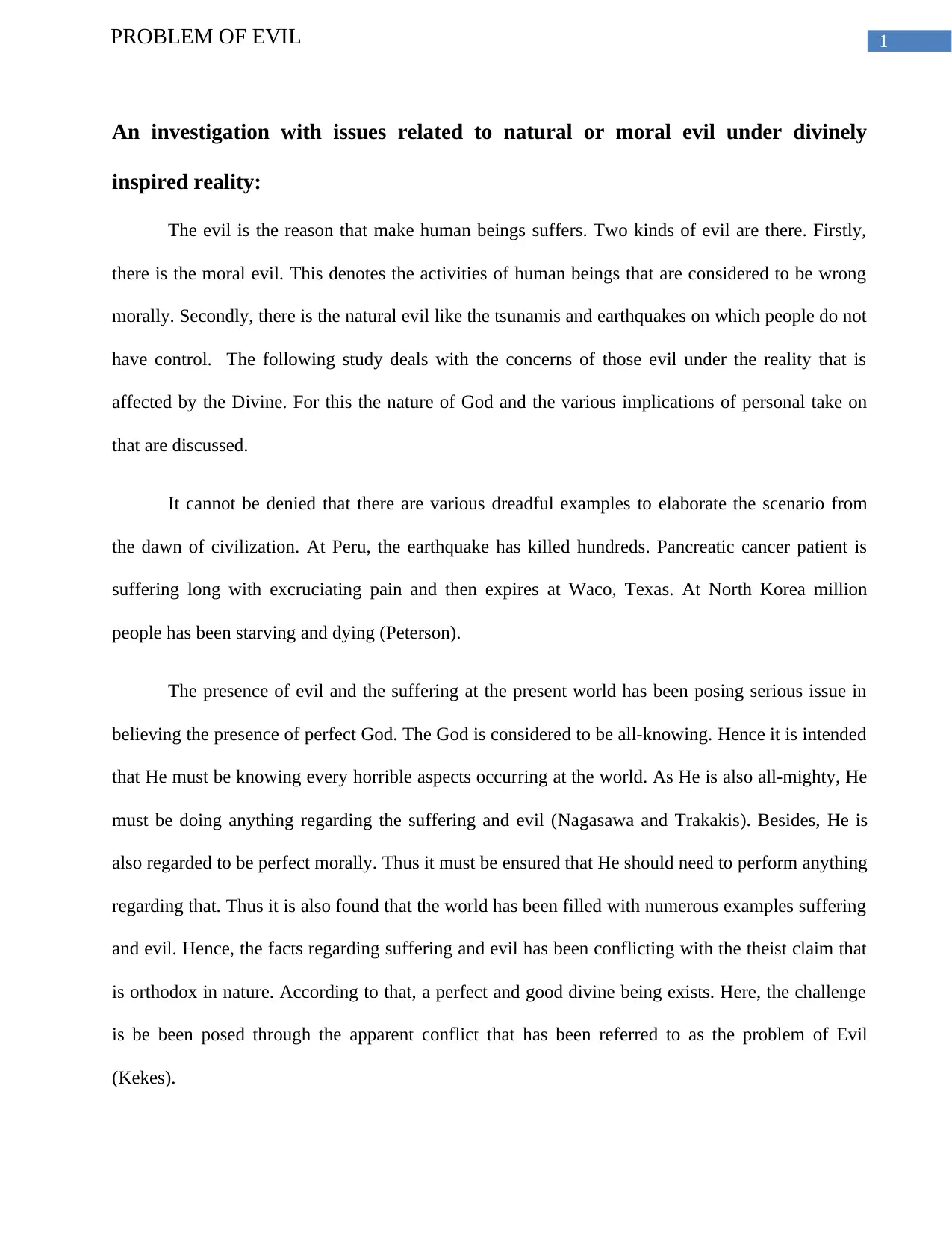
1PROBLEM OF EVIL
An investigation with issues related to natural or moral evil under divinely
inspired reality:
The evil is the reason that make human beings suffers. Two kinds of evil are there. Firstly,
there is the moral evil. This denotes the activities of human beings that are considered to be wrong
morally. Secondly, there is the natural evil like the tsunamis and earthquakes on which people do not
have control. The following study deals with the concerns of those evil under the reality that is
affected by the Divine. For this the nature of God and the various implications of personal take on
that are discussed.
It cannot be denied that there are various dreadful examples to elaborate the scenario from
the dawn of civilization. At Peru, the earthquake has killed hundreds. Pancreatic cancer patient is
suffering long with excruciating pain and then expires at Waco, Texas. At North Korea million
people has been starving and dying (Peterson).
The presence of evil and the suffering at the present world has been posing serious issue in
believing the presence of perfect God. The God is considered to be all-knowing. Hence it is intended
that He must be knowing every horrible aspects occurring at the world. As He is also all-mighty, He
must be doing anything regarding the suffering and evil (Nagasawa and Trakakis). Besides, He is
also regarded to be perfect morally. Thus it must be ensured that He should need to perform anything
regarding that. Thus it is also found that the world has been filled with numerous examples suffering
and evil. Hence, the facts regarding suffering and evil has been conflicting with the theist claim that
is orthodox in nature. According to that, a perfect and good divine being exists. Here, the challenge
is be been posed through the apparent conflict that has been referred to as the problem of Evil
(Kekes).
Document Page
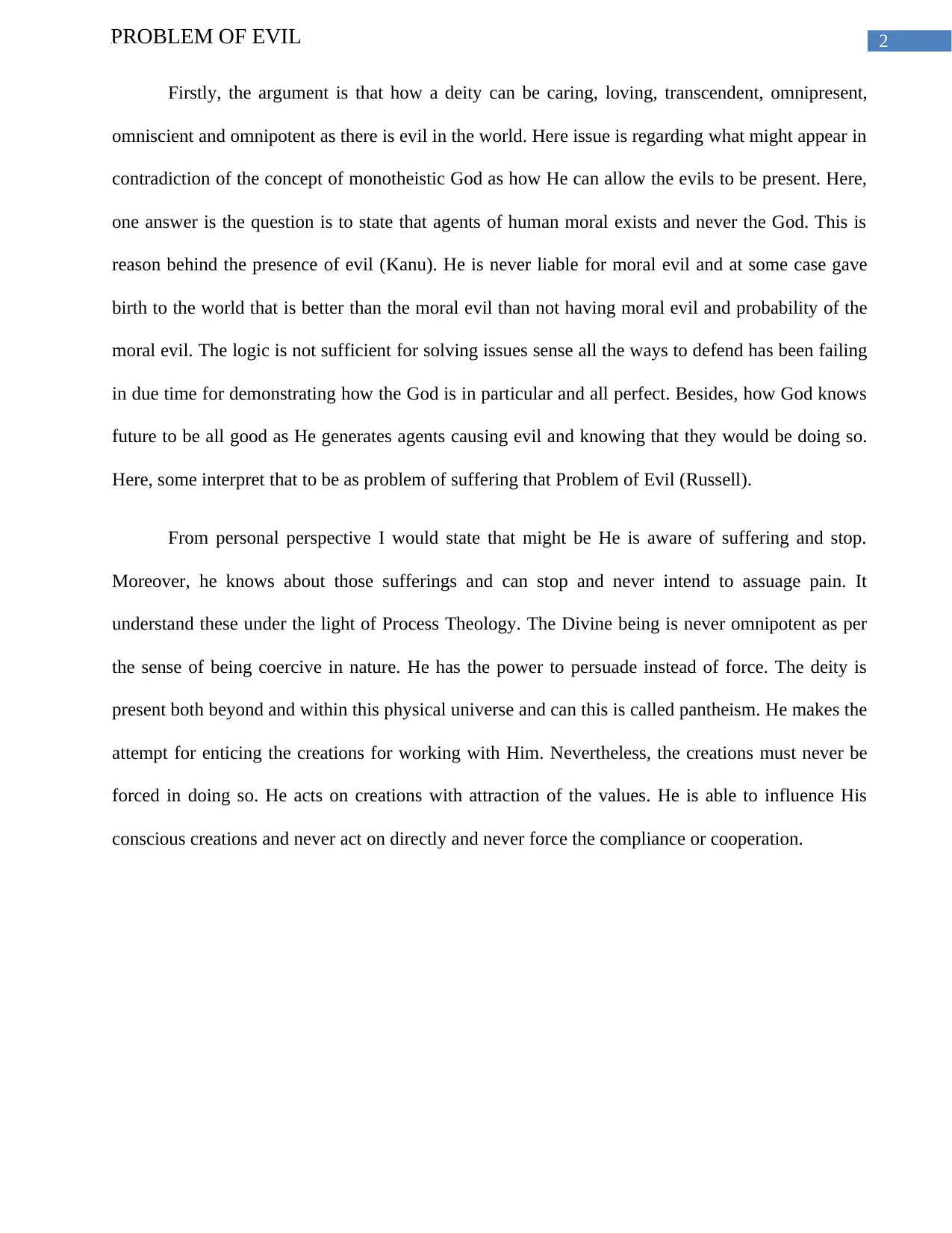
2PROBLEM OF EVIL
Firstly, the argument is that how a deity can be caring, loving, transcendent, omnipresent,
omniscient and omnipotent as there is evil in the world. Here issue is regarding what might appear in
contradiction of the concept of monotheistic God as how He can allow the evils to be present. Here,
one answer is the question is to state that agents of human moral exists and never the God. This is
reason behind the presence of evil (Kanu). He is never liable for moral evil and at some case gave
birth to the world that is better than the moral evil than not having moral evil and probability of the
moral evil. The logic is not sufficient for solving issues sense all the ways to defend has been failing
in due time for demonstrating how the God is in particular and all perfect. Besides, how God knows
future to be all good as He generates agents causing evil and knowing that they would be doing so.
Here, some interpret that to be as problem of suffering that Problem of Evil (Russell).
From personal perspective I would state that might be He is aware of suffering and stop.
Moreover, he knows about those sufferings and can stop and never intend to assuage pain. It
understand these under the light of Process Theology. The Divine being is never omnipotent as per
the sense of being coercive in nature. He has the power to persuade instead of force. The deity is
present both beyond and within this physical universe and can this is called pantheism. He makes the
attempt for enticing the creations for working with Him. Nevertheless, the creations must never be
forced in doing so. He acts on creations with attraction of the values. He is able to influence His
conscious creations and never act on directly and never force the compliance or cooperation.
Document Page
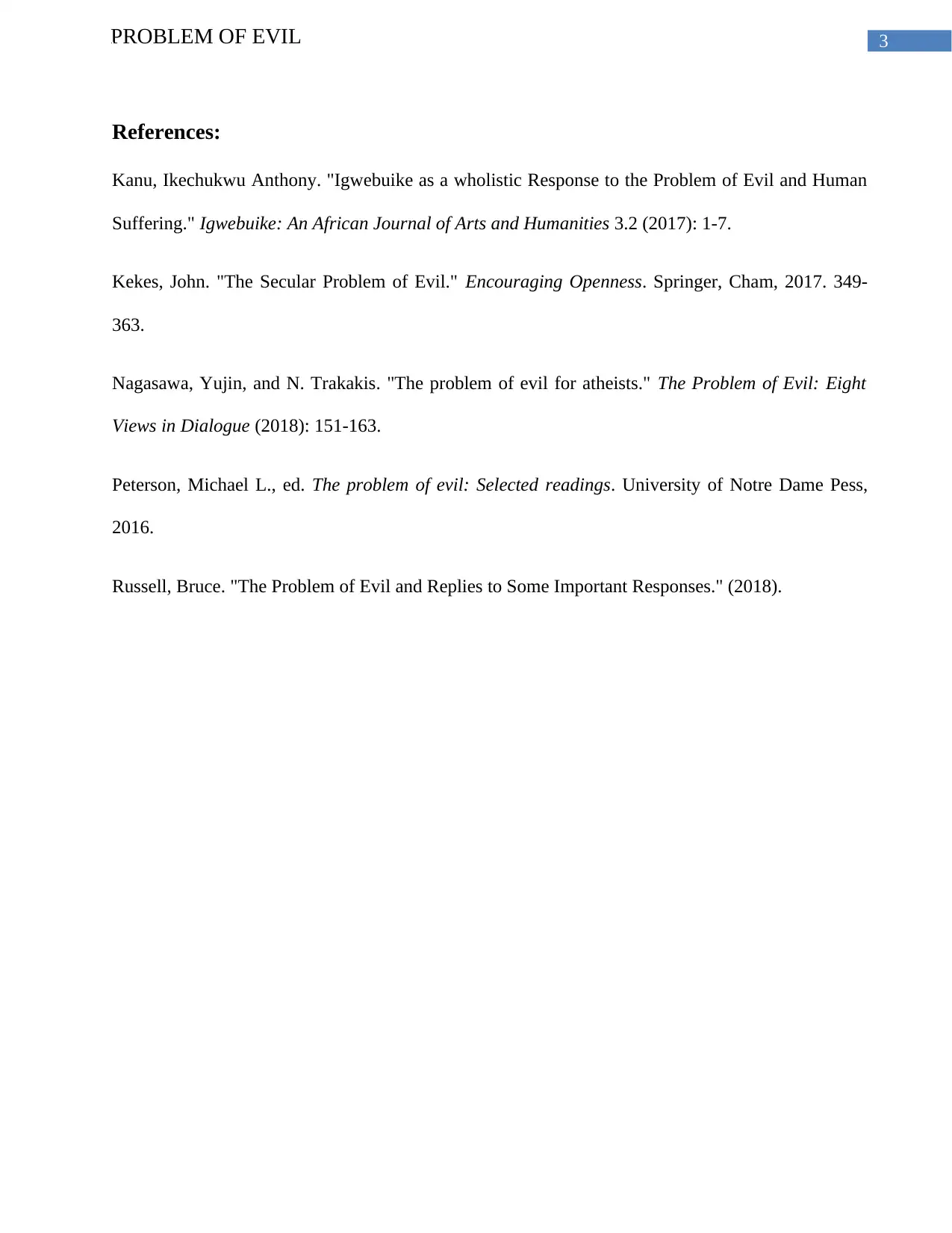
3PROBLEM OF EVIL
References:
Kanu, Ikechukwu Anthony. "Igwebuike as a wholistic Response to the Problem of Evil and Human
Suffering." Igwebuike: An African Journal of Arts and Humanities 3.2 (2017): 1-7.
Kekes, John. "The Secular Problem of Evil." Encouraging Openness. Springer, Cham, 2017. 349-
363.
Nagasawa, Yujin, and N. Trakakis. "The problem of evil for atheists." The Problem of Evil: Eight
Views in Dialogue (2018): 151-163.
Peterson, Michael L., ed. The problem of evil: Selected readings. University of Notre Dame Pess,
2016.
Russell, Bruce. "The Problem of Evil and Replies to Some Important Responses." (2018).
chevron_up_icon
1 out of 4
circle_padding
hide_on_mobile
zoom_out_icon
[object Object]