Procurement Strategy Report for Tasman House Project
VerifiedAdded on 2020/01/07
|6
|1865
|183
Report
AI Summary
This report presents a procurement strategy for the Tasman House project, focusing on refurbishment and expansion. It provides an individual rationale for the chosen strategy, considering the building's history, current condition, and the need for renovation. The report explores the benefits of implementing an alliance strategy, emphasizing risk management, cost certainty, and time considerations. It also highlights the importance of quality, environmental regulations, and negotiation within a clear framework. The conclusion summarizes the key aspects of procurement, emphasizing its role in acquiring products and services at the best possible price while ensuring quality and adherence to timelines. The report references various books and journals to support its analysis.
PROCUREMENT
STRATEGY
1
STRATEGY
1

Paraphrase This Document
Need a fresh take? Get an instant paraphrase of this document with our AI Paraphraser
INTRODUCTION
Procurement strategy refers to planned approach of cost effective buying of required
supplies by enterprise by taking into consideration various components and factors like, duration of
procurement, funding, budget the planned risk and opportunities among others (Sutton, 2013). The
procurement can be defined as the acquisition of the raw-material, supplies, services etc. that a
organization or project needs so as to function smoothly. In this report, various aspects of
procurement strategy will be studied in the context of Tasman House, 65 Wells St. London W1. In
this report a procurement strategy to deliver of a commercial development at cited location will be
provided. Further, learning will be shown regarding how the strategy meets the needs of the brief.
Thereafter, the benefits of implementing the strategy with regards to client and project will be
provided.
INDIVIDUAL RATIONALE
The present report is based on the procurement strategy for the Tasman House. It is held
freehold through a subsidiary interest of Great Portland Estates Plc. The building was leased for 10
years to The Secretary of State for Communities and Local Government (Ghaffari and Venkatesh,
2013). Later, the property was used as magistrates court during this duration with individual
courtrooms, conference, meeting rooms along with office accommodation etc. The present study
has been selected as it is very important for gaining in depth knowledge regarding the procurement
strategy that must be adopted by a company (Watermeyer, 2012). With the help of effective
procurement strategy the Tasman house will be able to attain its purpose of refurbishment and
expansion. The process of procurement is part of the business strategy of cited organization as the
efficiency of company to buy specific materi al will decide the continuity of business. At present,
Tasman House is facing serious need for renovation and modification (Gurnani, Gümüş, Ray and
Ray, 2012). Due to its occupancy for such a long period by Magistrates and other parties the
property has suffered severe damage. Thereafter, the case study reveals that there are many
opportunities for the improvement in Tasman house. Such as, original property consist of a
improved concrete frame arranged over a ground bearing block foundation. Outwardly the façade is
capsulated through the exercise of metal frame single glazed Crittal windows set within
reconstituted stone surroundings, and spandrels panels beneath (Lenderink, Halman and Voordijk,
2016). Elsewhere the façade is polished with cavity brickwork, which to the rear is formed using
calcium silicate brick. The primary asphalt canopied flat roof has undergone several repairs over its
existence and been healed with a fluid plastic cold membrane and houses further building plant and
equipment. Regular floor to ceiling heights are 2.4m ffl to ceilings with a clear slab to soffit
2
Procurement strategy refers to planned approach of cost effective buying of required
supplies by enterprise by taking into consideration various components and factors like, duration of
procurement, funding, budget the planned risk and opportunities among others (Sutton, 2013). The
procurement can be defined as the acquisition of the raw-material, supplies, services etc. that a
organization or project needs so as to function smoothly. In this report, various aspects of
procurement strategy will be studied in the context of Tasman House, 65 Wells St. London W1. In
this report a procurement strategy to deliver of a commercial development at cited location will be
provided. Further, learning will be shown regarding how the strategy meets the needs of the brief.
Thereafter, the benefits of implementing the strategy with regards to client and project will be
provided.
INDIVIDUAL RATIONALE
The present report is based on the procurement strategy for the Tasman House. It is held
freehold through a subsidiary interest of Great Portland Estates Plc. The building was leased for 10
years to The Secretary of State for Communities and Local Government (Ghaffari and Venkatesh,
2013). Later, the property was used as magistrates court during this duration with individual
courtrooms, conference, meeting rooms along with office accommodation etc. The present study
has been selected as it is very important for gaining in depth knowledge regarding the procurement
strategy that must be adopted by a company (Watermeyer, 2012). With the help of effective
procurement strategy the Tasman house will be able to attain its purpose of refurbishment and
expansion. The process of procurement is part of the business strategy of cited organization as the
efficiency of company to buy specific materi al will decide the continuity of business. At present,
Tasman House is facing serious need for renovation and modification (Gurnani, Gümüş, Ray and
Ray, 2012). Due to its occupancy for such a long period by Magistrates and other parties the
property has suffered severe damage. Thereafter, the case study reveals that there are many
opportunities for the improvement in Tasman house. Such as, original property consist of a
improved concrete frame arranged over a ground bearing block foundation. Outwardly the façade is
capsulated through the exercise of metal frame single glazed Crittal windows set within
reconstituted stone surroundings, and spandrels panels beneath (Lenderink, Halman and Voordijk,
2016). Elsewhere the façade is polished with cavity brickwork, which to the rear is formed using
calcium silicate brick. The primary asphalt canopied flat roof has undergone several repairs over its
existence and been healed with a fluid plastic cold membrane and houses further building plant and
equipment. Regular floor to ceiling heights are 2.4m ffl to ceilings with a clear slab to soffit
2
dimension of 2.7m (Olanrewaju, Chen and Han, 2016). Also, it has been identified from the report
that Tasman House is facilitated by two stair midpoint which are further served by single
passenger lift. Thus, there is need for separate lift in the Tasman house. From the available
information from the case study it is clearly evident that there is wide scope of modification in t he
Tasman House. This is the main reason for selecting the study. Since, its inception that major
refurbishment and expansion project will require heavy funds therefore, the decision and choice of
strategy must be done wisely (Lenderink, Halman and Voordijk, 2016).
Furthermore, Tasman house can consider Alliance strategy can be taken into consideration.
The reason for this is that it enable the early participation of the contractor. Therefore, to facilitate
the alliance the main participants of the project ie, principal and contractor are involved. They all
are jointly liable for all the aspects of the delivery of the project (Cooke and Williams, 2013). The
main benefit of alliance strategy is that all the commercial risk and rewards are shared among the
alliance partners. Since, the major refurbishment high risk and there is possibility that alternative
strategies for risk apportionment can be ineffective, it is appropriate for Tasman house to take
alliance strategy into consideration (Chen, 2016). The fundamental objective is to assure that the
procurement scheme is performed on time, to a superior standard in proportion to with the market
where attempting to draw in potential tenants and at a fixed cost. To accomplish these objectives,
the choice and appointment of a contractor must be cautiously appraised such that the organization
have a established track record of running with like similar thinking customers in this sector and
location, have proper resource and levels of skillfulness either in-house or through a trustworthy
and reliable supply chain, at the same time guarantee that risk is moved or stays within controllable
levels (McDermott, Dickinson, Ioannnou and Heard, 2012). Even where transferring risk it does
not go away and remains with the project to wind-up so the requirement to be in good order must be
defined, ranked and then treated or transferred consequently and on a regular basis evaluated to
completion and hand over. Cost certainty is very important as it influences performance /
profitability (Sutton, 2013). Therefore, the Tasman house must understand that modification are
probable to develop during construction and company is required to be flexible sometimes. Time is
another key aspect of any business plan, with delays eroding any profit, especially in a challenging
marketplace like at present. A key consideration where advising in respect of procurement should
address the transfer and appetite for risk, then issues such as cost certainty and program will be
further understood, rather than the usual COST / TIME / QUALITY epitome (Tan, 2015). Further,
it must be considered that negotiation can sometimes be a power for good if advanced within a clear
framework between long-familiar parties. Thereafter, while procuring the raw material from
different sources, the consideration must be given on the quality of inputs. Also, the laws regarding
3
that Tasman House is facilitated by two stair midpoint which are further served by single
passenger lift. Thus, there is need for separate lift in the Tasman house. From the available
information from the case study it is clearly evident that there is wide scope of modification in t he
Tasman House. This is the main reason for selecting the study. Since, its inception that major
refurbishment and expansion project will require heavy funds therefore, the decision and choice of
strategy must be done wisely (Lenderink, Halman and Voordijk, 2016).
Furthermore, Tasman house can consider Alliance strategy can be taken into consideration.
The reason for this is that it enable the early participation of the contractor. Therefore, to facilitate
the alliance the main participants of the project ie, principal and contractor are involved. They all
are jointly liable for all the aspects of the delivery of the project (Cooke and Williams, 2013). The
main benefit of alliance strategy is that all the commercial risk and rewards are shared among the
alliance partners. Since, the major refurbishment high risk and there is possibility that alternative
strategies for risk apportionment can be ineffective, it is appropriate for Tasman house to take
alliance strategy into consideration (Chen, 2016). The fundamental objective is to assure that the
procurement scheme is performed on time, to a superior standard in proportion to with the market
where attempting to draw in potential tenants and at a fixed cost. To accomplish these objectives,
the choice and appointment of a contractor must be cautiously appraised such that the organization
have a established track record of running with like similar thinking customers in this sector and
location, have proper resource and levels of skillfulness either in-house or through a trustworthy
and reliable supply chain, at the same time guarantee that risk is moved or stays within controllable
levels (McDermott, Dickinson, Ioannnou and Heard, 2012). Even where transferring risk it does
not go away and remains with the project to wind-up so the requirement to be in good order must be
defined, ranked and then treated or transferred consequently and on a regular basis evaluated to
completion and hand over. Cost certainty is very important as it influences performance /
profitability (Sutton, 2013). Therefore, the Tasman house must understand that modification are
probable to develop during construction and company is required to be flexible sometimes. Time is
another key aspect of any business plan, with delays eroding any profit, especially in a challenging
marketplace like at present. A key consideration where advising in respect of procurement should
address the transfer and appetite for risk, then issues such as cost certainty and program will be
further understood, rather than the usual COST / TIME / QUALITY epitome (Tan, 2015). Further,
it must be considered that negotiation can sometimes be a power for good if advanced within a clear
framework between long-familiar parties. Thereafter, while procuring the raw material from
different sources, the consideration must be given on the quality of inputs. Also, the laws regarding
3
⊘ This is a preview!⊘
Do you want full access?
Subscribe today to unlock all pages.

Trusted by 1+ million students worldwide
the environment protection and related protocols must be considered while procurement process.
Such as, in green public procurement the contracting authorities and company take environmental
concern into consideration while tendering for raw material or services (Adriaanse and Robinson,
2015).
CONCLUSION
From the above report, it can be concluded that procurement is important function that will
help the Tasman House Ltd in finding, acquiring, purchasing products and services from outside
source through tender or competitive bidding prices. With the help of clear strategy, company can
assure it get the offerings at best possible price within the desired time frame. The strategy will also
check that quality of input is good and thereby maintain the standard of entity.
4
Such as, in green public procurement the contracting authorities and company take environmental
concern into consideration while tendering for raw material or services (Adriaanse and Robinson,
2015).
CONCLUSION
From the above report, it can be concluded that procurement is important function that will
help the Tasman House Ltd in finding, acquiring, purchasing products and services from outside
source through tender or competitive bidding prices. With the help of clear strategy, company can
assure it get the offerings at best possible price within the desired time frame. The strategy will also
check that quality of input is good and thereby maintain the standard of entity.
4
Paraphrase This Document
Need a fresh take? Get an instant paraphrase of this document with our AI Paraphraser
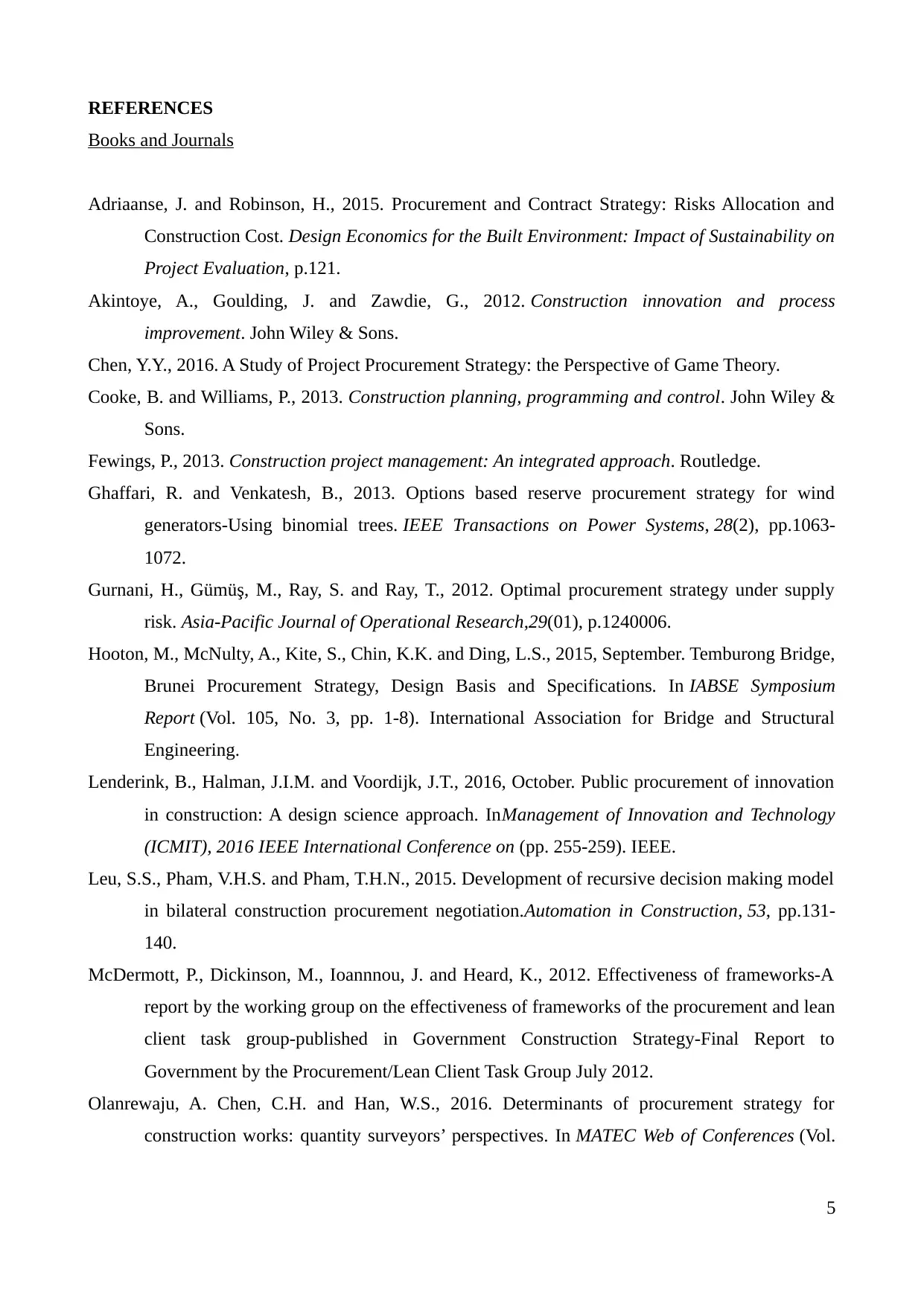
REFERENCES
Books and Journals
Adriaanse, J. and Robinson, H., 2015. Procurement and Contract Strategy: Risks Allocation and
Construction Cost. Design Economics for the Built Environment: Impact of Sustainability on
Project Evaluation, p.121.
Akintoye, A., Goulding, J. and Zawdie, G., 2012. Construction innovation and process
improvement. John Wiley & Sons.
Chen, Y.Y., 2016. A Study of Project Procurement Strategy: the Perspective of Game Theory.
Cooke, B. and Williams, P., 2013. Construction planning, programming and control. John Wiley &
Sons.
Fewings, P., 2013. Construction project management: An integrated approach. Routledge.
Ghaffari, R. and Venkatesh, B., 2013. Options based reserve procurement strategy for wind
generators-Using binomial trees. IEEE Transactions on Power Systems, 28(2), pp.1063-
1072.
Gurnani, H., Gümüş, M., Ray, S. and Ray, T., 2012. Optimal procurement strategy under supply
risk. Asia-Pacific Journal of Operational Research,29(01), p.1240006.
Hooton, M., McNulty, A., Kite, S., Chin, K.K. and Ding, L.S., 2015, September. Temburong Bridge,
Brunei Procurement Strategy, Design Basis and Specifications. In IABSE Symposium
Report (Vol. 105, No. 3, pp. 1-8). International Association for Bridge and Structural
Engineering.
Lenderink, B., Halman, J.I.M. and Voordijk, J.T., 2016, October. Public procurement of innovation
in construction: A design science approach. InManagement of Innovation and Technology
(ICMIT), 2016 IEEE International Conference on (pp. 255-259). IEEE.
Leu, S.S., Pham, V.H.S. and Pham, T.H.N., 2015. Development of recursive decision making model
in bilateral construction procurement negotiation.Automation in Construction, 53, pp.131-
140.
McDermott, P., Dickinson, M., Ioannnou, J. and Heard, K., 2012. Effectiveness of frameworks-A
report by the working group on the effectiveness of frameworks of the procurement and lean
client task group-published in Government Construction Strategy-Final Report to
Government by the Procurement/Lean Client Task Group July 2012.
Olanrewaju, A. Chen, C.H. and Han, W.S., 2016. Determinants of procurement strategy for
construction works: quantity surveyors’ perspectives. In MATEC Web of Conferences (Vol.
5
Books and Journals
Adriaanse, J. and Robinson, H., 2015. Procurement and Contract Strategy: Risks Allocation and
Construction Cost. Design Economics for the Built Environment: Impact of Sustainability on
Project Evaluation, p.121.
Akintoye, A., Goulding, J. and Zawdie, G., 2012. Construction innovation and process
improvement. John Wiley & Sons.
Chen, Y.Y., 2016. A Study of Project Procurement Strategy: the Perspective of Game Theory.
Cooke, B. and Williams, P., 2013. Construction planning, programming and control. John Wiley &
Sons.
Fewings, P., 2013. Construction project management: An integrated approach. Routledge.
Ghaffari, R. and Venkatesh, B., 2013. Options based reserve procurement strategy for wind
generators-Using binomial trees. IEEE Transactions on Power Systems, 28(2), pp.1063-
1072.
Gurnani, H., Gümüş, M., Ray, S. and Ray, T., 2012. Optimal procurement strategy under supply
risk. Asia-Pacific Journal of Operational Research,29(01), p.1240006.
Hooton, M., McNulty, A., Kite, S., Chin, K.K. and Ding, L.S., 2015, September. Temburong Bridge,
Brunei Procurement Strategy, Design Basis and Specifications. In IABSE Symposium
Report (Vol. 105, No. 3, pp. 1-8). International Association for Bridge and Structural
Engineering.
Lenderink, B., Halman, J.I.M. and Voordijk, J.T., 2016, October. Public procurement of innovation
in construction: A design science approach. InManagement of Innovation and Technology
(ICMIT), 2016 IEEE International Conference on (pp. 255-259). IEEE.
Leu, S.S., Pham, V.H.S. and Pham, T.H.N., 2015. Development of recursive decision making model
in bilateral construction procurement negotiation.Automation in Construction, 53, pp.131-
140.
McDermott, P., Dickinson, M., Ioannnou, J. and Heard, K., 2012. Effectiveness of frameworks-A
report by the working group on the effectiveness of frameworks of the procurement and lean
client task group-published in Government Construction Strategy-Final Report to
Government by the Procurement/Lean Client Task Group July 2012.
Olanrewaju, A. Chen, C.H. and Han, W.S., 2016. Determinants of procurement strategy for
construction works: quantity surveyors’ perspectives. In MATEC Web of Conferences (Vol.
5
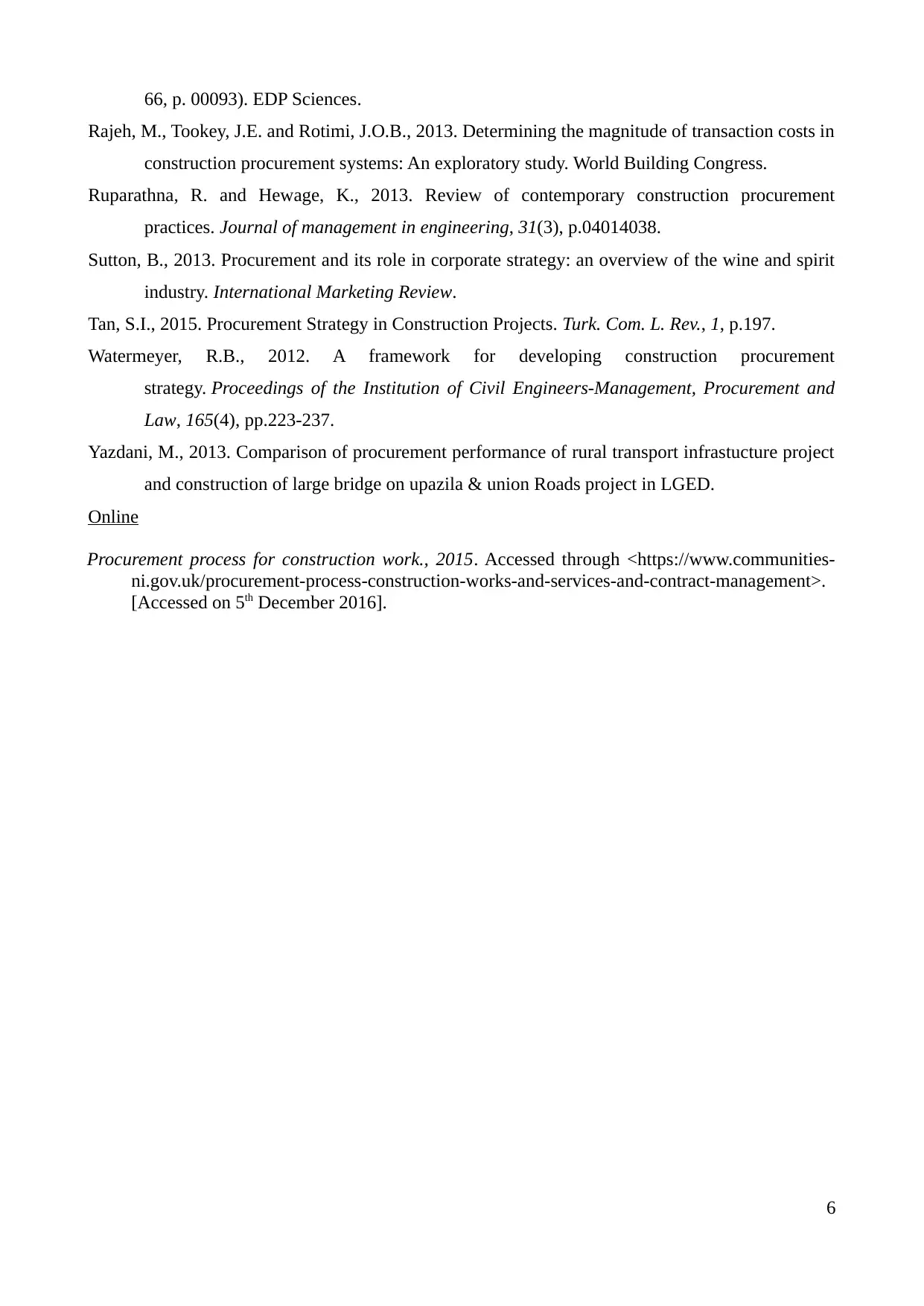
66, p. 00093). EDP Sciences.
Rajeh, M., Tookey, J.E. and Rotimi, J.O.B., 2013. Determining the magnitude of transaction costs in
construction procurement systems: An exploratory study. World Building Congress.
Ruparathna, R. and Hewage, K., 2013. Review of contemporary construction procurement
practices. Journal of management in engineering, 31(3), p.04014038.
Sutton, B., 2013. Procurement and its role in corporate strategy: an overview of the wine and spirit
industry. International Marketing Review.
Tan, S.I., 2015. Procurement Strategy in Construction Projects. Turk. Com. L. Rev., 1, p.197.
Watermeyer, R.B., 2012. A framework for developing construction procurement
strategy. Proceedings of the Institution of Civil Engineers-Management, Procurement and
Law, 165(4), pp.223-237.
Yazdani, M., 2013. Comparison of procurement performance of rural transport infrastucture project
and construction of large bridge on upazila & union Roads project in LGED.
Online
Procurement process for construction work., 2015. Accessed through <https://www.communities-
ni.gov.uk/procurement-process-construction-works-and-services-and-contract-management>.
[Accessed on 5th December 2016].
6
Rajeh, M., Tookey, J.E. and Rotimi, J.O.B., 2013. Determining the magnitude of transaction costs in
construction procurement systems: An exploratory study. World Building Congress.
Ruparathna, R. and Hewage, K., 2013. Review of contemporary construction procurement
practices. Journal of management in engineering, 31(3), p.04014038.
Sutton, B., 2013. Procurement and its role in corporate strategy: an overview of the wine and spirit
industry. International Marketing Review.
Tan, S.I., 2015. Procurement Strategy in Construction Projects. Turk. Com. L. Rev., 1, p.197.
Watermeyer, R.B., 2012. A framework for developing construction procurement
strategy. Proceedings of the Institution of Civil Engineers-Management, Procurement and
Law, 165(4), pp.223-237.
Yazdani, M., 2013. Comparison of procurement performance of rural transport infrastucture project
and construction of large bridge on upazila & union Roads project in LGED.
Online
Procurement process for construction work., 2015. Accessed through <https://www.communities-
ni.gov.uk/procurement-process-construction-works-and-services-and-contract-management>.
[Accessed on 5th December 2016].
6
⊘ This is a preview!⊘
Do you want full access?
Subscribe today to unlock all pages.
Trusted by 1+ million students worldwide

1 out of 6


Your All-in-One AI-Powered Toolkit for Academic Success.
+13062052269
info@desklib.com
Available 24*7 on WhatsApp / Email
![[object Object]](/_next/static/media/star-bottom.7253800d.svg)
Unlock your academic potential
Copyright © 2020–2026 A2Z Services. All Rights Reserved. Developed and managed by ZUCOL.