Analysis of New Product Planning and Development in Cosmetic Industry
VerifiedAdded on 2022/09/15
|6
|1157
|17
Report
AI Summary
This report delves into the critical process of new product planning and development within the dynamic cosmetic industry. It outlines the essential stages, including idealization, conceptualization, product development, test marketing, and commercialization, all of which constitute the product life cycle. The report emphasizes the importance of continuous innovation to meet evolving consumer needs, while ensuring cost-effectiveness and rapid market entry. Key aspects covered include regulatory compliance, efficacy evaluation through sensorial and instrumental approaches, microbiology testing for product preservation, and stability evaluation to ensure product integrity. Furthermore, the report highlights the significance of process development and supply chain management in the successful launch of new cosmetic products, referencing the latest industry practices and trends.
Running Head: NEW BRAND
NEW PRODUCT PLANNING AND DEVELOPMENT
Name
Institution
NEW PRODUCT PLANNING AND DEVELOPMENT
Name
Institution
Paraphrase This Document
Need a fresh take? Get an instant paraphrase of this document with our AI Paraphraser

NEW BRAND 2
New product planning and development
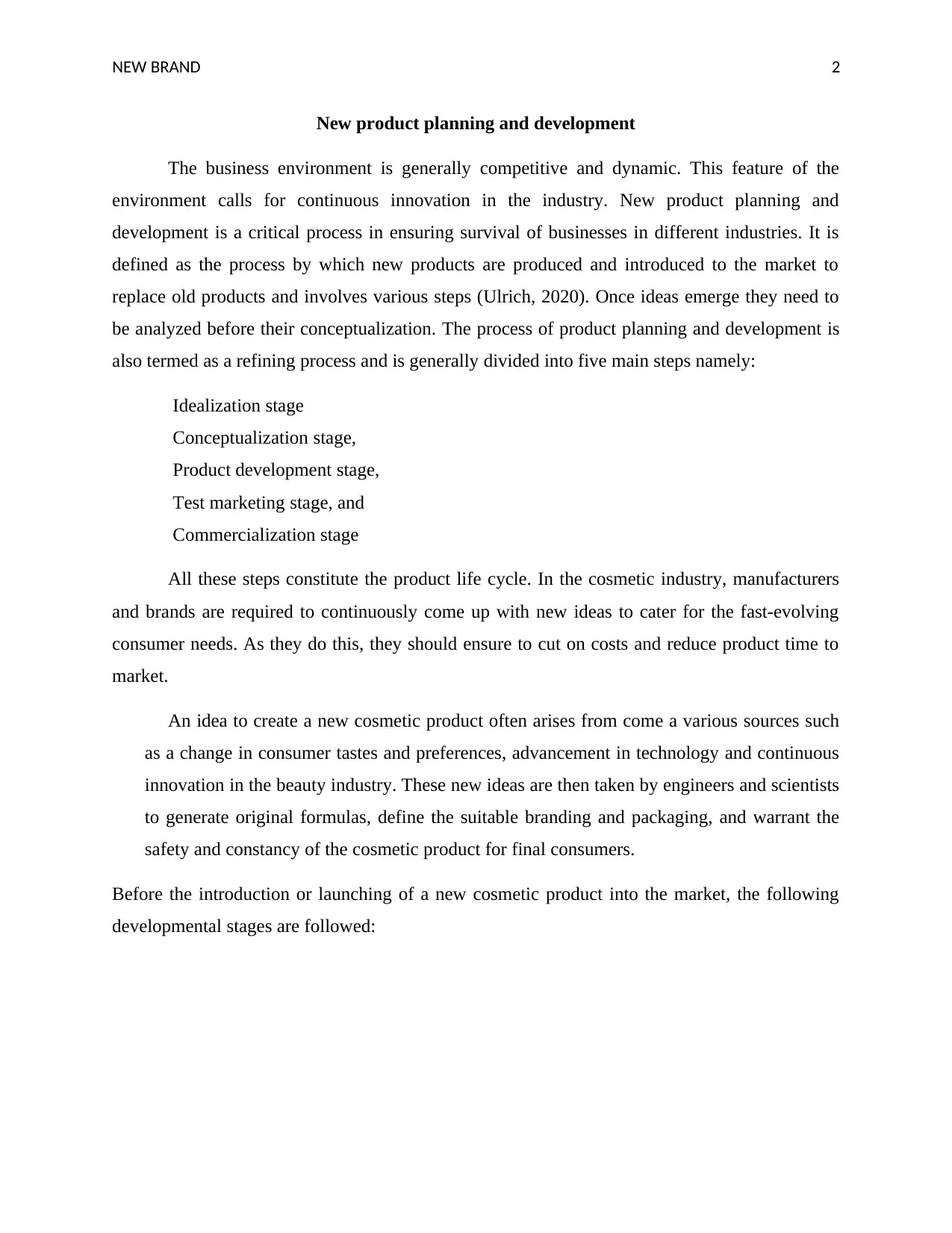
The business environment is generally competitive and dynamic. This feature of the
environment calls for continuous innovation in the industry. New product planning and
development is a critical process in ensuring survival of businesses in different industries. It is
defined as the process by which new products are produced and introduced to the market to
replace old products and involves various steps (Ulrich, 2020). Once ideas emerge they need to
be analyzed before their conceptualization. The process of product planning and development is
also termed as a refining process and is generally divided into five main steps namely:
Idealization stage
Conceptualization stage,
Product development stage,
Test marketing stage, and
Commercialization stage
All these steps constitute the product life cycle. In the cosmetic industry, manufacturers
and brands are required to continuously come up with new ideas to cater for the fast-evolving
consumer needs. As they do this, they should ensure to cut on costs and reduce product time to
market.
An idea to create a new cosmetic product often arises from come a various sources such
as a change in consumer tastes and preferences, advancement in technology and continuous
innovation in the beauty industry. These new ideas are then taken by engineers and scientists
to generate original formulas, define the suitable branding and packaging, and warrant the
safety and constancy of the cosmetic product for final consumers.
Before the introduction or launching of a new cosmetic product into the market, the following
developmental stages are followed:
New product planning and development
The business environment is generally competitive and dynamic. This feature of the
environment calls for continuous innovation in the industry. New product planning and
development is a critical process in ensuring survival of businesses in different industries. It is
defined as the process by which new products are produced and introduced to the market to
replace old products and involves various steps (Ulrich, 2020). Once ideas emerge they need to
be analyzed before their conceptualization. The process of product planning and development is
also termed as a refining process and is generally divided into five main steps namely:
Idealization stage
Conceptualization stage,
Product development stage,
Test marketing stage, and
Commercialization stage
All these steps constitute the product life cycle. In the cosmetic industry, manufacturers
and brands are required to continuously come up with new ideas to cater for the fast-evolving
consumer needs. As they do this, they should ensure to cut on costs and reduce product time to
market.
An idea to create a new cosmetic product often arises from come a various sources such
as a change in consumer tastes and preferences, advancement in technology and continuous
innovation in the beauty industry. These new ideas are then taken by engineers and scientists
to generate original formulas, define the suitable branding and packaging, and warrant the
safety and constancy of the cosmetic product for final consumers.
Before the introduction or launching of a new cosmetic product into the market, the following
developmental stages are followed:

NEW BRAND 3
Compliance of cosmetic product with regulatory requirements
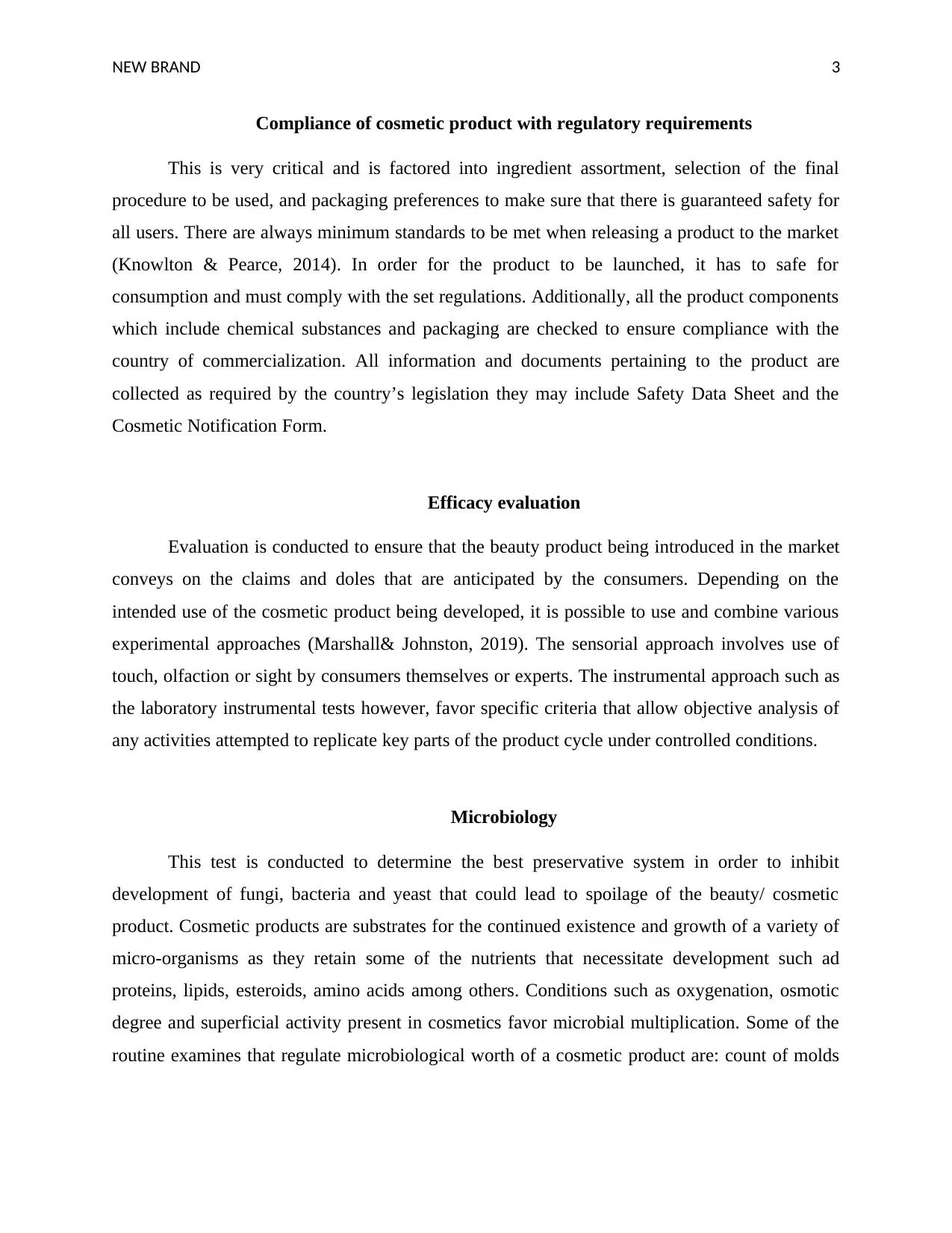
This is very critical and is factored into ingredient assortment, selection of the final
procedure to be used, and packaging preferences to make sure that there is guaranteed safety for
all users. There are always minimum standards to be met when releasing a product to the market
(Knowlton & Pearce, 2014). In order for the product to be launched, it has to safe for
consumption and must comply with the set regulations. Additionally, all the product components
which include chemical substances and packaging are checked to ensure compliance with the
country of commercialization. All information and documents pertaining to the product are
collected as required by the country’s legislation they may include Safety Data Sheet and the
Cosmetic Notification Form.
Efficacy evaluation
Evaluation is conducted to ensure that the beauty product being introduced in the market
conveys on the claims and doles that are anticipated by the consumers. Depending on the
intended use of the cosmetic product being developed, it is possible to use and combine various
experimental approaches (Marshall& Johnston, 2019). The sensorial approach involves use of
touch, olfaction or sight by consumers themselves or experts. The instrumental approach such as
the laboratory instrumental tests however, favor specific criteria that allow objective analysis of
any activities attempted to replicate key parts of the product cycle under controlled conditions.
Microbiology
This test is conducted to determine the best preservative system in order to inhibit
development of fungi, bacteria and yeast that could lead to spoilage of the beauty/ cosmetic
product. Cosmetic products are substrates for the continued existence and growth of a variety of
micro-organisms as they retain some of the nutrients that necessitate development such ad
proteins, lipids, esteroids, amino acids among others. Conditions such as oxygenation, osmotic
degree and superficial activity present in cosmetics favor microbial multiplication. Some of the
routine examines that regulate microbiological worth of a cosmetic product are: count of molds
Compliance of cosmetic product with regulatory requirements
This is very critical and is factored into ingredient assortment, selection of the final
procedure to be used, and packaging preferences to make sure that there is guaranteed safety for
all users. There are always minimum standards to be met when releasing a product to the market
(Knowlton & Pearce, 2014). In order for the product to be launched, it has to safe for
consumption and must comply with the set regulations. Additionally, all the product components
which include chemical substances and packaging are checked to ensure compliance with the
country of commercialization. All information and documents pertaining to the product are
collected as required by the country’s legislation they may include Safety Data Sheet and the
Cosmetic Notification Form.
Efficacy evaluation
Evaluation is conducted to ensure that the beauty product being introduced in the market
conveys on the claims and doles that are anticipated by the consumers. Depending on the
intended use of the cosmetic product being developed, it is possible to use and combine various
experimental approaches (Marshall& Johnston, 2019). The sensorial approach involves use of
touch, olfaction or sight by consumers themselves or experts. The instrumental approach such as
the laboratory instrumental tests however, favor specific criteria that allow objective analysis of
any activities attempted to replicate key parts of the product cycle under controlled conditions.
Microbiology
This test is conducted to determine the best preservative system in order to inhibit
development of fungi, bacteria and yeast that could lead to spoilage of the beauty/ cosmetic
product. Cosmetic products are substrates for the continued existence and growth of a variety of
micro-organisms as they retain some of the nutrients that necessitate development such ad
proteins, lipids, esteroids, amino acids among others. Conditions such as oxygenation, osmotic
degree and superficial activity present in cosmetics favor microbial multiplication. Some of the
routine examines that regulate microbiological worth of a cosmetic product are: count of molds
⊘ This is a preview!⊘
Do you want full access?
Subscribe today to unlock all pages.

Trusted by 1+ million students worldwide

NEW BRAND 4
and yeasts and count of mesospheric aerobic micro-organisms. For example face creams and
foundations are tested to check for harmful micro-organisms.
Stability evaluation
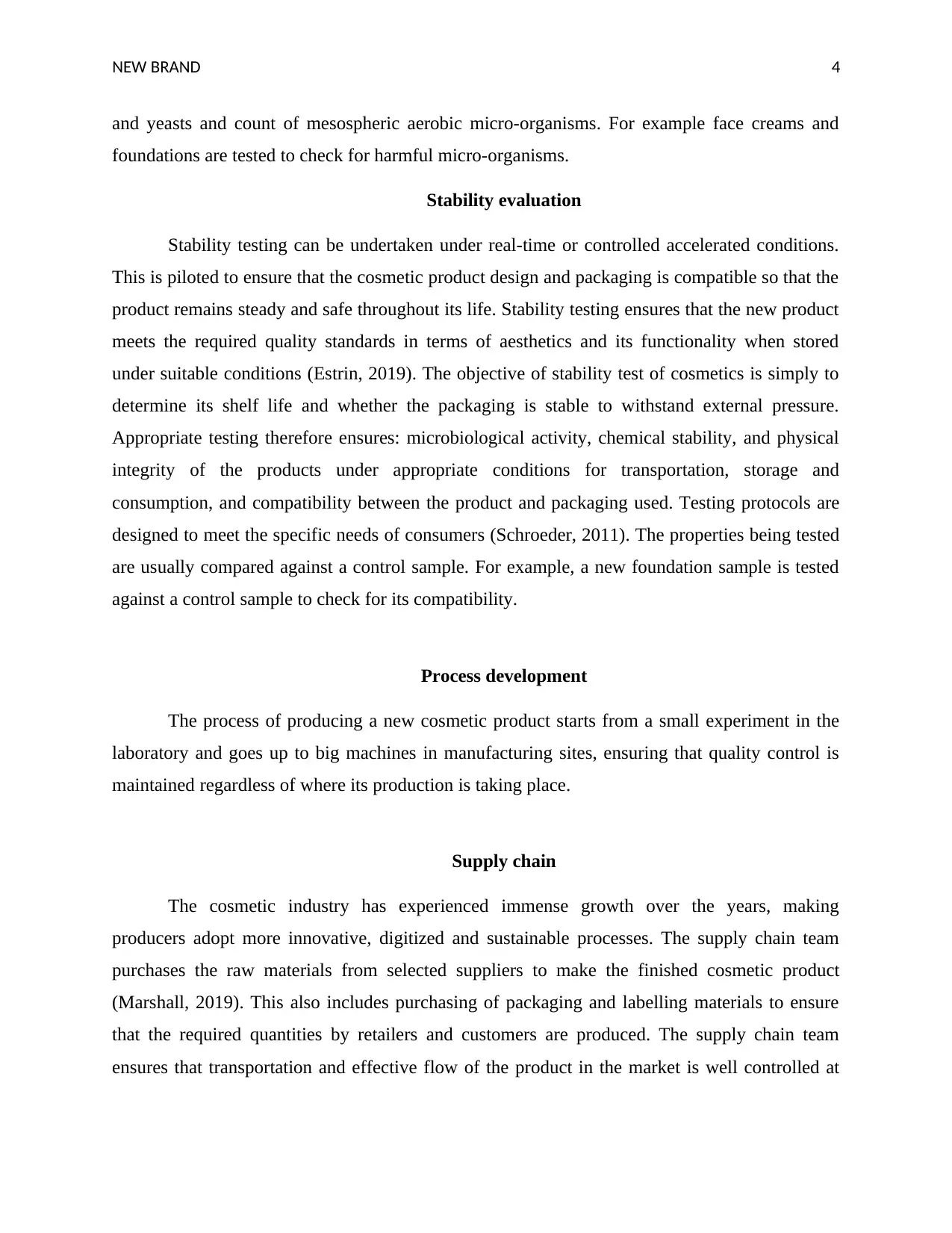
Stability testing can be undertaken under real-time or controlled accelerated conditions.
This is piloted to ensure that the cosmetic product design and packaging is compatible so that the
product remains steady and safe throughout its life. Stability testing ensures that the new product
meets the required quality standards in terms of aesthetics and its functionality when stored
under suitable conditions (Estrin, 2019). The objective of stability test of cosmetics is simply to
determine its shelf life and whether the packaging is stable to withstand external pressure.
Appropriate testing therefore ensures: microbiological activity, chemical stability, and physical
integrity of the products under appropriate conditions for transportation, storage and
consumption, and compatibility between the product and packaging used. Testing protocols are
designed to meet the specific needs of consumers (Schroeder, 2011). The properties being tested
are usually compared against a control sample. For example, a new foundation sample is tested
against a control sample to check for its compatibility.
Process development
The process of producing a new cosmetic product starts from a small experiment in the
laboratory and goes up to big machines in manufacturing sites, ensuring that quality control is
maintained regardless of where its production is taking place.
Supply chain
The cosmetic industry has experienced immense growth over the years, making
producers adopt more innovative, digitized and sustainable processes. The supply chain team
purchases the raw materials from selected suppliers to make the finished cosmetic product
(Marshall, 2019). This also includes purchasing of packaging and labelling materials to ensure
that the required quantities by retailers and customers are produced. The supply chain team
ensures that transportation and effective flow of the product in the market is well controlled at
and yeasts and count of mesospheric aerobic micro-organisms. For example face creams and
foundations are tested to check for harmful micro-organisms.
Stability evaluation
Stability testing can be undertaken under real-time or controlled accelerated conditions.
This is piloted to ensure that the cosmetic product design and packaging is compatible so that the
product remains steady and safe throughout its life. Stability testing ensures that the new product
meets the required quality standards in terms of aesthetics and its functionality when stored
under suitable conditions (Estrin, 2019). The objective of stability test of cosmetics is simply to
determine its shelf life and whether the packaging is stable to withstand external pressure.
Appropriate testing therefore ensures: microbiological activity, chemical stability, and physical
integrity of the products under appropriate conditions for transportation, storage and
consumption, and compatibility between the product and packaging used. Testing protocols are
designed to meet the specific needs of consumers (Schroeder, 2011). The properties being tested
are usually compared against a control sample. For example, a new foundation sample is tested
against a control sample to check for its compatibility.
Process development
The process of producing a new cosmetic product starts from a small experiment in the
laboratory and goes up to big machines in manufacturing sites, ensuring that quality control is
maintained regardless of where its production is taking place.
Supply chain
The cosmetic industry has experienced immense growth over the years, making
producers adopt more innovative, digitized and sustainable processes. The supply chain team
purchases the raw materials from selected suppliers to make the finished cosmetic product
(Marshall, 2019). This also includes purchasing of packaging and labelling materials to ensure
that the required quantities by retailers and customers are produced. The supply chain team
ensures that transportation and effective flow of the product in the market is well controlled at
Paraphrase This Document
Need a fresh take? Get an instant paraphrase of this document with our AI Paraphraser

NEW BRAND 5
each point in the supply chain, from manufacturing points to distribution facilities then to
retailers, to ensure that the demand is met.
each point in the supply chain, from manufacturing points to distribution facilities then to
retailers, to ensure that the demand is met.

NEW BRAND 6
References
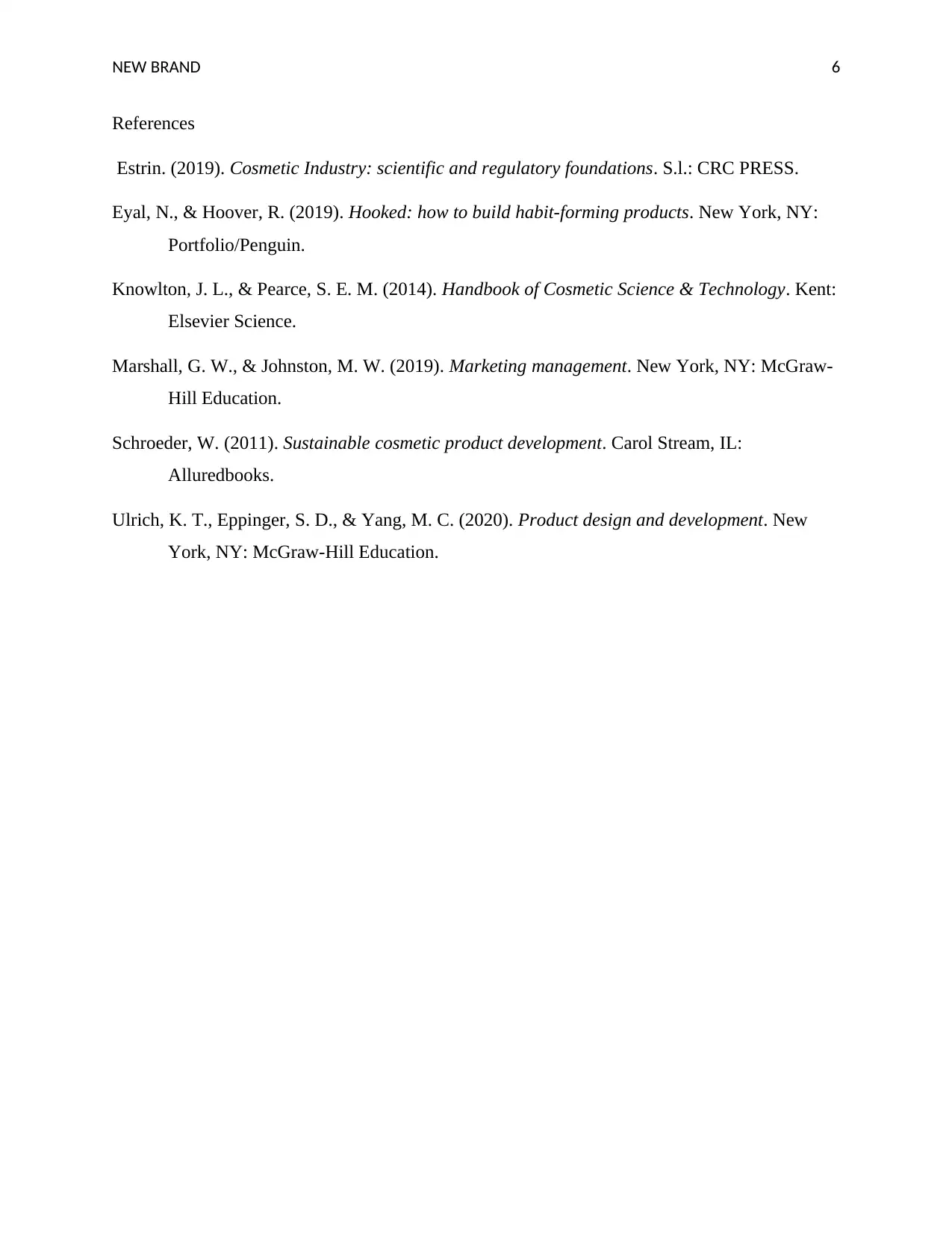
Estrin. (2019). Cosmetic Industry: scientific and regulatory foundations. S.l.: CRC PRESS.
Eyal, N., & Hoover, R. (2019). Hooked: how to build habit-forming products. New York, NY:
Portfolio/Penguin.
Knowlton, J. L., & Pearce, S. E. M. (2014). Handbook of Cosmetic Science & Technology. Kent:
Elsevier Science.
Marshall, G. W., & Johnston, M. W. (2019). Marketing management. New York, NY: McGraw-
Hill Education.
Schroeder, W. (2011). Sustainable cosmetic product development. Carol Stream, IL:
Alluredbooks.
Ulrich, K. T., Eppinger, S. D., & Yang, M. C. (2020). Product design and development. New
York, NY: McGraw-Hill Education.
References
Estrin. (2019). Cosmetic Industry: scientific and regulatory foundations. S.l.: CRC PRESS.
Eyal, N., & Hoover, R. (2019). Hooked: how to build habit-forming products. New York, NY:
Portfolio/Penguin.
Knowlton, J. L., & Pearce, S. E. M. (2014). Handbook of Cosmetic Science & Technology. Kent:
Elsevier Science.
Marshall, G. W., & Johnston, M. W. (2019). Marketing management. New York, NY: McGraw-
Hill Education.
Schroeder, W. (2011). Sustainable cosmetic product development. Carol Stream, IL:
Alluredbooks.
Ulrich, K. T., Eppinger, S. D., & Yang, M. C. (2020). Product design and development. New
York, NY: McGraw-Hill Education.
⊘ This is a preview!⊘
Do you want full access?
Subscribe today to unlock all pages.

Trusted by 1+ million students worldwide
1 out of 6
Related Documents
Your All-in-One AI-Powered Toolkit for Academic Success.
+13062052269
info@desklib.com
Available 24*7 on WhatsApp / Email
Unlock your academic potential
Copyright © 2020–2025 A2Z Services. All Rights Reserved. Developed and managed by ZUCOL.