Meal Management and Product Development: A Case Study of Fat Duck

Verified

Added on  2020/07/23

|7
|1964
|69
Report
AI Summary
This report provides a detailed analysis of meal management and product development, focusing on the Fat Duck restaurant as a case study. It explores the principles and factors of recipe development, including cooking techniques, taste, and alignment with health measures. The report assesses factors influencing menu-planning decisions, such as balance, variety, occasion, and dietary restrictions. Furthermore, it discusses various factors that influence service methods, including website development, advertising, and different food service styles like English, French, and Russian service. The report also examines the stages of menu product development planning, considering sales mix, competitor activity, and feasibility studies, and evaluates the influences of social, economic, and media factors on the development process. The conclusion summarizes the key findings, highlighting the importance of strategic planning and understanding market dynamics for successful new product development in the food industry.
Document Page
MEAL MANAGEMENT
&
PRODUCT DEVELOPMENT
tabler-icon-diamond-filled.svg

Paraphrase This Document

Need a fresh take? Get an instant paraphrase of this document with our AI Paraphraser
Document Page
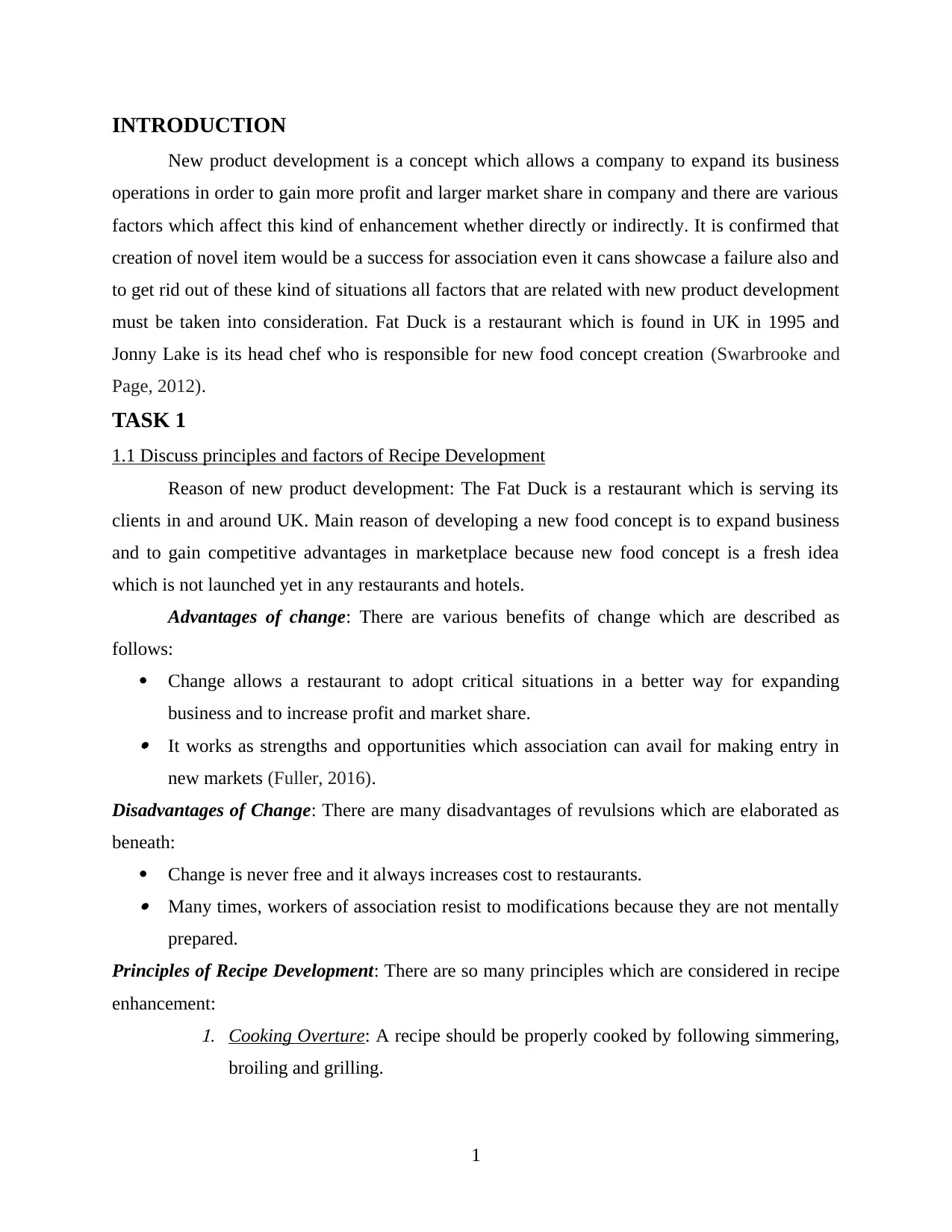
Table of Contents
INTRODUCTION...........................................................................................................................1
TASK 1............................................................................................................................................1
1.1 Discuss principles and factors of Recipe Development...................................................1
1.2 Assess factors that influence menu-planning decisions...................................................2
1.3 Discuss factors that influence service methods................................................................2
2.1 Discuss stages of menu product development planning...................................................3
2.2 Evaluate influences of different factors on development process....................................4
TASK 2............................................................................................................................................4
Covered in PPT.......................................................................................................................4
CONCLUSION................................................................................................................................4
REFERENCES................................................................................................................................5
Document Page
INTRODUCTION
New product development is a concept which allows a company to expand its business
operations in order to gain more profit and larger market share in company and there are various
factors which affect this kind of enhancement whether directly or indirectly. It is confirmed that
creation of novel item would be a success for association even it cans showcase a failure also and
to get rid out of these kind of situations all factors that are related with new product development
must be taken into consideration. Fat Duck is a restaurant which is found in UK in 1995 and
Jonny Lake is its head chef who is responsible for new food concept creation (Swarbrooke and
Page, 2012).
TASK 1
1.1 Discuss principles and factors of Recipe Development
Reason of new product development: The Fat Duck is a restaurant which is serving its
clients in and around UK. Main reason of developing a new food concept is to expand business
and to gain competitive advantages in marketplace because new food concept is a fresh idea
which is not launched yet in any restaurants and hotels.
Advantages of change: There are various benefits of change which are described as
follows:
Change allows a restaurant to adopt critical situations in a better way for expanding
business and to increase profit and market share. It works as strengths and opportunities which association can avail for making entry in
new markets (Fuller, 2016).
Disadvantages of Change: There are many disadvantages of revulsions which are elaborated as
beneath:
Change is never free and it always increases cost to restaurants. Many times, workers of association resist to modifications because they are not mentally
prepared.
Principles of Recipe Development: There are so many principles which are considered in recipe
enhancement:
1. Cooking Overture: A recipe should be properly cooked by following simmering,
broiling and grilling.
1
Document Page
2. Ascertaining Alignment: Food is for general public so all health measures should
be considered.
3. Taste and Quality: Quality should be tasted and all aspects must be checked.
4. Instauration: Creativity should be acceptable for public and potential customers.
1.2 Assess factors that influence menu-planning decisions
There are various factors that must be considered while making decisions in development
of new food concept:
Balance: Executive must pay attention on providing a well-rounded meal. While
development of new meal, there are four things that should be taken into consideration. For
instance: an entrȅe, side dish, vegetables and desserts. These are some points which have strong
place in decision making procedure (Carpenter, Lyon and Hasdell, 2012).
Variety: Before planning development of new food concept, executive chef must consider
that his new meal should provide various varieties to their clients. Food should be appealing to
clients and public.
Occasions: Sometimes, new meal should belong to specific occasions. Elegance of event
should be matched with elegance of menu. Consideration of this aspect is necessary for being
more specific and specialised.
Dietary Restrictions: While planning a new meal, then all dietary factors must be added
in new food concept which should be healthy for every kind of consumer. All dietary points
should be added because if these particals are not added, then it could be a problem for Fat Duck
Restaurant.
1.3 Discuss factors that influence service methods
Factors to create business image: There are various aspects which are used in building a
prominent portrait of business and these are stated as beneath:
Building a Terrific Website: Creation of new website is the best method of reaching to
large number of customer because in whole world, approximately more than half people are
using internet on wide scale (Filieri, 2013).
Create a persuasive as campaign: Main focus of advertisement is consumers and concept
of concet building should be clearly visible for everyone.
Use press to tell your story: Fat Duck Restaurant can ask and allow media to display and
tell their story in front of public.
2
tabler-icon-diamond-filled.svg

Paraphrase This Document

Need a fresh take? Get an instant paraphrase of this document with our AI Paraphraser
Document Page
Methods of serving food: There are various modes of serving food to customers
(Viswanathan and Sridharan, 2012). These methods are described below:
English Service: It includes two kinds which are stated as follows: Silver: Empty dishes are put on right side of table by waiter and he displays platter with
food to left side of host. Queridon: Meal is presented into portions at platters and taken to clients in queridon
trolleys and then waiter puts all food from trolley to table, immediately.
Advantages of this method: Customers are served quickly and on the other hand, display of food
on platter is fine.
Disadvantages: This facility needs specialised people for food serving which is hard to find.
French Service: It is a traditional method of service which is done for honourable people
of France.
Advantages: There are many food to serve and portions of varieties are not decided prior.
Disadvantages: It is applicable in rich meals which are not in range of every people.
Russian Service: Main feature of this facility is that all food is prepared together which
are served in platter (Morris and Morris, 2012).
Advantages: This service is a display of chef's skills and virtue and food is decorated well.
Disadvantages: This service needs talented waiters and chefs who can showcase their
specialisation.
2.1 Discuss stages of menu product development planning
There are various factors which leaves impact on decision of menu planning and are
discussed as beneath:
Sales Mix: It means variety of products and their ratio to sales. This factor is having large
impact on new product development like which kind of concept is developing should have a
reasonable sales volume otherwise, it would not be a success for Fat Duck Restaurant.
Competitor Activity: It should be identified by executive chef that if rivals are not
planning to develop a new food concept and if business enemies are doing so then concept of Fat
Duck restaurant should be changed positively for making specialised competitive advantages
(Wang and et. al., 2013).
Feasibility Study: This is an analysis of profit and loss and it provides a clear vision that
food concept should be launched or not. Feasibility study of new food concept must be done for
3
Document Page
gaining an idea about how much profit this concept will give or it would be sale on break even
point.
2.2 Evaluate influences of different factors on development process
Factors that influence the development process are discussed below:
Social: This aspect talks about nature of societies and their taste and preferences and if
these are not checked before developing a process, then it will generate a loss for association. For
instance, if more than half population used to eat vegetarian food and new concept belongs to
non-vegetarian foods, then it will be a failure of idea and all aspects should be taken into
consideration of executive chef (Prahalad, 2012).
Economic: In this section, if public is having demand of variety of food, then new
concept is fruitful otherwise not. Economical factor comprises demands and per capita income
which allow a customer to make purchases of variety of food products if these items are high in
prices.
Domestic: Executive chef must recognise that for whom restaurant is developing a new
food concept whether international or domestic customers The Fat Duck is going to serve.
Influences of Media: As discussed above, company can choose media to tell their story in public
so that all people could get aware about facilities and products. Media is a very useful tool for
promotion.
Importance of Staff Member's Skills: As it is mentioned above that there are various food serving
services which needs qualified and talented staff who are able in serving different kind of
services like English, French, Russian etc. (Pitta and Pitta, 2012).
TASK 2
Covered in PPT.
CONCLUSION
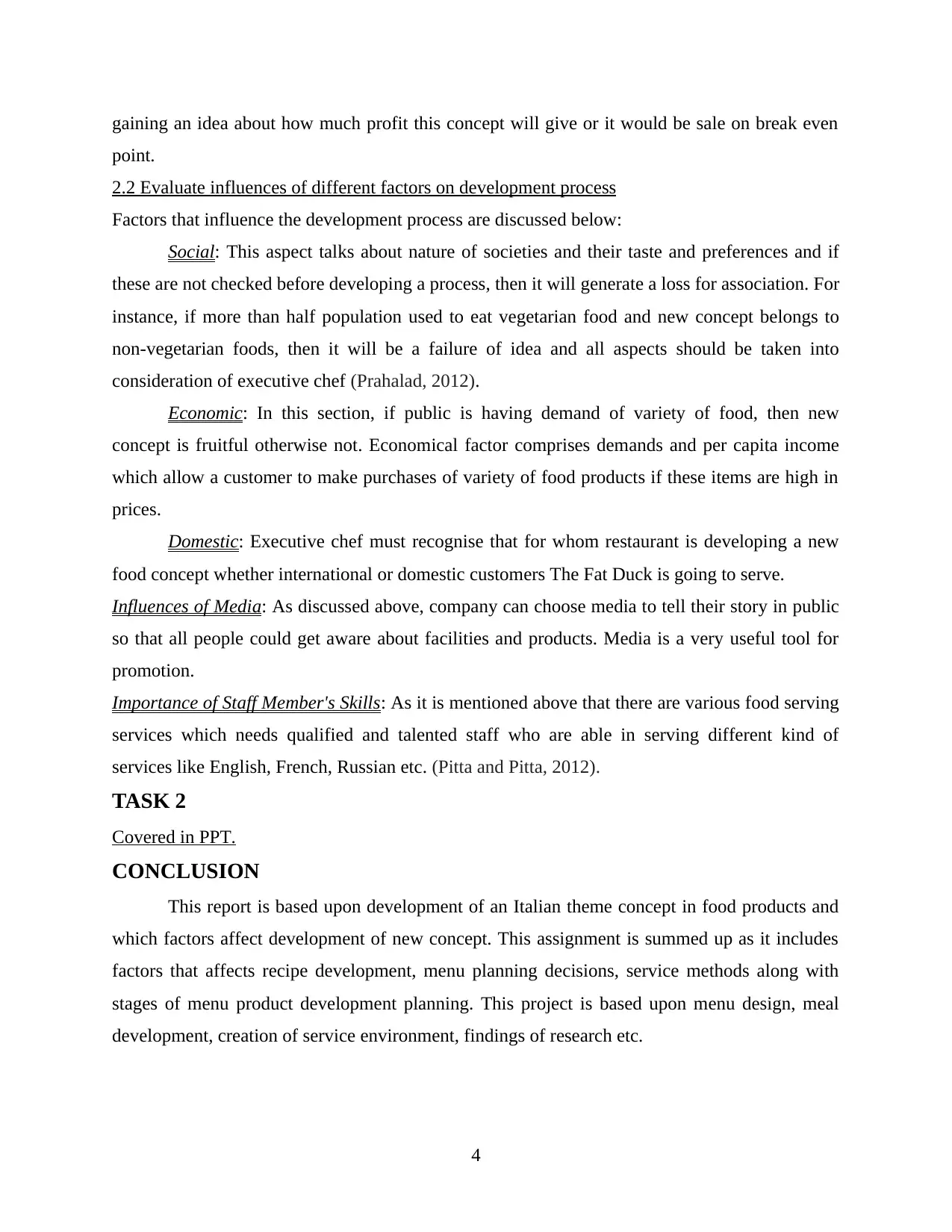
This report is based upon development of an Italian theme concept in food products and
which factors affect development of new concept. This assignment is summed up as it includes
factors that affects recipe development, menu planning decisions, service methods along with
stages of menu product development planning. This project is based upon menu design, meal
development, creation of service environment, findings of research etc.
4
Document Page
REFERENCES
Books & Journals
Carpenter, R. P., Lyon, D.H. and Hasdell, T.A., 2012. Guidelines for sensory analysis in food
product development and quality control. Springer Science & Business Media.
Filieri, R., 2013. Consumer co-creation and new product development: a case study in the food
industry. Marketing Intelligence & Planning. 31(1). pp.40-53.
Fuller, G. W., 2016. New food product development: from concept to marketplace. CRC Press.
Harrington, R. J. and Ottenbacher, M. C., 2013. Managing the culinary innovation process: The
case of new product development. Journal of culinary science & technology. 11(1).
pp.4-18.
Morris, C. and Morris, G. A., 2012. The effect of inulin and fructo-oligosaccharide
supplementation on the textural, rheological and sensory properties of bread and their
role in weight management: a review. Food chemistry. 133(2). pp.237-248.
Pitta, D. and Pitta, E., 2012. Transforming the nature and scope of new product
development. Journal of Product & Brand Management. 21(1). pp.35-46.
Prahalad, C. K., 2012. Bottom of the Pyramid as a Source of Breakthrough Innovations. Journal
of Product Innovation Management. 29(1). pp.6-12.
Stolzenbach, S., Bredie, W. L. and Byrne, D. V., 2013. Consumer concepts in new product
development of local foods: Traditional versus novel honeys. Food Research
International. 52(1). pp.144-152.
Swarbrooke, J. and Page, S. J., 2012. Development and management of visitor attractions.
Routledge.
Viswanathan, M. and Sridharan, S., 2012. Product development for the BoP: Insights on concept
and prototype development from university‐based student projects in India. Journal of
Product Innovation Management. 29(1). pp.52-69.
Wang, Y. F. and et. al., 2013. Developing green management standards for restaurants: An
application of green supply chain management. International Journal of Hospitality
Management. 34. pp.263-273.
5
chevron_up_icon
1 out of 7
circle_padding
hide_on_mobile
zoom_out_icon
[object Object]