The Impact of Health and Social Care Services on Learning Disabilities
VerifiedAdded on 2020/01/28
|10
|2711
|37
Report
AI Summary
This report delves into the health and social care services available for individuals with learning disabilities, emphasizing the crucial role of nurses and the evolution of healthcare policies. It highlights the necessity of individualized care, the ongoing efforts to combat discrimination, and the importance of fostering an inclusive environment. The report examines the barriers to inclusion, including social, communication, and attitudinal challenges, while also exploring the policies and amendments, like those to the Mental Health Act of 1983, that aim to improve care. It underscores the significance of health promotion, encompassing disease prevention, health education, and community development, as vital components in enhancing the quality of life for individuals with learning disabilities. The report also discusses the role of learning disability nurses in facilitating access to services and supporting both patients and their families. The report concludes by emphasizing the ongoing transformation in healthcare systems to provide specialized, responsive, and comprehensive support.
Professional Aspect of Care
Module
Module

Paraphrase This Document
Need a fresh take? Get an instant paraphrase of this document with our AI Paraphraser
Table of Contents
INTRODUCTION...........................................................................................................................3
HEALTH AND SOCIAL SERVICES FOR PEOPLE WITH LEARNING DISABILITY............3
BARRIERS TO INCLUSION AND HEALTH PROMOTION......................................................4
ACCESS TO THE SERVICES BY LEARNING DISABLITIES INDIVIDUAL.........................6
POLICIES AND DRIVERS............................................................................................................7
CONCLUSION................................................................................................................................8
REFERENCES................................................................................................................................9
INTRODUCTION...........................................................................................................................3
HEALTH AND SOCIAL SERVICES FOR PEOPLE WITH LEARNING DISABILITY............3
BARRIERS TO INCLUSION AND HEALTH PROMOTION......................................................4
ACCESS TO THE SERVICES BY LEARNING DISABLITIES INDIVIDUAL.........................6
POLICIES AND DRIVERS............................................................................................................7
CONCLUSION................................................................................................................................8
REFERENCES................................................................................................................................9
INTRODUCTION
Some people requires extra care and emotional support to lead a normal life just like
everyone else. The health care and social services are required to help the people with special
need to live a active life and do things which many of take for granted (Hale and Dumont, 2010).
Government is working on providing a social care system that provides care to all those who need
it. This will help people in living and independent life with dignity. This research is done to
understand the impact of health and social care services for the people who are suffering from
learning disability, also how well the nursing staff is supporting them. This report has also
considered the barriers which exist in the way of inclusion of health and social care services.
Different policies regarding the treatment of learning disability individual are also considered. It
is very challenging task for the learning disability nurse in taking care of the individuals with
learning disabilities also they play a very essential role in health promotion.
HEALTH AND SOCIAL SERVICES FOR PEOPLE WITH LEARNING
DISABILITY
After the reports about some incidents revealed that there have been issues of
mistreatment of people with learning disability. The national health care services have decided to
change the whole system, so as to counter every case of learning disability individual according
to the need of the individual. The national health services has formulated a plan to transform the
whole health and social care system after the parliament made amendments to the mental health
act 1983 in 2015. The new system provides a platform for every local area across England to
formulate their own plan according to the needs of the area and individual (Geary, 2013). Each
area is different and every area need different type of services and to enhance services, it is
necessary.. Broadly, this transformation in system will make services better, increase the number
of staff and beds, also it will strengthen support in the community for the people and the health
care services Each area commissioner has to identify different requirements as well as their range
of providers have different strengths and weakness (Brault, 2012). Therefore each area will have
to develop their own model to make the services future ready.
However, there are the services which will have national consistency according to the best
practices. It is being done to enhance the services provided. National health services is aiming to
make the services beneficial for all the people involved, like the patient, his/her family, staff and
Some people requires extra care and emotional support to lead a normal life just like
everyone else. The health care and social services are required to help the people with special
need to live a active life and do things which many of take for granted (Hale and Dumont, 2010).
Government is working on providing a social care system that provides care to all those who need
it. This will help people in living and independent life with dignity. This research is done to
understand the impact of health and social care services for the people who are suffering from
learning disability, also how well the nursing staff is supporting them. This report has also
considered the barriers which exist in the way of inclusion of health and social care services.
Different policies regarding the treatment of learning disability individual are also considered. It
is very challenging task for the learning disability nurse in taking care of the individuals with
learning disabilities also they play a very essential role in health promotion.
HEALTH AND SOCIAL SERVICES FOR PEOPLE WITH LEARNING
DISABILITY
After the reports about some incidents revealed that there have been issues of
mistreatment of people with learning disability. The national health care services have decided to
change the whole system, so as to counter every case of learning disability individual according
to the need of the individual. The national health services has formulated a plan to transform the
whole health and social care system after the parliament made amendments to the mental health
act 1983 in 2015. The new system provides a platform for every local area across England to
formulate their own plan according to the needs of the area and individual (Geary, 2013). Each
area is different and every area need different type of services and to enhance services, it is
necessary.. Broadly, this transformation in system will make services better, increase the number
of staff and beds, also it will strengthen support in the community for the people and the health
care services Each area commissioner has to identify different requirements as well as their range
of providers have different strengths and weakness (Brault, 2012). Therefore each area will have
to develop their own model to make the services future ready.
However, there are the services which will have national consistency according to the best
practices. It is being done to enhance the services provided. National health services is aiming to
make the services beneficial for all the people involved, like the patient, his/her family, staff and
⊘ This is a preview!⊘
Do you want full access?
Subscribe today to unlock all pages.

Trusted by 1+ million students worldwide
all other supporters. There are different program being run by the national health services to help
the individual, like-
Supporting people living with the family or accommodation
Their education, work and day opportunities
Providing access to all other health care services.
Enhancing the specialisation of the providers.
It is a very challenging task to treat the people with learning disabilities, it requires better
staff which includes specialist doctors, nurses and the supporting staff (Emerson and Baines,
2011). National Health services is trying to bring in as much facilities to the staff, so they can
treat people with no problems and stress.
Learning disability nurse provides people with the learning disability help and care. They
require specialised skills to treat people according to their needs. They are the main member in
enhancing the program quality. While helping the people with learning disability to lead an active
life, these nurses also provide support to their family (Büttner and Hasselhorn, 2011). These
nurses also have health promotion role as to make the society aware and more responsible
towards the individuals with learning disabilities. These nurses need to have following skills with
their specialised knowledge:
they should have strong communication skills
Nurses need to be emotionally strong to support the individual and their families
This job requires total commitment from them
They need to be creative, adaptable, and flexible, also always be ready to prevent
discrimination.
BARRIERS TO INCLUSION AND HEALTH PROMOTION
There are many barriers in inclusion of the people with learning disabilities in society as
well as in health and social care. Individual with learning disabilities requires an environment
which do not discriminates in any way. They need special treatment and support in living an
active independent life with dignity. This is a challenge for the health care services and society.
With the change in the service proving system, the government is trying to bring in the required
attention and support to the individuals with learning disabilities (McLeskey and Waldron,
2011). The environment which do not allow and care for the individual with learning disability
the individual, like-
Supporting people living with the family or accommodation
Their education, work and day opportunities
Providing access to all other health care services.
Enhancing the specialisation of the providers.
It is a very challenging task to treat the people with learning disabilities, it requires better
staff which includes specialist doctors, nurses and the supporting staff (Emerson and Baines,
2011). National Health services is trying to bring in as much facilities to the staff, so they can
treat people with no problems and stress.
Learning disability nurse provides people with the learning disability help and care. They
require specialised skills to treat people according to their needs. They are the main member in
enhancing the program quality. While helping the people with learning disability to lead an active
life, these nurses also provide support to their family (Büttner and Hasselhorn, 2011). These
nurses also have health promotion role as to make the society aware and more responsible
towards the individuals with learning disabilities. These nurses need to have following skills with
their specialised knowledge:
they should have strong communication skills
Nurses need to be emotionally strong to support the individual and their families
This job requires total commitment from them
They need to be creative, adaptable, and flexible, also always be ready to prevent
discrimination.
BARRIERS TO INCLUSION AND HEALTH PROMOTION
There are many barriers in inclusion of the people with learning disabilities in society as
well as in health and social care. Individual with learning disabilities requires an environment
which do not discriminates in any way. They need special treatment and support in living an
active independent life with dignity. This is a challenge for the health care services and society.
With the change in the service proving system, the government is trying to bring in the required
attention and support to the individuals with learning disabilities (McLeskey and Waldron,
2011). The environment which do not allow and care for the individual with learning disability
Paraphrase This Document
Need a fresh take? Get an instant paraphrase of this document with our AI Paraphraser
enhances the chances of challenging behaviour from the individual which results in distressful
situations.
Often there are many barriers which makes the situation impossible for the person with
learning disabilities to function. Following are some of the barriers:
Social barriers: The barriers which exist due to the social mechanism. People with
learning disability are less likely to be employed (Klassen, 2010). They have to bear
social discrimination. The health and social services also are not fully functional
according to the needs of the person in specific area.
Communication barriers: these barriers are faced by people who have learning
disabilities as they are not able to understand what other person is trying say.
Physical barriers: When people with disabilities develop an unfavourable behaviour it
becomes challenging to move them from one place to another.
Programme barriers: These barriers exist when the program developed for the people
with disabilities fails to deliver the required results. Reason can be inconvenient
scheduling, lack of accessible equipment, insufficient medical treatment.
Attitude Barriers: The attitude problem in society and the services lead to these
problems (Johnson and Swanson, 2010). As people sometimes stereotype the individuals
with disabilities or they are discriminated on the basis of their disability.
Policy and Procedural Barriers: Barriers occur when people with disabilities are not
aware about the laws and regulations for the program developed to treat them or they are
denied to participate in programs which are federally run for their betterment.
Transportation barriers: These barriers exist because of lack of transport for the
disabled person. This makes them to be dependent on other people.
To cope up with all these problems, there is a system being developed. All the supporting
factors are being strengthen. Specially the learning disability nurse who play a major role in the
identification and treatment of individual with learning disability. These nurses are responsible
for the identification of all the problems a patient have and also for the health inclusion and
promotion (Cortiella and Horowitz, 2014). Nurse works for social awareness and developing
strong community support for the learning disability individual. These nurses are also being
tasked to promote health promotion which refers to the group of activities which help in
situations.
Often there are many barriers which makes the situation impossible for the person with
learning disabilities to function. Following are some of the barriers:
Social barriers: The barriers which exist due to the social mechanism. People with
learning disability are less likely to be employed (Klassen, 2010). They have to bear
social discrimination. The health and social services also are not fully functional
according to the needs of the person in specific area.
Communication barriers: these barriers are faced by people who have learning
disabilities as they are not able to understand what other person is trying say.
Physical barriers: When people with disabilities develop an unfavourable behaviour it
becomes challenging to move them from one place to another.
Programme barriers: These barriers exist when the program developed for the people
with disabilities fails to deliver the required results. Reason can be inconvenient
scheduling, lack of accessible equipment, insufficient medical treatment.
Attitude Barriers: The attitude problem in society and the services lead to these
problems (Johnson and Swanson, 2010). As people sometimes stereotype the individuals
with disabilities or they are discriminated on the basis of their disability.
Policy and Procedural Barriers: Barriers occur when people with disabilities are not
aware about the laws and regulations for the program developed to treat them or they are
denied to participate in programs which are federally run for their betterment.
Transportation barriers: These barriers exist because of lack of transport for the
disabled person. This makes them to be dependent on other people.
To cope up with all these problems, there is a system being developed. All the supporting
factors are being strengthen. Specially the learning disability nurse who play a major role in the
identification and treatment of individual with learning disability. These nurses are responsible
for the identification of all the problems a patient have and also for the health inclusion and
promotion (Cortiella and Horowitz, 2014). Nurse works for social awareness and developing
strong community support for the learning disability individual. These nurses are also being
tasked to promote health promotion which refers to the group of activities which help in
preventing disease and improving well-being. Basically the nurses need to conceptualise the idea
about the health promotion on the basis of four elements:
Disease prevention: Identification of any problem a person or a community is having and
reducing the disease with all available resources.
Health education and health information: making the society aware about the problem,
symptoms and ways to treat them right is part of educating people about the possible
healthcare issue (Lerner and Johns, 2011). When nurses provide all the information to the
patients and the community through various government programs they are reducing the
chances of any spread of disease.
Public health promotion: In today scenario it is very important to maintain public health
by promoting social and environmental measures, policy development and equal
distribution of resources.
Community development: These are the activities which engage the community directly
into health services(Mastropieri and Scruggs, 2012). This way nurses promote skill
development and allow communities in taking active participation in providing quality
health services to all without discrimination.
ACCESS TO THE SERVICES BY LEARNING DISABLITIES INDIVIDUAL
The learning disabilities nurses play an essential role in providing easy access to the
health care services to learning disabilities individual. There are many cases when due to the
health promotion done by the learning disability nurse helped a person with learning disability.
Individuals with learning disability have many issues in accessing the health and social services
provided by the government. It is the task of the nurses to identify people with the issue and help
and support them in accessing the services easily. Learning disability nurses are responsible for
health promotion which aims in identification, treatment and supporting the patients with
learning disability (Miller and Faucett, 2010). There are various health promotions being done by
government, to make people aware about the issue and help them in getting a better treatment.
National health Services run many program to enhance its reach to the learning disabled
individual, it is the nurses who are used in promoting these programs in the hospitals as well as in
the communities. The learning disabilities nurses provide individualistic approach to all the
patients so as to make them feel much better. They re also responsible for making better policies
and when to change the path of treatment of the individual. These learning disabilities nurses also
about the health promotion on the basis of four elements:
Disease prevention: Identification of any problem a person or a community is having and
reducing the disease with all available resources.
Health education and health information: making the society aware about the problem,
symptoms and ways to treat them right is part of educating people about the possible
healthcare issue (Lerner and Johns, 2011). When nurses provide all the information to the
patients and the community through various government programs they are reducing the
chances of any spread of disease.
Public health promotion: In today scenario it is very important to maintain public health
by promoting social and environmental measures, policy development and equal
distribution of resources.
Community development: These are the activities which engage the community directly
into health services(Mastropieri and Scruggs, 2012). This way nurses promote skill
development and allow communities in taking active participation in providing quality
health services to all without discrimination.
ACCESS TO THE SERVICES BY LEARNING DISABLITIES INDIVIDUAL
The learning disabilities nurses play an essential role in providing easy access to the
health care services to learning disabilities individual. There are many cases when due to the
health promotion done by the learning disability nurse helped a person with learning disability.
Individuals with learning disability have many issues in accessing the health and social services
provided by the government. It is the task of the nurses to identify people with the issue and help
and support them in accessing the services easily. Learning disability nurses are responsible for
health promotion which aims in identification, treatment and supporting the patients with
learning disability (Miller and Faucett, 2010). There are various health promotions being done by
government, to make people aware about the issue and help them in getting a better treatment.
National health Services run many program to enhance its reach to the learning disabled
individual, it is the nurses who are used in promoting these programs in the hospitals as well as in
the communities. The learning disabilities nurses provide individualistic approach to all the
patients so as to make them feel much better. They re also responsible for making better policies
and when to change the path of treatment of the individual. These learning disabilities nurses also
⊘ This is a preview!⊘
Do you want full access?
Subscribe today to unlock all pages.
Trusted by 1+ million students worldwide
provide support to the families of the individuals with learning disabilities. They are the one who
is responsible to bring down the barriers in the society and health care which discriminates
against the individuals with learning disabilities (Kagohara and Green, 2013). They use different
techniques in the promotion of healthcare. They act as an supporter to the learning disabilities
person which make them to trust the learning disabilities nurses. They help them in education,
work as well as in their daily life until they get ready to live independently.
Case- Smith is a patient of learning disabilities. He have a mild learning problem. He had
a small accident which caused swelling on his shoulder, which was identified by the learning
disability nurse and she took him to hospital for treatment.
POLICIES AND DRIVERS
There have been so many changes in the policies and acts to provide quality services to
the people with disabilities, like- Amendments in Mental Health Act 1983. these amendments are
made to enable the law to help the learning disabilities person get best medical and social
treatment and protect them against any discrimination. It also recommends to develop an
environment which is favourable for the individual with learning disabilities (Adam and Epstein,
2010). As favourable environment makes them in growing and being independent, confident and
let them live a life of dignity. The amendments also bough several sections to punish the offender
on the basis of their crime. The National Health Services with local governments is in process of
developing the infrastructure to tackle every individual case of learning disability according to
the need. They are on the way of developing best services according to the area and also making
a consistent national criteria of treating people in emergency to provide best service. This
transformation is going to change the whole scenario as the commissions of a area will be able to
formulate the range of services according to the need of area and individuals with learning
disabilities (Büttner and Hasselhorn, 2011). The drivers of services are the specialised doctors,
the learning disabilities nurses, the supporting staff, government and the community. When
everyone tries to create a favourable environment for the individuals, the disease will be rectified,
even though they will not be cured but they will be accepted without any discrimination.
CONCLUSION
The main aim behind the transformation of services is to enable the responders, hospitals,
community to provide a favourable and high level of healthcare. The National health Services
is responsible to bring down the barriers in the society and health care which discriminates
against the individuals with learning disabilities (Kagohara and Green, 2013). They use different
techniques in the promotion of healthcare. They act as an supporter to the learning disabilities
person which make them to trust the learning disabilities nurses. They help them in education,
work as well as in their daily life until they get ready to live independently.
Case- Smith is a patient of learning disabilities. He have a mild learning problem. He had
a small accident which caused swelling on his shoulder, which was identified by the learning
disability nurse and she took him to hospital for treatment.
POLICIES AND DRIVERS
There have been so many changes in the policies and acts to provide quality services to
the people with disabilities, like- Amendments in Mental Health Act 1983. these amendments are
made to enable the law to help the learning disabilities person get best medical and social
treatment and protect them against any discrimination. It also recommends to develop an
environment which is favourable for the individual with learning disabilities (Adam and Epstein,
2010). As favourable environment makes them in growing and being independent, confident and
let them live a life of dignity. The amendments also bough several sections to punish the offender
on the basis of their crime. The National Health Services with local governments is in process of
developing the infrastructure to tackle every individual case of learning disability according to
the need. They are on the way of developing best services according to the area and also making
a consistent national criteria of treating people in emergency to provide best service. This
transformation is going to change the whole scenario as the commissions of a area will be able to
formulate the range of services according to the need of area and individuals with learning
disabilities (Büttner and Hasselhorn, 2011). The drivers of services are the specialised doctors,
the learning disabilities nurses, the supporting staff, government and the community. When
everyone tries to create a favourable environment for the individuals, the disease will be rectified,
even though they will not be cured but they will be accepted without any discrimination.
CONCLUSION
The main aim behind the transformation of services is to enable the responders, hospitals,
community to provide a favourable and high level of healthcare. The National health Services
Paraphrase This Document
Need a fresh take? Get an instant paraphrase of this document with our AI Paraphraser
and the local authorities are trying to make the services as individualistic as possible so they can
provide the services which are needed by them. This will help them in understanding each case in
much better way and also help in making the health programme according to the need. Time is
moving forward and there is dire need to formulate new concepts and theories which focuses on
the person according to their need.
REFERENCES
Books and Journals
provide the services which are needed by them. This will help them in understanding each case in
much better way and also help in making the health programme according to the need. Time is
moving forward and there is dire need to formulate new concepts and theories which focuses on
the person according to their need.
REFERENCES
Books and Journals
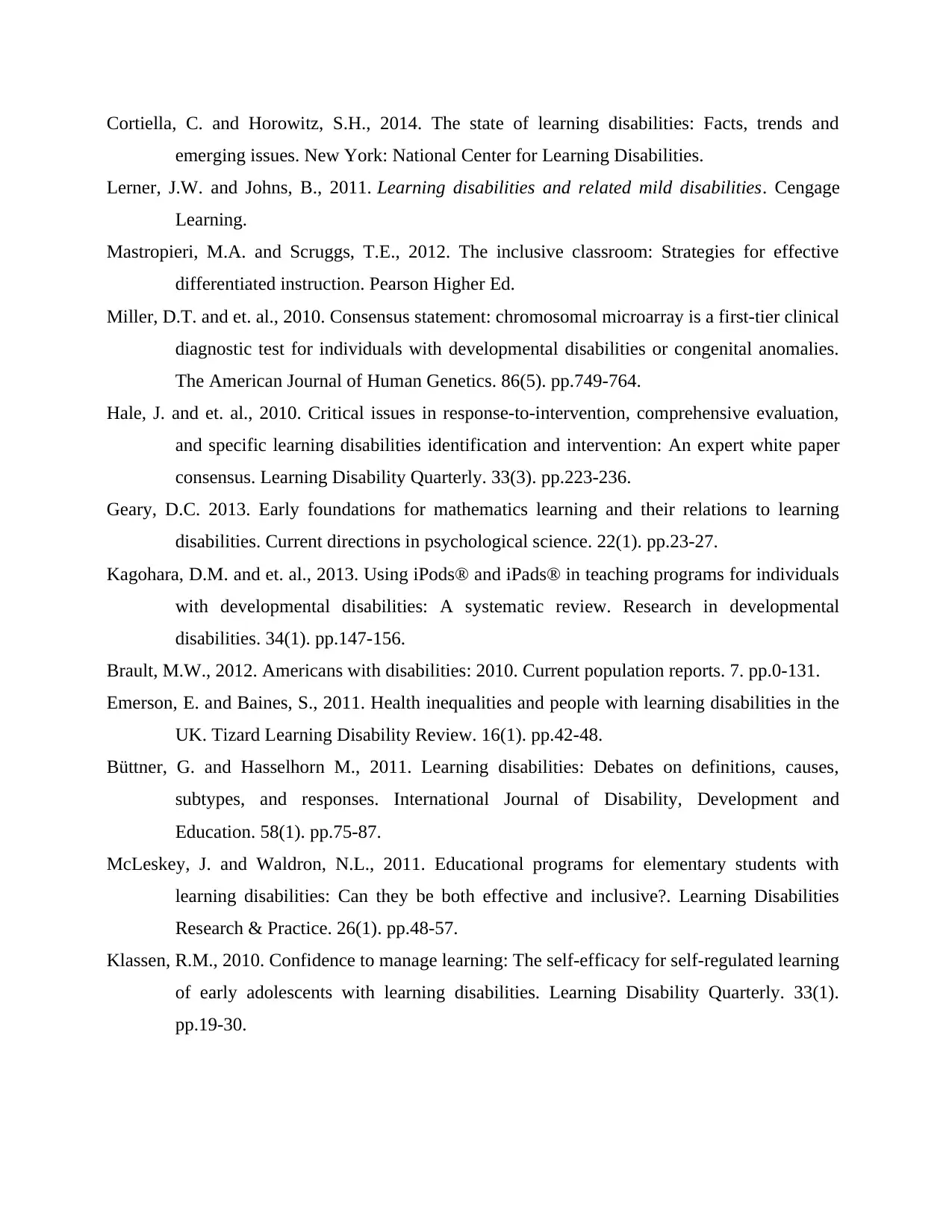
Cortiella, C. and Horowitz, S.H., 2014. The state of learning disabilities: Facts, trends and
emerging issues. New York: National Center for Learning Disabilities.
Lerner, J.W. and Johns, B., 2011. Learning disabilities and related mild disabilities. Cengage
Learning.
Mastropieri, M.A. and Scruggs, T.E., 2012. The inclusive classroom: Strategies for effective
differentiated instruction. Pearson Higher Ed.
Miller, D.T. and et. al., 2010. Consensus statement: chromosomal microarray is a first-tier clinical
diagnostic test for individuals with developmental disabilities or congenital anomalies.
The American Journal of Human Genetics. 86(5). pp.749-764.
Hale, J. and et. al., 2010. Critical issues in response-to-intervention, comprehensive evaluation,
and specific learning disabilities identification and intervention: An expert white paper
consensus. Learning Disability Quarterly. 33(3). pp.223-236.
Geary, D.C. 2013. Early foundations for mathematics learning and their relations to learning
disabilities. Current directions in psychological science. 22(1). pp.23-27.
Kagohara, D.M. and et. al., 2013. Using iPods® and iPads® in teaching programs for individuals
with developmental disabilities: A systematic review. Research in developmental
disabilities. 34(1). pp.147-156.
Brault, M.W., 2012. Americans with disabilities: 2010. Current population reports. 7. pp.0-131.
Emerson, E. and Baines, S., 2011. Health inequalities and people with learning disabilities in the
UK. Tizard Learning Disability Review. 16(1). pp.42-48.
Büttner, G. and Hasselhorn M., 2011. Learning disabilities: Debates on definitions, causes,
subtypes, and responses. International Journal of Disability, Development and
Education. 58(1). pp.75-87.
McLeskey, J. and Waldron, N.L., 2011. Educational programs for elementary students with
learning disabilities: Can they be both effective and inclusive?. Learning Disabilities
Research & Practice. 26(1). pp.48-57.
Klassen, R.M., 2010. Confidence to manage learning: The self-efficacy for self-regulated learning
of early adolescents with learning disabilities. Learning Disability Quarterly. 33(1).
pp.19-30.
emerging issues. New York: National Center for Learning Disabilities.
Lerner, J.W. and Johns, B., 2011. Learning disabilities and related mild disabilities. Cengage
Learning.
Mastropieri, M.A. and Scruggs, T.E., 2012. The inclusive classroom: Strategies for effective
differentiated instruction. Pearson Higher Ed.
Miller, D.T. and et. al., 2010. Consensus statement: chromosomal microarray is a first-tier clinical
diagnostic test for individuals with developmental disabilities or congenital anomalies.
The American Journal of Human Genetics. 86(5). pp.749-764.
Hale, J. and et. al., 2010. Critical issues in response-to-intervention, comprehensive evaluation,
and specific learning disabilities identification and intervention: An expert white paper
consensus. Learning Disability Quarterly. 33(3). pp.223-236.
Geary, D.C. 2013. Early foundations for mathematics learning and their relations to learning
disabilities. Current directions in psychological science. 22(1). pp.23-27.
Kagohara, D.M. and et. al., 2013. Using iPods® and iPads® in teaching programs for individuals
with developmental disabilities: A systematic review. Research in developmental
disabilities. 34(1). pp.147-156.
Brault, M.W., 2012. Americans with disabilities: 2010. Current population reports. 7. pp.0-131.
Emerson, E. and Baines, S., 2011. Health inequalities and people with learning disabilities in the
UK. Tizard Learning Disability Review. 16(1). pp.42-48.
Büttner, G. and Hasselhorn M., 2011. Learning disabilities: Debates on definitions, causes,
subtypes, and responses. International Journal of Disability, Development and
Education. 58(1). pp.75-87.
McLeskey, J. and Waldron, N.L., 2011. Educational programs for elementary students with
learning disabilities: Can they be both effective and inclusive?. Learning Disabilities
Research & Practice. 26(1). pp.48-57.
Klassen, R.M., 2010. Confidence to manage learning: The self-efficacy for self-regulated learning
of early adolescents with learning disabilities. Learning Disability Quarterly. 33(1).
pp.19-30.
⊘ This is a preview!⊘
Do you want full access?
Subscribe today to unlock all pages.
Trusted by 1+ million students worldwide
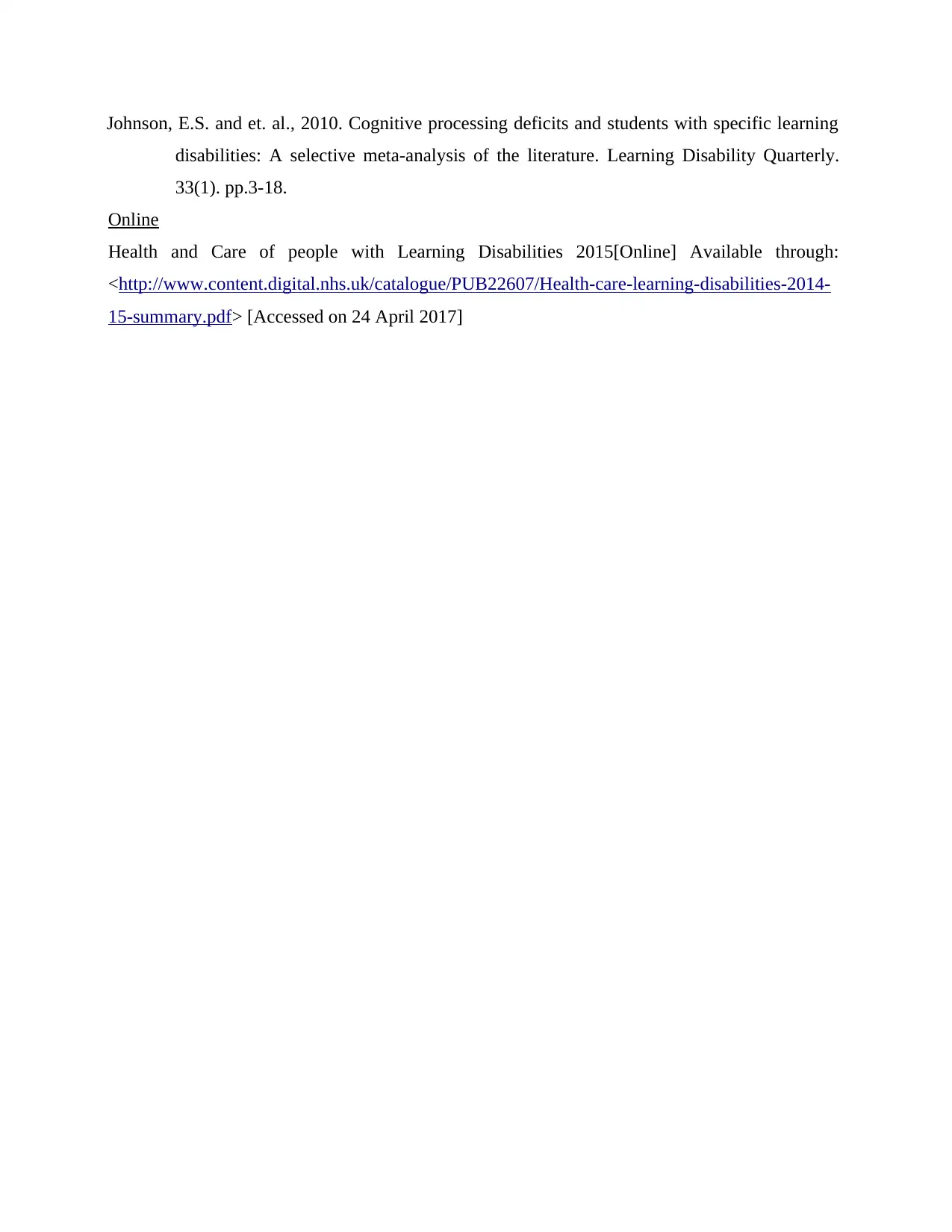
Johnson, E.S. and et. al., 2010. Cognitive processing deficits and students with specific learning
disabilities: A selective meta-analysis of the literature. Learning Disability Quarterly.
33(1). pp.3-18.
Online
Health and Care of people with Learning Disabilities 2015[Online] Available through:
<http://www.content.digital.nhs.uk/catalogue/PUB22607/Health-care-learning-disabilities-2014-
15-summary.pdf> [Accessed on 24 April 2017]
disabilities: A selective meta-analysis of the literature. Learning Disability Quarterly.
33(1). pp.3-18.
Online
Health and Care of people with Learning Disabilities 2015[Online] Available through:
<http://www.content.digital.nhs.uk/catalogue/PUB22607/Health-care-learning-disabilities-2014-
15-summary.pdf> [Accessed on 24 April 2017]

1 out of 10


Related Documents


![Essay: Health and Socio-Political Issues in Aged Care - [Course Name]](/_next/image/?url=https%3A%2F%2Fdesklib.com%2Fmedia%2Fimages%2Fvs%2F0bb57a769db247618d0c7eb523e0850c.jpg&w=256&q=75)

Your All-in-One AI-Powered Toolkit for Academic Success.
+13062052269
info@desklib.com
Available 24*7 on WhatsApp / Email
![[object Object]](/_next/static/media/star-bottom.7253800d.svg)
Unlock your academic potential
Copyright © 2020–2026 A2Z Services. All Rights Reserved. Developed and managed by ZUCOL.