Professional Development Course Assignment: Weeks 1-8 Analysis
VerifiedAdded on 2022/11/30
|21
|4851
|267
Homework Assignment
AI Summary
This document presents a comprehensive solution to a Professional Development assignment spanning eight weeks. The assignment begins with self-assessment questionnaires on adult learning styles, differentiating between 'doing' and 'watching' approaches, and 'thinking' and 'feeling' preferences. It then includes a time management exercise to calculate study hours and a detailed guide to essay writing, including structuring introductions and conclusions, with specific tasks to rearrange sentence orders and answer questions about essay components. Further, the assignment covers academic writing and referencing, providing examples of how to cite sources, including online materials and books, and questions to test the understanding of in-text referencing rules. Finally, the assignment touches upon a case study related to COVID-19, focusing on the impact on older people, ways to enhance care and protection, and analyzing healthcare models in pandemic situations, including patient-centered and community-centered approaches.


Paraphrase This Document
Need a fresh take? Get an instant paraphrase of this document with our AI Paraphraser
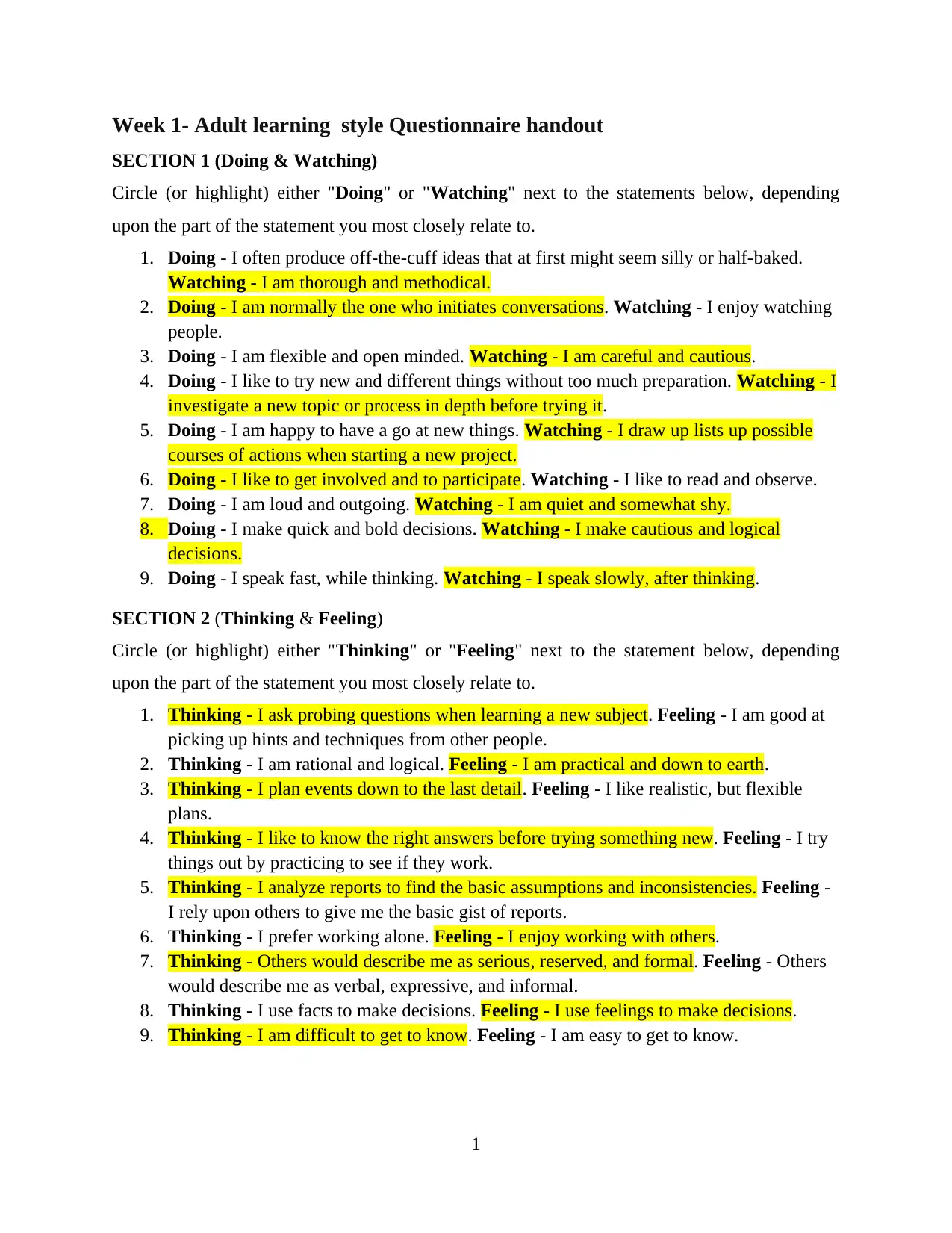
Week 1- Adult learning style Questionnaire handout
SECTION 1 (Doing & Watching)
Circle (or highlight) either "Doing" or "Watching" next to the statements below, depending
upon the part of the statement you most closely relate to.
1. Doing - I often produce off-the-cuff ideas that at first might seem silly or half-baked.
Watching - I am thorough and methodical.
2. Doing - I am normally the one who initiates conversations. Watching - I enjoy watching
people.
3. Doing - I am flexible and open minded. Watching - I am careful and cautious.
4. Doing - I like to try new and different things without too much preparation. Watching - I
investigate a new topic or process in depth before trying it.
5. Doing - I am happy to have a go at new things. Watching - I draw up lists up possible
courses of actions when starting a new project.
6. Doing - I like to get involved and to participate. Watching - I like to read and observe.
7. Doing - I am loud and outgoing. Watching - I am quiet and somewhat shy.
8. Doing - I make quick and bold decisions. Watching - I make cautious and logical
decisions.
9. Doing - I speak fast, while thinking. Watching - I speak slowly, after thinking.
SECTION 2 (Thinking & Feeling)
Circle (or highlight) either "Thinking" or "Feeling" next to the statement below, depending
upon the part of the statement you most closely relate to.
1. Thinking - I ask probing questions when learning a new subject. Feeling - I am good at
picking up hints and techniques from other people.
2. Thinking - I am rational and logical. Feeling - I am practical and down to earth.
3. Thinking - I plan events down to the last detail. Feeling - I like realistic, but flexible
plans.
4. Thinking - I like to know the right answers before trying something new. Feeling - I try
things out by practicing to see if they work.
5. Thinking - I analyze reports to find the basic assumptions and inconsistencies. Feeling -
I rely upon others to give me the basic gist of reports.
6. Thinking - I prefer working alone. Feeling - I enjoy working with others.
7. Thinking - Others would describe me as serious, reserved, and formal. Feeling - Others
would describe me as verbal, expressive, and informal.
8. Thinking - I use facts to make decisions. Feeling - I use feelings to make decisions.
9. Thinking - I am difficult to get to know. Feeling - I am easy to get to know.
1
SECTION 1 (Doing & Watching)
Circle (or highlight) either "Doing" or "Watching" next to the statements below, depending
upon the part of the statement you most closely relate to.
1. Doing - I often produce off-the-cuff ideas that at first might seem silly or half-baked.
Watching - I am thorough and methodical.
2. Doing - I am normally the one who initiates conversations. Watching - I enjoy watching
people.
3. Doing - I am flexible and open minded. Watching - I am careful and cautious.
4. Doing - I like to try new and different things without too much preparation. Watching - I
investigate a new topic or process in depth before trying it.
5. Doing - I am happy to have a go at new things. Watching - I draw up lists up possible
courses of actions when starting a new project.
6. Doing - I like to get involved and to participate. Watching - I like to read and observe.
7. Doing - I am loud and outgoing. Watching - I am quiet and somewhat shy.
8. Doing - I make quick and bold decisions. Watching - I make cautious and logical
decisions.
9. Doing - I speak fast, while thinking. Watching - I speak slowly, after thinking.
SECTION 2 (Thinking & Feeling)
Circle (or highlight) either "Thinking" or "Feeling" next to the statement below, depending
upon the part of the statement you most closely relate to.
1. Thinking - I ask probing questions when learning a new subject. Feeling - I am good at
picking up hints and techniques from other people.
2. Thinking - I am rational and logical. Feeling - I am practical and down to earth.
3. Thinking - I plan events down to the last detail. Feeling - I like realistic, but flexible
plans.
4. Thinking - I like to know the right answers before trying something new. Feeling - I try
things out by practicing to see if they work.
5. Thinking - I analyze reports to find the basic assumptions and inconsistencies. Feeling -
I rely upon others to give me the basic gist of reports.
6. Thinking - I prefer working alone. Feeling - I enjoy working with others.
7. Thinking - Others would describe me as serious, reserved, and formal. Feeling - Others
would describe me as verbal, expressive, and informal.
8. Thinking - I use facts to make decisions. Feeling - I use feelings to make decisions.
9. Thinking - I am difficult to get to know. Feeling - I am easy to get to know.
1
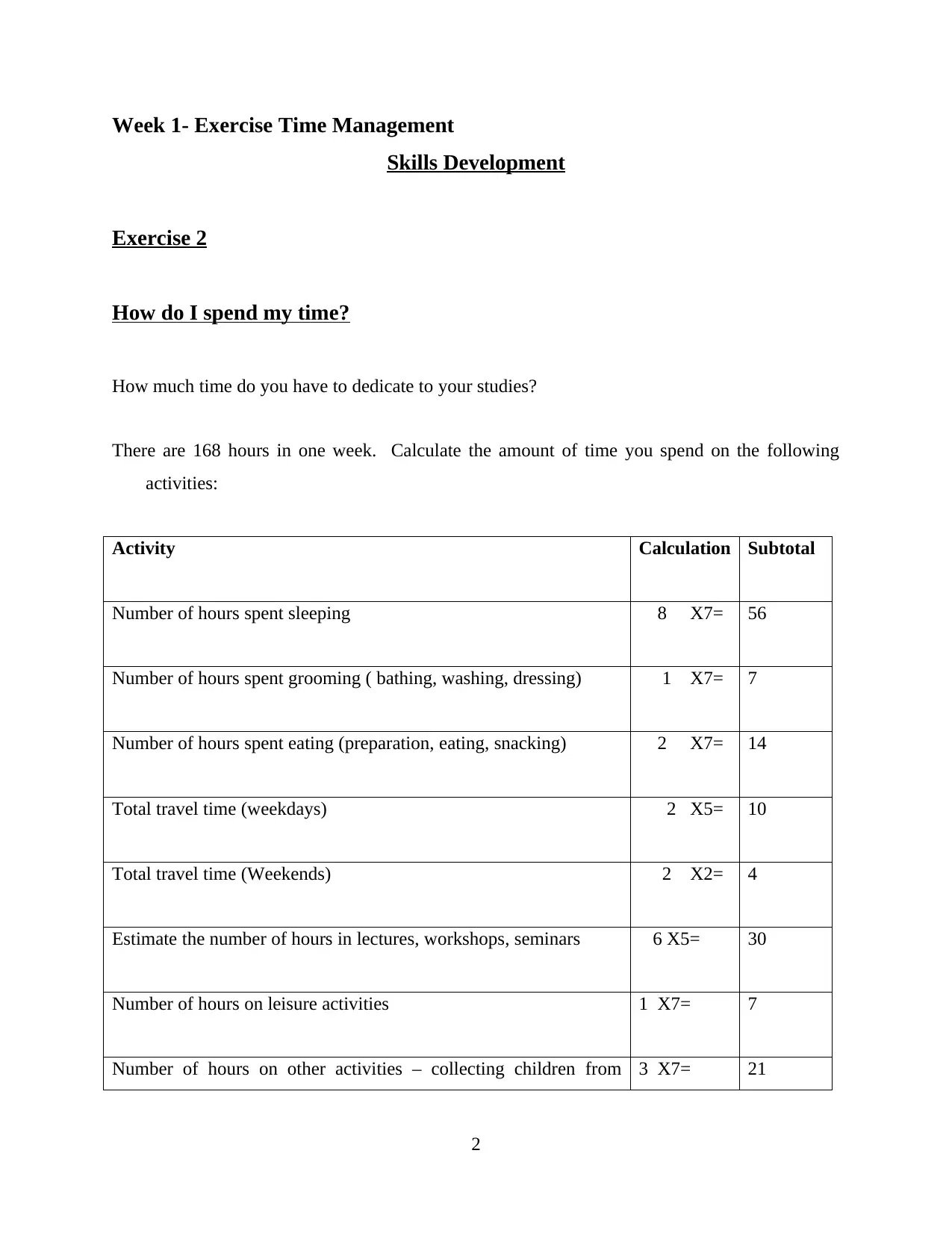
Week 1- Exercise Time Management
Skills Development
Exercise 2
How do I spend my time?
How much time do you have to dedicate to your studies?
There are 168 hours in one week. Calculate the amount of time you spend on the following
activities:
Activity Calculation Subtotal
Number of hours spent sleeping 8 X7= 56
Number of hours spent grooming ( bathing, washing, dressing) 1 X7= 7
Number of hours spent eating (preparation, eating, snacking) 2 X7= 14
Total travel time (weekdays) 2 X5= 10
Total travel time (Weekends) 2 X2= 4
Estimate the number of hours in lectures, workshops, seminars 6 X5= 30
Number of hours on leisure activities 1 X7= 7
Number of hours on other activities – collecting children from 3 X7= 21
2
Skills Development
Exercise 2
How do I spend my time?
How much time do you have to dedicate to your studies?
There are 168 hours in one week. Calculate the amount of time you spend on the following
activities:
Activity Calculation Subtotal
Number of hours spent sleeping 8 X7= 56
Number of hours spent grooming ( bathing, washing, dressing) 1 X7= 7
Number of hours spent eating (preparation, eating, snacking) 2 X7= 14
Total travel time (weekdays) 2 X5= 10
Total travel time (Weekends) 2 X2= 4
Estimate the number of hours in lectures, workshops, seminars 6 X5= 30
Number of hours on leisure activities 1 X7= 7
Number of hours on other activities – collecting children from 3 X7= 21
2
⊘ This is a preview!⊘
Do you want full access?
Subscribe today to unlock all pages.

Trusted by 1+ million students worldwide
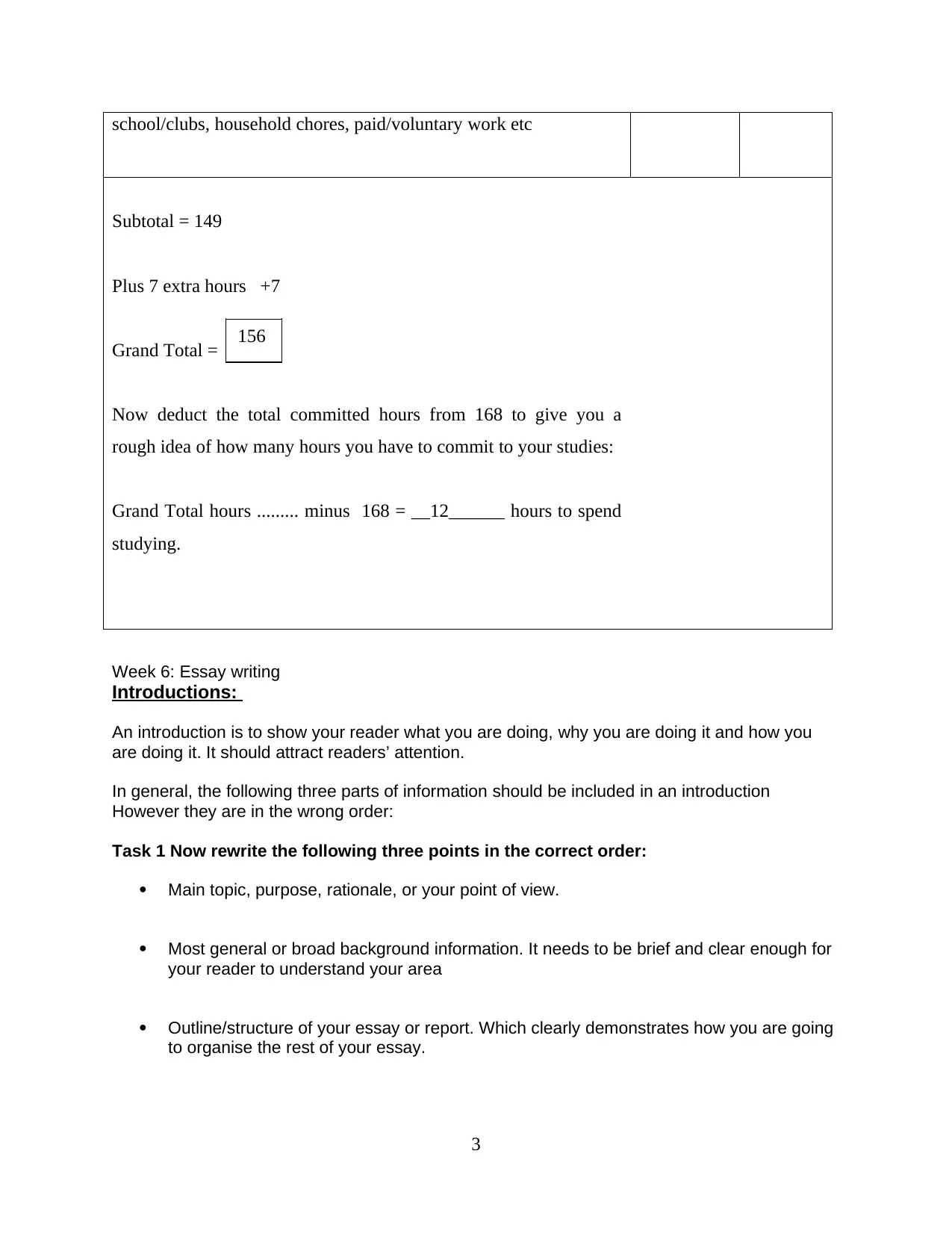
school/clubs, household chores, paid/voluntary work etc
Subtotal = 149
Plus 7 extra hours +7
Grand Total =
Now deduct the total committed hours from 168 to give you a
rough idea of how many hours you have to commit to your studies:
Grand Total hours ......... minus 168 = __12______ hours to spend
studying.
Week 6: Essay writing
Introductions:
An introduction is to show your reader what you are doing, why you are doing it and how you
are doing it. It should attract readers’ attention.
In general, the following three parts of information should be included in an introduction
However they are in the wrong order:
Task 1 Now rewrite the following three points in the correct order:
Main topic, purpose, rationale, or your point of view.
Most general or broad background information. It needs to be brief and clear enough for
your reader to understand your area
Outline/structure of your essay or report. Which clearly demonstrates how you are going
to organise the rest of your essay.
3
156
Subtotal = 149
Plus 7 extra hours +7
Grand Total =
Now deduct the total committed hours from 168 to give you a
rough idea of how many hours you have to commit to your studies:
Grand Total hours ......... minus 168 = __12______ hours to spend
studying.
Week 6: Essay writing
Introductions:
An introduction is to show your reader what you are doing, why you are doing it and how you
are doing it. It should attract readers’ attention.
In general, the following three parts of information should be included in an introduction
However they are in the wrong order:
Task 1 Now rewrite the following three points in the correct order:
Main topic, purpose, rationale, or your point of view.
Most general or broad background information. It needs to be brief and clear enough for
your reader to understand your area
Outline/structure of your essay or report. Which clearly demonstrates how you are going
to organise the rest of your essay.
3
156
Paraphrase This Document
Need a fresh take? Get an instant paraphrase of this document with our AI Paraphraser
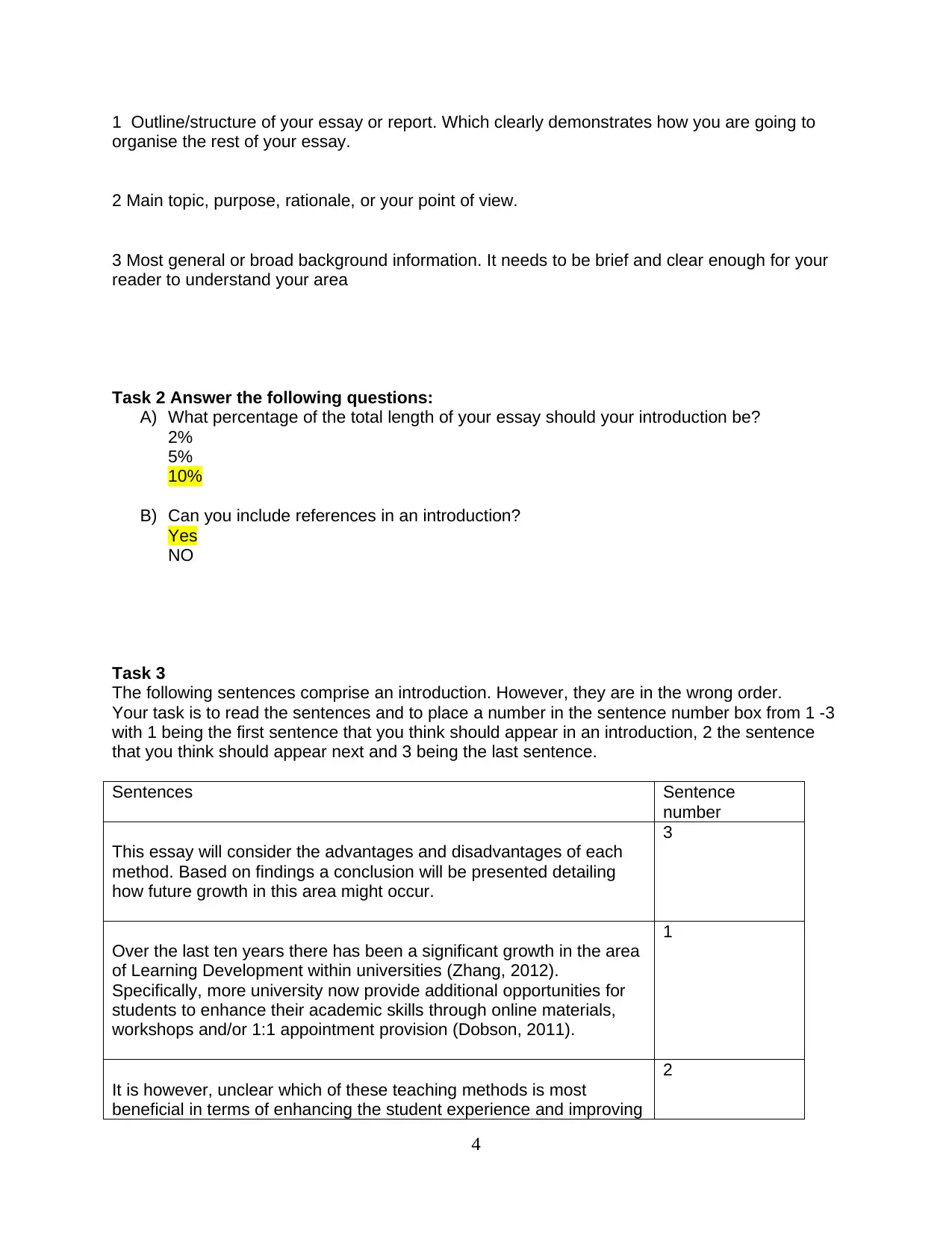
1 Outline/structure of your essay or report. Which clearly demonstrates how you are going to
organise the rest of your essay.
2 Main topic, purpose, rationale, or your point of view.
3 Most general or broad background information. It needs to be brief and clear enough for your
reader to understand your area
Task 2 Answer the following questions:
A) What percentage of the total length of your essay should your introduction be?
2%
5%
10%
B) Can you include references in an introduction?
Yes
NO
Task 3
The following sentences comprise an introduction. However, they are in the wrong order.
Your task is to read the sentences and to place a number in the sentence number box from 1 -3
with 1 being the first sentence that you think should appear in an introduction, 2 the sentence
that you think should appear next and 3 being the last sentence.
Sentences Sentence
number
This essay will consider the advantages and disadvantages of each
method. Based on findings a conclusion will be presented detailing
how future growth in this area might occur.
3
Over the last ten years there has been a significant growth in the area
of Learning Development within universities (Zhang, 2012).
Specifically, more university now provide additional opportunities for
students to enhance their academic skills through online materials,
workshops and/or 1:1 appointment provision (Dobson, 2011).
1
It is however, unclear which of these teaching methods is most
beneficial in terms of enhancing the student experience and improving
2
4
organise the rest of your essay.
2 Main topic, purpose, rationale, or your point of view.
3 Most general or broad background information. It needs to be brief and clear enough for your
reader to understand your area
Task 2 Answer the following questions:
A) What percentage of the total length of your essay should your introduction be?
2%
5%
10%
B) Can you include references in an introduction?
Yes
NO
Task 3
The following sentences comprise an introduction. However, they are in the wrong order.
Your task is to read the sentences and to place a number in the sentence number box from 1 -3
with 1 being the first sentence that you think should appear in an introduction, 2 the sentence
that you think should appear next and 3 being the last sentence.
Sentences Sentence
number
This essay will consider the advantages and disadvantages of each
method. Based on findings a conclusion will be presented detailing
how future growth in this area might occur.
3
Over the last ten years there has been a significant growth in the area
of Learning Development within universities (Zhang, 2012).
Specifically, more university now provide additional opportunities for
students to enhance their academic skills through online materials,
workshops and/or 1:1 appointment provision (Dobson, 2011).
1
It is however, unclear which of these teaching methods is most
beneficial in terms of enhancing the student experience and improving
2
4
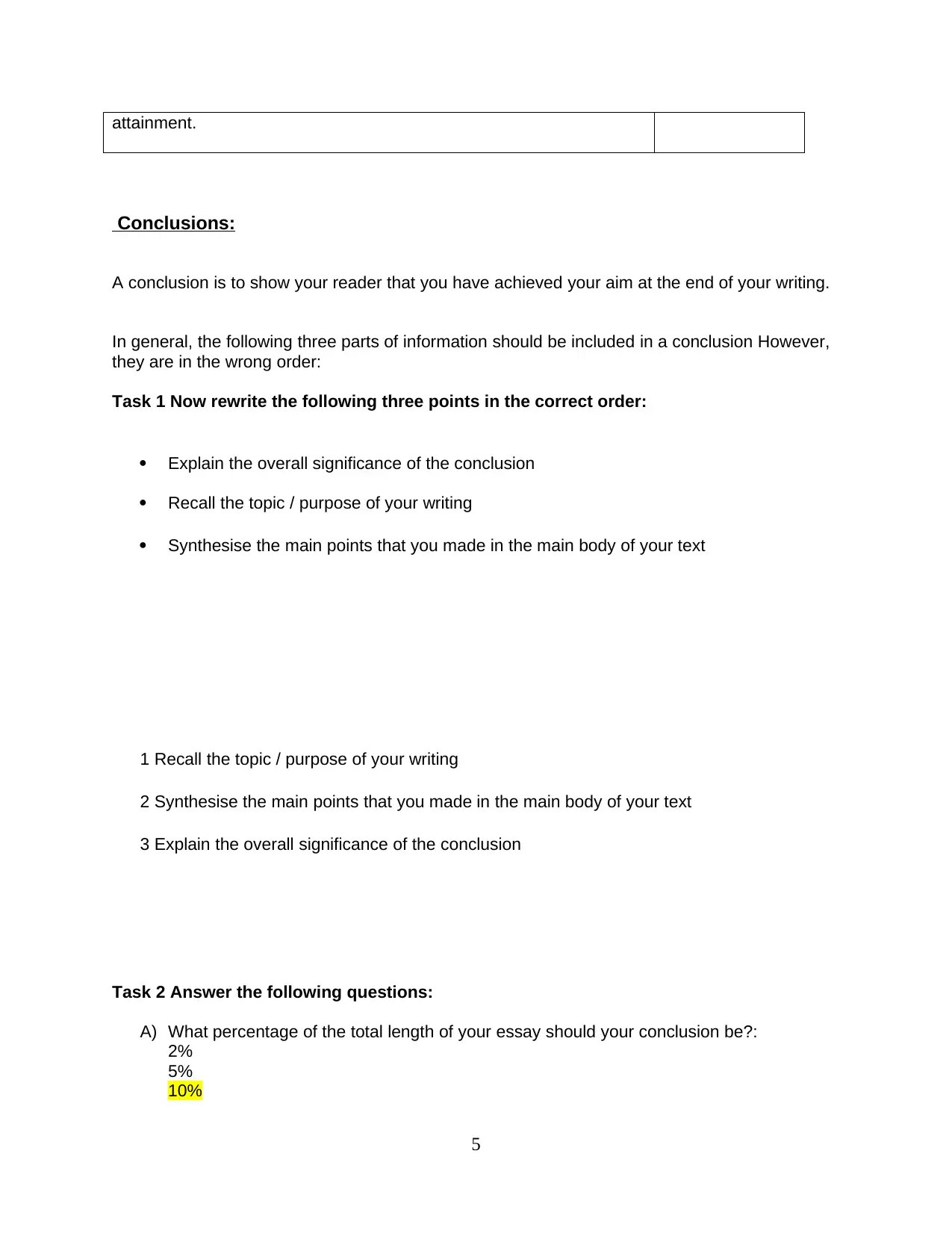
attainment.
Conclusions:
A conclusion is to show your reader that you have achieved your aim at the end of your writing.
In general, the following three parts of information should be included in a conclusion However,
they are in the wrong order:
Task 1 Now rewrite the following three points in the correct order:
Explain the overall significance of the conclusion
Recall the topic / purpose of your writing
Synthesise the main points that you made in the main body of your text
1 Recall the topic / purpose of your writing
2 Synthesise the main points that you made in the main body of your text
3 Explain the overall significance of the conclusion
Task 2 Answer the following questions:
A) What percentage of the total length of your essay should your conclusion be?:
2%
5%
10%
5
Conclusions:
A conclusion is to show your reader that you have achieved your aim at the end of your writing.
In general, the following three parts of information should be included in a conclusion However,
they are in the wrong order:
Task 1 Now rewrite the following three points in the correct order:
Explain the overall significance of the conclusion
Recall the topic / purpose of your writing
Synthesise the main points that you made in the main body of your text
1 Recall the topic / purpose of your writing
2 Synthesise the main points that you made in the main body of your text
3 Explain the overall significance of the conclusion
Task 2 Answer the following questions:
A) What percentage of the total length of your essay should your conclusion be?:
2%
5%
10%
5
⊘ This is a preview!⊘
Do you want full access?
Subscribe today to unlock all pages.
Trusted by 1+ million students worldwide
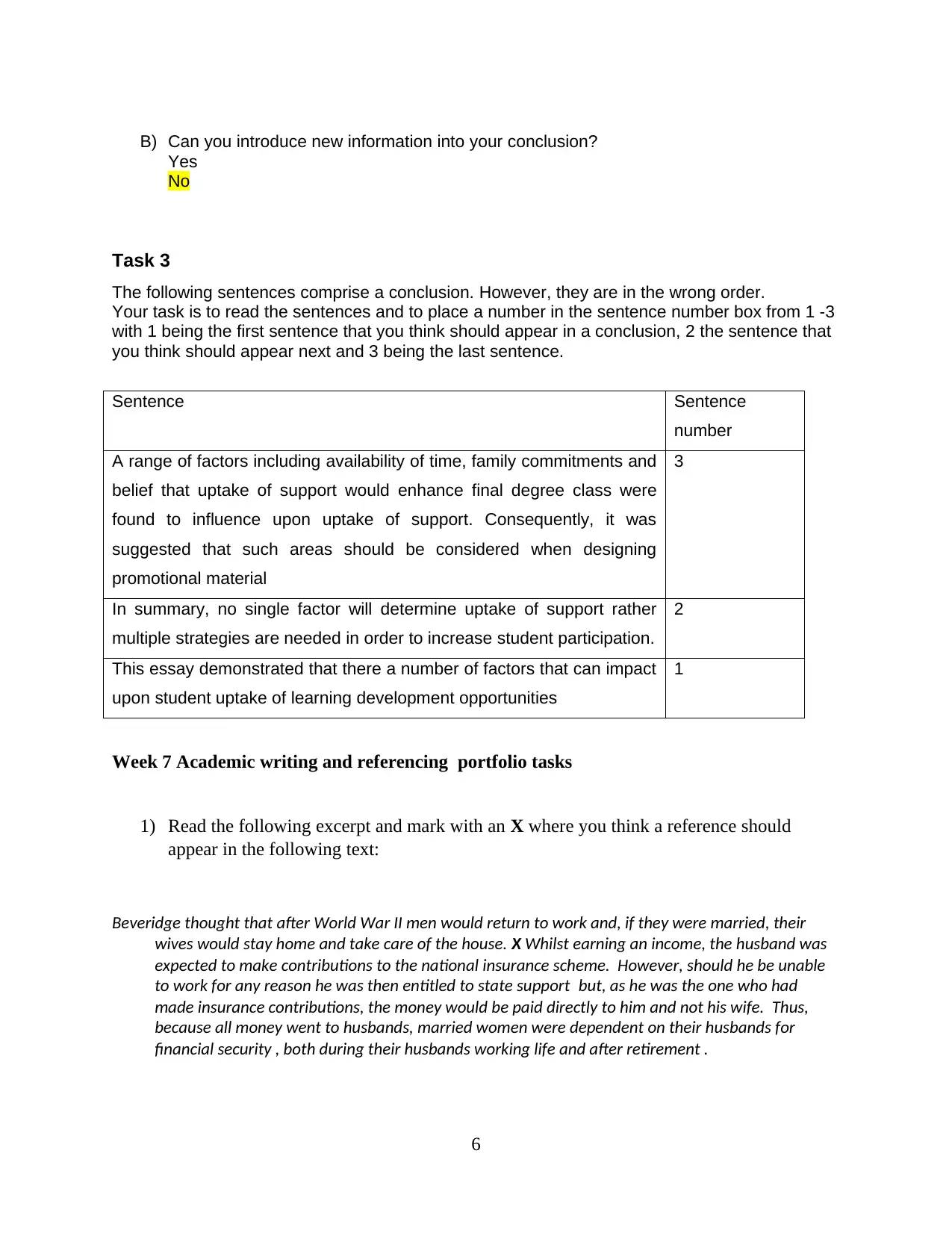
B) Can you introduce new information into your conclusion?
Yes
No
Task 3
The following sentences comprise a conclusion. However, they are in the wrong order.
Your task is to read the sentences and to place a number in the sentence number box from 1 -3
with 1 being the first sentence that you think should appear in a conclusion, 2 the sentence that
you think should appear next and 3 being the last sentence.
Sentence Sentence
number
A range of factors including availability of time, family commitments and
belief that uptake of support would enhance final degree class were
found to influence upon uptake of support. Consequently, it was
suggested that such areas should be considered when designing
promotional material
3
In summary, no single factor will determine uptake of support rather
multiple strategies are needed in order to increase student participation.
2
This essay demonstrated that there a number of factors that can impact
upon student uptake of learning development opportunities
1
Week 7 Academic writing and referencing portfolio tasks
1) Read the following excerpt and mark with an X where you think a reference should
appear in the following text:
Beveridge thought that after World War II men would return to work and, if they were married, their
wives would stay home and take care of the house. X Whilst earning an income, the husband was
expected to make contributions to the national insurance scheme. However, should he be unable
to work for any reason he was then entitled to state support but, as he was the one who had
made insurance contributions, the money would be paid directly to him and not his wife. Thus,
because all money went to husbands, married women were dependent on their husbands for
financial security , both during their husbands working life and after retirement .
6
Yes
No
Task 3
The following sentences comprise a conclusion. However, they are in the wrong order.
Your task is to read the sentences and to place a number in the sentence number box from 1 -3
with 1 being the first sentence that you think should appear in a conclusion, 2 the sentence that
you think should appear next and 3 being the last sentence.
Sentence Sentence
number
A range of factors including availability of time, family commitments and
belief that uptake of support would enhance final degree class were
found to influence upon uptake of support. Consequently, it was
suggested that such areas should be considered when designing
promotional material
3
In summary, no single factor will determine uptake of support rather
multiple strategies are needed in order to increase student participation.
2
This essay demonstrated that there a number of factors that can impact
upon student uptake of learning development opportunities
1
Week 7 Academic writing and referencing portfolio tasks
1) Read the following excerpt and mark with an X where you think a reference should
appear in the following text:
Beveridge thought that after World War II men would return to work and, if they were married, their
wives would stay home and take care of the house. X Whilst earning an income, the husband was
expected to make contributions to the national insurance scheme. However, should he be unable
to work for any reason he was then entitled to state support but, as he was the one who had
made insurance contributions, the money would be paid directly to him and not his wife. Thus,
because all money went to husbands, married women were dependent on their husbands for
financial security , both during their husbands working life and after retirement .
6
Paraphrase This Document
Need a fresh take? Get an instant paraphrase of this document with our AI Paraphraser
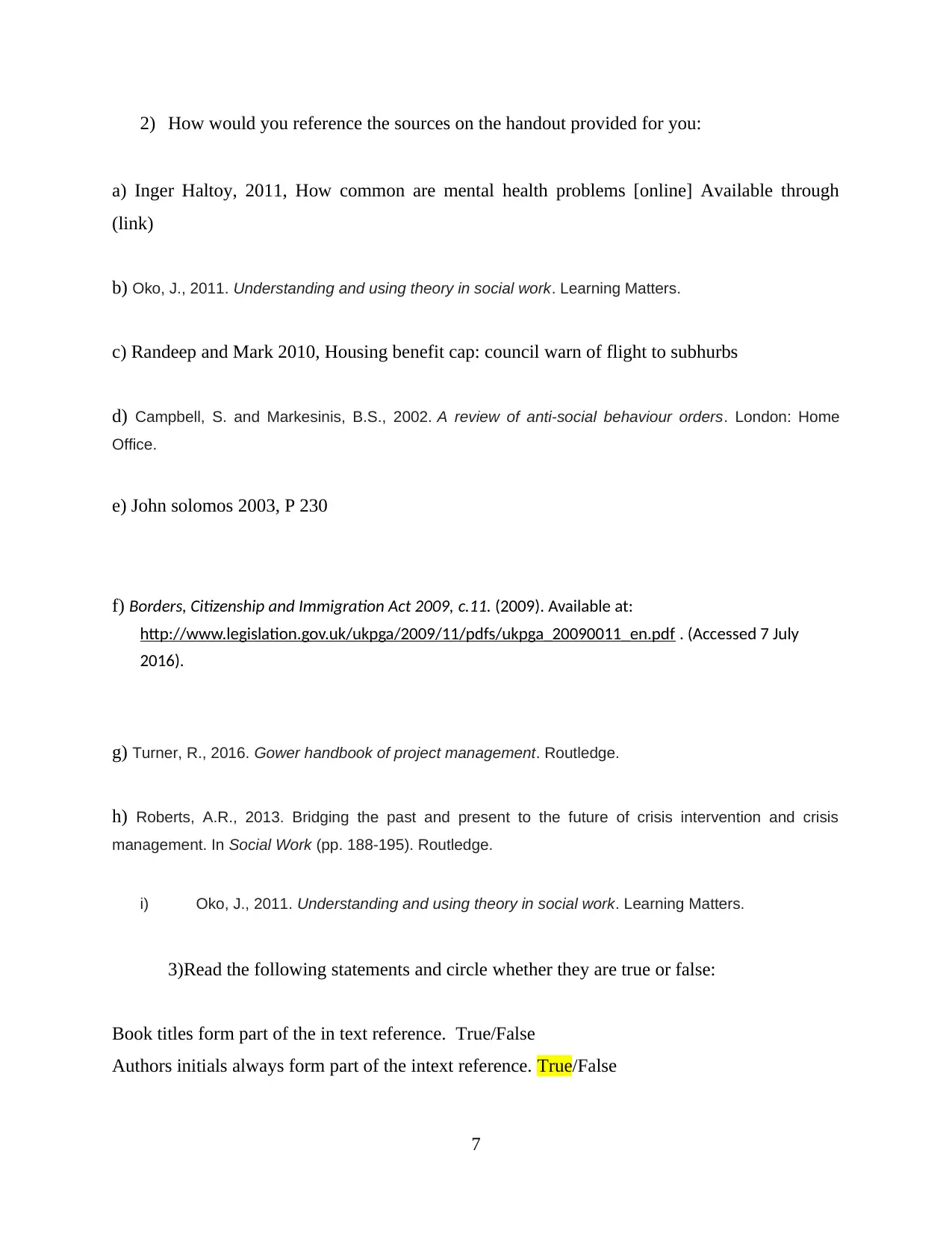
2) How would you reference the sources on the handout provided for you:
a) Inger Haltoy, 2011, How common are mental health problems [online] Available through
(link)
b) Oko, J., 2011. Understanding and using theory in social work. Learning Matters.
c) Randeep and Mark 2010, Housing benefit cap: council warn of flight to subhurbs
d) Campbell, S. and Markesinis, B.S., 2002. A review of anti-social behaviour orders. London: Home
Office.
e) John solomos 2003, P 230
f) Borders, Citizenship and Immigration Act 2009, c.11. (2009). Available at:
http://www.legislation.gov.uk/ukpga/2009/11/pdfs/ukpga_20090011_en.pdf . (Accessed 7 July
2016).
g) Turner, R., 2016. Gower handbook of project management. Routledge.
h) Roberts, A.R., 2013. Bridging the past and present to the future of crisis intervention and crisis
management. In Social Work (pp. 188-195). Routledge.
i) Oko, J., 2011. Understanding and using theory in social work. Learning Matters.
3)Read the following statements and circle whether they are true or false:
Book titles form part of the in text reference. True/False
Authors initials always form part of the intext reference. True/False
7
a) Inger Haltoy, 2011, How common are mental health problems [online] Available through
(link)
b) Oko, J., 2011. Understanding and using theory in social work. Learning Matters.
c) Randeep and Mark 2010, Housing benefit cap: council warn of flight to subhurbs
d) Campbell, S. and Markesinis, B.S., 2002. A review of anti-social behaviour orders. London: Home
Office.
e) John solomos 2003, P 230
f) Borders, Citizenship and Immigration Act 2009, c.11. (2009). Available at:
http://www.legislation.gov.uk/ukpga/2009/11/pdfs/ukpga_20090011_en.pdf . (Accessed 7 July
2016).
g) Turner, R., 2016. Gower handbook of project management. Routledge.
h) Roberts, A.R., 2013. Bridging the past and present to the future of crisis intervention and crisis
management. In Social Work (pp. 188-195). Routledge.
i) Oko, J., 2011. Understanding and using theory in social work. Learning Matters.
3)Read the following statements and circle whether they are true or false:
Book titles form part of the in text reference. True/False
Authors initials always form part of the intext reference. True/False
7
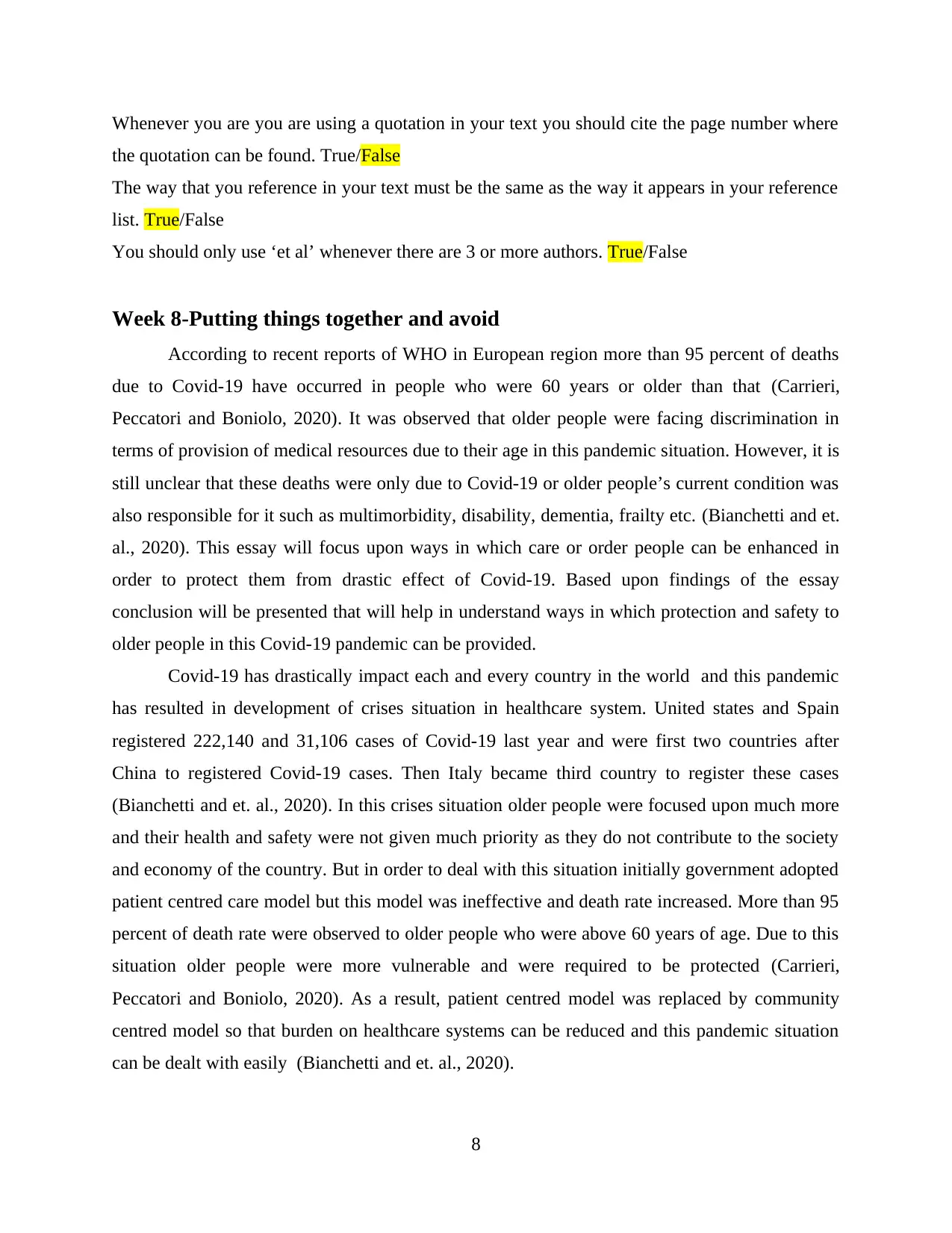
Whenever you are you are using a quotation in your text you should cite the page number where
the quotation can be found. True/False
The way that you reference in your text must be the same as the way it appears in your reference
list. True/False
You should only use ‘et al’ whenever there are 3 or more authors. True/False
Week 8-Putting things together and avoid
According to recent reports of WHO in European region more than 95 percent of deaths
due to Covid-19 have occurred in people who were 60 years or older than that (Carrieri,
Peccatori and Boniolo, 2020). It was observed that older people were facing discrimination in
terms of provision of medical resources due to their age in this pandemic situation. However, it is
still unclear that these deaths were only due to Covid-19 or older people’s current condition was
also responsible for it such as multimorbidity, disability, dementia, frailty etc. (Bianchetti and et.
al., 2020). This essay will focus upon ways in which care or order people can be enhanced in
order to protect them from drastic effect of Covid-19. Based upon findings of the essay
conclusion will be presented that will help in understand ways in which protection and safety to
older people in this Covid-19 pandemic can be provided.
Covid-19 has drastically impact each and every country in the world and this pandemic
has resulted in development of crises situation in healthcare system. United states and Spain
registered 222,140 and 31,106 cases of Covid-19 last year and were first two countries after
China to registered Covid-19 cases. Then Italy became third country to register these cases
(Bianchetti and et. al., 2020). In this crises situation older people were focused upon much more
and their health and safety were not given much priority as they do not contribute to the society
and economy of the country. But in order to deal with this situation initially government adopted
patient centred care model but this model was ineffective and death rate increased. More than 95
percent of death rate were observed to older people who were above 60 years of age. Due to this
situation older people were more vulnerable and were required to be protected (Carrieri,
Peccatori and Boniolo, 2020). As a result, patient centred model was replaced by community
centred model so that burden on healthcare systems can be reduced and this pandemic situation
can be dealt with easily (Bianchetti and et. al., 2020).
8
the quotation can be found. True/False
The way that you reference in your text must be the same as the way it appears in your reference
list. True/False
You should only use ‘et al’ whenever there are 3 or more authors. True/False
Week 8-Putting things together and avoid
According to recent reports of WHO in European region more than 95 percent of deaths
due to Covid-19 have occurred in people who were 60 years or older than that (Carrieri,
Peccatori and Boniolo, 2020). It was observed that older people were facing discrimination in
terms of provision of medical resources due to their age in this pandemic situation. However, it is
still unclear that these deaths were only due to Covid-19 or older people’s current condition was
also responsible for it such as multimorbidity, disability, dementia, frailty etc. (Bianchetti and et.
al., 2020). This essay will focus upon ways in which care or order people can be enhanced in
order to protect them from drastic effect of Covid-19. Based upon findings of the essay
conclusion will be presented that will help in understand ways in which protection and safety to
older people in this Covid-19 pandemic can be provided.
Covid-19 has drastically impact each and every country in the world and this pandemic
has resulted in development of crises situation in healthcare system. United states and Spain
registered 222,140 and 31,106 cases of Covid-19 last year and were first two countries after
China to registered Covid-19 cases. Then Italy became third country to register these cases
(Bianchetti and et. al., 2020). In this crises situation older people were focused upon much more
and their health and safety were not given much priority as they do not contribute to the society
and economy of the country. But in order to deal with this situation initially government adopted
patient centred care model but this model was ineffective and death rate increased. More than 95
percent of death rate were observed to older people who were above 60 years of age. Due to this
situation older people were more vulnerable and were required to be protected (Carrieri,
Peccatori and Boniolo, 2020). As a result, patient centred model was replaced by community
centred model so that burden on healthcare systems can be reduced and this pandemic situation
can be dealt with easily (Bianchetti and et. al., 2020).
8
⊘ This is a preview!⊘
Do you want full access?
Subscribe today to unlock all pages.
Trusted by 1+ million students worldwide
This essay demonstrated that older people are served less priority in terms of accessing
high quality healthcare services because their contribution to overall economy of country is less
as compared to young generation who actively participate in society. In summary it was
concluded that despite of less efforts o older people towards society, society has moral
imperative to protect and respect the dignity towards older people as they find then a vulnerable
part of society and think that they can enrich the society. Due to this, government has proposed
appropriate care of older people in different settings of care in order to enhance effectivity of
community centred care.
References
Carrieri, D., Peccatori, F.A. and Boniolo, G., 2020. COVID-19: a plea to protect the older
population. International journal for equity in health. 19(1). pp.1-4.
Bianchetti, A., and et. al., 2020. Improving the care of older patients during the COVID-19
pandemic. Aging clinical and experimental research. 32(9). pp.1883-1888.
Week 9: Working with others
Task 1
In such case I will be focusing upon having one to one interaction with both the team
members who are not coming to the meeting and hasn’t produced anything yet. I will ask them
their reason of being inefficient and not contributing to the team work. If they are facing issues in
terms of contributing to the team or coming to the meeting then I will focus upon resolving the
issues so that they can feel comfortable with the group members and can effectively contribute to
the team. In this one- to- one interaction I will also explain importance of team work and ways in
which lack of contribution of even one member can affect or compromise hard work of all the
team member. So that both the members understand and again start contributing in the team
work
Task 2
Five positive things about working with others:
1.) It can help in increasing or improving productivity and targeted goals can be achieved more
effectively.
2.) Working with other inspire others to socialize and engage in team work and can help in
ensuring success in achievement of desired task.
9
high quality healthcare services because their contribution to overall economy of country is less
as compared to young generation who actively participate in society. In summary it was
concluded that despite of less efforts o older people towards society, society has moral
imperative to protect and respect the dignity towards older people as they find then a vulnerable
part of society and think that they can enrich the society. Due to this, government has proposed
appropriate care of older people in different settings of care in order to enhance effectivity of
community centred care.
References
Carrieri, D., Peccatori, F.A. and Boniolo, G., 2020. COVID-19: a plea to protect the older
population. International journal for equity in health. 19(1). pp.1-4.
Bianchetti, A., and et. al., 2020. Improving the care of older patients during the COVID-19
pandemic. Aging clinical and experimental research. 32(9). pp.1883-1888.
Week 9: Working with others
Task 1
In such case I will be focusing upon having one to one interaction with both the team
members who are not coming to the meeting and hasn’t produced anything yet. I will ask them
their reason of being inefficient and not contributing to the team work. If they are facing issues in
terms of contributing to the team or coming to the meeting then I will focus upon resolving the
issues so that they can feel comfortable with the group members and can effectively contribute to
the team. In this one- to- one interaction I will also explain importance of team work and ways in
which lack of contribution of even one member can affect or compromise hard work of all the
team member. So that both the members understand and again start contributing in the team
work
Task 2
Five positive things about working with others:
1.) It can help in increasing or improving productivity and targeted goals can be achieved more
effectively.
2.) Working with other inspire others to socialize and engage in team work and can help in
ensuring success in achievement of desired task.
9
Paraphrase This Document
Need a fresh take? Get an instant paraphrase of this document with our AI Paraphraser
3.) Working with other enhances flexibility of task that further helps us in overcoming any kind
of challenge.
4.) Working together helps in learning faster and encourage team members to take healthy risk.
5.) Working together facilitates idea generation and creativity.
Task 3
5 challenges of working with others
1.) Building trust is one of the major challenges that working together can create.
2.) Lack of trust among team members can result in not sharing important information with
others because of which overall progress of the work can get impacted.
3.) Difficult to maintain optimal working condition for each and every team members because
some of us work in fast passed work environment and some of them do not.
4.) Self-awareness among team members is another challenge because many times if others are
frustrated then it will automatically reduce their self-awareness.
5.) development of common purpose of working together is another challenge.
Week 10 Presentation skills
Task 1 this week is to plan a presentation on how you would structure an essay.
Step 1 Find one of the articles that you read in week 4 and re read the article
Step 2 Now take some notes in your own words about the key points from the article
Step 3: using the notes that you have made in your own words plan in the following
presentation slides how you would structure a presentation on this topic
Title page- Covid 19- A plea to protect old people.
Introduction
10
of challenge.
4.) Working together helps in learning faster and encourage team members to take healthy risk.
5.) Working together facilitates idea generation and creativity.
Task 3
5 challenges of working with others
1.) Building trust is one of the major challenges that working together can create.
2.) Lack of trust among team members can result in not sharing important information with
others because of which overall progress of the work can get impacted.
3.) Difficult to maintain optimal working condition for each and every team members because
some of us work in fast passed work environment and some of them do not.
4.) Self-awareness among team members is another challenge because many times if others are
frustrated then it will automatically reduce their self-awareness.
5.) development of common purpose of working together is another challenge.
Week 10 Presentation skills
Task 1 this week is to plan a presentation on how you would structure an essay.
Step 1 Find one of the articles that you read in week 4 and re read the article
Step 2 Now take some notes in your own words about the key points from the article
Step 3: using the notes that you have made in your own words plan in the following
presentation slides how you would structure a presentation on this topic
Title page- Covid 19- A plea to protect old people.
Introduction
10
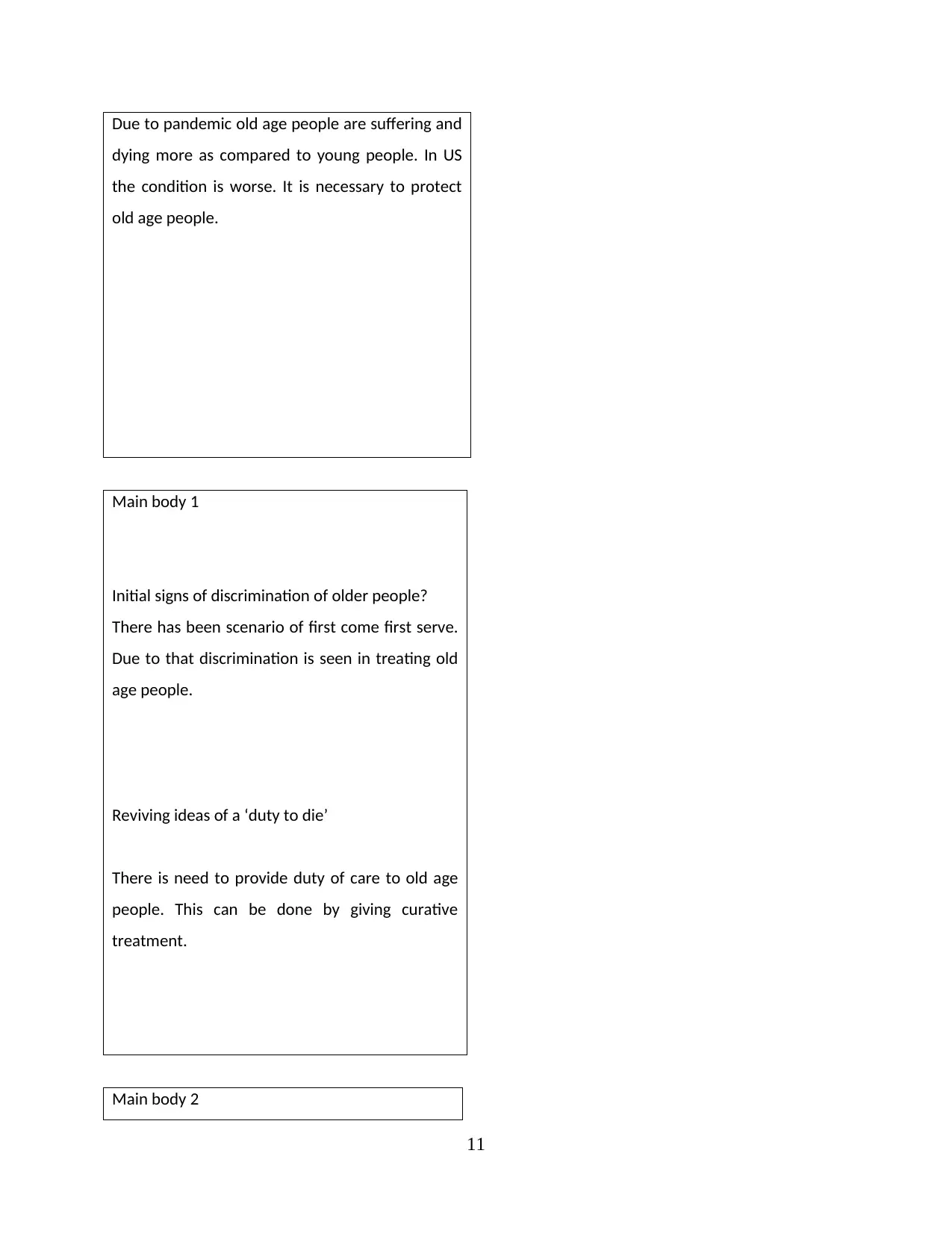
Due to pandemic old age people are suffering and
dying more as compared to young people. In US
the condition is worse. It is necessary to protect
old age people.
Main body 1
Initial signs of discrimination of older people?
There has been scenario of first come first serve.
Due to that discrimination is seen in treating old
age people.
Reviving ideas of a ‘duty to die’
There is need to provide duty of care to old age
people. This can be done by giving curative
treatment.
Main body 2
11
dying more as compared to young people. In US
the condition is worse. It is necessary to protect
old age people.
Main body 1
Initial signs of discrimination of older people?
There has been scenario of first come first serve.
Due to that discrimination is seen in treating old
age people.
Reviving ideas of a ‘duty to die’
There is need to provide duty of care to old age
people. This can be done by giving curative
treatment.
Main body 2
11
⊘ This is a preview!⊘
Do you want full access?
Subscribe today to unlock all pages.
Trusted by 1+ million students worldwide

1 out of 21


Related Documents


Your All-in-One AI-Powered Toolkit for Academic Success.
+13062052269
info@desklib.com
Available 24*7 on WhatsApp / Email
![[object Object]](/_next/static/media/star-bottom.7253800d.svg)
Unlock your academic potential
Copyright © 2020–2026 A2Z Services. All Rights Reserved. Developed and managed by ZUCOL.