Professional Ethics Report: Morgan Stanley and Ethical Practices
VerifiedAdded on 2021/01/01
|11
|3926
|479
Report
AI Summary
This report delves into the realm of professional ethics within the accounting and finance sector, using Morgan Stanley as a case study. It explores the fundamental principles of ethical behavior, including integrity, objectivity, professional competence, confidentiality, and professional conduct. The report examines the legal, regulatory, and ethical requirements that govern the financial industry, highlighting the role of professional bodies in upholding these standards. It discusses the importance of adhering to codes of conduct, managing risks of improper practices, and staying updated on industry changes. The report also covers ethical considerations when interacting with clients, suppliers, and colleagues, emphasizing objectivity, professional distance, and adherence to organizational values. It addresses the handling of client monies, situations requiring confidential information disclosure, and the importance of working within one's professional expertise. Furthermore, the report identifies reporting procedures for illegal acts and unethical behavior, strategies for preventing conflicts, and the significance of an ethical approach to sustainability within the finance sector. The conclusion emphasizes the critical role of ethics in maintaining trust, ensuring responsible financial practices, and promoting long-term sustainability within the industry.
Professional Ethics

Paraphrase This Document
Need a fresh take? Get an instant paraphrase of this document with our AI Paraphraser
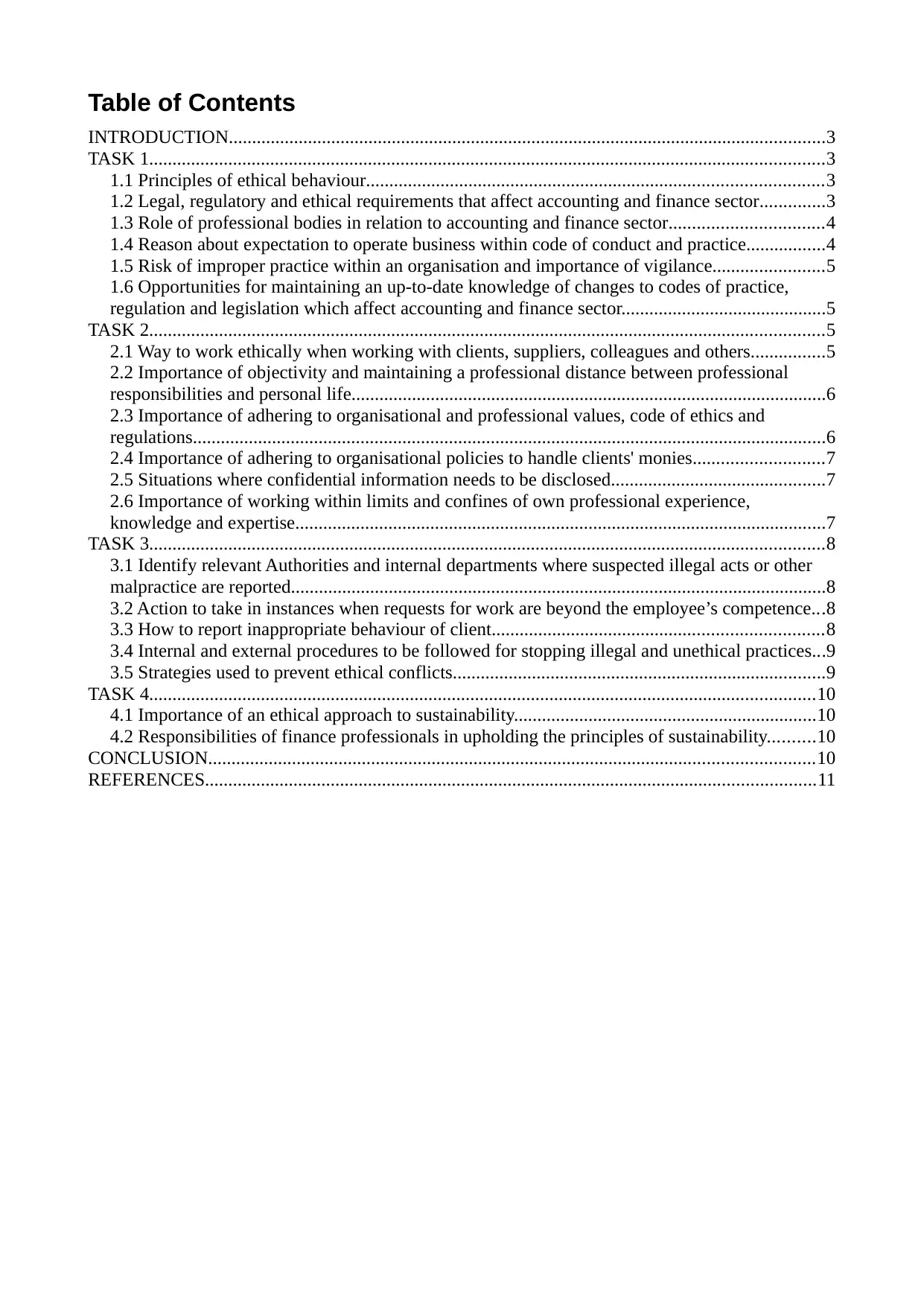
Table of Contents
INTRODUCTION................................................................................................................................3
TASK 1.................................................................................................................................................3
1.1 Principles of ethical behaviour..................................................................................................3
1.2 Legal, regulatory and ethical requirements that affect accounting and finance sector..............3
1.3 Role of professional bodies in relation to accounting and finance sector.................................4
1.4 Reason about expectation to operate business within code of conduct and practice.................4
1.5 Risk of improper practice within an organisation and importance of vigilance........................5
1.6 Opportunities for maintaining an up-to-date knowledge of changes to codes of practice,
regulation and legislation which affect accounting and finance sector............................................5
TASK 2.................................................................................................................................................5
2.1 Way to work ethically when working with clients, suppliers, colleagues and others................5
2.2 Importance of objectivity and maintaining a professional distance between professional
responsibilities and personal life......................................................................................................6
2.3 Importance of adhering to organisational and professional values, code of ethics and
regulations........................................................................................................................................6
2.4 Importance of adhering to organisational policies to handle clients' monies............................7
2.5 Situations where confidential information needs to be disclosed..............................................7
2.6 Importance of working within limits and confines of own professional experience,
knowledge and expertise..................................................................................................................7
TASK 3.................................................................................................................................................8
3.1 Identify relevant Authorities and internal departments where suspected illegal acts or other
malpractice are reported...................................................................................................................8
3.2 Action to take in instances when requests for work are beyond the employee’s competence...8
3.3 How to report inappropriate behaviour of client.......................................................................8
3.4 Internal and external procedures to be followed for stopping illegal and unethical practices...9
3.5 Strategies used to prevent ethical conflicts................................................................................9
TASK 4...............................................................................................................................................10
4.1 Importance of an ethical approach to sustainability.................................................................10
4.2 Responsibilities of finance professionals in upholding the principles of sustainability..........10
CONCLUSION..................................................................................................................................10
REFERENCES...................................................................................................................................11
INTRODUCTION................................................................................................................................3
TASK 1.................................................................................................................................................3
1.1 Principles of ethical behaviour..................................................................................................3
1.2 Legal, regulatory and ethical requirements that affect accounting and finance sector..............3
1.3 Role of professional bodies in relation to accounting and finance sector.................................4
1.4 Reason about expectation to operate business within code of conduct and practice.................4
1.5 Risk of improper practice within an organisation and importance of vigilance........................5
1.6 Opportunities for maintaining an up-to-date knowledge of changes to codes of practice,
regulation and legislation which affect accounting and finance sector............................................5
TASK 2.................................................................................................................................................5
2.1 Way to work ethically when working with clients, suppliers, colleagues and others................5
2.2 Importance of objectivity and maintaining a professional distance between professional
responsibilities and personal life......................................................................................................6
2.3 Importance of adhering to organisational and professional values, code of ethics and
regulations........................................................................................................................................6
2.4 Importance of adhering to organisational policies to handle clients' monies............................7
2.5 Situations where confidential information needs to be disclosed..............................................7
2.6 Importance of working within limits and confines of own professional experience,
knowledge and expertise..................................................................................................................7
TASK 3.................................................................................................................................................8
3.1 Identify relevant Authorities and internal departments where suspected illegal acts or other
malpractice are reported...................................................................................................................8
3.2 Action to take in instances when requests for work are beyond the employee’s competence...8
3.3 How to report inappropriate behaviour of client.......................................................................8
3.4 Internal and external procedures to be followed for stopping illegal and unethical practices...9
3.5 Strategies used to prevent ethical conflicts................................................................................9
TASK 4...............................................................................................................................................10
4.1 Importance of an ethical approach to sustainability.................................................................10
4.2 Responsibilities of finance professionals in upholding the principles of sustainability..........10
CONCLUSION..................................................................................................................................10
REFERENCES...................................................................................................................................11
INTRODUCTION
Ethics is a branch of psychology, which says about the morality of a person. Profession
ethics is concerned to the good habits that a business use to follow. This covers some important
points that help a business to grow and build a positive goodwill in their favour. It is a set of rules
and principles that insist an individual and team to follow them for a healthy business. In this report,
it will get explained about how the employees of Morgan Stanley follows their ethics while dealing
with confidential informations of their clients ( Bertrand, 2018). It is a multi national bank of UK,
which provides services in about 42 countries.
TASK 1
1.1 Principles of ethical behaviour
Ethical behaviour is concerned with the following the rules of ethics which are made by
organisation for valuing the society. In banking and financing sector it is very important to maintain
and monitor the ethics of the employees, some of these principles are:-
1. Integrity: The act of honesty and following the moral principles for governing the ethic of
employees. It is necessary for an employee in financial sector to be truthful about the
investments by public, that they are investing the fund in society wale fare only.
2. Objectivity: It states that a professional have to fair in all conditions and situations. While
dealing with day-to-day problems, an individual or scenarios may get appeared which can
damage their objectives.
3. Professional competence and due care: Professionals must be skill full so they can provide
their products and services efficiently to their clients.
4. Confidentiality: A professional have not to disclose the confidential informations of an
client or customer in front of third party.
5. Professional behaviour: While performing an activity, professional have to follow the rules
and regulations designed by government and other authorities, this will help them to
maintain their professional ethics ( Floridi, 2016).
1.2 Legal, regulatory and ethical requirements that affect accounting and finance sector
There are various legal laws, regulatory and ethical requirements which can affect a
financial sector, such as:-
Ethics is a branch of psychology, which says about the morality of a person. Profession
ethics is concerned to the good habits that a business use to follow. This covers some important
points that help a business to grow and build a positive goodwill in their favour. It is a set of rules
and principles that insist an individual and team to follow them for a healthy business. In this report,
it will get explained about how the employees of Morgan Stanley follows their ethics while dealing
with confidential informations of their clients ( Bertrand, 2018). It is a multi national bank of UK,
which provides services in about 42 countries.
TASK 1
1.1 Principles of ethical behaviour
Ethical behaviour is concerned with the following the rules of ethics which are made by
organisation for valuing the society. In banking and financing sector it is very important to maintain
and monitor the ethics of the employees, some of these principles are:-
1. Integrity: The act of honesty and following the moral principles for governing the ethic of
employees. It is necessary for an employee in financial sector to be truthful about the
investments by public, that they are investing the fund in society wale fare only.
2. Objectivity: It states that a professional have to fair in all conditions and situations. While
dealing with day-to-day problems, an individual or scenarios may get appeared which can
damage their objectives.
3. Professional competence and due care: Professionals must be skill full so they can provide
their products and services efficiently to their clients.
4. Confidentiality: A professional have not to disclose the confidential informations of an
client or customer in front of third party.
5. Professional behaviour: While performing an activity, professional have to follow the rules
and regulations designed by government and other authorities, this will help them to
maintain their professional ethics ( Floridi, 2016).
1.2 Legal, regulatory and ethical requirements that affect accounting and finance sector
There are various legal laws, regulatory and ethical requirements which can affect a
financial sector, such as:-
⊘ This is a preview!⊘
Do you want full access?
Subscribe today to unlock all pages.

Trusted by 1+ million students worldwide
1. Laws and regulation: Morgan Stanley deals with finance of public, therefore they have to
keep knowledge about the civil and criminal laws. This would help them to protect the rights
of the clients and the accounts, by not get fixed into any unethical activity.
2. Compliance: The professional in financial sector have to follow the rules and regulations
very carefully, as this sector is regularly inspected by government ( GHORBANI, 2014).
Thus the organisation belonging to financial sector, generally do not get fixed in unethical
activities.
3. Code of Practice: This is concerned with the manner of performing any activity in finance
sector which is related to the values and beliefs of an organisation. The code of practice help
a professional to keep them self away from getting witness to any unethical activity.
1.3 Role of professional bodies in relation to accounting and finance sector
Countries have many different bodies which work to govern the activities performed by
financial sectors. In UK, accountants are not required to be a part of any government organisation or
body, but Chartered Accountants are needed to be to the part of ICAEW, CAI or ICAS. There are
many government bodies present all over the world which use to monitor the accountants across the
world and verify that their work is ethical and according to professional standard or not.
Accountants which use to for work for different organisations have to be skill full and must have
knowledge to perform daily activity. Financial bodies from all over the world work to monitor the
accountants who use to work with public, this ensures that they do not get enforce their in any
unethical activity.
1.4 Reason about expectation to operate business within code of conduct and practice.
Code of conduct represent the core values, beliefs, responsibilities, global commitments and
promises made by individuals, financial organisations or finance sector. The code of conduct is
generally a guideline which explain the expectation from the financial business entities and
professionals in accordance to their ethics ( Gillam, 2014). There are several reasons for which the
professional and companies of financial sector like Morgan Stanley have to follow the guidelines in
their operations, some of the reasons are:-
It provides equal opportunities of the employment in the organisation at each and every level
of business environment.
The customers, business entities and the employees which deals daily with them, gets the
fundamental human rights in organisation.
keep knowledge about the civil and criminal laws. This would help them to protect the rights
of the clients and the accounts, by not get fixed into any unethical activity.
2. Compliance: The professional in financial sector have to follow the rules and regulations
very carefully, as this sector is regularly inspected by government ( GHORBANI, 2014).
Thus the organisation belonging to financial sector, generally do not get fixed in unethical
activities.
3. Code of Practice: This is concerned with the manner of performing any activity in finance
sector which is related to the values and beliefs of an organisation. The code of practice help
a professional to keep them self away from getting witness to any unethical activity.
1.3 Role of professional bodies in relation to accounting and finance sector
Countries have many different bodies which work to govern the activities performed by
financial sectors. In UK, accountants are not required to be a part of any government organisation or
body, but Chartered Accountants are needed to be to the part of ICAEW, CAI or ICAS. There are
many government bodies present all over the world which use to monitor the accountants across the
world and verify that their work is ethical and according to professional standard or not.
Accountants which use to for work for different organisations have to be skill full and must have
knowledge to perform daily activity. Financial bodies from all over the world work to monitor the
accountants who use to work with public, this ensures that they do not get enforce their in any
unethical activity.
1.4 Reason about expectation to operate business within code of conduct and practice.
Code of conduct represent the core values, beliefs, responsibilities, global commitments and
promises made by individuals, financial organisations or finance sector. The code of conduct is
generally a guideline which explain the expectation from the financial business entities and
professionals in accordance to their ethics ( Gillam, 2014). There are several reasons for which the
professional and companies of financial sector like Morgan Stanley have to follow the guidelines in
their operations, some of the reasons are:-
It provides equal opportunities of the employment in the organisation at each and every level
of business environment.
The customers, business entities and the employees which deals daily with them, gets the
fundamental human rights in organisation.
Paraphrase This Document
Need a fresh take? Get an instant paraphrase of this document with our AI Paraphraser
It help to promote the social and economical developments of individual and country.
1.5 Risk of improper practice within an organisation and importance of vigilance.
Organisations related to financial and banking sector has a huge probability of facing
improper activities by the professionals in their day to day life. Companies like Morgan Stanley
have to handle such situations carefully as any type of carelessness in these matters can harm their
goodwill as well as their position in market. Some of the risks are:-
1. Operational risk: There are many different types of operational risks that can influence the
operations and working of the Morgan Stanley ( Gotterbarn, 2017). These are namely,
reputation-al, process, people, systems, legal and event risk that can largely harm the
conduct of operations and affect their growth.
2. Money Laundering: This is a process by which criminal get funding and proceeds for
crime. This can lead to loss in reputation of bank and financial organisation.
3. Terrorist financing: It is referred to providing funds for the terrorists and other unstated
persons by a professional. This can cause a loss in goodwill and position of Morgan Stanley.
Awareness is constantly monitoring the performances of personnel and taking an action on the spot,
which can promote fair and ethical activities along with assurance of integration with financial
transactions.
1.6 Opportunities for maintaining an up-to-date knowledge of changes to codes of practice,
regulation and legislation which affect accounting and finance sector.
It is very necessary to keep the updated knowledge of code of practice, regulations and
legislations that can affect the working of accounting and financial sector. This help professionals to
work with desirable manner along with the requirements of laws and other regulatory bodies
( Grace, 2017). It is very necessary for professionals present financial and banking sectors like,
Morgan Stanley has to follow the changes so that they can work easily and do not disturb the
environment of business.
TASK 2
2.1 Way to work ethically when working with clients, suppliers, colleagues and others.
While dealing with clients, suppliers, colleagues and other people, the organisations related
to banking and financial sector like Morgan Stanley, has to follow the ethical manner, as they deal
with large number of people on daily basis. Some of the ways they can follow are:-
1.5 Risk of improper practice within an organisation and importance of vigilance.
Organisations related to financial and banking sector has a huge probability of facing
improper activities by the professionals in their day to day life. Companies like Morgan Stanley
have to handle such situations carefully as any type of carelessness in these matters can harm their
goodwill as well as their position in market. Some of the risks are:-
1. Operational risk: There are many different types of operational risks that can influence the
operations and working of the Morgan Stanley ( Gotterbarn, 2017). These are namely,
reputation-al, process, people, systems, legal and event risk that can largely harm the
conduct of operations and affect their growth.
2. Money Laundering: This is a process by which criminal get funding and proceeds for
crime. This can lead to loss in reputation of bank and financial organisation.
3. Terrorist financing: It is referred to providing funds for the terrorists and other unstated
persons by a professional. This can cause a loss in goodwill and position of Morgan Stanley.
Awareness is constantly monitoring the performances of personnel and taking an action on the spot,
which can promote fair and ethical activities along with assurance of integration with financial
transactions.
1.6 Opportunities for maintaining an up-to-date knowledge of changes to codes of practice,
regulation and legislation which affect accounting and finance sector.
It is very necessary to keep the updated knowledge of code of practice, regulations and
legislations that can affect the working of accounting and financial sector. This help professionals to
work with desirable manner along with the requirements of laws and other regulatory bodies
( Grace, 2017). It is very necessary for professionals present financial and banking sectors like,
Morgan Stanley has to follow the changes so that they can work easily and do not disturb the
environment of business.
TASK 2
2.1 Way to work ethically when working with clients, suppliers, colleagues and others.
While dealing with clients, suppliers, colleagues and other people, the organisations related
to banking and financial sector like Morgan Stanley, has to follow the ethical manner, as they deal
with large number of people on daily basis. Some of the ways they can follow are:-
Respect employees and treat them fairly and truthfully.
Assure that the manner of working is a healthy process and conducted in a secure
environment so that clients, suppliers and colleagues do not face any risk.
All the social and ethical obligations get fulfilled by the functioning of organisation, and
also ensures that it follows the code of conduct.
Make sure that no transaction get performed with any individual or organisation which use
to perform any unethical activity like child labour, adulteration, money laundering, terrorists
financing, and black marketing.
Maintain am honest and transparency in behaviour while making communication with
clients, suppliers and colleagues.
2.2 Importance of objectivity and maintaining a professional distance between professional
responsibilities and personal life.
Objectivity is concerned with working in an unbiased manner without being subjected to
individual perceptions, imaginations, values and beliefs or undue influence of others. It is very
necessary for a professional in financial and banking to keep their personal and professional life
separate, so that the decision making over professional and ethical duties do not get affected due to
personal problems ( Harris, 2014). Some times, an individual get exposed in such situations where
they have to make decisions that are aligned with personal life or advantages. From professionals it
is largely expected that they will prevent them self from such decisions.
2.3 Importance of adhering to organisational and professional values, code of ethics and regulations.
Morgan Stanley is one of the biggest banking company of the world, which provides
services globally. Company have decided a fix values for rules and follows the code of conduct and
practice, where they use to make sure that each and every employee in the organisation has right for
preventing their basic human rights and do not face any type of discrimination. Along with this,
organisation make sure that the employees are well being and secure them from any health and
psychological harms. They also take that, the bank follows their operating and working time
policies, guidelines for money laundering, Entertainment and gift policies etc. Also,they ensure that,
the other entities which are the part of organisation is behaving ethically or not and following the
code of practice or not.
Assure that the manner of working is a healthy process and conducted in a secure
environment so that clients, suppliers and colleagues do not face any risk.
All the social and ethical obligations get fulfilled by the functioning of organisation, and
also ensures that it follows the code of conduct.
Make sure that no transaction get performed with any individual or organisation which use
to perform any unethical activity like child labour, adulteration, money laundering, terrorists
financing, and black marketing.
Maintain am honest and transparency in behaviour while making communication with
clients, suppliers and colleagues.
2.2 Importance of objectivity and maintaining a professional distance between professional
responsibilities and personal life.
Objectivity is concerned with working in an unbiased manner without being subjected to
individual perceptions, imaginations, values and beliefs or undue influence of others. It is very
necessary for a professional in financial and banking to keep their personal and professional life
separate, so that the decision making over professional and ethical duties do not get affected due to
personal problems ( Harris, 2014). Some times, an individual get exposed in such situations where
they have to make decisions that are aligned with personal life or advantages. From professionals it
is largely expected that they will prevent them self from such decisions.
2.3 Importance of adhering to organisational and professional values, code of ethics and regulations.
Morgan Stanley is one of the biggest banking company of the world, which provides
services globally. Company have decided a fix values for rules and follows the code of conduct and
practice, where they use to make sure that each and every employee in the organisation has right for
preventing their basic human rights and do not face any type of discrimination. Along with this,
organisation make sure that the employees are well being and secure them from any health and
psychological harms. They also take that, the bank follows their operating and working time
policies, guidelines for money laundering, Entertainment and gift policies etc. Also,they ensure that,
the other entities which are the part of organisation is behaving ethically or not and following the
code of practice or not.
⊘ This is a preview!⊘
Do you want full access?
Subscribe today to unlock all pages.
Trusted by 1+ million students worldwide
2.4 Importance of adhering to organisational policies to handle clients' monies
The financial organisations like Morgan Stanley, daily deals with a huge number of client for
solving their problems related to provision of security. The company use to offer different types of
accounts to save the money in their banking premises, along with different withdrawing power to
different customer ( Jacquette, 2016). This all depends on the type of bank account and services
client use to select. Banks use to increase their profitability by providing different types of accounts
and services to their clients, which make them easier to manage their cash in bank according to their
needs. This all decreases the probabilities of legal conflicts with their clients and regulatory bodies.
This also reduces the interference of government and professional bodies in working of bank.
2.5 Situations where confidential information needs to be disclosed.
There are certain situations where Morgan Stanley can unwrap the confidential informations
of their clients and customer to some of their members in Morgan Stanley Groups like agents, sub
contractors, service providers, government or other local or statutory bodies. These are all the third
parties that company involves in the process of completing the application of a client. These
situations can be:-
When government or any other statutory body orders for it.
Any individual or organisation have duty to disclose the information.
Death of any account holder.
While completion of application of a client it is required.
While it is necessary and in public interest to disclose information.
2.6 Importance of working within limits and confines of own professional experience, knowledge
and expertise.
When an individual start working in an organisation like Morgan Stanley, they wish to work
in a manner where they do not have any limitations and can work freely. But it is necessary to have
some limitations in a work and at work place ( Jahanpour, 2014). When a person is working in bank
and have knowledge about it's limits and fail to perform in them, then the probable conditions that
may that can occur are failure of contract in relation to supply of service, accusations of fraud,
professional neglect along with breach of faith and trust of clients.
The financial organisations like Morgan Stanley, daily deals with a huge number of client for
solving their problems related to provision of security. The company use to offer different types of
accounts to save the money in their banking premises, along with different withdrawing power to
different customer ( Jacquette, 2016). This all depends on the type of bank account and services
client use to select. Banks use to increase their profitability by providing different types of accounts
and services to their clients, which make them easier to manage their cash in bank according to their
needs. This all decreases the probabilities of legal conflicts with their clients and regulatory bodies.
This also reduces the interference of government and professional bodies in working of bank.
2.5 Situations where confidential information needs to be disclosed.
There are certain situations where Morgan Stanley can unwrap the confidential informations
of their clients and customer to some of their members in Morgan Stanley Groups like agents, sub
contractors, service providers, government or other local or statutory bodies. These are all the third
parties that company involves in the process of completing the application of a client. These
situations can be:-
When government or any other statutory body orders for it.
Any individual or organisation have duty to disclose the information.
Death of any account holder.
While completion of application of a client it is required.
While it is necessary and in public interest to disclose information.
2.6 Importance of working within limits and confines of own professional experience, knowledge
and expertise.
When an individual start working in an organisation like Morgan Stanley, they wish to work
in a manner where they do not have any limitations and can work freely. But it is necessary to have
some limitations in a work and at work place ( Jahanpour, 2014). When a person is working in bank
and have knowledge about it's limits and fail to perform in them, then the probable conditions that
may that can occur are failure of contract in relation to supply of service, accusations of fraud,
professional neglect along with breach of faith and trust of clients.
Paraphrase This Document
Need a fresh take? Get an instant paraphrase of this document with our AI Paraphraser
TASK 3
3.1 Identify relevant Authorities and internal departments where suspected illegal acts or other
malpractice are reported.
In an organisation there are different authorities and internal departments which can provide
detail about any suspected unethical behaviour, breach of confidentiality, illegal acts or any other
malpractice, which has been performed by an individual in the business premises and environment
of Morgan Stanley ( Knapp, 2017). Some of these departments and authorities are:
Board of directions or authority.
National Crime Agency (NCA) and Money Laundering Reporting Officer (MLRO): come in
action when any probable case of terrorists financing and money laundering is detected or
suspected.
MLRO and NCA also get reported when any case related to tax fraud by any professional
which is a part of financial or bank get suspected.
Majesty's Revenue and Customs (HMRC) or any other legal and regulatory authority of
United Kingdom get report when any fraud get suspected, unethical behaviour, breach of
confidentiality or misconduct, along with the copy of police FIR.
3.2 Action to take in instances when requests for work are beyond the employee’s competence.
When it is said to an individual or a professional to perform some task which is beyond it's
skills and do not able to posses sufficient expertise, time, training and/or support. In such
conditions, a huge change in mind of that employee get arises related to the efficiency and
effectiveness in their work along with the accuracy. In such cases, employees in Morgan Stanley
can take some measures like inter change their roles and responsibilities with individuals, inter
departmental shifting of employees, so that they can perform well according to their skills and
knowledge ( MacKinnon, 2017). An another solution for this is to provide an appropriate training
for employees regarding to that task, this will help them to complete the work and task easily.
3.3 How to report inappropriate behaviour of client.
If a professional use to deal with a client, who is not behaving properly and their behaviour
is concern-able and inappropriate, then some steps and measures have to be taken over the unethical
behaviour performed by that client. In such cases, some measures that organisation can take are, try
to redirect the behaviour of client, remove such client from the list of company's client, make a
distance from the client so that the working scenario of business do not get affected. Another
3.1 Identify relevant Authorities and internal departments where suspected illegal acts or other
malpractice are reported.
In an organisation there are different authorities and internal departments which can provide
detail about any suspected unethical behaviour, breach of confidentiality, illegal acts or any other
malpractice, which has been performed by an individual in the business premises and environment
of Morgan Stanley ( Knapp, 2017). Some of these departments and authorities are:
Board of directions or authority.
National Crime Agency (NCA) and Money Laundering Reporting Officer (MLRO): come in
action when any probable case of terrorists financing and money laundering is detected or
suspected.
MLRO and NCA also get reported when any case related to tax fraud by any professional
which is a part of financial or bank get suspected.
Majesty's Revenue and Customs (HMRC) or any other legal and regulatory authority of
United Kingdom get report when any fraud get suspected, unethical behaviour, breach of
confidentiality or misconduct, along with the copy of police FIR.
3.2 Action to take in instances when requests for work are beyond the employee’s competence.
When it is said to an individual or a professional to perform some task which is beyond it's
skills and do not able to posses sufficient expertise, time, training and/or support. In such
conditions, a huge change in mind of that employee get arises related to the efficiency and
effectiveness in their work along with the accuracy. In such cases, employees in Morgan Stanley
can take some measures like inter change their roles and responsibilities with individuals, inter
departmental shifting of employees, so that they can perform well according to their skills and
knowledge ( MacKinnon, 2017). An another solution for this is to provide an appropriate training
for employees regarding to that task, this will help them to complete the work and task easily.
3.3 How to report inappropriate behaviour of client.
If a professional use to deal with a client, who is not behaving properly and their behaviour
is concern-able and inappropriate, then some steps and measures have to be taken over the unethical
behaviour performed by that client. In such cases, some measures that organisation can take are, try
to redirect the behaviour of client, remove such client from the list of company's client, make a
distance from the client so that the working scenario of business do not get affected. Another
measure that can be taken by organisation is to talk with that client in a clam and politely by using a
assertive tone so that the client can get composed and situation get diffused ( Marcuse, 2015). After
the matter get closed, the professional has to be describe whole matter to the supervisor and
manager, so that they can take an required action in that case.
3.4 Internal and external procedures to be followed for stopping illegal and unethical practices.
For an employee in Morgan Stanley is very necessary to report the internal and external
authorities in a case, when they find any suspected employee, colleagues or client to performing an
illegal or unethical activity, so that the environment in working place do not get hampered. For
solving this problem, internal process is where the professional complaint about the unhappening to
their seniors and superiors, and they will take it to the manager and to boss of organisation. After
that, manager or boss (who so ever have authority) will take appropriate actions against it. Where
as, they also have an external process where the professional use to communicate with the person
who has performed the activity and try to solve it externally.
3.5 Strategies used to prevent ethical conflicts.
There many methods and strategies which Morgan Stanley can use to prevent ethical
conflicts in work place. Some of these are:-
Offer Ethics Training- Arranging different types of seminars, workshops, and training
sessions is very necessary for Morgan Stanley, which use to deal with large number of
employees. As this will help them to increase the practice of code of conduct in their firm
and help professionals to deliver a quality behaviour, which reduces chances of conflict.
Visibly Reward Ethical Acts and Punish Unethical Ones- Rewarding those managers and
professionals who use to encourage ethical activities and punish for any unethical activity in
Morgan Stanley will be a good option to increase practice of ethics in organisation.
Provide Protective Mechanisms- Developing roles of ethical officers, and counsellors in
Morgan Stanley, will encourage employees to make open discussion on the problems related
to ethics (Parker, 2017). This also lead employees to report for any unethical business in
organisation.
assertive tone so that the client can get composed and situation get diffused ( Marcuse, 2015). After
the matter get closed, the professional has to be describe whole matter to the supervisor and
manager, so that they can take an required action in that case.
3.4 Internal and external procedures to be followed for stopping illegal and unethical practices.
For an employee in Morgan Stanley is very necessary to report the internal and external
authorities in a case, when they find any suspected employee, colleagues or client to performing an
illegal or unethical activity, so that the environment in working place do not get hampered. For
solving this problem, internal process is where the professional complaint about the unhappening to
their seniors and superiors, and they will take it to the manager and to boss of organisation. After
that, manager or boss (who so ever have authority) will take appropriate actions against it. Where
as, they also have an external process where the professional use to communicate with the person
who has performed the activity and try to solve it externally.
3.5 Strategies used to prevent ethical conflicts.
There many methods and strategies which Morgan Stanley can use to prevent ethical
conflicts in work place. Some of these are:-
Offer Ethics Training- Arranging different types of seminars, workshops, and training
sessions is very necessary for Morgan Stanley, which use to deal with large number of
employees. As this will help them to increase the practice of code of conduct in their firm
and help professionals to deliver a quality behaviour, which reduces chances of conflict.
Visibly Reward Ethical Acts and Punish Unethical Ones- Rewarding those managers and
professionals who use to encourage ethical activities and punish for any unethical activity in
Morgan Stanley will be a good option to increase practice of ethics in organisation.
Provide Protective Mechanisms- Developing roles of ethical officers, and counsellors in
Morgan Stanley, will encourage employees to make open discussion on the problems related
to ethics (Parker, 2017). This also lead employees to report for any unethical business in
organisation.
⊘ This is a preview!⊘
Do you want full access?
Subscribe today to unlock all pages.
Trusted by 1+ million students worldwide
TASK 4
4.1 Importance of an ethical approach to sustainability.
Now a days, people are getting aware to the social issues in which organisations perform
their businesses. Such social problems are appearing themselves in decision making related to
financial services, this leads in affecting the bottom line of banking and financial businesses. In the
modern businesses, it is noticed that companies are very much likely to adopt and perform the
ethical activities in their working, which has become a marketing and publicity strategies. This can
lead a business to sustain for a long term duration.
4.2 Responsibilities of finance professionals in upholding the principles of sustainability.
For the companies like Morgan Stanley, financial professionals plays an vital role in long
term sustainability. As they are the professionals in organisation who encourage and lead to increase
in ethical activities in an organisation ( Wald, 2015). They work to stop unethical activities like
money laundering, terrorists financing, frauds, thefts, bribery, non-compliance with laws and
regulations. As they also encourage the practices of ethics while dealing with customers and clients.
CONCLUSION
As per the above discussion, it is concluded that professional ethics have to be a part of each
and every business organisations specially organisations related to finance and banking sector. It has
been also determined that, working with ethical code of conduct and practice is very necessary for
the growth of employees an well as for growth of organisation. Also, there are several legislation
that use to govern the practices of professional and financial institutes. It is also analysed that, for a
professional it is very necessary to keep their personal and professional life separate, so that they
can focus on work and and execute business efficiently.
4.1 Importance of an ethical approach to sustainability.
Now a days, people are getting aware to the social issues in which organisations perform
their businesses. Such social problems are appearing themselves in decision making related to
financial services, this leads in affecting the bottom line of banking and financial businesses. In the
modern businesses, it is noticed that companies are very much likely to adopt and perform the
ethical activities in their working, which has become a marketing and publicity strategies. This can
lead a business to sustain for a long term duration.
4.2 Responsibilities of finance professionals in upholding the principles of sustainability.
For the companies like Morgan Stanley, financial professionals plays an vital role in long
term sustainability. As they are the professionals in organisation who encourage and lead to increase
in ethical activities in an organisation ( Wald, 2015). They work to stop unethical activities like
money laundering, terrorists financing, frauds, thefts, bribery, non-compliance with laws and
regulations. As they also encourage the practices of ethics while dealing with customers and clients.
CONCLUSION
As per the above discussion, it is concluded that professional ethics have to be a part of each
and every business organisations specially organisations related to finance and banking sector. It has
been also determined that, working with ethical code of conduct and practice is very necessary for
the growth of employees an well as for growth of organisation. Also, there are several legislation
that use to govern the practices of professional and financial institutes. It is also analysed that, for a
professional it is very necessary to keep their personal and professional life separate, so that they
can focus on work and and execute business efficiently.
Paraphrase This Document
Need a fresh take? Get an instant paraphrase of this document with our AI Paraphraser
REFERENCES
Books and Journals
Bertrand, C. J., 2018. Media ethics and accountability systems. Routledge.
Floridi, L. and Taddeo, M., 2016. What is data ethics?.
GHORBANI, A., ETEMADI, R. and JAFARI, G. N., 2014. Study the responsibility of nurses
(professional ethics and human), the recovery rate of patients.
Gillam, L. and et. al., 2014. The role of emotions in health professional ethics teaching. Journal of
medical ethics. 40(5). pp.331-335.
Gotterbarn, D., 2017. The use and abuse of computer ethics. In Computer Ethics (pp. 57-62).
Routledge.
Grace, P. J. ed., 2017. Nursing ethics and professional responsibility in advanced practice. Jones &
Bartlett Learning.
Harris, S. E. and Robinson Kurpius, S. E., 2014. Social networking and professional ethics: Client
searches, informed consent, and disclosure. Professional Psychology: Research and
Practice. 45(1). p.11.
Jacquette, D., 2016. Journalistic ethics: Moral responsibility in the media. Routledge.
Jahanpour, F. and et. al, 2014. Construction and evaluation of nursing ethics questionnaire.
Knapp, S. J., VandeCreek, L. D. and Fingerhut, R., 2017. Practical ethics for psychologists: A
positive approach. American Psychological Association.
MacKinnon, F. B., 2017. Contingent Fees for Legal Services: Professional Economics and
Responsibilities. Routledge.
Marcuse, P., 2015. Gentrification, social justice and personal ethics. International journal of urban
and regional research. 39(6). pp.1263-1269.
Miloradova, N. and Ishkov, A., 2015. Environmental ethics as a social, professional and personal
value of the students of civil engineering university. Procedia Engineering. 117. pp.246-
251.
Parker, D. B., 2017. Rules of ethics in information processing. In Computer Ethics (pp. 17-20).
Routledge.
Wald, H.S., 2015. Professional identity (trans) formation in medical education: reflection,
relationship, resilience. Academic Medicine. 90(6). pp.701-706.
Books and Journals
Bertrand, C. J., 2018. Media ethics and accountability systems. Routledge.
Floridi, L. and Taddeo, M., 2016. What is data ethics?.
GHORBANI, A., ETEMADI, R. and JAFARI, G. N., 2014. Study the responsibility of nurses
(professional ethics and human), the recovery rate of patients.
Gillam, L. and et. al., 2014. The role of emotions in health professional ethics teaching. Journal of
medical ethics. 40(5). pp.331-335.
Gotterbarn, D., 2017. The use and abuse of computer ethics. In Computer Ethics (pp. 57-62).
Routledge.
Grace, P. J. ed., 2017. Nursing ethics and professional responsibility in advanced practice. Jones &
Bartlett Learning.
Harris, S. E. and Robinson Kurpius, S. E., 2014. Social networking and professional ethics: Client
searches, informed consent, and disclosure. Professional Psychology: Research and
Practice. 45(1). p.11.
Jacquette, D., 2016. Journalistic ethics: Moral responsibility in the media. Routledge.
Jahanpour, F. and et. al, 2014. Construction and evaluation of nursing ethics questionnaire.
Knapp, S. J., VandeCreek, L. D. and Fingerhut, R., 2017. Practical ethics for psychologists: A
positive approach. American Psychological Association.
MacKinnon, F. B., 2017. Contingent Fees for Legal Services: Professional Economics and
Responsibilities. Routledge.
Marcuse, P., 2015. Gentrification, social justice and personal ethics. International journal of urban
and regional research. 39(6). pp.1263-1269.
Miloradova, N. and Ishkov, A., 2015. Environmental ethics as a social, professional and personal
value of the students of civil engineering university. Procedia Engineering. 117. pp.246-
251.
Parker, D. B., 2017. Rules of ethics in information processing. In Computer Ethics (pp. 17-20).
Routledge.
Wald, H.S., 2015. Professional identity (trans) formation in medical education: reflection,
relationship, resilience. Academic Medicine. 90(6). pp.701-706.

1 out of 11


Related Documents


Your All-in-One AI-Powered Toolkit for Academic Success.
+13062052269
info@desklib.com
Available 24*7 on WhatsApp / Email
![[object Object]](/_next/static/media/star-bottom.7253800d.svg)
Unlock your academic potential
Copyright © 2020–2026 A2Z Services. All Rights Reserved. Developed and managed by ZUCOL.