Professional Responsibility of Nurses in ICU During COVID-19 Crisis
VerifiedAdded on 2023/01/06
|7
|2121
|74
Report
AI Summary
This report provides a critical evaluation of the professional responsibilities of registered nurses in intensive care units (ICU) during the COVID-19 pandemic. It explores the multifaceted roles nurses play, including patient care, emotional support, and communication with families. The report highlights key findings such as the emotional exhaustion experienced by nurses, the importance of teamwork, and the need for ethical considerations in decision-making. It also discusses strategies for nurses to cope with the challenges, including effective communication, medication administration, and patient monitoring. The report emphasizes the significance of nurses' professional duty in providing high-quality care while maintaining their well-being and advocating for their patients' needs. Furthermore, the report references various sources to support its findings and analysis, providing a comprehensive overview of the topic.
Registered
Professional
repsonsibility
Professional
repsonsibility

Paraphrase This Document
Need a fresh take? Get an instant paraphrase of this document with our AI Paraphraser
Contents
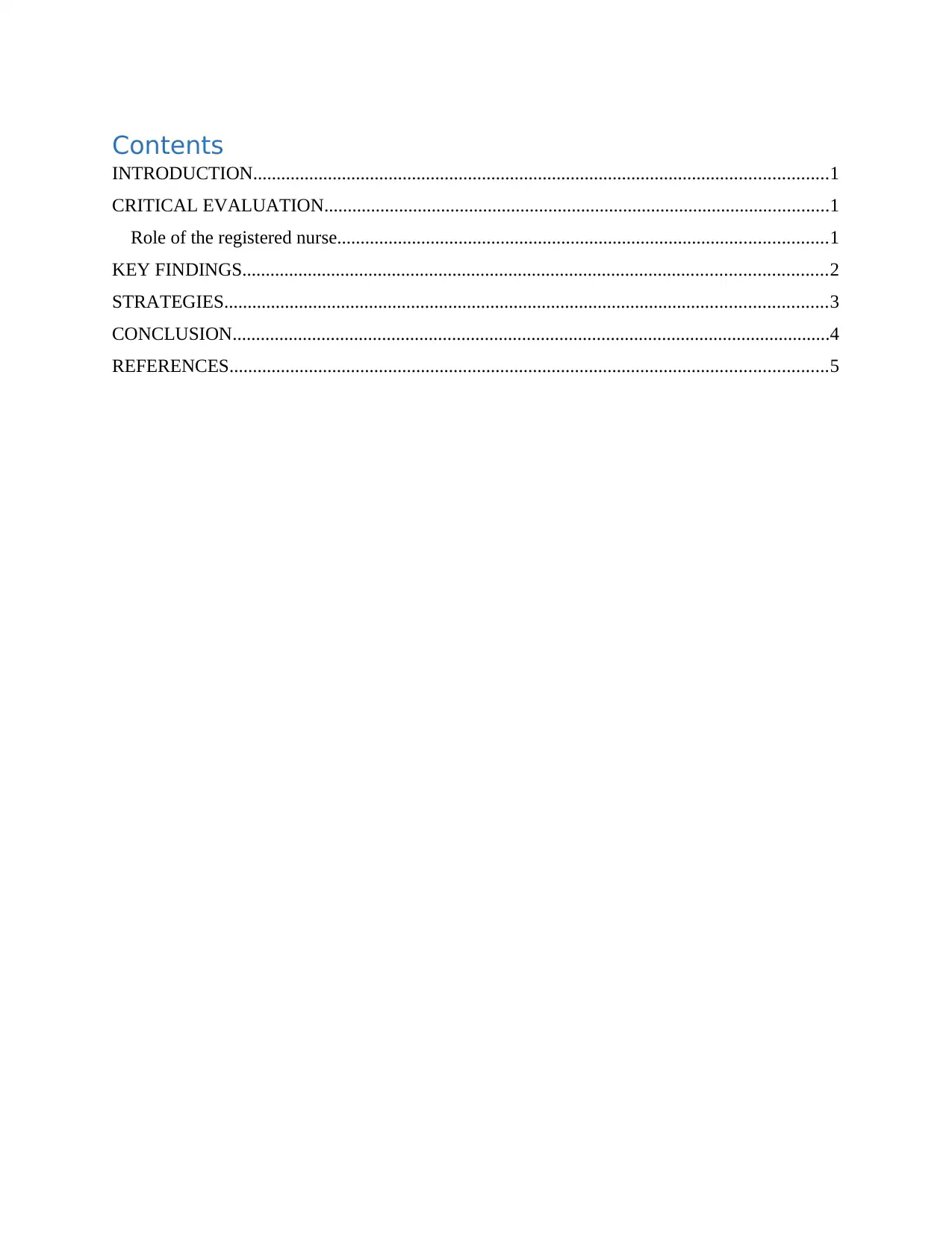
INTRODUCTION...........................................................................................................................1
CRITICAL EVALUATION............................................................................................................1
Role of the registered nurse.........................................................................................................1
KEY FINDINGS.............................................................................................................................2
STRATEGIES.................................................................................................................................3
CONCLUSION................................................................................................................................4
REFERENCES................................................................................................................................5
INTRODUCTION...........................................................................................................................1
CRITICAL EVALUATION............................................................................................................1
Role of the registered nurse.........................................................................................................1
KEY FINDINGS.............................................................................................................................2
STRATEGIES.................................................................................................................................3
CONCLUSION................................................................................................................................4
REFERENCES................................................................................................................................5
INTRODUCTION
Professional responsibility as applied to nurses refers to the ethical and moral obligations
permeating the nursing profession. There are various roles which nurses needs to be performed
by nurses while taking care of patients, it includes recording medical history, collaborating with
team and monitoring patient’s health conditions. Present case study is based on nurse’s role
which they perform in intensive care unit while treating patients suffering from COVID-19.
Professional responsibility is selected as the topic as it provides competent level of care in each
phase of nursing process. Standards based on professional practice are important as it assists in
promoting clinical practice.
CRITICAL EVALUATION
Role of the registered nurse
Many changes are occurring in healthcare, in areas ranging from technology to the delivery
of patient care. As stated by Maridon et.al., (2017) during the time of this adverse situation,
nurses have taken on the responsibility to take care of patients who are suffering from COVID-
19. They are working day and night with limited resources to provide intense treatment to
patients. The case study is based on nurse’s professional responsibility in intensive care unit. In
the present case situation nurse has also described the issues which they face while taking care of
patients. They say that it is emotionally exhausting to see people die in ICU alone without their
loved ones and families. The code of ethics provides nurses with the guidance for how to react in
situation of pandemic. It is the professional duty if nurse to decide about how much high quality
of care they need to give to patients while taking care of themselves and also their family
members. It has also been analysed that in this situation of pandemic, nurses are bound to
maintain integrity and also they need to understand needs of employer and employee.
In the opinion of Kelly et.al., (2017) nurses has a choice to respond, and they have a right to
not respond if they feel unsafe in a situation or even they can back out if there is unavailability of
personal protection equipment’s or there is a lack of support for in meeting out nurses personal
and family needs. Nurses are also allowed to get cut off from the situation if they have any doubt
related to personal, professional and legal protection.
Professional duty of nurses in present case situation is to analyse needs and demands of
patients during such adverse time. They need to act patiently and also provide adequate support
to patients. Case study has provided the details that performing these duties has become really
1
Professional responsibility as applied to nurses refers to the ethical and moral obligations
permeating the nursing profession. There are various roles which nurses needs to be performed
by nurses while taking care of patients, it includes recording medical history, collaborating with
team and monitoring patient’s health conditions. Present case study is based on nurse’s role
which they perform in intensive care unit while treating patients suffering from COVID-19.
Professional responsibility is selected as the topic as it provides competent level of care in each
phase of nursing process. Standards based on professional practice are important as it assists in
promoting clinical practice.
CRITICAL EVALUATION
Role of the registered nurse
Many changes are occurring in healthcare, in areas ranging from technology to the delivery
of patient care. As stated by Maridon et.al., (2017) during the time of this adverse situation,
nurses have taken on the responsibility to take care of patients who are suffering from COVID-
19. They are working day and night with limited resources to provide intense treatment to
patients. The case study is based on nurse’s professional responsibility in intensive care unit. In
the present case situation nurse has also described the issues which they face while taking care of
patients. They say that it is emotionally exhausting to see people die in ICU alone without their
loved ones and families. The code of ethics provides nurses with the guidance for how to react in
situation of pandemic. It is the professional duty if nurse to decide about how much high quality
of care they need to give to patients while taking care of themselves and also their family
members. It has also been analysed that in this situation of pandemic, nurses are bound to
maintain integrity and also they need to understand needs of employer and employee.
In the opinion of Kelly et.al., (2017) nurses has a choice to respond, and they have a right to
not respond if they feel unsafe in a situation or even they can back out if there is unavailability of
personal protection equipment’s or there is a lack of support for in meeting out nurses personal
and family needs. Nurses are also allowed to get cut off from the situation if they have any doubt
related to personal, professional and legal protection.
Professional duty of nurses in present case situation is to analyse needs and demands of
patients during such adverse time. They need to act patiently and also provide adequate support
to patients. Case study has provided the details that performing these duties has become really
1
⊘ This is a preview!⊘
Do you want full access?
Subscribe today to unlock all pages.

Trusted by 1+ million students worldwide
exhaustive for nurses, they are emotionally drained. Nurses say that health workers are only sort
of connection patients have with their families in their final moments. Riklikiene, Karosas &
Kaseliene, (2018) describes that it is the professional responsibility of nurse to identify physical
and personal needs of patients. Main role of nurse is to analyse patients interest and to establish
professional dignity and integrity throughout procedure of treatment. Nurses are facing high
level of risks and the utmost risk is being faced by those who are working in ICU. Health care
workers are only persons who are held responsible for holding on responsibility and
accountability for providing adequate support to patients. These are the people who serve as a
network between needs of patients and the various other department in hospital.
As per the view of Harkin, (2020) nurses are aware of the issues that can be faced by them
while providing high quality of care during this critical time. They have also provided details
about how their productivity can be improved. Nurses make sure that patient in ICU is their first
priority and also they make sure that care is been provided with dignity and integrity. It is a
professional responsibility of nurses to be engaged in making proper planning related to care.
They must be engaged in evaluating vital signs and also assessing cause of problem faced by
patient so that proper treatment can be provided and this will assist them in improvising health
outcome of patient who are been suffering from COVID-18 and are also been admitted to
intensive care unit. Patients interest needs to be taken into account when decisions related to
them are been taken (Covid-19: balancing personal risk and professional duty, (2020). The key
area on which nurses utmost attention is needed that nurses must be involved in monitoring signs
and symptoms of patient and communicating them to health care professional so that adequate
care can be provided. They should also discuss problems faced by COVID-19 patients to other
team members. Patient educational support also comes under the professional responsibility of
nurses. They must be engaged in making sure that service user has best knowledge related to
illness, treatment and medication which is being provided to them. It is really crucial so that
health outcome of patient can be improved.
KEY FINDINGS
When a graduate nurse enters the workforce during the time of pandemic, it is really
necessary that they have knowledge of their professional responsibility and also they need to
perform it when nurses are addressing patients. It has been analysed that they need to focus on
team work and to make use of innovative techniques and measures which can assist them in
2
of connection patients have with their families in their final moments. Riklikiene, Karosas &
Kaseliene, (2018) describes that it is the professional responsibility of nurse to identify physical
and personal needs of patients. Main role of nurse is to analyse patients interest and to establish
professional dignity and integrity throughout procedure of treatment. Nurses are facing high
level of risks and the utmost risk is being faced by those who are working in ICU. Health care
workers are only persons who are held responsible for holding on responsibility and
accountability for providing adequate support to patients. These are the people who serve as a
network between needs of patients and the various other department in hospital.
As per the view of Harkin, (2020) nurses are aware of the issues that can be faced by them
while providing high quality of care during this critical time. They have also provided details
about how their productivity can be improved. Nurses make sure that patient in ICU is their first
priority and also they make sure that care is been provided with dignity and integrity. It is a
professional responsibility of nurses to be engaged in making proper planning related to care.
They must be engaged in evaluating vital signs and also assessing cause of problem faced by
patient so that proper treatment can be provided and this will assist them in improvising health
outcome of patient who are been suffering from COVID-18 and are also been admitted to
intensive care unit. Patients interest needs to be taken into account when decisions related to
them are been taken (Covid-19: balancing personal risk and professional duty, (2020). The key
area on which nurses utmost attention is needed that nurses must be involved in monitoring signs
and symptoms of patient and communicating them to health care professional so that adequate
care can be provided. They should also discuss problems faced by COVID-19 patients to other
team members. Patient educational support also comes under the professional responsibility of
nurses. They must be engaged in making sure that service user has best knowledge related to
illness, treatment and medication which is being provided to them. It is really crucial so that
health outcome of patient can be improved.
KEY FINDINGS
When a graduate nurse enters the workforce during the time of pandemic, it is really
necessary that they have knowledge of their professional responsibility and also they need to
perform it when nurses are addressing patients. It has been analysed that they need to focus on
team work and to make use of innovative techniques and measures which can assist them in
2
Paraphrase This Document
Need a fresh take? Get an instant paraphrase of this document with our AI Paraphraser
analysing patient’s condition remotely. Nurses also needs to assess the ethical principles; they
need to make sure that fair access to services are been provided to those irrespective of their
medical conditions. Graduate nurses also have professional responsibility to identify ethical
issues which are affecting care of patients and is also affecting staff members. It is also their
professional duty to identify clients emotional need when they are being admitted in intensive
care unit. They are also required to make use of holistic approach in order to manage patients,
they can also address patients cultural, mental and spiritual needs (Santos et.al., (2016).
There are chances that patients may have different demands because of their religion or
gender. All these needs to be addressed during the time of taking care of patients in intensive
care unit suffering from corona virus. Nurses are also provided with the duty to advocate their
patients; they must be working towards protecting legal rights and also respect needs to be
provided for self-determination of patients. These responsibilities need to be performed nurses so
that professionalism can be maintained in intensive care unit while providing patients with
treatment facilities. They also need to have proper knowledge about the education related to
medications given in treating COVID-19 (Schmidt & McArthur, (2018). This has assisted them
in enhancing health outcome of patient. They should have a feeling of respect and mortality with
those working with them and also with service user. It has also been evaluated that nurses needs
to be calm and compose as this job can be emotionally exhausted. They also need to collaborate
with health care professionals so that adequate care can be provided to those who are in need.
This has assisted them in enhancing wellbeing and quality of life.
STRATEGIES
In the time of pandemic it has been stated by Beuthin, Bruce & Scaia, (2018) the
professional roles and responsibilities for nurse has been changed in order to meet out the needs
of patient, hospital and families. To cope up with this infectious out breaks following strategies
can be adopted by nurses:
Effective communication is one of the most important technique which can be used by
nurses while treating patients during time of pandemic. In this nurses can be engaged in
interacting with physicians and other team members so that proper and adequate care can be
provided to patient as they are the only connection between their families and patient. It is the
professional duty of nurse to have better interaction.
3
need to make sure that fair access to services are been provided to those irrespective of their
medical conditions. Graduate nurses also have professional responsibility to identify ethical
issues which are affecting care of patients and is also affecting staff members. It is also their
professional duty to identify clients emotional need when they are being admitted in intensive
care unit. They are also required to make use of holistic approach in order to manage patients,
they can also address patients cultural, mental and spiritual needs (Santos et.al., (2016).
There are chances that patients may have different demands because of their religion or
gender. All these needs to be addressed during the time of taking care of patients in intensive
care unit suffering from corona virus. Nurses are also provided with the duty to advocate their
patients; they must be working towards protecting legal rights and also respect needs to be
provided for self-determination of patients. These responsibilities need to be performed nurses so
that professionalism can be maintained in intensive care unit while providing patients with
treatment facilities. They also need to have proper knowledge about the education related to
medications given in treating COVID-19 (Schmidt & McArthur, (2018). This has assisted them
in enhancing health outcome of patient. They should have a feeling of respect and mortality with
those working with them and also with service user. It has also been evaluated that nurses needs
to be calm and compose as this job can be emotionally exhausted. They also need to collaborate
with health care professionals so that adequate care can be provided to those who are in need.
This has assisted them in enhancing wellbeing and quality of life.
STRATEGIES
In the time of pandemic it has been stated by Beuthin, Bruce & Scaia, (2018) the
professional roles and responsibilities for nurse has been changed in order to meet out the needs
of patient, hospital and families. To cope up with this infectious out breaks following strategies
can be adopted by nurses:
Effective communication is one of the most important technique which can be used by
nurses while treating patients during time of pandemic. In this nurses can be engaged in
interacting with physicians and other team members so that proper and adequate care can be
provided to patient as they are the only connection between their families and patient. It is the
professional duty of nurse to have better interaction.
3
Nurses also have another professional duty and role which is to administer medications
provided to patients. This strategy can be useful as most patients with symptomatic MERS-CoV
are going through breathing difficulties. For this they need to analyse medications as they can
need nebulised medicines. If this is not being analysed, then risk of virus to be airborne
increases.
Nurses after graduation who are placed in ICU, also needs to be engaged in evaluating
patient’s health. As stated by Dowie, (2017) they need to monitor signs and symptoms related to
corona virus so that proper assistance and care can be given to patients. This will assist in
enhancing health outcome of patients. Monitoring is essential as if not done then it can develop
into kidney failure and ARDS.
CONCLUSION
From the above study it has been summarised that there has been various professional roles
and responsibilities of nurses which have been performed by them during this pandemic
situation. It has also been analysed that nurses while treating patients in ICU can be emotionally
drained as they are only connection left between patient and their family members. It has also
been summarised that nurses have adequate knowledge related to patient’s medical history and
have performed their responsibilities with integrity and dignity. Thus, has assisted them in
enhancing quality of life and wellbeing of patients.
4
provided to patients. This strategy can be useful as most patients with symptomatic MERS-CoV
are going through breathing difficulties. For this they need to analyse medications as they can
need nebulised medicines. If this is not being analysed, then risk of virus to be airborne
increases.
Nurses after graduation who are placed in ICU, also needs to be engaged in evaluating
patient’s health. As stated by Dowie, (2017) they need to monitor signs and symptoms related to
corona virus so that proper assistance and care can be given to patients. This will assist in
enhancing health outcome of patients. Monitoring is essential as if not done then it can develop
into kidney failure and ARDS.
CONCLUSION
From the above study it has been summarised that there has been various professional roles
and responsibilities of nurses which have been performed by them during this pandemic
situation. It has also been analysed that nurses while treating patients in ICU can be emotionally
drained as they are only connection left between patient and their family members. It has also
been summarised that nurses have adequate knowledge related to patient’s medical history and
have performed their responsibilities with integrity and dignity. Thus, has assisted them in
enhancing quality of life and wellbeing of patients.
4
⊘ This is a preview!⊘
Do you want full access?
Subscribe today to unlock all pages.
Trusted by 1+ million students worldwide
REFERENCES
Books and Journals
Beuthin, R., Bruce, A., & Scaia, M. (2018, October). Medical assistance in dying (MAiD):
Canadian nurses’ experiences. In Nursing forum (Vol. 53, No. 4, pp. 511-520).
DOI:10.1136/bmj.m3898
Bindon, S.L., 2017. Professional development strategies to enhance nurses’ knowledge and
maintain safe practice. Aorn Journal.106(2). pp.99-110. doi: 10.1177
Dowie, I. (2017). Legal, ethical and professional aspects of duty of care for nurses. Nursing
Standard.32. doi: 10.7748/ns.2017.e10959
Harkin, D. W. (2020). Covid-19: balancing personal risk and professional duty. BMJ: British
Medical Journal (Online). 369. doi: 10.1136/bmj.m1606
Jacobs, G., 2019. Patient autonomy in home care: Nurses’ relational practices of
responsibility. Nursing ethics.26(6). pp.1638-1653. doi: 10.7784/ns. 2018.e10959
Kelly, M., Wills, J., Jester, R., & Speller, V. (2017). Should nurses be role models for healthy
lifestyles? Results from a modified Delphi study. Journal of advanced nursing, 73(3),
665-678. DOI:10.1146/jmk.m3898
Maridor, M., Ruch, S., Bangerter, A., & Emery, V. (2017). Skepticism toward emerging
infectious diseases and influenza vaccination intentions in nurses. Journal of health
communication.22(5). 386-394. doi: 10.7754/ns. 2018.e10959
Riklikiene, O., Karosas, L., & Kaseliene, S. (2018). General and professional values of student
nurses and nurse educators. Journal of advanced nursing.74(3). 666-676.
doi.org/10.1111/scs.12337
Santos, A. P. A., Camelo, S. H. H., Santos, F. C. D., Leal, L. A., & Silva, B. R. D. (2016).
Nurses in post-operative heart surgery: professional competencies and organization
strategies. Revista da Escola de Enfermagem da USP. 50(3). 474-481.
doi.org/10.1111/inm.12230
Schmidt, B. J., & McArthur, E. C. (2018, January). Professional nursing values: A concept
analysis. In Nursing forum (Vol. 53, No. 1, pp. 69-75). doi.org/10.1111/scs.12337
Online
Covid-19: balancing personal risk and professional duty. (2020). [ONLINE] Available through:
< https://search.proquest.com/openview/fa9f32aa76ea4ea95554688ffef70fc8/1?pq-
origsite=gscholar&cbl=2043523 >
5
Books and Journals
Beuthin, R., Bruce, A., & Scaia, M. (2018, October). Medical assistance in dying (MAiD):
Canadian nurses’ experiences. In Nursing forum (Vol. 53, No. 4, pp. 511-520).
DOI:10.1136/bmj.m3898
Bindon, S.L., 2017. Professional development strategies to enhance nurses’ knowledge and
maintain safe practice. Aorn Journal.106(2). pp.99-110. doi: 10.1177
Dowie, I. (2017). Legal, ethical and professional aspects of duty of care for nurses. Nursing
Standard.32. doi: 10.7748/ns.2017.e10959
Harkin, D. W. (2020). Covid-19: balancing personal risk and professional duty. BMJ: British
Medical Journal (Online). 369. doi: 10.1136/bmj.m1606
Jacobs, G., 2019. Patient autonomy in home care: Nurses’ relational practices of
responsibility. Nursing ethics.26(6). pp.1638-1653. doi: 10.7784/ns. 2018.e10959
Kelly, M., Wills, J., Jester, R., & Speller, V. (2017). Should nurses be role models for healthy
lifestyles? Results from a modified Delphi study. Journal of advanced nursing, 73(3),
665-678. DOI:10.1146/jmk.m3898
Maridor, M., Ruch, S., Bangerter, A., & Emery, V. (2017). Skepticism toward emerging
infectious diseases and influenza vaccination intentions in nurses. Journal of health
communication.22(5). 386-394. doi: 10.7754/ns. 2018.e10959
Riklikiene, O., Karosas, L., & Kaseliene, S. (2018). General and professional values of student
nurses and nurse educators. Journal of advanced nursing.74(3). 666-676.
doi.org/10.1111/scs.12337
Santos, A. P. A., Camelo, S. H. H., Santos, F. C. D., Leal, L. A., & Silva, B. R. D. (2016).
Nurses in post-operative heart surgery: professional competencies and organization
strategies. Revista da Escola de Enfermagem da USP. 50(3). 474-481.
doi.org/10.1111/inm.12230
Schmidt, B. J., & McArthur, E. C. (2018, January). Professional nursing values: A concept
analysis. In Nursing forum (Vol. 53, No. 1, pp. 69-75). doi.org/10.1111/scs.12337
Online
Covid-19: balancing personal risk and professional duty. (2020). [ONLINE] Available through:
< https://search.proquest.com/openview/fa9f32aa76ea4ea95554688ffef70fc8/1?pq-
origsite=gscholar&cbl=2043523 >
5

1 out of 7


Related Documents


Your All-in-One AI-Powered Toolkit for Academic Success.
+13062052269
info@desklib.com
Available 24*7 on WhatsApp / Email
![[object Object]](/_next/static/media/star-bottom.7253800d.svg)
Unlock your academic potential
Copyright © 2020–2026 A2Z Services. All Rights Reserved. Developed and managed by ZUCOL.