Student Plagiarism and Professional Practice in Nursing Education

Verified

Added on  2020/01/28

|7
|2228
|100
Essay
AI Summary
This essay delves into the critical issue of student plagiarism and its profound impact on professional practice, particularly within the field of nursing education. It explores the pervasive nature of plagiarism, facilitated by easy access to online information, and its implications for academic integrity and ethical conduct. The essay highlights the detrimental effects of plagiarism, including the degradation of learning quality and the erosion of trust within the profession. It examines the various forms of plagiarism, such as direct copying and the misuse of sources, and discusses the underlying causes, including time constraints and a lack of understanding of ethical principles. The author emphasizes the importance of fostering ethical behavior through education, role modeling by professionals, and the implementation of strict penalties. The essay concludes by advocating for a holistic approach that combines education, ethical guidelines, and technological solutions to combat plagiarism and promote academic honesty, ensuring that students develop the necessary knowledge and skills for their future careers. The author reflects on their own learning journey, emphasizing the significance of acquiring knowledge to avoid plagiarism.
Document Page
STUDENT PLAGIARISM
AND PROFESSIONAL
PRACTICE
tabler-icon-diamond-filled.svg

Paraphrase This Document

Need a fresh take? Get an instant paraphrase of this document with our AI Paraphraser
Document Page
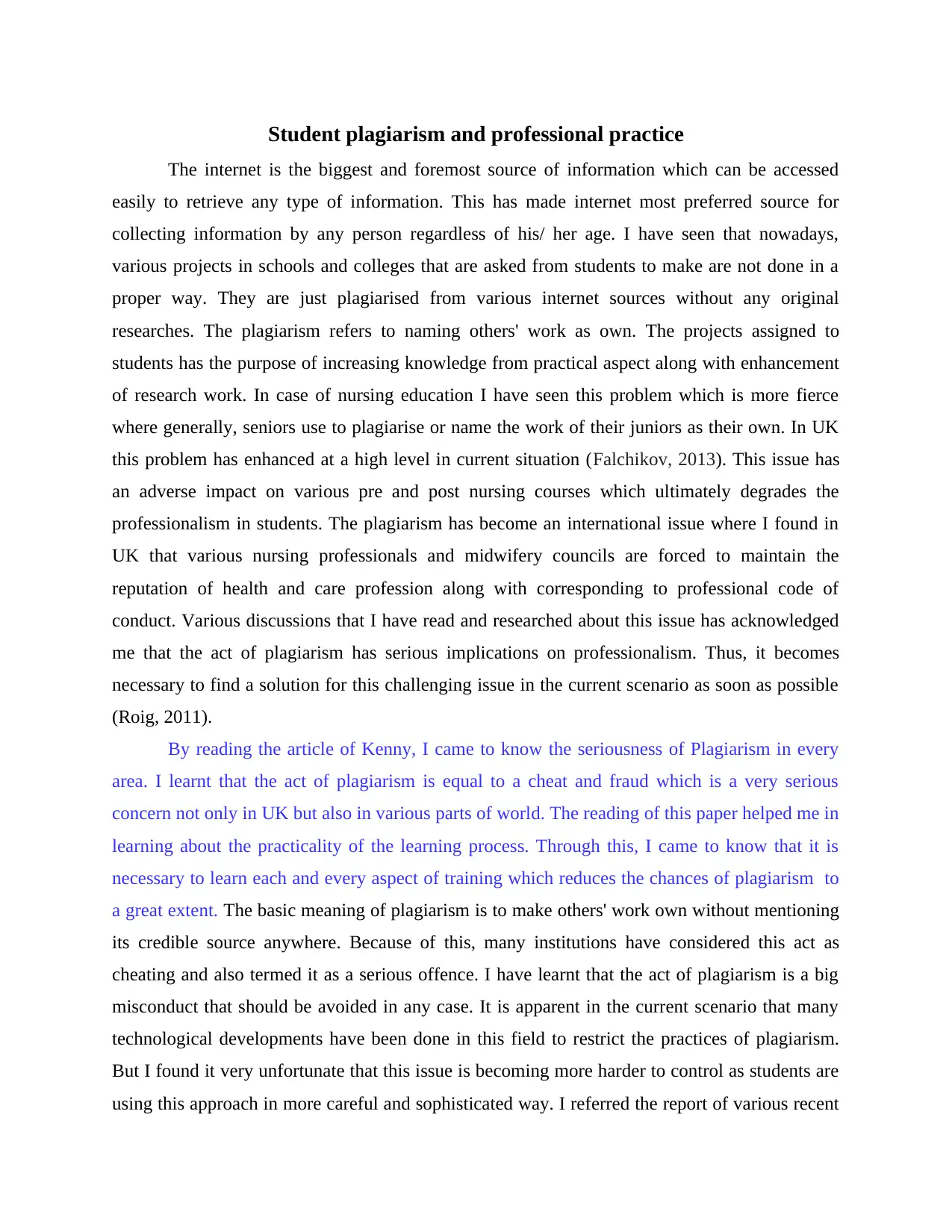
TABLE OF CONTENTS
Student plagiarism and professional practice..................................................................................3
REFERENCES................................................................................................................................7
Document Page
Student plagiarism and professional practice
The internet is the biggest and foremost source of information which can be accessed
easily to retrieve any type of information. This has made internet most preferred source for
collecting information by any person regardless of his/ her age. I have seen that nowadays,
various projects in schools and colleges that are asked from students to make are not done in a
proper way. They are just plagiarised from various internet sources without any original
researches. The plagiarism refers to naming others' work as own. The projects assigned to
students has the purpose of increasing knowledge from practical aspect along with enhancement
of research work. In case of nursing education I have seen this problem which is more fierce
where generally, seniors use to plagiarise or name the work of their juniors as their own. In UK
this problem has enhanced at a high level in current situation (Falchikov, 2013). This issue has
an adverse impact on various pre and post nursing courses which ultimately degrades the
professionalism in students. The plagiarism has become an international issue where I found in
UK that various nursing professionals and midwifery councils are forced to maintain the
reputation of health and care profession along with corresponding to professional code of
conduct. Various discussions that I have read and researched about this issue has acknowledged
me that the act of plagiarism has serious implications on professionalism. Thus, it becomes
necessary to find a solution for this challenging issue in the current scenario as soon as possible
(Roig, 2011).
By reading the article of Kenny, I came to know the seriousness of Plagiarism in every
area. I learnt that the act of plagiarism is equal to a cheat and fraud which is a very serious
concern not only in UK but also in various parts of world. The reading of this paper helped me in
learning about the practicality of the learning process. Through this, I came to know that it is
necessary to learn each and every aspect of training which reduces the chances of plagiarism to
a great extent. The basic meaning of plagiarism is to make others' work own without mentioning
its credible source anywhere. Because of this, many institutions have considered this act as
cheating and also termed it as a serious offence. I have learnt that the act of plagiarism is a big
misconduct that should be avoided in any case. It is apparent in the current scenario that many
technological developments have been done in this field to restrict the practices of plagiarism.
But I found it very unfortunate that this issue is becoming more harder to control as students are
using this approach in more careful and sophisticated way. I referred the report of various recent
Document Page
medical councils through which it was discovered that these councils have considered this issue
in case of medical students who are currently practising. Various senior associated who are
concerned with this issue has left this issue of fraud or plagiarism on individual medical schools
(Lampert, 2014). Further, different medical councils have commonly agreed that related
authorities must make some new laws in this regard so that this situation can be ameliorated.
However, the authorities suggest that individual medical councils and colleges may resolve this
issue by constructing some rules by posing penalties as they consider fit for restricting mentioned
practice. By reading the article on plagiarism I have come to know that this act is much serious
concern in present time which should be resolved as soon as possible.
The reading of articles has asserted that plagiarism can be done through many ways
which is most probably comes out of group tasks. There are more possibilities in group works
that student do their work as a team and of them may claim the entire work as his own. Similarly,
I have noted that most of the times students use to help each other and submit their copied work
from friends. Another way is internet where nowadays many sites have come on internet which
provide free or chargeable essays on desired topics (Angélil-Carter, 2014). Thus, overall more
than 30% students use to copy the material of assignments and researches from internet and
many other sources. In this concern, the professor of Singapore has admitted this practice as
Alteration and amendment. The problem has affected not only UK but various other countries as
well.
As per the various researches and articles, I think that solution to this problem can be
developed with the help of moral principles. It is necessary for student s to know about ethics
and morality so that they can successfully decide that what is right an d what is wrong. In various
professions like nursing, before registration to become a professional practitioner, it is necessary
that student develops within themselves assorted ethical and moral principles (Elander and et.al.,
2010). The professional qualification of a student should not be just limited to their degrees but it
should be extended to honesty and trustworthiness as well. This is necessary as the student who
is indulging in plagiarism at any stage of learning and training will not gain the required
knowledge. This will be a definite loss for students and also for the institution promoting that
student.
As a student, I learned that learning is the best thing that a person can do to avoid the this
fraud related to plagiarism. By reading this article, I came to know that by due to p[lagiarism the
tabler-icon-diamond-filled.svg

Paraphrase This Document

Need a fresh take? Get an instant paraphrase of this document with our AI Paraphraser
Document Page
quality of education and learning is degrading which is a serious concern fir everyone. Every one
is dependent on different sources from where they can copy the work and make it their own. By
the researches I found many reasons due to which students use to do plagiarism. In context of
nursing students, there is a difficult task for them to balance the life between academic practices
along with various competencies required in profession. Further, it is also manifested that in this
profession that many of the students entering this field are enough matured and married. As per
this, it becomes very difficult for them to manage the work of academics and their parental
responsibilities (Löfström & Kupila, 2013). Most of the times the work load become heavy
which makes enough pressurising for students to manage their work and maintaining quality in
it. This becomes some obvious reason which has increased the practice of plagiarism. For this, it
is necessary to maintain basic values by the key professionals so that they can develop the moral
and necessary values within students whether thay are entering in pre or post registration. In my
point of view whatever be the reason of plagiarism, it cannot lessen the impact and result of the
act (Heitman & Litewka, 2011). But, it is necessary to remove this issue from the scenario as
bounding into a professional code of conduct and posing some penalties will not fulfil the
purpose in proper way. Here, the professionals and higher authorities should work as a role
model by keeping themselves as the example before students so that they can develop values and
ethics. This example of presenting the role model should be presented at each and every stage of
assigning work, giving seminars and sharing information.
The ethical concern in this issue lies with honesty which is necessary to be maintained.
But involving in plagiarism leads to a kind of fraud whether it is done on any stage ( Jiang,
Emmerton & McKauge, 2013). In context of health care profession, I think this is a more serious
concern as cheating at the time of learning or training may cause a serious results for clients or
patients in future. Various practical cases have seen in such scenario where about 50% students
have admitted the act of plagiarism in nursing profession intentionally or unintentionally. This
act leads a serious damage to the professionalism. Therefore, it is necessary to take some strict
steps that can restrict student to execute this act. For enhancing their professional degree,
students use to indulge in act of cheating which if discovered may lead to serious consequences.
I think, for this concern, it is necessary to develop changes in current practices so that students
may develop their interest in learning instead of cheating (Kift, Nelson & Clarke, 2010).
Document Page
To restrict the practice of plagiarism, it is necessary to develop new policies and norms
necessary to confine practice of plagiarism. I also recommend that the institutions on individual
basis and various councils commonly develop some rules in this regard so that students can
maintain transparency in their work. The institutions may make a formal and common meeting
among themselves to discuss the matter. The high professionals should make students to
understand the necessity of fairness in their work in present and future context as well. The strict
implementation of penalties in the case of plagiarism should be posed which should be detected
from highly efficient software (Xiao, 2010). In addition, the development of ethical and moral
concerns among students will be the most useful tool for restricting the practice of plagiarism.
With the help of Kenny's article, I have understood the concept of plagiarism in better
perspective and its necessity to be avoided. Now I am also able to avoid such circumstance by
increasing my actual knowledge so that there will be no need of doing plagiarism from
anywhere. This has increased my experience related with the issues related to plagiarism and its
ill effects so I will also make my best efforts to minimise the plagiarism in my work.
By summarising the entire study, I found that the plagiarism is a serious concern that
should be solved as soon as possible. It is also evident that students who are under training in the
nursing profession also use to indulge in cheating which leads to fraudulent practices with
clients. For solving this problem it is necessary that the higher authorities set examples before
students and develop the sense of values and ethical behaviour so that work can be maintained
without any plagiarism (Evering & Moorman, 2012)..
Document Page
REFERENCES
Journals and Books
Angélil-Carter, S. (2014). Stolen language?: Plagiarism in writing. Routledge.
Elander, J. and et.al., (2010). Evaluation of an intervention to help students avoid unintentional
plagiarism by improving their authorial identity. Assessment & Evaluation in Higher
Education. 35(2). 157-171.
Evering, L. C., & Moorman, G. (2012). Rethinking plagiarism in the digital age. Journal of
Adolescent & Adult Literacy. 56(1). 35-44.
Falchikov, N. (2013). Improving assessment through student involvement: Practical solutions for
aiding learning in higher and further education. Routledge.
Heitman, E., & Litewka, S. (2011, February). International perspectives on plagiarism and
considerations for teaching international trainees. In Urologic Oncology: Seminars and
Original Investigations (Vol. 29, No. 1, pp. 104-108). Elsevier.
Jiang, H., Emmerton, L., & McKauge, L. (2013). Academic integrity and plagiarism: a review of
the influences and risk situations for health students.Higher Education Research &
Development. 32(3). 369-380.
Kift, S. M., Nelson, K. J., & Clarke, J. A. (2010). Transition pedagogy: a third generation
approach to FYE: a case study of policy and practice for the higher education sector. The
International Journal of the First Year in Higher Education. 1(1). 1-20.
Lampert, L. (2014). Combating student plagiarism: An academic librarian’s guide. Elsevier.
Löfström, E., & Kupila, P. (2013). The instructional challenges of student plagiarism. Journal of
Academic Ethics. 11(3). 231-242.
Roig, M. (2011). Avoiding plagiarism, self-plagiarism, and other questionable writing practices:
A guide to ethical writing.
Xiao, J. (2010). Integrating information literacy into Blackboard: Librarian-faculty collaboration
for successful student learning. Library Management,31(8/9). 654-668.
chevron_up_icon
1 out of 7
circle_padding
hide_on_mobile
zoom_out_icon
[object Object]