Conflict Resolution in Professional Practice Assignment Analysis

Verified

Added on  2023/03/17

|5
|1041
|93
Homework Assignment
AI Summary
This assignment analyzes a case study involving workplace conflict between Kristy and Tom, focusing on their interpersonal work relationship. The assignment begins by identifying the level of conflict reached by the individuals and justifying the response. It then outlines the four steps Kristy and Tom could follow to map the conflict, providing a detailed explanation of each step. The benefits of conflict mapping for both parties are discussed, highlighting how it can improve their understanding of workplace dynamics and build stronger relationships. The assignment concludes by exploring constructive responses Kristy and Tom could use to manage the conflict positively, emphasizing the importance of calm, respectful communication and avoiding harsh language. The analysis draws on relevant literature to support the arguments and recommendations for conflict resolution within a professional setting.
Document Page
Student’s Last Name 1
Professional Practice
By (Name)
Course
Professor
University
Date
tabler-icon-diamond-filled.svg

Paraphrase This Document

Need a fresh take? Get an instant paraphrase of this document with our AI Paraphraser
Document Page
Student’s Last Name 2
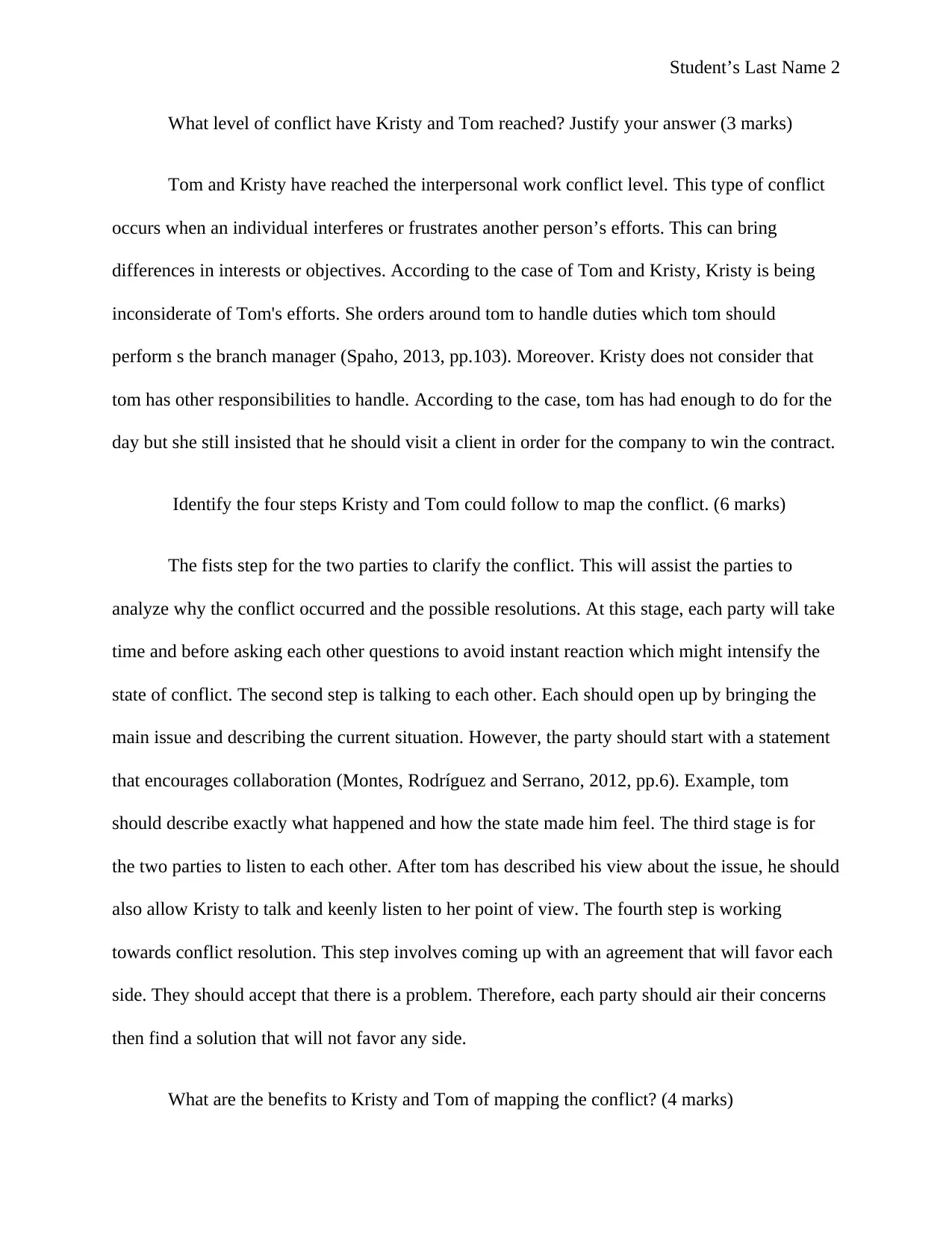
What level of conflict have Kristy and Tom reached? Justify your answer (3 marks)
Tom and Kristy have reached the interpersonal work conflict level. This type of conflict
occurs when an individual interferes or frustrates another person’s efforts. This can bring
differences in interests or objectives. According to the case of Tom and Kristy, Kristy is being
inconsiderate of Tom's efforts. She orders around tom to handle duties which tom should
perform s the branch manager (Spaho, 2013, pp.103). Moreover. Kristy does not consider that
tom has other responsibilities to handle. According to the case, tom has had enough to do for the
day but she still insisted that he should visit a client in order for the company to win the contract.
Identify the four steps Kristy and Tom could follow to map the conflict. (6 marks)
The fists step for the two parties to clarify the conflict. This will assist the parties to
analyze why the conflict occurred and the possible resolutions. At this stage, each party will take
time and before asking each other questions to avoid instant reaction which might intensify the
state of conflict. The second step is talking to each other. Each should open up by bringing the
main issue and describing the current situation. However, the party should start with a statement
that encourages collaboration (Montes, Rodríguez and Serrano, 2012, pp.6). Example, tom
should describe exactly what happened and how the state made him feel. The third stage is for
the two parties to listen to each other. After tom has described his view about the issue, he should
also allow Kristy to talk and keenly listen to her point of view. The fourth step is working
towards conflict resolution. This step involves coming up with an agreement that will favor each
side. They should accept that there is a problem. Therefore, each party should air their concerns
then find a solution that will not favor any side.
What are the benefits to Kristy and Tom of mapping the conflict? (4 marks)
Document Page
Student’s Last Name 3
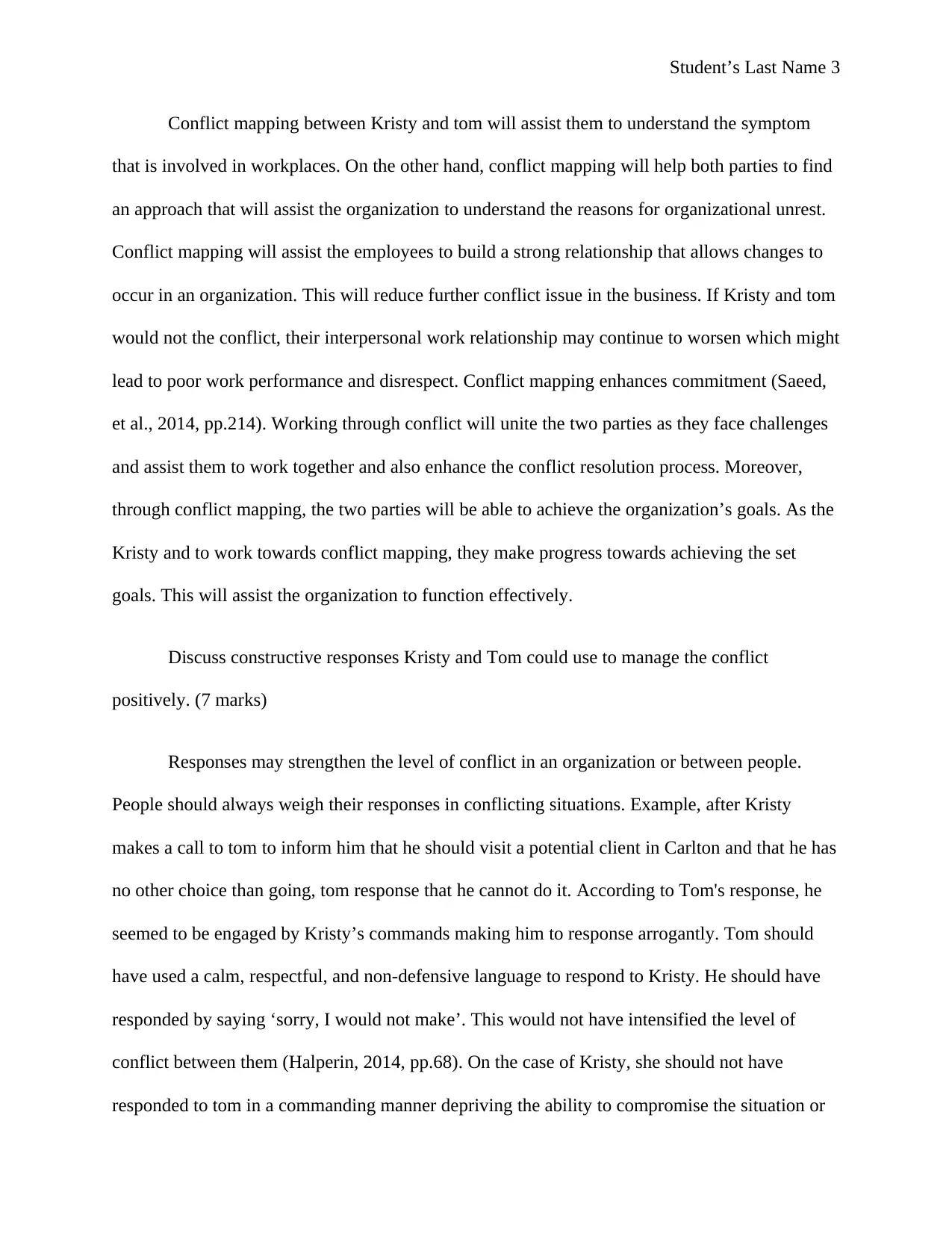
Conflict mapping between Kristy and tom will assist them to understand the symptom
that is involved in workplaces. On the other hand, conflict mapping will help both parties to find
an approach that will assist the organization to understand the reasons for organizational unrest.
Conflict mapping will assist the employees to build a strong relationship that allows changes to
occur in an organization. This will reduce further conflict issue in the business. If Kristy and tom
would not the conflict, their interpersonal work relationship may continue to worsen which might
lead to poor work performance and disrespect. Conflict mapping enhances commitment (Saeed,
et al., 2014, pp.214). Working through conflict will unite the two parties as they face challenges
and assist them to work together and also enhance the conflict resolution process. Moreover,
through conflict mapping, the two parties will be able to achieve the organization’s goals. As the
Kristy and to work towards conflict mapping, they make progress towards achieving the set
goals. This will assist the organization to function effectively.
Discuss constructive responses Kristy and Tom could use to manage the conflict
positively. (7 marks)
Responses may strengthen the level of conflict in an organization or between people.
People should always weigh their responses in conflicting situations. Example, after Kristy
makes a call to tom to inform him that he should visit a potential client in Carlton and that he has
no other choice than going, tom response that he cannot do it. According to Tom's response, he
seemed to be engaged by Kristy’s commands making him to response arrogantly. Tom should
have used a calm, respectful, and non-defensive language to respond to Kristy. He should have
responded by saying ‘sorry, I would not make’. This would not have intensified the level of
conflict between them (Halperin, 2014, pp.68). On the case of Kristy, she should not have
responded to tom in a commanding manner depriving the ability to compromise the situation or
Document Page
Student’s Last Name 4
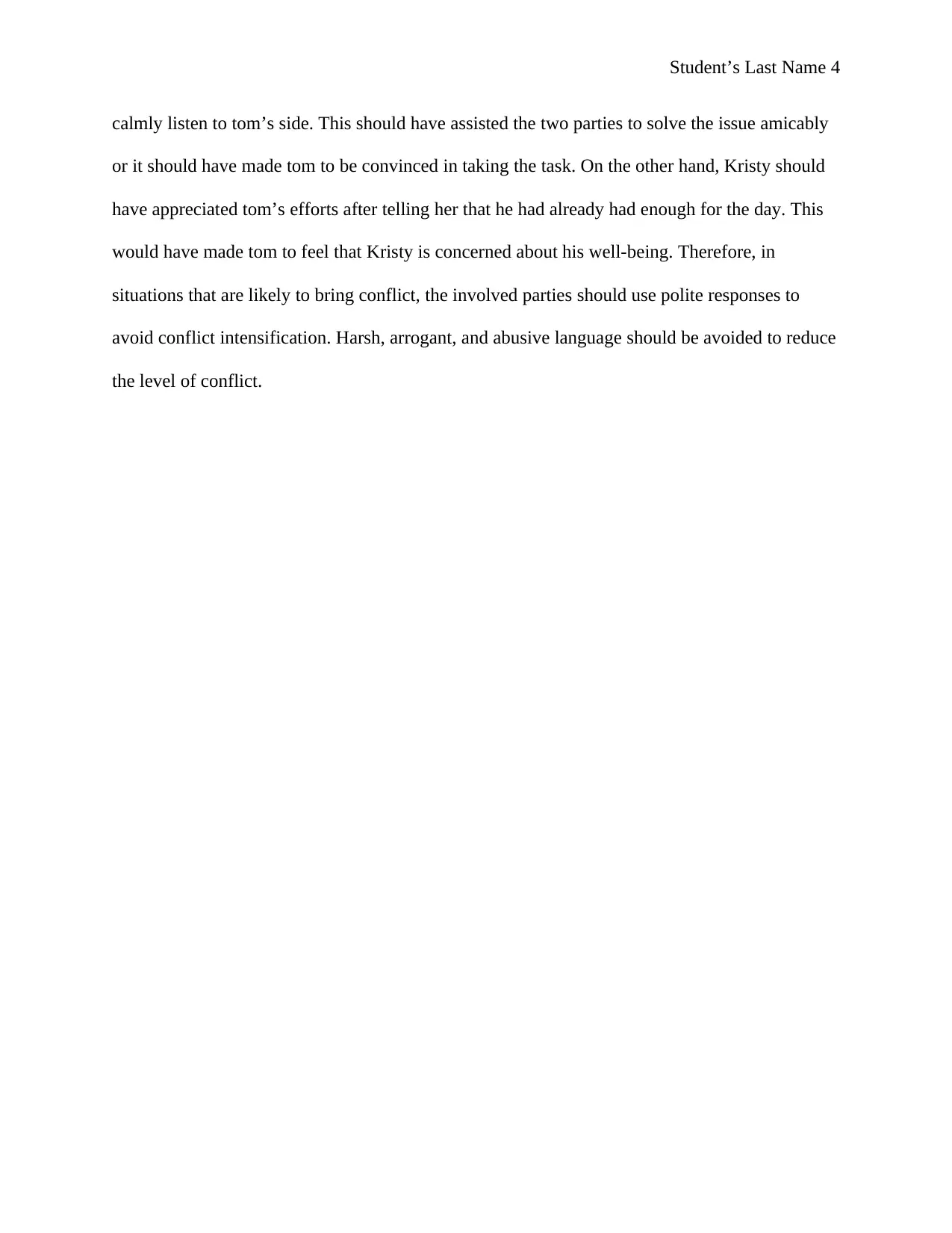
calmly listen to tom’s side. This should have assisted the two parties to solve the issue amicably
or it should have made tom to be convinced in taking the task. On the other hand, Kristy should
have appreciated tom’s efforts after telling her that he had already had enough for the day. This
would have made tom to feel that Kristy is concerned about his well-being. Therefore, in
situations that are likely to bring conflict, the involved parties should use polite responses to
avoid conflict intensification. Harsh, arrogant, and abusive language should be avoided to reduce
the level of conflict.
tabler-icon-diamond-filled.svg

Paraphrase This Document

Need a fresh take? Get an instant paraphrase of this document with our AI Paraphraser
Document Page
Student’s Last Name 5
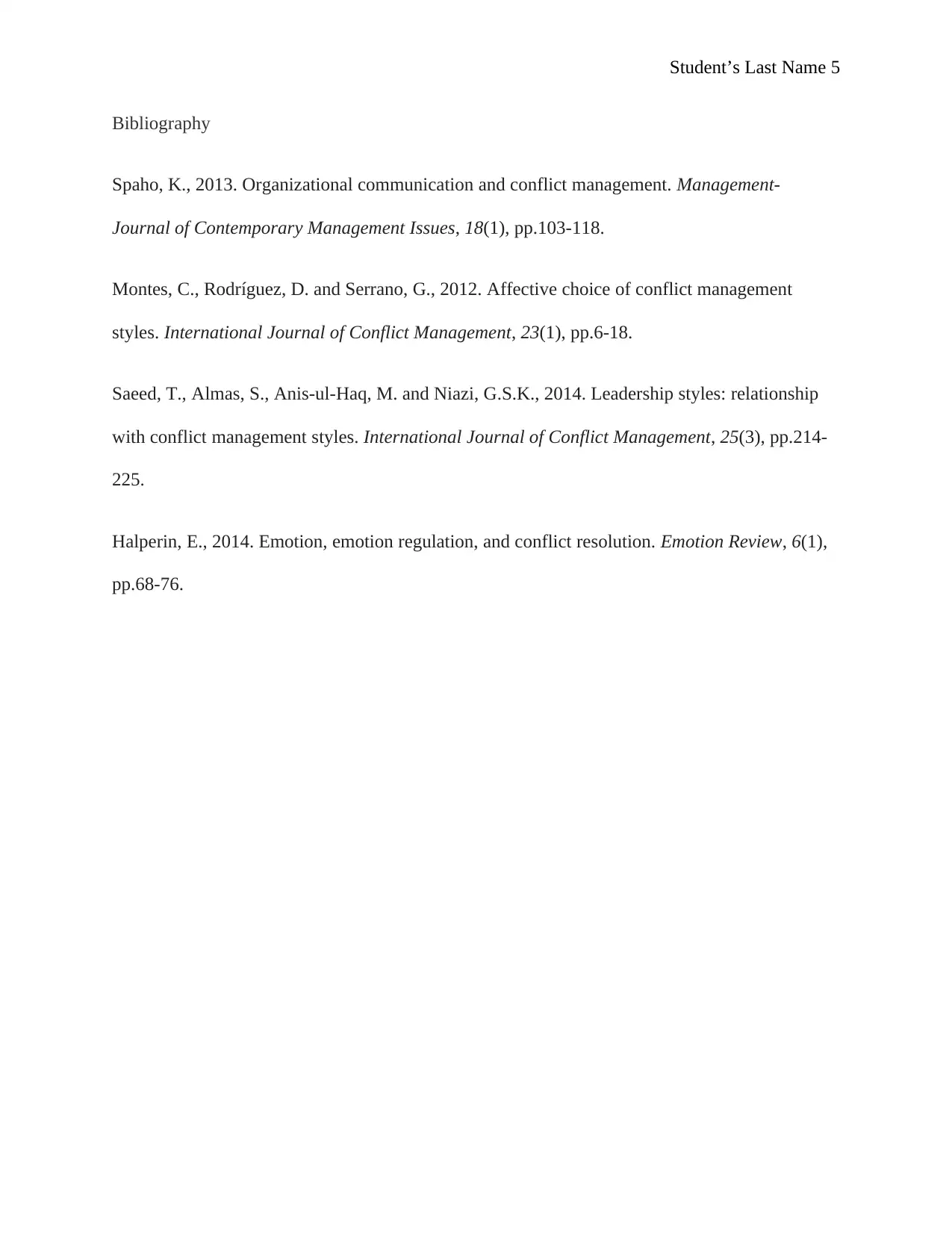
Bibliography
Spaho, K., 2013. Organizational communication and conflict management. Management-
Journal of Contemporary Management Issues, 18(1), pp.103-118.
Montes, C., Rodríguez, D. and Serrano, G., 2012. Affective choice of conflict management
styles. International Journal of Conflict Management, 23(1), pp.6-18.
Saeed, T., Almas, S., Anis-ul-Haq, M. and Niazi, G.S.K., 2014. Leadership styles: relationship
with conflict management styles. International Journal of Conflict Management, 25(3), pp.214-
225.
Halperin, E., 2014. Emotion, emotion regulation, and conflict resolution. Emotion Review, 6(1),
pp.68-76.
chevron_up_icon
1 out of 5
circle_padding
hide_on_mobile
zoom_out_icon
[object Object]