Economic, Social, and Environmental Analysis of Project Investments
VerifiedAdded on 2023/06/04
|10
|1870
|153
Essay
AI Summary
This essay provides an economic, social, and environmental analysis of project viability, emphasizing the importance of considering these factors in investment decisions. It discusses how conflicts arise between organizational goals and societal expectations, and proposes strategic solutions using financial tools such as NPV analysis, stakeholder engagement, and multi-criteria analysis. The essay explores how economic analysis, incorporating NPV and strategic management, can help organizations maximize returns while aligning with their vision and mission. It also examines environmental analysis through enterprise risk management and multi-criteria analysis to meet legal requirements and address unforeseen risks. Furthermore, the social analysis focuses on external stakeholder management and corporate strategic management to meet customer expectations and create customer value. The essay concludes by highlighting the importance of these strategies in resolving conflicts and ensuring project success.
By student name
Economics
Assignment
Economics
Assignment
Paraphrase This Document
Need a fresh take? Get an instant paraphrase of this document with our AI Paraphraser

1
Professor
University
Date: 23rd Sep 2018.
1 | Page
Professor
University
Date: 23rd Sep 2018.
1 | Page

2
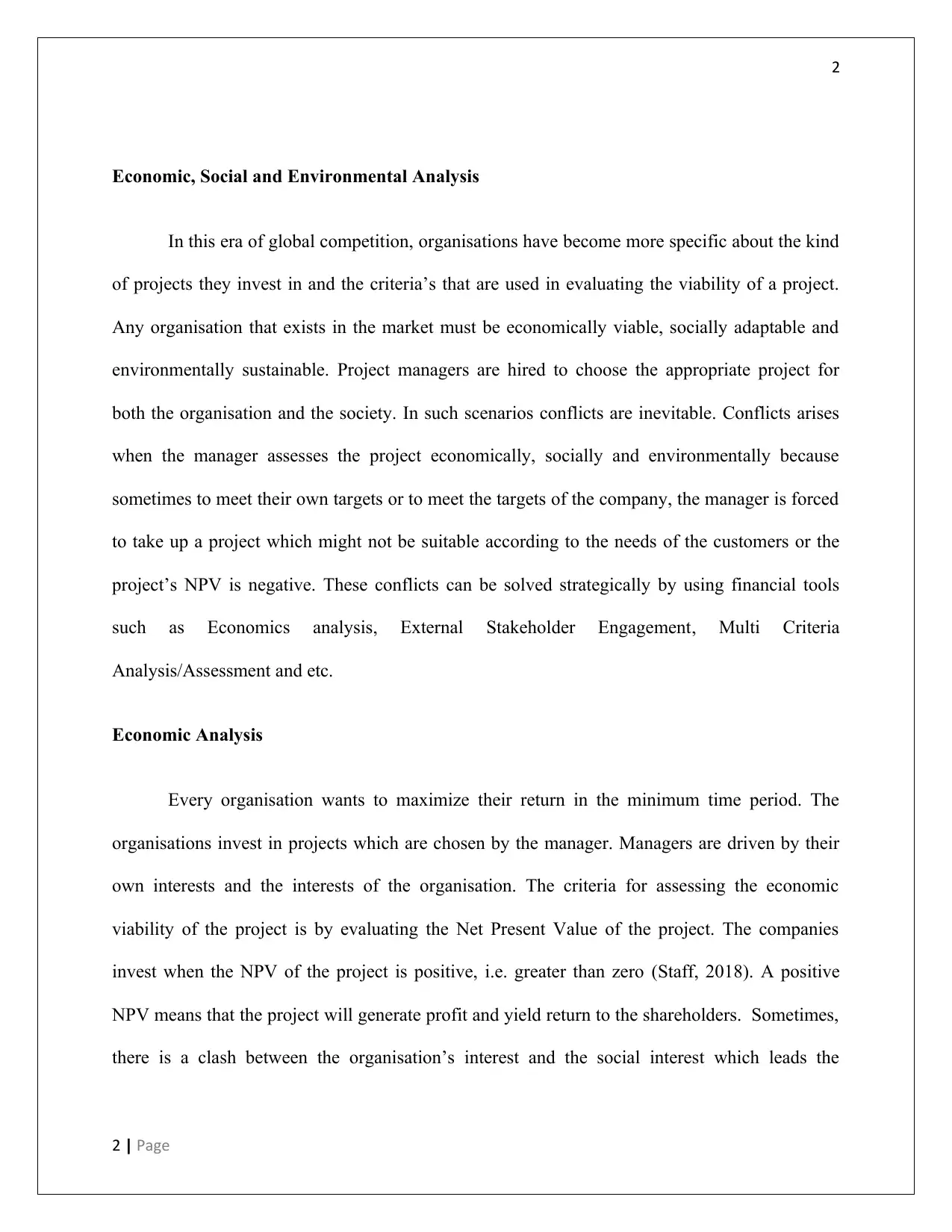
Economic, Social and Environmental Analysis
In this era of global competition, organisations have become more specific about the kind
of projects they invest in and the criteria’s that are used in evaluating the viability of a project.
Any organisation that exists in the market must be economically viable, socially adaptable and
environmentally sustainable. Project managers are hired to choose the appropriate project for
both the organisation and the society. In such scenarios conflicts are inevitable. Conflicts arises
when the manager assesses the project economically, socially and environmentally because
sometimes to meet their own targets or to meet the targets of the company, the manager is forced
to take up a project which might not be suitable according to the needs of the customers or the
project’s NPV is negative. These conflicts can be solved strategically by using financial tools
such as Economics analysis, External Stakeholder Engagement, Multi Criteria
Analysis/Assessment and etc.
Economic Analysis
Every organisation wants to maximize their return in the minimum time period. The
organisations invest in projects which are chosen by the manager. Managers are driven by their
own interests and the interests of the organisation. The criteria for assessing the economic
viability of the project is by evaluating the Net Present Value of the project. The companies
invest when the NPV of the project is positive, i.e. greater than zero (Staff, 2018). A positive
NPV means that the project will generate profit and yield return to the shareholders. Sometimes,
there is a clash between the organisation’s interest and the social interest which leads the
2 | Page
Economic, Social and Environmental Analysis
In this era of global competition, organisations have become more specific about the kind
of projects they invest in and the criteria’s that are used in evaluating the viability of a project.
Any organisation that exists in the market must be economically viable, socially adaptable and
environmentally sustainable. Project managers are hired to choose the appropriate project for
both the organisation and the society. In such scenarios conflicts are inevitable. Conflicts arises
when the manager assesses the project economically, socially and environmentally because
sometimes to meet their own targets or to meet the targets of the company, the manager is forced
to take up a project which might not be suitable according to the needs of the customers or the
project’s NPV is negative. These conflicts can be solved strategically by using financial tools
such as Economics analysis, External Stakeholder Engagement, Multi Criteria
Analysis/Assessment and etc.
Economic Analysis
Every organisation wants to maximize their return in the minimum time period. The
organisations invest in projects which are chosen by the manager. Managers are driven by their
own interests and the interests of the organisation. The criteria for assessing the economic
viability of the project is by evaluating the Net Present Value of the project. The companies
invest when the NPV of the project is positive, i.e. greater than zero (Staff, 2018). A positive
NPV means that the project will generate profit and yield return to the shareholders. Sometimes,
there is a clash between the organisation’s interest and the social interest which leads the
2 | Page
⊘ This is a preview!⊘
Do you want full access?
Subscribe today to unlock all pages.

Trusted by 1+ million students worldwide

3
manager to select a project with negative NPV, i.e. a project which might lead to losses and no
return for the investors. This conflict can be solved by conducting an economic analysis.
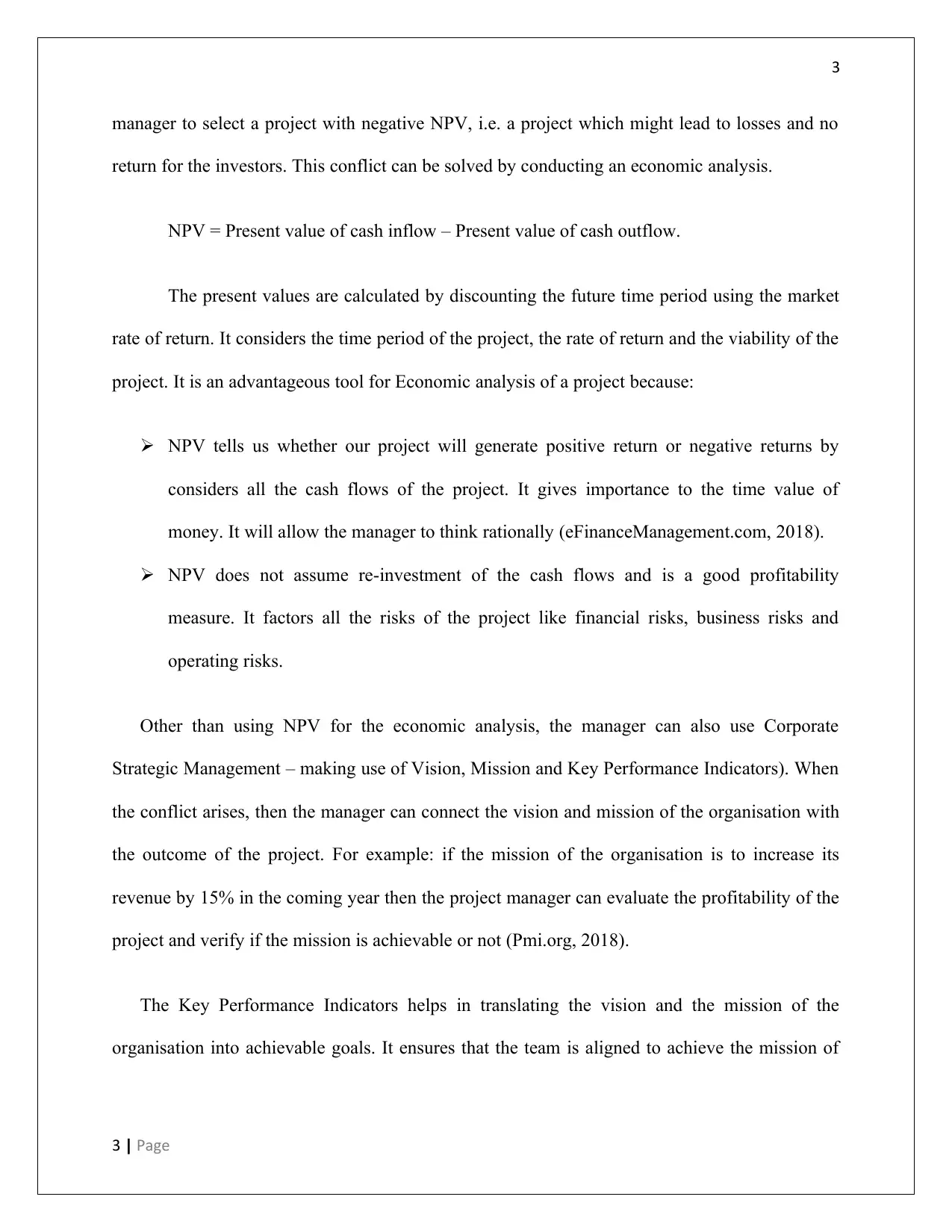
NPV = Present value of cash inflow – Present value of cash outflow.
The present values are calculated by discounting the future time period using the market
rate of return. It considers the time period of the project, the rate of return and the viability of the
project. It is an advantageous tool for Economic analysis of a project because:
NPV tells us whether our project will generate positive return or negative returns by
considers all the cash flows of the project. It gives importance to the time value of
money. It will allow the manager to think rationally (eFinanceManagement.com, 2018).
NPV does not assume re-investment of the cash flows and is a good profitability
measure. It factors all the risks of the project like financial risks, business risks and
operating risks.
Other than using NPV for the economic analysis, the manager can also use Corporate
Strategic Management – making use of Vision, Mission and Key Performance Indicators). When
the conflict arises, then the manager can connect the vision and mission of the organisation with
the outcome of the project. For example: if the mission of the organisation is to increase its
revenue by 15% in the coming year then the project manager can evaluate the profitability of the
project and verify if the mission is achievable or not (Pmi.org, 2018).
The Key Performance Indicators helps in translating the vision and the mission of the
organisation into achievable goals. It ensures that the team is aligned to achieve the mission of
3 | Page
manager to select a project with negative NPV, i.e. a project which might lead to losses and no
return for the investors. This conflict can be solved by conducting an economic analysis.
NPV = Present value of cash inflow – Present value of cash outflow.
The present values are calculated by discounting the future time period using the market
rate of return. It considers the time period of the project, the rate of return and the viability of the
project. It is an advantageous tool for Economic analysis of a project because:
NPV tells us whether our project will generate positive return or negative returns by
considers all the cash flows of the project. It gives importance to the time value of
money. It will allow the manager to think rationally (eFinanceManagement.com, 2018).
NPV does not assume re-investment of the cash flows and is a good profitability
measure. It factors all the risks of the project like financial risks, business risks and
operating risks.
Other than using NPV for the economic analysis, the manager can also use Corporate
Strategic Management – making use of Vision, Mission and Key Performance Indicators). When
the conflict arises, then the manager can connect the vision and mission of the organisation with
the outcome of the project. For example: if the mission of the organisation is to increase its
revenue by 15% in the coming year then the project manager can evaluate the profitability of the
project and verify if the mission is achievable or not (Pmi.org, 2018).
The Key Performance Indicators helps in translating the vision and the mission of the
organisation into achievable goals. It ensures that the team is aligned to achieve the mission of
3 | Page
Paraphrase This Document
Need a fresh take? Get an instant paraphrase of this document with our AI Paraphraser

4
the organisation and the right decision is taken for realising the goals (Successfactors.com,
2018).
Environmental Analysis
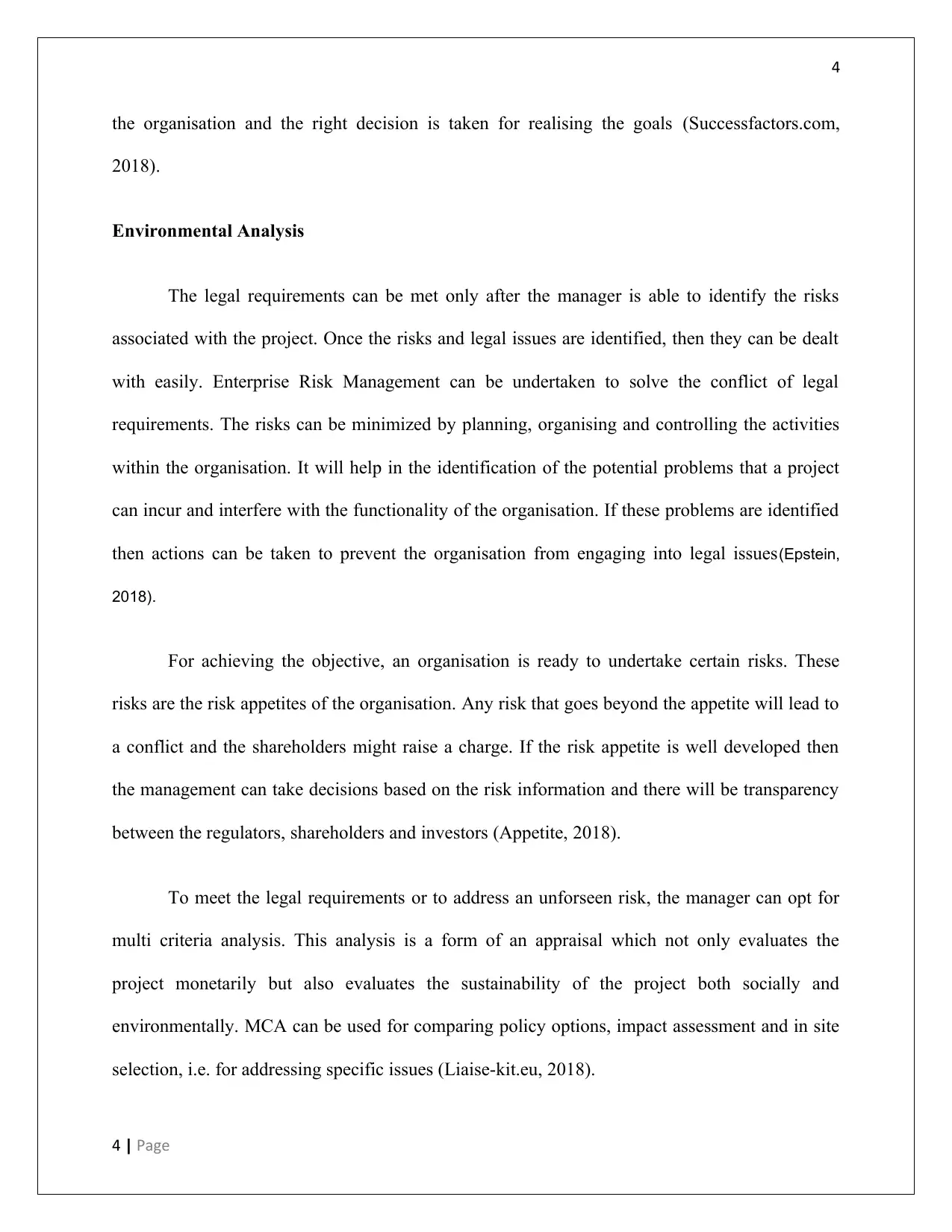
The legal requirements can be met only after the manager is able to identify the risks
associated with the project. Once the risks and legal issues are identified, then they can be dealt
with easily. Enterprise Risk Management can be undertaken to solve the conflict of legal
requirements. The risks can be minimized by planning, organising and controlling the activities
within the organisation. It will help in the identification of the potential problems that a project
can incur and interfere with the functionality of the organisation. If these problems are identified
then actions can be taken to prevent the organisation from engaging into legal issues(Epstein,
2018).
For achieving the objective, an organisation is ready to undertake certain risks. These
risks are the risk appetites of the organisation. Any risk that goes beyond the appetite will lead to
a conflict and the shareholders might raise a charge. If the risk appetite is well developed then
the management can take decisions based on the risk information and there will be transparency
between the regulators, shareholders and investors (Appetite, 2018).
To meet the legal requirements or to address an unforseen risk, the manager can opt for
multi criteria analysis. This analysis is a form of an appraisal which not only evaluates the
project monetarily but also evaluates the sustainability of the project both socially and
environmentally. MCA can be used for comparing policy options, impact assessment and in site
selection, i.e. for addressing specific issues (Liaise-kit.eu, 2018).
4 | Page
the organisation and the right decision is taken for realising the goals (Successfactors.com,
2018).
Environmental Analysis
The legal requirements can be met only after the manager is able to identify the risks
associated with the project. Once the risks and legal issues are identified, then they can be dealt
with easily. Enterprise Risk Management can be undertaken to solve the conflict of legal
requirements. The risks can be minimized by planning, organising and controlling the activities
within the organisation. It will help in the identification of the potential problems that a project
can incur and interfere with the functionality of the organisation. If these problems are identified
then actions can be taken to prevent the organisation from engaging into legal issues(Epstein,
2018).
For achieving the objective, an organisation is ready to undertake certain risks. These
risks are the risk appetites of the organisation. Any risk that goes beyond the appetite will lead to
a conflict and the shareholders might raise a charge. If the risk appetite is well developed then
the management can take decisions based on the risk information and there will be transparency
between the regulators, shareholders and investors (Appetite, 2018).
To meet the legal requirements or to address an unforseen risk, the manager can opt for
multi criteria analysis. This analysis is a form of an appraisal which not only evaluates the
project monetarily but also evaluates the sustainability of the project both socially and
environmentally. MCA can be used for comparing policy options, impact assessment and in site
selection, i.e. for addressing specific issues (Liaise-kit.eu, 2018).
4 | Page

5
The benefit of using MCA is that the methods are developed in a way which improves the
decision quality involving multiple requirements by adapting more explicit, efficient and rational
choices(Awasthi, Omrani, & Gerber, 2018). It creates a structured process which identifies
objectives and creates alternatives so that they can be compared from different perspectives
(Environment.sal.aalto.fi, 2018).
Social Analysis
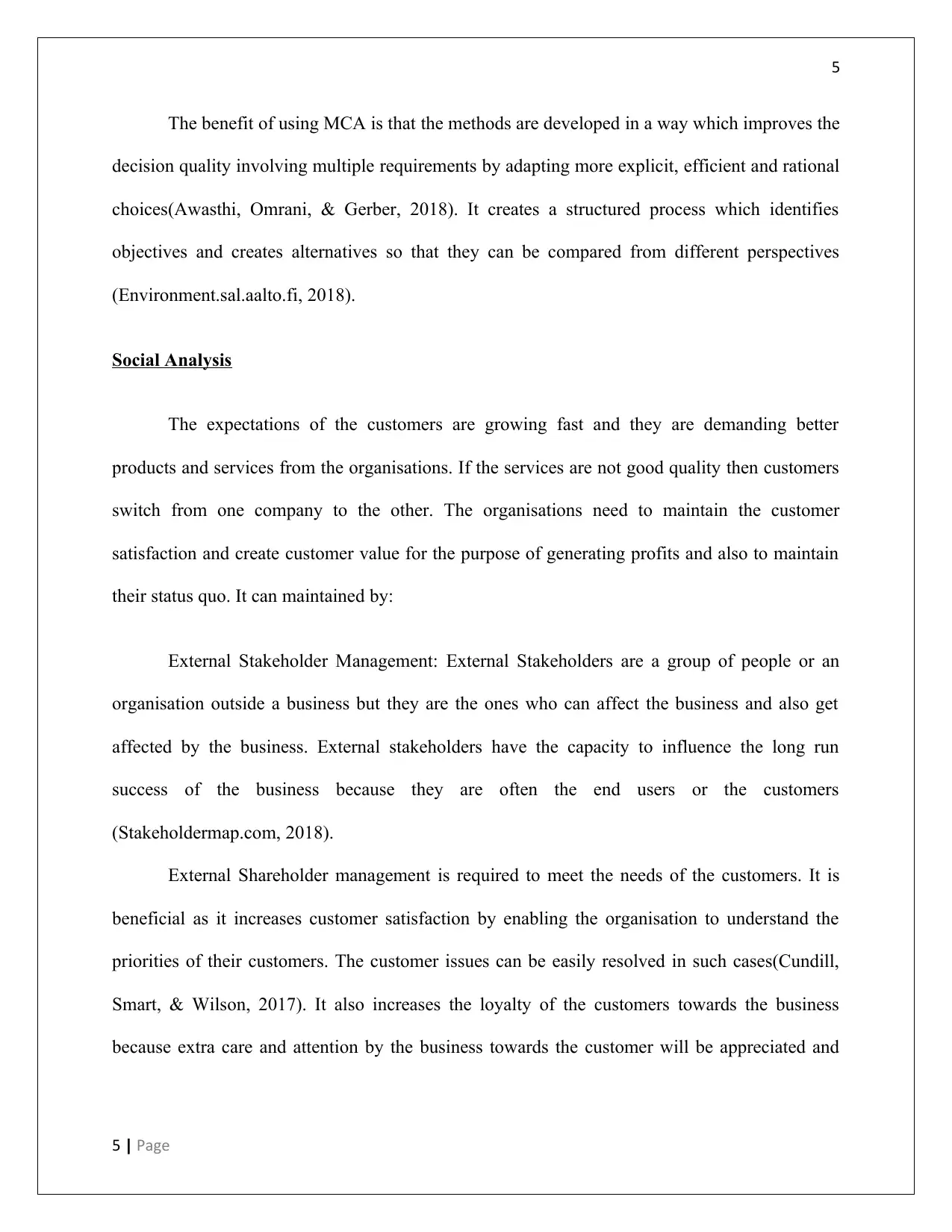
The expectations of the customers are growing fast and they are demanding better
products and services from the organisations. If the services are not good quality then customers
switch from one company to the other. The organisations need to maintain the customer
satisfaction and create customer value for the purpose of generating profits and also to maintain
their status quo. It can maintained by:
External Stakeholder Management: External Stakeholders are a group of people or an
organisation outside a business but they are the ones who can affect the business and also get
affected by the business. External stakeholders have the capacity to influence the long run
success of the business because they are often the end users or the customers
(Stakeholdermap.com, 2018).
External Shareholder management is required to meet the needs of the customers. It is
beneficial as it increases customer satisfaction by enabling the organisation to understand the
priorities of their customers. The customer issues can be easily resolved in such cases(Cundill,
Smart, & Wilson, 2017). It also increases the loyalty of the customers towards the business
because extra care and attention by the business towards the customer will be appreciated and
5 | Page
The benefit of using MCA is that the methods are developed in a way which improves the
decision quality involving multiple requirements by adapting more explicit, efficient and rational
choices(Awasthi, Omrani, & Gerber, 2018). It creates a structured process which identifies
objectives and creates alternatives so that they can be compared from different perspectives
(Environment.sal.aalto.fi, 2018).
Social Analysis
The expectations of the customers are growing fast and they are demanding better
products and services from the organisations. If the services are not good quality then customers
switch from one company to the other. The organisations need to maintain the customer
satisfaction and create customer value for the purpose of generating profits and also to maintain
their status quo. It can maintained by:
External Stakeholder Management: External Stakeholders are a group of people or an
organisation outside a business but they are the ones who can affect the business and also get
affected by the business. External stakeholders have the capacity to influence the long run
success of the business because they are often the end users or the customers
(Stakeholdermap.com, 2018).
External Shareholder management is required to meet the needs of the customers. It is
beneficial as it increases customer satisfaction by enabling the organisation to understand the
priorities of their customers. The customer issues can be easily resolved in such cases(Cundill,
Smart, & Wilson, 2017). It also increases the loyalty of the customers towards the business
because extra care and attention by the business towards the customer will be appreciated and
5 | Page
⊘ This is a preview!⊘
Do you want full access?
Subscribe today to unlock all pages.

Trusted by 1+ million students worldwide

6
valued. The customers will be attracted to the efficient services (Tti-global-research.co.uk,
2018).
The needs of the customers can also be met by using Corporate Strategic Management. A
customer strategy can be formulated which will be the articulation of distinctive experiences and
values that the organisation is ready to deliver to the customers over a given time period via
different channels(Carolus, Hanley, Olsen, & Pedersen, 2018). A well-designed strategy will
help in the coordination of different functions, practices and skills. It will help the organisation in
targeting the specific set of customers, create customer loyalty, develop comparative and
competitive advantage and create status quo in the market (Bouquet, 2018).
The above strategies can be used for the purpose of solving conflicts that arises in an
organisation while undertaking a project.
6 | Page
valued. The customers will be attracted to the efficient services (Tti-global-research.co.uk,
2018).
The needs of the customers can also be met by using Corporate Strategic Management. A
customer strategy can be formulated which will be the articulation of distinctive experiences and
values that the organisation is ready to deliver to the customers over a given time period via
different channels(Carolus, Hanley, Olsen, & Pedersen, 2018). A well-designed strategy will
help in the coordination of different functions, practices and skills. It will help the organisation in
targeting the specific set of customers, create customer loyalty, develop comparative and
competitive advantage and create status quo in the market (Bouquet, 2018).
The above strategies can be used for the purpose of solving conflicts that arises in an
organisation while undertaking a project.
6 | Page
Paraphrase This Document
Need a fresh take? Get an instant paraphrase of this document with our AI Paraphraser

7
References
Appetite, U. (2018). Understanding Risk Appetite - ERM - Enterprise Risk Management
Initiative | North Carolina State Poole College of Management. [online] Erm.ncsu.edu.
Available at: https://erm.ncsu.edu/library/article/understanding-risk-appetite [Accessed
26 Sep. 2018].
Awasthi, A., Omrani, H., & Gerber, P. (2018). Investigating ideal-solution based multicriteria
decision making techniques for sustainability evaluation of urban mobility projects.
Transportation Research Part A: Policy and Practice, 116(2), 247-259.
Bouquet, T. (2018). 10 Principles of Customer Strategy. [online] strategy+business. Available at:
https://www.strategy-business.com/article/10-Principles-of-Customer-Strategy?
gko=083a5 [Accessed 26 Sep. 2018].
Carolus, J., Hanley, N., Olsen, S., & Pedersen, S. (2018). A Bottom-up Approach to
Environmental Cost-Benefit Analysis. Ecological Economics, 152(1), 282-295.
Cundill, G., Smart, P., & Wilson, H. (2017). Non financial Shareholder Activism: A Process‐
Model for Influencing Corporate Environmental and Social Performance. International
Journal of Management Reviews, 20(2), 606-626.
eFinanceManagement.com. (2018). Advantages and Disadvantages of Net Present Value (NPV) |
eFM. [online] Available at:
https://efinancemanagement.com/investment-decisions/advantages-and-disadvantages-of-
npv [Accessed 26 Sep. 2018].
7 | Page
References
Appetite, U. (2018). Understanding Risk Appetite - ERM - Enterprise Risk Management
Initiative | North Carolina State Poole College of Management. [online] Erm.ncsu.edu.
Available at: https://erm.ncsu.edu/library/article/understanding-risk-appetite [Accessed
26 Sep. 2018].
Awasthi, A., Omrani, H., & Gerber, P. (2018). Investigating ideal-solution based multicriteria
decision making techniques for sustainability evaluation of urban mobility projects.
Transportation Research Part A: Policy and Practice, 116(2), 247-259.
Bouquet, T. (2018). 10 Principles of Customer Strategy. [online] strategy+business. Available at:
https://www.strategy-business.com/article/10-Principles-of-Customer-Strategy?
gko=083a5 [Accessed 26 Sep. 2018].
Carolus, J., Hanley, N., Olsen, S., & Pedersen, S. (2018). A Bottom-up Approach to
Environmental Cost-Benefit Analysis. Ecological Economics, 152(1), 282-295.
Cundill, G., Smart, P., & Wilson, H. (2017). Non financial Shareholder Activism: A Process‐
Model for Influencing Corporate Environmental and Social Performance. International
Journal of Management Reviews, 20(2), 606-626.
eFinanceManagement.com. (2018). Advantages and Disadvantages of Net Present Value (NPV) |
eFM. [online] Available at:
https://efinancemanagement.com/investment-decisions/advantages-and-disadvantages-of-
npv [Accessed 26 Sep. 2018].
7 | Page

8
Environment.sal.aalto.fi. (2018). Description of Multi-Criteria Decision Analysis (MCDA).
[online] Available at: http://environment.sal.aalto.fi/MCDA/ [Accessed 26 Sep. 2018].
Epstein, M. (2018). Making Sustainability Work. London: Routledge.
Liaise-kit.eu. (2018). Multi-criteria analysis | LIAISE KIT. [online] Available at:
http://www.liaise-kit.eu/ia-method/multi-criteria-analysis [Accessed 26 Sep. 2018].
Pmi.org. (2018). Vision - strategy - objectives - projects - outputs, and return. [online] Available
at: https://www.pmi.org/learning/library/discussing-ultimate-management-model-9903
[Accessed 26 Sep. 2018].
Staff, I. (2018). Net Present Value Rule. [online] Investopedia. Available at:
https://www.investopedia.com/terms/n/npv-rule.asp [Accessed 26 Sep. 2018].
Stakeholdermap.com. (2018). External Stakeholders | Who are External Stakeholders?. [online]
Available at: https://www.stakeholdermap.com/external-stakeholders.html [Accessed 26
Sep. 2018].
Successfactors.com. (2018). Using Key Performance Indicators to Increase Productivity and
Profitability | SuccessFactors. [online] Available at:
https://www.successfactors.com/en_us/lp/articles/key-performance-indicators.html
[Accessed 26 Sep. 2018].
Tti-global-research.co.uk. (2018). Understanding and meeting your stakeholders’ needs with
market research. [online] Available at:
8 | Page
Environment.sal.aalto.fi. (2018). Description of Multi-Criteria Decision Analysis (MCDA).
[online] Available at: http://environment.sal.aalto.fi/MCDA/ [Accessed 26 Sep. 2018].
Epstein, M. (2018). Making Sustainability Work. London: Routledge.
Liaise-kit.eu. (2018). Multi-criteria analysis | LIAISE KIT. [online] Available at:
http://www.liaise-kit.eu/ia-method/multi-criteria-analysis [Accessed 26 Sep. 2018].
Pmi.org. (2018). Vision - strategy - objectives - projects - outputs, and return. [online] Available
at: https://www.pmi.org/learning/library/discussing-ultimate-management-model-9903
[Accessed 26 Sep. 2018].
Staff, I. (2018). Net Present Value Rule. [online] Investopedia. Available at:
https://www.investopedia.com/terms/n/npv-rule.asp [Accessed 26 Sep. 2018].
Stakeholdermap.com. (2018). External Stakeholders | Who are External Stakeholders?. [online]
Available at: https://www.stakeholdermap.com/external-stakeholders.html [Accessed 26
Sep. 2018].
Successfactors.com. (2018). Using Key Performance Indicators to Increase Productivity and
Profitability | SuccessFactors. [online] Available at:
https://www.successfactors.com/en_us/lp/articles/key-performance-indicators.html
[Accessed 26 Sep. 2018].
Tti-global-research.co.uk. (2018). Understanding and meeting your stakeholders’ needs with
market research. [online] Available at:
8 | Page
⊘ This is a preview!⊘
Do you want full access?
Subscribe today to unlock all pages.

Trusted by 1+ million students worldwide

9
https://www.tti-global-research.co.uk/understanding-and-meeting-your-stakeholders
%E2%80%99-needs-market-research [Accessed 26 Sep. 2018].
9 | Page
https://www.tti-global-research.co.uk/understanding-and-meeting-your-stakeholders
%E2%80%99-needs-market-research [Accessed 26 Sep. 2018].
9 | Page
1 out of 10
Related Documents
Your All-in-One AI-Powered Toolkit for Academic Success.
+13062052269
info@desklib.com
Available 24*7 on WhatsApp / Email
Unlock your academic potential
Copyright © 2020–2026 A2Z Services. All Rights Reserved. Developed and managed by ZUCOL.