A Comparison of Project Based Evaluation and Traditional Exam Methods

Verified

Added on  2023/05/29

|7
|1036
|386
Essay
AI Summary
This essay provides a comparative analysis of project-based evaluation and traditional examination methods in the context of learning. It explores the role and advantages of project-based evaluation and creative assignments over traditional techniques, supported by literature review highlighting the effectiveness of flipped classrooms and assessment-based game development. The research questions focus on the role, advantages, and scientific approaches of project-based evaluation. The study hypothesizes positive outcomes from project-based evaluation based on past research and proposes a mixed methodology approach, including surveys, exams, and secondary data from peer-reviewed journals, to compare the two learning processes and determine inclinations toward effective learning.
Document Page
Running head: COMPARISON OF VARIOUS LEARNING METHODS
Comparison of various learning methods
Name of the Student
Name of the University
Author Note
tabler-icon-diamond-filled.svg

Paraphrase This Document

Need a fresh take? Get an instant paraphrase of this document with our AI Paraphraser
Document Page
1COMPARISON OF VARIOUS LEARNING METHODS
Table of Contents
Research questions.....................................................................................................................2
Significance of study..................................................................................................................2
Purpose of study objective.........................................................................................................2
Literature Review.......................................................................................................................3
Summary....................................................................................................................................4
Hypothesis..................................................................................................................................5
Methodology..............................................................................................................................5
References..................................................................................................................................6
Document Page
2COMPARISON OF VARIOUS LEARNING METHODS
Research questions
RQ1: What is the role of the Project based evaluation and creative assignments in effective
learning procedure?
RQ2: How is Project based evaluation and creative assignments advantageous to traditional
learning techniques?
RQ3: What are the scientific approaches adopted by the Project based evaluation and creative
assignments for the betterment of learning?
Significance of study
The study of the comparison between the traditional exams and project based
evaluation and creative assignments is to highlight on the idea that the effective learning can
be easily achievable with the project-based evaluation. Studies in the past depicts evidence
their positive effects are more as compared to that of the traditional exams.
Purpose of study objective
As the world is progressing at a fast pace, a rapid revolution in the academic fields is
becoming significantly distinct. The education system is getting more and more inclined
towards adopting project based learning techniques. Few of the objectives that are at par with
the proposed study are as follows:
i. To realize the role of Project based evaluation and creative assignments in the modern
system of education.
ii. To assess the means by which Project based evaluation and creative assignments can
be advantageous over the traditional exams.
iii. To advocate the various measures that an education system may adopt in order to
implement Project based evaluation.
Document Page
3COMPARISON OF VARIOUS LEARNING METHODS
Literature Review
According to Amresh, Carberry and Femiani, (2013), the use of flipped classroom has
always been an effective method in imparting knowledge to the students. In the article, it has
been said the flipped classrooms comes into play whenever there is an occurrence of the
assignments and the various forms of lecture. The majority of the courses that have
implemented this innovative change in the system have applied the learning-by-doing
strategies along with the several other forms of learning techniques (Brame, 2013). The
article is inclined towards such type of courses that adopt the implications of the flipped
pedagogy. A quantitative analysis has been undertaken by this article in the form of
assessments where it has been found that the flipped classroom techniques have been more
effective than the traditional models of learning. However, it has been also stated in the
article that it is not clear whether the flipped classrooms are effective in every department of
the courses.
According to Hwang, Hung and Chen, (2014), the learning achievements, the
motivations and the problem skills of the students are improved with the help of an
assessment-based game development approach. In the article, an experiment had been
conducted for the evaluation of the proposed approach in an elementary school. A
quantitative approach has been undertaken in this form of study. The conducted experiment
included a total of 167 students among which 82 students were subjected to assessment-based
development approach and 87 students were subjected to conventional game development
approach. The result showed that the assessment-based approach depicted positive results in
improving the learning achievement, the learning motivation and the problem solving skills.
The article states that from the open-ended questions to the students it has been found that the
proposed approach was capable in engaging the students into in-depth thinking, creativity and
tabler-icon-diamond-filled.svg

Paraphrase This Document

Need a fresh take? Get an instant paraphrase of this document with our AI Paraphraser
Document Page
4COMPARISON OF VARIOUS LEARNING METHODS
motivation (Daly, Mosyjowski & Seifert, 2014). It clearly proves that creative learning
approaches are much more beneficial than the traditional learning practices.
Summary
From analysing the above two paragraphs it is seen that the project based evaluation
and creative assignments are more advantageous over the traditional exams for the effective
learning methods. In the first paragraph of the literature review the flipped classrooms are
more beneficial whereas in the second paragraph the assessment-based game development
approach is found to be of greater value than the traditional models of education
Document Page
5COMPARISON OF VARIOUS LEARNING METHODS
Hypothesis
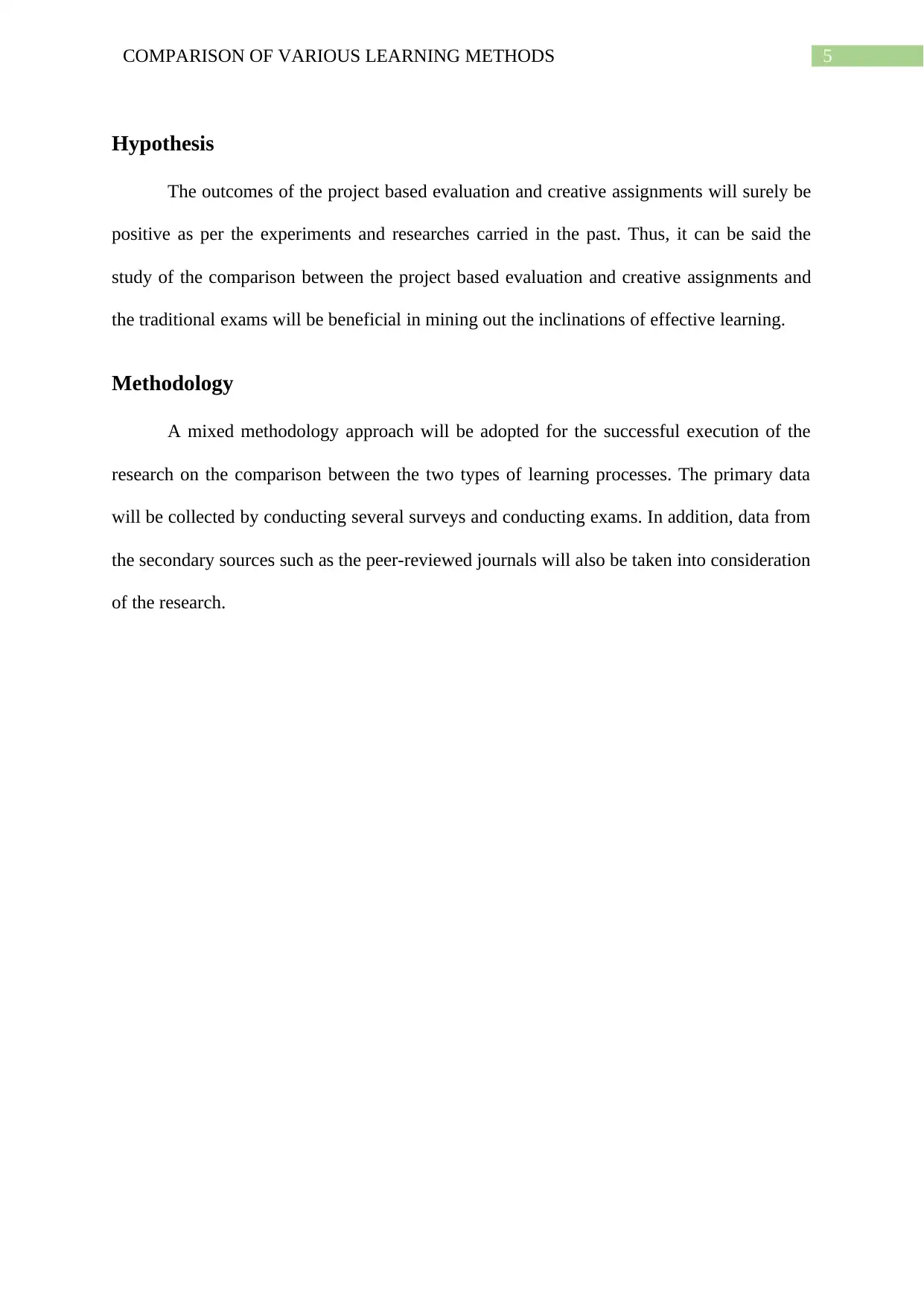
The outcomes of the project based evaluation and creative assignments will surely be
positive as per the experiments and researches carried in the past. Thus, it can be said the
study of the comparison between the project based evaluation and creative assignments and
the traditional exams will be beneficial in mining out the inclinations of effective learning.
Methodology
A mixed methodology approach will be adopted for the successful execution of the
research on the comparison between the two types of learning processes. The primary data
will be collected by conducting several surveys and conducting exams. In addition, data from
the secondary sources such as the peer-reviewed journals will also be taken into consideration
of the research.
Document Page
6COMPARISON OF VARIOUS LEARNING METHODS
References
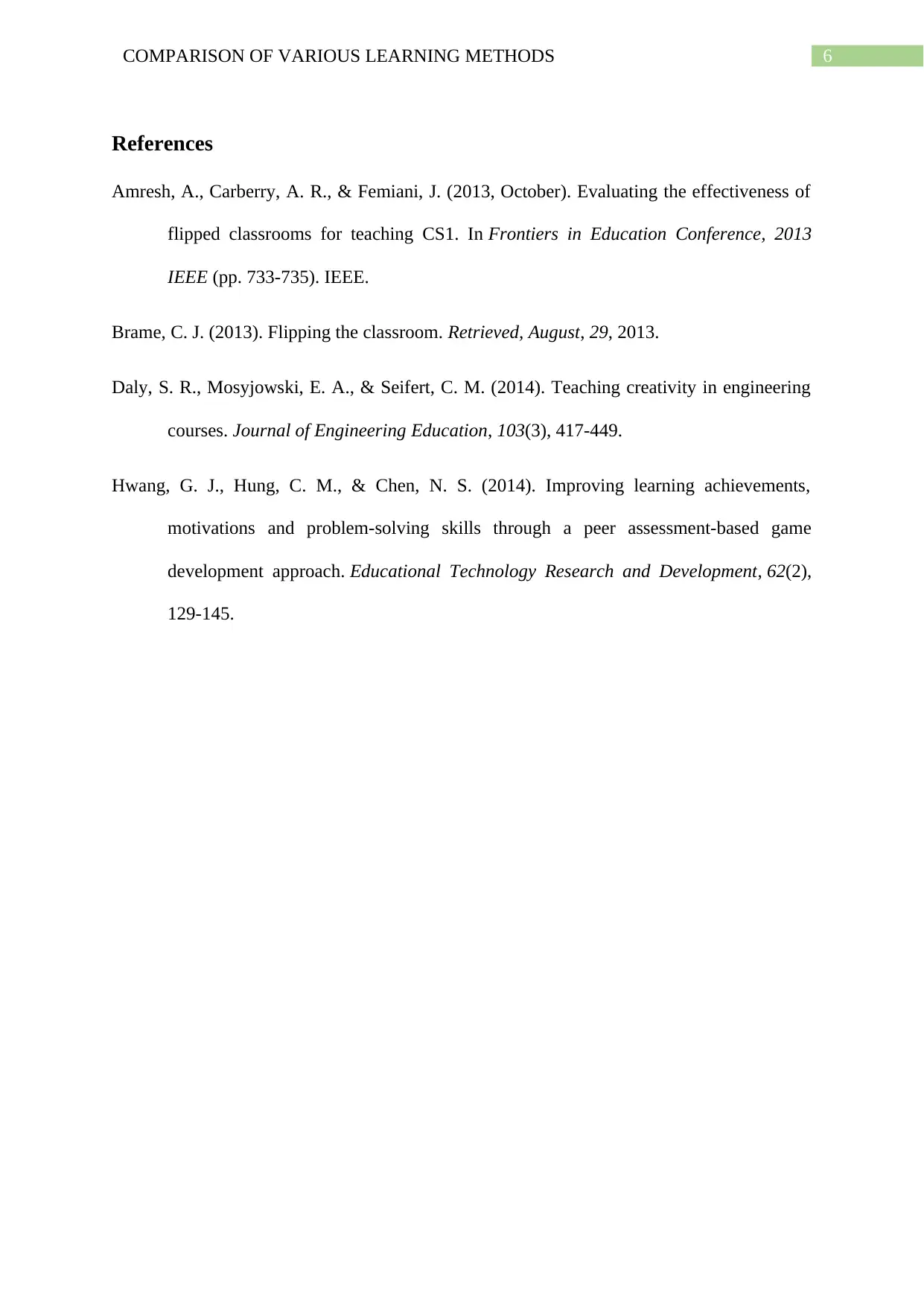
Amresh, A., Carberry, A. R., & Femiani, J. (2013, October). Evaluating the effectiveness of
flipped classrooms for teaching CS1. In Frontiers in Education Conference, 2013
IEEE (pp. 733-735). IEEE.
Brame, C. J. (2013). Flipping the classroom. Retrieved, August, 29, 2013.
Daly, S. R., Mosyjowski, E. A., & Seifert, C. M. (2014). Teaching creativity in engineering
courses. Journal of Engineering Education, 103(3), 417-449.
Hwang, G. J., Hung, C. M., & Chen, N. S. (2014). Improving learning achievements,
motivations and problem-solving skills through a peer assessment-based game
development approach. Educational Technology Research and Development, 62(2),
129-145.
chevron_up_icon
1 out of 7
circle_padding
hide_on_mobile
zoom_out_icon
[object Object]